Time Out of Order: Physicists Put Causality in Quantum Superposition
A new experiment in PRX Quantum recorded an 18-sigma violation of the assumption that events happen in a fixed order. Cause can come after effect. Both orderings can exist simultaneously. Here is what that actually means - and why it matters.

Physics has had a bad habit of taking our most fundamental assumptions and quietly destroying them. First it was the idea of absolute space - gone with Einsteinian relativity. Then simultaneous universal time - also gone. Then the idea that quantum particles have definite properties before you measure them - gone, proven by decades of Bell test experiments starting in the 1980s and sealed loophole-free in 2015.
Now, causality itself is on the chopping block.
A new paper published in PRX Quantum in early 2026 presents what researchers describe as a formal experimental test of "indefinite causal order" - the notion that two quantum operations can exist in a superposition of orderings, where A precedes B and B precedes A simultaneously, with neither fixed until measurement forces a choice. The results came back 18 standard deviations away from what classical causal physics predicts. That number is not a rounding error. It is a statement.
The experiment builds on over a decade of theoretical and lab work around what physicists call the "quantum switch" - a device that routes a quantum particle through operations in a superposition of different sequences. It is the kind of thing that sounds impossible until you remember that quantum superposition also sounds impossible, and it runs your laptop's processor.
What "Indefinite Causal Order" Actually Means

Start with the simplest possible example. You send a letter before you write it. That makes no sense under classical physics - cause must precede effect, always, no exceptions. This rule - that events happen in some fixed, definite order - is called "causal order," and it underlies essentially everything we know about how the world works. Newton assumed it. Einstein encoded it into spacetime geometry. Every computer program ever written depends on it.
Quantum mechanics already messed with several things we thought were foundational. Particles do not have definite positions until measured. They do not have definite spins. Entangled particles correlate instantly across arbitrary distances in ways that cannot be explained by local hidden variables. Each of these facts violated previous intuitions so completely that they took decades of argument and experiment to fully accept.
Indefinite causal order pushes further. The question here is not whether a particle has a definite position or spin - it is whether two quantum operations have a definite order. Can Operation A precede Operation B while simultaneously, in the same physical scenario, Operation B precedes Operation A?
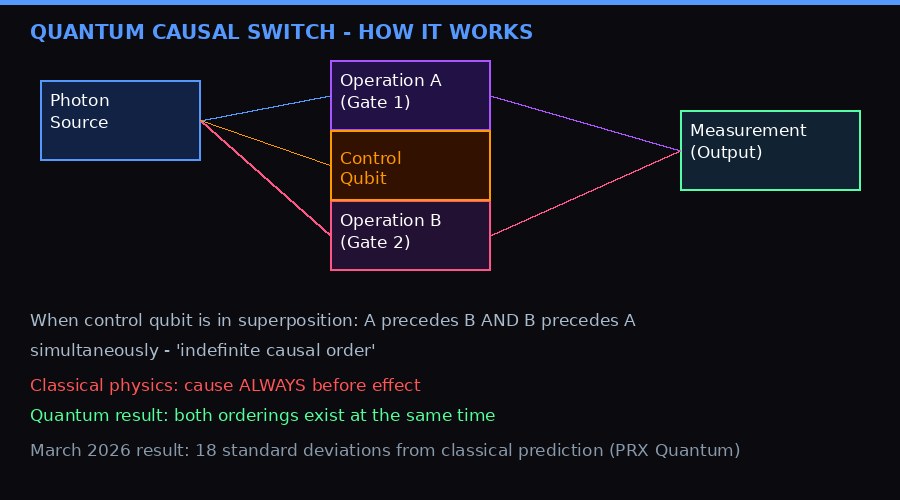
Theorists first formalized this question around 2009-2013, developing a mathematical object called the "quantum switch" and proving that if you could physically realize it, it would enable computational advantages unavailable to any classically-ordered process. The quantum switch uses a "control qubit" - a quantum bit held in superposition - to route a target particle through two operations in both possible orders simultaneously. If the control qubit is in the state representing "0," the particle goes through A then B. If the control qubit is in the state representing "1," the particle goes through B then A. If the control qubit is in superposition of 0 and 1 - which quantum mechanics permits - both orderings happen at once.
"It's as if the measurement had reached backward in time to alter the behavior - raising questions about whether causality itself actually applies to quantum mechanics." - Ars Technica, covering earlier causal-order experiments (2012)
The March 2026 PRX Quantum paper takes this beyond previous demonstrations. Prior experiments had realized the quantum switch in the lab but relied on specific theoretical frameworks that left room to argue the results were consistent with some deeper fixed causal structure. This team designed a protocol to formally test whether the measured quantum process genuinely lacks a definite causal order - and found it does, to 18 sigma of confidence.
The Experiment: What They Built and How They Tested It

The experiment is photonic - it works with individual photons, the particles of light, which are the standard workhorse of quantum optics experiments. Photons travel at the speed of light, do not interact easily with their environment, and can be precisely manipulated with beam splitters, wave plates, and mirrors. Crucially, they can be put into superposition states with high fidelity and measured with single-photon detectors.
The team built a physical quantum switch using a polarizing beam splitter as the routing mechanism. A photon's polarization served as the control qubit - whether it was horizontally or vertically polarized determined which path through the apparatus it took. A photon prepared in diagonal polarization - which is a superposition of horizontal and vertical - would therefore travel both paths simultaneously.
The two "operations" - call them A and B - were unitary quantum gates applied to the photon. In one path through the apparatus, the photon experiences A and then B. In the other path, it experiences B and then A. Because the photon is in a superposition of both paths, it effectively experiences A-before-B and B-before-A simultaneously.
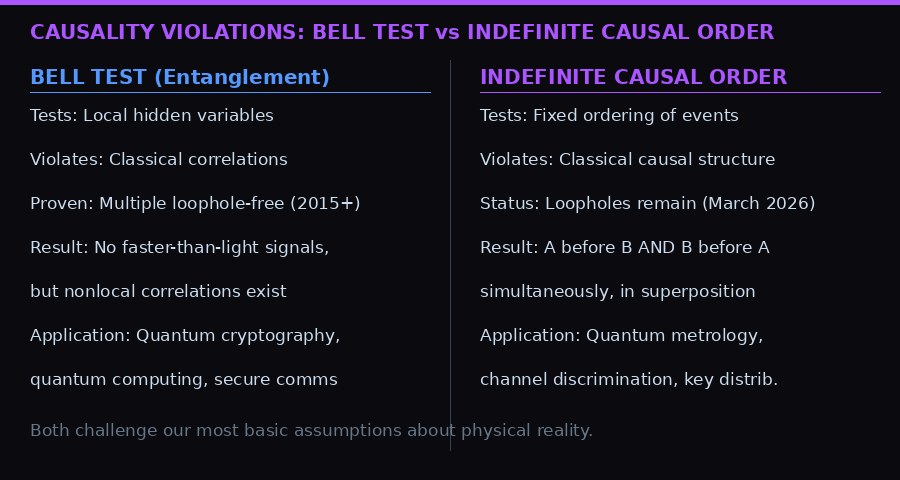
The specific test for "indefinite causal order" came from measuring correlations between the control qubit's state and the target photon's final state - and then checking whether those correlations were compatible with any classical model that assigns a definite probability to each of the two possible orderings. This is analogous to a Bell test, but instead of testing for local hidden variables in space, it tests for "causal hidden variables" - some underlying fixed order that might explain the correlations classically.
The result: the measured correlations violated the classical bound by 18 standard deviations. A 3-sigma deviation is typically considered evidence of new physics. A 5-sigma result is a discovery threshold in particle physics. Eighteen sigma is the universe screaming that something is fundamentally different from what your classical intuitions predict.
Why 18 Sigma Matters
In statistics, "sigma" (standard deviation) is a measure of how far a result is from what a model predicts. A 1-sigma deviation happens by chance roughly 32% of the time. A 5-sigma deviation - the gold standard for declaring a discovery in physics - has a probability of roughly 1 in 3.5 million of occurring by chance. An 18-sigma result is so far from the classical prediction that even if you ran the experiment trillions of times, you would essentially never see it happen if the classical model were true. The researchers' quantum switch behaves in a way that classical causal theory cannot explain, period.
The Loopholes That Remain - and Why They Matter

The result is striking. It is not yet definitive in the way that Bell tests became definitive after 2015. The research team acknowledges several loopholes that remain open.
The most significant is photon loss. Only about 1 percent of photons sent into the apparatus come out the other side to be detected. The other 99 percent are lost to imperfect optical components, misalignment, and detector inefficiency. It remains technically possible - though implausible - that the photons being lost are preferentially the ones that would have restored classical correlations if they had been detected. This is the "fair sampling" loophole, the same one that plagued early Bell tests until loophole-free experiments in 2015 closed it by using highly efficient detectors.
A second loophole involves spatial separation. The experiment's components are not separated by large enough distances to rule out sub-light-speed classical influences passing between them during the measurement window. If some physical signal could travel between the "A gate" and the "B gate" fast enough, it might in principle coordinate their behavior in a way that mimics indefinite causal order without actually requiring it. Closing this loophole requires either scaling up the physical apparatus considerably or developing significantly faster detection electronics.
There are also loopholes more specific to causal-order experiments that do not have direct analogues in Bell tests - technical issues around the precise mathematical definition of what counts as "indefinite causal order" versus a very sophisticated fixed ordering with quantum control. These are subtle and have been discussed extensively in the theoretical literature, and the experimental team explicitly notes them as areas requiring further work.
None of this means the result is wrong. Bell tests had loopholes for decades before they were closed - and the physics stood up every time a loophole was sealed. The same pattern is expected here. The 2026 PRX Quantum result is a proof of principle and a formal first test, not the final word. But it is a rigorous test, and the 18-sigma figure leaves very little room for the universe to wriggle out through theoretical back doors.
A Brief History of Physics Breaking Causality (And Surviving)

To understand why this matters, it helps to know how physics got here.
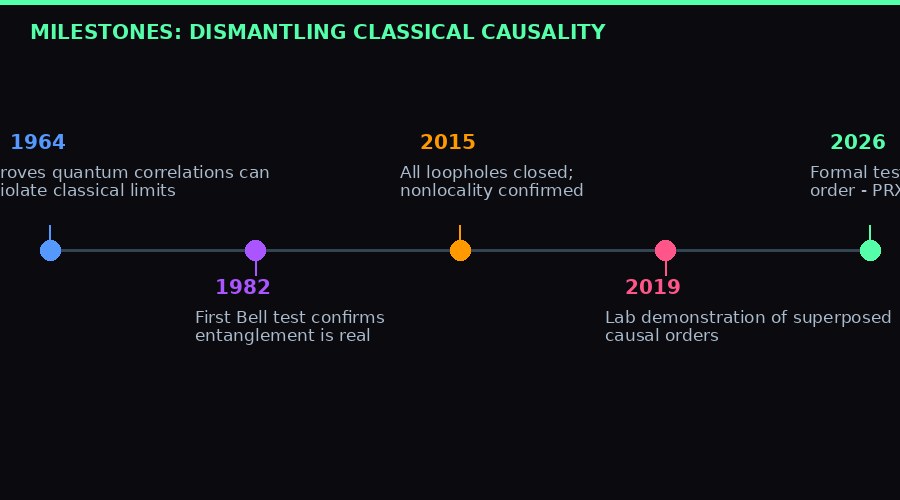
In 1964, Northern Irish physicist John Stewart Bell proved a theorem that set limits on how correlated two measurements could be if there were any "hidden variables" behind quantum mechanics - some deeper classical reality that determined outcomes before measurement. Bell's theorem said that if classical hidden variables existed, certain statistical correlations between entangled particle measurements would be bounded by a specific number. Quantum mechanics predicted those correlations would exceed that bound.
The first experiments to test this - by Alain Aspect's group in Paris in 1982 - showed quantum mechanics was right. Classical hidden variables were out. But loopholes remained. For the next 33 years, experimenters closed them one by one: the detection loophole, the locality loophole, the freedom-of-choice loophole. The 2015 experiments by groups in Delft, Vienna, and NIST finally closed all loopholes simultaneously. Entanglement was confirmed as a fundamental feature of reality, not an artifact of our ignorance.
Around the same time as those early Bell tests, physicists were wrestling with another deeply uncomfortable implication of quantum mechanics: what happens when a measurement seems to retroactively determine a particle's history? A 2012 "quantum eraser" experiment showed that measuring one half of an entangled photon pair seemed to retroactively determine whether the other half had behaved as a wave or a particle - even after the first photon had already completed its journey through the apparatus. It was as if the measurement reached backward in time.
This raised serious questions about causality in quantum mechanics that theorists began formalizing in the 2000s. By 2009, Giulio Chiribella and colleagues had developed the formal mathematical framework of the quantum switch. By 2015, the first laboratory implementations were appearing. By 2019, several teams had demonstrated quantum advantages using the switch. And now, in 2026, comes the first formal experimental test of the indefinite causal structure itself, with an 18-sigma result.
Why This Is Not Just Philosophy - The Practical Applications

There is a temptation to file results like this under "cool physics" and move on. That would be a mistake. The authors of the PRX Quantum paper explicitly list the known practical uses of indefinite causal order - and the list is long.
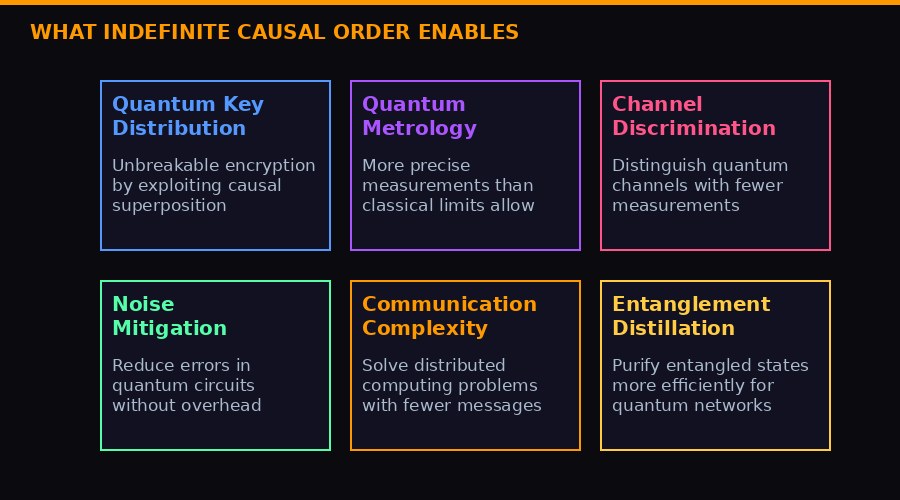
Quantum key distribution is the most immediately commercially relevant. It is already a live industry, with companies like ID Quantique, Toshiba Quantum, and several Chinese national programs deploying quantum-secured networks. The security of these networks ultimately rests on quantum mechanical properties. Adding indefinite causal order to the cryptographic toolkit means adding another layer of security that is impossible to break under classical physics - because you cannot eavesdrop on a system where the order of operations is undefined.
Quantum metrology is perhaps the highest-stakes application. Precision measurement underlies GPS, atomic clocks, gravitational wave detection, and emerging quantum sensing for medical imaging. Any advantage in measurement precision - and indefinite causal order has been theoretically proven to offer such advantages - translates into better timing, better positioning, and better detection of faint physical signals. The 18-sigma result from 2026 strengthens the case that these advantages are real, not theoretical artifacts.
Channel discrimination - the ability to distinguish between two quantum communication channels - benefits directly from indefinite causal order processes. The quantum switch has been proven to solve channel discrimination tasks with fewer queries than any classically-ordered quantum protocol. In practical terms, this means more efficient quantum networks that require less measurement overhead to characterize their own performance.
Noise mitigation is the quiet application that could matter most for near-term quantum computing. Current quantum computers suffer from decoherence - interactions with the environment that destroy quantum superpositions and introduce errors. Indefinite causal order has been shown theoretically to suppress certain types of noise in ways impossible with classical operation ordering. If this can be turned into a practical engineering technique, it could extend the useful computation window of current-generation quantum processors without requiring hardware improvements.
Finally, entanglement generation and distillation - the processes of creating and purifying entangled quantum states for use in quantum networks - have both been shown to benefit from indefinite causal order protocols. Given that entanglement is the fundamental resource that makes quantum computing and quantum cryptography useful, anything that generates more of it, or higher-quality entanglement, more efficiently, is a core infrastructure advantage.
"The [quantum switch] may also be interesting for applications as it has been shown that it can outperform causally ordered processes at a wide variety of tasks such as channel discrimination, promise problems, communication complexity, noise mitigation, various thermodynamic applications, quantum metrology, quantum key distribution, entanglement generation, and distillation, among others." - PRX Quantum paper authors, March 2026
What This Means for Physics, and Why the Loopholes Still Need Closing

The deeper implication of this result - assuming the loopholes are eventually closed the way Bell test loopholes were - is profound and troubling in the best possible scientific sense.
Classical physics, including Einsteinian general relativity, assumes that spacetime has a definite causal structure. Events happen in a definite order. The past causes the future; the future does not cause the past. This assumption is embedded so deeply in physics that most researchers do not even think of it as an assumption - it is just how reality works.
Quantum mechanics, as it turns out, does not share this constraint. The universe at the quantum scale is happy to put not just particle positions, not just spin states, but the very ordering of physical events into superposition. This is not a theoretical curiosity - the 2026 PRX Quantum experiment measured it, formally, to 18 sigma of statistical confidence.
What does this mean for the grand project of unifying quantum mechanics and general relativity - the so-called theory of quantum gravity that has occupied theoretical physics for the better part of a century? Here things get genuinely speculative, but productively so. Several research groups have argued that indefinite causal order is not just a feature of quantum information processing - it may be a fundamental feature of spacetime at the Planck scale, where quantum gravitational effects become relevant. In quantum gravity theories like loop quantum gravity and some formulations of string theory, spacetime geometry itself becomes subject to quantum uncertainty. The causal structure of spacetime might not be fixed but quantum - a superposition of different geometries, different orderings of cause and effect.
If that is true, then experiments like the 2026 PRX Quantum result are not just clever demonstrations of quantum information theory. They are probing, in a laboratory-accessible way, the structure of spacetime at its most fundamental level. They are measuring something that general relativity - the theory of gravity, the theory of spacetime - cannot accommodate. And that is exactly the kind of experimental pressure that could crack open new physics.
The comparison to Bell tests is instructive. When Aspect ran his 1982 experiment, the practical applications of entanglement-based quantum cryptography were decades away. The experiment was done because the physics was important to understand. Three decades later, that same physics is running commercial quantum encryption networks. The investment in understanding fundamental reality paid off in technology. The same pattern should be expected here.
What Comes Next: Closing the Loopholes

The path from here is clear, if technically demanding.
The detection loophole - the 99% photon loss rate - requires better optical components and single-photon detectors with higher efficiency. Superconducting nanowire single-photon detectors (SNSPDs) have been achieving detection efficiencies above 90% in controlled laboratory settings for several years. Incorporating them into a quantum switch experiment while maintaining the phase stability required for the superposition is the engineering challenge. It is not a fundamental obstacle; it is a hardware problem, and hardware problems get solved.
The locality loophole - the need to separate the apparatus's components far enough to rule out sub-light-speed classical signals - requires either larger experimental setups or faster switching and detection. Distributing a quantum switch experiment over a free-space optical link or a fiber network would close this loophole. Given that quantum network experiments have already transmitted entangled photons over hundreds of kilometers of fiber, this is a realistic medium-term goal.
The theory-specific loopholes around the precise definition of indefinite causal order are being actively addressed in the theoretical literature. The 2026 paper itself identifies several of these and proposes experimental refinements. This is normal scientific progress - the result motivates the theory, which motivates the next experiment.
If the loopholes close the way Bell test loopholes did - and there is no known reason why they should not - then the physics community will have experimentally confirmed that causal order, like position and spin, is a quantum mechanical variable. Not just something that can be probabilistic in some hidden-variable sense, but something that genuinely has no definite value until measurement forces a choice. The universe will have turned out to be even stranger than the last strange thing we discovered about it.
This is, to be clear, not bad news. Every time physics has expanded its envelope of strangeness, it has come with new tools, new understanding, and eventually new technology. The strangeness is the point. The experiment is working correctly. The universe is being honest about what it is.
And what it is, apparently, is a place where cause does not always come before effect - except when you look.
Get BLACKWIRE reports first.
Breaking news, investigations, and analysis - straight to your phone.
Join @blackwirenews on TelegramSources
PRX Quantum (2026) - "Formal experimental test of indefinite causal order" - DOI: 10.1103/5t2y-ddmt
Ars Technica - "Causality optional? Testing the 'indefinite causal order' superposition" - March 28, 2026
Nature (2025) - Chiribella et al. foundational quantum switch theory - via citations in PRX Quantum paper
Physical Review Letters (2015) - Loophole-free Bell test results, Hensen et al. (Delft)
American Physical Society Physics - v19/38 - summary article on indefinite causal order results, 2026