The Body Farm: Inside Silicon Valley's Secret Plan to Grow Brainless Human Clones
A Bay Area startup backed by billionaire Tim Draper has been pitching investors on "brainless clones" - human bodies without consciousness, grown as spare-parts reservoirs for the ultra-rich. MIT Technology Review just blew the lid off what may be the most ethically charged biotech venture of the century.

The intersection of longevity science and cloning technology has moved from science fiction to startup pitch decks. Photo: Unsplash
Somewhere in Richmond, California, in a lab that most of the biotech world didn't know existed until last week, a company called R3 Bio has been working on something that sounds like it was ripped from the pages of Aldous Huxley's Brave New World. The pitch: grow human bodies without brains, keep them alive on life support, and harvest their organs when a wealthy client needs a new kidney, liver, or heart.
This is not science fiction. R3 Bio has real investors - including billionaire venture capitalist Tim Draper - real employees, real lab space, and a real technical roadmap. And as of March 30, 2026, the company's secret ambitions are a secret no longer.
An explosive investigation by MIT Technology Review has revealed that R3 Bio's founder, John Schloendorn, has been privately pitching what he calls "brainless clones" to a tight circle of Silicon Valley investors, longevity enthusiasts, and government-connected scientists. The vision goes far beyond the company's public-facing story about replacing lab animals with monkey "organ sacks." What Schloendorn actually wants is to create unconscious human bodies - clones with just enough brainstem to stay alive - that serve as biological spare-parts warehouses for their genetic originals.
The implications stretch across medicine, ethics, law, economics, and philosophy. If it works, it could end the organ shortage crisis that kills 13 Americans every day. If it goes wrong, it opens a door that humanity may not be able to close.
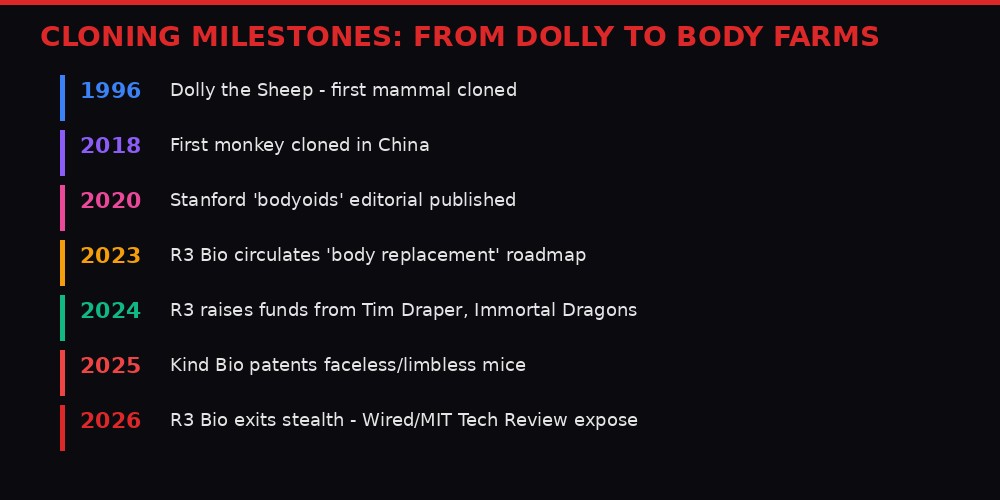
From Dolly the Sheep to brainless human clones - the accelerating timeline of cloning technology. BLACKWIRE / PRISM
The Man Who Would Clone You

R3 Bio's vision requires advances in cloning, gene editing, and neuroscience that no one has combined before. Photo: Unsplash
John Schloendorn is not a household name in biotech. He holds a PhD, but he has published little in mainstream scientific journals. He is perhaps best known for once running a DIY biology lab out of his Bay Area garage. His doctoral research at the University of Arizona was sponsored by the SENS Foundation, an organization co-founded by the controversial longevity advocate Aubrey de Grey, who has called Schloendorn "one of my proteges."
Around 2010, Peter Thiel reportedly invested $1.5 million in ImmunePath, a stem-cell treatment company that Schloendorn started. It failed. By 2021, he had moved on to something far more ambitious: R3 Biotechnologies.
The company's name comes from the "three R's" of animal research - replacement, reduction, and refinement - a framework developed by British scientists William Russell and Rex Burch in 1959 to promote humane experimentation. On paper, R3's mission was about creating better alternatives to animal testing. The reality, according to documents reviewed by MIT Technology Review, was considerably more radical.
A 2023 "letter to stakeholders" signed by Schloendorn begins by stating that "body replacement cloning will require multicomponent genetic engineering on a scale that has never been attempted in primates." The letter discusses molecular techniques for "brain knockout" that are already proven in mice, noting they should also function in "birthing whole primates" - a biological class that includes both monkeys and humans.
"Would it work? There's one way to find out."- R3 Bio 2023 stakeholder letter, as reported by MIT Technology Review
People who know Schloendorn describe him as a "dynamo-like presence" who is "100% dedicated" to the goal of extreme life extension. In 2006, he published a paper in a bioethics journal arguing that the "desire to live forever" is rational. He operates outside mainstream academia, which, according to collaborators, gave him the advantage of "not being bound by getting the next paper out, or the next grant."
His co-founder, Alice Gilman, says she was inspired partly by her father's experience undergoing a heart transplant. She doesn't like the term "brainless" for the company's planned creations. "It's not missing anything, because we design it to only have the things we want," she told Wired in a March 23 interview that served as R3's official public debut.
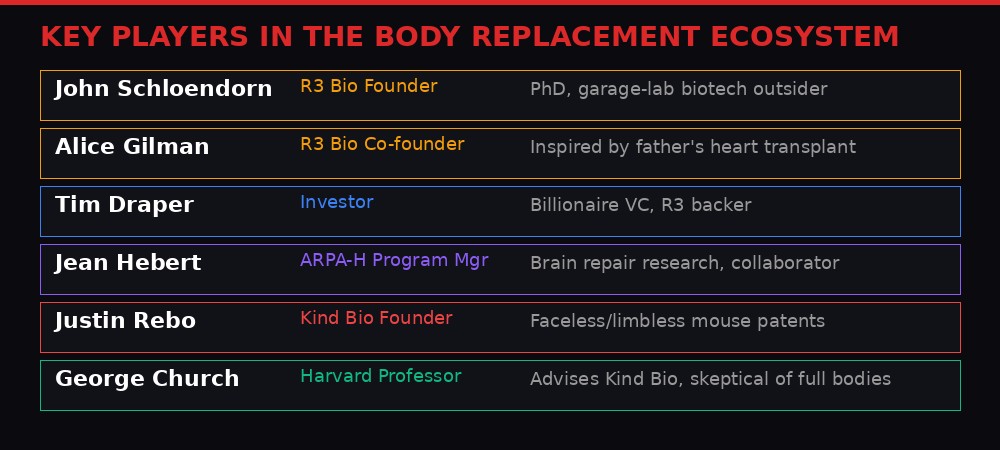
The network of founders, investors, and scientists behind the body replacement movement. BLACKWIRE / PRISM
The $70,000 Pitch

Behind closed doors at elite longevity conferences, body replacement has become the hottest topic among the ultra-wealthy. Photo: Unsplash
Last September, Schloendorn and Gilman presented at Abundance Longevity, a $70,000-per-ticket event in Boston organized by Peter Diamandis, the promoter behind the XPRIZE Foundation and a fixture on the Silicon Valley longevity circuit. The presentation was not recorded. It was meant to be confidential. It was delivered to roughly 40 attendees.
The session was titled "Full Body Replacement."
According to a person who was in the room, both animal research and personal clones for spare organs were discussed openly. Gilman and Schloendorn stood in front of an image of a cloning needle. When MIT Technology Review pressed Gilman on whether this was a talk about brainless clones, she replied that while R3's current business is replacing animal models, "the team reserves the right to hold hypothetical futuristic discussions."
That "hypothetical futuristic discussion" had very concrete elements. According to documents obtained by MIT Technology Review, R3's technical roadmap includes:
- Improvements to the basic cloning procedure using histone demethylase proteins that help erase a cell's genetic memory, dramatically increasing cloning success rates
- Genetic "wiring diagrams" for creating animals without complete brains
- A "birthing fix" to address placental defects that cause many cloned animals to die shortly after birth
- Plans to test these techniques in monkeys from a base in the Caribbean
- A job ad for a veterinarian in Puerto Rico to "implant embryos, monitor pregnancies and help deliver healthy births" in nonhuman primates
When MIT Technology Review confronted R3 with these findings, the company sent what the publication described as "a sweeping disavowal." R3 stated that Schloendorn "never made any statement regarding hypothetical 'non-sentient human clones' [that] would be carried by surrogates" and that "any allegations of intent or conspiracy to create human clones or humans with brain damage are categorically false."
The company also claimed it "never produced any degree of brain alterations in any species, did not attempt to do so, did not hire another party to do so, and have no specific plans to do so in the future." It added: "We do not work with live non-human primates."
These denials stand in tension with the documented evidence of presentations, stakeholder letters, job postings, and investor testimony that MIT Technology Review assembled.
The Money Trail

Billionaire money has poured into the body replacement space, with investors treating it as a moonshot bet against death itself. Photo: Unsplash
R3 Bio has three confirmed investors: billionaire Tim Draper, the Singapore-based fund Immortal Dragons, and UK-based LongGame Ventures. Draper, whose portfolio includes Tesla, SpaceX, Skype, and Coinbase, offered Wired a characteristically optimistic take: "We are all better off than we were 150 years ago, and because of forward-thinking entrepreneurs, we will be a lot better off 150 years from now."
Boyang Wang, head of Immortal Dragons, was more specific about what drew him in. He confirmed to MIT Technology Review that he invested $500,000 in R3 during a 2024 fundraising round after the company showed him evidence it could create mice without complete brains. "There were imperfections, but the resulting mice survived, grew up, and to me, that is a pretty strong experiment," Wang said. The evidence was enough for him to fund R3's attempt to "replicate the result in primates."
Wang has spoken at longevity conferences about body-swapping technology, referring to the possibility that "when the time comes, you can transplant your brain into a new body." But since making his investment, Wang says he has become less bullish. He now views whole-body transplant as "very infeasible, not even very scientific" and "far away from hope for any realistic application."
"What can really move the needle? Because time is running out."- Boyang Wang, CEO of Immortal Dragons fund, R3 Bio investor
The financial picture connects to a broader movement. A road map for anti-aging technology produced by the Longevity Biotech Fellowship - a Vitalist group that advocates redirecting society's resources toward achieving unlimited lifespans - estimated that a proof-of-concept human clone lacking a neocortex would cost $40 million to create. In the world of venture capital moonshots, that is a rounding error.
The Fellowship's report cited two stealth companies working on cloning whole nonsentient bodies, though it carefully avoided naming them. Kris Borer, an entrepreneur who presented the road map at a French resort last August, warned that if these companies' work becomes public, "there will be a huge backlash - people will hate it."
"We have to have the angel investors and other people invest kind of in secret until things are ready," Borer said.
His suggested strategy for eventual public disclosure was calculated: start with palatable goals, then escalate. "We are not going to start with Let's clone you and give you a body. We are going to start with Let's solve the organ shortage. Eventually people will warm up to it, and then we can go to the more hardcore stuff."
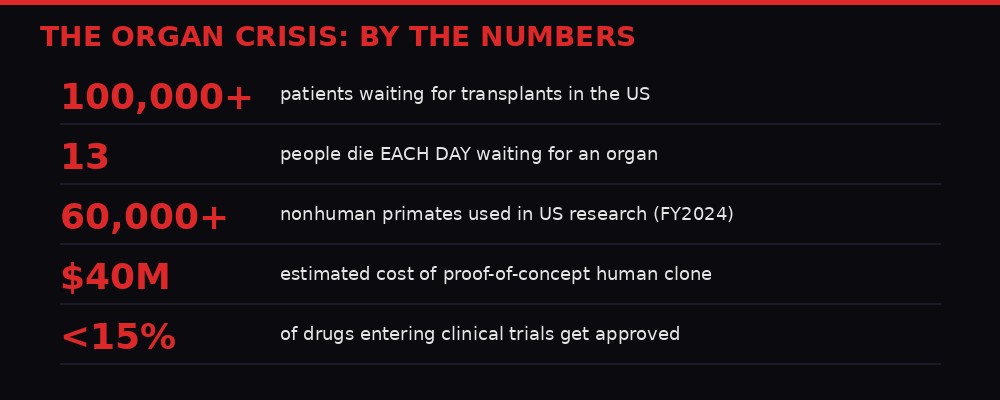
The scale of the organ crisis that body replacement advocates use to justify their work. BLACKWIRE / PRISM
The Other Company: Kind Biotechnology and the Faceless Mice

Behind the public debate about animal testing, some labs have already created mice without faces, brains, or limbs. Photo: Unsplash
R3 Bio is not alone. MIT Technology Review also identified Kind Biotechnology, a New Hampshire-based startup founded by Justin Rebo, a sometime collaborator of Schloendorn's. Kind Bio's work is arguably even more disturbing in its specificity.
According to patent applications filed by the company, Rebo's team has been working to create animals with a "complete lack of ability to feel, think, or sense the environment." Patent filings include images of mice the company produced that lack a complete brain, and others that don't have faces or limbs. They achieved this by deleting genes in embryos using CRISPR gene-editing technology, with the goal of creating a "sack of organs that grows mostly on its own" with only a minimal nervous system.
A cartoon rendering submitted to the patent office shows what looks like a fleshy duffel bag connected to life-support tubes. The patent number - WO2025260099, filed via WIPO - is publicly available.
In an email to MIT Technology Review, Rebo described his company's work as pursuing an "ethical and scalable" way to create animal organs for experimental transplant to humans. He pointed to the organ shortage crisis: "thousands die while waiting" for an organ.
Some of Kind's patent applications cover the possibility of producing these organ sacks from human cells. Rebo characterizes that as a "speculative possibility" but frames it within the replacement approach to longevity. "With abundant high-quality organs, replacement could become a direct form of rejuvenation by replacement of failing parts," he said. "Ultimately, replacing failing parts is a direct path to extending healthy human lifespan."
George Church, the Harvard genetics professor and advisor to Kind Bio, sees his role as an attempt to "nudge these technologies toward something that is more useful and more acceptable from the get-go. And then let's see how society responds to that - rather than jumping to the most repulsive and most useless form, which some of them seem to be aiming for."
Church's assessment of full brainless human bodies was blunt: "There's almost no scenario where you need a whole body. I just think even if it's someday acceptable, it's not a good place to start." He added: "Not very useful, in addition to being repulsive."
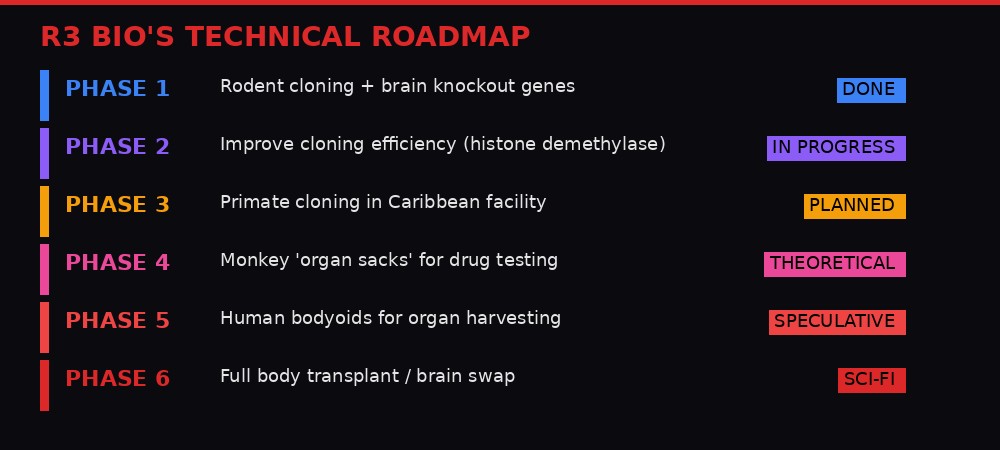
The step-by-step path from rodent experiments to human body farming. BLACKWIRE / PRISM
The ARPA-H Connection

The US government's own advanced research agency has connections to the body replacement ecosystem. Photo: Unsplash
One of the most consequential details in MIT Technology Review's investigation is the link between R3 Bio and ARPA-H, the Advanced Research Projects Agency for Health. Created by the Biden administration in 2022 with a mandate to fund high-risk, high-reward biomedical research, ARPA-H represents the US government's most aggressive bet on transformative health technology.
Jean Hebert, a former professor at the Albert Einstein College of Medicine, joined ARPA-H as a program manager in 2024. He oversees a project to use stem cells to restore damaged brain tissue. Before joining the government, Hebert described an informal but "very collaborative" relationship with Schloendorn to MIT Technology Review.
The logic of their partnership was elegant in its division of labor: Hebert would figure out how to repair a brain, while Schloendorn would figure out how to create a body without one. "It's a perfect match, right? Body, brain," Hebert said in that earlier interview.
Hebert popularized the "replacement" approach to avoiding death in a 2020 book called Replacing Aging. R3 now appears on the ARPA-H website on a list of prospective partners for Hebert's program. The implications are significant: a US government health agency has a formal connection, however preliminary, to a company whose founder has been pitching brainless human clones to investors.
There is also a personnel overlap. Maitriyee Mahanta, a scientist who co-signed R3's 2023 stakeholder letter and is a former research assistant to Hebert, lists her current role on LinkedIn as "molecular lead" studying cloning, "birth rate fixing," and cortical development using cells from nonhuman primates. Her listed employer is the Longevity Escape Velocity Foundation, a nonprofit where Aubrey de Grey is president. But de Grey told MIT Technology Review that his foundation only arranged a work visa for Mahanta as part of a partnership "with the company she actually spends her time at."
De Grey made what the publication described as "a resourceful effort" to avoid directly confirming the existence of R3 while simultaneously discussing theoretical aspects of body cloning technology. He even volunteered that a further genetic mutation could be added to cause "central precocious puberty" in a clone - a condition that causes a growth spurt, even pubic hair, in a toddler - which would shorten the wait for the clone to grow large enough for organ harvesting.
When Dictators Talk About Spare Parts

A hot mic caught world leaders discussing the very technologies that Silicon Valley is secretly developing. BLACKWIRE / PRISM
If the technology ever reaches maturity, its first customers would almost certainly be the ultra-rich and the ultra-powerful. That prospect has not escaped the attention of the world's most consequential leaders.
In September 2025, a hot microphone captured a conversation between Russian President Vladimir Putin and Chinese leader Xi Jinping as they walked through Beijing alongside North Korean dictator Kim Jong Un. Putin speculated about life extension through organ replacement:
"Biotechnology is continuously developing. Human organs can be continuously transplanted. The longer you live, the younger you become, and [you can] even achieve immortality. Some predict that in this century, humans will live to 150 years old."- Vladimir Putin to Xi Jinping, September 2025, Beijing
Xi responded agreeably. How these leaders learned about body replacement technology is unknown. But within the tight community of body replacement enthusiasts, scenarios involving dictators commissioning personal clone farms are a constant topic of discussion.
Will Harborne, an investment officer quoted in MIT Technology Review's investigation, offered a chilling assessment: "There are companies working on this. They are in stealth - we can't reveal too much about them - but the general concept on this is if you didn't have any ethical qualms, you could do most of it today."
The geopolitical dimension is impossible to ignore. If body replacement technology advances primarily in jurisdictions with fewer ethical constraints - such as China, where the first monkey was cloned in 2018, or unregulated offshore locations - the technology could develop without the oversight that Western bioethicists consider essential. R3's own plans included testing in the Caribbean, far from US regulatory scrutiny.
This is not merely a question of scientific ethics. It is a question of who gets access to functional immortality, and under what rules. A world where billionaires and autocrats can maintain biological youth through clone-derived organ replacement while the rest of humanity ages and dies on transplant waiting lists is not a hypothetical dystopia. It is the logical endpoint of the trajectory these companies are on.
The Ethical Minefield

The gap between "can we?" and "should we?" has never been wider than in the body replacement debate. Photo: Unsplash
The ethical questions surrounding brainless clones are not merely academic. They represent perhaps the most complex bioethics challenge of the 21st century, sitting at the intersection of personhood, consciousness, bodily autonomy, and the commodification of human biology.
The central argument from body replacement advocates is deceptively simple: if a body lacks a brain - or lacks the parts of the brain associated with consciousness, sentience, and the capacity to feel pain - then it is not a person. Harvesting its organs is no different, ethically, from harvesting organs from a body that has been declared brain-dead. Hank Greely, a bioethicist at Stanford University who has written in support of the "bodyoid" concept, puts it this way: "If you make a living entity without a brain at all, I think we'd be pretty comfortable with thinking it can't feel pain."
But this argument rests on assumptions about consciousness that neuroscience has not fully resolved. We do not have a complete understanding of what creates subjective experience. We cannot be certain that a body with a brainstem but no cortex has zero capacity for some form of awareness. The hard problem of consciousness - explaining how and why physical processes give rise to subjective experience - remains unsolved.
Jose Cibelli, a researcher at Michigan State University who was among the first scientists to clone human embryos 25 years ago, reacted with alarm when MIT Technology Review described R3's plans. "It sounds crazy, in my opinion," he said. "How do you demonstrate safety? What is safety when you're trying to create an abnormal human?" He added: "There is no limit to human imagination and ways to make money, but there have to be boundaries. And this is the boundary of making a human being who is not a human being."
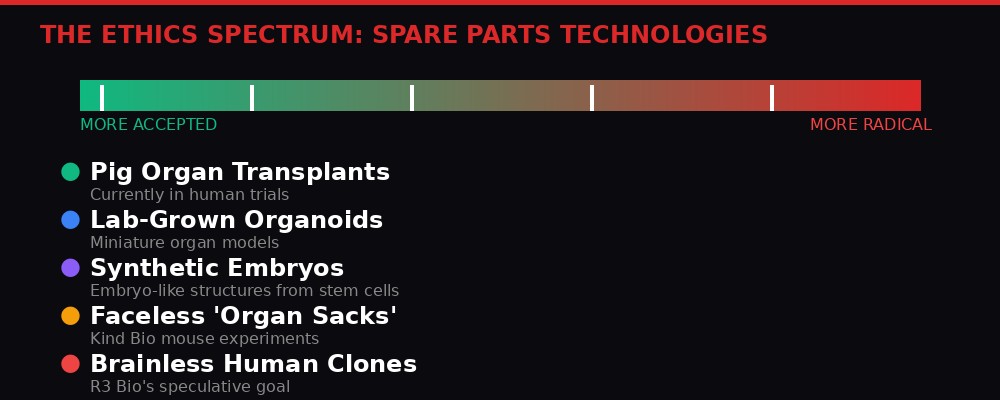
Where brainless clones fall on the spectrum of biological spare-parts technologies. BLACKWIRE / PRISM
Then there is the surrogacy problem. Since artificial womb technology does not yet exist, the first generation of brainless clones would need to be carried to term by human women. Schloendorn has discussed paying women to serve as surrogates for these non-sentient bodies. The ethical implications of that arrangement are staggering: women carrying pregnancies they know will result not in a child but in an organ reservoir. The psychological burden alone raises questions that no IRB review board has ever had to contemplate.
There is also the slippery slope concern that ethicists call the "diminishment argument." If we accept that bodies without cortical brain function are not persons and can be used as biological resources, does that change how we treat actual humans who lack consciousness? People in persistent vegetative states? Individuals with severe cognitive disabilities? Two Stanford professors who advocated for bodyoids acknowledged this risk in their 2025 MIT Technology Review editorial, noting that "bodyoids might diminish the human status of real people who lack consciousness or sentience."
Legal frameworks are entirely unprepared. No country has laws specifically addressing the creation of nonsentient human clones for organ harvesting. Human reproductive cloning is banned in many jurisdictions, but the definition of "reproductive" cloning typically assumes the intent to create a person. If the intent is explicitly to create something that is not a person, existing laws may not apply.
The Science: What Actually Works and What Doesn't

The science of cloning has advanced enormously since Dolly, but human cloning remains extraordinarily difficult. Photo: Unsplash
The scientific reality behind body replacement is considerably more complicated than the investor pitch decks suggest. Since Dolly the Sheep was born in 1996, researchers have successfully cloned dogs, cats, camels, horses, cattle, ferrets, and other mammals. The process involves somatic cell nuclear transfer (SCNT) - injecting a cell from an existing animal into an egg that has had its nucleus removed - to create a carbon-copy embryo.
But cloning remains profoundly inefficient. Out of 100 attempts to clone an animal, only a few typically succeed. Defects, deformities, and stillbirths are common. The first successful monkey clone, achieved in China in 2018, required a massive and costly effort to handle a large number of monkeys in estrus and perform IVF on them. According to Cibelli, monkey cloning remains nearly impossible on US territory simply because it is "unaffordable."
R3 appears to have been working on this efficiency problem. Documents reviewed by MIT Technology Review describe improvements to the basic SCNT procedure using histone demethylase proteins - molecules that help erase a cell's epigenetic memory, allowing the injected cell to more effectively reprogram into an embryonic state. These proteins were critical to the 2018 Chinese monkey cloning breakthrough. R3 also references a proprietary "birthing fix" designed to address placental defects that kill many cloned animals shortly after birth.
The "brain knockout" component draws on established genetic engineering techniques. Scientists have long been able to delete genes required for brain development in mouse embryos. The resulting animals can survive - they have enough brainstem function to maintain basic life processes like breathing and heartbeat - but they lack higher brain structures. Schloendorn's key insight, cited by investors, is that hydranencephaly - a rare birth defect in which children are born missing most of their cortical hemispheres - demonstrates that a human body can live without much of a brain. He has reportedly shown medical scans of these children's nearly empty skulls as evidence that the concept is biologically feasible.
Kind Biotechnology's patent filings provide the most concrete evidence that these techniques have moved beyond theory. The company has produced mice without complete brains, faces, or limbs by using CRISPR to delete specific genes in embryos. The resulting animals - or more accurately, the resulting biological structures - represent proof-of-concept for the organ sack idea.
But the gap between a mouse and a human is vast. A mouse gestation is about 20 days. A human gestation is 40 weeks. The energy, resources, and biological complexity required to sustain a brainless human body for months or years are orders of magnitude greater. No one has demonstrated that a human clone without higher brain function could survive long enough for its organs to mature to transplantable size.
The complete body transplant idea - moving a brain from one body to another - faces even steeper obstacles. The most advanced experiment to date was published last July by Russian surgeons who removed a pig's head and sewed it back on. The animal breathed weakly and could lap water from a syringe, but it was totally paralyzed because its spinal cord had been severed. There is currently no proven method to rejoin a severed spinal cord. The surgeons euthanized the pig after 12 hours.
The Vitalist Underground

The Vitalist movement believes society should redirect its resources toward achieving unlimited lifespans. Photo: Unsplash
Body replacement technology has found its most fervent supporters in a movement called Vitalism, a philosophy that holds society should redirect resources toward achieving unlimited lifespans. The growing influence of this community - achieved through lobbying, investment, recruiting, and public messaging - represents a significant force in how these technologies will develop.
Last spring, during a meetup for this community, an invite-only "Replacement Day" gathering took place off the public schedule. It was where more radical ideas could be discussed freely, since within the Vitalist circle, replacing body parts has emerged as the most plausible and least expensive way to defeat death.
Emil Kendziorra, CEO of Tomorrow Bio, a Berlin-based company that stores human bodies at minus 196 degrees Celsius in the hope they can be restored to life, attended the session. He described the dynamic with dry humor: "Everybody's like, yeah, you know, cryopreservation makes total sense. And then you talk about total body replacement. And then everybody's like, Whoa, whoa, whoa."
The Vitalist movement's strategic approach to public disclosure is revealing. As Borer laid out at the French resort presentation, the plan is incremental normalization. Start with animal testing alternatives - something most people find palatable, even praiseworthy. Then move to individual organ growth for transplant patients. Then to multi-organ sacks. Then, eventually, to full nonsentient human bodies. By the time the public reaches the final step, each previous step will have made it seem like a natural extension of accepted practice.
This strategy has historical parallels in other technologies that society initially found repugnant. In vitro fertilization was widely condemned as "playing God" when Louise Brown, the first "test tube baby," was born in 1978. Today it is routine. Organ transplantation itself was once considered macabre. The question is whether body replacement follows the same arc of normalization - or whether it crosses a line that other medical technologies did not.
The cryonics connection is particularly illuminating. Many people who opt to be cryogenically preserved choose the less expensive "head only" option. As transhumanist philosopher Anders Sandberg noted, "there might be a market for having an extra cloned body" when (or if) cryonic revival technology becomes possible. The body replacement industry and the cryonics industry are natural allies: one promises to bring your head back, the other promises to give it somewhere to go.
What Happens Next

The body replacement movement is no longer theoretical - it is operational, funded, and seeking regulatory pathways. Photo: Unsplash
The immediate fallout from MIT Technology Review's investigation will likely include increased scrutiny of R3 Bio's activities, possible regulatory inquiries, and a public debate that the company spent years trying to avoid. The timing is significant: R3 chose to exit stealth mode through a carefully controlled Wired interview on March 23, presenting itself as an animal-testing alternative company. One week later, MIT Technology Review published the fuller story.
Several developments are likely in the near term:
Regulatory response. The US currently has no specific legislation governing the creation of nonsentient human clones. The Dickey-Wicker Amendment prohibits federal funding for research that creates, destroys, or knowingly injures human embryos, but its applicability to cloned nonsentient bodies is unclear. Congress may face pressure to act, though the current political environment - with the Trump administration simultaneously gutting the Nuclear Regulatory Commission and cutting science funding - is not conducive to thoughtful biotech regulation.
International arbitrage. If US regulation tightens, body replacement research will likely move offshore. R3 already had plans for Caribbean operations. China, which achieved the first monkey clone and operates under different ethical frameworks, is a natural alternative venue. Singapore, where R3 investor Immortal Dragons is based, has been positioning itself as a biotech hub with relatively permissive regulations.
The ARPA-H question. The connection between R3 Bio and a US government health agency will draw attention. Congress may ask whether ARPA-H funding is directly or indirectly supporting body replacement research. Hebert's dual role - overseeing brain repair research at ARPA-H while maintaining a collaborative relationship with Schloendorn's body-replacement work - creates an optics problem at minimum.
The organ shortage argument. Body replacement advocates will continue to leverage the very real organ shortage crisis - over 100,000 Americans on transplant waiting lists, 13 deaths per day - as moral justification for their work. This argument has genuine force. If nonsentient human bodies could provide a limitless supply of perfectly matched organs, the utilitarian case is strong. The question is whether the utilitarian case is strong enough to override the deep moral intuitions that most humans feel about creating and dismembering bodies that look human.
Competing alternatives. The body replacement approach is not the only path to solving the organ shortage. Genetically engineered pig organs are already in human trials - the longest a patient has lived with a pig kidney is just under nine months. Lab-grown organoids, 3D bioprinted tissues, and xenotransplantation represent less ethically fraught alternatives. If these technologies advance quickly enough, the case for brainless clones weakens considerably.
The Bottom Line
R3 Bio and the body replacement movement represent something genuinely new: a funded, organized, strategically calculating effort to normalize the creation of nonsentient human bodies for organ harvesting. Whether you view this as a humanitarian breakthrough or a moral catastrophe depends largely on where you draw the line between a person and a body - and whether you trust Silicon Valley billionaires to draw that line for the rest of us.
The technology is not ready. The ethics are not resolved. The regulations do not exist. And the money is already flowing.
We have entered the era of body farming. What we do about it in the next five years will determine whether this technology serves humanity or devours it.
Get BLACKWIRE reports first.
Breaking news, investigations, and analysis - straight to your phone.
Join @blackwirenews on TelegramSources: MIT Technology Review, Wired, Stanford University bodyoids editorial (MIT Tech Review, March 2025), R3 Bio stakeholder documents, Kind Biotechnology patent filings (WO2025260099/WIPO), Immortal Dragons investor statements, ARPA-H prospective partners list, Longevity Biotech Fellowship anti-aging technology roadmap, US organ transplant statistics (organdonor.gov), USDA Animal and Plant Health Inspection Service FY2024 report.