Resolv USR Stablecoin Implodes: $25M Stolen, Protocol Insolvent as Bitcoin Holds $68K Amid Iran War Chaos
A stablecoin is supposed to be worth a dollar. Resolv's USR is worth 27 cents, the protocol holds $95 million in assets against $173 million in liabilities, and the attacker is sitting on 11,409 ETH worth $23.7 million. Everything broke at once this weekend - and Bitcoin is somehow the best-performing major asset in the room.

The Anatomy of a Protocol Failure

At 2:21 a.m. UTC on Sunday, March 22, an attacker deposited 100,000 USDC into Resolv's USR minting contract. The contract sent back 50 million USR. That 500-to-1 ratio should have been impossible. Nothing in the system checked whether it made sense.
That single fact - no validation, no oracle check, no maximum mint limit - is the story. Resolv's USR, a dollar-pegged stablecoin using a delta-neutral hedging strategy backed by ETH and BTC, was built on a minting contract controlled by a single privileged account called SERVICE_ROLE. That account was an externally-owned wallet, not a multisig. One compromised key. Game over.
Multiple blockchain security firms confirmed the sequence within hours. The attacker executed two transactions totaling approximately 80 million unbacked USR tokens. They then routed those tokens across decentralized exchanges, swapping USR for USDC and USDT before converting everything to ETH. The ETH split across wallets - 11,409 ETH worth roughly $23.7 million in one address, plus $1.1 million in wrapped USR parked separately. (CoinDesk)
The collateral damage was immediate and catastrophic. On Curve Finance, USR's most liquid pool, the token crashed from $1.00 to $0.025 in exactly 17 minutes. That's not a depeg. That's an annihilation. USR later recovered to around $0.85 as some liquidity providers attempted arbitrage, but the recovery was short-lived. By Monday morning, it was trading at $0.27 - down 72% on the week.
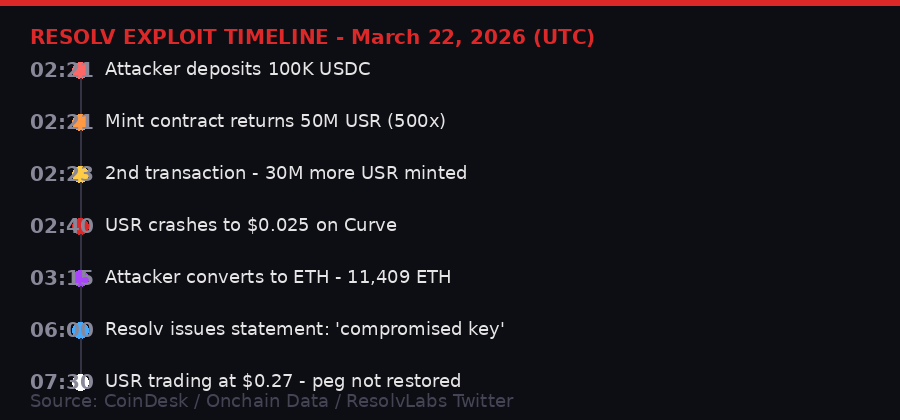
Resolv's initial statement described the incident as a "compromised private key" and "targeted infrastructure compromise." That framing is technically accurate but strategically incomplete. The real failure wasn't that a key got stolen - it's that a single stolen key was sufficient to drain a protocol with $95 million in TVL and mint 80 million tokens with zero checks.
"This notice is issued on behalf of Resolv Digital Assets Ltd. in relation to the Resolv protocol. Earlier today, a malicious actor gained unauthorized access to Resolv infrastructure through compromised private key, resulting in the minting of approximately $80M of..." - Resolv Labs (@ResolvLabs), March 22, 2026
The team said it was working with law enforcement and onchain analytics firms and would "pursue all available avenues to recover assets." They also strongly advised against trading USR while recovery measures are being implemented, adding that "actions of users during post-exploit period may affect the recovery." Translation: don't make it harder for us to track the money by creating noise on DEXs.
The Insolvency Math That Doesn't Work

Here's the part that doesn't get better. DeFiLlama data shows Resolv held approximately $95 million in total value locked at the time of the exploit. But the protocol has approximately $173 million worth of USR outstanding in circulation - tokens that were, at least nominally, supposed to be redeemable for one dollar each.
That's a $78 million gap. The protocol is functionally insolvent.
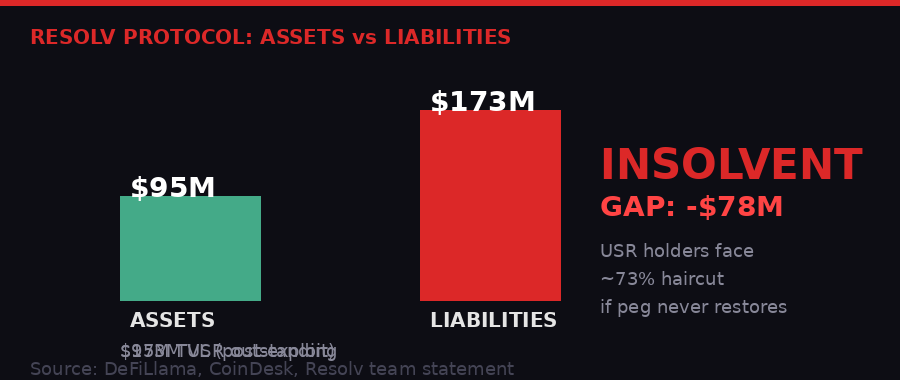
The math: if you divide the total assets ($95 million) by the total USR outstanding ($173 million worth at $1 peg), you get approximately $0.55 per USR as the theoretical maximum recovery value - assuming every single dollar of remaining assets goes toward USR redemptions and nothing is lost to operational costs or further price deterioration of the underlying ETH and BTC collateral.
USR is trading at $0.27. The market is pricing in worse than that theoretical maximum, because markets don't assume best-case scenarios for exploited protocols with no clear recovery path.
DeFiLlama data also shows that Resolv's TVL peaked near $684 million in February 2025 - down to $95 million by the time of the exploit, a 86% collapse in a year. The protocol was already bleeding users before Sunday's attack. It was running a structurally compromised architecture in a declining market with weakening collateral values, and a single key was all that stood between it and catastrophe.
WARNING FOR USR HOLDERS: Resolv has explicitly advised against trading USR while recovery is underway. If you hold USR, any trades may interfere with on-chain asset recovery. The current $0.27 price may not reflect ultimate recovery value in either direction.
The Resolv case is the latest in a long series of DeFi disasters traced to the same root cause: privileged single-key accounts controlling critical infrastructure. MakerDAO, Compound, Aave, and dozens of other protocols spent years implementing multi-signature governance precisely to eliminate single points of failure. Resolv apparently did not. In 2026, that's not a bug - it's negligence.
Bitcoin Holds as Everything Else Breaks

The macro backdrop makes everything worse. Bitcoin is trading at $68,316 as of Monday morning Asia time - down 6% on the week, but by any objective measure, the least-bad performer in a market that's gotten ugly everywhere.
Gold dropped for a ninth consecutive day to around $4,360. Nine straight days of losses for an asset that's supposed to be the global panic button. Asian equity markets are entering correction territory after three consecutive sessions of losses. Bond yields are climbing. S&P futures pointed to further losses. Brent crude is at $113 a barrel - up more than 70% year-to-date. (CoinDesk)
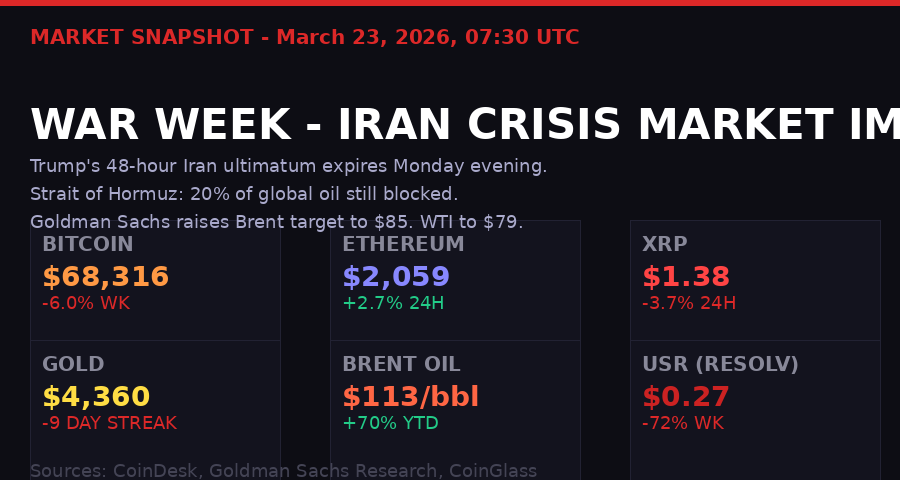
The Iran war is now four weeks old and has broken the traditional safe-haven playbook. Gold is supposed to go up in geopolitical crises. Instead, it's down nearly 18% from recent highs. The explanation: China and other central banks spent months systematically loading gold as part of a dollar-decoupling strategy. When the conflict intensified and liquidity became the priority, that accumulated supply hit the market and overwhelmed demand.
"The gold rally and the BTC collapse are more structural than market-based. China and others have been systematically buying gold as part of a broader effort to decouple from Western markets and the US dollar. That buying has reversed as the conflict intensified and liquidity became the priority over safety." - Alexander Blume, CEO, Two Prime (SEC-registered investment advisor)
Bitcoin fell sharply on Saturday after Trump's 48-hour ultimatum to Iran, taking $299 million in liquidations across 84,239 traders - with long positions accounting for $254 million, or 85% of the damage. Bitcoin longs alone took $122 million. Ether longs lost $95.7 million. The largest single liquidation was a $10 million BTC-USDT swap on OKX. The market had been building confidence around de-escalation after Trump floated "winding down" the operation on Friday. That confidence evaporated in 24 hours.
The 48-hour window in Trump's ultimatum expires Monday evening. Iran has shown no indication of compliance, and has responded that any strike on its power plants would trigger an indefinite Hormuz closure plus retaliatory strikes on U.S. and Israeli energy infrastructure across the region. Goldman Sachs has already revised its full-year Brent forecast to $85 from $77 and WTI to $79 from $72, describing the disruption as the "largest-ever supply shock for global crude markets."
If that deadline passes without compliance and U.S. strikes follow, $113 oil looks like a floor, not a ceiling.
Bitcoin Miners: Bleeding $19,000 Per Coin

The war isn't just hitting crypto prices - it's attacking the cost side of the mining equation simultaneously. Checkonchain's difficulty regression model pegged average bitcoin production cost at $88,000 per coin as of March 13. Bitcoin is trading at $68,316. That's a $19,684 loss on every block mined by the average operator. They're losing 21% on every coin produced.
The squeeze has been building since October's crash from $126,000 to below $70,000. But oil above $113 accelerates it directly. Approximately 8-10% of global hashrate operates in energy markets sensitive to Middle Eastern supply - meaning a significant fraction of miners are getting hit by the same war that's suppressing their output price. (CoinDesk)
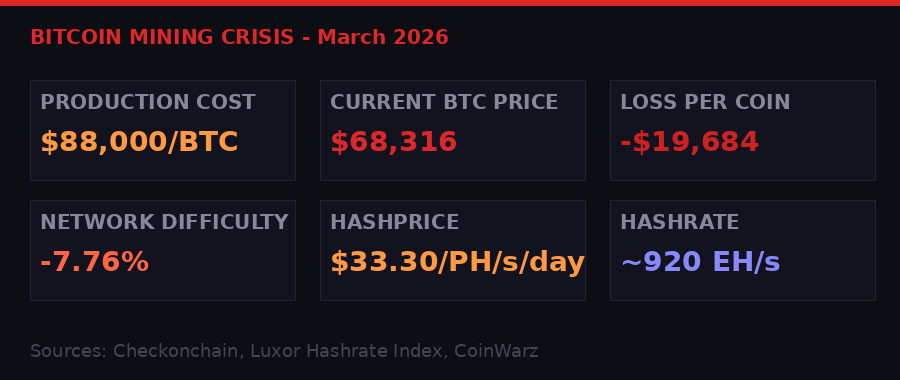
The network is showing stress in the difficulty data. The adjustment dropped 7.76% on Saturday to 133.79 trillion - the second-largest negative adjustment of 2026, behind only February's 11.16% plunge during Winter Storm Fern. Network difficulty is now nearly 10% below where it started the year and far below November 2025's all-time high of 155 trillion. Hashrate has retreated to roughly 920 EH/s, well below the record 1 zetahash reached in 2025.
Hashprice - the revenue per petahash per second per day tracked by Luxor's Hashrate Index - is hovering around $33.30. That's near breakeven for most hardware and not far from the all-time low of $28 hit February 23. Average block times during the last epoch stretched to 12 minutes and 36 seconds, 26% above the 10-minute target.
When miners can't cover costs, they sell bitcoin to fund operations. That selling adds supply pressure to a market where 43% of total supply sits at a loss and whales continue distributing into rallies. Mining economics aren't just a sector story in isolation - they're a market structure story that shows up in price.
The publicly traded miners have been adapting by diversifying into AI and high-performance computing for more predictable revenue. Marathon Digital, Cipher Mining, and others have been building out data center capacity alongside their mining operations. That's the right strategic call, but it doesn't solve the near-term cash flow problem. The next difficulty adjustment, projected for early April, is expected to decline further. Until then, the forced selling continues.
Options Markets Are Screaming Fear - History Says Buy

Here's the contrarian signal hiding inside all the fear. Bitcoin's options markets are displaying a level of defensive positioning that historically marks turning points rather than continued breakdowns.
VanEck's mid-March 2026 Bitcoin ChainCheck found the put/call open interest ratio averaged 0.77 and peaked at 0.84 - the highest level since June 2021, when China cracked down on bitcoin mining and triggered one of the largest corrections in crypto history. Traders spent $685 million on put options over 30 days, while call premiums fell 12% to about $562 million. Relative to spot volume, put premiums reached roughly 4 basis points - an all-time high in VanEck's data. (CoinDesk)
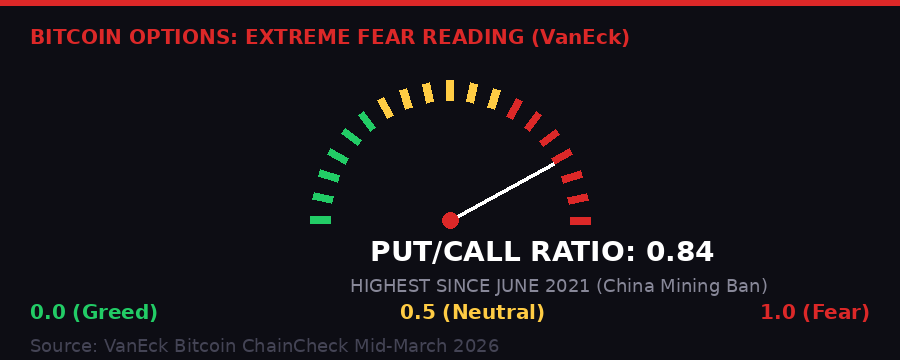
For context: 4 basis points is roughly three times the levels seen in mid-2022 following the Terra/Luna stablecoin collapse and the Ethereum staking liquidity crisis. Markets were more afraid of the future in mid-March 2026 than they were when a $40 billion ecosystem vaporized in a week. That's extraordinary positioning.
VanEck's analysts noted a historical pattern in their data spanning the past six years: similar extreme put skew readings have been followed by average bitcoin gains of 13% over 90 days and 133% over 360 days. That's not a guarantee - the sample size is limited and every geopolitical situation differs. But it establishes context for reading current market fear as potentially a sentiment extreme rather than fundamental deterioration.
Futures funding rates also eased significantly - down to 2.7% from 4.1% in the prior period - confirming that leveraged speculation has cooled substantially. That deleveraging reduces the risk of a cascading liquidation cascade if prices move lower. The market is leaning defensive now rather than aggressively long, which paradoxically makes aggressive downside moves harder to sustain.
Two Prime's Alexander Blume said the firm is positioned for "an increase in funding and futures rates in the weeks and months to come," effectively betting on an upside surprise. Whether that plays out depends on what happens Monday evening when Trump's Iran deadline expires.
South Korea's Crypto Liquidity Drain and the Stablecoin Rotation

One of the more underreported dynamics in the current market: South Korean crypto liquidity has collapsed. On-chain data shows a sharp drawdown in dollar-linked token holdings since July 2025, with the latest wave triggered by Korean won weakness. Stablecoin balances on Korean exchanges have plunged 55% from peak levels. (CoinDesk)
The rotation pattern is telling: as the won depreciated against the dollar, Korean retail investors facing inflation and currency devaluation have been shifting crypto stablecoin holdings into domestic equities - particularly defensive sectors. This is a reversal of the pattern seen in 2021-2022, when Korean retail was a significant driver of crypto premiums and stablecoin inflows.
The timing overlaps with the global risk-off environment. Crypto liquidity in Korea tends to be a leading indicator for retail sentiment across Asia. When Korean stablecoin balances are 55% below peak and declining, it signals that the traditional retail "buy the dip" dynamics that powered previous recovery cycles are not in place right now.
This matters for anyone trying to call a bottom. Institutional positioning through options and ETF flows is defensive but potentially contrarian-positioned. Retail is simply gone. For a recovery to sustain, retail needs to return - and that typically requires either a resolution of the macro uncertainty (Iran war ending or escalating to a defined ceiling) or a significant price move that triggers fear-of-missing-out buying. Neither condition exists today.
The broader stablecoin picture also factors in here. With Resolv's USR now functionally broken, Tether and Circle's USDC further consolidate their position as the only two stablecoins with meaningful trust at scale. Every algorithmic or delta-neutral stablecoin experiment that collapses makes the regulatory case for permissioned, reserve-backed stablecoins stronger - and complicates the path for any alternative designs looking to challenge USDT's $136 billion dominance.
What the Market Is Watching: The Next 72 Hours

Three things will determine where markets trade by Wednesday.
First: the Iran deadline. Trump's 48-hour ultimatum expires Monday evening. If Iran doesn't open the Strait of Hormuz - and there is no indication it will - markets face two paths: Trump escalates with strikes on power infrastructure, sending oil and volatility spiking higher while crypto gets caught in the risk-off trade, or Trump backs down and the ceasefire speculation that drove last week's rally to $75,912 returns. The third option - Iran complying - is currently priced at approximately zero probability by the market.
Second: the Fed's next move. The Fed held rates on Wednesday with what CoinDesk described as a "dovish lean" - a signal that should theoretically support risk assets. But with oil at $113 and Brent at Goldman's new $85 full-year target, inflation expectations are moving the wrong direction for rate cuts. Bond yields are already climbing. If the next CPI print shows oil-driven inflation re-acceleration, the dovish lean evaporates and rate expectations shift back toward hikes. That scenario is the most dangerous one for crypto - it removes the "lower rates eventually" thesis that has supported bitcoin's 2025 narrative.
Third: Resolv contagion. The $78 million insolvency gap doesn't just affect USR holders. It creates questions about every delta-neutral stablecoin design currently operating. Protocols using similar single-SERVICE_ROLE architectures will face scrutiny. Liquidity may drain from smaller experimental stablecoins toward USDC and USDT as the safety rotation continues. Watch for governance votes and emergency audits across DeFi protocols this week.
Bitcoin's $66,000 floor has held through every war-driven sell-off since February 28. If Trump strikes Iran and oil goes to $130, that floor will be tested hard. If a ceasefire materializes, the oversold conditions and extreme put skew set up a sharp bounce. The market is coiled - it just doesn't know which direction yet.
Alexander Blume's contrarian bet - that funding rates increase and upside surprise is more likely than the market expects - is the kind of trade that either looks brilliant or disastrous in 72 hours. The exit price on the Resolv attacker's 11,409 ETH will tell you something about how sophisticated participants are reading that same setup.
Get BLACKWIRE reports first.
Breaking news, investigations, and analysis - straight to your phone.
Join @blackwirenews on TelegramKey Numbers to Watch
Bitcoin: $66,000 floor support - the line that has held every war-driven sell-off since Feb 28.
Resolv USR: $0.27 current - theoretical maximum recovery approximately $0.55 if all assets go to holders.
Oil (Brent): $113/bbl. Goldman's revised full-year target: $85. The war-premium gap is $28.
Iran deadline: Monday evening - market expects non-compliance. Watch for Trump's response.
Mining difficulty: Next adjustment early April, expected to decline further. Miner selling pressure continues.
VanEck signal: Put/call ratio 0.84 - historically preceded 13% gains in 90 days, 133% in 360 days.
BLACKWIRE covers the moves that matter. Sources: CoinDesk, VanEck Bitcoin ChainCheck, CoinGlass, Luxor Hashrate Index, Checkonchain, DeFiLlama, Goldman Sachs Research, Two Prime, ResolvLabs official statement. All price data as of Monday March 23, 2026, approximately 07:30 UTC.