Robert S. Mueller III died Friday night at 81. The family confirmed his death Saturday in a statement to the Associated Press: "With deep sadness, we are sharing the news that Bob passed away." No cause was given. His family asked for privacy.
Within hours, the sitting president of the United States posted on Truth Social: "Robert Mueller just died. Good, I'm glad he's dead. He can no longer hurt innocent people!"
The statement produced immediate, widespread condemnation - and an eerie silence from the current leadership of the FBI itself. Director Kash Patel, a Trump loyalist who spent years calling for investigations of the Russia-probe officials, did not acknowledge Mueller's death on any social media platform. The FBI Agents Association posted a tribute citing Mueller's "commitment to public service and to the FBI's mission."
Mueller leaves behind his wife of nearly 60 years, Ann Cabell Standish, their two daughters, and three grandchildren. He leaves behind something else too: a country still actively fighting over the meaning of the investigation that consumed his public life between 2017 and 2019, and a Justice Department that is now using that investigation as the basis for what critics call a retribution campaign against its participants.
From Princeton to Vietnam: The Making of a Public Servant
Robert Swan Mueller III was born in New York City in 1944 and raised in circumstances that, in another era, would have made public service optional. Princeton University. A graduate degree in international relations. The kind of background that sent people to Wall Street or to the think tanks that orbit Washington.
Mueller went to Vietnam instead. He enlisted in the United States Marine Corps, trained as an infantry officer, and deployed in 1968 - the bloodiest year of the war. As a lieutenant, he led a platoon of Marines through firefights that left him wounded twice. He received the Bronze Star for valor, two Purple Hearts, two Navy Commendation Medals, and the Vietnamese Cross of Gallantry.
These were not honorary awards. The Bronze Star citation documented an action in which Mueller rallied his platoon under fire after its leader fell. The men he served with remembered him as the kind of officer who led from the front.
After Vietnam, he went to the University of Virginia School of Law, graduating in 1973. He spent the next three decades building a reputation inside the federal prosecutorial system as a man who finished what he started and who did not cut corners. He prosecuted the 1988 Lockerbie bombing case. He prosecuted Manuel Noriega. He ran the Criminal Division of the Justice Department. He was, by any measure, a serious person operating at the top of his field.
In August 2001, the United States Senate confirmed him as Director of the Federal Bureau of Investigation by a vote of 98 to zero. Nine days after he took the job, al-Qaeda flew planes into the World Trade Center, the Pentagon, and a field in Pennsylvania.
"In 2001, only one week into the job as the 6th Director of the FBI, Bob transitioned the agency mission to protecting the homeland after September 11. He led the agency effectively, helping prevent another terrorist attack on US soil." - Former President George W. Bush, statement on Mueller's death, March 22, 2026
The transformation Mueller drove at the FBI in the years after September 11 was structural and lasting. He reorganized the entire bureau around intelligence rather than case-by-case law enforcement. He created fusion centers. He embedded analysts with CIA and NSA counterparts. He built the Joint Terrorism Task Force network into a national architecture. He reduced the emphasis on bank robberies and drug cases and directed resources toward counterterrorism prevention. Agents who served under him credit that transformation with disrupting multiple subsequent plots.
He served 12 years - two full terms, one under Bush and one extended at Obama's personal request when Mueller's statutory term expired - making him the second-longest-serving FBI director in history. Only J. Edgar Hoover served longer. That comparison is often made, though the two men's methods and reputations could not be more different.
The Russia Investigation That Defined His Final Chapter
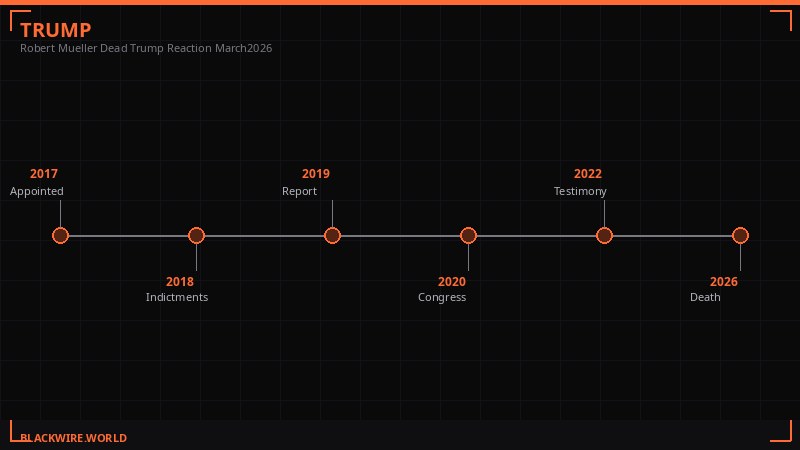
Mueller had been in private practice at WilmerHale for four years when Deputy Attorney General Rod Rosenstein made the call in May 2017. President Trump had just fired FBI Director James Comey - the man who had replaced Mueller at the bureau - in a move that Comey himself later described as an attempt to shut down the Russia investigation. Within days, the Justice Department needed someone to take that investigation out of the hands of the regular chain of command.
Rosenstein called Mueller. Mueller, then 72 years old and under no obligation to return to the most politically exposed job in American law enforcement, said yes.
For 675 days, his team worked in near-total silence. No press conferences. No statement to media. No acknowledgment of what they were finding or where the investigation was heading. While Trump raged on social media - calling the probe a "witch hunt" more than 200 times across his platforms - Mueller said nothing publicly. He worked.
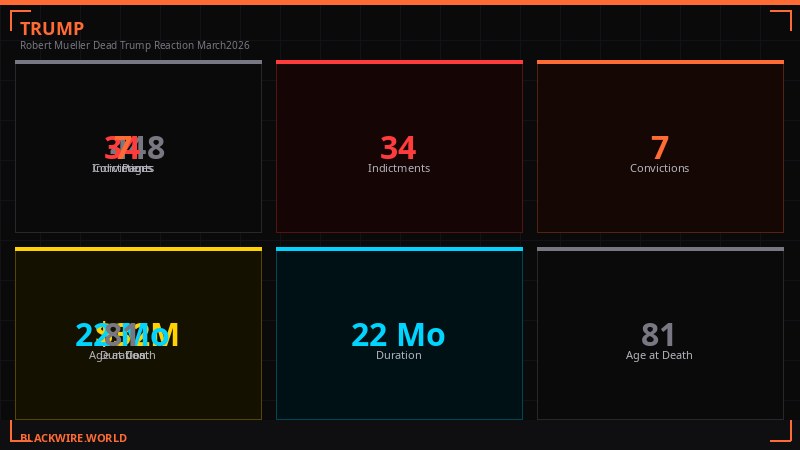
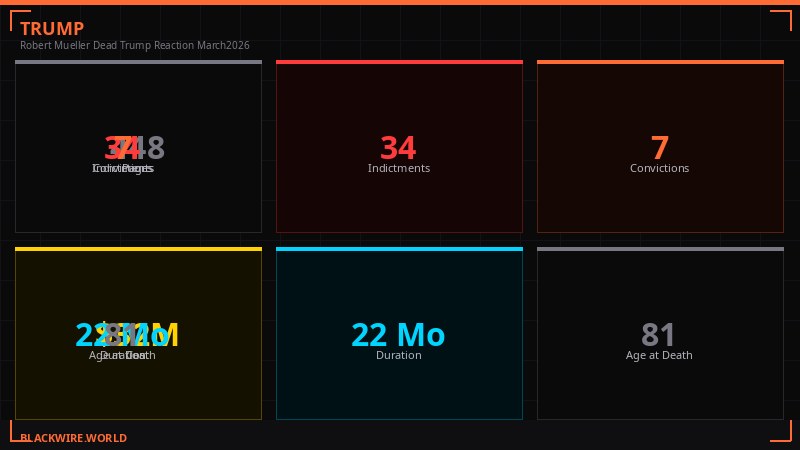
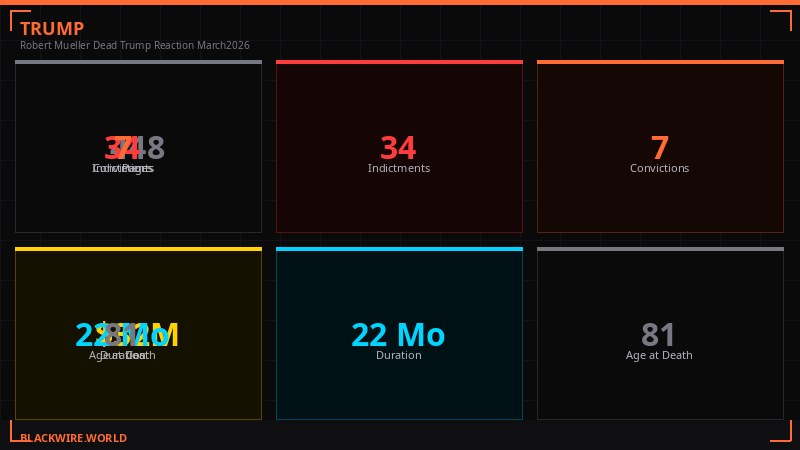
The numbers that eventually emerged were staggering in their scope. His office issued more than 2,800 subpoenas. They executed nearly 500 search warrants and obtained more than 230 orders for communications records. They made 13 requests to foreign governments for evidence and assistance. They interviewed approximately 500 witnesses. They brought 34 indictments - including 25 against Russian nationals and three Russian entities for election interference operations. They secured convictions or guilty pleas from six Trump associates.
Paul Manafort, who had run the Trump campaign through its most critical pre-convention period, was convicted on eight counts of bank and tax fraud and later pleaded guilty to additional conspiracy charges. He was sentenced to 7.5 years in federal prison, though Trump pardoned him during his final weeks in office in January 2021.
Roger Stone, Trump's longtime political adviser and self-described "dirty trickster," was convicted on seven counts including witness tampering and lying to Congress. Stone was also pardoned. Michael Flynn, who had served as Trump's first national security adviser for 24 days before resigning, pleaded guilty to lying to the FBI - then attempted to withdraw his plea, a legal battle that consumed years and ended with a pardon. Michael Cohen, Trump's personal attorney and fixer, pleaded guilty to multiple felonies and served prison time. Rick Gates and George Papadopoulos also pleaded guilty.
The 448-page report Mueller produced in March 2019, publicly released in April of that year, reached two central conclusions. First: Russia had interfered in the 2016 election "in a sweeping and systemic fashion," through both a hacking operation that targeted Democratic Party emails and a covert social media influence campaign designed to sow discord and favor Trump. Second: while the Trump campaign had multiple contacts with Russian operatives and "welcomed" Russia's help, the evidence was insufficient to establish a criminal conspiracy to coordinate that interference.
"While this report does not conclude that the President committed a crime, it also does not exonerate him." - Mueller Report, Volume II, April 2019 - the most analyzed sentence in modern American legal history
On the obstruction question - did Trump attempt to interfere with the investigation itself - Mueller documented 10 episodes of potential criminal conduct. But he declined to reach a prosecutorial decision, citing both the evidentiary complexity and a longstanding Justice Department policy that bars the indictment of a sitting president. Mueller's reasoning was that it would be unfair to accuse someone of a crime if they had no legal avenue to clear their name through trial.
Attorney General William Barr stepped into that void. His four-page summary letter, released before the full report, characterized Mueller's findings in ways Mueller found inaccurate and misleading. Mueller wrote to Barr privately, objecting. The exchange later became public, casting a shadow over Barr's initial framing. But by then, Trump had already declared total exoneration, and the political damage was done.
The Congressional Hearing and the Silence That Followed
Mueller's July 2019 appearance before the House Judiciary and Intelligence Committees was among the most anticipated congressional hearings in modern memory. Democrats who had hoped the special counsel would use the occasion to narrate his report's most damaging findings aloud - to make them visceral and impossible to ignore - were profoundly disappointed.
Mueller, then 74, appeared slow and hesitant. He frequently asked members to repeat their questions. He declined to read sections of his own report aloud, saying repeatedly that he preferred the written document to stand on its own. He objected to being characterized as saying things he had not said. He was careful to the point of opacity, and the result was a hearing that produced no new revelations and delivered no political momentum.
Trump declared victory. Congressional Democrats moved on. Mueller returned to private life and said almost nothing publicly for the next several years. He gave one significant interview - to MSNBC in February 2021 - in which he reflected briefly on the investigation and the reasons he had accepted the assignment.
It was a characteristic answer: no drama, no self-pity, no attempt to relitigate the decisions that critics on both sides had spent years second-guessing. He had been asked to do a difficult thing by people who trusted his judgment, and he had done it. That was enough.
Trump's War on the Intelligence Community, Chapter Two
Mueller did not die in a static political moment. He died in a week when the Trump administration is waging war against Iran - now in its fourth week - while simultaneously running what critics characterize as a systematic legal campaign against the officials who investigated Trump during his first term.
Former CIA Director John Brennan, who helped oversee the January 2017 intelligence community assessment that concluded Russia had interfered in the 2016 election on Trump's behalf, has been formally informed by prosecutors that he is a criminal target in a Florida-based investigation. His lawyers have filed a formal request asking courts to prevent the Justice Department from steering the case to Judge Aileen Cannon - the same judge who dismissed Trump's classified documents case in 2024 and who Trump's allies view as reliably favorable.
"In short, we are seeking assurance that any litigation arising out of this grand jury proceeding will be heard by a judge who is selected by the court's neutral and impartial processes, not by the prosecution's self-interested maneuvering contrary to the interests of justice." - Attorneys Kenneth Wainstein and Natasha Harnwell-Davis, on behalf of John Brennan, March 2026
Former FBI Director James Comey - whose firing by Trump in May 2017 triggered Mueller's appointment - was indicted last year on false statement and obstruction charges. The case was subsequently dismissed. Its legal future remains uncertain after a judge ruled that prosecutors could not rely on certain communications as evidence if they attempt to revive it.
Federal Reserve Chair Jerome Powell, whom Trump appointed to the position in 2017, has been served with a Justice Department subpoena and informed that criminal indictments are under consideration. The ostensible basis is a $2.5 billion building renovation project. The political backdrop is Powell's refusal to cut interest rates at the pace Trump has demanded. Powell publicly called the investigation a "pretext" to weaken the Fed's historic independence from political pressure.
The DOJ's Florida-based investigation into Russia-probe origins has also expanded its scope. Initial subpoenas sought documents from the months surrounding the January 2017 intelligence assessment. New subpoenas, issued in recent weeks, seek any relevant records from the years since then - a significant broadening of the inquiry's temporal reach.
Larry Pfeiffer, a 32-year intelligence veteran who served as CIA chief of staff and as senior director of the White House Situation Room, told the Associated Press this week: "I don't think we've seen another president push back as strong as this guy has." The context was Trump's public rejection of a CIA assessment that U.S. strikes had set Iran's nuclear program back only a few months - an assessment Trump dismissed as wrong while declaring the program "completely and fully obliterated."
Mueller died into this environment. His investigation, which he conducted with meticulous institutional discipline and deliberate restraint, has become the founding grievance of an administration that has made retribution not just a political slogan but an operational priority.
The Tributes and the Presidential Response
The statements that followed Mueller's death on Saturday morning divided cleanly along lines of institutional respect on one side and political score-settling on the other.
Former President George W. Bush - the Republican who nominated Mueller to lead the FBI - issued a statement saying he was "deeply saddened" and praised Mueller's "lifetime of service" and his transformation of the bureau after September 11. Bush called Mueller's dedication an example of what public service at its best could look like.
Former President Barack Obama - who kept Mueller past his 10-year statutory term at personal request because he trusted him - called him "one of the finest directors in the history of the FBI" and praised his "relentless commitment to the rule of law and his unwavering belief in our bedrock values." Obama added that Mueller had saved "countless lives" through the counterterrorism architecture he built.
James Comey, who succeeded Mueller at the FBI and whose firing set the Russia investigation in motion, wrote: "A great American died today, one I was lucky enough to learn from and stand beside."
WilmerHale, Mueller's law firm, called him an "extraordinary leader and public servant and a person of the greatest integrity."
The FBI Agents Association - the professional organization representing the rank-and-file agents of the bureau Mueller once led - cited his "commitment to public service and to the FBI's mission."
Donald Trump, 47th and current President of the United States, posted on Truth Social: "Robert Mueller just died. Good, I'm glad he's dead. He can no longer hurt innocent people!"
Kash Patel, Trump's FBI director and a man who built much of his public profile on attacking the Russia-probe officials, said nothing. On any platform.
That is the historical record. Two former presidents offering condolences to the family of a decorated veteran who spent 12 years leading the nation's top law enforcement agency. And the current president expressing satisfaction that he was dead.
What the Mueller Investigation Actually Proved
The debate over what Mueller's investigation actually accomplished has never fully resolved, and Mueller's death will not resolve it. The two sides remain entrenched.
To Trump and his allies, the investigation was illegitimate from the start - a political operation disguised as a legal one, designed to destroy a presidency that the intelligence establishment had decided to oppose. In this reading, Mueller was not a neutral investigator but an instrument of institutional revenge. The investigation found no conspiracy because there was no conspiracy. The "welcome" the report described as Trump's campaign's posture toward Russian interference was political fantasy dressed up in legal language.
To Mueller's defenders, the investigation did exactly what it was designed to do. It documented, with evidentiary precision, a foreign power's covert effort to influence an American election on behalf of a specific candidate. It documented that candidate's campaign's knowledge of and enthusiasm for that interference. It documented the subsequent attempts to obstruct the investigation. It put six people in prison, secured convictions for campaign fraud and tax evasion and witness tampering, and produced a record that will remain in the archives regardless of what any individual president says about it.
What the investigation did not do - could not do, Mueller would argue - was produce the criminal conspiracy indictment that would have forced the question of presidential accountability directly into the courts. That gap, between what the evidence showed and what Mueller was willing or able to prosecute, is where the political argument lives.
Mueller's decision to leave the obstruction question unresolved - to document 10 episodes of potential criminal conduct and then step back from a prosecutorial judgment - remains the most contested decision of his tenure. His reasoning was principled and internally consistent. Its practical effect was to hand the resolution to William Barr, who used it in ways Mueller privately objected to.
Whether that constituted justice depends on what you thought justice would look like. The evidence is documented. The record is permanent. What American institutions chose to do with it is a different question - one that outlasts Robert Mueller and will outlast Donald Trump.
The Weight of the Record
Measured by biography alone, Robert Mueller's career was exceptional by any standard. Six decades of public service. Vietnam combat. Thirty years as a federal prosecutor. Twelve years transforming the FBI. Two years under relentless political attack, silent, working.
He is survived by his wife Ann, whom he married nearly six decades ago, by their two daughters, and by three grandchildren. He is survived, too, by the 448-page document that bears his name - the most comprehensive legal examination of a presidential campaign's relationship with a foreign adversary that American law has ever produced.
That document will be studied by historians for generations. Whether its conclusions resulted in accountability is a question those historians will debate in the context of everything that came after it - including, now, a president who responded to Mueller's death by expressing satisfaction on social media.
Trump's post will also be in the archives. The two documents - Mueller's careful, footnoted, evidence-based 448 pages and Trump's gleeful 17 words - will sit together in the historical record of this particular moment in American life. Future generations will decide what to make of them.
Robert Mueller asked nothing of history except that the facts be recorded accurately. His own record - the combat wounds, the years of public service, the silent discipline of the investigation, the final restraint of the report - does not require anyone's approval to stand. It stands on its own, the way Mueller himself always stood: straight, without explanation, doing the job.
Quick Reference - Robert Mueller III
- Born: 1944, New York City - Died: March 21, 2026, aged 81
- Military service: US Marines, Vietnam 1968 - Bronze Star for valor, two Purple Hearts, two Navy Commendation Medals
- Education: Princeton University (BA), University of Virginia School of Law (JD, 1973)
- FBI Director: September 4, 2001 to September 4, 2013 - confirmed 98-0 by the Senate, began nine days before 9/11
- Special Counsel: May 2017 to March 2019 - 675 days
- Mueller Report: 448 pages, 34 indictments, 6 Trump associates convicted or pleaded guilty, 500+ witnesses interviewed
- Key finding: Russia interfered "in a sweeping and systemic fashion" on Trump's behalf; insufficient evidence of criminal conspiracy by campaign
- Survived by: Wife Ann Cabell Standish (nearly 60 years married), two daughters, three grandchildren
- Trump's reaction: "Good, I'm glad he's dead. He can no longer hurt innocent people." (Truth Social, March 21, 2026)
- Current FBI Director Kash Patel's reaction: No statement on any platform
- George W. Bush's reaction: "Deeply saddened. Dedicated his life to public service."
- Barack Obama's reaction: "One of the finest directors in the history of the FBI."
Get BLACKWIRE reports first.
Breaking news, investigations, and analysis - straight to your phone.
Join @blackwirenews on TelegramSources: AP News (multiple reports, March 21-22, 2026), BBC News, WilmerHale statement, DOJ court filings, Mueller Report (April 2019), MSNBC interview (February 2021), George W. Bush statement, Barack Obama statement