Drones by Day, Grain Thief by Night: The Sanctioned Russian Weapons Maker Pillaging Ukraine's Harvest
Roman Gurov runs a company that builds kamikaze drones used to kill Ukrainians. He also runs a company that ships stolen Ukrainian wheat to Turkey. Both operations are sanctioned by the United States. Both are still running.
Mariupol, seized by Russian forces after a brutal three-month siege in 2022, has become a primary source of looted Ukrainian grain. Russia has shipped an estimated $400 million-plus in agricultural products from occupied Ukrainian territory since the invasion. (BLACKWIRE illustration)
The investigation, published March 24 by the Organized Crime and Corruption Reporting Project (OCCRP) in collaboration with Ukrainian outlet Slidstvo.info, lays out in precise documentary detail how two companies - one manufacturing weaponized drones, one exporting agricultural commodities - are connected by family, by management, and by the same sanctioned individual at their center.
The arrangement is not accidental. It is systematic. And it has been quietly generating millions of dollars for Russia's war machine while sanctions authorities in Washington looked the other way - at least at the half of the business they could see.
The story of Roman Gurov is a case study in how Russian sanctions evasion operates in the real world: not through encrypted offshore accounts or anonymous shell companies alone, but through the mundane architecture of agricultural trade, family ownership structures, and a Turkish milling company that, in a detail almost too perverse to believe, exports noodles back to the country whose food was stolen in the first place.
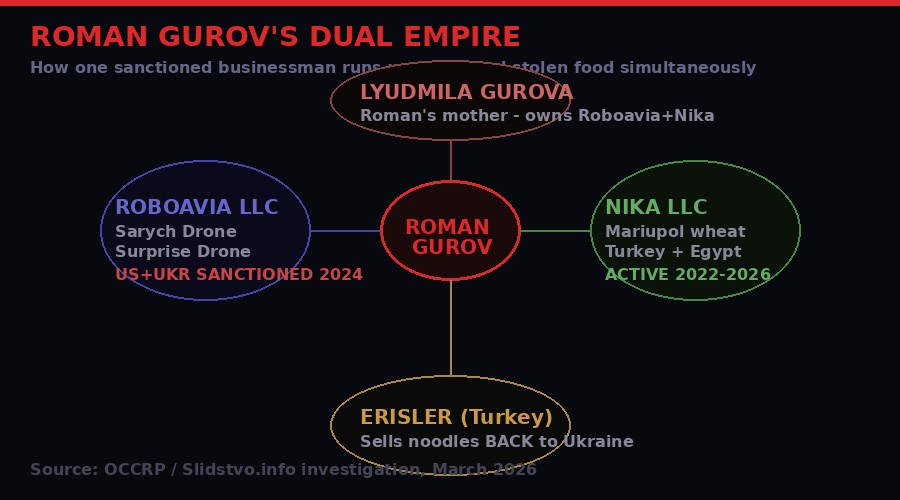
Roman Gurov sits at the center of two parallel businesses: Roboavia, a US-sanctioned kamikaze drone manufacturer, and Nika LLC, an active grain trading company shipping looted wheat from Russian-occupied Mariupol. His mother Lyudmila Gurova is registered as owner of both. (BLACKWIRE analysis based on OCCRP reporting)
The Drone Factory and the Man Behind It
Roboavia does not advertise itself. There is no glossy website, no LinkedIn presence for its executives, no press releases about production milestones. What there is, instead, is a documented record - corporate filings, military contracts, and the kind of evidence that only emerges when investigators are patient enough to follow registration numbers and shipping manifests.
The company was first registered in 2015. Lyudmila Gurova - Roman Gurov's mother, a woman in her mid-seventies at the time of writing - became its registered owner in July 2022, five months into Russia's full-scale invasion of Ukraine. Roman Gurov took the role of general director in November 2022. Prior to Roboavia, neither mother nor son had any documented background in drone manufacturing or aerospace industries of any kind.
What changed them into weapons manufacturers? The evidence does not say. What it does say is that by July 2023, Gurov was signing official agreements with the deputy governor of Rostov Oblast, the Russian border region adjacent to eastern Ukraine. He had become, in the span of roughly a year, a credentialed defense industry figure.
Roboavia produces at least two weapons systems. The Sarych is a reconnaissance drone. The Surprise is what the Belgian arms industry publication Army Recognition describes as a strike drone that is "virtually invisible and inaudible to adversaries" and capable of laying mines. These are not hobbyist quadcopters. They are precision instruments of war, and they are being used in an active conflict where tens of thousands of people have died.
Ukraine's military intelligence agency had identified both systems by 2024. The United States Treasury Office of Foreign Assets Control sanctioned Roboavia - and Gurov personally - in October 2024 under Executive Order 14024, which targets entities supporting Russia's military-industrial base.
"Roman Gurov became general director of Roboavia in November 2022. Neither he nor his mother had any prior documented involvement in drone production or related industries." - OCCRP / Slidstvo.info, March 24, 2026
The sanctions were real. Gurov's assets in U.S. jurisdictions - if any existed - were frozen. American persons were barred from doing business with him or Roboavia. The designation was public. His name went onto the SDN list.
And then, apparently, nothing changed in the grain business.
The Grain Company Nobody Sanctioned
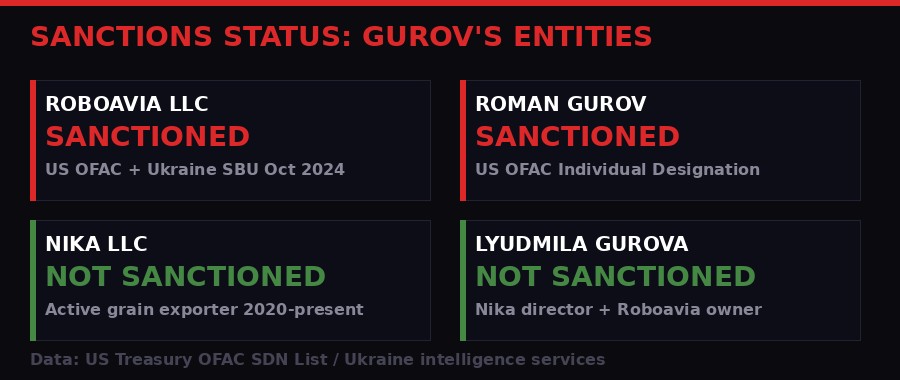
The structural gap in Western sanctions: Roboavia and Roman Gurov as an individual are designated under US and Ukrainian sanctions. But Nika LLC - through which the actual grain theft revenue flows - remains unsanctioned, with Lyudmila Gurova as its director. (BLACKWIRE sanctions analysis)
Nika LLC was registered in 2020, with Roman Gurov as its owner. In November 2022 - the same month he became Roboavia's director - his mother Lyudmila Gurova was installed as Nika's director. The timing is precise. The structure is clean. The son runs the weapons company under his own name until sanctions make that untenable. The mother's name appears on the grain company. Her name does not appear on any sanctions list.
Nika's business is simple to describe and difficult to defend. The company sources wheat from Mariupol - a Ukrainian port city that Russian forces took after one of the most brutal sieges of the entire conflict - and ships it abroad. The wheat comes from production sites in Mariupol. The certificates of conformity that Slidstvo.info obtained - more than 20 of them, covering shipments from July 2022 through early 2026 - consistently identify Mariupol as the origin of production.
That wheat is Ukrainian grain. Ukraine grew it before the invasion, and Ukraine's farmers would have harvested it. Under Russian occupation, the harvest belongs to Russia - or rather, to whoever Russia chooses to grant the right to export it. In Nika's case, that right appears to have been granted to a family with a parallel weapons manufacturing business.
The numbers are not trivial. In 2023, Nika shipped 15,500 tonnes of wheat to Turkey and Egypt, generating $3.7 million. In 2024, those exports nearly quadrupled: 59,500 tonnes, worth $12.9 million. In just the first quarter of 2025, another 4,500 tonnes went out the door. The revenue flows have not paused for sanctions, for diplomatic pressure, or for the ongoing investigation by OCCRP and Slidstvo.info.
Ukraine's deputy foreign intelligence chief stated in a January 2026 interview with Ukraine's national news agency that Russia shipped more than two million tonnes of grain worth approximately $400 million from the temporarily occupied territories of Zaporizhia, Crimea, and Donetsk in 2025 alone. Nika LLC is one contributor to that total, but it is not operating in isolation. It is a node in a much larger network of systematic agricultural looting that has proceeded largely uninterrupted since 2022.
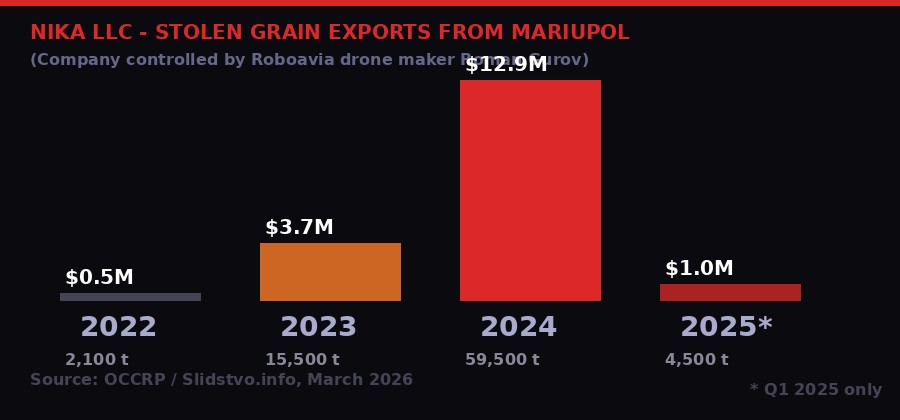
Nika LLC's documented grain exports from Russian-occupied Mariupol have grown sharply year over year, reaching $12.9 million in 2024 before appearing to contract in early 2025. The revenues flow from stolen Ukrainian agricultural land through Turkish intermediaries. (BLACKWIRE chart based on OCCRP / Slidstvo.info data)
The Turkish Connection and the Noodle Irony
The wheat does not stay in Russia. It moves westward, or rather south and west, through a chain of transactions that crosses multiple jurisdictions and involves at least one company that operates in the heart of NATO territory.
The primary recipient documented in the investigation is Erisler Gida Sanayi Ve Ticaret A.S., a Turkish milling company. According to one April 2024 maritime manifest obtained by Slidstvo.info, at least 7,800 tonnes of Nika's wheat was shipped aboard the Russian vessel Alfa M - a ship under Ukrainian sanctions since November 2023 - to the Russian port of Temryuk, across the Sea of Azov from Mariupol. From Temryuk, Russian customs records show the goods were forwarded to Turkey.
Erisler is not an obscure operation. It describes itself as producing 850,000 tonnes of flour annually across four mills. It also manufactures what it describes as "Turkey's first national instant noodle brand." That detail matters because of what comes next: Erisler exports those noodles to Ukraine - the country whose wheat was stolen, milled, and processed into the product now being sold back to Ukrainian consumers.
Erisler did not respond to requests for comment from OCCRP. Their silence sits alongside Turkey's long-maintained position that it does not permit illegal grain trade - a position articulated by then-Foreign Minister Mevlüt Cavusoglu in June 2022 after Ukraine's ambassador publicly accused Russia of stealing grain and exporting it through Turkish ports. "Turkey will not allow illegal trade in Ukrainian grain or any other products from any country, including Russia," Cavusoglu said at a press conference in Ankara.
Four years later, a sanctioned Russian drone manufacturer's grain company is documented supplying a Turkish miller, via a sanctioned Russian vessel, using wheat from Ukrainian territory occupied by force. The position that Turkey does not permit this has not prevented it from happening.
"Turkey will not allow illegal trade in Ukrainian grain or any other products from any country, including Russia." - Mevlüt Cavusoglu, Turkish Foreign Minister, June 2022 press conference in Ankara
Turkey has maintained a careful neutrality throughout the Russia-Ukraine war, refusing to join Western sanctions regimes while also providing Ukraine with Bayraktar drones. That neutrality has created a structural gap in the sanctions architecture: goods sanctioned in U.S. and EU jurisdictions flow through Turkish intermediaries, and Turkish companies face no legal obligation to enforce foreign sanctions designations.
Erisler's situation is legally ambiguous. The company is not itself on any Western sanctions list. Doing business with Nika LLC - which is also not on any sanctions list - is not technically prohibited under Turkish law. The fact that Nika's owner is sanctioned, and that Nika appears to be a vehicle for laundering the proceeds of what Ukraine's government characterizes as a war crime, does not automatically create legal liability for every company in the supply chain.
That legal ambiguity is the architecture of sanctions evasion. It is not accidental.
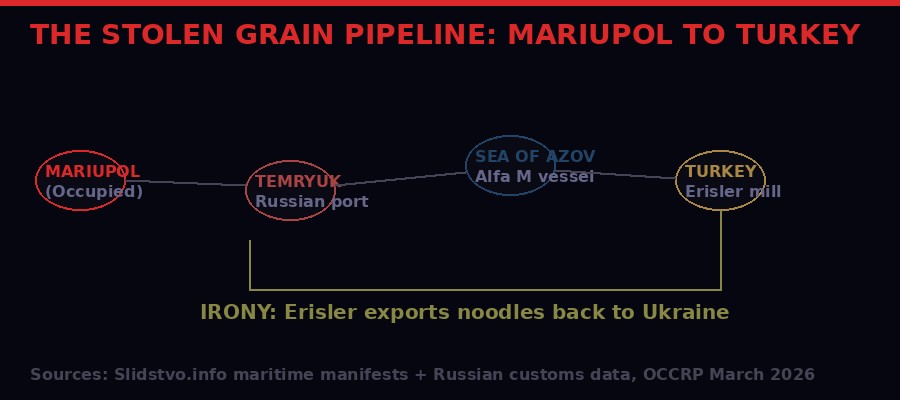
The stolen grain pipeline: Nika LLC ships wheat from Mariupol to the Russian port of Temryuk aboard sanctioned vessels, then onward to Turkey. The final destination includes Erisler, a Turkish milling company that separately exports processed noodle products back to Ukraine. (BLACKWIRE reconstruction based on OCCRP maritime manifests and Russian customs data)
A Timeline of Calculated Construction
When you lay out the chronology of how this operation was built, the deliberateness becomes visible. This was not opportunism. Each step preceded the next with the logic of someone who anticipated where the pressure would eventually land.
The Architecture of Legal Separation
The structural design of this operation deserves forensic attention, because it represents something that Western sanctions architects have repeatedly failed to anticipate and address: the deliberate use of family ownership to launder the beneficial interests of a sanctioned individual through a clean corporate vehicle.
Roman Gurov is sanctioned. Roboavia is sanctioned. But Nika LLC - the entity through which the ongoing revenue flows - is not. Lyudmila Gurova, its director, is not sanctioned. The grain exports have continued for years after the drone company entered the SDN list.
This is not an unusual evasion technique. OFAC has long recognized what it calls "50 percent rule" - the principle that any company owned 50 percent or more by a sanctioned individual is itself considered sanctioned, regardless of whether OFAC has formally listed it. Gurov was listed as Nika's owner as of June 2020. If his ownership was not formally transferred before his October 2024 designation, Nika should theoretically be subject to the same restrictions as Gurov himself.
But enforcement is not the same as rule-making. The question is whether any regulator, in any jurisdiction, has taken action against Nika on those grounds. The investigation does not report that they have.
Gurova's role as director of both companies is also significant beyond the obvious. In Russian corporate law, a director has formal authority over company operations. A mother who takes the directorship of her son's weapons company in July 2022 - the same month his grain company begins shipping stolen wheat - is not a bystander. She is a structural participant. The fact that her name does not appear on any sanctions list is a gap in the enforcement regime, not evidence that she plays a peripheral role.
Key Figure
General director of Roboavia LLC, a Russian drone manufacturer producing the Sarych reconnaissance drone and the Surprise strike drone. Owner of Nika LLC, a grain trading company. Sanctioned by the United States (OFAC, October 2024) and Ukraine under EO 14024 for supporting Russia's military-industrial complex. No prior documented background in aerospace or defense manufacturing before 2022. First appeared in Russian press in July 2023 when he signed a regional government agreement.
Key Figure
Roman Gurov's mother. Registered owner of Roboavia LLC (from July 2022). Director of Nika LLC (from November 2022). Not listed on any US, EU, or Ukrainian sanctions list as of this reporting. The corporate structure places both companies under her nominal control while her son operates as director of Roboavia and beneficial owner of both entities.
Why Stolen Grain Is a War Crime - And Why Nobody Is Prosecuted For It
Ukraine's government has been explicit about its legal characterization of what Russia is doing with the agricultural output of occupied territories. This is not a trade dispute. It is pillage - a war crime under Article 33 of the Fourth Geneva Convention and Article 8(2)(b)(xvi) of the Rome Statute, which criminalizes the pillaging of property in the context of an armed conflict.
Ukraine's then-ambassador to Turkey made that argument publicly in June 2022. The International Criminal Court has jurisdiction over war crimes committed by nationals of non-member states when referred by the UN Security Council, or - as in Russia's case - when the territorial state has accepted ICC jurisdiction. Ukraine accepted ICC jurisdiction in 2014.
The ICC has already issued arrest warrants in connection with the Ukraine conflict. The deportation of Ukrainian children generated the warrant for Vladimir Putin himself in March 2023. But the systematic looting of agricultural resources - an operation that has generated hundreds of millions of dollars and denied food security to occupied populations and global markets - has not generated comparable prosecutorial action.
The gap between the legal framework and its enforcement is where operations like Nika LLC thrive. The law says this is a war crime. The law says sanctioned individuals cannot profit from their commercial entities. The enforcement record says otherwise.
"Last year Russia shipped more than two million tonnes of grain, worth $400 million, from the temporarily occupied territories of Zaporizhia, Crimea, and Donetsk." - Ukrainian deputy foreign intelligence chief, January 2026 interview with Ukraine's national news agency
There is also a food security dimension that gets less attention than it deserves. Mariupol before the invasion was a significant grain export hub. Ukraine as a whole was one of the world's five largest wheat exporters. The diversion of Ukrainian grain production through Russian-controlled supply chains - shipped on sanctioned Russian vessels, processed in Turkish mills, sold into global commodity markets - has real effects on global food prices and supply. The populations most exposed to those effects are in Africa and the Middle East, not in Europe or North America.
When OCCRP reports that Nika LLC shipped stolen wheat to Egypt alongside Turkey, that is not a minor detail. Egypt is one of the world's largest wheat importers. If Egyptian buyers are purchasing Ukrainian grain that was looted from its original owners, they are - likely unknowingly - participating in a war crime supply chain.
The Alfa M and the Sanctioned Fleet
The shipping layer of this operation adds another dimension of documented violations. The vessel used to transport at least some of Nika's grain - the Alfa M - has been under Ukrainian sanctions since November 2023. Its continued operation in this trade, documented in the April 2024 maritime manifest obtained by Slidstvo.info, means the ship was operating in sanctioned trade more than four months after its designation.
The Alfa M is part of a broader pattern. Russia has assembled what analysts and Western governments call a "shadow fleet" - a collection of vessels that operate outside the normal maritime insurance and compliance system, carrying Russian oil and other commodities in defiance of Western sanctions. OCCRP and other investigative organizations have documented dozens of these ships. Some fly flags of convenience in third-party jurisdictions. Some operate without insurance from Lloyd's of London or other major underwriters. All are designed to create enough documentary distance from Russian state ownership and Western financial systems to continue moving sanctioned goods.
The Alfa M was not, at the time of the April 2024 voyage, operating under a Western flag. It was not using Western insurance. It was not passing through Western ports. It was moving between Russia and Turkey - two countries with no legal obligation to enforce Ukrainian sanctions - carrying agricultural goods that technically belong to a nation at war.
Tracking these vessels is difficult. Enforcing against them is harder. The ship's AIS transponder data can be spoofed, its flag changed, its insurance arranged through opaque intermediaries. The maritime manifest that Slidstvo.info obtained is the rare documentary exception that proves the investigative rule: most of what moves on shadow fleet vessels leaves no paper trail accessible to Western investigators.
The full network connecting Gurov's sanctioned drone manufacturing operation to his active grain exporting business, with his mother serving as the formal corporate intermediary between both entities. (BLACKWIRE analysis)
What Happens Now
The investigation has been published. The names are on record. The shipping manifests, the conformity certificates, the corporate filings, the sanctions designations - they are all in the public domain now. The question is whether any enforcement authority will act on them.
The most direct lever available is OFAC. If Nika LLC is found to be 50 percent or more beneficially owned by Gurov - the individual already on the SDN list - it should technically be treated as a sanctioned entity regardless of formal listing. If Gurova is assessed to be acting as a front for her son, OFAC has the authority to designate her as well.
Neither step requires new legal authority. Both require political will, investigative resources, and the decision to treat stolen Ukrainian grain as a serious enforcement priority rather than a second-tier sanctions issue behind oil and financial institutions.
Turkey presents the harder problem. Ankara will not sanction Russian entities unilaterally. It will not compel Turkish companies to stop buying commodities that arrive through Russian intermediaries unless those intermediaries are specifically designated under Turkish law. Erisler, which has not been accused of knowingly participating in war crime supply chains, is operating in a legal gray zone that Turkish authorities have shown no urgency to color in.
Ukraine's government has the strongest claim and the least enforcement power. It cannot reach into Turkey to shut down Nika's export market. It cannot compel the sanctioned Alfa M to stop sailing. What it can do - and what it has done through its intelligence services - is document, publicize, and appeal to allies with more leverage than it currently has in the Turkish relationship.
The ringleaders of Nika LLC have not been named as fugitives. No arrest warrants have been issued for Roman Gurov on war crime grounds. No Turkish regulatory authority has announced an investigation into Erisler's supply chains. The grain shipments, as of the publication of the OCCRP investigation, appear to be ongoing.
That is the state of enforcement against a sanctioned weapons manufacturer who is simultaneously running a stolen food export operation from an occupied Ukrainian city. The documentation is thorough. The legal violations are clear. The consequence, so far, is a press release from OCCRP and silence from the people named in it.
In this war, some people build drones. Some people ship stolen wheat. Some people do both, at the same time, through their mother's name, and they are still doing it while investigators write about them.
Get BLACKWIRE reports first.
Breaking news, investigations, and analysis - straight to your phone.
Join @blackwirenews on Telegram