
Russia launched nearly 1,000 Shahed drones at Ukraine in a single overnight assault on March 24-25 - the largest attack of the entire war. Seven people are dead. Fifty-five injured. Zelensky says Washington's attention is somewhere else entirely.
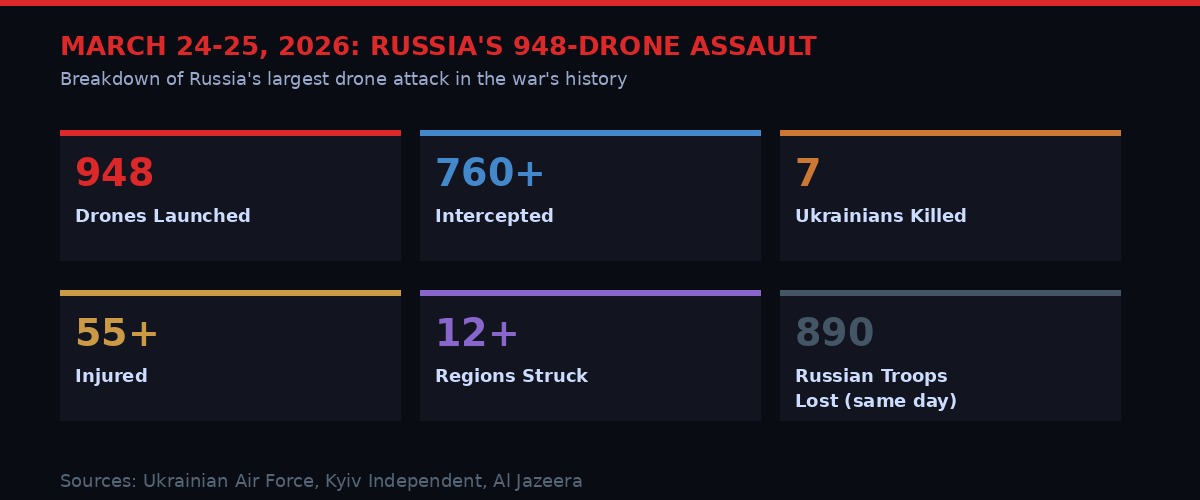
The numbers are not abstractions. On the night of March 24 into March 25, 2026, Russia's military fired 948 Shahed-series drones at Ukrainian cities, towns, and energy infrastructure. According to Ukraine's Air Force, more than 760 were intercepted. The rest got through. Seven Ukrainian civilians are confirmed dead. At least 55 were wounded. Multiple regions across the country were struck simultaneously - a coordinated, multi-axis swarm designed to overwhelm air defenses through sheer volume.
This is not how drone war was supposed to work. When Russia began fielding Iranian-designed Geran-2 drones in late 2022, analysts predicted Ukraine's air defenses would adapt. They did. But Russia adapted faster - and now, with the United States consumed by a shooting war against Iran in the Persian Gulf, Kyiv's access to replacement interceptors, ammunition resupply, and diplomatic bandwidth from Washington has shrunk to almost nothing.
President Volodymyr Zelensky put it plainly after the attack: "The geopolitical situation has become more complicated." That is the understatement of the war.

The assault began in the late evening hours of March 24. Ukrainian air force tracking systems lit up across their full operational range. The drones - predominantly Shahed-136 variants assembled inside Russia under the designation Geran-2 - came from multiple launch vectors simultaneously. Eastern Belarus-adjacent corridors. The Black Sea approach. Crimea. The tactic is deliberate: force Ukrainian air defense systems to rotate coverage, exhaust interceptor supplies, and guarantee some percentage of the swarm breaks through.
According to Ukraine's General Staff, the Ukrainian Air Force successfully intercepted more than 760 of the 948 incoming drones. That is an intercept rate above 80 percent - by any historical measure, an extraordinary achievement for a nation fighting a grinding three-year war on three fronts with NATO's attention divided. But 80 percent is not 100 percent. The remainder fell on apartment buildings, energy stations, railway infrastructure, and civilian streets.
Ukraine's military intelligence service (SBU) reported separately that Russian forces lost approximately 890 troops in the same 24-hour period - continuing a grinding attrition that Moscow appears willing to absorb indefinitely. The General Staff has assessed total Russian losses since February 24, 2022 at over 1,289,740 personnel - killed, wounded, captured, or missing.
"Russia is constantly changing its tactics for massive strikes, trying to find vulnerabilities and break through Ukraine's air defenses." - Serhii Flash, Ukrainian Air Force spokesman, as reported by Kyiv Independent, March 25, 2026
At the same time as the drone barrage, Ukrainian forces struck back. Intelligence assets destroyed a Zircon hypersonic missile launcher in Russian-occupied Crimea, Ukraine's military intelligence directorate confirmed. Ukraine also struck Russia's key Baltic Sea oil port and the Bashkortostan oil refinery in Russian territory, actions confirmed by the Ukrainian General Staff. The war is very much a two-way exchange - but the exchange rate is becoming harder to sustain.
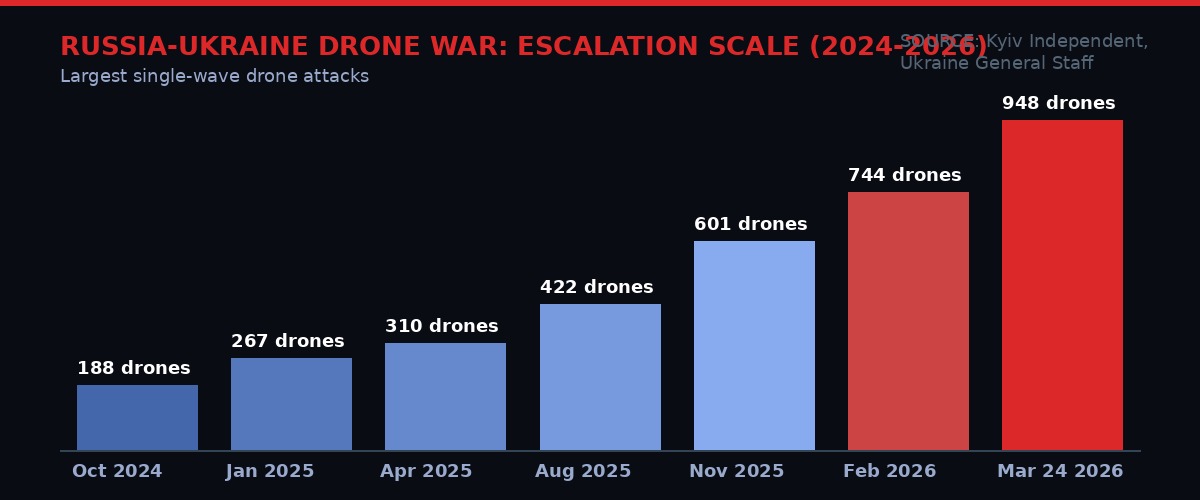
Russia's drone war did not arrive at 948 units per night overnight. The escalation has been methodical, calculated, and tied directly to Iran's expanding arms pipeline. When Russia first deployed Iranian-designed Shahed-136 drones in September 2022, salvos rarely exceeded 30-40 drones in a single night. Ukraine's air defenses, bolstered by Western-supplied systems, knocked down most of them.
Russia's response was volume. The Islamic Republic of Iran had begun transferring drone technology - and then production licenses - to Russia beginning in 2022. By 2024, Russia had operationalized domestic Geran-2 production facilities, primarily in Alabuga, Tatarstan, giving Moscow a supply chain that did not depend on Iranian shipments. Ukrainian and Western intelligence confirmed the production scale in 2025: estimates ranged from 2,000 to 4,000 drones per month capacity.
The result is the curve we see now. Attacks that numbered in the hundreds in 2024 - themselves records at the time - have been surpassed quarter by quarter. The October 2024 record of 188 drones became a floor, not a ceiling. By early 2026, 600-drone nights were becoming routine. Now 948 drones in a single night is the new benchmark.
Each escalation step has a logic to it. Ukraine's air defenses have been strengthening too, which means Russia must send more drones to guarantee equivalent damage. Patriot batteries, NASAMS, German IRIS-T, and trained Ukrainian crews have steadily improved the intercept rate. But interceptors cost money, require resupply, and depend on political will in Washington and European capitals. Russia's Geran-2 drones cost an estimated $20,000-50,000 each. A Patriot interceptor costs over $3 million. The math, at scale, is unsustainable.
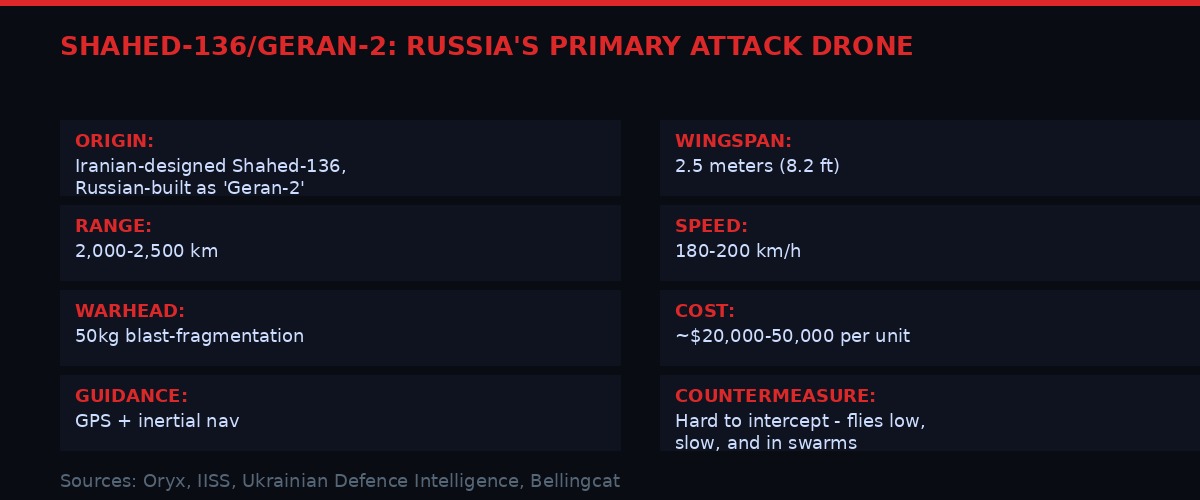
Understanding why Ukraine cannot simply "shoot them all down" requires understanding what the Shahed-136 - Russia's Geran-2 - actually is. It is not a sophisticated precision weapon. It is a slow, cheap, disposable kamikaze drone with a 50-kilogram warhead. Its top speed is under 200 kilometers per hour - slower than a World War II propeller fighter. Its wingspan is 2.5 meters. It flies at low altitude to avoid radar. It makes a distinctive, loud engine noise that Ukrainians have nicknamed "the moped" or "the lawnmower."
And yet it works. At scale.
The drone's value is not in any individual unit. It is in saturation. Send enough of them from enough directions and some will get through. The ones that get through destroy transformers, substations, apartment buildings, railway junctions. Even failed interceptions impose costs: the fuel and manpower to track, the interceptors expended, the anti-aircraft crews kept at stations for hours through the night. Sleep deprivation. Civilian terror. Economic disruption.
Bellingcat and Ukrainian investigators have documented that even after European Union sanctions targeting drone components, Russian Geran-2 drones recovered from crash sites continued to contain Western-manufactured microchips, capacitors, and electronic components - sourced through third-country intermediaries. The sanctions leakage problem has not been solved. Russia's production line has not been meaningfully disrupted.
"Ukraine's drone makers fear Zelensky risks missing a 'window of opportunity' amid the Iran war." - Kyiv Independent headline, March 24, 2026
Ukraine has responded with its own drone program - and with considerable success. Ukrainian FPV drones and long-range strike drones have hit oil refineries deep inside Russian territory, including the Bashkortostan facility struck this week. But Ukraine's production capacity, while growing, still cannot match the volume Russia can generate from its Alabuga factory complex and expanding production network. The asymmetry is structural.
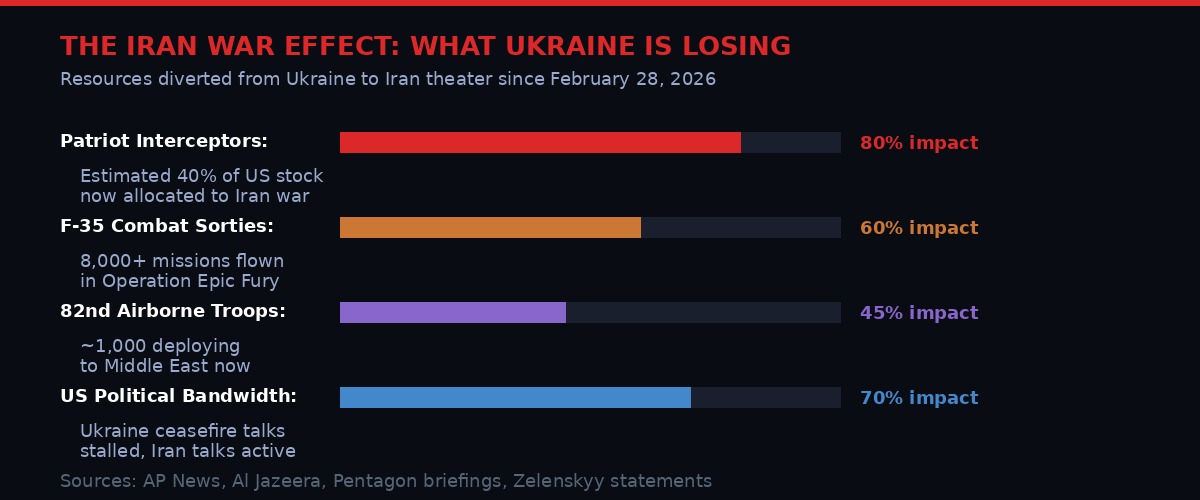
On February 28, 2026, the United States and Israel launched coordinated strikes on Iran's nuclear facilities - initiating Operation Epic Fury, the name CENTCOM has since attached to the ongoing air campaign. Since then, more than 8,000 US combat sorties have been flown against Iranian targets. At least 13 American service members have been killed. Roughly 200 wounded. The war is real, bloody, and consuming an enormous share of Washington's diplomatic, military, and political energy.
Ukraine has watched this unfold with unconcealed alarm. Zelensky's direct warning, delivered March 24 after meetings with Trump administration officials, was precise: Washington is focused on Iran, and Russia knows it. The emboldening effect is measurable in the scale of that same night's drone assault.
The specific resource constraints bear examination. US Patriot air defense batteries and interceptors were already in short supply before the Iran war began - BLACKWIRE reported on Ukraine's Patriot shortage in February. Since February 28, an estimated portion of US Patriot stocks and the attention of US defense acquisition officials have been reoriented toward the Middle East theater. The 82nd Airborne Division is deploying approximately 1,000 additional troops to the region as of March 24, according to AP News. The carrier USS Gerald Ford, while damaged in combat, has remained in the Mediterranean rather than being rotated home.
The US political calendar is similarly consumed. Trump's claim on March 24 that the US is actively negotiating with Iran - a claim Iranian officials immediately denied - dominated global headlines. Ukraine ceasefire negotiations, which had been stumbling along since early February, have effectively stalled. The deal-making energy that might have gone toward Kyiv is going toward Tehran.
The core calculation Russia is making: With American attention on Iran, European commitment under pressure, and Ukraine's air defense resupply chain stretched thin, now is the time to hit harder and faster. The 948-drone night is not random. It is an attempt to break something fundamental before a ceasefire window that may never open again.
Zelensky's warning was delivered with precision: "The geopolitical situation has become more complicated." Behind that diplomatic language is a starker calculation. Ukraine was already asking for more Patriot batteries, more interceptors, more F-16 support before the Iran war started. None of those requests have been fulfilled at scale. And now the requester is speaking to officials whose minds are on the Strait of Hormuz.

While Russian drones fell on Ukrainian cities, Ukrainian intelligence was executing a strike of its own in occupied Crimea. Ukraine's military intelligence directorate confirmed the destruction of a Zircon hypersonic missile launcher - a weapon system Russia uses to strike Ukrainian infrastructure and naval targets at speeds that conventional air defenses cannot intercept.
The Zircon - Russia's Tsirkon 3M22 - is a sea-launched hypersonic cruise missile with a reported speed of Mach 8-9 and a range of over 1,000 kilometers. Russia has deployed it against Ukraine from naval vessels in the Black Sea and from ground-based launchers positioned on the Crimean peninsula. Its speed and maneuverability make it one of the most difficult threats for Ukrainian air defense to counter.
Destroying a launcher before missiles are fired is precisely the kind of intelligence-led precision strike Ukraine has become adept at. The SBU's unit responsible for operations in occupied territories has maintained an active covert network inside Crimea throughout the war. The March 24 Zircon launcher strike was the product of that network - human intelligence, drone reconnaissance, and a precision strike that removed a system capable of devastating Ukrainian infrastructure.
Ukraine also confirmed separate strikes on Russia's key Baltic Sea oil port and the Bashkortostan oil refinery - both targeting Russia's energy revenue infrastructure. Ukraine's long-range drone campaign against Russian oil facilities has been one of the few areas where Kyiv can genuinely impose economic costs on Moscow that accumulate over time.
The intelligence operation score for this week: Russia destroyed seven Ukrainian civilians and hit apartment buildings, railway stations, and energy grids. Ukraine destroyed a hypersonic missile launcher, an oil port installation, and a major refinery. By any human accounting, the week was a disaster. By the cold math of attrition warfare, Ukraine scored significant strategic returns even as its cities burned.

Russia's timing on the 948-drone barrage is not coincidental. The Kremlin is operating under a clear strategic calculus: the Iran war creates a window of reduced US attention and stretched US resources. Russia's military planners assessed - correctly - that Washington's political and military bandwidth is finite. With the US fighting Iran, any resumption of large-scale Ukraine support faces domestic political headwinds. Trump's base is not enthusiastic about two simultaneous military commitments. European allies, themselves grappling with energy crises linked to the Iran war, face their own constraints.
Russia has also been watching Ukraine's air defense consumption rate. Three years of high-intensity drone war have depleted interceptor stockpiles. Patriot missiles take time to manufacture. The supply chains are not infinite. Russia is betting that enough consecutive massive strikes will eventually exhaust Ukraine's ability to defend its airspace - that the 80 percent intercept rate will slip to 70, then 60, then lower, as batteries run dry and resupply stalls.
The daytime barrage component is also new. Al Jazeera and Kyiv Independent both reported that Russia launched a rare daytime attack alongside the overnight assault - a tactical shift designed to strain Ukrainian air raid response systems during daylight hours when civilian movement is higher, warning times are harder to communicate, and economic disruption is more visible.
Russia's Russian-backed signals doctrine for this phase seems to be: hit at maximum volume, day and night, exploiting every window of diminished Western resolve. The goal is not merely territorial gain. It is cognitive exhaustion - in Ukraine's civilian population, in European governments watching refugee counts climb again, and in Washington where attention is finite and the Iran war is already consuming enormous political capital.
"Ukrainian drones are killing Russian troops faster than Moscow can replace them." - Kyiv Independent, quoting Ukrainian drone commanders, March 2026
That quote from Ukrainian drone operators reflects the paradox of this war. On the ground, Russia is losing men at a rate that would have collapsed any democratic government. Over 1.28 million casualties since February 2022. But Russia is not a democratic government. Putin's system has absorbed that attrition, mobilized replacement troops, and continued. The war grinds on.

The 948-drone night is a benchmark but not an end state. Russia has the production capacity to sustain and increase this scale. Ukrainian intelligence operators and drone manufacturers have warned explicitly that the "window of opportunity" - the period when Kyiv could establish a decisive drone production and interception advantage - is at risk of closing as Washington remains distracted by the Iran theater.
The most immediate pressure point is interceptors. Ukraine's air defense architecture depends on Patriot PAC-2 and PAC-3 missiles, NASAMS interceptors, and German IRIS-T systems. All of them require Western resupply. The Patriot missile manufacturing pipeline in the US typically requires 18-24 months to surge production. Even under emergency authorization, shortfalls are real and documented. Ukraine's defense minister raised the issue formally in February. The response from Washington was sympathetic but not decisive.
European actors are stepping in where they can. Germany accelerated IRIS-T system deliveries in early 2026. France has discussed additional SAMP/T battery deployments. But the scale of Russia's current assault - 948 drones in a single night, with credible capacity to sustain similar operations weekly - requires American-scale commitments, not European-scale supplements.
The diplomatic dimension is no less grim. Ceasefire talks that had tentatively resumed under Trump administration mediation have effectively stalled. Trump's attention is on Iran - specifically, on the market-calming narrative that the US is "negotiating" with Tehran (a claim Iran's government has publicly denied). The political energy required to sustain serious Ukraine diplomacy simply is not available in a White House managing an active shooting war in the Gulf.
Russia understands this. The Kremlin's calculation is that time - and Western attention deficits - work in Moscow's favor. Every week that Ukraine cannot resupply interceptors is a week Russia can degrade Ukrainian air defenses with mass. Every month the Iran war dominates Washington's agenda is a month the Ukraine file drifts toward benign neglect. The 948-drone barrage is not just a military operation. It is a message: we are still here, and we are not stopping.
The Tucker Carlson intelligence revelation adds another layer. Kyiv Independent reported on March 25 that Ukraine believes Carlson "works for Putin" amid growing US scrutiny of his access to Russian officials and messaging channels. The information war over US public opinion - which shapes Congressional willingness to fund Ukraine - is an active front alongside the drone war. Russia is fighting on every dimension simultaneously.

Seven dead. Fifty-five wounded. Twelve regions struck. These are the accounting terms for the night of March 24 in Ukraine. They will not be the final numbers. In a war that has produced over 1.28 million Russian casualties and tens of thousands of Ukrainian ones, single-night figures accumulate into an unbearable weight. But the accumulation is exactly the mechanism Russia is weaponizing.
The 948-drone attack tells us several things that diplomatic communiques will not say plainly. Russia has not been degraded to the point where it cannot sustain escalation. Russia has correctly read the strategic moment created by the Iran war. Russia is willing to absorb Ukrainian counter-strikes - the oil refinery, the Baltic Sea port, the Zircon launcher in Crimea - and continue regardless. The math of attrition, viewed from Moscow, still favors persistence.
Ukraine's position is more complicated. The counter-strikes are real and meaningful. The 80-percent drone intercept rate is genuine and remarkable. The Zircon launcher destruction is a genuine capability gain. But none of these accomplishments prevent the next 948-drone night. Or the one after that. Or the 1,200-drone night that becomes logically plausible given the escalation curve.
Zelensky's warning on March 24 was not rhetorical. "The geopolitical situation has become more complicated" is his diplomatic way of saying: we are being left exposed while the world looks elsewhere. The question no one in Brussels, Washington, or Kyiv wants to answer out loud is whether that exposure - measured in dead civilians, depleted interceptors, and stalled peace talks - is the price of fighting two wars at once, or whether it is the price of not having fought decisively enough when the moment was available.
948 drones. That number will be exceeded. The ceiling, if one exists, is determined not by Russia's capacity but by Ukraine's ability to defend and the West's willingness to fund that defense. Right now, both are under pressure from a direction nobody planned for: the Persian Gulf.
Get BLACKWIRE reports first.
Breaking news, investigations, and analysis - straight to your phone.
Join @blackwirenews on Telegram