Russia's Wagner Ghosts in Angola: The Trial Exposing Moscow's Africa Playbook
Two Russian operatives are going on trial in Angola's capital charged with terrorism, espionage, and orchestrating a disinformation campaign to destabilize an oil-rich government that drifted away from Moscow's orbit. The case is the most detailed public reckoning yet with the network that succeeded Wagner in Africa.
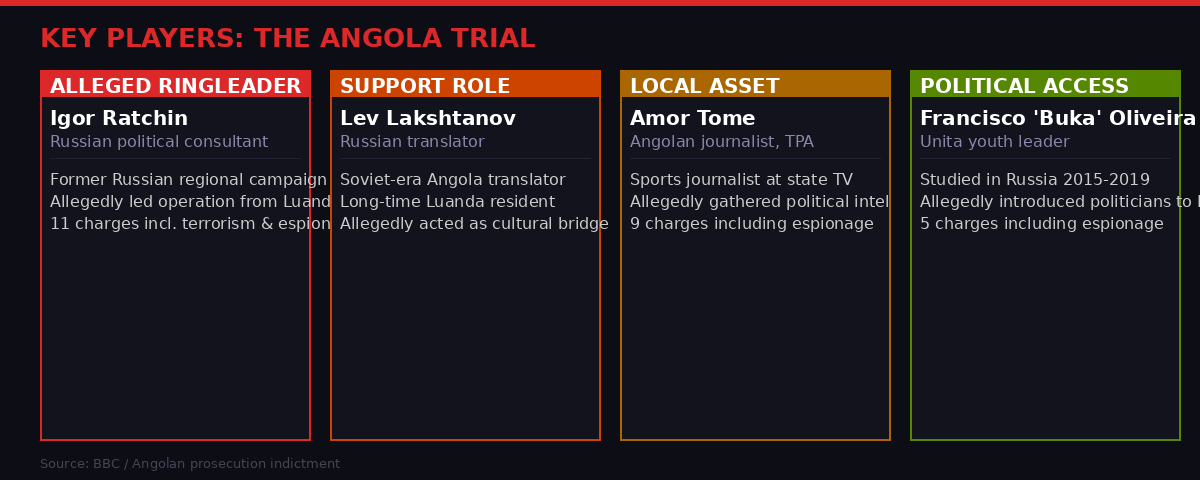
The courtroom in Luanda holds four defendants. Two are Russian nationals - Igor Ratchin, a political consultant who had previously run election campaigns in Russia, and Lev Lakshtanov, a translator who has worked in Angola since the Soviet era. The other two are Angolan citizens: Amor Carlos Tome, a sports journalist at the state broadcaster TPA, and Francisco "Buka Tanda" Oliveira, a youth leader for the opposition party Unita who studied chemical engineering in Russia between 2015 and 2019.
Together, according to an indictment obtained by the BBC's Global Disinformation Unit and corroborated by court filings reviewed for this investigation, they stand accused of running a coordinated influence operation against one of Africa's most strategically important oil states - paying local journalists and media outlets to plant disinformation, meeting with major presidential candidates to offer funding and intelligence support, and helping to foment protests that turned deadly last July.
All four deny the charges. Their lawyers say the indictment lacks concrete facts and rests on conjecture. But the prosecution's theory of the case - and the network it describes - reveals something significant about how Russian intelligence operations in Africa work after the death of Yevgeny Prigozhin, the mercenary warlord who built the original architecture for this kind of interference.
The Drift That Moscow Wanted to Reverse
Angola's relationship with Russia runs deep - deeper than most Western observers remember. During the Cold War, the Soviet Union backed the MPLA, the ruling party that has governed Angola since independence in 1975, in a brutal proxy conflict against the UNITA rebels, who were supported by the United States and apartheid South Africa. Soviet military advisers, Cuban troops, and AK-47s from Eastern European stockpiles were the lifeblood of the MPLA's survival through a civil war that killed an estimated half a million people before it formally ended in 2002.
But that history has not translated into lasting strategic alignment. Angola is one of Africa's largest oil producers and a major diamond exporter. Its natural resources have attracted Western capital, American energy companies, and Chinese infrastructure investment in roughly equal measure. The country was never a satellite - it was always a prize to be competed over.
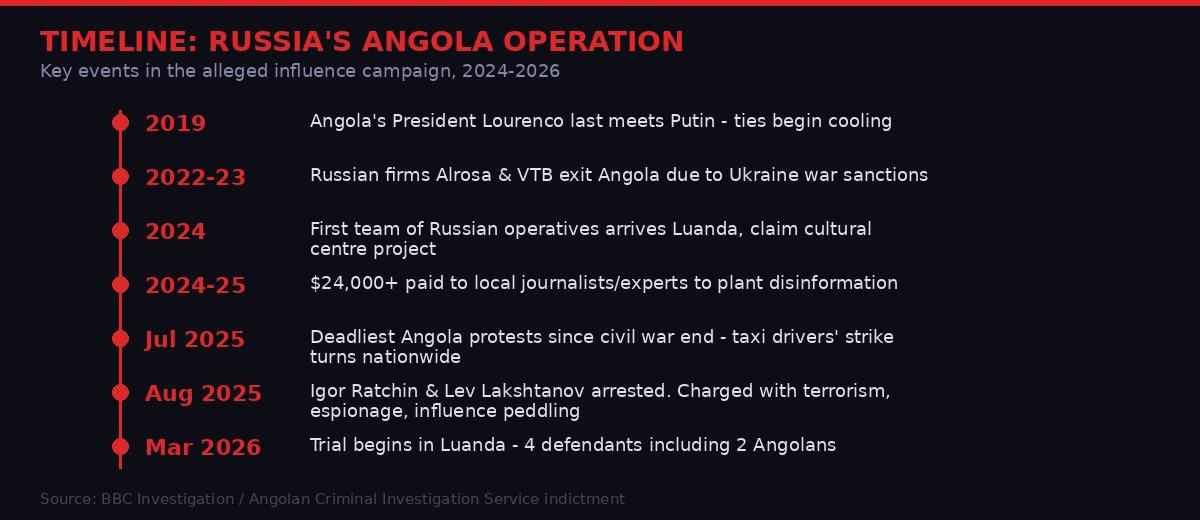
President Joao Lourenco, who took power in 2017 after succeeding the long-serving Jose Eduardo dos Santos, began pivoting Angola deliberately toward the West. He pursued anti-corruption reforms, invited IMF engagement, and cultivated ties with Washington. His last meeting with Vladimir Putin was in 2019. The relationship went cold.
The rupture accelerated after Russia's full-scale invasion of Ukraine in February 2022. Two significant Russian economic presences in Angola were forced to exit: diamond mining company Alrosa, a state-linked giant with a 32.8 percent stake in Angola's Catoca diamond mine, and bank VTB, both hit by Western sanctions that made their Angolan operations untenable. The sanctions didn't just damage commercial ties - they were read in Moscow as a signal that Angola's leadership had chosen a side.
"This is indicative of Russian anxiety about the direction of travel of Angola under the Lourenco administration. There's clearly an element of Russian disinformation to try and build up more sympathy towards the Russian Federation." - Alex Vines, Africa Programme Director, European Council on Foreign Relations
The 2026 Angolan presidential election - now looming on the horizon - was the deadline. Angola chooses its president through parliamentary elections in which the leader of the party that wins the most seats becomes head of state. The MPLA has held that position since 1975. But internal divisions, economic pressures, and growing youth disillusionment have made the 2026 contest genuinely competitive in a way Angola has rarely seen.
According to prosecutors, Russian operatives saw both uncertainty and opportunity. What followed was a textbook-style influence operation - small budget, local proxies, targeted disinformation - executed, by at least one insider account, badly.
Africa Politology: The Wagner Successor Nobody Named
Understanding who Ratchin and Lakshtanov allegedly worked for requires understanding what happened to the Wagner Group after Prigozhin's death.
In August 2023, the private plane carrying Yevgeny Prigozhin and several of his senior commanders was shot out of the sky over Russia's Tver region. The Kremlin denied involvement. No serious analyst believed that denial. Prigozhin had led a mutiny against the Russian military two months earlier, marching a Wagner column toward Moscow before standing it down. His death ended that chapter. But it didn't end the Africa operations he had spent years constructing.
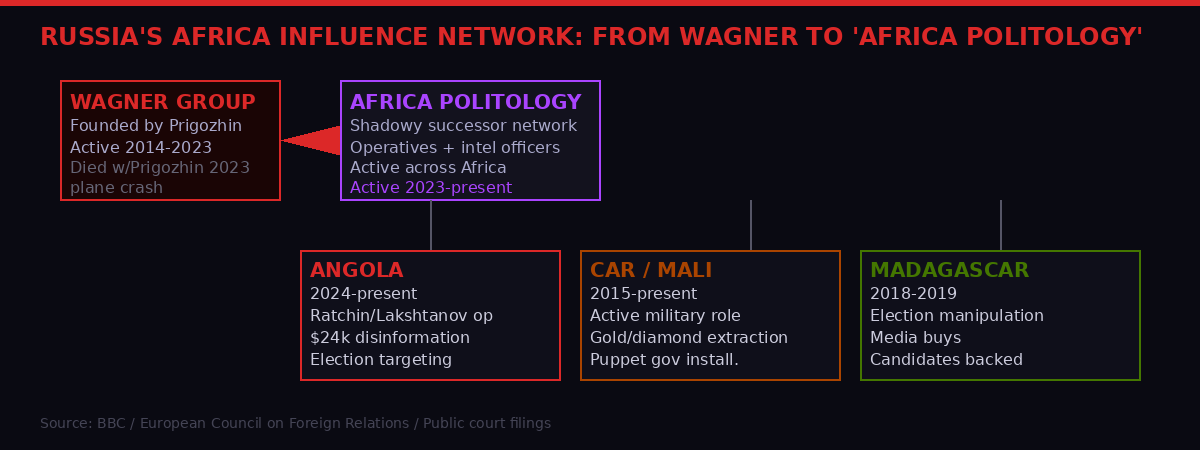
Wagner had been active across Africa for nearly a decade. In the Central African Republic, Wagner fighters provided personal security to President Faustin-Archange Touadera and ran gold and diamond extraction operations that funneled profits back to Russia. In Mali, Wagner units - later rebranded as the Africa Corps under Russian military supervision - replaced French forces as the backbone of the junta's counter-insurgency efforts. In Madagascar, Prigozhin operatives ran a covert operation to back a preferred presidential candidate in 2018 and 2019. In Sudan, in Libya, in Mozambique - wherever there was instability and extractable resources, Wagner planted its flag.
After Prigozhin's death, the Kremlin restructured these operations under more formal state control. But a parallel informal network also emerged. Prosecutors in Angola call it Africa Politology - described in the indictment as a "shadowy network of operatives and intelligence officers in Africa" that grew out of the Wagner ecosystem.
The name Africa Politology does not appear in Western sanctions lists. It has no public-facing presence. Multiple analysts contacted for this investigation said they were aware of the network but had seen limited documentation of its structure. The Angola trial - with its unsealed indictment and court proceedings - represents the most detailed public exposure of Africa Politology to date.
"This year they handed the whole African topic over to some complete idiots. It feels like they were just picked up at the Sadovod market. And right before New Year they really wanted publications in Angolan media. But I told them all to go to hell." - Former Prigozhin Africa project associate, speaking to BBC on condition of anonymity
The contempt in that account matters. It suggests that even within Russian influence networks, the Angola operation was regarded as amateurish - a low-budget effort run by contractors rather than professionals. That assessment aligns with the scale of documented spending: just over $24,000 in payments to local journalists and experts over the course of the alleged operation.
The Operation: Cultural Cover, Media Buys, and Presidential Candidates
According to the prosecution, the first team of Russian operatives arrived in Luanda in 2024 under the pretext of establishing a Russian cultural centre - a project that never materialized. The use of cultural diplomacy as an entry point is a pattern well documented in Russian influence operations globally. The "Russian House" concept - a physical space offering language classes, cultural events, and information services - has been used as an organizational cover from West Africa to the Balkans.
The BBC's investigation links earlier arrivals to Maxim Shugalei, a Russian political operative who starred in a propaganda film trilogy about his alleged escapades in Africa. Shugalei was arrested in Chad in September 2024 and returned to Moscow in November 2024. The indictment contains an apparent factual error: it states the Russian operation began on October 9, 2024, with Shugalei's arrival, but Shugalei was already detained by that date. The BBC requested clarification from the Angolan prosecution and received no response.
Ratchin was allegedly at the centre of the actual operation on the ground. He had a documented political consultancy background in Russia, claiming victories in multiple regional election campaigns. Prosecutors say he hired or directed the two Angolan defendants to carry out operational tasks.
The disinformation campaign, as described in the indictment, had specific targets. A January 2025 Facebook post on a page imitating the recognized news outlet Angola 24 Horas - presenting itself as a "satirical" page - claimed that Angola risked being drawn into the Ukraine war if it maintained ties with Western partners. Another article, published the following day on news website Lil Pasta News, attacked the Lobito Corridor - a US-backed railway development project connecting Angola, the Democratic Republic of Congo, and Zambia - suggesting the country had "signed a pact with the Devil" by participating.
Lil Pasta News told the BBC that the articles in question were not written by their team but received through an intermediary. They said they had no contact with the original author and were not paid for the publication. Whether that statement is accurate, and whether the intermediary had connections to the Russian network, remains an open question in the trial.
The prosecution also alleges that Ratchin and Lakshtanov sought direct access to potential presidential candidates. This is where the case becomes most politically explosive for Angola.
Prosecutors claim the two Russians held meetings with MPLA heavyweight General Higino Carneiro - a former mayor of Luanda and potential ruling-party presidential candidate - and with Adalberto Costa Junior, leader of the main opposition Unita party. They allege the Russians offered Carneiro up to $15 million in campaign support, alongside security assistance, strategic advice, and intelligence gathering. The BBC notes that no evidence of this specific financial offer appeared in the version of the indictment it reviewed. Carneiro did not respond to requests for comment. Unita called the allegations false and suggested the trial was being used for political purposes.
Alleged Operation Components
- Disinformation: Facebook impersonation pages, planted articles on local news sites, anti-Western narrative injection
- Payments: $24,000+ documented payments to journalists and political "experts" in Angola
- Political access: Alleged meetings with two major presidential candidates; $15m offer alleged to MPLA's Carneiro (disputed)
- Protest instigation: Notes about July 2025 demonstrations found on defendants' phones; photos allegedly taken by Ratchin
- Electoral interference: Gathering political intelligence ahead of 2026 presidential contest
The Protests That Changed the Calculus
In July 2025, Angola experienced the deadliest civil unrest since the end of its civil war in 2002. What began as a strike by Luanda's taxi drivers - angry over new transport regulations and fuel price increases - metastasized into nationwide protests that turned violent. Police responded with what human rights organizations described as excessive force.
The protests were, by any economic analysis, deeply organic. The World Bank estimates that approximately 40 percent of Angolans live below the international poverty line of $3 per day. Angola's oil wealth has never translated into broad prosperity for ordinary citizens. Youth unemployment is high. Inequality is stark and visible. The taxi drivers' strike was not spontaneous in the conspiratorial sense - it was the predictable result of genuine grievances that had been building for years.
"People were protesting because of their living conditions, not because someone from another country told them to." - Sheila Nhancale, Angola researcher, Human Rights Watch
The prosecution's theory is not that Russia created the protests from nothing. It is that Russian operatives were positioned to amplify and potentially redirect unrest that was already inevitable. Prosecutors point to notes about the demonstrations found on the defendants' mobile phones and to photographs allegedly taken by Ratchin during the protests. Ratchin's lawyers say he took the photographs for personal safety - to have evidence if he were attacked. The BBC has not seen the photos or the notes.
Multiple Angolan journalists and civil society activists have pushed back hard on the prosecution's framing. They argue that framing the protests as foreign-orchestrated is politically convenient for a government that used lethal force against its own citizens and now faces accountability. The suggestion that ordinary Angolans needed Russian provocateurs to realize they were poor is, in their view, an insult masquerading as an investigation.
Both things can be true. Genuine grievance and external exploitation are not mutually exclusive. What the trial will need to establish is whether the Russian operatives materially contributed to the violence - or whether their presence was more opportunistic than causative.
The Indictment's Problems
The prosecution faces significant credibility challenges that defense lawyers and independent legal observers have already flagged publicly.
The indictment contains misspellings and apparent factual errors. Beyond the Shugalei timeline problem, legal expert Rui Verde - a research associate at Oxford University's African Studies Centre - notes that the prosecution faces a structural challenge: it must prove that the individual acts described in the indictment form a deliberate, intentional pattern of subversion rather than coincidental or loosely coordinated activity.
The 11 charges against Ratchin, which include terrorism and espionage, represent the most serious tier of the Angolan criminal code. Defense lawyer Elizeu Nguiniti has said he does not know whether the alleged meeting with General Carneiro even took place. The defense team for the Angolan defendants argues there are no "subjective or objective elements" of crimes "minimally demonstrated" in the indictment.
The $24,000 in documented payments - spread across multiple media outlets and individuals over more than a year - is modest by any standard of influence operation financing. It is consistent with a low-budget contractor operation rather than a state-directed strategic campaign. That gap between the ambition alleged by prosecutors and the budget documented in court records is something defense lawyers will likely exploit heavily.
| Defendant | Nationality | Charges | Defense Position |
|---|---|---|---|
| Igor Ratchin | Russian | 11 (terrorism, espionage, influence peddling) | "No concrete and objective facts" in indictment |
| Lev Lakshtanov | Russian | 11 (terrorism, espionage, influence peddling) | Not connected to Africa Politology or Wagner |
| Amor Carlos Tome | Angolan | 9 (terrorism, espionage, influence peddling) | No subjective/objective elements demonstrated |
| Francisco "Buka" Oliveira | Angolan | 5 (terrorism, espionage, influence peddling) | Only knew about cultural centre project |
Sources: BBC Global Disinformation Unit, Angolan prosecution indictment, defense lawyer statements.
Moscow's Silence and What It Means
One of the most telling elements of this case is the Russian government's response - or rather, its near-total absence of one.
A source described as close to the Russian diplomatic community told the BBC that Moscow's calculation was deliberately cold: these men were contractors, not official state agents. Russia's position in Angola is already weak. Making a diplomatic scene would cost more than it gains. "Let these remnants of Prigozhin's operation sort it out themselves," the source said.
That framing serves multiple Russian interests simultaneously. It distances the Kremlin from direct responsibility. It preserves the fiction that the operations were private commercial activity rather than state-directed covert action. And it allows Russia to sacrifice low-level operatives - men who likely understood this was always a possibility when they took the work - while protecting the broader architecture of the influence network.
The deniability structure of Africa Politology appears deliberately designed for exactly this scenario. If contractors get caught, the state shrugs. The network survives. The methodology - low-budget, media-focused, election-targeting - gets refined and redeployed elsewhere. Angola is, in this reading, less a disaster for Russian Africa operations than a proof of concept with an unfortunate arrest.
According to several sources cited in the investigation, the Russians could be returned to Russia if convicted - an unusual arrangement that would reflect both the weakness of Angola's diplomatic leverage over Moscow and the possibility of a quiet deal that makes the trial's outcome less significant than its evidence.
Angola's Strategic Position and Why This Matters Beyond the Trial
Angola holds 8.3 billion barrels in proven oil reserves and is sub-Saharan Africa's second-largest oil producer. Its Lobito Corridor railway project - the target of one of the alleged disinformation articles - represents a $4.5 billion US-backed infrastructure investment designed to link the DRC's mineral-rich interior to the Atlantic coast, routing commodities through Angola rather than through ports controlled by Chinese-aligned actors. The strategic competition this project represents is real and explicit.
For Washington and Brussels, Angola is a success story of sorts - a former Soviet client state that normalized into a Western economic partner, reduced its dependence on Chinese financing, and maintained stability during a difficult transition between leaders. For Moscow, it is an example of how a country with deep historical ties can be peeled away from Russian influence through patient economic and diplomatic engagement by the West.
The alleged Russian operation was not, by any reasonable analysis, going to reverse Angola's strategic direction on its own. The budget was too small, the execution apparently too amateurish, and the underlying structural forces - economic integration with Western capital markets, the IMF program, US energy investment - too entrenched. What the operation could do, at the margins, was seed distrust of Western partners, amplify grievances around the Lobito Corridor and other Western-linked projects, and potentially tilt a close election in a direction more sympathetic to Moscow.
That is, precisely, the Africa Politology playbook. Not regime change. Marginal influence. Narrative pollution. Enough friction to keep options open.
"The Russian operatives in Africa were breaking new ground by moving into Angola. This is indicative of Russian anxiety about the direction of travel of Angola under the Lourenco administration." - Alex Vines, European Council on Foreign Relations
The Broader Reckoning
The Angola trial matters beyond its immediate facts for three reasons.
First, it is the most transparent public accounting of Africa Politology yet available. The unsealed indictment, the BBC's access to legal documents, and the public nature of the proceedings mean that more is known about this network's Angolan operation than about most Russian influence operations on the continent. Researchers, governments, and journalists now have a template to look for elsewhere.
Second, it illustrates the structural vulnerability that makes low-budget influence operations viable. Angola's media landscape, like that of many African countries, includes outlets with thin revenue models, limited editorial independence, and journalists who are underpaid relative to the cost of living. Twenty-four thousand dollars buys a significant footprint in that environment. This is not an argument for blaming the media - it is an observation about the structural conditions that Russian (and other) influence operations exploit. The solution is journalism funding and media resilience, not finger-pointing at vulnerable reporters.
Third, the trial tests something important about accountability. Russia has operated influence networks across Africa for a decade with near-total impunity. Wagner mercenaries killed journalists and civilians in Mali, the Central African Republic, and Sudan. Prigozhin operatives interfered in elections from Madagascar to Sudan. The reckoning has been minimal. Angola's decision to arrest, charge, and try Russian nationals on terrorism charges - however imperfect the indictment - represents a different response than the continent has typically seen. Whether it results in conviction, acquittal, or a quiet deportation deal will tell its own story.
The four defendants in a Luanda courtroom are the visible end of a chain that runs back through Africa Politology, through the Wagner Group's ruins, and into the structures of Russian state power that have spent a decade trying to reshape Africa's political geography through covert means. They may be amateurs. They may even be scapegoats for genuine popular anger that needed no foreign catalyst. But the network they allegedly served is real, active, and already learning from what went wrong in Angola.
Follow the money. Name the network. Connect the dots. That is what the Angolan prosecutors are attempting. Whether they succeed or not, they have put enough on the record to make the pattern visible.
Get BLACKWIRE reports first.
Breaking news, investigations, and analysis - straight to your phone.
Join @blackwirenews on TelegramSources & Methodology
- BBC Global Disinformation Unit investigation (Maria Jevstafjeva, Ilya Barabanov, Leandro Prazeres) - March 2026
- Angolan Criminal Investigation Service (SIAC) indictment, obtained by BBC
- Alex Vines, Africa Programme Director, European Council on Foreign Relations
- Sheila Nhancale, Angola researcher, Human Rights Watch
- Rui Verde, research associate, Oxford University African Studies Centre
- World Bank poverty data for Angola (2024)
- Defense lawyer statements: Pedro Cangombe, Elizeu Nguiniti
- Unita spokesperson Jonas Mulato