The Sanctioned Tanker: Russia's Oil Reaches Cuba as Trump's Blockade Cracks Open
730,000 barrels of Russian crude arrive at the port of Matanzas - the first foreign oil delivery to Cuba in three months. Trump says he has "no problem" with it. The Kremlin calls it "humanitarian duty." The island's 11 million people call it survival.
CUBA RUSSIA OIL BLOCKADE GEOPOLITICS ENERGY CRISIS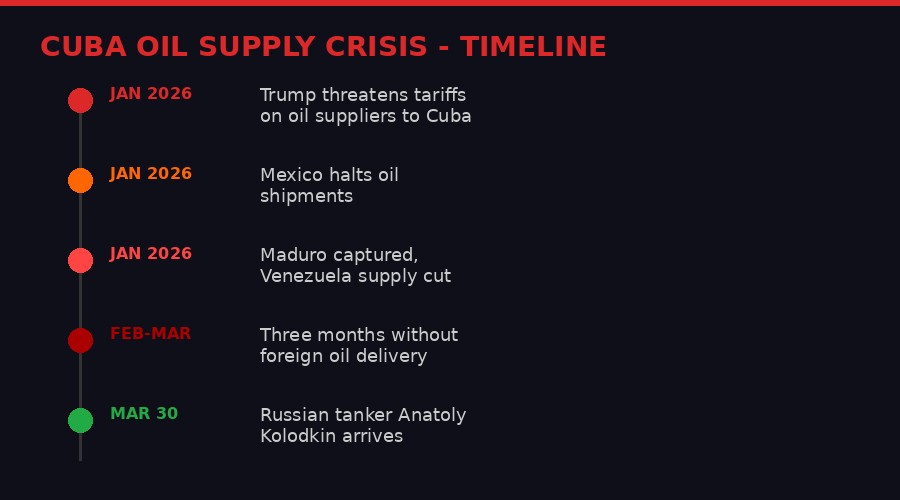
BLACKWIRE infographic: The three-month arc from blockade to Russian arrival.
On Monday morning, the Russian-flagged tanker Anatoly Kolodkin completed its Atlantic crossing and docked at Cuba's port of Matanzas carrying approximately 730,000 barrels of crude oil. It is the first foreign oil delivery to reach the island since January 9, when a Mexican shipment of 85,000 barrels arrived from the port of Pajaritos. Between then and now, Cuba went completely dark - three times.
The vessel is sanctioned by the United States, the European Union, and the United Kingdom for its role in transporting Russian petroleum following Moscow's invasion of Ukraine. None of that mattered on Sunday night when President Donald Trump, speaking to reporters aboard Air Force One, said he had "no problem" with the delivery.
"We have a tanker out there. We don't mind having somebody get a boatload because they need... they have to survive," Trump told reporters, according to the Associated Press. When pressed on whether this constituted a breach of his own blockade, the president was characteristically blunt: "I told them, if a country wants to send some oil into Cuba right now, I have no problem whether it's Russia or not."
The Kremlin framed the delivery differently. Spokesman Dmitry Peskov said Monday that Russia had previously discussed the shipment with the United States and that Moscow "considers it its duty not to stand aside, but to provide the necessary assistance to our Cuban friends," according to Russian state media. Russia's Transport Ministry confirmed the arrival.
The delivery is a lifeline. It is also a geopolitical signal with implications that stretch far beyond the Caribbean.
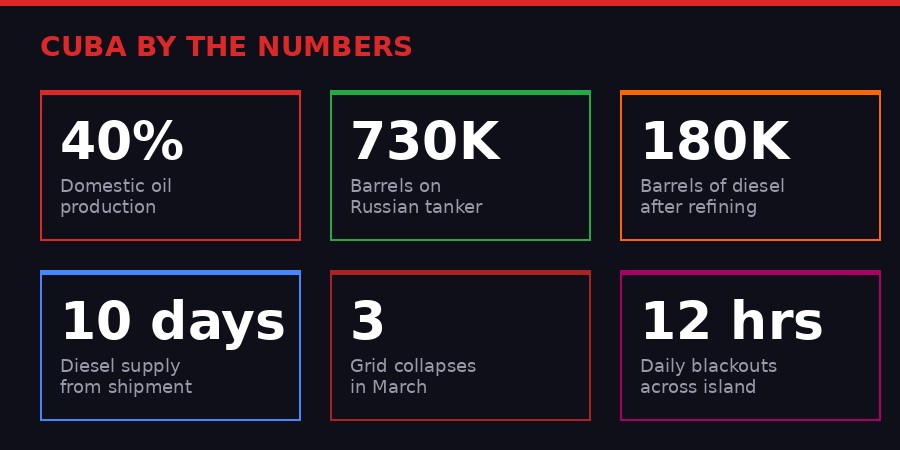
The scale of Cuba's energy emergency in six numbers.
I. Three Months in the Dark
To understand why 730,000 barrels of oil arriving on a sanctioned Russian ship constitutes front-page news, you need to understand what three months without foreign fuel has done to Cuba.
The island nation produces barely 40 percent of its own petroleum needs. The rest has historically come from three sources: Venezuela, Mexico, and Russia. All three pipelines were severed in rapid succession beginning in January 2026.
The first blow came when the Trump administration captured Venezuelan President Nicolas Maduro in a military operation in early January. Venezuela had been Cuba's most reliable energy patron for decades, shipping subsidized crude as part of a broader ideological alliance. That supply vanished overnight when the U.S. installed a transitional government in Caracas.
The second blow followed within weeks. In late January, Trump threatened to impose tariffs on any country that sells or supplies oil to Cuba. Mexico, which had been providing modest shipments, immediately halted deliveries. The threat was not idle - the tariff regime threatened by Washington carried real teeth, and Mexico's government calculated that provoking Trump on Cuba was not worth the economic risk.
The third blow was quieter but no less devastating. Russia's own deliveries, already sporadic due to logistical complexities and the shadow fleet dynamics of its sanctioned tanker network, simply stopped arriving. No Russian oil reached Cuba for the entirety of January, February, or the first twenty-nine days of March.
The result was a cascading systems failure across the entire island.
Cuba's power grid collapsed completely on three separate occasions in March alone. The most recent total blackout hit on Saturday, March 29, when the Nuevitas thermoelectric plant in Camaguey province suffered an unexpected generating unit failure. The Cuban Electric Union reported that a "cascading effect occurred in the machines that were online," plunging all 11 million residents into darkness.
Before that, the grid had collapsed on Monday, March 24, and again earlier in the month. Even when the grid technically remains operational, Cubans face daily blackouts of up to 12 hours in many provinces. The Ministry of Energy and Mines activated "micro-islands" of generating units to keep hospitals, water systems, and critical infrastructure alive during the worst outages.
"Cuba is waiting for Trump and Marco Rubio, because we can't wait any longer. It's too much - there is a lot of repression, there is a lot of hunger. Cuba is in tears." - Matilde Visoso, 64, single mother and homemaker, Havana (AP)
President Miguel Diaz-Canel acknowledged publicly that the island had not received oil from foreign suppliers for three months. The government said it was operating on a skeleton mix of domestic natural gas, limited solar capacity, and what little crude its own aging wells could produce. None of it was enough.
II. The Ship: Anatoly Kolodkin
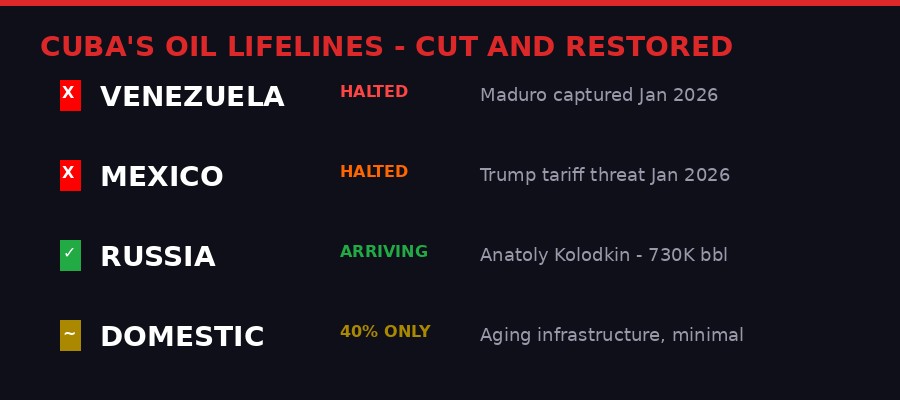
Cuba's four oil sources: three severed, one arriving.
The Anatoly Kolodkin is not a subtle vessel. It is a Russian-flagged tanker that appears on the sanctions lists of three major Western powers for its role in transporting Russian petroleum in violation of restrictions imposed after the 2022 invasion of Ukraine. Its arrival at a Cuban port, in full view of U.S. Southern Command surveillance, is a deliberate act of geopolitical theater.
According to Jorge Pinon, an energy expert at the University of Texas Energy Institute who has tracked the vessel, the tanker crossed approximately 3,000 nautical miles of the Atlantic to reach Matanzas. Pinon told the Associated Press that the 730,000 barrels of crude on board represent a significant but ultimately temporary reprieve.
"We're talking about crude oil that has to be refined into liquid fuels. Each product has its specific demand," Pinon said. His analysis suggests the cargo could produce approximately 180,000 barrels of diesel after refining - enough to cover Cuba's daily diesel consumption for nine to ten days.
Ten days. That is the math of a country on the brink. Ten days of diesel buys time for generators at hospitals. It buys fuel for buses that have been sitting idle. It buys perhaps two weeks of stabilized grid operations before the clock starts running again. It does not buy recovery.
A second vessel adds an additional layer to the picture. The Sea Horse, a Hong Kong-flagged ship reportedly carrying 200,000 barrels of Russian diesel, has been tracked moving through the Atlantic and was estimated to be roughly 958 nautical miles from Matanzas as of late last week. Pinon noted that the ship had lingered for 20 days in the middle of the Atlantic before resuming its westward journey - a pattern consistent with vessels that turn off satellite tracking devices to avoid detection or interception while navigating the sanctions landscape.
If the Sea Horse also reaches Cuba, the combined delivery would be approximately 930,000 barrels of fuel. Still a stopgap. Still not enough to reverse three months of accumulated damage to an energy system that was already deteriorating before the blockade began.
III. Trump's Contradictions
The timing of Trump's acquiescence to the Russian delivery creates a bizarre policy contradiction that the White House has shown no interest in reconciling.
This is the same president who, in late January, threatened any country on Earth with tariffs for selling oil to Cuba. That threat was effective enough to halt Mexican shipments within days. It was credible enough to keep every other potential supplier at bay for three months. The blockade was, by any measure, devastatingly successful at its stated goal of cutting off Cuba's energy supply.
Now the president says he has "no problem" with a sanctioned Russian vessel delivering 730,000 barrels to the very country he blockaded. His explanation, delivered with characteristic dismissiveness, was that "the people need heat and cooling and all of the other things."
"It doesn't help him. He loses one boatload of oil, that's all it is. If he wants to do that, and if other countries want to do it, it doesn't bother me much. It's not going to have an impact. Cuba's finished. They have a bad regime. They have very bad and corrupt leadership and whether or not they get a boat of oil, it's not going to matter." - President Donald Trump, aboard Air Force One, March 30, 2026 (AP)
Read those sentences carefully. The president of the United States has simultaneously maintained that Cuba is "finished," that its government is corrupt and illegitimate, that the blockade will continue, and that one Russian oil shipment won't make a difference. He is both tightening the noose and allowing oxygen through. The logic is not designed to be consistent. It is designed to project omnipotence.
The humanitarian dimension is impossible to ignore. Cuba's health care system, once a point of national pride, has been described by Cuban officials as "teetering" under the combined weight of fuel shortages and U.S. sanctions. Hospitals have canceled surgeries. The University of Havana has reduced its class schedule due to power outages and transportation shutdowns. Food spoilage from refrigeration failures has become endemic.
Secretary of State Marco Rubio, the son of Cuban immigrants, has pushed the hardest line. The State Department has publicly stated that Cuba's blackouts are "a symptom of the Cuban government's failure to provide the most basic needs for its people." Rubio has demanded that Cuba's political system "change dramatically" as a precondition for sanctions relief. The administration has made clear, through officials speaking on condition of anonymity, that it wants President Diaz-Canel removed from power - though no one in Washington has specified who should replace him.
Trump himself has gone further than any American president in recent memory. After a previous grid collapse, he told reporters he believed he'd soon have "the honor of taking Cuba." He has said he can do "whatever he wants" with the island. The phrase "friendly takeover" has been deployed repeatedly, though never defined.
IV. Russia's Play
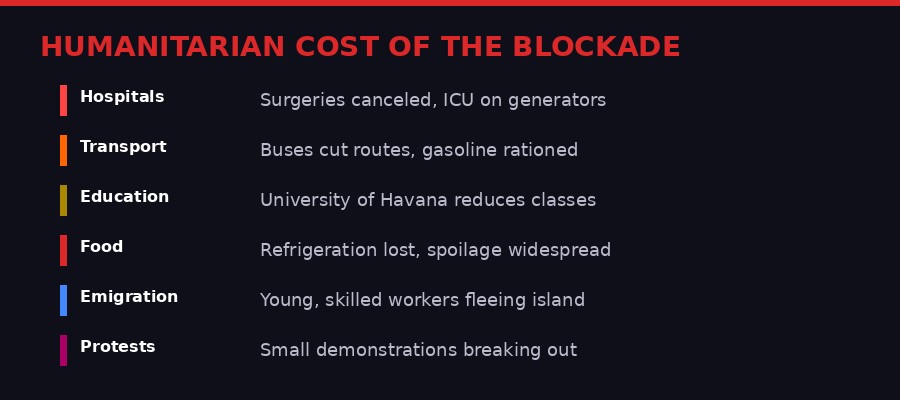
The blockade's toll: six sectors of Cuban life under strain.
Moscow's decision to send the Anatoly Kolodkin to Cuba is not charity. It is a strategic deployment wrapped in humanitarian language.
Cuba has been at the heart of Russian-American proxy competition since 1959. The missile crisis of 1962 nearly ended civilization. The Soviet Union propped up Cuba's economy for three decades. When the USSR collapsed, Cuba entered a devastating "Special Period" of austerity. Russia's re-engagement with Havana under Vladimir Putin has been more transactional than ideological, but the symbolism has never faded.
Kremlin spokesman Peskov's framing - that Russia "considers it its duty" to help "our Cuban friends" - deliberately echoes Cold War solidarity language. The message is aimed not at Havana but at Washington: Russia still has reach in America's backyard.
The timing amplifies the signal. This delivery arrives while the United States is simultaneously fighting a war against Iran that has consumed the attention, resources, and diplomatic capital of the entire national security apparatus. American aircraft carrier groups are in the Persian Gulf. U.S. Marines are arriving in the Middle East for potential ground operations against Iran. Oil prices have hit $115 per barrel, up 60 percent since the U.S.-Israeli strikes on Iran began on February 28.
In this environment, Russia sends an oil tanker to Cuba. The vessel is sanctioned. The cargo is politically explosive. And the United States does nothing. Trump waves it through with a shrug.
The military dimension adds another layer. General Francis Donovan, commander of U.S. Southern Command, testified before the Senate last Thursday that his officers are tracking a Russian destroyer supported by an oil "replenishment ship" scheduled to make a port call in Cuba. Donovan was careful to calibrate expectations: the oiler, even if it unloads, is "unlikely to have any significant impact on Cuba's oil supplies." He confirmed that SOUTHCOM is not currently planning military intervention in Cuba and that its sole focus is protecting the U.S. Embassy and the military base at Guantanamo Bay.
But the symbolism of a Russian warship making a Cuban port call in March 2026 - while America fights a shooting war in the Middle East and faces the longest government shutdown in its history - is not lost on anyone tracking the global balance of power. Russia is testing limits. It is probing the edges of American capacity to enforce its own blockade while simultaneously managing a war, a constitutional crisis at home, and oil prices that are crushing allied economies worldwide.
V. The Humanitarian Abyss
Geopolitics is abstract. What is happening to ordinary Cubans is not.
The island has been experiencing a severe economic crisis since the beginning of this decade, driven by tightened U.S. sanctions, the lasting impact of the COVID-19 pandemic, and an internal financial reform that triggered runaway inflation. Food and medicine shortages have become the baseline reality for most of Cuba's 11 million residents. Emigration has surged, particularly among young people and skilled workers, flowing to the United States, Mexico, and Europe.
The energy blockade dropped a second crisis on top of the first. Daily blackouts of 10 to 12 hours are now standard across much of the island. When the grid fails completely - as it did three times in March - the consequences cascade across every sector of Cuban life.
Hospitals have been forced to cancel surgeries and run intensive care units on generators that themselves depend on scarce diesel. The health care system, which historically served as one of the Cuban government's strongest claims to legitimacy, is visibly degrading. Cuban officials have used the word "teetering" to describe its status.
Transportation has been crippled. Bus routes have been cut. Gasoline is strictly rationed. Workers who depend on public transit to reach their jobs are stranded. Businesses that depend on workers are shuttering. The economic contraction feeds on itself.
The University of Havana, the country's flagship institution of higher education, has reduced its class schedule due to the combined impact of power outages and transportation failures. Students who cannot get to campus cannot study. Professors who cannot keep the lights on cannot teach.
Small protests have broken out across the island - notable in a country where public dissent has historically been met with swift repression. The protests are a measure of desperation. People who risk arrest to demand electricity are people who have reached a breaking point.
International aid efforts have attempted to fill the gap, but the scale of need dwarfs the response. This week, European activists delivered more than four tons of medical supplies. Brazil announced it would send 20,000 tons of food - mainly rice, beans, and powdered milk. A convoy from Mexico, organized by activists including British parliamentarian Jeremy Corbyn and Irish hip-hop trio Kneecap, was set to arrive by flotilla over the weekend carrying 30 tons of humanitarian aid, solar panels, and nonperishable food.
These are gestures of solidarity. They are not solutions. Four tons of medical supplies does not fix a hospital that cannot power its ventilators. Twenty thousand tons of rice does not repair a grid that collapses every ten days. Solar panels shipped from Mexico cannot substitute for the industrial-scale fuel imports that Cuba needs to keep its thermoelectric plants running.
"Really, all of this has people very alarmed and in a bad state. No one knows what is going to happen." - Maria del Carmen Companioni, 51, Havana (AP)
VI. The Broader Chessboard
The Cuba-Russia oil delivery does not exist in isolation. It is one move on a board that now spans the Caribbean, the Persian Gulf, Eastern Europe, and the Pacific.
Consider the parallel crises unfolding simultaneously on March 30, 2026. In the Middle East, the U.S.-Israeli war against Iran has entered its fifth week. Trump told the Financial Times on Monday that he is considering seizing Iran's Kharg Island, the critical oil terminal through which 90 percent of Iranian crude exports flow. At the same time, Iran launched attacks on Kuwait's power and desalination infrastructure, killed an Indian worker, and struck targets in Saudi Arabia, Bahrain, and Israel. Oil at $115 per barrel is feeding into inflation that is punishing consumers across the developed world.
In Washington, the partial government shutdown - triggered by a fight over DHS funding and immigration enforcement - has reached its 44th day, surpassing the previous record set in November 2025. TSA agents are quitting. Airport security lines stretch for hours. Congress left for a two-week recess without a deal. Trump signed an executive order to pay TSA workers, but its legality is uncertain, and Georgetown University law professor Josh Chafetz told the BBC it appears to violate the Antideficiency Act, which prohibits spending money that Congress has not appropriated.
In the streets of American cities, the third "No Kings" protest drew an estimated eight million demonstrators - the largest protest in American history - expressing opposition to the administration's handling of multiple simultaneous crises.
Against this backdrop, Russia sends a sanctioned tanker to Cuba. It is a low-cost, high-visibility move that exploits American distraction. It tests whether the blockade that Washington built against Havana can survive when Washington is simultaneously blockading Iranian oil, fighting a shooting war, managing a domestic constitutional standoff, and facing its worst airport crisis since September 2001.
The answer, at least today, is that it cannot. The blockade has cracked. Whether it cracks further depends on decisions that have not yet been made in Moscow, Beijing, and a dozen other capitals watching the Anatoly Kolodkin's GPS track with intense interest.
VII. What 730,000 Barrels Actually Buys
Energy analysts describe the Russian delivery in starkly pragmatic terms. Jorge Pinon's assessment - that the crude could yield roughly 180,000 barrels of diesel after refining, enough for about 10 days of national demand - is the consensus view among Caribbean energy experts tracked by BLACKWIRE.
Cuba consumes approximately 20,000 barrels of diesel per day across its economy. Diesel powers the generators that keep hospitals running during blackouts. It fuels the buses that constitute the backbone of urban public transportation. It runs the agricultural equipment that produces food for 11 million people. It keeps water pumping stations operational in a country where municipal water systems depend on electric and diesel-powered pumps.
The crude oil itself, before refining, serves different functions. Cuba's thermoelectric plants can burn heavy crude to generate electricity, but the island's refining capacity is limited and aging. The Antonio Guiteras plant in Matanzas province, Cuba's largest, has been plagued by breakdowns. Other facilities scattered across the island operate far below their theoretical capacity.
If the Sea Horse also reaches Matanzas with its reported 200,000 barrels of diesel - already refined and ready for distribution - the combined impact could extend the breathing room to perhaps three weeks. Three weeks is enough time for the government to stabilize grid operations, resume full hospital services, restore some bus routes, and begin addressing the most acute food distribution failures.
It is not enough time to rebuild an energy system that has been decaying for decades. It is not enough to reverse the emigration wave. It is not enough to quell the simmering public anger that has produced street protests. And it is emphatically not enough to change the fundamental power dynamic between Washington and Havana.
What it buys is time. Time for diplomatic channels that Cuban President Diaz-Canel confirmed are active between Havana and Washington. Time for the Cuban military to plan for contingencies that include continued blockade, partial relaxation, or - in the worst case scenario that Trump's rhetoric has not excluded - direct American intervention.
The Key Numbers
- 730,000 barrels - Crude oil on the Anatoly Kolodkin
- 200,000 barrels - Diesel reportedly on the Sea Horse (unconfirmed arrival)
- 180,000 barrels - Estimated diesel yield after refining the Kolodkin cargo
- 20,000 barrels/day - Cuba's daily diesel consumption
- 9-10 days - Supply duration from the Kolodkin delivery alone
- 40% - Share of oil Cuba produces domestically
- 3 - Total grid collapses in March 2026
- 12 hours - Average daily blackout duration across much of the island
- 90 days - Duration of Cuba's oil dry spell before this delivery
- 11 million - People affected by the energy crisis
VIII. Cuba as Cold War Redux
The parallels to history are not subtle, and the participants are not trying to hide them.
In October 1962, the discovery of Soviet nuclear missiles in Cuba brought the world closer to nuclear annihilation than at any point before or since. The crisis was resolved through a combination of brinkmanship, back-channel diplomacy, and a mutual recognition that the stakes were too high for miscalculation. Cuba remained in the Soviet orbit for another three decades.
In 2026, the dynamics are different but the geography is identical. Cuba sits 90 miles from Florida. It hosts a U.S. military base at Guantanamo Bay that Washington has maintained since 1903, through colonial governance, revolution, Cold War, and every iteration of Cuban-American relations since. The base remains operational. General Donovan's SOUTHCOM focuses its Cuba planning on protecting that installation and the U.S. Embassy.
Russia's re-engagement with Cuba under Putin has been methodical. Naval visits to Cuban ports resumed years ago. Intelligence cooperation between Moscow and Havana has continued, according to U.S. officials. Economic ties, while modest compared to the Soviet era, provide Moscow with a Caribbean foothold that no amount of American sanctions has dislodged.
The Anatoly Kolodkin's arrival is a reminder that this foothold remains active. When Cuba needed fuel to keep its people alive, Russia delivered - on a sanctioned vessel, through an American blockade, with the tacit permission of the American president. That sequence of facts will be studied in Moscow, Beijing, Tehran, and every other capital currently assessing the durability of American power projection.
Trump's dismissal of the delivery's significance - "it's not going to have an impact" and "Cuba's finished" - may prove accurate in the narrow sense that one oil shipment does not save a failing state. But the strategic message is the opposite: Russia demonstrated that it can supply an American adversary 90 miles from Florida while America is occupied elsewhere. The blockade, however punishing its effects on Cuban civilians, is porous when Moscow decides to test it.
IX. What Comes Next
Several trajectories remain open, and they are not mutually exclusive.
The diplomatic track is the most promising and the least visible. Diaz-Canel has confirmed talks with Washington. Pakistan has offered to host U.S.-Iran negotiations. If the Iran war reaches some form of ceasefire or diplomatic off-ramp in the coming weeks, the administration may have bandwidth to intensify its Cuba pressure campaign - or, alternatively, to cut a deal that eases sanctions in exchange for political concessions.
The humanitarian track is the most urgent. Even with the Russian delivery, Cuba's energy system remains structurally fragile. The next grid collapse could come at any time. Each one erodes the government's capacity to maintain basic services and, consequently, its legitimacy in the eyes of a population that is increasingly willing to voice its dissatisfaction in the streets.
The military track is the most dangerous. Trump has not ruled out intervention. He has spoken openly about "taking" Cuba. General Donovan's testimony confirmed that SOUTHCOM is not currently planning offensive operations, but also confirmed that the command could respond to migration or humanitarian crises. In bureaucratic language, "respond to" a crisis often means creating the conditions for intervention under a humanitarian banner.
The Russia track is the wildcard. If Moscow calculates that supporting Cuba is a low-cost way to distract and embarrass Washington, more shipments will follow. The question is whether Putin sees Cuba as worth the diplomatic capital, or whether the Anatoly Kolodkin was a one-time signal designed to remind Washington that Russia has options.
For ordinary Cubans, these geopolitical calculations are academic. What matters is whether the lights stay on. Whether the hospitals can operate. Whether there is fuel for the bus that takes them to work. Whether the food in the refrigerator survives until morning.
On Monday morning in Matanzas, the Anatoly Kolodkin sat at the dock, offloading 730,000 barrels of crude into a country that has been running on fumes. It is not enough. It is something. And in Cuba in March 2026, something is all there is.
X. Timeline: Cuba's Energy Crisis and the Blockade
Key Dates
- January 2026 - U.S. military operation captures Venezuelan President Maduro; Venezuelan oil shipments to Cuba halt immediately
- Late January 2026 - Trump threatens tariffs on any country selling or supplying oil to Cuba
- Late January 2026 - Mexico halts oil shipments to Cuba in response to tariff threat
- January 9, 2026 - Last confirmed oil delivery to Cuba: 85,000 barrels from Mexico via Ocean Mariner
- February 2026 - Cuba reports zero foreign oil deliveries for entire month; blackouts intensify
- February 14, 2026 - U.S. government partial shutdown begins over DHS funding dispute
- February 28, 2026 - U.S. and Israel launch strikes on Iran; global oil markets spike
- Early March 2026 - First total grid collapse of March; 12-hour daily blackouts standard
- March 17-18, 2026 - Trump says he could have "the honor of taking Cuba" after grid collapse
- March 24, 2026 - Second total grid collapse in March
- March 26, 2026 - Gen. Donovan testifies SOUTHCOM tracking Russian destroyer and oiler headed to Cuba
- March 29, 2026 - Third total grid collapse in March; power collapses after Nuevitas plant failure
- March 30, 2026 - Anatoly Kolodkin arrives at Matanzas with 730,000 barrels of Russian crude
- March 30, 2026 - Trump says he has "no problem" with the Russian delivery
- March 30, 2026 - Kremlin confirms delivery, calls it "humanitarian duty"
The lights in Matanzas are on tonight. They may not be next week. The tanker has arrived, but the blockade has not been lifted. Russia has made its move. Washington is watching from multiple war fronts. And 11 million Cubans are living day to day, barrel to barrel, in a crisis that no single shipment can resolve.
Get BLACKWIRE reports first.
Breaking news, investigations, and analysis - straight to your phone.
Join @blackwirenews on Telegram