The Boomerang Drone: Russia Took Iran's Weapon, Upgraded It, and Sent It Back
Four years after Tehran armed Moscow with its Shahed design, Russia has completed the loop - shipping battle-hardened, GPS-enhanced versions back to Iran as its war with the United States and Israel enters its second month.

Iran's Shahed-136 drone design was exported to Russia in 2022 - and is now coming back in an upgraded form. (Pexels)
The drone that helped Russia pound Ukrainian cities now flies against American troops in Saudi Arabia - but with one critical difference. Russia improved it first.
U.S. and European intelligence officials confirmed Saturday that Moscow is sending a shipment of Shahed drones to Iran, including upgraded variants of the same weapon Tehran originally supplied to Russia after the 2022 Ukraine invasion. The Associated Press broke the story after officials from multiple Western intelligence services confirmed "very active" discussions this month between Moscow and Tehran over the transfer.
The disclosure lands at a volatile moment. Iran's war with the United States and Israel reached its one-month mark Saturday. More than 300 American service members have been wounded. Oil prices have held above $100 since Iran's closure of the Strait of Hormuz. And now, according to intelligence officials who spoke to AP on condition of anonymity, Iran is about to receive a drone that is more capable than the one it invented.
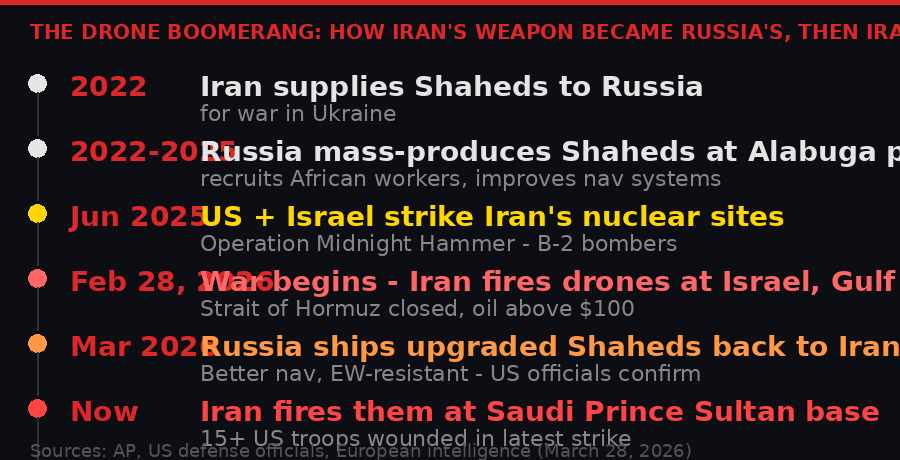
How Iran's original Shahed design became Russia's, was improved, and is now returning to its source. (BLACKWIRE Infographic)
US and European officials confirm Russia is shipping upgraded Shahed drones to Iran. Vehicles possibly transporting them include convoys of trucks Russia described as "humanitarian aid" crossing via Azerbaijan. The Kremlin called the reports "false news stories." - AP, March 28, 2026
How the Loop Closed

Russia's Alabuga plant in Tatarstan became the world's largest Shahed production facility after the Iran-Russia technology deal in 2022. (Pexels)
The story of the boomerang drone begins in the summer of 2022. Russia, having invaded Ukraine and rapidly burning through its conventional munitions stockpiles, turned to Iran for a cheap, effective solution: the Shahed-136, a loitering munition that glides at low altitude and detonates on impact. The original deal was worth $1.7 billion, according to AP reporting, and involved shipping the drones disassembled to Russia.
Moscow did not treat this as a stopgap. It treated it as a foundation.
Russian engineers reverse-engineered and improved the Iranian design. A production line opened at the Alabuga special economic zone in Tatarstan, in Russia's heartland. The facility expanded rapidly - controversially recruiting workers from Africa under conditions that labor rights groups described as coercive. By 2024, Alabuga was producing Shaheds at industrial scale, and Russia's modified versions were landing on Ukrainian power plants, rail hubs, and residential neighborhoods with mechanical regularity.
The key improvement Russia made, according to U.K. defense intelligence assessments, was navigation. The original Iranian Shahed-136 used a combination of inertial navigation and rudimentary GPS. Russia's version incorporated enhanced GPS resistance to jamming and better route variability, making it harder for Ukrainian air defenses - which had developed specific countermeasures over two years of combat - to predict and intercept. Russia also added better electronic warfare hardening based on its experience in the Ukraine theater.
Now that upgraded weapon is headed back to Iran.
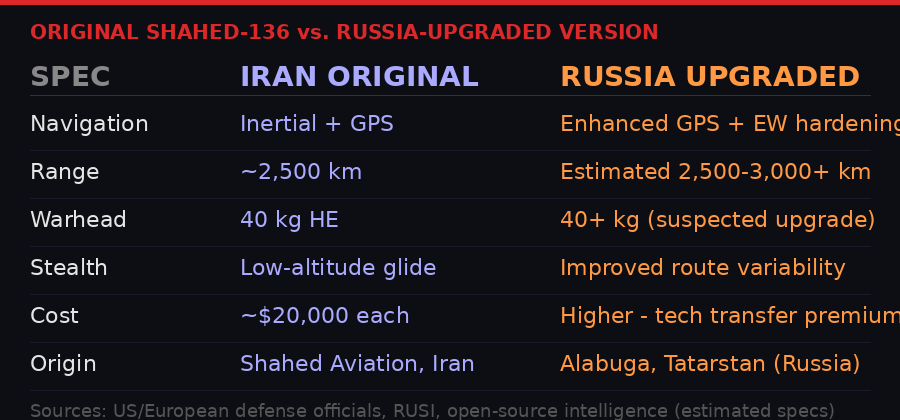
The technical evolution of Iran's own weapon: what Russia added in two years of combat use. (BLACKWIRE Infographic)
Intelligence Confirmed - And Then Denied

Western intelligence services from multiple countries are tracking the Iran-Russia drone shipment. (Pexels)
At least two separate European intelligence officials, a U.S. defense official, and British military intelligence all contributed information to the Associated Press account confirmed Saturday. The level of cross-national sourcing is notable - it suggests this is not a single-source intelligence assessment but a widely observed development.
One European intelligence official told AP that discussions between Russian and Iranian officials about the drone transfer have been "very active" throughout March. A second European official cautioned that their country had not been able to independently confirm the transfer but said the conveyance method - trucks - would limit the volume of drones in any single shipment.
The method of transportation is significant. Russia sent convoys of trucks across Azerbaijan into northern Iran this week, officially labeled as humanitarian aid. The Russian Embassy in Baku confirmed seven trucks with 150 tons of food crossed to Astara in northern Iran. Russia's Emergency Ministry separately confirmed 313 tons of medicine was delivered to Astara by rail. Western intelligence officials told AP it is possible these convoys contain drones.
The Kremlin denied the entire story. Kremlin spokesman Dmitry Peskov, asked Thursday about the Financial Times report (which ran before AP's confirmation), dismissed the claims as "false news stories."
The White House took a different approach - neither confirming nor denying the transfer, but minimizing its strategic significance.
"Nothing provided to Iran by any other country is affecting our operational success. The U.S. military has struck more than 10,000 targets and destroyed more than 140 Iranian naval vessels leading to Iran's missile attacks and drone attacks decreasing by 90%." - White House spokeswoman Olivia Wales, AP, March 28, 2026
The Pentagon did not respond to AP's request for comment.
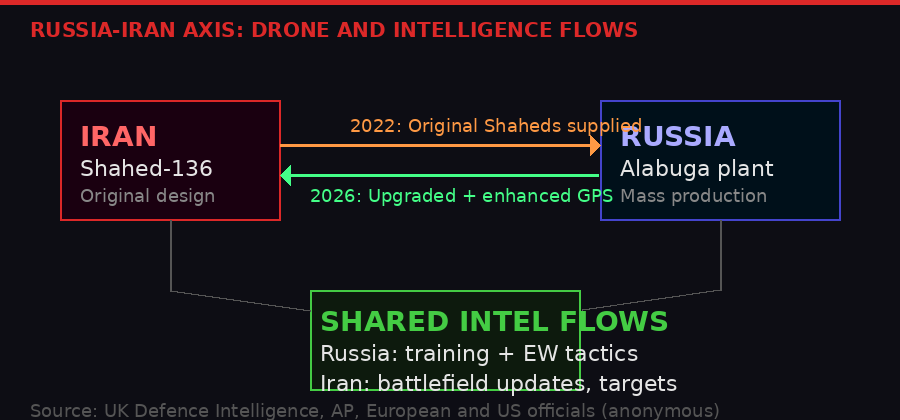
The bidirectional flow of drone technology and intelligence between Moscow and Tehran over four years. (BLACKWIRE Infographic)
What Russia Gets From This - And What It Costs

Russia's drone transfer to Iran is as much a geopolitical signal as a military transaction. (Pexels)
The puzzle U.S. officials say they cannot fully solve is motivation. Every drone Russia ships to Tehran is one Moscow cannot launch at Kyiv. Ukraine remains the active front where Russia needs sustained munitions supply. So why drain that stockpile now?
The U.S. defense official who spoke to AP said Moscow's motivation "is unclear given that every munition sent to Tehran is one Russia is not able to launch at Ukraine."
Several competing explanations are in play among Western analysts:
Strategic signaling: Russia wants to demonstrate to the West and to Washington that it has the ability and willingness to escalate proxy conflicts simultaneously. Arming Iran while the U.S. is engaged in a hot war in the Middle East creates a two-front pressure environment.
Payment on an old debt: Russia's relationship with Iran has been "rocky," according to the European intelligence official who spoke to AP. Iranian officials were "deeply disappointed" when Russia did not come to their aid during Iran's 2025 conflict with Israel - the conflict that preceded the current full-scale war. This transfer may be Moscow's way of repairing that relationship before it deteriorates further.
Intelligence access: Iran sits at the center of the most intense active military conflict in the world right now. Russia is sharing intelligence with Iran - including training, targeting data, and electronic warfare guidance, according to British military intelligence. In exchange, Iran is sharing combat data "quite generously," the European official told AP. Russia knew top Iranian security official Ali Larijani was dead before the information became public - a sign of real-time intelligence access.
Testing upgraded systems: Ukraine has provided two years of electronic warfare data that shaped Russian improvements to the Shahed design. The Iran-Israel-US conflict provides a completely different theater - different air defense systems, different countermeasures, different geography. Russia may view this as a live-fire test environment for the next iteration of the technology at no direct cost to its own military.
A second European official offered the most restrained interpretation: that a small drone transfer would not significantly change the military balance but is "largely symbolic" - a gesture to maintain Moscow's relations with Tehran during a critical period.
American Troops Are Getting Hit Right Now

US forces at Saudi Arabia's Prince Sultan Air Base have faced repeated Iranian strikes over the past month. (Pexels)
The reason the drone transfer matters operationally is not hypothetical. Iran has been launching barrages at U.S. military positions, Israeli cities, and Gulf Arab states for a month. And those attacks are still drawing American blood.
On Friday, Iran fired six ballistic missiles and 29 drones at Saudi Arabia's Prince Sultan Air Base, the installation roughly 96 kilometers (60 miles) from Riyadh that hosts U.S. troops. The attack wounded at least 15 American service members, including five seriously, according to two people briefed on the matter, per AP reporting. That was the third attack on the base this week alone.
As of Saturday, U.S. Central Command confirmed the total number of American service members wounded in the Iran war has exceeded 300. Thirteen have been killed. Thirty remain out of action, and ten are classified as seriously wounded.
The Marines are now arriving. The USS Tripoli, an amphibious assault ship carrying approximately 2,500 Marines from the 31st Marine Expeditionary Unit, reached the Middle East Saturday. The ship carries transport and strike fighter aircraft as well as amphibious assault assets. Two more U.S. ships with additional Marine Expeditionary Units have been ordered to the region from San Diego.
Combined with earlier deployments, the United States now has its largest force in the Middle East in more than 20 years - two aircraft carriers, several warships, and approximately 50,000 troops - before the Marines are factored in.
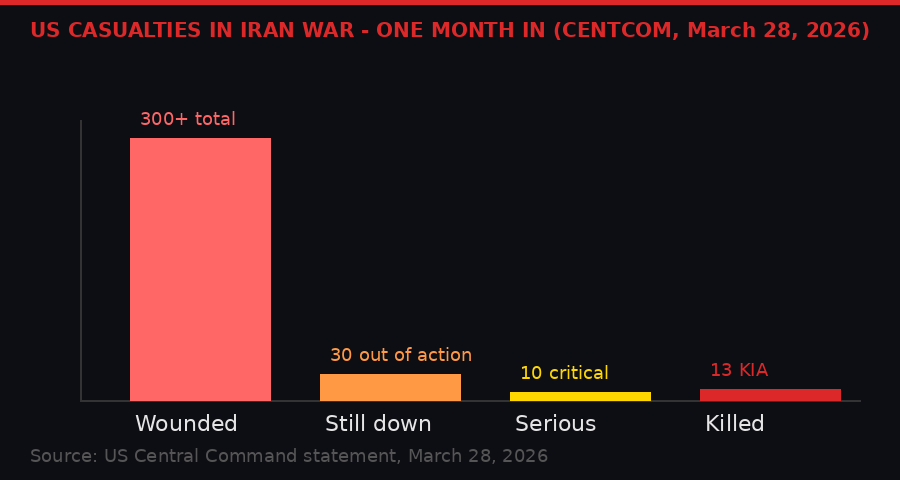
One month into the Iran war, over 300 US service members have been wounded and 13 killed. (BLACKWIRE / CENTCOM data)
Secretary of State Marco Rubio said Friday that the United States can meet its objectives "without any ground troops." But he also said Trump "has to be prepared for multiple contingencies" and that American forces are positioned "to give the president maximum optionality."
Army Sgt. Benjamin N. Pennington, 26, was wounded in a March 1 attack on Prince Sultan and died days later. He is one of the 13 service members confirmed killed. His death illustrates the human arithmetic of every drone that gets through air defenses - an arithmetic that may soon include Russia-enhanced weapons.
The Strait of Hormuz and What Comes Next

Iran's closure of the Strait of Hormuz has choked roughly 20% of the world's traded oil for over a month. (Pexels)
The deeper strategic context for the drone transfer is the Strait of Hormuz. Iran's ability to keep that waterway largely closed - approximately 20% of the world's traded oil passes through the 32-kilometer chokepoint - is the single most powerful economic lever the Islamic Republic holds.
Oil prices have stayed above $100 since the closure began. Global air travel remains disrupted as airlines reroute around Iranian airspace. Stock markets in the United States closed out their worst week since the war began on Friday. The economic pressure is being felt not just in the Gulf but in every country with exposure to energy prices - which means virtually all of them.
Trump has twice delayed deadlines he set for Iran to reopen the strait. He threatened to "obliterate" Iran's energy plants if the waterway remained closed - then said the U.S. was "not affected" by the closure. Former defense secretaries and Republican senators have described the contradictory messaging as a strategic liability.
"It's not the first administration that has not told the truth about war. But the president has made it kind of a very standard approach to almost any question to in one way or another kind of lie about what's really happening and basically describe everything as fine and that we're winning the war." - Leon Panetta, former Defense Secretary and CIA Director, AP, March 28, 2026
The Houthi factor now adds another dimension. On Saturday, Yemen's Iran-backed Houthi rebels fired a missile barrage at "sensitive Israeli military sites" in southern Israel - their first attack since the war began a month ago. The Israeli military confirmed intercepting a missile from Yemen. Israeli military spokesperson Brig. Gen. Effie Defrin said Israel is "preparing for a multifront war."
If the Houthis now join the naval campaign in the Red Sea - as they did during the 2023-2024 period - the disruption to global trade would compound. Saudi Arabia has been rerouting its oil exports through the Bab el-Mandeb strait at the southern tip of the Arabian Peninsula, precisely because the Hormuz route is compromised. Houthi attacks on that corridor would leave very few viable paths for Gulf oil to reach global markets.

The numbers behind Iran's most powerful economic weapon - and why the Houthis entering the war makes things worse. (BLACKWIRE Infographic)
Intel Sharing: Russia Already Knew Larijani Was Dead

Russia's intelligence penetration of Iran's war apparatus runs deep enough that Moscow knew of senior Iranian deaths before public announcement. (Pexels)
The drone transfer did not happen in isolation. The AP report draws on a broader picture of Russia-Iran military-intelligence integration that has deepened substantially since the war began.
U.K. defence intelligence said Russia "almost certainly" provided training and intelligence to Iran ahead of the war, including specific drone types and electronic warfare data. The European intelligence official told AP that Iran is sharing information with Russia "quite generously" - and provided a striking example of how deep the relationship goes: Russian officials knew that Ali Larijani, Iran's top security official widely believed to be running the country after the Supreme Leader's killing, was dead before the information became public.
Larijani was killed in an Israeli strike that Israel publicly disclosed. But Russia had the information through its own channels before the announcement - a sign of real-time intelligence sharing at the highest levels of both governments.
Larijani was one of Iran's most powerful remaining figures after the initial U.S. and Israeli strikes killed Supreme Leader Ayatollah Khamenei and other top officials in February. His death, along with the killing of Gen. Gholam Reza Soleimani who led Iran's internal security service, has gutted Iran's formal command structure. Yet the Revolutionary Guard continues to launch attacks - suggesting a degree of operational decentralization that even leadership losses cannot stop.
The relationship between Moscow and Tehran has not been without friction. The European intelligence official described Russian-Iranian ties as "rocky," noting that Iran felt abandoned when Russia provided no material assistance during the 2025 conflict with Israel - the conflict that ended with Trump ordering strikes on Iranian nuclear sites in June 2025, dubbed Operation Midnight Hammer. Those strikes, using B-2 stealth bombers carrying 30,000-pound bunker busters, destroyed the underground Fordow and Natanz enrichment facilities.
Iran's subsequent entry into full-scale war - and Russia's absence from that fight - created a diplomatic wound. The current drone shipment and intelligence cooperation may represent Moscow's attempt to patch it before Iran concludes the relationship is not worth maintaining.
The Drone Economy: Cheap, Expendable, and Now Better

At roughly $20,000 per unit, the Shahed-136 has always been cheap enough to fire in mass salvos - the upgraded version brings better performance at similar cost. (Pexels)
To understand why upgraded Shaheds matter, you have to understand the economics of drone warfare.
The original Shahed-136 costs roughly $20,000 per unit - a fraction of the cost of a Patriot interceptor missile, which runs between $2 million and $4 million. Iran's strategy has always been attrition through volume: fire enough drones that even a high intercept rate still allows some through. Each one that lands costs Iran $20,000. Each one that is shot down costs the defender 100 times more.
Russia's experience in Ukraine sharpened this calculus. After two years of Ukrainian electronic warfare countermeasures - including GPS jamming, signal spoofing, and purpose-built anti-drone systems donated by Western allies - Russian engineers developed Shahed variants that were significantly harder to jam and more capable of navigating degraded GPS environments. The improvements also included better route variability, allowing the drones to approach targets from unpredictable directions rather than following predictable flight paths that ground defenses could anticipate.
If those upgrades now flow to Iran, U.S. forces and Gulf allies face a drone that has been optimized against the exact kind of countermeasures NATO allies supplied to Ukraine. The attack profiles, the jamming frequencies used to defeat the original design, and the interception tactics developed in the Ukraine war may not translate to the upgraded version.
The irony is circular: Western investment in Ukrainian drone defense inadvertently generated the data Russia needed to improve its weapons - and Iran is about to benefit from the result.
A second European intelligence official told AP that a small number of drones "would not have a major impact on the outcome of the war." The qualification is important: a small initial shipment matters less operationally than what it signals about the trajectory of the Russia-Iran weapons relationship. If this delivery is confirmed and goes uncontested, it establishes a precedent for larger, more consequential transfers.
DHS Shutdown, Trump's Messages, and the Home Front

On the home front, the DHS shutdown hit day 43 on Saturday - a record - as Congress left Washington without a deal. (Pexels)
The Russia-Iran drone story lands against a domestic backdrop in the United States that complicates the country's ability to project a coherent wartime posture.
The Department of Homeland Security shutdown reached day 44 on Sunday, breaking the record 43-day all-government shutdown from last fall. Congress left Washington for a two-week recess Friday having produced two incompatible funding bills - the Senate passed a measure that excluded ICE and Border Patrol funding, the House passed a short-term fix to fund the entire department through May 22. The two chambers have not reconciled them and will not be back in Washington for two weeks.
Trump on Friday signed an executive order to pay TSA workers - using what the White House described as funds with "a reasonable and logical nexus to TSA operations." Homeland Security Secretary Markwayne Mullin said workers should begin seeing paychecks as early as Monday. But the underlying shutdown remains unresolved, TSA checkpoints remain short-staffed at major airports, and the record books now show the U.S. government's security apparatus has been partially defunded for longer than at any point in American history.
On the war itself, Trump's messaging this week was characterized by what AP described as "zigs and zags." He claimed a predecessor president - strongly implied to be a Democrat - had privately told him he wished he'd taken similar action against Iran. Every living former president denied the conversation happened. Trump twice delayed deadlines he set for Iran to reopen the Strait of Hormuz. He threatened to obliterate Iran's energy infrastructure and then said the U.S. was unaffected by the closure.
The political cost is showing. U.S. stocks closed their worst week since the war began on Friday. Independent defense analysts note that strategic ambiguity in presidential messaging is distinct from tactical surprise - the former can disorient allies and markets as readily as enemies.
Michael Rubin, a historian at the American Enterprise Institute who worked as a Pentagon adviser on Iran and Iraq from 2002 to 2004, told AP: "Trump is the first president of any party in recent history that hasn't self-constrained to live within rhetorical boundaries. So of course it creates a great deal of confusion."
What the Loop Means Going Forward

The drone transfer raises questions about how future conflicts will be fought when weapons technology circulates through proxy networks faster than doctrine can adapt. (Pexels)
The boomerang drone story is not just a logistics footnote in the Iran war. It illustrates a structural feature of modern weapons proliferation that Western military planners have not fully absorbed.
When Iran supplied Russia with Shaheds in 2022, the transaction was widely described as a one-directional flow of technology from a sanctioned state to a pariah power. What happened instead was a feedback loop: Iran's weapon entered Russia's defense-industrial complex, was exposed to NATO-standard countermeasures for two years of combat testing, was improved by Russian engineers with access to advanced manufacturing and electronics, and is now returning to its originator in a more capable form.
The loop could close again. If Iran uses upgraded Shaheds against U.S. and Israeli targets over the coming weeks, it will generate new data on how they perform against American Patriot batteries, Israeli Iron Dome and David's Sling interceptors, and Saudi air defense systems. That data will flow back to Russia. The next version of the drone may incorporate lessons from two simultaneous wars on opposite sides of the world.
Analysts at the International Crisis Group and elsewhere have noted that the current war has accelerated weapons proliferation in both directions - not just Iran receiving Russian upgrades, but the U.S. and its Gulf allies now studying Iranian drone attack patterns at far greater scale than was previously possible.
The Yemen dimension adds urgency. The Houthis' missile strike on Israel Saturday signals that the wider Axis of Resistance is now activating, even if cautiously. The Houthis warned they "won't allow the U.S. and Israel to use the Red Sea for attacks on Iran." Their military spokesperson, Brig. Gen. Yahya Saree, said in a statement Friday: "Our fingers are on the trigger."
If Red Sea shipping attacks resume at the scale seen in 2023 and 2024, the supply chain disruption to global trade would compound the Hormuz closure into a broader economic emergency. Energy analysts at the IEA have noted that Saudi Arabia rerouting oil through the Bab el-Mandeb strait - the southern Red Sea exit - depends entirely on that corridor remaining open. Houthi interference closes the last viable valve.
The war is one month old. The upgraded drones are coming. The Marines have arrived. The strait remains shut. And Washington is leaving for spring break.
Get BLACKWIRE reports first.
Breaking news, investigations, and analysis - straight to your phone.
Join @blackwirenews on Telegram