All Four DNA Bases Found on Asteroid Ryugu - What Space Chemistry Tells Us About Life's Origins
A new analysis of Ryugu samples confirms the complete set of five nucleobases that encode all life on Earth. The discovery closes a years-long mystery and sharpens a disturbing implication: the raw material of genetics may be among the most common chemicals in the Solar System.

Asteroid rock in space. Credit: Pexels
The letters that encode every living thing on Earth - A, T, C, G, and U - have now been found on an asteroid that has never touched our planet. Researchers confirmed this week that samples from Ryugu, a carbon-rich near-Earth asteroid visited by Japan's Hayabusa2 spacecraft, contain all five of the nucleobases that make up DNA and RNA. Every single one.
The headline sounds familiar because it basically is. Similar findings have come from the Murchison meteorite, from asteroid Bennu, and from a succession of other carbonaceous rocks analyzed over the past 15 years. What makes the new Ryugu result significant is not that we found these compounds in space - we knew they were out there. What makes it significant is where they came from, how they got there, and what a growing convergence of data is telling us about chemistry at cosmic scales.
The implications are not simple to articulate without sliding into overstatement. Nobody is saying life is common in the universe because we found adenine on an asteroid. But nobody credible is saying it is rare anymore either.
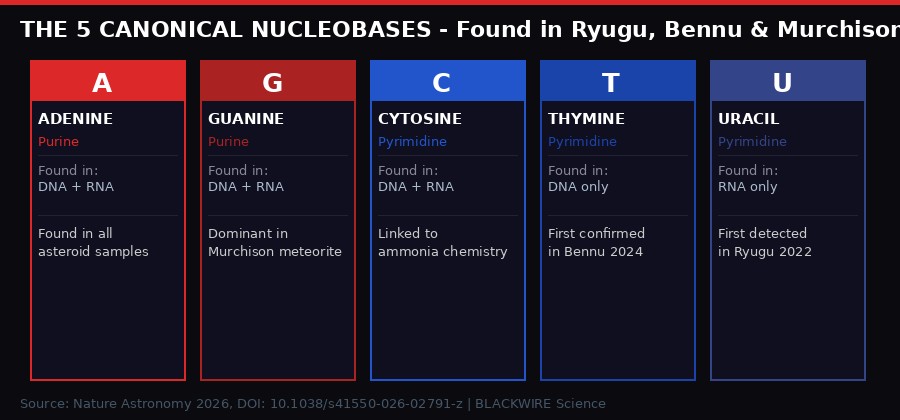
The five canonical nucleobases: adenine, guanine, cytosine, thymine, and uracil. All five have now been confirmed in the Ryugu asteroid samples. Credit: BLACKWIRE Science
What Ryugu Actually Is - and Why It Matters

The cosmos contains far more organic chemistry than scientists once assumed. Credit: Pexels
Ryugu is a C-type asteroid - the "C" stands for carbonaceous. It is roughly 900 meters in diameter and sits in an orbit that crosses Earth's path around the Sun, making it technically an Apollo-class near-Earth object. It is not particularly glamorous as space rocks go: no rings, no moons, nothing exotic about its orbit. What it has is chemistry.
C-type asteroids are relics. They represent some of the oldest material in the Solar System, dating back 4.5 billion years to the era before the planets formed. They have not been heavily processed by heat or pressure. They are, in a sense, time capsules - small frozen libraries of the chemical environment that existed when the Sun was young and the planets were still accreting from dust and gas.
Japan's Hayabusa2 spacecraft visited Ryugu in 2018 and 2019, making two touchdowns on its surface to collect material. In December 2020, the sample capsule re-entered Earth's atmosphere and was recovered in the Australian outback. Researchers at JAXA and partner institutions received approximately 5.4 grams of pristine asteroid material - tiny by everyday standards, but enormously valuable scientifically because it had never been exposed to Earth's atmosphere or biosphere.
That last point is critical. Earlier nucleobase discoveries in meteorites were always shadowed by a contamination problem. Meteorites fall through the atmosphere and land on the surface. They sit there, sometimes for thousands of years, before anyone finds them. Every day they spend on Earth, they absorb trace amounts of biological molecules from soil, water, and air. When scientists later analyze those samples and find DNA bases, the question is always the same: did those molecules arrive from space, or were they picked up here? The Hayabusa2 mission was specifically designed to remove that ambiguity. The samples went directly from asteroid to sealed container to laboratory without touching Earth's environment.
"Pristine asteroid samples - those not exposed to Earth's atmosphere - hold high scientific value, as exemplified by the samples collected by the Hayabusa2 mission from the C-type asteroid (162173) Ryugu." - Nature Astronomy, 2026 paper on Ryugu nucleobase detection
So when initial analyses of the Hayabusa2 samples in 2022 turned up uracil - one of the five nucleobases, found in RNA - that result carried weight that meteorite studies simply cannot match. But the puzzle was that uracil was the only base detected. Every other carbonaceous asteroid sample had shown multiple bases. Why was Ryugu apparently so depleted?
The Mystery of the Missing Bases - and How It Was Solved

Nucleobases are the letters of the genetic code - the information-carrying units of DNA and RNA. Credit: Pexels
The initial failure to detect all five nucleobases in Ryugu was not necessarily evidence of their absence. It was potentially evidence of a detection problem.
Analytical chemistry at the parts-per-billion scale is brutally unforgiving. When you have only micrograms of sample to work with, the sensitivity of your instruments and the efficiency of your extraction protocols determine what you find. The 2022 Ryugu study worked with limited starting material and standard analytical thresholds. Uracil was above those thresholds. The other four bases were apparently not - or barely so.
The new 2026 study, published in Nature Astronomy with DOI 10.1038/s41550-026-02791-z, used two approaches to solve this: more sample material and more sensitive detection methods. The team analyzed samples designated A0480 and C0370 - collected from Ryugu's first and second touchdown sites respectively - using optimized liquid chromatography-mass spectrometry protocols. They also analyzed the Orgueil meteorite, a well-characterized CI-type carbonaceous chondrite, as a comparative reference.
The result: all five canonical nucleobases - adenine, guanine, cytosine, thymine, and uracil - are present in Ryugu. Their concentrations are low, in the parts-per-billion range, but they are unambiguously there. The mystery of the missing bases was not really a mystery at all. It was a measurement problem, now solved.
Chemistry Without Biology - How Nucleobases Form in Space

Laboratory analysis of asteroid samples requires extreme precision - concentrations in the parts-per-billion range. Credit: Pexels
The most scientifically interesting part of the new Ryugu study is not the detection itself but what the distribution patterns reveal about how these molecules formed.
Nucleobases come in two structural categories. Purines - adenine and guanine - have a two-ring molecular architecture. Pyrimidines - cytosine, thymine, and uracil - have simpler single-ring structures. The chemical pathways that produce each category are different, and the conditions required for those pathways are different too.
The Ryugu data, combined with comparisons to Bennu and Murchison samples, shows a consistent pattern: the ratio of purines to pyrimidines across different asteroids correlates with the amount of ammonia present in those bodies. Asteroids with more ammonia tend to show a higher proportion of pyrimidines. This is not a random finding - it points toward specific reaction pathways that were active in the early Solar System.
Ammonia is not rare in space. It condenses as ice in the outer Solar System and is abundant in molecular clouds - the cold, dense regions of gas and dust where stars form. The presence of ammonia in asteroid parent bodies suggests those bodies either formed in the outer Solar System and migrated inward, or accreted ammonia-ice at a time when the protoplanetary disk was still cold enough to retain it.
The chemistry goes roughly like this: in the presence of water, ammonia, hydrogen cyanide, and formaldehyde - all of which are present in carbonaceous asteroids - a class of reactions called Strecker synthesis and photochemical processes can produce amino acids and nucleobases. These reactions do not require biology. They do not require a planet, a warm ocean, or even a star nearby. They occur in cold interstellar ice, on the surfaces of dust grains, and in asteroid interiors where liquid water briefly existed during early Solar System heating.
"The detection of nucleobases in carbonaceous meteorites demonstrates that these molecules can be synthesized abiotically under interstellar ice and aqueous planetary conditions. This implies that the molecular prerequisites for life are not unique to Earth." - Nature Astronomy, 2026 Ryugu nucleobase paper
What this means, translated out of the technical language: life's alphabet is not an accident that happened once on one planet. It is a predictable product of ordinary chemistry operating under conditions that prevailed throughout the early Solar System - and that likely prevail around other stars with similar chemistry.
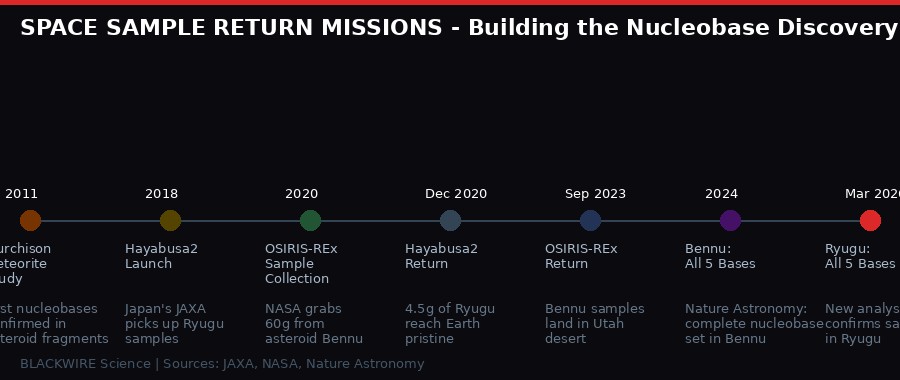
From Murchison meteorite analyses in 2011 to Ryugu's complete nucleobase confirmation in 2026 - a 15-year discovery arc. Credit: BLACKWIRE Science
The Bennu Comparison - Two Asteroids, Two Chemical Histories

Asteroids Ryugu and Bennu are both primitive C-type bodies, but their chemical histories differ significantly. Credit: Pexels
The parallel data from asteroid Bennu - returned by NASA's OSIRIS-REx mission in September 2023 - provides an important contrast that helps scientists distinguish chemistry from coincidence.
When the Bennu samples were analyzed (results published in Nature Astronomy in 2024), they also contained all five nucleobases. But the distribution was different from what Ryugu shows. In Bennu samples, pyrimidines are more abundant than purines. In the Murchison carbonaceous meteorite, purines dominate. Ryugu sits somewhere in between, leaning slightly toward purines.
These variations are not random. They reflect genuine differences in the chemical histories of these parent bodies. Bennu's samples show unusually high nitrogen-15 isotopic enrichments - a signature of cold molecular cloud or outer protoplanetary disk chemistry. Bennu material also has more ammonia and nitrogen-rich organics than Ryugu, which is consistent with the ammonia-nucleobase correlation the new paper documents.
Together, these two asteroid datasets paint a picture of a Solar System that was, in its earliest stages, far richer in organic chemistry than most people intuitively appreciate. We are not talking about trace contamination. We are talking about systematic, widespread synthesis of the same classes of molecules that life on Earth depends on, operating across billions of years before the first cell ever existed.
The fact that two independently sampled asteroids, in different orbits, with different sizes and different thermal histories, both contain the complete nucleobase set is exactly the kind of redundancy scientists need to rule out coincidence. This is not one lucky asteroid. This is a pattern.
The Delivery Question - Could Asteroids Have Seeded Earth?

The early Earth was pummeled by asteroids during the Late Heavy Bombardment period - a potential delivery mechanism for organic chemistry. Credit: Pexels
Finding nucleobases in asteroids is not the same as proving that those nucleobases contributed to the origin of life on Earth. That is a separate - and harder - question. The Ryugu paper addresses it carefully, and the answer is nuanced enough to be worth working through.
The early Earth, between approximately 4.1 and 3.8 billion years ago, experienced what geologists call the Late Heavy Bombardment - a period of intense meteorite and asteroid impacts. The craters visible on the Moon are largely a record of this era. During this period, enormous quantities of carbonaceous material rained down on the young Earth's surface. Some of it vaporized on impact. Some survived to reach the surface intact.
The question is whether surviving organic molecules, including nucleobases, would have been present in high enough concentrations at the right locations to have contributed to prebiotic chemistry. The current scientific consensus is: possibly, but probably not primarily. Life likely used multiple sources of organic molecules - some delivered from space, some synthesized in hydrothermal vents, tidal pools, or other environments on early Earth itself.
The Ryugu data does not settle this debate. What it does is sharpen the terms of it. The nucleobases in Ryugu were not there in huge quantities - we are measuring parts per billion. On Earth, in a concentrated warm pool, those concentrations would not be sufficient to kick off chemistry on their own. But the Earth's entire early surface received asteroid impacts continuously over hundreds of millions of years. The cumulative input of organic material over that period was enormous.
There is also a chemical diversity argument worth noting. The Bennu samples contain not just the five standard nucleobases but also structural isomers - chemically related molecules that are not used by present-day life. This is significant because it suggests the chemistry was not specifically optimized for the nucleobases that ended up in DNA and RNA. Life, if it emerged from this raw material, selected the five canonical bases from a much larger chemical library. The others were tried and discarded, or simply never got incorporated.
"The Universe is a really big place, and the conditions present in space are likely to be far more common than those typical of early Earth. So finding out more about the reactions that prevail in asteroids may be more relevant to life elsewhere in the Universe." - John Timmer, Ars Technica, citing Nature Astronomy findings (March 2026)
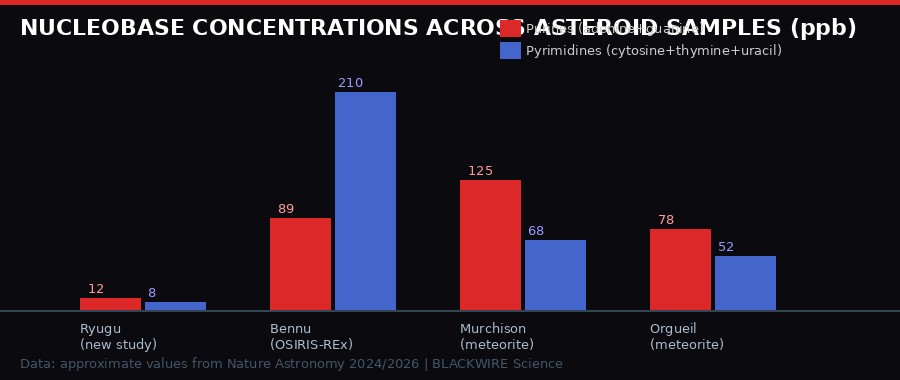
Approximate nucleobase concentrations (ppb) across different asteroid bodies. Note Bennu's elevated pyrimidines - linked to its ammonia-rich aqueous history. Credit: BLACKWIRE Science, data from Nature Astronomy 2024/2026
Second-Order Effects - What This Does to the Drake Equation

Astrobiology research is slowly narrowing the question from "is life possible elsewhere" to "how does chemistry transition to biology." Credit: Pexels
The Drake Equation, formulated by astronomer Frank Drake in 1961, attempts to estimate the number of technologically communicating civilizations in the Milky Way by multiplying together a series of probability factors. One of those factors - traditionally assigned a very low value by skeptics - is the probability that life actually arises on a planet where the right conditions exist.
Every discovery of prebiotic chemistry in pristine asteroid samples nudges that factor upward. Not dramatically, not conclusively, but consistently and in one direction.
The logic is straightforward. If the nucleobases were rare, exotic molecules that required unusual chemistry to produce, then their presence in life would itself require an extraordinary explanation - a lucky synthesis event, perhaps, that happened only once. But if nucleobases are a natural, repeatable product of common Solar System chemistry, then the question shifts. The bottleneck for life stops being "can you make the building blocks" and starts being "can you assemble those building blocks into a self-replicating system."
That second question is still unanswered. No one has successfully demonstrated a plausible pathway from nucleobases to the first RNA molecule to a self-replicating system in the lab. The RNA world hypothesis - the leading framework for early life - requires not just nucleobases but ribose sugars, phosphate groups, specific concentrations, the right pH, and a mechanism for polymerization. Those requirements are far more demanding than simply having the right monomers available.
But the asteroid data is slowly reducing the number of "impossible" steps. Each time a molecule previously thought rare turns up in multiple asteroid samples, the inventory of space's chemical complexity expands. We have now found amino acids, nucleobases, sugars, carboxylic acids, and polycyclic aromatic hydrocarbons in extraterrestrial samples. The components of life are not special to Earth. They are common chemicals in a chemically active Solar System.
There is a second implication that rarely gets discussed in the popular science coverage: if these molecules are this common in our Solar System, they are almost certainly common around other stars with similar chemistry. The processes that produce nucleobases in asteroids - photochemical reactions in interstellar ice, aqueous alteration in asteroid interiors - are not unique to the Sun's neighborhood. They depend on physics and chemistry that operate universally. Carbon, nitrogen, hydrogen, and oxygen are the most abundant reactive elements in the universe. The molecular architecture of nucleobases emerges from their interactions under conditions that occur everywhere.
The Ryugu Puzzle That Remains

Despite the latest findings, fundamental questions about life's cosmic origins remain open. Credit: Pexels
The new Nature Astronomy paper closes one chapter of the Ryugu story but opens others. The fact that nucleobase concentrations in Ryugu are lower than in Bennu or Murchison samples raises questions about what happened to the original chemistry during Ryugu's 4.5-billion-year history.
Ryugu and Bennu are both C-type asteroids, but their aqueous alteration histories differ. Bennu experienced more extensive - and apparently more ammonia-rich - liquid water processing. Water in asteroids acts as a chemical reactor: it dissolves organic molecules, enables reactions, and redistributes compounds throughout the rock. The different levels of aqueous alteration between Ryugu and Bennu may explain why Bennu's organic inventory is richer in both quantity and diversity.
Ryugu may also have experienced episodes of thermal processing that partially degraded its organic content. C-type asteroids can be heated by impacts, by radioactive decay in their interiors, or by solar radiation if their orbits bring them close enough to the Sun. Each of those processes can destroy delicate organic molecules. The relatively low nucleobase concentrations in Ryugu could reflect a history of modest organic degradation over billions of years.
There is also the chirality question lurking in the background. Life on Earth uses amino acids of a specific handedness - left-handed, or L-amino acids. The reason for this bias is unknown. The Bennu samples show that amino acids from space are racemic - equal mixtures of left- and right-handed forms - suggesting that whatever established life's chiral preference was not a pre-existing bias in the cosmic supply. That conclusion applies to nucleobases too. Space chemistry produces both forms of chiral organic molecules equally. Biology chose one. How, when, and why that choice was made remains one of the deepest unresolved questions in origins-of-life science.
The Bigger Picture - A Solar System That Practiced Chemistry Before Life Did

The building blocks of life are not rare. They are products of chemistry that runs at cosmic scale. Credit: Pexels
Step back from the technical details and consider what the cumulative picture looks like. In 2011, researchers confirmed nucleobases in fragments of carbonaceous meteorites. In 2022, Hayabusa2 samples from Ryugu showed uracil - promising but incomplete. In 2024, NASA's OSIRIS-REx Bennu samples produced the complete set of five nucleobases plus a stunning diversity of other organic molecules. And now, in 2026, a more sensitive re-analysis of the original Ryugu samples confirms the complete nucleobase set there too.
Every data point is consistent. Every independent sample from every uncontaminated asteroid source tells the same story. The Solar System's early chemistry was a prebiotic soup, running in parallel across billions of small bodies, producing the molecular components of genetics without any biology guiding the process.
This is not a minor footnote to the question of life's origins. It is a fundamental shift in how we should think about the problem. Life did not have to invent its building blocks from scratch on early Earth. Those building blocks were already there, delivered and replenished by a constant rain of carbonaceous material during the planet's first billion years. The question of life's origin is therefore less about the chemistry of the components and more about the organizational leap - from molecules to the first self-replicating system.
That organizational leap is harder to detect, harder to study, and harder to explain. But it is also the right question to be asking. And the asteroid data - from Murchison to Ryugu to Bennu - has helped us get there faster by removing one class of objections from the table entirely.
The building blocks of genetics are common. They are old. They are cosmic. What is still rare - or at least still unproven at any other location - is the step that comes next.
What Comes Next

From cosmic chemistry to genetic code - the path between is still being mapped. Credit: Pexels
Three missions currently in development or planning stages will extend this research significantly.
Japan's Hayabusa2 spacecraft, having delivered its Ryugu samples in 2020, is not retired. It has been extended on a new mission targeting asteroid 1998 KY26, a tiny fast-rotating body in the inner Solar System. The extended mission will not return samples - it is a flyby - but it will provide spectral data that could help map the chemical diversity of the asteroid population more broadly.
NASA's OSIRIS-APEX mission - the renamed OSIRIS-REx spacecraft after its Bennu sample delivery - is currently en route to asteroid Apophis, the 370-meter near-Earth asteroid that will pass exceptionally close to Earth in April 2029. OSIRIS-APEX will not collect samples, but it will study Apophis in detail during and after that close approach, when Earth's tidal forces are expected to reshape its surface and expose fresher material.
The most consequential future mission for this line of research may be ESA's Comet Interceptor, approved in 2019 and currently under development for a late-2020s launch. Unlike asteroid missions, Comet Interceptor is designed to intercept a dynamically new comet - one making its first pass through the inner Solar System from the Oort Cloud. Such comets carry material that has been preserved in deep freeze since the Solar System's formation, potentially even more pristine than what Hayabusa2 found on Ryugu.
The scientific question driving all of this work has not changed since Carl Sagan first pointed a radio telescope at the sky looking for organic molecules. It is still: how common is the chemistry that leads to life? The asteroid sample missions of the past decade have not answered that question. But they have answered a preliminary one: the molecular feedstock for life is not rare. It is everywhere. What remains to be understood is the spark that turned that feedstock into something that could copy itself.
The five letters of the genetic alphabet - A, T, C, G, U - have now been found on two different pristine asteroids, in multiple meteorites, and in laboratory simulations of interstellar ice chemistry. They are not Earth's invention. They are the Solar System's vocabulary. Life borrowed them. The next discovery we need is the one that shows us how.
Get BLACKWIRE reports first.
Breaking news, investigations, and analysis - straight to your phone.
Join @blackwirenews on TelegramSources: Nature Astronomy (DOI: 10.1038/s41550-026-02791-z), Nature Astronomy 2024 Bennu paper (DOI: 10.1038/s41550-024-02472-9), Ars Technica, JAXA mission documentation, NASA OSIRIS-REx official releases.