Blood Money: Sara Duterte's Fabricated Receipts, Assassination Threats, and the Impeachment That Won't Die
P125 million gone in 11 days. Receipts bearing names of people who don't exist. Cash-stuffed envelopes handed to government officials in corridors. And then, when the walls began closing in, a threat to kill the president. The story of Sara Duterte's vice presidency is the story of how impunity gets inherited.
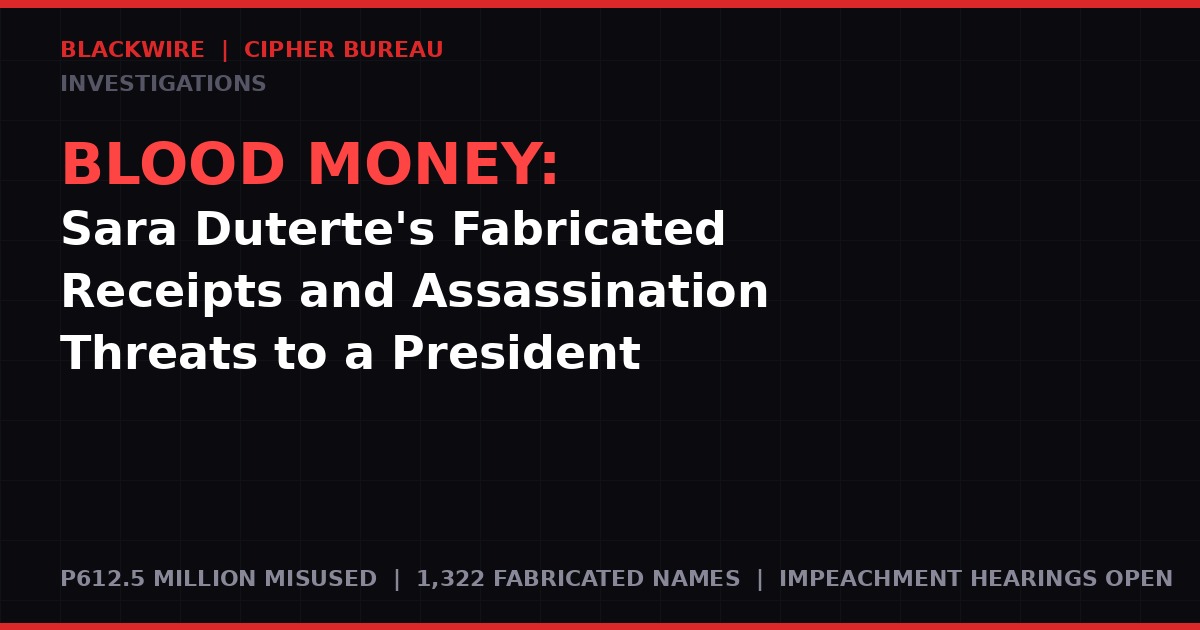
On March 25, 2026, Philippine lawmakers convened the opening session of formal impeachment proceedings against Vice President Sara Duterte - for the second time in just over a year. The first attempt collapsed when the Supreme Court declared it unconstitutional. This time, four separate complaints have been consolidated, witnesses are under subpoena, and investigators are demanding 18 years of financial records.
Duterte was a no-show. Instead, she posted on Facebook, calling the hearings a "fishing expedition." It is a phrase that will be tested against the evidence now accumulating in public testimony: envelopes of cash passed down government corridors, audit reports listing recipients who were never born, and a confession from her own former aide that he personally transported wads of government money to a series of unknown recipients.
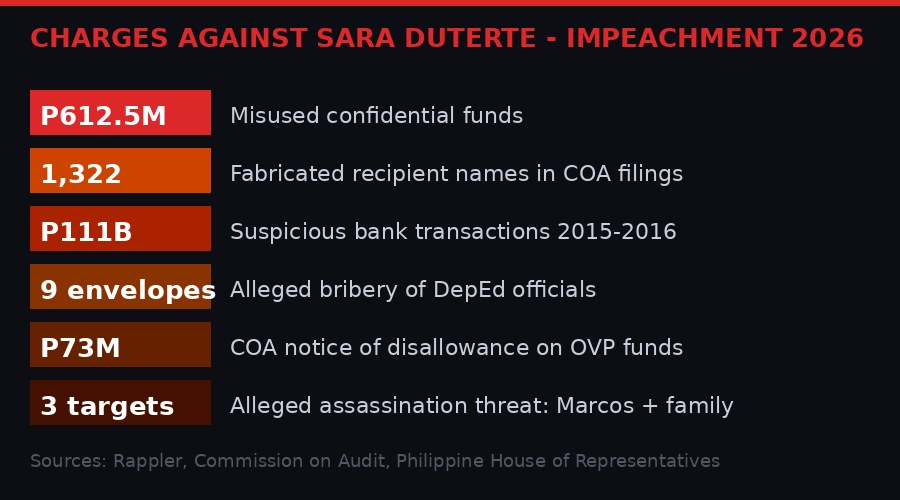
At the center of it all: P612.5 million in confidential government funds that passed through Sara Duterte's offices in her first 18 months as vice president and education secretary - funds the state auditor says were not properly accounted for. The Philippine Commission on Audit (COA) has already disallowed P73 million in spending. What happened to the rest remains, for now, a matter of fabricated paperwork and sealed envelopes.
The Architecture of a Disappearing Act
Government confidential funds exist for a reason. Intelligence operations, undercover law enforcement, witness protection - these are legitimate purposes that require the kind of spending that cannot appear on a public ledger. In the Philippines, such funds carry a legal carve-out: they can be spent without the same itemized receipts that normal government expenditures demand. It is, in effect, a pocket of unaccountable money embedded in the budget of every senior official who can argue for one.
Sara Duterte argued for a great deal. During her first 18 months in office - split between serving as Secretary of Education under President Ferdinand Marcos Jr. and operating the Office of the Vice President (OVP) - she drew down P500 million in confidential funds for the OVP and an additional P112.5 million for the Department of Education (DepEd). That total, P612.5 million, or approximately $10.19 million at current exchange rates, was more than any previous occupant of either office had drawn in comparable periods, according to reporting by Rappler, OCCRP's media partner in the Philippines.
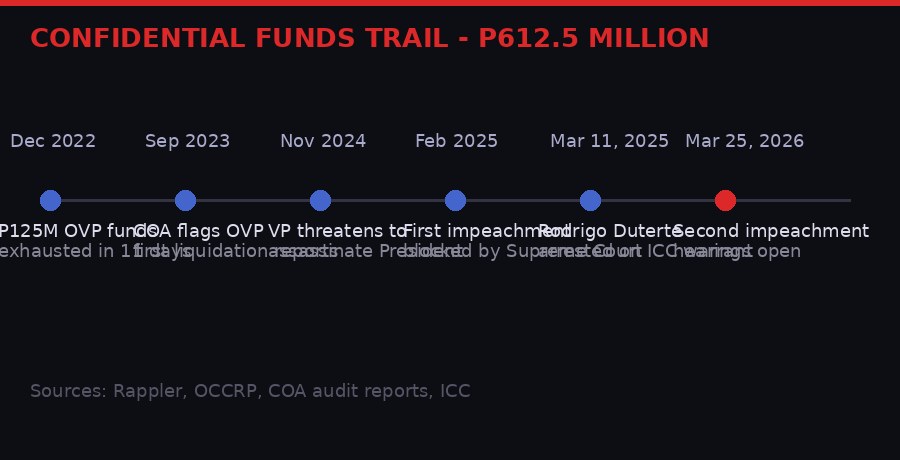
The pace was staggering. According to the COA, P125 million of the OVP's confidential allocation was exhausted within 11 days in December 2022, in what investigators characterized as a concentrated burst of spending that defied any ordinary operational logic. The COA subsequently flagged the filings supporting that expenditure, finding them insufficient - and later issued a notice of disallowance for P73 million of it.
"The OVP could not submit acknowledgment receipts when it liquidated the confidential funds for the first time. The truth is quite straightforward. VP Sara did not carry out legitimate activities with the confidential funds. She misappropriated them for herself." - Third impeachment complaint filed against Sara Duterte, as cited by Rappler
What the auditors found when they looked at the paperwork was, in some ways, worse than a simple absence of documentation. There was documentation - extensive documentation. The problem was that the documentation appeared to be invented.
Mary Grace Piattos and 1,322 People Who Never Existed
In the Philippines, when confidential funds are spent and government offices cannot produce standard receipts, they are allowed to submit acknowledgment receipts - signed documents confirming that a named individual received a cash disbursement for a legitimate purpose. The OVP and DepEd submitted thousands of these to the COA as part of their mandatory liquidation reporting.
Among the names on those acknowledgment receipts was "Mary Grace Piattos." Piattos is a brand of cornstick snack popular across Southeast Asia. It is not, as far as the Philippine Statistics Authority has been able to determine, a name held by any living person born in the country. The PSA certified in December 2024 that there are no birth records for anyone named Marry Grace Piattos in its national registry.
She was not alone. Investigators who cross-referenced the names submitted in the OVP and DepEd liquidation reports with PSA records found that at least 1,322 of 1,992 named recipients had no birth records in the national database. More than two-thirds of the people who supposedly received government cash did not appear to exist. (Source: Rappler, Philippine Statistics Authority certification, December 2024)
The fourth impeachment complaint went further, identifying unsigned receipts, duplicate payments for the same stated purpose, and what investigators described as "temporal mismatches" - dates on receipts that contradicted other documentation in ways that suggested the paperwork was created after the fact rather than contemporaneously with any real transaction.
For a sitting vice president who had already survived one impeachment attempt, the accumulation of specific, documented detail - names checked against government registries, dates compared against audit trails - represents a different quality of evidence than political accusation. The COA's own disallowance notice is not a political document. It is an administrative finding by the state's own financial watchdog that the spending could not be justified by the paperwork provided.
The Cash in the Corridor - Witness Testimony and the Bribery Allegations
While the COA findings address the macro-level accounting failure, the most damaging testimony heard by the House justice committee has come from insiders - people who were present when the cash moved.
Ramil Madriaga, a former aide in the Office of the Vice President, filed a sworn affidavit claiming that he had personally coordinated with two of Duterte's military security officers - identified as Colonel Dennis Nolasco and Colonel Raymund Dante Lachica - in physically transporting large sums of government money to various recipients. Madriaga said this was done at Sara Duterte's direct instruction. He has since been subpoenaed by the House justice committee to testify in person, and the committee took the extraordinary step of asking for additional protection for him - citing what it described as a threat to his life inside a military detention facility. (Source: Rappler, March 25, 2026)
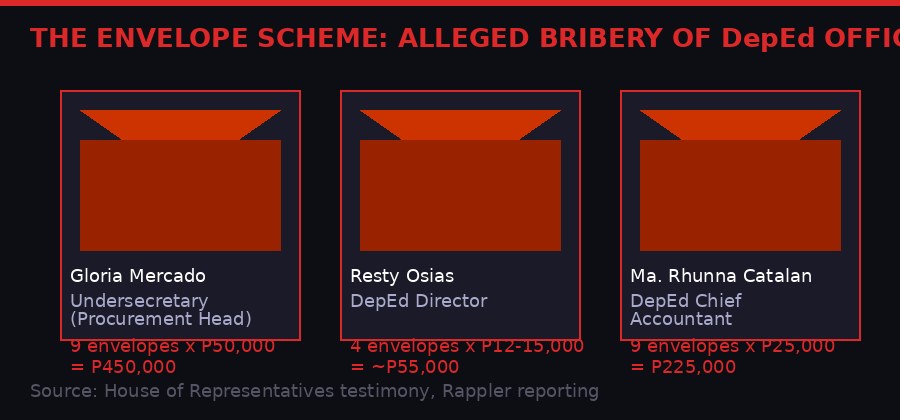
Madriaga's account is corroborated, in part, by the testimony of three Department of Education officials who appeared before the House good government committee and described receiving cash payments in physical envelopes while serving under Duterte as education secretary.
Former education undersecretary Gloria Mercado testified that she received nine envelopes each containing P50,000 - a total of P450,000 - delivered by then-DepEd assistant secretary Sunshine Fajarda. The payments, she said, appeared intended to influence her decisions as head of the department's procurement committee. Former DepEd director Resty Osias testified to receiving four envelopes ranging in value from P12,000 to P15,000. Chief accountant Ma. Rhunna Catalan said she received nine envelopes totaling P225,000.
None of these payments appeared in any official government record. None of the recipients reported them to the COA or to any anti-corruption body at the time of receipt. Their decision to come forward - under the pressure of congressional inquiry rather than their own initiative - raises its own questions about the culture of complicity that permits such payments to remain unreported for years. Nevertheless, the convergence of their accounts, the testimony of Madriaga, and the documentary evidence from the COA creates a coherent picture of a government office that operated with cash as its primary administrative instrument.
KEY WITNESSES SUBPOENAED - MARCH 25, 2026
- Ramil Madriaga - Former OVP aide; claims he transported cash bundles on Duterte's orders; sought protection after claiming his life is at risk
- Cynthia Vinas-Pantonal - Lawyer who notarized Madriaga's affidavit
- Gloria Camora - COA team leader who examined Duterte's confidential fund filings
- Michael Poa - Former DepEd undersecretary and OVP spokesperson; part of Duterte's defense team
Source: Rappler, House of Representatives Committee on Justice, March 25, 2026
The Unexplained Wealth and the Billion-Peso Question
Independent of the confidential funds scandal, impeachment complainants have focused attention on Sara Duterte's declared financial history, drawing on documents surfaced during her father Rodrigo's presidency by former opposition senator Antonio Trillanes IV.
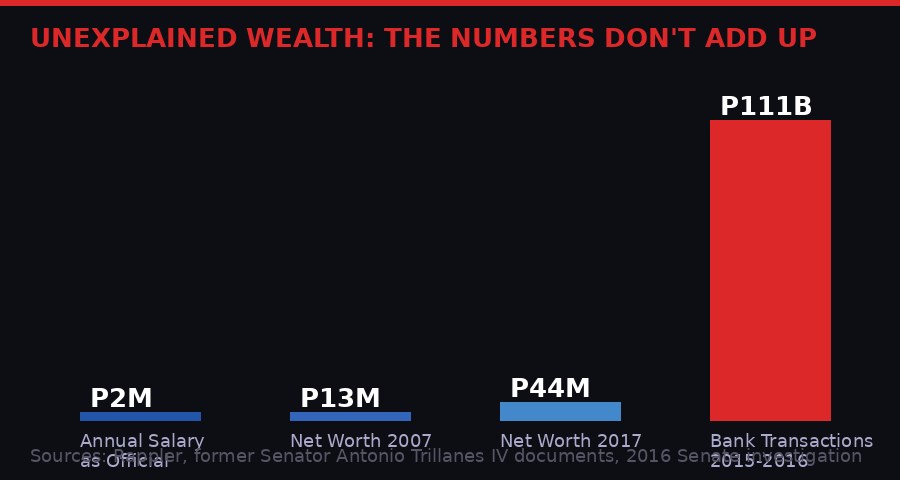
Those documents raise a question that has never been satisfactorily answered. Sara Duterte spent the bulk of her career between 2007 and 2022 as a local official in Davao City - mayor, vice mayor, and various other positions - with an estimated annual government income of approximately P2 million. Yet her declared net worth grew from P13 million in 2007 to P44 million by 2017 - a 238% increase over a decade on a civil service salary.
That discrepancy alone might be explained by smart investments or inheritance. What the second impeachment complaint focuses on is more difficult to explain away: P111 billion in bank transactions recorded in her accounts between 2015 and 2016. That figure - which is over $1.8 billion at current exchange rates - is not the total balance in her account. It is the volume of money that passed through accounts in her name in a 12-month period, on a government salary that would have been less than P2 million for the year. (Source: Rappler, Senate documents obtained by former Senator Trillanes IV, 2016)
The fourth complaint has asked the House to subpoena Sara Duterte's complete bank records from 2007 to 2025 to determine whether the transactions represent criminal violations and whether her Statements of Assets, Liabilities, and Net Worth (SALNs) - the annual financial disclosure required of all Philippine public officials - accurately reflected her true financial position. The Committee on Justice has also asked the Bureau of Internal Revenue for complete tax records for both Duterte and her husband Manases Carpio, and for financial records related to business entities associated with her.
Duterte has not responded to the specific figures. Her lawyers argue the committee lacks jurisdiction over matters that predate her service as vice president. It is a legal argument that may have some technical merit in the narrow context of the impeachment proceeding - but it does not address the underlying question of where the money came from.
The Threat That Shocked a Nation - and What It Revealed
By November 2024, the political relationship between Sara Duterte and President Ferdinand Marcos Jr. - once an electoral alliance of dynastic convenience, their combined ticket having won one of the largest popular vote margins in Philippine history in 2022 - had collapsed into something closer to open warfare.
The rupture had been building for months. Duterte had been excluded from key cabinet discussions. Her allies in the House had been systematically sidelined. The Marcos administration had made clear it was preparing to support legislation that would reduce the OVP's budget and, with it, Sara's political footprint in national government.
Then, in November 2024, Duterte appeared to lose all political calculation. She announced publicly, in terms that left no ambiguity, that she had hired a hitman and given the contractor instructions to kill President Marcos Jr., his wife First Lady Liza Araneta-Marcos, and House Speaker Martin Romualdez if she herself were to be killed. (Source: OCCRP, Philippine Presidential Communications Office, November 2024)
"I already hired someone to do the job. If he kills me, I will kill him. If I die, Marcos, Liza, and Romualdez are dead." - Sara Duterte, as reported by Rappler and confirmed by the Presidential Communications Office, November 2024
The threat - made by a sitting constitutional officer against a sitting president, publicly and on record - was, by any measure, extraordinary. In the Philippines, where the political class has historically operated with a broad tolerance for heated rhetoric, the explicit naming of a hired killer crossed a line that even allies could not defend.
The National Bureau of Investigation was asked to open an investigation. The House justice committee has now subpoenaed NBI records on the matter as part of the impeachment proceeding. Whatever the legal outcome, the episode functions as a kind of political X-ray: it reveals, in high contrast, the degree to which the Duterte family's political style - the blunt instrumentalization of violence as a rhetorical register - survived intact from Rodrigo to Sara.
The First Impeachment, the Supreme Court, and Why This Time Is Different
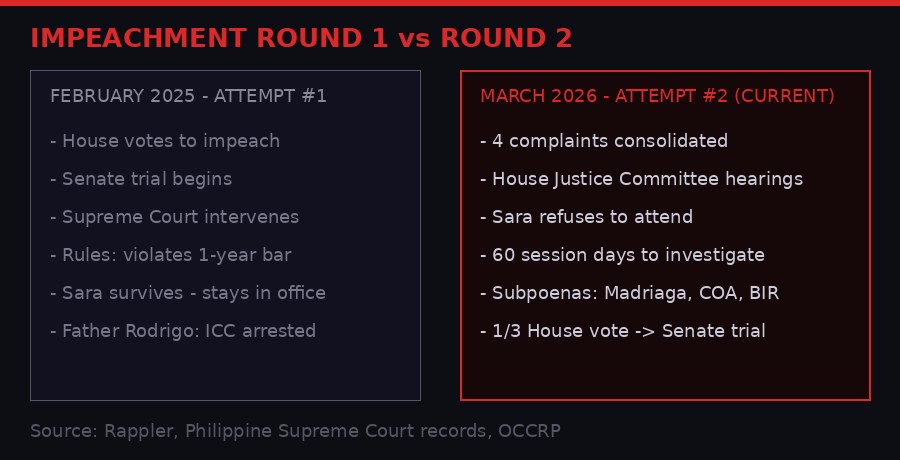
February 2025 was not the first time the Philippine House voted to send Sara Duterte to the Senate for trial. But the first attempt collapsed under the weight of its own procedural haste.
The House had moved quickly - some would say too quickly. Facing political pressure and a tight timeline, members had voted to impeach Duterte without first properly processing three earlier complaints that had been filed and theoretically required action under constitutional rules. When the case reached the Senate and subsequently came before the Supreme Court, the justices ruled that the House had violated the constitutional provision prohibiting the initiation of more than one impeachment proceeding against the same official within a single year. The 2025 impeachment was declared unconstitutional and voided.
Sara Duterte remained in office. The victory was essentially procedural - she had not been acquitted on the merits, merely saved by a technical flaw in the parliamentary process that had come for her. (Source: Rappler, Philippine Supreme Court ruling, 2025)
The 2026 attempt has been constructed with that failure in mind. The complaints now before the House were filed and processed with explicit attention to constitutional requirements. The House justice committee formally took up the matter on February 23, 2026, and the March 25 hearing represents the official opening of the investigation proper. The committee now has a maximum of 60 session days to conclude its work. If the committee recommends impeachment and the full House plenary agrees - with at least one-third of members voting in favor - the articles of impeachment move to the Senate for trial.
Only a two-thirds majority in the Senate, voting as a jury, can remove Sara Duterte from office and permanently bar her from public service. That outcome is far from guaranteed. The Philippine Senate is a political institution, not a purely judicial one, and its members have their own calculations about alliances, elections, and the enduring influence of the Duterte name in the southern Philippines. But the procedural groundwork is more solid this time. And the evidence that has already entered the public record - the fabricated receipts, the missing people, the testimony of Madriaga, the cash envelopes - is not going away.
Father and Daughter - The ICC, The Drugs, and the Legacy That Binds Them
Sara Duterte's legal troubles cannot be fully understood apart from those of her father. Rodrigo Duterte served as President of the Philippines from 2016 to 2022, presiding over an anti-drug campaign that, by the government's own count, killed more than 6,000 people in extrajudicial police operations. Independent human rights organizations and investigative journalists put the actual toll significantly higher - some estimates exceed 27,000.
Long before his presidency, Rodrigo Duterte had exercised power as mayor of Davao City through what became known as the Davao Death Squad - a paramilitary formation that conducted killings in the city for more than two decades, targeting alleged drug dealers, petty criminals, and political enemies. In 2017, OCCRP named Duterte its Corrupt Person of the Year.
The International Criminal Court opened its investigation into Duterte's anti-drug killings during his presidency. The Philippine government, under Rodrigo Duterte himself, responded by withdrawing from the Rome Statute - formally exiting the ICC's jurisdiction. What Rodrigo Duterte apparently did not foresee was that his successor, Ferdinand Marcos Jr., would reverse course.
On March 11, 2025, Rodrigo Duterte was arrested at Manila's Ninoy Aquino International Airport upon returning from a trip to Hong Kong. He was transported to the Netherlands to face judges at the International Criminal Court. He remains in ICC custody as of this writing, facing charges of crimes against humanity. (Source: OCCRP, Amnesty International, March 11, 2025)
"The man who said, 'my job is to kill' oversaw the shooting deaths of victims - including children - as part of a deliberate, widespread, and well-organized campaign of state-sanctioned killings." - Agnes Callamard, Secretary General of Amnesty International, March 11, 2025
Sara Duterte's response to her father's arrest was revealing. Rather than distancing herself or accepting the legitimacy of international accountability, she attacked the Marcos administration directly, calling the arrest "a blatant affront to our sovereignty and an insult to every Filipino who believes in our nation's independence." The statement positioned her politically as the defender of the Duterte legacy - and made clear that she viewed the ICC process, and the Marcos administration's cooperation with it, as acts of war against her family.
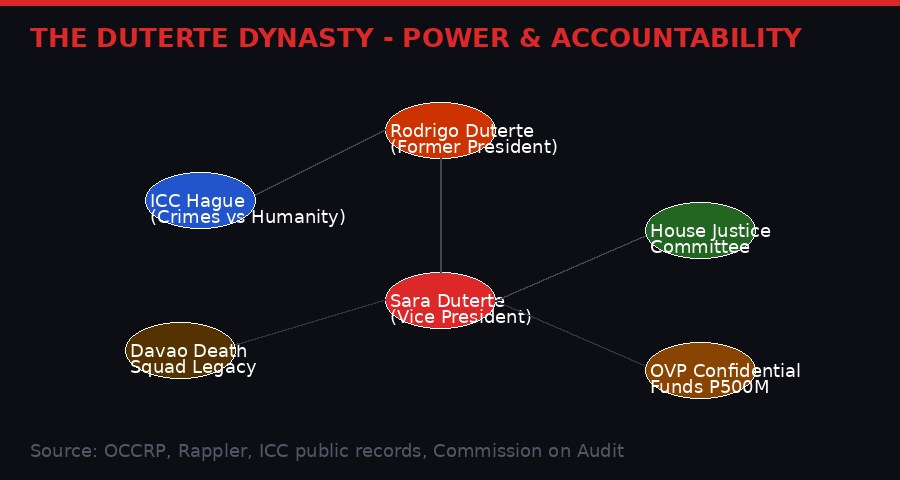
The convergence of these two trajectories - Rodrigo in The Hague facing charges of organized killing, Sara in Manila facing charges of organized theft - is not coincidental. They represent the two dominant modes of impunity in the Duterte political project: the impunity of violence and the impunity of money. The ICC is pursuing one. The Philippine Congress is, for the second time, attempting to pursue the other.
DUTERTE ACCOUNTABILITY TIMELINE
OCCRP names Rodrigo Duterte Corrupt Person of the Year. Extrajudicial killings under anti-drug campaign exceed 6,000 in government estimates; human rights groups say far higher.
Sara Duterte publicly announces she has hired a hitman to kill President Marcos, First Lady Araneta-Marcos, and House Speaker Romualdez if she is killed. NBI investigation opened.
Philippine House votes to impeach Sara Duterte. Supreme Court blocks it as unconstitutional - procedural violation of the one-year bar on multiple impeachments.
Rodrigo Duterte arrested at Manila airport on ICC warrant. Transferred to The Hague to face charges of crimes against humanity. Currently in ICC custody.
Philippine House formally takes up four consolidated impeachment complaints against Sara Duterte. Committee given 60 session days to investigate.
First impeachment hearing opens. Sara Duterte is a no-show. House issues sweeping subpoenas for SALNs, bank records, audit files, and NBI investigation documents. Witness Ramil Madriaga sought for protection after claiming his life is at risk.
What Happens Next - and What It Means for Philippine Democracy
The immediate procedural path is clear enough. The House justice committee will hold hearings over the next 60 session days, taking testimony, reviewing subpoenaed documents, and building - or failing to build - the evidentiary record needed to send articles of impeachment to the full House. A one-third vote in the plenary sends the case to the Senate for trial. A two-thirds Senate majority removes Duterte from office.
The political path is less predictable. Sara Duterte retains substantial support in Mindanao, the southern island where the Duterte name carries the weight of two decades of local power and the mythology of a strongman who, for all the blood, delivered a version of order that many residents found preferable to the chaos that preceded it. That base does not disappear because of audit findings or congressional subpoenas. It may, in fact, consolidate when it feels threatened.
There is also the question of what happens if the impeachment succeeds. Removing a sitting vice president by legislative act is a political earthquake in a country where the presidency and vice presidency are elected on separate tickets - where the vice president can be, as in the current case, a constitutional successor who is also the administration's most dangerous political enemy. A successful conviction would not simply end Sara Duterte's career. It would reshape the 2028 presidential race in ways that no one can fully predict from this vantage point.
For analysts of democratic backsliding and elite impunity, the case is also a stress test for Philippine institutions. The Supreme Court blocked the first impeachment on a technicality that, whatever its legal validity, had the practical effect of shielding a powerful official from accountability. The COA's initial findings - which were strong and specific - did not trigger any criminal prosecution in the two years since the confidential funds were first flagged. The NBI investigation into the assassination threat has not, as far as the public record shows, resulted in any criminal charge.
The institutions exist. The evidence exists. Whether they function as designed - or whether, as in so many accountability processes involving families this powerful, they stop just short of consequence - is the question the next 60 session days will begin to answer.
Sara Duterte's lawyers say the committee has no jurisdiction. Sara Duterte herself calls the process a fishing expedition. But her former aide says he transported the cash personally. Her former officials testified about the envelopes. The state auditor issued a formal disallowance. And 1,322 people who received government money left no trace in the national birth registry.
Those are not allegations. They are documented facts. What remains to be determined is whether the Philippine Senate considers documented facts sufficient grounds for consequences - or whether the Duterte name, once again, proves more powerful than the paper trail.
Get BLACKWIRE reports first.
Breaking news, investigations, and analysis - straight to your phone.
Join @blackwirenews on TelegramSOURCES
- OCCRP - "Philippine Vice President Faces Impeachment Over Corruption and Assassination Threats," March 25, 2026
- Rappler - "House panel demands VP Sara's SALNs, summons Madriaga at impeach hearing kickoff," March 25, 2026
- Rappler - "LIST: What are the issues raised in Sara Duterte impeachment complaints?," 2026
- OCCRP - "Rodrigo Duterte Arrested on ICC Warrant for Crimes Linked to War on Drugs," March 11, 2025
- Amnesty International - Statement on Duterte arrest, March 2025
- Philippine Commission on Audit (COA) - Notice of Disallowance, OVP confidential funds
- Philippine Statistics Authority - Certification regarding birth records of OVP/DepEd named recipients, December 2024
- Senate documents obtained by former Senator Antonio Trillanes IV, 2016
- Presidential Communications Office (Philippines) - Statement on Duterte assassination threat, November 2024
- Philippine House of Representatives, Committee on Justice - Hearing transcripts, March 25, 2026