On a cool London morning, on a course that has broken hearts and made legends for 45 years, Sabastian Sawe ran through the most famous barrier in distance running and did not stop. His time of 1 hour, 59 minutes, and 30 seconds is not just a world record. It is a redrawing of what the human body is believed capable of achieving in competition.
The 30-year-old Kenyan did it in the London Marathon, on the streets of the British capital, with 50,000 runners behind him and the world's media alongside. Not in a controlled experiment. Not with rotating pacemakers swapped mid-race. Not on a custom course engineered for a single purpose. He did it in a race - the same race where Kelvin Kiptum set the previous record of 2:00:35 in 2023, the same race where Eliud Kipchoge ran 2:01:39 in 2019.
And he was not alone. Yomif Kejelcha, making his marathon debut, crossed the line in 1:59:41 - the second man ever to break two hours in official competition. Jacob Kiplimo, the half marathon world record holder, finished third in 2:00:28. Three men under Kiptum's old record, two under two hours, one morning in London.
"The goalposts have literally just moved for marathon running and where you benchmark yourself as being world-class."
- Paula Radcliffe, former women's marathon world record holder
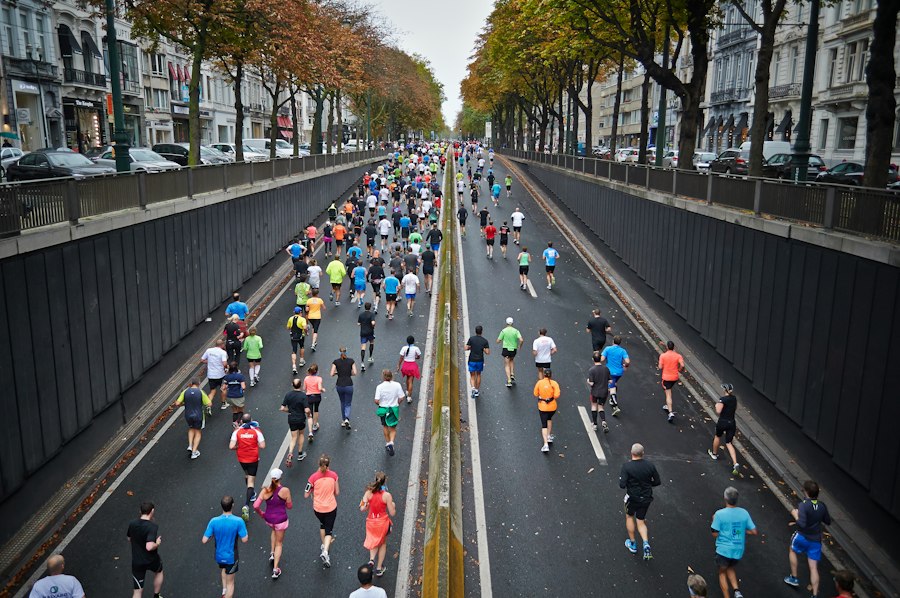
London's streets have witnessed some of marathon running's greatest moments. On April 27, 2026, they witnessed the greatest of all. (Photo: Unsplash)
The Number: 1:59:30
For decades, the two-hour marathon was running's equivalent of the four-minute mile - a barrier that existed more in the imagination than on the road. Roger Bannister's 3:59.4 mile in 1954 proved that barriers built in the mind can fall. But the marathon's two-hour mark had a different quality. It was not a round number that happened to be fast. It was a physiological limit that, for most of human history, seemed genuinely unreachable.
Consider the pace. To run 26.2 miles in under two hours, an athlete must sustain 4 minutes 34 seconds per mile. For 26 consecutive miles. Not a single mile off pace. Not a moment of recovery. The body consumes oxygen at near-maximum capacity, the heart pumps at threshold, the legs absorb forces equivalent to three times body weight with every stride. At this pace, the margin between success and collapse is measured in heartbeats.
The Race: How It Unfolded
Sawe arrived in London as the favourite. He had won all four marathons he had contested. He had won this very race in 2025 in 2:02:27. He had targeted Kiptum's world record in Berlin last September, going through halfway in 60:16 before the heat destroyed the bid. He told BBC Sport this week that breaking two hours was "only a matter of time." He just did not say it would be this Sunday.
The conditions were perfect. Cool temperatures, low wind, the kind of overcast London morning that distance runners dream about. The early pace was honest but not reckless. Sawe crossed the halfway point in 1:00:29, already on world record pace but still with the second half to run.
What followed was extraordinary. Sawe ran the second half in 59:01. Let that settle. His second half was faster than his first by 88 seconds. Only 63 men in history have run a half marathon as quickly as 59:01. Sawe's personal best for the half marathon distance stands at 58:05. He essentially ran a world-class half marathon, then ran another one, faster.
The decisive move came before the final 10 kilometres. Sawe surged. Only Kejelcha, the Ethiopian making his marathon debut with all the audacity that implies, could match it. The two ran shoulder to shoulder through the streets of Canary Wharf, along the Embankment, past Big Ben. In the final kilometres, Sawe's strength told. He pulled clear. Kejelcha, incredibly, still broke two hours. Kiplimo, equally incredibly, still broke Kiptum's old record.
| Split | Time | Pace/km | Notes |
|---|---|---|---|
| Half Marathon | 1:00:29 | 2:52 | On world record pace |
| 25 km | 1:11:45 | 2:50 | Pace quickening |
| 30 km | 1:25:39 | 2:48 | Sawe begins to push |
| 35 km | 1:39:33 | 2:46 | 13:54 split - decisive move |
| 40 km | 1:53:15 | 2:45 | 13:42 split - closing hard |
| Finish | 1:59:30 | 2:45 | Sub-two secured. History made. |

The second half of a marathon is where legends are separated from contenders. Sawe's 59:01 second half is faster than most elite runners can manage in a standalone half marathon. (Photo: Unsplash)
The Podium: Three Men, One Morning
The 2026 London Marathon did not produce one historic result. It produced three. The top three finishers all beat or matched what was, until Sunday, the most feared number in distance running.
Kipchoge's Shadow: The Difference Between Laboratory and Road
In October 2019, Eliud Kipchoge ran 1:59:40 in Vienna. It was one of the most watched sporting moments of the decade. Kipchoge, the greatest marathon runner in history, had broken the two-hour barrier. But the INEOS 1:59 Challenge was not a race. It was an experiment. A hand-picked course in Vienna's Prater park. A pace car with a laser beam projecting the required split times onto the road. Rotating teams of 41 pacemakers, swapped in and out like Formula One pit crews. A time trial in every sense, designed to answer a single question: could a human run 26.2 miles in under two hours?
The answer was yes. But the question that lingered, the question that kept the two-hour barrier alive as a meaningful mark, was different: could a human do it in a real race? With competitors, not pacemakers. With a field, not a formation. With the chaos and surges and tactical decisions that make a marathon a race rather than a time trial.
Sawe answered that question on Sunday. His pacemakers were not rotating professionals hired for the job. They were rivals trying to beat him. Kejelcha was not there to drag Sawe to a time; he was there to win. The London Marathon course is not a flat loop designed for speed; it includes hills, turns, cobbles, and 50,000 other runners sharing the road.
This distinction matters. Kipchoge's achievement was monumental. It proved the barrier was physical, not psychological. But Sawe's achievement is of a different order. It happened in the sport's natural habitat, under the sport's natural conditions, against the sport's natural competitors. It is a record that stands without asterisk.
The Two-Hour Chase: A Timeline
Dennis Kimetto sets world record at Berlin: 2:02:57. The two-hour barrier seems years away.
Nike's Breaking2 project. Eliud Kipchoge runs 2:00:25 in Monza, Italy. Not record-eligible. Missing by 25 seconds stings.
Kipchoge sets official world record at Berlin: 2:01:39. The gap to two hours narrows to 99 seconds.
Kipchoge runs 1:59:40 in the INEOS 1:59 Challenge in Vienna. Sub-two achieved, but not in competition. The barrier is psychological, not physiological.
Kelvin Kiptum shatters Kipchoge's official record at Chicago: 2:00:35. At 23, the Kenyan becomes the youngest marathon world record holder in history. The gap to two hours: 35 seconds.
Kiptum dies in a car crash in Kenya at age 24. The sport loses its brightest young star. Sawe wins the London Marathon in 2:02:27. The quest for sub-two continues.
Sabastian Sawe crosses The Mall in 1:59:30. The two-hour barrier falls in competition. History is made. Kejelcha finishes in 1:59:41. Two men under two hours. Three men under Kiptum's record. The marathon will never be the same.

London's crowds, estimated at 750,000 along the 26.2-mile course, were credited by Sawe as a crucial factor. "If it was not for them, you don't feel so loved," he said. (Photo: Unsplash)
The Shoe Question: Technology and the Human Body
Any discussion of marathon records in 2026 must contend with the carbon-fibre plate. Sawe ran in Adidas' latest supershoe, part of a generation of footwear that has transformed distance running since Nike introduced the Vaporfly in 2017. These shoes - thick midsoles of energy-returning foam, embedded carbon-fibre plates that act as springs - have been credited with shaving 1-2% off elite marathon times. World Athletics has regulated their thickness (maximum 40mm for road shoes) and mandated that they be available to the public for at least four months before use in competition.
Sawe has addressed the doping question proactively. He underwent 25 drug tests before competing in Berlin last September, and has continued to be tested regularly since. The anti-doping infrastructure around elite marathons has tightened considerably since the era of state-sponsored doping scandals, with the Athletics Integrity Unit now conducting out-of-competition testing across Kenya, Ethiopia, and other distance-running nations.
But the shoe question will persist. When Kipchoge ran 2:01:39 in 2018, critics argued the record was partly a product of technology. When Kiptum ran 2:00:35, the same questions arose. Sawe's time will face the same scrutiny, and the sport will have the same answer: the shoes are legal, available, and worn by everyone in the field. The advantage, if it exists, is shared.
What is not shared is what Sawe did with the second half of the race. No shoe has yet been invented that can make a runner faster in the final 10 kilometres than in the opening 10. That is physiology, courage, and talent.
Kelvin Kiptum's Legacy
It is impossible to write about the marathon in 2026 without mentioning the man who is not here. Kelvin Kiptum set the world record of 2:00:35 at the 2023 Chicago Marathon at the age of 23. He was, by every measure, a generational talent - a runner who seemed likely to be the one to break two hours in competition. He ran a negative split in Chicago, going through halfway in 60:51 and coming home in 59:44. He told reporters he could go faster.
On February 11, 2024, Kiptum died in a car crash in Kenya. He was 24 years old. His coach, Gervais Hakizimana, was also killed. The sport lost its most exciting young talent, and the two-hour chase lost its leading contender. The record Kiptum set - 2:00:35 - stood for two and a half years. It was the shortest-lived marathon world record since the IAAF began ratifying them.
Sawe, who knew Kiptum personally, paid tribute to his legacy in the aftermath. The baton has passed. The record book will show that Kiptum held the world record for 943 days. What it cannot show is what might have been.
The Women's Race: Assefa Owns London
While the men's race produced history, the women's race produced dominance. Ethiopia's Tigst Assefa retained her London Marathon title and improved her own world record for a women-only field, finishing in 2:15:41 - nine seconds faster than her 2025 mark.
Assefa, the third-fastest woman in history over the full marathon distance, was pushed all the way by Kenyan rivals Hellen Obiri and Joyciline Jepkosgei. The three ran together for 38 kilometres before Assefa summoned the finishing kick that has become her signature. Obiri crossed 12 seconds back, Jepkosgei close behind.
Britain's Eilish McColgan finished seventh in 2:24:51, continuing her steady improvement over the marathon distance. Rose Harvey was ninth in 2:26:14. In the wheelchair races, Switzerland's Marcel Hug won a record-equalling eighth London Marathon title, while Catherine Debrunner retained the women's title.

The finish line on The Mall. Sawe's 1:59:30 will be the time that defines this course, this sport, this era. (Photo: Unsplash)
What Comes Next: The New Frontier
Sawe's achievement does not close the book on the two-hour marathon. It opens a new one. Now that the barrier has been broken in competition, the question shifts from "can it be done?" to "how fast can they go?"
The trajectory of the men's marathon world record tells its own story. Since 2003, when Paul Tergat ran 2:04:55 in Berlin, the record has been broken eight times. The improvements have come in larger increments in recent years: Kimetto's 2:02:57 in 2014, Kipchoge's 2:01:39 in 2018, Kiptum's 2:00:35 in 2023, and now Sawe's 1:59:30. Each step has been bigger than expected, a pattern that suggests the sport is in a period of rapid acceleration rather than marginal gains.
Kejelcha's debut is perhaps the most tantalising indicator. A 1:59:41 on your first marathon is not a finished product; it is a beginning. Kiplimo, at 25, has years of improvement ahead. And behind them, a generation of East African runners has grown up watching Kipchoge's 1:59:40 on loop, internalising the possibility that the barrier was not a barrier at all.
Steve Cram, the former world champion and BBC commentator, captured the moment: "There are things that happen in sport and you want to be there to see history being made. If you are watching on TV then well done, but if you're in London, it is a privilege and it is incredible."
Mo Farah, Britain's four-time Olympic champion, was more succinct: "We've waited long enough to see a human go sub-two. That's always been the question that we've asked. We've just witnessed something incredible."
By the Numbers
The Bigger Picture
Sport does not happen in a vacuum. On the same day Sawe ran through the two-hour barrier, 20 people were killed by a highway bomb in Colombia, a defence minister was assassinated in a coordinated jihadist assault across Mali, gunshots shattered a presidential dinner in Washington, and a ceasefire in Lebanon frayed further toward open war. The world is on fire in ways that make a marathon seem trivial.
But sport has always carried a different weight. It is the thing that happens while the world burns, a demonstration that human bodies - any human body, from any village, under any government - can still do extraordinary things. Sawe grew up in Kenya, a country that has produced more marathon champions per capita than any nation on earth, in no small part because running is the sport that requires the least equipment. No swimming pool, no tennis court, no golf course. Just a road and a pair of shoes and the will to keep going.
The road on Sunday was London's. The shoes were Adidas'. The will belonged entirely to Sabastian Sawe. He ran through the barrier that everyone said was impossible, and when he crossed the line, he looked more relieved than triumphant. As if he had known all along what he was capable of, and the only question was whether the day would let him show it.
The day let him show it. The two-hour marathon is over. Long live whatever comes next.
Sources
- BBC Sport - "Sawe smashes two-hour mark to 'move goalposts for marathon running'" - April 27, 2026
- BBC Sport - London Marathon 2026 results and analysis
- BBC Sport - Steve Cram and Mo Farah commentary reactions
- Sabastian Sawe post-race interview, BBC TV, April 27, 2026
- Paula Radcliffe reaction, BBC Sport commentary, April 27, 2026
- World Athletics marathon world record progression data
- INEOS 1:59 Challenge records and conditions documentation
- London Marathon official splits and timing data, April 27, 2026
- Kelvin Kiptum world record verification, Chicago Marathon 2023