SBF's Trump Play: The Pardon Gambit, $70K Bitcoin, and the Macro War Nobody Is Winning
Sam Bankman-Fried is tweeting praise for Trump's Iran strikes from a federal prison cell. Bitcoin is the best-performing major asset since the war started. And the bond market is giving signals not seen since 2008. March 21, 2026 - everything is on fire.

Bitcoin held above $70,000 for the fourth straight day as macro markets deteriorated around it. (Pexels)
It is day 25 of the Iran war and Sam Bankman-Fried is asking Donald Trump for a favor.
The jailed FTX founder - serving 25 years for one of the largest financial frauds in history - has been broadcasting his support for Trump's military decisions through a prison-approved X account, backing the Iran strikes as "necessary to counter nuclear risk." The message is not subtle: SBF wants a pardon, he knows how pardons get done in the Trump era, and he is playing the game the only way he can from a federal facility.
Meanwhile, bitcoin sits at $70,641. Oil was briefly above $100 per barrel this week before cooling to $96. The 10-year U.S. Treasury yield just hit 4.38%, up 10 basis points in a single session. UK gilt yields crossed 5% for the first time since 2008. The Federal Reserve, which was expected to cut rates by now, is watching CME FedWatch show a 12% chance of a rate hike at the April meeting - up from exactly 0% one week ago.
Everything that was supposed to be safe is selling. Bitcoin, against all intuition, is outperforming. This is what week 25 of the war looks like.
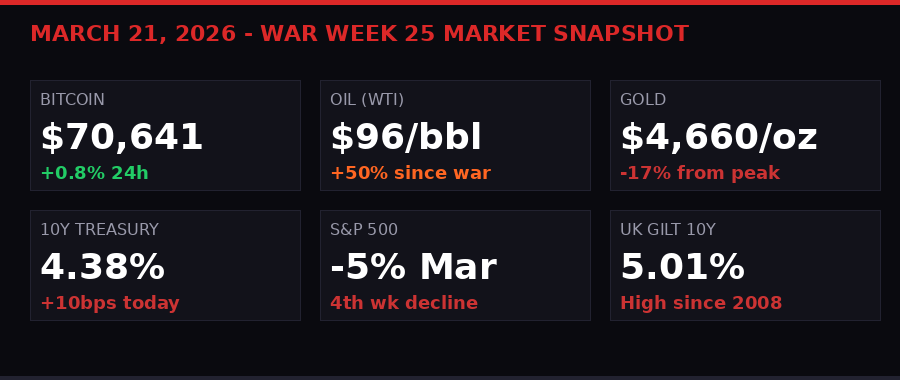
Cross-asset performance as of March 21, 2026. Bitcoin is the standout positive in a sea of red. (BLACKWIRE)
SBF's Pardon Campaign - Transparent, Calculated, and Possibly Working

SBF continues communicating via proxy through prison-approved channels. (Pexels)
The playbook is the Ross Ulbricht playbook. The Silk Road founder spent a decade in federal prison on a life sentence before Trump freed him within weeks of taking office in January 2025. Ulbricht had built a massive social media following. His case became a libertarian cause. Trump made the pardon a campaign talking point.
SBF is trying to run the same play, except his starting position is far worse. He defrauded retail investors out of billions of dollars. His victims are not an abstract concept - they are real people who lost savings, retirement funds, and businesses when FTX collapsed in November 2022. The Ulbricht case was philosophically contested. The SBF case is not.
But SBF is working with what he has. According to CoinDesk, his recent X posts, written through an approved proxy, have included:
- Backing the Iran strikes as "sharply reducing Iran's military capacity"
- Crediting Trump with "saving" the SEC by replacing Gary Gensler with Paul Atkins
- Noting that gas prices are lower under Trump than under Biden or in other countries
- Framing the Iran operation as necessary to counter nuclear risk
"Presidential pardons have historically extended to financial crimes, and Trump has shown a willingness to grant clemency in high-profile cases." - CoinDesk, March 21, 2026
The math here is cold. SBF's lawyers filed a motion for a new trial in February 2026, which the government opposed. The legal route is essentially closed. His only realistic exit from a 25-year sentence is executive clemency. That means playing politics, and Trump's politics happen to align with crypto-industry interests right now.
The awkward part: Trump's own allies are directly invested in the crypto space. His family's crypto venture, World Liberty Financial, raised hundreds of millions in its token sale. His son Eric is publicly bullish on Bitcoin. Paul Atkins, now heading the SEC, has been a consistent critic of heavy-handed crypto enforcement. The regulatory environment that SBF is now crediting Trump for building is, in part, the very environment that gave SBF's former competitors the room to operate legally while FTX imploded illegally.
Whether the flattery works is genuinely unknowable. What is clear is that SBF is not going quietly. He is communicating, messaging, and positioning - even from behind bars. And the FTX Recovery Trust's announcement this week that it will distribute approximately $2.2 billion to creditors as part of the ongoing Chapter 11 process adds a strange subplot: his victims are being paid back at near-full recovery rates, which arguably removes one of the loudest objections to a pardon.
FTX Recovery - Current Status (March 2026)
- Latest distribution: ~$2.2 billion to creditors
- Recovery rate: Near full for many claim classes
- SBF sentence: 25 years, handed down November 2023
- New trial motion: Filed February 2026, opposed by government
- Pardon precedent: Ross Ulbricht (life sentence) freed Jan 2025
- Regulatory context: Paul Atkins now SEC chair, pro-crypto
Bitcoin at $70K - The Strangest Safe Haven in Financial History

Bitcoin has outperformed gold by 20% since the Iran conflict began - a dynamic that has surprised traders. (Pexels)
Here are the numbers. Since the Iran war started roughly 25 days ago, gold dropped from $5,500 per ounce to $4,569 - a 17% decline. Silver collapsed from $95 to $69.50. The S&P 500 is down more than 5% since late February, now in its fourth consecutive weekly decline. The Nasdaq is off a similar amount, down 1.2% on Friday alone.
Bitcoin started March around the same level it is now - just above $70,000. It is the best-performing major asset through the war. Not by a little. By a lot.
"Bitcoin has once again acted as the canary in the macro coal mine. At current levels, bitcoin is already pricing a recession, while many traditional assets are not." - Andre Dragosch, European Head of Research at Bitwise (via CoinDesk, March 20, 2026)
The logic Dragosch is pointing at: crypto fell sharply in early February during the initial war shock, dropping to near $60,000 when the conflict began. It has since recovered to $70,641 while everything else has continued deteriorating. Bitcoin effectively front-ran the macro damage. It priced the recession before it was obvious.
The counterargument from Wintermute's Bryan Tan is worth keeping in mind: "When sentiment swings on each headline about the conflict, and correlation to oil prices are so elevated, being flat is a strong position. We lean towards reserving dry powder until we see a meaningful confirmation in either direction or a material change in market conditions." Translation: this could reverse hard, and the lack of follow-through above $75,000 means nobody is confident enough to press long.
The Technical Warning
The chart pattern forming right now is concerning for bulls. According to CoinDesk technical analysis, bitcoin's price action since early February shows a counter-trend recovery inside a narrow upward channel - nearly identical to the November-January pattern that preceded the February crash from $90,000 to nearly $60,000.
The key level to watch is $65,800. That is the lower trendline of the current channel. A break below it would signal a return of bearish control. A break above the upper channel would challenge the downtrend altogether. Right now, bitcoin is ranging between both, grinding sideways with no explosive momentum either direction.
Bitcoin Derivatives Snapshot - March 20-21, 2026
- Open interest: $16.9 billion (stable vs $17B last week)
- Funding rates: Neutral 0%-10% across major platforms
- 3-month basis: 2.8% - institutional conviction cautious
- Options skew (1w 25-delta): 14%, up from 9% - downside more expensive
- 24h liquidations: $308 million (63% longs, 37% shorts)
- Key liquidation level: $68,500 (Coinglass heatmap)
- Key breakdown trigger: Sub-$65,800 signals bear resumption
The Fed Does Not Know What to Do - And Markets Know It

The Fed was pricing rate cuts two months ago. Now markets are seriously debating a rate hike. (Pexels)
Two months ago, the only debate among rate traders was how many Fed rate cuts there would be in 2026. Three? Two? The question of a hike never entered the conversation.
Then oil went up 50% in three weeks.
According to CME FedWatch, the probability of the Federal Reserve raising rates at its April 2026 meeting has jumped to 12%. One week ago, that number was 0%. The reversal is historically rare - a complete flip in the priced-in rate trajectory within a single trading week.
The underlying problem is arithmetic. February data showed annual headline CPI at 2.4% and core at 2.5%. Both numbers were collected before the Iran conflict began. Oil was not at $96-$120 per barrel in February. It is now. The energy shock that blew up those inflation projections has not fully transmitted to consumer prices yet. When it does, the February numbers will look like prehistory.
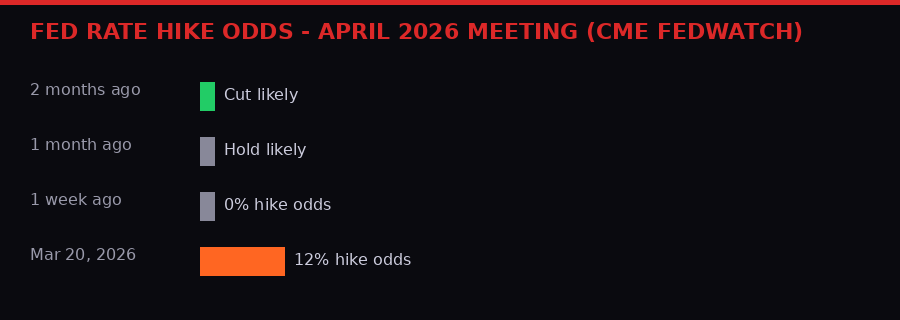
The probability of an April Fed rate hike went from 0% to 12% in one week. (BLACKWIRE/CME FedWatch)
The bond market is pricing this already. The 10-year U.S. Treasury yield hit 4.38% on Friday, up 10 basis points in a single session. Since the start of March, the long end of the yield curve has sold off sharply. That is money leaving bonds, betting that inflation stays high and the Fed either cannot or will not cut.
The UK's situation is, if anything, more acute. The 10-year gilt yield crossed 5% this week - a level not seen since 2008, up 15% in the past month. For context, 2008 was when Lehman Brothers failed. UK 5% gilt yields are not a signal of normal functioning credit markets. They are a signal of stress.
What this means for crypto is layered. Historically, a Fed that is tightening or threatening to tighten is bad for risk assets including Bitcoin. Higher rates mean higher discount rates, less speculative capital, and a stronger dollar that compresses dollar-denominated asset prices. But the current situation is not historically normal. Bitcoin is the only major asset in the green this month. Traditional safe havens - gold, bonds, CHF - are all selling. Something different is happening in the relationship between Bitcoin and macro stress, and no one has a clean model for what it is yet.
Strategy Buys Through the Crash - 761,068 Bitcoin and Counting

Strategy has bought 89,618 BTC in Q1 2026 alone - on pace for its second-largest buying quarter ever. (Pexels)
Michael Saylor is not selling. In the middle of the war, the bond market rout, the Fed flip-flop, and the gold collapse, Strategy has been buying bitcoin every Monday like it is a grocery run.
According to CoinDesk, Strategy has acquired 89,618 BTC in Q1 2026, bringing total holdings to 761,068 BTC. The quarter is not yet over. Two more Mondays remain. That 89,618 BTC figure already makes this the second-largest quarterly accumulation in the company's history, behind only Q4 2024, when it added 194,180 BTC as the price surged to $100,000 following Trump's election victory.
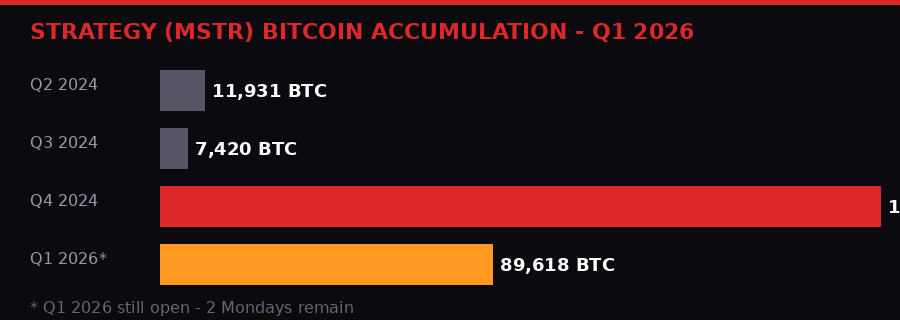
Strategy's quarterly BTC buying. Q1 2026 is already the second-largest buying quarter on record. (BLACKWIRE)
The funding mechanism is notable. Recent purchases have been partly funded by sales of the company's perpetual preferred stock offering called Stretch (ticker: STRC). Over the past two weeks, STRC-funded purchases accounted for up to 15,000 BTC. However, the STRC price failed to reach its $100 par value this week, which means the program is temporarily unavailable as a funding source until the preferred shares trade back up.
Strategy's common stock (MSTR) is down 15% this year, tracking the broader risk-off mood. But the company's bitcoin position is up from those average acquisition costs. At $70,641 per coin, 761,068 BTC is worth approximately $53.7 billion. Saylor has been public about the strategy: they will not stop buying, they fund purchases through equity and debt offerings, and the thesis is that bitcoin is the only truly scarce global monetary asset.
Whether that thesis survives a prolonged stagflationary environment, a Fed that raises rates, and a stock price that is already under pressure is the $53 billion question.
Morgan Stanley's MSBT - Wall Street's Next Move Into Bitcoin

Morgan Stanley's latest SEC filing reveals key ETF details including ticker and seed capital. (Pexels)
Morgan Stanley just filed a major update with the SEC for its spot Bitcoin ETF. The ticker: MSBT. The seed capital at debut: $1 million. The custodian: Coinbase. The cash and administrative services provider: BNY Mellon.
According to CoinDesk, the latest S-1/A filing with the SEC also specifies a 10,000-share creation unit requirement. The investment bank bought two shares earlier this month for audit purposes. If approved, MSBT would join 11 other spot Bitcoin ETFs including BlackRock's IBIT, which have collectively attracted over $56 billion in investor inflows since January 2024.
The timing of this filing, in the middle of a macro crisis with oil at $96 and bond yields spiking, is worth noting. Morgan Stanley is not pulling back from Bitcoin exposure - it is accelerating its push toward it. The Coinbase custodian arrangement is standard (BlackRock also uses Coinbase), but the BNY Mellon cash management role signals serious institutional infrastructure build-out.
Morgan Stanley also filed for a Solana ETF earlier in 2026. It has not yet submitted updates on that fund. Bitcoin gets the regulatory priority treatment, which makes sense - it is the product that BlackRock has already proven can attract tens of billions in inflows.
Morgan Stanley MSBT ETF Filing Details (March 20, 2026 S-1/A)
- Ticker: MSBT
- Asset type: Spot Bitcoin ETF
- Seed capital: $1 million at launch
- Creation unit: 10,000 shares
- Custodian: Coinbase
- Cash/admin services: BNY Mellon
- Regulatory status: Under SEC review
- Existing spot BTC ETFs: 11 (including BlackRock IBIT at $56B+ AUM)
The strategic implication is longer-term than the current macro noise. Every institutional ETF filing normalizes Bitcoin as an asset class. When Morgan Stanley - with $1.5 trillion in assets under management and relationships with millions of retail brokerage clients - launches MSBT, its financial advisors gain a simple vehicle to put client money into Bitcoin. That is a structural inflow driver that operates independent of whether oil is at $80 or $120.
The SBF Gambit in Context: The Crypto Pardon Economy

The precedent set by the Ulbricht pardon has created a new category of crypto political lobbying from prison. (Pexels)
The Ulbricht pardon created a new playbook. That pardon was not just clemency - it was a political signal. Trump told the crypto community that he was on their side, and he made it tangible by freeing a man who had been convicted of operating a drug marketplace that ran on Bitcoin. The libertarian crypto crowd went wild. The message received was: align with Trump, and outcomes improve.
SBF is reading that message and trying to apply it. But the structure of his case is fundamentally different from Ulbricht's in ways that matter politically.
First, SBF defrauded people who were crypto believers. His victims are not abstract. They are specific people who held FTX accounts and lost money when he moved customer funds to his hedge fund Alameda Research without authorization. These are the same people who make up Trump's crypto constituency. Pardoning SBF without ironclad political cover would be handing Democrats a weapon: "Trump freed the man who stole your crypto."
Second, the FTX collapse was the single largest reputational damage event in crypto history. The industry spent two years after 2022 rebuilding credibility, getting ETFs approved, and convincing regulators it could police itself. A presidential pardon for SBF would drag all of that back into the headlines.
Third, there is the political donation angle. SBF was the second-largest Democratic donor in the 2022 election cycle. His money went to the people Trump spent years fighting. A Think Big PAC mailer flagged by CoinDesk this week is already connecting Democratic House candidate Alex Bores in the NY-12 primary to $100,000 in past SBF-network support - showing that the political weaponization of SBF's money is still very much alive in Democratic primaries, which cuts against any Trump pardon narrative.
The FTX creditor recovery numbers do matter here. With $2.2 billion more flowing to creditors, the total recovery is approaching dollar-for-dollar repayment for many claim holders. That removes the "victims are still hurting" argument, which is typically the hardest political obstacle to a financial crime pardon. If everyone is paid back, the moral calculus shifts.
"His public messaging suggests he is trying to shape an outcome beyond the courtroom." - CoinDesk, March 21, 2026
What Week 25 Means: A Timeline of the Macro Damage

25 days of war and the global economy is showing structural damage that will not reverse quickly. (Pexels)
It helps to track the macro sequence from the beginning to understand where we are now.
The sequence shows something important: this is not a one-event shock. The market has been processing the war for 25 days, and it is still finding new damage. Gold was the first casualty of the reversal - it ran too fast, too high, and is now selling as the initial safe-haven trade unwinds into liquidity needs. Bonds are selling because inflation is back on the table. Equities are selling because growth is faltering while costs rise - the classic stagflation setup.
Bitcoin is the anomaly in every direction. It sold off harder than most assets at the start of the war. It recovered faster. It is now the only major asset roughly flat from the start of 2026. That is either an incredibly prescient inflation-hedge thesis playing out, or it is a positioning artifact that will correct violently when risk appetite truly collapses. Nobody knows which one yet.
The Bigger Picture: Crypto Inside a Stagflation Regime

Stagflation - rising prices plus slowing growth - is the economic scenario that breaks most traditional investment models. (Pexels)
Stagflation is the economic scenario that breaks models. Normal inflation: rates go up, bonds sell, but equities hold because growth is strong. Normal recession: rates get cut, bonds rally, equities fall then recover. Stagflation is the third path: inflation is high, but the economy is also weakening. There is no clean rate response. Hike and you kill the economy. Cut and you let inflation run. The Fed is staring directly at this choice right now.
Oil at $96-$120 is inflationary. An economy under energy shock is also contractionary. The combination is feeding the 12% April rate hike probability while simultaneously pushing S&P 500 futures lower. These two things - hawkish rate pricing and weak equity prices - do not normally coexist for long. One of them is usually wrong about what comes next.
For crypto, the stagflation playbook is underdeveloped. Bitcoin was born in 2009 after the financial crisis. It has never operated through a serious stagflationary regime as a mature, institutionally-held asset. The 1970s stagflation playbook (the last comparable episode) favored hard assets like gold and commodities, but gold is currently selling alongside equities. The correlations that usually anchor portfolio theory are breaking down in real time.
What the derivatives market is pricing is caution, not collapse. Open interest is stable at $16.9 billion. Funding rates have normalized. But the options skew has shifted to 43/57 call/put - meaning traders are paying more for downside protection than upside exposure. That is not a market pricing a run to new highs. That is a market positioning for an event risk that resolves sharply in one direction or the other.
Altcoins are showing pockets of strength - Quant (QNT) and Fetch.AI (FET) leading gains according to CoinDesk's market data, with the altcoin season index improving even as major tokens remain rangebound. That divergence within crypto is its own signal: capital is not fleeing the space, it is rotating within it looking for yield and narrative momentum.
Key Risk Levels to Watch (Week of March 23)
- BTC downside trigger: Sub-$65,800 - channel breakdown
- BTC liquidation cluster: $68,500 (Coinglass heatmap)
- Fed meeting: April 2026 - 12% rate hike probability (was 0% a week ago)
- Oil: Sub-$90 would relieve inflation pressure; above $100 reignites fears
- Treasury yield: 4.38% 10Y - further rises pressure all risk assets
- UK gilt yield: 5.01% - first time above 5% since 2008 financial crisis
- S&P 500: Down 5%+ from late Feb, 4th consecutive weekly decline
- STRC par value: MSTR's preferred share program frozen until STRC reaches $100
The week ahead is set up for continued volatility. The war on day 25 has no clear off-ramp being negotiated publicly. Oil has pulled back from the $119 peak but remains at a level that sustains inflation pressure. The Fed's April meeting is not that far away, and every piece of economic data between now and then will be viewed through the lens of whether Powell has to hike in the middle of a war.
SBF will keep posting. Strategy will keep buying. Morgan Stanley will keep filing. Bitcoin will keep sitting at $70,000, refusing to behave like any asset the traditional financial world has a model for.
That is not necessarily a reason to buy. But it is a reason to pay attention.
Get BLACKWIRE reports first.
Breaking news, investigations, and analysis - straight to your phone.
Join @blackwirenews on Telegram