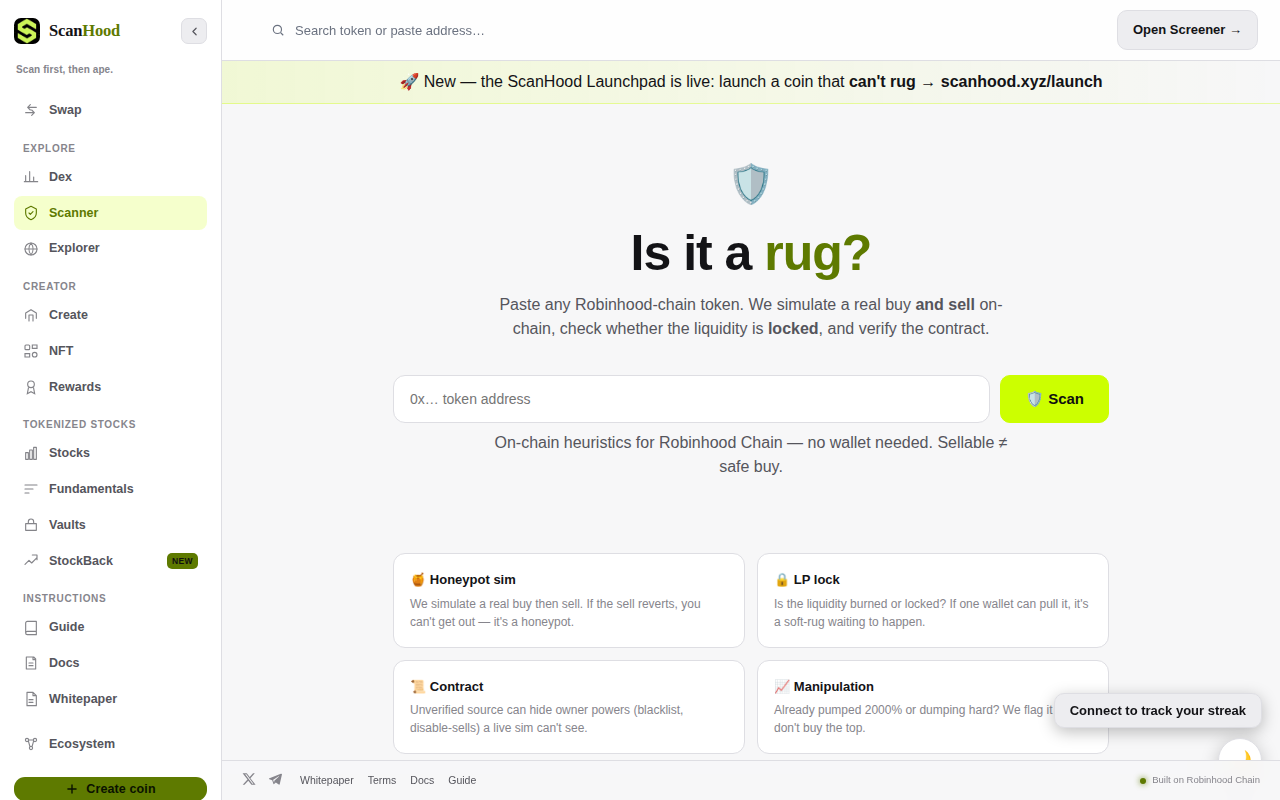
ScanHood's dashboard on 2026-10-29 displays three passes, two caution flags, and no danger alerts for five Robinhood‑Chain tokens.
SCANHOOD REPORTS ZERO RUG FAILURES AMID CAUTION FLAGS ON ROBINHOOD-CHAIN TOKENS
*On 2026-10-29 ScanHood scanned five Robinhood‑Chain tokens. Three passed the safety scan, two received caution flags, and none were marked dangerous. The zero‑percent failure rate underscores the tool’s selective detection.*
On October 29, 2026 ScanHood released its daily safety‑scan report for the Robinhood Chain. The live scanner evaluated five tokens, delivering a clear pass‑caution‑danger breakdown. Three tokens passed every test, two earned caution flags, and none were deemed dangerous. The Rug Check failure rate was recorded at zero percent, indicating no outright rug‑pulls were detected among the batch. This snapshot arrives as DeFi investors scramble for reliable on‑chain risk tools amid a flood of new token launches.
The report underscores ScanHood’s role as a real‑time watchdog. By simulating buys and sells, checking liquidity locks, and verifying contract transparency, the platform offers a concise risk profile without requiring a wallet connection. Investors receive actionable data at the moment of token creation, a critical advantage in a market where seconds can dictate profit or loss.
What did ScanHood find on 2026‑10‑29?
The live scanner logged five Robinhood‑Chain tokens on 2026-10-29. Three tokens cleared every check and were marked passed. Two tokens triggered a caution flag, indicating potential risk but not an outright danger. No token was labeled DANGER, and the Rug Check failure rate stood at 0.0 percent. The tally reflects ScanHood’s binary outcome model: pass, caution, or danger. By reporting a clean failure rate, the platform signals that none of the five tokens exhibited the most severe red flags during its simulated buy‑sell test.
How does ScanHood assess honeypot risk?
ScanHood runs a honeypot simulation that mimics a real purchase followed by a sell transaction on‑chain. If the sell call reverts, the token is classified as a honeypot, meaning investors cannot exit. The tool also checks whether liquidity is locked or burned, flagging any wallet that could withdraw funds as a soft‑rug risk. Contract verification runs in parallel; unverified contracts may conceal owner powers such as blacklisting or disabling sales. These heuristics operate without requiring a wallet connection, delivering a rapid risk snapshot for each token.
What does a caution flag mean for investors?
A caution flag signals that ScanHood detected one or more warning signs but not enough to label the token dangerous. Typical triggers include soft‑rug conditions, partial liquidity lock, or an unverified contract that could hide owner privileges. Investors should treat cautioned tokens as high‑risk and conduct additional due diligence before committing capital. The flag does not guarantee a loss, but it highlights that the token’s safety profile is incomplete or potentially manipulable.
Can the ScanHood launchpad prevent future rugs?
ScanHood recently launched a launchpad that promises to issue coins that "can't rug." The service integrates the same on‑chain heuristics used in the scanner, requiring a clean safety check before a token can be listed. By enforcing liquidity lock, contract verification, and honeypot simulation at launch, the platform aims to eliminate the most common rug‑pull vectors. While no system can guarantee absolute safety, the launchpad’s pre‑screening adds a barrier that could reduce the frequency of malicious token releases on the Robinhood Chain.
Frequently asked questions
How many Robinhood‑Chain tokens did ScanHood scan on 2026‑10‑29?
ScanHood scanned five Robinhood‑Chain tokens on that date.
What was the Rug Check failure rate reported by ScanHood?
The Rug Check failure rate was 0.0 percent.
How many tokens were flagged as caution versus danger?
Two tokens were flagged caution and none were flagged danger.
The zero‑failure figure does not equate to a risk‑free market, but it highlights the value of on‑chain simulation and verification. As the Robinhood Chain continues to attract new projects, tools like ScanHood and its launchpad could become essential gatekeepers, forcing developers to meet higher safety standards before reaching investors. The next batch of tokens will be judged by the same metrics, and any deviation will be instantly visible to the community.
Sources: ScanHood live scan data