March 30, 2026 | Washington, D.C.
The Pardon Machine: How a Nursing Home Fraudster Bought His Way Out of Prison While Families of Dead Patients Got Nothing
Joseph Schwartz stole $39 million in payroll taxes, ran 100 nursing homes into the ground, and let patients die in filthy beds. He served 90 days. Then he went to the White House Hanukkah party.

Across 11 states, Skyline Healthcare facilities descended into crisis - water shut-off notices, food supply failures, and patients left without basic care. Photo: Pexels
Doris Coulson was a retired cardiac nurse. She liked cooking shows, crossword puzzles, and wheeling herself down the hallway to show off her visiting granddaughter. Her medical records were marked "NPO" - nothing by mouth. Parkinson's disease had made swallowing dangerous.
Then someone fed her scrambled eggs.
A nursing assistant found Coulson unresponsive, skin ashy, barely breathing, hanging off the side of her bed at Hillview Post Acute and Rehabilitation Center in Little Rock, Arkansas. She was rushed to a hospital in a coma. She died days later. The chief cause of death was aspiration pneumonia - food in her lungs.
"The doctors said they found scrambled eggs in her lungs," her daughter Melissa Coulson told ProPublica.
The facility was run by Skyline Healthcare, a New Jersey-based chain owned by a man named Joseph Schwartz. By the time Coulson died, Schwartz was already siphoning millions from his nursing homes - stealing payroll taxes from workers, billing Medicaid for services never rendered, and paying himself $5 million as a "ghost employee" at his own facilities. A judge awarded Coulson's family nearly $19 million in damages. They have never collected a cent.
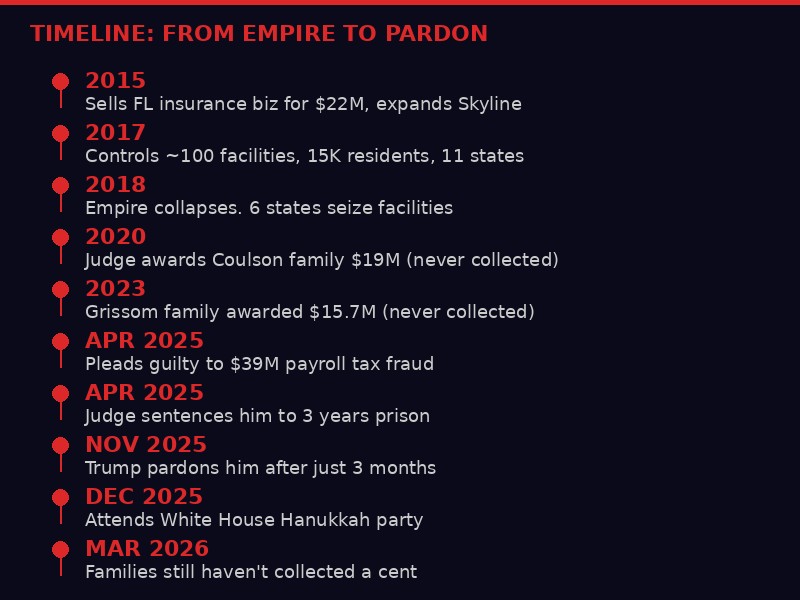
Last April, Schwartz pleaded guilty to a $39 million payroll tax fraud scheme and was sentenced to three years in federal prison. He served exactly ninety days. In November 2025, President Donald Trump granted him a full pardon - negating his criminal conviction entirely - after Schwartz spent more than $1 million on Washington lobbyists and received the public backing of far-right activist Laura Loomer.
Weeks later, the pardoned fraudster attended the White House Hanukkah party.
01 // The Empire Above the Pizza Parlor

Skyline Healthcare's headquarters operated from a second-floor office above a pizza parlor in Wood-Ridge, New Jersey. Photo: Pexels
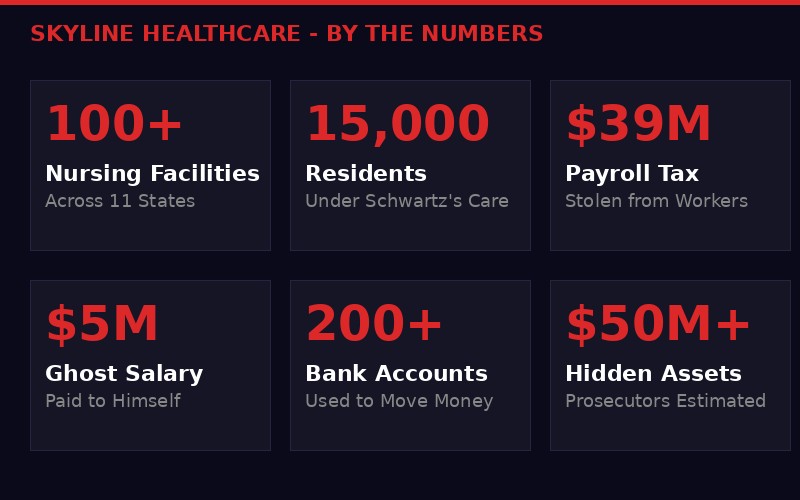
The headquarters of what became one of America's fastest-growing nursing home chains was a second-floor office above a pizza parlor in Wood-Ridge, New Jersey. From this unassuming perch, Joseph Schwartz assembled a medical empire that, at its peak in 2017, controlled approximately 100 skilled nursing facilities across 11 states, caring for roughly 15,000 residents.
Schwartz entered the nursing home business in the late 2000s and formed Skyline Healthcare to acquire and operate skilled nursing facilities, initially concentrated in New Jersey and Pennsylvania. The expansion accelerated dramatically after 2015, when Schwartz sold a Florida-based insurance business for $22 million. The proceeds fueled an acquisition spree that extended Skyline's reach from Nebraska to Massachusetts, from South Dakota to Arkansas.
The business model was straightforward: buy nursing homes, cut costs to the bone, extract as much revenue as possible from Medicare and Medicaid reimbursements, and repeat. In a 2017 deposition for a wrongful death suit in Philadelphia, Schwartz described the care at his facilities as "superb" and insisted his nursing homes were "very, very, very, very, very compliant" with staffing standards. He minimized reports of chronic shortages and unpaid bills as simple business "disagreements."
The federal government's own data told a different story. Under the Centers for Medicare & Medicaid Services' Five-Star Quality Rating System, several Schwartz-controlled facilities received one-star staffing ratings between 2010 and 2014 - the lowest possible score. When confronted with this during sworn testimony, Schwartz said he recalled having "a good star rating."
Behind the depositions and the public relations spin, the financial architecture of Skyline was something else entirely. Prosecutors would later discover that Schwartz moved money through more than 200 bank accounts. Not a single asset was held in his own name. When U.S. District Judge Susan D. Wigenton examined the structure at sentencing, she noted the "number of layers and businesses and LLCs that were created" and found it impossible to view Schwartz as a confused or foolish businessman.
"Not a single asset is in your name. Not one."- U.S. District Judge Susan D. Wigenton, at Schwartz's sentencing hearing, April 2025
The corporate structure was not the product of incompetence. It was architecture - deliberately constructed to shield the man at the top from the consequences of what was happening on the ground floor. And on the ground floor, people were dying.
02 // The Collapse: Six States, Six Crises

Health officials in at least six states were forced to intervene as Skyline facilities ran out of money for food, utilities, and basic medical supplies. Photo: Pexels
The implosion of Skyline Healthcare was not a gradual decline. It was a system-wide failure that happened almost simultaneously across multiple states, exposing the fragility of a chain that had expanded far beyond its ability to deliver even minimal standards of care.
Schwartz had been withholding payroll taxes from workers' paychecks - deducting the money as required by law but never transmitting it to the Internal Revenue Service. Over time, the total reached $39 million. At the same time, he was overbilling Medicaid and collecting himself $5 million as a "ghost employee" on the payroll of facilities he owned. The money flowed into more than 200 bank accounts, and prosecutors would later say they never completed a forensic accounting of where it all went. They believed Schwartz still controlled more than $50 million in assets.
On the ground, the consequences were immediate and devastating. Skyline facilities failed to make payments for food and medical supplies. Staff hours were slashed. Workers found themselves unable to provide the most basic forms of care. In South Dakota, Debbie Menzenberg, a vice president who oversaw 18 Schwartz-owned nursing homes, began sending increasingly desperate emails to state health officials as the system disintegrated.
"I need water paid at Bella Vista and Prairie Hills today or it will be SHUT OFF - Skyline is SILENT!!!"- Debbie Menzenberg, email to South Dakota state health officials, from court records
Her messages grew more frantic as the days passed. "Disconnect notice came today for Pierre May 8 electric." Then: "I NEED HELP!!!!!" And finally: "CEO's are aware of stuff going on!!!" Schwartz's own son Louis, an executive officer for Skyline, had reportedly told Menzenberg that the state "has to do something - there is no money - he told me to discharge residents???"
Health officials in at least six states - from Nebraska to Massachusetts - were eventually forced to seize, transfer, or take emergency control of Skyline facilities. Residents were relocated. Some had nowhere to go. The infrastructure of care that Schwartz had built was revealed to be hollow - a revenue extraction machine wearing the mask of a healthcare company.
The workers suffered alongside the patients. A group of Skyline employees across the country filed a lawsuit alleging that the company withheld more than $2 million in health insurance premiums from more than 1,000 workers' paychecks but never actually purchased the coverage. Employees who believed they had insurance discovered, only when they needed it, that they had nothing.
Margaret Gates, an activities director at a nursing home in Arkansas, told ProPublica she was left with more than $50,000 in medical bills after back and neck surgery. Her credit was destroyed.
"They withheld over $1,000 from my paycheck for insurance premiums and did nothing with them except abscond with them."- Margaret Gates, former Skyline Healthcare employee, to ProPublica
The employees' lawsuit remains pending in federal court in New Jersey. A lawyer for the workers has asked a judge to award a $2.4 million default judgment. Schwartz has not defended himself against the claim.
03 // The Dead: Doris Coulson and Zelma Grissom

Two wrongful death cases at Hillview - the same Arkansas facility - paint a picture of systematic neglect under Schwartz's ownership. Photo: Pexels
The financial crimes were enormous. But the human cost was measured in bedsores and aspiration pneumonia, in infections that spread because nobody turned a patient over, in water that was about to be shut off at the facility where elderly people depended on it to survive.
Doris Coulson's case is the one that lingers. The retired cardiac nurse, admitted to Hillview Post Acute and Rehabilitation Center in January 2016, had Parkinson's disease that put her at risk of choking. Her chart was clearly marked NPO. Someone on the understaffed ward either didn't read the chart or didn't care. She was fed solid food. She aspirated. She went into a coma. She died. Autopsy found scrambled eggs in her lungs.
Her family sued Skyline and Schwartz directly. He didn't contest the case. In 2020, a judge awarded nearly $19 million in damages. By then, Schwartz had relinquished all his property in Arkansas. There was nothing left in the state for the family's lawyer to seize, and not enough information about assets elsewhere to pursue them. Six years after the judgment, the Coulson family has collected exactly zero dollars.
Zelma Grissom died at the same facility. The mother of six had entered Hillview after brain surgery left her unable to move independently. She was entirely dependent on staff to turn her in bed - a basic nursing procedure that prevents pressure sores from developing on immobilized patients. Under Schwartz's ownership, the turning didn't happen consistently. A wound-care nurse eventually called Grissom's family in and showed them a severe pressure sore that had developed from neglect.
Surgeons had to cut away infected tissue, leaving a large open wound. Her son LeVester Ivy watched his mother's health spiral downward. "She started getting infection after infection," he recalled. During one late-night ambulance transfer, an emergency medical worker quietly took Ivy aside and described how his mother had arrived at the hospital. "She pulled me to the side and told me how dirty and nasty, how wet she was."
Grissom's lawyers said she died of sepsis from the bedsores that Hillview caregivers allowed to become infected. In February 2023, a judge ordered Schwartz to pay the Grissom family $15.7 million after neither Schwartz nor any representative challenged the wrongful death claim. Schwartz later tried to overturn the ruling, claiming poor health, lack of notice, and insisting he was "merely an investor" with no operational role. A judge rejected every argument.
The Grissom family, like the Coulson family, has never collected any of the judgment. Their lawyer told ProPublica he doesn't have enough information about Schwartz's assets to even begin recovery proceedings.
"We wanted nobody else to go through the things we had to go through," Ivy said.
Between the two families, the courts have ordered Schwartz to pay $34.7 million. The total collected: nothing.
04 // The Sentencing: A Judge Who Saw Through It

In a Newark federal courtroom, Judge Wigenton rejected both the defense's framing and the prosecution's recommended sentence. Photo: Pexels
When Joseph Schwartz stood before U.S. District Judge Susan D. Wigenton in Newark, New Jersey, in April 2025, the case was formally about taxes. He had pleaded guilty to failure to pay the IRS $39 million in payroll taxes withheld from his employees and to failing to file a required financial report for his employees' benefit plan. On paper, it was a white-collar tax case.
But Wigenton saw something else.
She could not understand why federal prosecutors had agreed to recommend a sentence of just a year and a day. She noted that even after years of investigation, it remained unclear where much of the $39 million had actually gone. Prosecutors admitted they had never completed a forensic accounting of Schwartz's finances, despite identifying more than 200 bank accounts through which money had flowed. They believed he still controlled upward of $50 million in assets, but the trail had not been fully followed.
The defense presented the familiar narrative of the overwhelmed businessman. Schwartz's attorneys argued his actions were not an attempt at personal enrichment but the desperate flailing of a man who "expanded too quickly, fell behind on bills and then made a series of financial decisions - some of them admittedly criminal." He was trying to save his company, they said. Not get rich.
Schwartz himself apologized to the court. He told Wigenton he had "always tried to live the right way" and set a good example. He acknowledged that in this instance, he had failed.
The judge was unpersuaded. She noted the avalanche of character letters submitted on Schwartz's behalf, many of which described him as a brilliant businessman. That brilliance, she observed, made the complex web of LLCs, shell companies, and layered corporate structures look less like incompetence and more like deliberate architecture designed to obscure the movement of money.
And she refused to treat the case as merely an abstract matter of tax law. She cited the collapse of Skyline's nursing homes and the direct harm to patients - the deaths, the untreated bedsores, the facilities where the water was about to be shut off. She stated that there was a clear need for deterrence.
Wigenton sentenced Schwartz to three years in federal prison - triple what prosecutors had recommended. She ordered him to pay $5 million in restitution, the amount he had paid himself as a ghost employee. The remaining $34 million in stolen payroll taxes was not part of the criminal sentence because prosecutors categorized it as money used to "fund his collapsing business" rather than for personal enrichment. The IRS could pursue the balance through a civil case.
Three years. For $39 million in stolen taxes, multiple patient deaths, more than a thousand workers defrauded of their health insurance, and a corporate structure specifically designed to put assets beyond the reach of victims.
He served ninety days.
05 // The Pardon Pipeline: $1 Million in Lobbyists, One Laura Loomer, and a White House Party
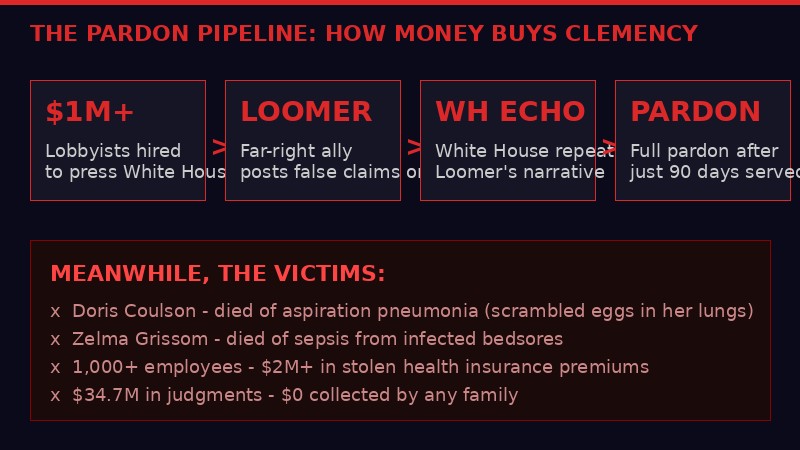
The mechanics of how Joseph Schwartz's conviction was erased reveal a system that operates with striking efficiency for those who can afford its entry fee.
According to lobbying disclosure forms reviewed by ProPublica, Schwartz paid more than $1 million to lobbyists to press the White House, the Department of Justice, and members of Congress on his behalf. The lobbying campaign included explicit efforts to secure a presidential pardon. The White House has maintained that paid lobbyists have no influence on clemency decisions. The timeline suggests otherwise.
One of the lobbyists Schwartz hired was Joshua Nass, who worked to try to reduce Schwartz's sentence in Arkansas. Nass was later charged with attempting to extort $500,000 from a client and his son. Although the victims are not identified in the criminal case, the circumstances described in court filings match those of Schwartz. Nass was released on a $5 million bond and, as of March 2026, prosecutors said they were negotiating a plea deal. He has not responded to the charge publicly.
The public advocacy came from Laura Loomer, the far-right activist and Trump ally. Loomer published a series of posts on X that falsely claimed Schwartz was not responsible for the tax violations, that he had been unfairly blamed for the collapse of his nursing home chain, and that he had paid back "every dime." None of these claims hold up against the court record and Schwartz's own guilty plea.
Loomer also accused the sentencing judge of antisemitism against Schwartz, who is Jewish. She offered no evidence. She claimed Schwartz was in "extremely poor health" and that prison would be a "death sentence." The judge had found no evidence that Schwartz was unfit for incarceration.
Loomer told ProPublica she was not paid for her advocacy. She said she learned about Schwartz's case through a group chat with members of an orthodox Jewish outreach movement and pointed to her influence within the Trump administration, citing multiple instances in which she publicly urged specific actions that the president subsequently took.
The White House's official explanation for the pardon echoed Loomer's narrative with remarkable fidelity. A White House official told ProPublica that Schwartz had "relied on a third-party entity" to manage tax filings, that he had paid restitution, that no funds were used for personal enrichment, that the sentence was "exceptionally harmful" to a 65-year-old man in deteriorating health, and that the case was "an example of over prosecution."
Every one of these claims is contradicted by the record. Schwartz acknowledged responsibility for the unpaid taxes in his guilty plea. The $5 million in restitution he paid covered only a fraction of the $39 million owed. Prosecutors explicitly identified the $5 million ghost-employee salary as personal enrichment. His three-year sentence fell in the middle of the range recommended under federal sentencing guidelines - not an outlier by any measure. And the judge had found no evidence of health conditions that would make imprisonment inappropriate.
When ProPublica asked the White House how these statements squared with the court record, the White House did not respond.
The celebration that followed was striking. Alice Marie Johnson, who has advised the White House on clemency, wrote online that the pardon meant Schwartz could now join his family for Shabbat. Weeks later, Schwartz attended the White House Hanukkah party. Loomer said Schwartz approached her at the party to thank her.
Melissa Coulson, whose mother died with scrambled eggs in her lungs at a Schwartz-owned nursing home, had a different reaction to the pardon.
"Apparently he's got money somewhere."- Melissa Coulson, daughter of Doris Coulson, to ProPublica
06 // The Pattern: Trump's Nursing Home Clemency Record
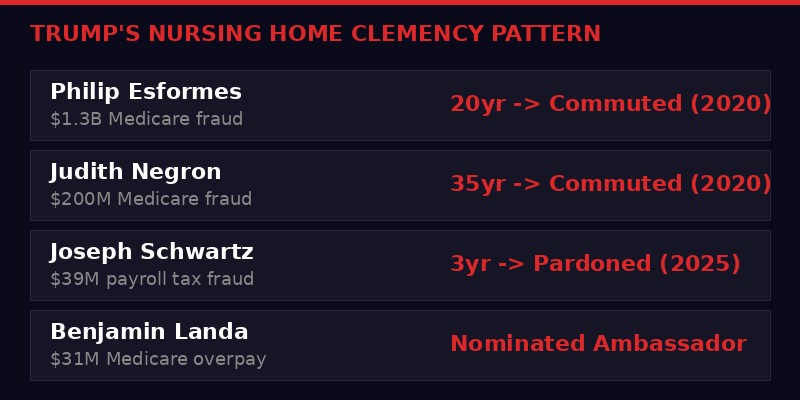
Joseph Schwartz is not an anomaly. He fits into a pattern of clemency decisions by President Trump that have specifically benefited individuals convicted of fraud in the healthcare and nursing home industries.
In 2020, during his first term, Trump commuted the 20-year federal prison sentence of Philip Esformes, a Florida nursing home magnate convicted in what prosecutors described as approximately $1.3 billion in fraudulent Medicare and Medicaid claims. The White House cited allegations of prosecutorial misconduct, echoing Esformes' defense team's claims that prosecutors improperly invaded attorney-client privilege by reviewing documents seized during an FBI raid. Appeals courts had not overturned the conviction on these grounds, but Esformes had the support of two former U.S. attorneys general.
That same year, Trump commuted the sentence of Judith Negron, convicted in a $200 million Medicare fraud case. The White House statement said the "ends of justice" did not require her to serve another two decades in prison.
The current administration has taken the pattern further. Trump has nominated nursing home owner Benjamin Landa as ambassador to Hungary. The nomination has remained in place even as a facility Landa co-owns faces a federal audit alleging more than $31 million in Medicare overpayments. Landa's company is suing the Trump administration to block repayment. An attorney for Landa has denied wrongdoing, saying issues identified in the audit occurred during the COVID-19 pandemic when nursing homes were in crisis.
What connects these cases is not merely the industry or the nature of the fraud. It is the infrastructure of access. Esformes had former attorneys general advocating on his behalf. Schwartz had over $1 million in lobbyists and Laura Loomer. Landa is being rewarded with an ambassadorship. The message to the nursing home industry is unmistakable: if you are caught defrauding Medicare, stealing from workers, or presiding over facilities where patients die from neglect, the system has a relief valve. It costs money to access, but it works.
The families of the dead do not have lobbyists. They do not attend White House parties. They have court judgments that no one will enforce and lawyers who cannot find the assets hidden behind 200 bank accounts and layers of LLCs.
07 // The Arkansas Window: Three Weeks to Follow the Money

Schwartz reported to an Arkansas state prison in December 2025 - creating a brief opportunity for families to depose him about his hidden assets. Photo: Pexels
Trump's federal pardon in November 2025 did not erase everything. Schwartz still faced a separate Arkansas state conviction for Medicaid fraud and tax evasion, in which he had admitted submitting false and misleading information that inflated the Medicaid rates paid to his facilities. A judge in Little Rock had sentenced him to one year in state prison, originally ordered to run concurrently with his federal term.
Arkansas Attorney General Tim Griffin, who had announced Schwartz's state conviction as a signature achievement, made clear after the federal pardon that the state prosecution stood on its own. Schwartz, Griffin said, owed the state nine months in prison and $1.8 million in restitution.
On December 29, 2025, Schwartz reported to an Arkansas state prison. For the families who had won multimillion-dollar wrongful death judgments against him, this created a rare opportunity. With Schwartz physically in state custody, lawyers could serve him with court papers and seek to compel him to answer questions under oath about his finances - his bank accounts, his companies, his assets. This kind of deposition is typically the essential first step in tracing money and identifying property that can be seized to satisfy a judgment.
From there, attorneys could potentially ask courts in other states to recognize the Arkansas judgments and pursue assets wherever they might be hidden. The legal mechanism exists. The problem has always been finding Schwartz and getting him in a room.
John Landis, an attorney with Reddick Law representing the Coulson and Grissom families, contacted the state prison system to set up depositions. Another attorney, representing yet another client with a separate judgment against Schwartz, did the same.
The Arkansas parole board released Schwartz after just three weeks.
Before anyone could ask a single question about where the money went, the chance to follow it was gone.
As of late March 2026, Schwartz still owes Arkansas approximately $1.2 million in state restitution, which must be fully repaid by April 2027. He has been making scheduled payments. But for the families of Doris Coulson and Zelma Grissom - owed a combined $34.7 million by court order - there is no payment schedule, no enforcement mechanism, and no clear path to the assets that prosecutors believe Schwartz still controls.
08 // The Lobbyist Who Got Charged

Joshua Nass, one of Schwartz's lobbyists, was later charged with attempting to extort $500,000 from a client whose circumstances match Schwartz's. Photo: Pexels
The story of Joseph Schwartz's pardon has one more layer that illuminates how the influence economy operates around presidential clemency.
Among the lobbyists Schwartz retained was Joshua Nass. His specific assignment, according to disclosure forms, included efforts to reduce Schwartz's sentence in Arkansas - the state conviction that survived the federal pardon. Nass was part of the broader lobbying apparatus that Schwartz funded to the tune of more than $1 million.
After his work on the Schwartz case, Nass was charged by federal prosecutors with attempting to extort $500,000 from a client and his son. The criminal complaint does not name the victims, but the circumstances described in court filings - including details about the nature of the client's legal situation and the lobbying work involved - match those of Joseph Schwartz.
Nass was released from federal custody after posting a $5 million bond. As of March 2026, prosecutors have told the court they are negotiating a plea deal that could resolve the case without trial. Nass has not publicly responded to the charge, and he declined ProPublica's request for comment.
The alleged extortion adds a predatory dimension to the pardon economy. In this version of the system, the money doesn't just flow from the convicted fraudster to the lobbyist to the political apparatus. The lobbyist allegedly turns around and tries to extract even more from the client who is already desperate and vulnerable. It is a racket built on top of a racket.
What makes the Schwartz case distinctive is not the existence of lobbying around presidential pardons - that has been a fixture of American politics for decades. It is the completeness of the ecosystem. A convicted fraudster whose victims include dead nursing home patients and defrauded workers hires lobbyists, receives public advocacy from a figure with direct access to the president, watches the White House adopt his advocate's talking points nearly verbatim, and walks out of prison in ninety days with a full pardon and an invitation to a holiday party. His victims, meanwhile, cannot find his assets, cannot compel his testimony, and cannot collect on court judgments that total tens of millions of dollars.
It is not a broken system. It is a system working exactly as designed - for those who can afford the entry fee.
09 // The Nursing Home Industry's Accountability Deficit

The U.S. nursing home industry operates in a regulatory environment where operators convicted of fraud can receive presidential clemency while families of dead patients have no recourse. Photo: Pexels
The Schwartz case exists within a broader crisis of accountability in the American nursing home industry. The sector operates at the intersection of massive government spending - Medicare and Medicaid fund the majority of nursing home care - and weak enforcement mechanisms that allow operators to extract profits while externalizing costs to patients, workers, and taxpayers.
Consider the structural dynamics at play. Nursing home chains like Skyline acquire facilities by leveraging government reimbursement streams as predictable revenue. They cut costs by reducing staffing - the single largest expense in any care facility - to levels that directly compromise patient safety. When things go wrong, the corporate structures are designed to shield individual operators from liability. Assets flow through layered LLCs. Property is held in corporate names. By the time families win wrongful death judgments, there is nothing left to seize.
The federal oversight mechanism - the CMS Five-Star Quality Rating System - provides information but not enforcement power. A facility can receive a one-star staffing rating and continue operating. An operator can preside over the collapse of 100 facilities across 11 states, serve three months of a three-year sentence, receive a presidential pardon, and face no meaningful financial consequences to the hidden wealth that prosecutors believe exceeds $50 million.
ProPublica recently reported that Trump has nominated Benjamin Landa, the co-owner of a nursing home facing a $31 million Medicare overpayment audit, as ambassador to Hungary. The nomination remains active. This is not merely a failure to hold nursing home operators accountable - it is an active reward structure for an industry that has learned to treat government healthcare funds as a profit center and regulatory enforcement as a manageable cost of doing business.
The families at the bottom of this pyramid have virtually no leverage. They can file lawsuits and win judgments, but those judgments become worthless pieces of paper when the defendant's assets are hidden behind corporate structures that were designed from the outset to defeat exactly this kind of recovery. They can hope for criminal prosecution, but even a successful prosecution - complete with a guilty plea and a three-year sentence - can be negated by a single presidential signature.
The Coulson family won $19 million. The Grissom family won $15.7 million. Margaret Gates is still dealing with the wreckage of $50,000 in medical bills from stolen insurance. More than 1,000 former Skyline employees are waiting on a $2.4 million default judgment. The Arkansas restitution sits at $1.2 million partially paid.
Joseph Schwartz went to the White House Hanukkah party.
10 // What the Money Trail Reveals About American Justice

The pardon did not just erase a prison sentence. It likely ended any IRS effort to recover the remaining $34 million in stolen payroll taxes. Photo: Pexels
Follow the money. It is the oldest instruction in investigative journalism, and in the case of Joseph Schwartz, the money tells a story that the official narrative cannot contain.
Start with the $39 million in payroll taxes. This was not a complex offshore scheme or an exotic financial instrument. Schwartz withheld money from workers' paychecks - money that was legally owed to the IRS - and simply kept it. The investigation never determined where all of it went. Prosecutors told the court they could not establish that Schwartz had used the money for a lavish lifestyle. But they also admitted they never completed a forensic accounting. They believed he controlled more than $50 million in assets. The money exists. It is somewhere. Nobody has been able to find it.
The $5 million ghost employee salary is the one piece that was tracked, recovered, and ordered as restitution. That is the sum total of what the federal justice system extracted from a man who stole $39 million. The remaining $34 million was classified as money used to "fund his collapsing business" - a categorization that effectively laundered the theft by reframing it as a failed business expense. The IRS retained the right to pursue the balance through civil proceedings, but Trump's pardon has almost certainly killed any momentum that effort might have had.
Then consider the $1 million spent on lobbyists. A man who claims to have no assets in his own name - a man whose entire corporate structure was designed to make wealth invisible - managed to spend seven figures on a lobbying campaign to secure his pardon. This is not the behavior of someone who is broke. This is the behavior of someone whose money is accessible when he needs it to be and invisible when others come looking.
The three-week window in Arkansas state prison is perhaps the most revealing detail of all. Lawyers for the Coulson and Grissom families had exactly one mechanism available to them: get Schwartz in custody, serve him with papers, compel him to answer questions about his finances under oath. This is the legal tool designed specifically for cases where a judgment debtor is hiding assets. It requires physical access to the debtor. The Arkansas parole board released Schwartz before a single deposition could be conducted.
Whether this was coincidence, standard procedure, or something more deliberate is unknown. What is clear is the effect: the one remaining path for these families to follow the money was closed before it could be opened.
The Ledger
- $39 million - Payroll taxes stolen from workers (never fully recovered)
- $5 million - Ghost employee salary paid to Schwartz (recovered as restitution)
- $2 million+ - Health insurance premiums stolen from 1,000+ workers
- $19 million - Judgment for Coulson family (zero collected)
- $15.7 million - Judgment for Grissom family (zero collected)
- $1 million+ - Spent on lobbyists to secure pardon
- $50 million+ - Assets prosecutors believe Schwartz still controls
- $0 - Amount collected by families of dead patients
- 90 days - Time served on a 3-year federal sentence
- 21 days - Time served in Arkansas before parole board release
The American justice system is not supposed to work this way. Criminal conviction is supposed to mean something. Court judgments are supposed to have force. The pardon power exists as a check on prosecutorial overreach and judicial error - a safety valve for cases where the system has produced an unjust result.
Joseph Schwartz pleaded guilty. The judge found the sentence appropriate. The victims are dead. The families are unpaid. The workers are uninsured. The lobbyists are retained. The pardon is granted. The party invitation is delivered.
This is not a failure of justice. It is a purchase.
Get BLACKWIRE reports first.
Breaking news, investigations, and analysis - straight to your phone.
Join @blackwirenews on Telegram