The Court Spoke 8-1: SCOTUS Guts Conversion Therapy Bans Across 26 States
In Chiles v. Salazar, the Supreme Court weaponizes the First Amendment to dismantle protections for LGBTQ+ minors - and only one justice stood in the way.

The Supreme Court delivered its most consequential LGBTQ+ ruling in years on Tuesday. Photo: Pexels
The Supreme Court of the United States dropped a legal bomb on Tuesday that will reshape the fight over LGBTQ+ rights for a generation. By an 8-1 vote in Chiles v. Salazar, the justices ruled that Colorado's ban on conversion therapy for minors violates the First Amendment. The decision does not technically strike down the law. It does something worse. It sends the case back to lower courts with instructions to apply the strictest possible legal test - one that almost no speech restriction survives.
The practical effect is devastating for advocates who spent years building a patchwork of state-level protections. Twenty-six states and the District of Columbia have laws restricting or banning conversion therapy for minors. Every single one of those laws now faces the same constitutional challenge that just gutted Colorado's. The ruling does not merely open the door to legal attacks. It hands litigants the key, the map, and the combination to the safe.
Justice Neil Gorsuch, writing for the majority, framed the question as straightforward. Colorado's law tells licensed therapists they cannot say certain things to their clients. That, Gorsuch wrote, is viewpoint discrimination - "an egregious form of content discrimination" where First Amendment protections are at their strongest. Only one justice disagreed. Ketanji Brown Jackson, reading from a 35-page dissent that took nearly twenty minutes to deliver from the bench, warned that the ruling "could be ushering in an era of unprofessional and unsafe medical care administered by effectively unsupervised healthcare providers."
She was not being dramatic. She was reading the opinion correctly.
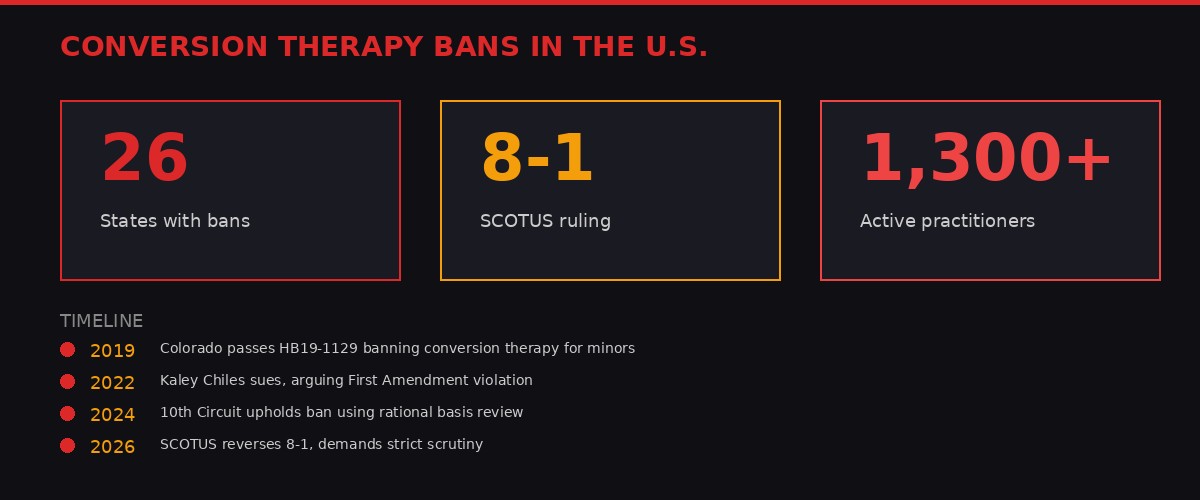
Key numbers behind the ruling. Infographic: BLACKWIRE
The Case: A Colorado Springs Counselor vs. The State

The case began in 2022 when Kaley Chiles challenged Colorado's 2019 law. Photo: Pexels
The case arrived at the Supreme Court through the kind of carefully crafted litigation strategy that conservative legal organizations have perfected over the past two decades. Kaley Chiles is a licensed professional counselor and practicing Christian in Colorado Springs. She does not use electroshock devices. She does not lock patients in rooms. She does not subject anyone to physical interventions. She talks to them.
That framing matters enormously because it allowed the Supreme Court to treat the case as purely about speech - not about the broader category of medical interventions that includes the most extreme and abusive forms of conversion therapy. Chiles told the court she merely helps clients "with their stated desires and objectives in counseling, which sometimes includes clients seeking to reduce or eliminate unwanted sexual attractions, change sexual behaviors, or grow in the experience of harmony with one's physical body."
Colorado passed House Bill 19-1129 in 2019, joining a growing list of states that banned licensed mental health professionals from performing conversion therapy on minors. The law defined conversion therapy as any practice or treatment that seeks to change a person's sexual orientation or gender identity, including efforts to change behaviors or gender expressions or to eliminate or reduce sexual or romantic attractions to people of the same sex.
Chiles challenged the law in 2022. A federal district court declined to block enforcement, and a divided panel of the U.S. Court of Appeals for the 10th Circuit upheld the ban. The 10th Circuit majority treated the law as a regulation of professional conduct that only incidentally touched speech. Under that framework, the court applied "rational basis review" - the lowest standard of judicial scrutiny, which essentially asks only whether the government had any reasonable justification for the law. The state's interest in protecting minors from harmful treatment easily cleared that bar.
The 10th Circuit's approach was consistent with how most federal courts had handled conversion therapy bans. Courts in the Third, Ninth, and Eleventh Circuits had all upheld similar laws, generally finding that they regulated professional conduct rather than protected speech. This legal consensus had held for nearly a decade.
Chiles petitioned the Supreme Court in 2024. The justices agreed to hear the case, and oral arguments last October signaled trouble for the state when justices from across the ideological spectrum expressed skepticism about Colorado's position. On Tuesday, that skepticism crystallized into a sweeping ruling.
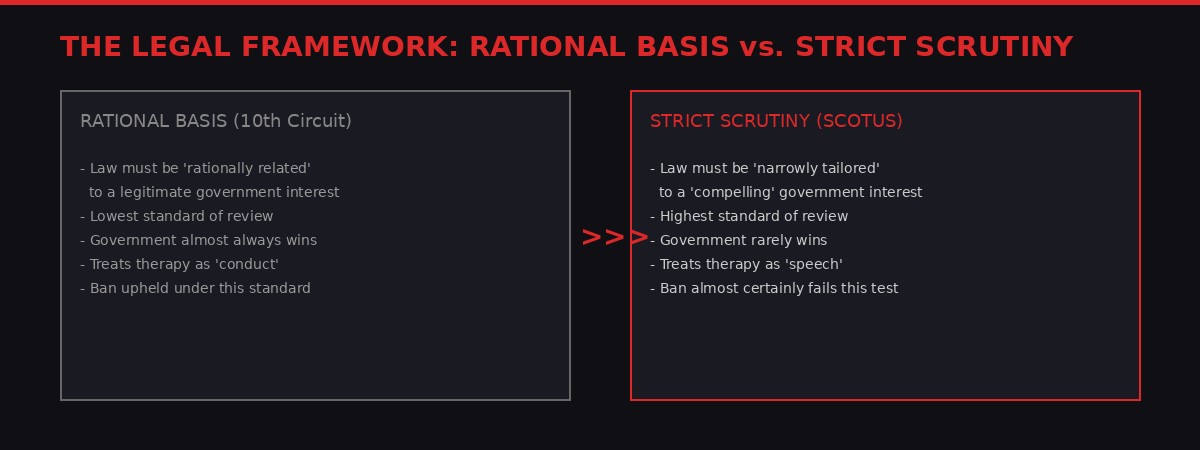
The shift from rational basis to strict scrutiny makes defending these bans nearly impossible. Infographic: BLACKWIRE
Gorsuch's Majority: Speech Is Speech

Justice Gorsuch's 23-page opinion reframed the entire debate around the First Amendment. Photo: Pexels
Gorsuch's 23-page opinion is a masterclass in legal framing. By defining the question narrowly - does the ban violate the First Amendment "as applied to" Chiles's talk therapy specifically - the majority avoided ruling on conversion therapy in the abstract. But the logic of the opinion extends far beyond one Colorado counselor. It effectively reclassifies an entire category of professional regulation as speech regulation, and in doing so, triggers the nuclear option of constitutional law: strict scrutiny.
The core of Gorsuch's reasoning runs through three steps. First, he established that what Chiles does is, fundamentally, speaking. "Although the First Amendment protects many and varied forms of expression," he wrote, "the spoken word is perhaps the quintessential form of protected speech. And that is exactly the kind of expression in which Ms. Chiles seeks to engage."
Second, he argued that Colorado's law does not merely regulate the subject matter of that speech - it targets specific viewpoints. A therapist who affirms a young person's sexual orientation can speak freely. A therapist who tries to change it cannot. That asymmetry, Gorsuch wrote, is textbook viewpoint discrimination. "Colorado does not regulate speech incident to conduct," he concluded. "It regulates 'speech as speech.'"
Third, Gorsuch invoked the court's strongest precedents on viewpoint discrimination to demand strict scrutiny. Under that standard, the government must prove that the restriction on speech is "narrowly tailored to serve a compelling government interest." The court has described this test as one that is "rare" to survive. Translation: conversion therapy bans, as currently written, are almost certainly unconstitutional under the framework this ruling establishes.
"Any law that suppresses speech based on viewpoint represents an 'egregious' assault on both of those commitments." - Justice Neil Gorsuch, majority opinion, Chiles v. Salazar
Gorsuch was careful to note that the court was not directly striking down Colorado's law. "We express no view on those matters," he wrote regarding whether the ban could survive strict scrutiny. But the opinion reads like a road map for the lower courts: apply strict scrutiny, recognize the viewpoint discrimination, and reach the obvious conclusion. Legal scholars who have read the full text describe it as a decision that technically remands but practically decides.
The opinion explicitly rejected Colorado's argument that the law regulates professional conduct rather than speech. This is the most consequential move in the entire ruling. For years, states had built their conversion therapy bans on the legal theory that professional licensing gives the government broad authority to regulate what practitioners do - including what they say in a therapeutic setting. Gorsuch demolished that foundation. When the regulated activity consists entirely of talking, he wrote, you are regulating speech, full stop.
The Kagan Concurrence: A Warning From an Unexpected Direction

Justice Kagan's concurrence joined by Sotomayor stunned observers who expected a liberal dissent bloc. Photo: Pexels
The most surprising element of Tuesday's ruling was not the 8-1 margin. It was the identity of the justices in the majority. Justices Elena Kagan and Sonia Sotomayor - two of the court's three remaining liberal justices - joined Gorsuch's opinion in full. Kagan went further, writing a four-page concurrence that Sotomayor also signed.
Kagan called Chiles's case "textbook" viewpoint discrimination. But her concurrence carried an important nuance that will shape the next round of litigation. She drew a distinction between viewpoint-based laws and content-based but viewpoint-neutral laws. A hypothetical Colorado law that banned all therapy aimed at changing any minor's sexual orientation or gender identity - including therapy that affirms a transition - would be viewpoint-neutral, Kagan wrote, and would raise "a different and more difficult question."
This distinction matters because it gives states a potential path to rewrite their conversion therapy bans. A law that restricts all identity-related therapy equally - whether the therapist is trying to affirm or change a young person's orientation - might survive judicial review. But such a law would be politically impossible. No state that passed a conversion therapy ban intended to restrict gender-affirming care. The bans exist precisely because legislatures wanted to prohibit one direction of therapy while preserving the other.
Kagan's concurrence also functions as a warning to conservatives who might read Tuesday's ruling as a blanket license to deregulate professional speech. "The mirror image of Colorado's law" - one that banned affirming therapy instead - "would raise the same First Amendment concerns," she wrote. In other words, the ruling cuts both ways. States that attempt to ban gender-affirming therapy for minors using the same legislative framework will face the same constitutional obstacle. This is not a one-sided weapon.
The fact that Kagan and Sotomayor joined the majority complicates the political narrative around the ruling. This was not a partisan 6-3 decision along the court's familiar ideological lines. It was a near-unanimous ruling on First Amendment principles, with the court's liberal wing agreeing that speech restrictions based on viewpoint are constitutionally suspect regardless of how well-intentioned the underlying policy might be.
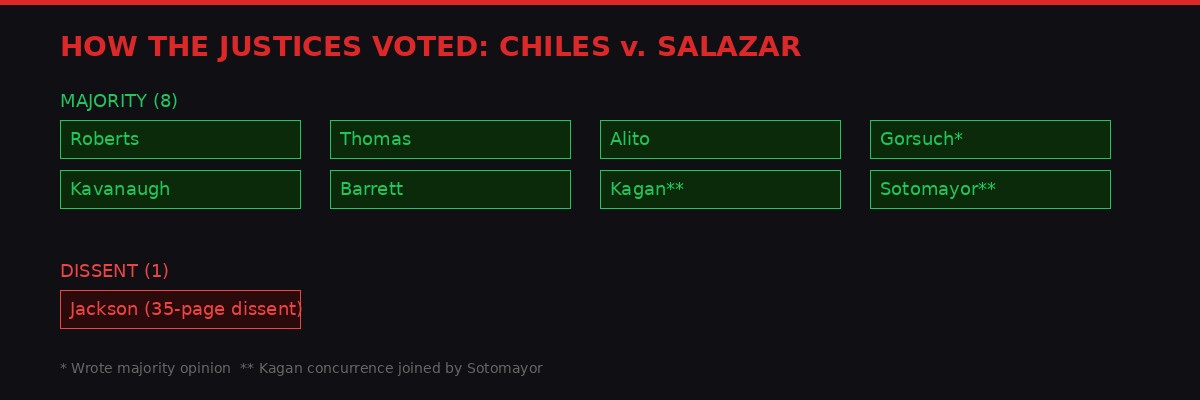
The 8-1 split defied the usual ideological lines. Infographic: BLACKWIRE
Jackson's Dissent: Playing With Fire

Justice Jackson's 35-page dissent warned of consequences for medical regulation far beyond LGBTQ+ rights. Photo: Pexels
Justice Ketanji Brown Jackson stood alone. Her 35-page dissent - read from the bench in a practice reserved for the sharpest disagreements - was a blistering warning about the majority's reasoning and its downstream consequences. She did not merely disagree with the outcome. She argued the entire framework was wrong and dangerous.
Jackson's central argument was that the majority had misidentified what Colorado's law actually does. The law does not target speech because of its content, she argued. It regulates medical treatment. The fact that the treatment happens to consist of talking does not transform it into constitutionally protected expression any more than a doctor's verbal prescription of a drug becomes protected speech because words are involved.
"Chiles is not speaking in the ether; she is providing therapy to minors as a licensed healthcare professional." - Justice Ketanji Brown Jackson, dissent
Jackson pointed out that licensed professionals are already subject to extensive speech-related restrictions. Lawyers cannot lie to judges. Doctors cannot prescribe treatments that violate the standard of care. Financial advisors cannot recommend investments without proper disclosure. Securities brokers face criminal penalties for certain kinds of speech. None of these restrictions have ever been treated as First Amendment violations, Jackson argued, because they regulate professional conduct that happens to involve words.
"Under Colorado law, licensed therapists must provide therapy that is consistent with the standard of care," Jackson wrote. And the standard of care, as defined by every major medical and mental health organization in the United States, holds that conversion therapy is ineffective and harmful to minors. The American Medical Association, the American Psychological Association, the American Academy of Pediatrics, the American Counseling Association, and dozens of other professional bodies have issued statements condemning the practice.
Jackson warned that the majority's reasoning extends far beyond conversion therapy. If a state cannot regulate what licensed professionals say to their clients because that speech reflects a particular viewpoint, then the entire edifice of professional licensing comes under threat. Could a state prevent a licensed nutritionist from recommending a dangerous diet? Could it stop a financial advisor from pushing fraudulent investments? Could it discipline a therapist who tells a suicidal patient to stop taking medication? Under the majority's framework, Jackson argued, all of these regulations become suspect because they all involve the government telling a professional which viewpoints they can and cannot express.
"Ultimately, because the majority plays with fire in this case, I fear that the people of this country will get burned," Jackson wrote. "Before now, licensed medical professionals had to adhere to standards when treating patients: They could neither do nor say whatever they want. The Court turns its back on that tradition. And, to be completely frank, no one knows what will happen now."
The Fallout: 26 States, Millions of Young People

LGBTQ+ advocacy groups called the ruling "painful" and warned it would put young lives at risk. Photo: Pexels
The immediate legal impact of Chiles v. Salazar is limited to Colorado. The case goes back to the 10th Circuit, which must now apply strict scrutiny to the state's conversion therapy ban. But the broader impact is seismic.
Twenty-six states plus the District of Columbia have laws restricting conversion therapy for minors. These laws vary in scope and language, but they share the same fundamental structure that the Supreme Court just condemned: they prohibit therapists from expressing one viewpoint (that a client's orientation or identity should change) while permitting them to express the opposite viewpoint (that a client's orientation or identity should be affirmed). Under the framework established Tuesday, every one of these laws is vulnerable.
Legal challenges will not take long to materialize. The Alliance Defending Freedom, the conservative legal organization that represented Chiles, has a network of affiliate attorneys and allied organizations in every state. They have been preparing for this moment. Within weeks, lawsuits challenging conversion therapy bans are expected in multiple jurisdictions, each one citing Chiles v. Salazar as controlling precedent.
The Trevor Project, which operates a crisis intervention and suicide prevention service for LGBTQ+ youth, responded to the ruling within hours. "The Supreme Court's decision to treat the dangerous practice of conversion therapy as constitutionally protected speech is a tragic step backward for our country that will put young lives at risk," said Jaymes Black, the organization's executive director. "These efforts, no matter what proponents call them, no matter what any court says, are still proven to cause lasting psychological harm."
The data behind that claim is extensive. A 2020 study published in the American Journal of Public Health found that LGBTQ+ youth who had been subjected to conversion therapy were more than twice as likely to report having attempted suicide. A 2023 Trevor Project survey found that more than 1,300 practitioners across the United States continue to offer conversion therapy, many of them in states where it remains legal for adults. With the legal protections for minors now under existential threat, advocates fear that number will grow.
Colorado's Attorney General Phil Weiser responded on social media, calling the ruling "wrong." He noted that conversion therapy "is condemned by all medical associations" and that the state's regulation of the practice "is not about speech." But Weiser's protest captures the political reality of the situation: the medical consensus against conversion therapy is overwhelming, but the Supreme Court has now decided that consensus is irrelevant to the constitutional question.
The ruling also creates a perverse symmetry in the culture war over gender and sexuality in the United States. Conservative states have been moving aggressively to restrict gender-affirming care for minors, passing laws that ban hormonal treatments, puberty blockers, and surgical interventions. Those laws now face the same First Amendment scrutiny that Chiles imposes on conversion therapy bans - a point Kagan made explicitly in her concurrence. The battlefield is level, and the weapon is the same: the government cannot tell licensed professionals which viewpoints they can and cannot express to their patients.
The Broader Constitutional Earthquake

The ruling's implications stretch far beyond LGBTQ+ rights into the foundations of professional regulation. Photo: Pexels
The implications of Chiles v. Salazar extend far beyond the conversion therapy debate. The ruling represents the latest and most dramatic escalation of a decades-long campaign to expand First Amendment protections into areas traditionally governed by professional regulation. Legal scholars have described this trend as "First Amendment Lochnerism" - a reference to the infamous 1905 Supreme Court decision that used economic liberty to strike down labor regulations, and which is now universally regarded as one of the court's worst decisions.
The pattern is clear. In 2018, the court struck down a California law requiring crisis pregnancy centers to disclose information about abortion services (NIFLA v. Becerra). In 2011, the court overturned restrictions on pharmaceutical companies using prescriber data for targeted marketing (Sorrell v. IMS Health). Each decision expanded the scope of the First Amendment into professional and commercial regulation, making it harder for states to set standards for what licensed practitioners can tell their clients.
Chiles takes this trajectory to its logical extreme. If talk therapy is protected speech, then virtually any profession that involves communicating with clients - law, medicine, financial planning, real estate, education - faces potential First Amendment challenges whenever a state tries to regulate the substance of what professionals say. The distinction between professional regulation and censorship, which courts maintained for over a century, is dissolving.
This is not a hypothetical concern. In the wake of NIFLA, litigants challenged state requirements that doctors provide informed consent information before performing abortions. They argued that forcing doctors to recite state-mandated scripts was compelled speech. Some of those challenges succeeded. Chiles gives ammunition to an even wider range of litigants: anyone who can frame a professional regulation as a viewpoint-based restriction on speech now has a plausible constitutional claim.
The irony is thick. The same First Amendment that protects political dissidents and investigative journalists now protects practitioners of a treatment that every major medical organization in the country considers harmful. The same legal framework that shields a citizen's right to criticize the government now shields a counselor's right to tell a fourteen-year-old that their sexual orientation is disordered and should be corrected.
Constitutional law scholars are divided on whether this outcome was inevitable. Some argue that the court's modern First Amendment jurisprudence, with its emphasis on content and viewpoint neutrality, made Chiles foreseeable even if regrettable. Others contend that the majority's opinion represents a radical departure from precedent, one that will destabilize professional regulation across multiple industries and ultimately force the court to articulate a more nuanced framework.
What Happens Next

The legal and political aftershocks of this ruling will play out for years. Photo: Pexels
The case returns to the 10th Circuit Court of Appeals, which must now apply strict scrutiny to Colorado's conversion therapy ban. Both sides will present arguments about whether the state has a compelling interest in banning the practice and whether the law is narrowly tailored to serve that interest. Given the signals in Gorsuch's opinion - which described the ban as viewpoint discrimination and noted that strict scrutiny is "rare" to survive - the outcome on remand appears predetermined.
Simultaneously, copycat lawsuits will begin. The Alliance Defending Freedom and allied organizations have been building a litigation pipeline for years, identifying sympathetic plaintiffs in states with conversion therapy bans and preparing constitutional challenges. The infrastructure exists. The precedent is now established. The only variable is speed.
States with conversion therapy bans face a difficult choice. They can defend their existing laws in court, likely losing under the strict scrutiny framework. They can attempt to rewrite the laws to be viewpoint-neutral, as Kagan's concurrence suggested - but doing so would require restricting affirming therapy alongside conversion therapy, which no state legislature would willingly do. Or they can let the bans die and seek alternative approaches to protecting LGBTQ+ minors, such as strengthening general child abuse statutes or creating new categories of prohibited conduct that do not rest on the speech-versus-conduct distinction.
Congress could act, but the political dynamics make federal legislation unlikely in the current environment. The Therapeutic Fraud Prevention Act, which would have banned conversion therapy nationwide, has been introduced in multiple sessions of Congress without advancing. With the Supreme Court now framing the issue as a First Amendment question, legislative action faces an additional constitutional hurdle.
The most likely near-term outcome is a patchwork of litigation, with conversion therapy bans falling in state after state as courts apply the Chiles framework. Some states may attempt creative legislative drafting to survive strict scrutiny. Others may abandon the effort entirely. The net effect will be a significant reduction in legal protections for LGBTQ+ minors at precisely the moment when political and social hostility toward transgender and gender-nonconforming youth is intensifying.
For the more than 1,300 conversion therapy practitioners already operating in the United States, the ruling is an invitation to expand. For the estimated 700,000 LGBTQ+ Americans who have been subjected to conversion therapy at some point in their lives, it is a signal that the legal system has decided their protection is less important than a therapist's right to speak freely.
Justice Jackson's final words in her dissent deserve to be read without commentary, because they say everything that needs to be said about where this ruling leaves the country:
"To be completely frank, no one knows what will happen now."
The court has spoken. The rest is consequences.
Sources: SCOTUSblog, Amy Howe (March 31, 2026); BBC News (March 31, 2026); AP News (March 31, 2026); Supreme Court opinion, Chiles v. Salazar, No. 24-539; Trevor Project; American Medical Association; American Psychological Association.
Get BLACKWIRE reports first.
Breaking news, investigations, and analysis - straight to your phone.
Join @blackwirenews on Telegram