Phantom Democracy: How Vucic's Machine Bought Serbia's Vote With MAGA Cover Fire
250,000 voters. 10 small municipalities. And enough dark money, fake ballot lists, and imported right-wing American "observers" to expose just how deeply Serbia's ruling party has weaponized democracy's own machinery against itself.

Sunday's local elections in Serbia were supposed to be unremarkable. Fewer than 250,000 voters spread across 10 small municipalities - places like Arandjelovac and Majdanpek - were being asked to choose their local councils. Small-town governance. The kind of vote that doesn't make international headlines.
But President Aleksandar Vucic and his Serbian Progressive Party (SNS) transformed these minor municipal races into a national battleground. They deployed millions of dinars in campaign cash that dwarfs any legal public subsidy. They flooded the ballot with 19 suspected "phantom" electoral lists designed to split and confuse the opposition vote. And they invited American ultra-right activists - figures from the MAGA orbit of Donald Trump - to act not as neutral observers but as enforcers for ruling party polling chiefs.
This is the methodical work of a political machine that has spent over a decade learning how to win elections without losing control. Independent watchdogs in Serbia are sounding the loudest alarm they have raised in years. What they are describing is not isolated irregularity. It is a system.
The Money Nobody Can Track
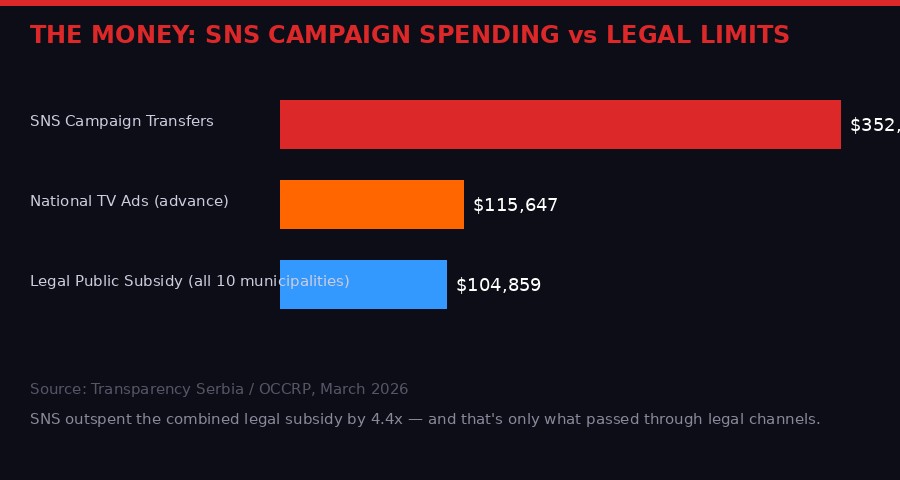
Follow the money - and the money runs out of road fast. According to preliminary campaign finance reports analyzed by the watchdog group Transparency Serbia, the SNS transferred 35.2 million dinars ($344,982) from its main party account specifically to bankroll its local campaigns in these 10 municipalities. It also advanced 11.8 million dinars ($115,647) for national television advertising tied to the race.
Those two figures alone total roughly $460,000 in disclosed spending for an election affecting fewer than a quarter-million voters. The combined legal public campaign subsidy allocated to all 10 municipalities came to just 10.7 million dinars ($104,859) - meaning the ruling party's declared spending already exceeds the public subsidy by more than four to one.
But the disclosed figures are almost certainly a thin slice of the real number. Nemanja Nenadic, program director at Transparency Serbia, told the Organized Crime and Corruption Reporting Project (OCCRP) that "only a small part of the money passes through legal channels."
"There are very serious suspicions that a significant part of the campaign is not financed in any way that complies with the law. The preliminary financial reports are quite useless because they omit the final weeks of the race and hide unpaid debts. The true costs are quietly buried in public budgets and the misuse of state personnel."
- Nemanja Nenadic, Program Director, Transparency Serbia (OCCRP, March 2026)
The Center for Investigative Journalism of Serbia (CINS) reported that during November 2025 local elections in several other municipalities, the SNS spent triple the amount of previous electoral cycles. Those elections were marred by violence - masked men and unmarked vehicles terrorizing polling stations in full view of police. The pattern from November appears to have been carried forward to March, with the dark money structure intact and the overt intimidation replaced by a more sophisticated electoral confusion strategy.
The state resources angle is particularly significant. Serbia's ruling party has effectively fused the SNS apparatus with state infrastructure over 13 years in power. Government employees are pressured to attend rallies. State media is coordinated around SNS messaging. Public contract awards track closely with party loyalty at the municipal level. Watchdogs say this institutional fusion makes the "true" cost of any SNS campaign essentially impossible to separate from ordinary government expenditure - a feature, not a bug, of how the machine operates.
The Phantom Lists: 19 Spoilers in the Ballot Box

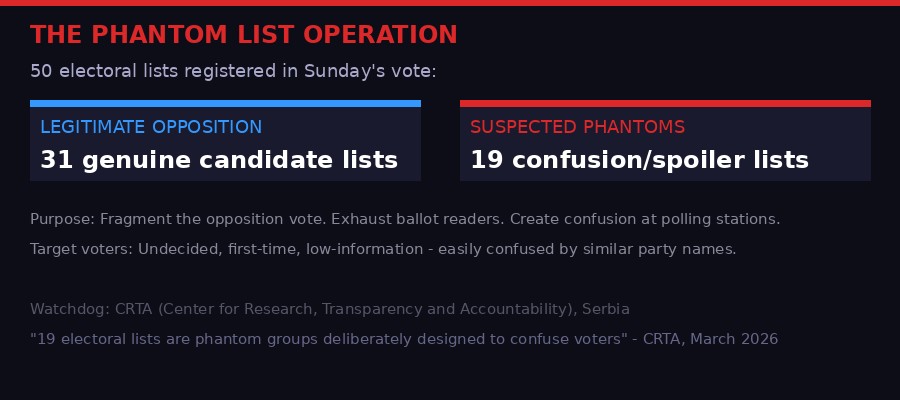
The second pillar of the operation is the ballot itself. Out of 50 registered electoral lists for Sunday's vote, the Center for Research, Transparency and Accountability (CRTA) suspects 19 are "phantom" groups - deliberately constructed entities with names designed to mimic genuine opposition parties, or simply to clog the ballot with noise that exhausts and confuses lower-information voters.
The tactic is elementary in its mechanics and devastating in its effect. A voter who walks into a polling station in Arandjelovac intending to vote for a center-left opposition party may encounter three or four lists with nearly identical names, similar logos, or neighboring position numbers on the ballot. The confusion this creates is not accidental. It is the product of organized, funded effort - entities that must be registered, must have addresses, must have legal signatories, all of which requires coordination and resources only a well-funded machine can provide at scale.
CRTA put the number at 19 out of 50 - a figure representing 38 percent of all registered electoral lists in this election. That proportion is not statistical noise. It represents an organized operation to dilute opposition representation before a single ballot is cast.
The phantom list tactic has precedent in Serbian elections. CRTA has documented its use in previous municipal and parliamentary cycles, but the scale in these March 2026 races represents a notable escalation. Watchdogs say the proliferation of phantom lists tracks directly with the degree to which the ruling party perceives itself under pressure - and SNS, facing ongoing student protests demanding snap elections and growing opposition coordination, is under more pressure than it has been in years.
"Of the 50 registered electoral lists, CRTA suspects 19 are phantom groups deliberately designed to confuse voters and dilute genuine opposition."
- CRTA (Center for Research, Transparency and Accountability), Serbia, March 2026
The legal framework governing electoral list registration in Serbia is permissive enough that establishing a phantom party requires minimal real infrastructure. A registered address, a small number of signatories, a modest registration fee - and a name that sounds plausibly like someone voters might actually want to vote for. The SNS machine, with its network of local party officials and access to state administrative structures, can generate phantom lists at scale with minimal friction. The independent electoral commission lacks both the mandate and the resources to investigate the provenance of every registration.
The MAGA Operatives at the Polling Stations

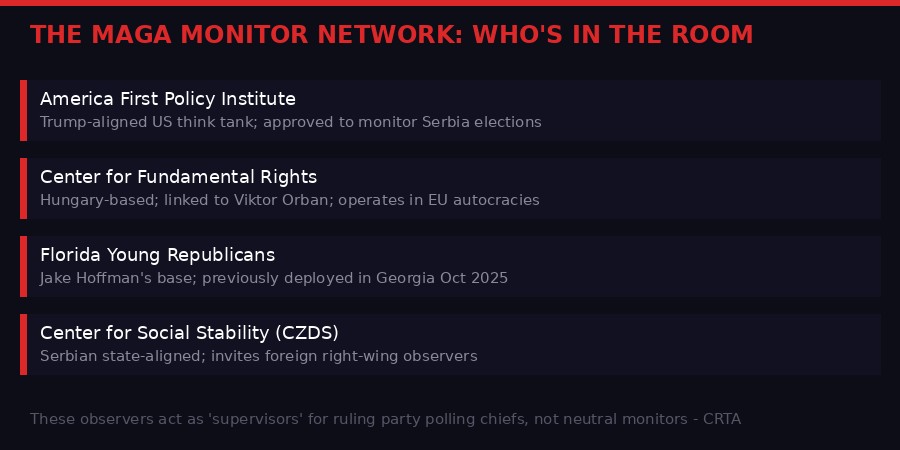
The most internationally significant element of Sunday's election is what showed up at the polling stations - specifically, who showed up claiming to observe them.
Serbian authorities rapidly approved monitoring missions from three U.S. organizations with direct ties to the MAGA movement of President Donald Trump. One of the most prominent is the America First Policy Institute, a Washington-based think tank founded by former Trump administration officials and explicitly dedicated to advancing Trump's policy agenda at home and abroad.
Also present are operatives connected to the Center for Fundamental Rights, a Hungary-based organization closely aligned with Prime Minister Viktor Orban that has operated in multiple European countries where right-wing parties face competitive electoral challenges. The center has a documented pattern of providing "observer" cover to elections held by governments sympathetic to the illiberal nationalist movement Orban represents.
Local media reports identify two specific American operatives slated to monitor Sunday's vote: Jake Hoffman, an executive with the Florida Young Republicans, and Jay Patel. Both men were deployed in an identical capacity during Georgia's local elections in October 2025, where the European Platform for Democratic Elections identified a network of 29 foreign "fake observers" who publicly praised elections that were heavily criticized by legitimate international monitors.
CRTA's program director Rasa Nedeljkov was direct about what these foreign observers actually do once inside Serbian polling stations.
"The appearance of foreign quasi-observers is a step further in destroying the integrity of the elections. Instead of observing neutrally, they act as supervisors for ruling party polling chiefs, even utilizing an SNS lawmaker as a translator."
- Rasa Nedeljkov, Program Director, CRTA (OCCRP, March 2026)
That detail - the SNS lawmaker acting as translator for American "observers" - is not incidental. It is structural evidence of the relationship between the foreign monitors and the ruling party. Genuine international observers do not arrive with party-affiliated interpreters. They do not coordinate with the organizations whose elections they are supposed to be independently evaluating. What Nedeljkov is describing is a cover operation: American right-wing operatives providing the visual and documentary appearance of international legitimacy to an electoral process their presence is designed to validate rather than scrutinize.
The state-aligned Center for Social Stability (CZDS) confirmed its partnership with the America First Policy Institute and explicitly defended the American presence by framing criticism of the monitors as an attack on "patriotism, tradition, a healthy family and sovereignty" - language drawn directly from the culture-war vocabulary of the American MAGA movement. CZDS even referenced conservative U.S. activist Charlie Kirk and past efforts to build a "Trump Tower" in Belgrade, underlining how deeply the Serbian ruling party apparatus has integrated itself with the international authoritarian right.
The Vucic Playbook: A Decade of Democratic Erosion

President Aleksandar Vucic came to power in 2012 as a figure who had previously served as information minister in Slobodan Milosevic's government during the 1990s wars - a record he explicitly renounced before rebranding himself as a pro-EU centrist. His Serbian Progressive Party has governed continuously since, and his personal control of the country solidified after he became president in 2017.
Over that decade, Freedom House's Nations in Transit index has tracked Serbia's democratic trajectory. The country has moved consistently from "Semi-Consolidated Democracy" toward "Hybrid Regime" territory. Press freedom rankings from Reporters Without Borders place Serbia 97th globally in 2025 - below countries like Kosovo, North Macedonia, and Moldova. The European Commission's annual reports on Serbia's EU accession progress have noted, year after year, "limited progress" on judicial independence, media freedom, and the separation of party from state.
The specific tactics deployed in these March 2026 local elections are not new inventions. They represent the mature, refined version of a playbook Vucic's machine has been developing and testing since 2014. The phantom ballot lists appeared in smaller form in local elections in 2016. The use of state resources for campaign purposes was documented in the 2017 presidential election. The dark money flows through non-transparent channels were flagged as a structural problem by Transparency Serbia in 2020. What is new in 2026 is the audacity of the scale and the addition of international right-wing "observer" cover - a development that reflects the SNS's awareness of how the global authoritarian playbook has evolved.
The student protests demanding snap elections that have roiled Serbia since late 2025 provide critical context for why these small municipal elections have become such a high-stakes performance. Vucic used Sunday's races as a dress rehearsal for national polls expected by 2027. Every tool the machine uses in March is being calibrated and tested for deployment at the national level. The phantom lists work at scale. The dark money channels work at scale. The imported "observer" cover works at scale. A machine that wins 10 small municipal elections with overwhelming resource dominance is a machine that believes it can replicate that dominance across 250 municipalities simultaneously.
The Georgia Template: How the Same Network Operates Across Borders

The deployment of Hoffman and Patel in Serbia follows a specific, documented pattern that began in Georgia in October 2025. Understanding what happened there illuminates exactly what the Serbia operation is designed to achieve.
In Georgia's local elections last October, an independent watchdog analysis identified a network of 29 foreign "fake observers" deployed by organizations with ties to the American and Hungarian right. These observers issued statements endorsing the elections' legitimacy while legitimate international monitoring bodies - OSCE/ODIHR and the European Network of Election Monitoring Organizations - documented serious irregularities including voter intimidation, ballot stuffing, and procedural violations at polling stations.
The European Platform for Democratic Elections specifically named the network as a "fake observer" operation and published a detailed account of its functioning. The EPDE concluded that the observers were not functioning as monitors at all but as validators - organizations whose pre-determined conclusions were that the ruling party had won a clean election, regardless of what they witnessed at polling stations.
Hoffman and Patel were among those identified in the Georgia network. Both are connected to the Center for Fundamental Rights in Budapest, which has been documented operating across multiple Central and Eastern European elections with consistent outcomes: the governments they "observe" are always found to have conducted satisfactory democratic processes. The center's funding sources are opaque. Its political alignment with Orban's Fidesz party is explicit and undisputed.
The America First Policy Institute adds a layer of direct Trump White House lineage. Founded by former White House officials including Brooke Rollins and Larry Kudlow, the Institute explicitly frames its international work as extending "America First" principles globally. Providing observer cover for allied authoritarian governments fits neatly within that mission - a service provided in exchange for political alignment, trade cooperation, and the projection of an image of American conservative approval for governance models the formal U.S. diplomatic apparatus would normally criticize.
THE FAKE OBSERVER PATTERN: HOW IT WORKS
- Ruling party invites friendly foreign organizations under "election observer" designation
- Observers are pre-screened for alignment; genuinely neutral observers face visa delays or access restrictions
- Foreign "observers" operate alongside ruling party poll workers, not independently
- Post-election, foreign groups issue statements endorsing election integrity before vote counting is verified
- These endorsements are quoted by state media to rebut legitimate criticism from OSCE/ODIHR
- The operation creates a paper trail of "international approval" that complicates EU and US diplomatic responses
The Timeline: How the Machine Was Built

What Happens Next: The Stakes Beyond the Municipal Race

The immediate outcome of these elections matters less than what the results reveal about the machine's confidence in its own methods. If the full toolkit - dark money, phantom lists, MAGA observers - produces comfortable SNS victories in all 10 municipalities, the conclusion the party will draw is that the system works and can be deployed at national scale when snap elections come, whether in 2027 as currently scheduled or sooner if the protest movement forces acceleration.
The European Union is the principal external actor with leverage over Serbia's behavior. Serbia is formally an EU candidate country, with accession negotiations that have been nominally ongoing since 2014 but have made negligible practical progress. The EU's ability to use accession conditionality as a democratic governance incentive has been significantly weakened by the bloc's own internal contradictions - Hungary's Orban remains an EU member in good standing while providing political cover and operational infrastructure for the exact fake observer network now deployed in Serbia.
The Trump administration's alignment with the MAGA organizations now providing cover for Vucic's elections has removed another traditional lever. Under previous administrations, the U.S. State Department and USAID were consistent sources of funding and political backing for independent election monitoring organizations like CRTA and Transparency Serbia. That funding has been radically curtailed as part of the broader USAID dismantlement that began in early 2025. The independent watchdogs sounding the alarm loudest about Sunday's elections are operating with a fraction of the institutional support they had two years ago.
Transparency Serbia's Nenadic was blunt about the operational challenge this creates: the people best positioned to document the manipulation are the ones whose resources have been most aggressively targeted. The MAGA observer network's arrival in Serbia is not merely political theater. It fills an institutional vacuum left by the defunding of genuine democratic support infrastructure - and it does so with a specific purpose: to produce documentation of "legitimacy" that makes the manipulation harder to contest in international forums.
For Serbia's student protesters - the young people who have been in the streets for months demanding accountability, snap elections, and a Serbia that functions as a genuine democracy rather than an elected autocracy - Sunday's results will be a test of whether the system can be challenged from within or whether the machine is now too deeply embedded to be dislodged through electoral participation alone.
The answer to that question has implications far beyond Serbia's borders. The tactics being refined in Arandjelovac and Majdanpek this weekend are being watched by every ruling party in the region that faces a population demanding accountability. When democratic machinery is systematically converted into an instrument of authoritarian consolidation - phantom by phantom, dinar by dinar, American "observer" by American "observer" - the point at which it can still be reversed grows harder to identify with each cycle.
Follow the money. It leads to the polling stations. And the polling stations are full of people who aren't there to count the votes - they're there to make sure the count comes out right.
WHAT THE WATCHDOGS ARE ASKING FOR
- CRTA: Full disclosure of all campaign finance sources, including in-kind state resource contributions, before results are certified
- Transparency Serbia: Revocation of monitoring credentials for organizations operating as partisan validators rather than independent observers
- OSCE/ODIHR: Deployment of a full observation mission to any subsequent national elections, not just a limited assessment team
- EU Commission: Explicit linkage of accession progress to electoral integrity standards, including rejection of fake observer endorsements as evidence of democratic legitimacy
- Independent journalists: Full registry of all phantom electoral list registrants, their funding sources, and their connections to SNS party infrastructure
Get BLACKWIRE reports first.
Breaking news, investigations, and analysis - straight to your phone.
Join @blackwirenews on Telegram