ShinyHunters' Supply Chain Siege, Magnetic Chips 1000x Faster, and AI That Hunts Its Own Bugs
The week everything converged: supply chain attacks, post-silicon hardware, agentic security, and the IPO-driven consolidation of AI.
Photo: Unsplash
Look at the past seven days and you see something rare: the attack surface, the hardware, the defense, and the corporate strategy all shifting at once. ShinyHunters and their Coinbase Cartel allies turned OAuth supply chains into battering rams, hitting Vercel, Grafana, and Instructure in rapid succession. Researchers published a magnetic switch that operates 1,000 times faster than silicon transistors. Microsoft's new 100-agent security system found 16 zero-days in Windows, including four critical remote code execution flaws. A startup called Recursive Superintelligence raised $650 million to build AI that literally rewrites its own code. And OpenAI, staring down an IPO and a Musk lawsuit, merged ChatGPT and Codex into a single product under Greg Brockman.
These are not separate stories. They are the same story, seen from different angles: the accelerating collision between autonomous systems and the infrastructure they run on, the infrastructure they attack, and the infrastructure that may replace the silicon we have known for 50 years.
I. The ShinyHunters Supply Chain Rampage

Photo: Unsplash
The most immediate lesson of the week is that your security is only as strong as the third-party tool your employee installed last Tuesday. The ShinyHunters group, now operating in alliance with Scattered Spider and Lapsus$ under the umbrella "Coinbase Cartel," has demonstrated exactly how devastating that dependency can be.
Consider the chain of events. In late April, attackers compromised Context.ai, a third-party AI productivity tool used by a Vercel employee. Through stolen Google Workspace OAuth tokens, they impersonated that employee, accessed their Vercel account, and then pivoted deeper into Vercel's platform. The result: partial decryption of customer environment variables, the kind that hold API keys, database credentials, and signing secrets. The stolen data, including a database access key, was listed on BreachForums for $2 million.
Vercel estimates "hundreds of users across many organizations" were affected. But the downstream damage could be far worse. Every API key, every database credential stored in those environment variables is now a potential entry point into the companies that trusted Vercel to keep them safe. Vercel itself was never directly compromised. It was a supply chain attack through an OAuth token granted to a third-party tool.
"The breach serves as a stark reminder that developer platforms are high-value targets - not because of what they contain, but because of what their customers store within them." — Secure Bulletin
Vercel was not the only target. The same cartel hit Instructure, the ed-tech giant behind Canvas LMS, used by universities worldwide. ShinyHunters claimed to have stolen massive amounts of student data. Instructure initially confirmed the breach, then announced it had reached an "agreement" with the hackers to stop the data leak. That "agreement" is widely understood to be a ransom payment, setting a dangerous precedent.
Then came Grafana, the open-source observability platform used by thousands of engineering teams. On May 15, Coinbase Cartel listed Grafana on its leak site. Two days later, Grafana confirmed the intrusion: a compromised token granted access to their GitHub environment. Attackers downloaded Grafana's codebase and demanded a ransom to prevent its public release. Grafana refused to pay.
Sources: Secure Bulletin, SecurityWeek, BleepingComputer
What Organizations Should Do Right Now
Based on the Vercel incident and the broader pattern, there are concrete steps any organization using cloud developer platforms should take immediately:
- Audit every OAuth application connected to your Google Workspace, GitHub, and cloud provider accounts. Remove any tool you cannot verify.
- Rotate all environment variables and secrets stored in platform configuration. Treat any non-sensitive-labeled variable as exposed.
- Mark all secrets as "sensitive" in Vercel and equivalent platforms. Sensitive variables are encrypted at rest and cannot be enumerated even with platform-level access.
- Monitor downstream services for anomalous API activity. If a database key was in those environment variables, assume it is compromised and rotate it at the source.
- Adopt least-privilege OAuth scopes. A productivity tool should not have access to your production infrastructure. If it does, that is a misconfiguration, not an attack.
II. The Magnetic Switch: Silicon's Successor?
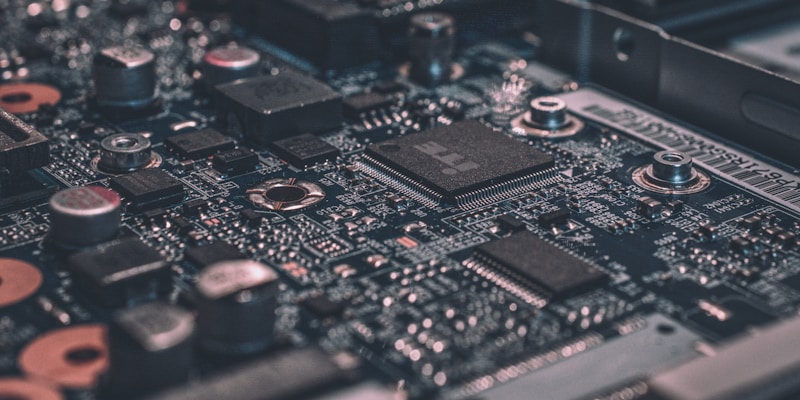
Photo: Unsplash
While attackers found new ways through software, researchers found a way past the physical limits of hardware. A team published a study in Science this week demonstrating a magnetic switch that flips binary states at picosecond speeds, roughly 1,000 times faster than the nanosecond-scale transistors in current silicon processors. The breakthrough, which builds on earlier work published in Nature in January 2025, manipulates the magnetic orientation of materials rather than pushing electrons through a channel.
The implications are enormous because they address the two biggest bottlenecks in modern AI hardware simultaneously: speed and heat.
| Feature | Standard Silicon (CMOS) | New Magnetic Switch |
|---|---|---|
| Switching Speed | Nanosecond scale (10^-9s) | Picosecond scale (10^-12s) |
| Heat Output | High (requires active cooling) | Negligible |
| Mechanism | Electron charge flow | Binary magnetic state flip |
| Relative Speed | 1x (baseline) | ~1,000x faster |
The speed advantage is intuitive: one thousand times faster means computations that currently take hours could take seconds. But the heat advantage may matter more. The thermal design power of NVIDIA's H100 GPU is 700 watts. A single B200 draws 1,000 watts. Data centers running thousands of these chips require industrial liquid cooling. The magnetic switch, because it does not rely on pushing current through silicon, generates negligible heat. This is not an incremental improvement in thermal management. It is the elimination of the thermal problem entirely.
If this scales, the consequences cascade outward:
- Edge AI becomes real. Current GPT-class models cannot run on phones or wearables because the chips overheat. A magnetic switch could put frontier intelligence on a wristwatch with no fan and no heat sink.
- Data center economics invert. Cooling infrastructure accounts for 30-40% of data center energy consumption. Remove the heat problem, and you remove the single largest operational cost.
- Hardware longevity improves. Heat is the primary killer of semiconductor lifespan. "Cold" chips would theoretically last significantly longer than current silicon.
- Decentralized AI becomes viable. If massive models can run on low-power hardware, the economic argument for centralized cloud AI providers weakens. Users could run models locally, with all the privacy and latency benefits that entails.
Source: TechSpot via Time News, original research published in Science
III. Microsoft's MDASH: AI That Finds Bugs Faster Than Humans

Photo: Unsplash
The same week that ShinyHunters demonstrated how far offense has come, Microsoft showed how far defense is advancing. On May 12, the company unveiled MDASH (Microsoft Security's multi-model agentic scanning harness), a system that orchestrates more than 100 specialized AI agents to discover, debate, and prove exploitable vulnerabilities end-to-end.
MDASH found 16 previously unknown Windows vulnerabilities, including four critical remote code execution flaws. One of them, CVE-2026-33827, was a remote unauthenticated use-after-free bug in the Windows IPv4 stack reachable through specially crafted packets. Another, CVE-2026-33824, was a pre-authentication double-free in the IKEEXT service affecting RRAS VPN, DirectAccess, and Always-On VPN deployments. Both had CVSS scores of 9.8.
What makes MDASH different from previous AI security tools is the architecture. It is not a single model prompted to find bugs. It is a pipeline of specialized agents, each with its own role:
- Prepare stage: Ingests source code, builds language-aware indices, and generates attack surface models from historical commit data.
- Scan stage: Specialized auditor agents run over candidate code paths, emitting findings with hypotheses and evidence.
- Validate stage: A second cohort of "debater" agents argues for and against each finding's reachability and exploitability. Disagreement between models increases a finding's credibility.
- Dedup stage: Collapses semantically equivalent findings.
- Prove stage: Constructs and executes triggering inputs. For C/C++ bugs, this means building actual crash-reproducing proof-of-concept inputs, not just theoretical descriptions.
The results are striking. On a private test driver with 21 planted vulnerabilities, MDASH found all 21 with zero false positives. Against five years of confirmed Microsoft Security Response Center cases in clfs.sys and tcpip.sys, it achieved 96% and 100% recall respectively. On the public CyberGym benchmark of 1,507 real-world vulnerabilities, it scored 88.45%, roughly five points ahead of the next entry.
Sources: Microsoft Security Blog, Computerworld
IV. Recursive Superintelligence: $650M for AI That Rewrites Itself
Photo: Unsplash
While Microsoft built AI that finds bugs, Richard Socher is building AI that might eventually find its own. Recursive Superintelligence Inc. launched this week with $650 million in funding led by GV (Alphabet's venture arm) and Greycroft, with participation from Nvidia and AMD's venture arm. The round values the company at $4.65 billion.
Socher, formerly Salesforce's Chief Scientist and the founder of You.com, is pursuing what the company calls "recursive self-improving superintelligence." The idea: build an AI model that can improve its own codebase, then improve the harness around it, then improve the training infrastructure, in an open-ended loop of automated scientific discovery.
The company's initial team of seven has grown to more than 25 employees across San Francisco and London. According to Socher, the AI will "search for ways to improve itself by carrying out simulations in an open-ended process of automated scientific discovery," developing experiment ideas, testing them, and validating results. Guardrails will prevent risky outputs, though the company has not detailed what those guardrails look like.
The competitive landscape is already heating up. Rival Ineffable Intelligence raised $1.1 billion at a $5.1 billion valuation in April, using reinforcement learning to pursue similar goals. OpenAI's GPT-5.5 recently demonstrated self-improvement by developing a more efficient parallelization method for its own inference, boosting token generation speeds by over 20%.
The timing is notable. Recursive's funding comes the same week that OpenAI is consolidating ChatGPT and Codex into a single platform under Brockman, and the same week that Google I/O 2026 is headlining agentic capabilities. The AI industry is no longer debating whether agents are real. It is fighting over who builds them best.
Source: SiliconANGLE, New York Times
V. OpenAI Consolidates: The Side Quests Are Over

Photo: Unsplash
In a move that tells you everything about where AI companies are heading, OpenAI co-founder Greg Brockman has permanently taken charge of product strategy, merging ChatGPT, Codex, and the developer API into a single product organization. In an internal memo obtained by Wired, Brockman wrote that OpenAI will "invest in a single agentic platform and to merge ChatGPT and Codex into one unified agentic experience for all."
The restructuring kills what OpenAI internally calls "side quests." Sora, the video generation app, was shut down after consuming vast computing resources relative to its revenue and triggering the collapse of a planned $1 billion Disney investment. OpenAI for Science was halted. An "adult mode" for ChatGPT was shelved after internal pushback. Kevin Weil, head of Sora, and Bill Peebles, who led the product, both departed.
The reason is resource constraint. As Brockman explained on a podcast, OpenAI's computing power is "not enough for even a personal assistant and the Codex line." When you cannot run multiple product teams with separate roadmaps on the same GPU fleet, you consolidate.
The competitive pressure is immediate. Cursor has reached $2 billion in annualized revenue and is raising at a $50 billion valuation. Anthropic's Claude Code is gaining ground with enterprise developers. Google Gemini has grown its AI web traffic share from 5.7% to 21.5% over the past year, while ChatGPT's share declined from 86.7% to 64.5%. Google I/O 2026 opened this week with agentic coding and Gemini updates headlining the agenda. Two years ago, OpenAI countered Google I/O by unveiling GPT-4o the day before. This year, OpenAI is countering with an org chart.
And then there is the Musk v. Altman trial, which began jury selection this week in Oakland federal court. Musk's lawsuit seeks up to $150 billion in damages and the unwinding of OpenAI's nonprofit-to-profit conversion. The most damaging evidence is a 2017 diary entry from Brockman himself: "I cannot believe that we committed to non-profit if three months later we're doing b-corp then it was a lie." Brockman is now simultaneously leading product strategy, overseeing infrastructure buildout, and serving as a central figure in the trial that could determine whether OpenAI's legal structure survives.
Source: The Next Web
VI. The Cosmic Ray Rule: Physics Catches Up to Pattern

Photo: Unsplash
Not every breakthrough this week happened in a data center. Researchers working with the DAMPE (Dark Matter Particle Explorer) space telescope, including a team from the University of Geneva, published findings in Nature that resolve a century-old mystery about cosmic rays.
Since their discovery in 1912, cosmic rays have presented a puzzle: where do they come from, and what accelerates them to such extreme energies? The DAMPE data reveals a universal pattern. For every type of nucleus studied, from lightweight protons to heavy iron, the number of particles begins dropping much faster beyond a rigidity threshold of roughly 15 TV (teraelectron-volts). This "spectral softening" appears across all particle types, strongly supporting theories that cosmic ray acceleration and propagation are controlled by rigidity, not energy per nucleon. The confidence level against competing models reaches 99.999%.
The University of Geneva team developed AI methods to reconstruct particle events detected by the telescope, and they built the Silicon-Tungsten Tracker (STK), the instrument essential for tracing particle paths and determining charge. It is another example of AI enabling scientific discovery, but this time the AI is analyzing data from space rather than scanning code on Earth.
Source: ScienceDaily, published in Nature
VII. The Convergence
Step back and the pattern is unmistakable. The same week:
- Attackers used OAuth supply chains to breach three major platforms, proving that integration is both the strength and the vulnerability of modern software.
- Researchers demonstrated a hardware technology that could eliminate the thermal bottleneck constraining every AI data center on Earth.
- Microsoft showed that AI can find security flaws faster and more accurately than human auditors, but only when you build the right system around the model.
- A startup raised $650 million to build AI that improves itself, while the largest AI company consolidated its products around a single platform in preparation for an IPO.
- And physicists used AI to decode a pattern in cosmic rays that has eluded explanation for over a century.
The thread connecting these stories is autonomy. Not just autonomous agents, but autonomous systems: systems that find bugs, systems that breach platforms through integration points, systems that improve their own code, systems that process cosmic ray data without human guidance. The question for the next decade is not whether autonomous systems will transform computing. It is whether the infrastructure, the governance, and the security can keep up with the pace of transformation.
Based on this week, the answer is: not yet. But the gap is narrowing.
Tags: ShinyHunters, Vercel, Grafana, Instructure, supply chain attack, OAuth, magnetic switch, post-silicon, spintronics, MDASH, Microsoft security, AI vulnerability discovery, Recursive Superintelligence, OpenAI, Greg Brockman, ChatGPT, Codex, IPO, cosmic rays, DAMPE, University of Geneva