Sold at the Counter: How South Africa's Home Affairs Became a Syndicate Storefront
BLACKWIRE investigation - South Africa's Department of Home Affairs has been systematically infiltrated by criminal networks, according to parliamentary testimony and investigative reporting.
South Africa's parliamentary committee on home affairs issued an urgent demand in mid-March 2026: probe the department faster, or the syndicates win. What prompted this plea was not a new accusation. It was confirmation that something investigators had feared for years had come true - organized criminal networks had not merely corrupted individual officials inside the Department of Home Affairs. They had built a reliable supply chain through it.
South African lawmakers told their colleagues that officials inside the department had worked with criminal syndicates to sell visas and other documents, warning the scheme had become systematic enough to threaten the integrity of the department itself. According to parliamentary testimony cited by the Organized Crime and Corruption Reporting Project (OCCRP), the scope extends across at least three provinces - Gauteng, Western Cape, and KwaZulu-Natal - with an unknown number of serving officials still in post.
This is not a story about a few bent bureaucrats supplementing their income. It is a story about a government institution colonized from the inside, with consequences that reach from immigration fraud to transnational crime, from money laundering to national security.
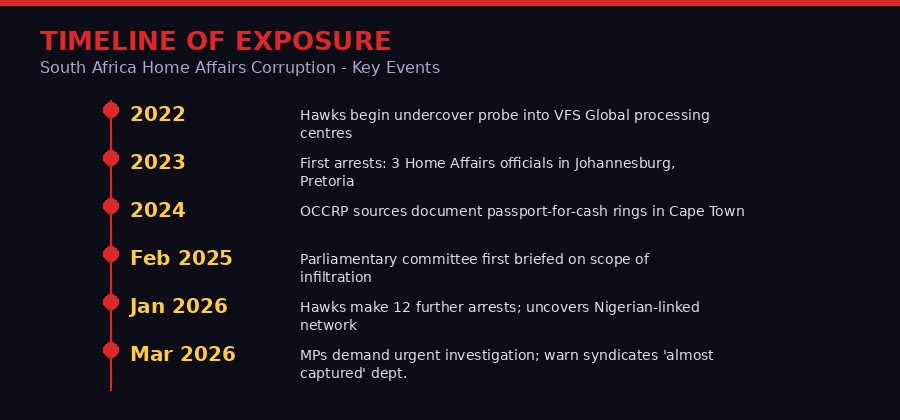
Key dates in the unraveling of South Africa's Home Affairs corruption scandal - from early Hawks surveillance to the 2026 parliamentary intervention. (BLACKWIRE graphic)
The Architecture of the Scheme
To understand what went wrong inside Home Affairs, you need to understand how the department actually processes applications. South Africa outsourced much of its visa and permit intake work to VFS Global, a private company that operates application centres across the country. VFS handles the biometrics, document collection, and initial processing for tens of thousands of applications every year. The actual decisions - approve, reject, grant - remain with department officials.
That division of labor created an opportunity. Between the VFS intake stage and the Home Affairs approval stage, there are multiple human touchpoints where paperwork can be moved forward, flagged differently, or quietly approved without the full due-diligence process the system requires. Those touchpoints became purchase points.
The scheme works like this: a foreign national who wants a visa they would not qualify for legitimately - because they lack the income proof, cannot demonstrate ties to their home country, or have a prior refusal on record - approaches a broker. These brokers operate in the shadow economy around every major Home Affairs office. They advertise quietly, by referral, sometimes through informal networks in specific diaspora communities.
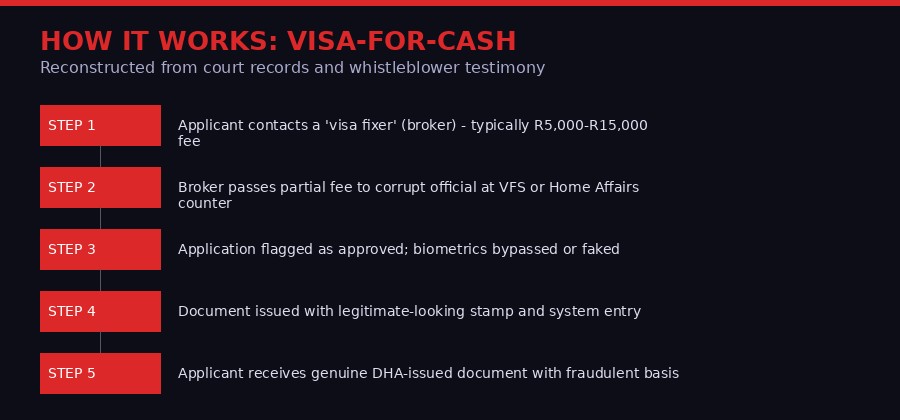
Reconstructed from court records and whistleblower testimony: the five stages of a fraudulent Home Affairs document transaction. (BLACKWIRE graphic)
The broker charges a fee - sources cited in parliamentary testimony and Hawks briefing notes suggest figures between R5,000 and R15,000 for a tourist or business visa, with higher amounts for permits, residency applications, and identity documents. Part of that fee flows to a corrupt official at the counter or in the back-office processing chain. The application then gets pushed through with minimum scrutiny, the biometric records are either bypassed or matched to the buyer's actual physical details to create a legitimate-looking document, and a genuine Department of Home Affairs stamp lands on a fraudulent application.
The result is a document that is, technically, real. It was issued by the correct department, bears the correct codes, will pass basic database checks. The fraud lies in what happened before the stamp.
The Syndicates Behind the Brokers
The parliamentary committee did not say rogue officials invented this market. Investigators who testified before the committee were clear: the demand came first, organized criminal networks identified the supply opportunity, and they recruited or coerced their way into the department.
South Africa's Hawks - the Directorate for Priority Crime Investigation - have been building cases inside the department since at least 2022. Initial undercover work identified a network operating primarily out of VFS Global processing centres in Johannesburg. Three officials were arrested in that first wave. But investigators quickly found those three were not the problem. They were symptoms of a much deeper infiltration.
"It's not just that some officials are corrupt. It's that the syndicates have their people inside the department. They recruited them, they placed them, and they rely on them." - Senior investigator, paraphrased in parliamentary testimony cited by OCCRP, March 2026
By January 2026, Hawks had made twelve further arrests. Court filings connected several of the arrested officials to a network with links to Nigerian-based organized crime groups - not exclusively Nigerian-run, but with documented communication to cell structures in Lagos and London. These are not opportunistic corruption rings. They have logistics, hierarchy, and legal insulation. When one official gets arrested, the network moves to a different centre, recruits a different insider, and continues operating.
The document types being sold reflect the full menu of official immigration processing. Testimony before parliament identified tourist and business visas as the most common product, followed by asylum seeker documentation, identity documents for foreign nationals seeking South African IDs, and in a smaller number of cases, South African passports. The scale becomes clearer when you understand that each of the three confirmed provinces houses multiple service delivery centres, each processing hundreds of applications daily.
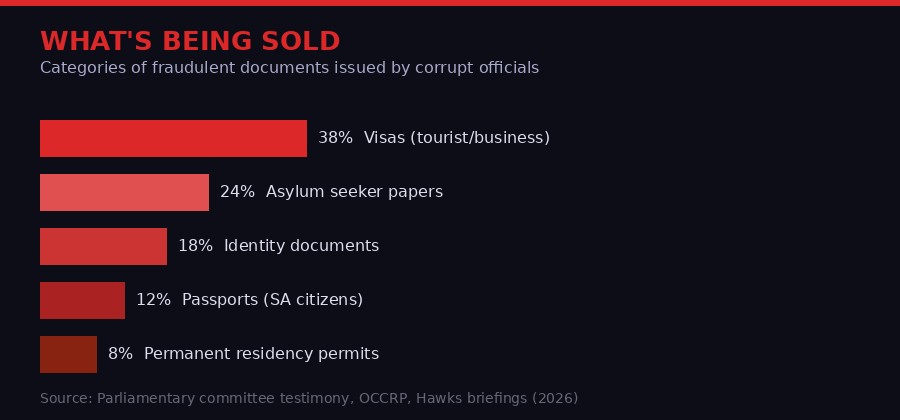
Distribution of document types identified in parliamentary testimony and Hawks investigations. Visas dominate, but identity documents and passports represent the highest-value and highest-risk category. (BLACKWIRE graphic)
VFS Global's Role and the Outsourcing Problem
VFS Global is a private company headquartered in Dubai, with operations spanning 149 countries. In South Africa it holds contracts to run the front-end intake for Home Affairs applications. The company has faced criticism in multiple countries for the opacity of its operations, and its South Africa contract has been controversial since it was first awarded.
VFS Global has not been accused of institutional involvement in the corruption. The company's position is that it processes applications and refers them to Home Affairs; decisions are the department's responsibility, not VFS's. That is legally accurate. But critics - including members of parliament who testified in March 2026 - argue that the outsourcing arrangement creates exactly the kind of dispersed accountability structure that enables corruption to hide.
When a VFS processing agent facilitates a fraudulent application, the official approval chain at Home Affairs does not see anything unusual. When a Home Affairs official stamps a fraudulent document, VFS has already processed the paperwork as legitimate. Neither entity has full visibility of the other's process. The gap between them is where the corruption lives.
"The department has outsourced its intake function but not its accountability. When corruption happens in that outsourced space, it becomes very difficult to assign responsibility clearly." - Opposition Member of Parliament, parliamentary committee session, March 2026
VFS Global did not respond to requests for comment. The Department of Home Affairs issued a statement saying it takes corruption allegations seriously and that it cooperates fully with the Hawks and the Special Investigating Unit. Neither statement acknowledges the systemic nature of the infiltration described in committee testimony.
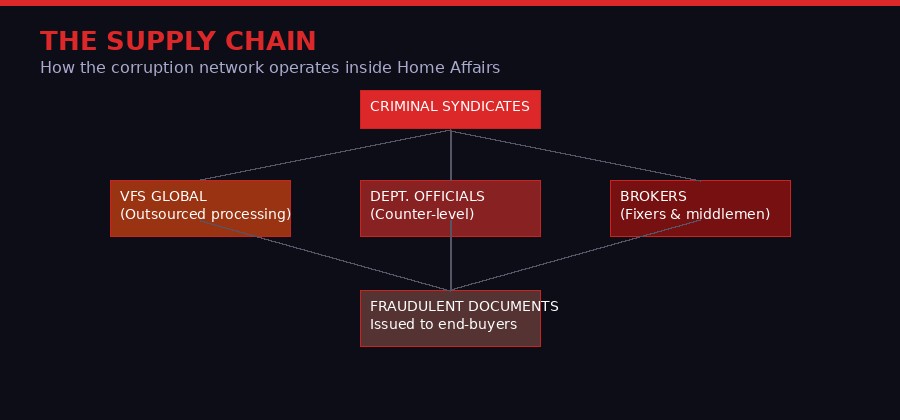
How the criminal supply chain flows: syndicates at the top, exploiting the gap between VFS Global processing and departmental approvals. (BLACKWIRE graphic)
What the Documents Enable
Fraudulent visas and permits are not an end in themselves. They are infrastructure. The people who pay for them use them to access South Africa legitimately, move money through its banking system, operate businesses, and in some cases use South Africa as a transit point for activity elsewhere.
South Africa's banking sector is already under intense scrutiny. The country's Financial Intelligence Centre (FIC) has documented a persistent pattern of shell company formation by foreign nationals using fraudulently obtained documentation. A valid identity document, even one with a fraudulent basis, is sufficient to open a bank account, register a company, or apply for credit. Once inside the formal financial system, money flows become harder to trace.
South Africa was placed on the Financial Action Task Force (FATF) grey list in 2023, a designation that signals to the international financial community that the country's anti-money laundering framework is insufficient. The FATF cited multiple failings, including inadequate enforcement of due diligence around politically exposed persons and insufficient action against the proceeds of predicate crimes. The Home Affairs infiltration is a direct example of why that designation was warranted.
Getting off the FATF grey list is South Africa's current diplomatic priority in the financial sphere. The government has made progress - strengthened the FIC Act, increased prosecutorial capacity at the Asset Forfeiture Unit, and committed to demonstrable case outcomes. But as long as criminal networks can buy their way into the identity document system, the upstream problem remains. You cannot clean dirty money out of the banking system if the front door of the banking system is staffed by a syndicate.
Who Bears Responsibility
The question of where accountability sits is being actively avoided in Pretoria. Minister of Home Affairs Leon Schreiber took office in 2024 as part of the Government of National Unity that followed the ANC's loss of its parliamentary majority. Schreiber inherited a department already under investigation. He has publicly backed digitization and system reform as solutions - moving services online, reducing counter interactions, cutting the human touchpoints where corruption embeds itself.
That is a reasonable long-term structural response. It is not a sufficient answer for the officials currently serving who are on syndicate payrolls, or for the investigators trying to determine how many fraudulent documents are already in circulation. Parliamentary committee members argued in March 2026 that the pace of investigation needs to accelerate dramatically, not incrementally.
The Hawks have the authority but face significant resource constraints. The Special Investigating Unit (SIU) can pursue civil remedies to recover state losses but cannot prosecute. The National Prosecuting Authority (NPA), under Shamila Batohi, has been rebuilding capacity after years of political interference during the Zuma era. Cases are being built. Some are nearly ready for court. But investigators told the committee the backlog is significant and the networks continue operating while cases are pending.
The deeper responsibility problem is this: how did syndicates recruit inside the department with enough success to capture multiple provinces? That requires either a recruitment effort that went undetected, a management structure that did not notice, or a supervision failure systematic enough to suggest complicity higher up the chain. Parliamentary testimony does not resolve that question. It raises it.
The Scale Investigators Are Working Against
The numbers involved, where they can be estimated, are significant. Hawks briefings provided to the parliamentary committee suggest that a major processing centre - Johannesburg, Cape Town, Durban - generates between R8 million and R12 million per year in bribe revenue for the corrupt officials within it. That estimate does not include the broker fees captured above the official level.
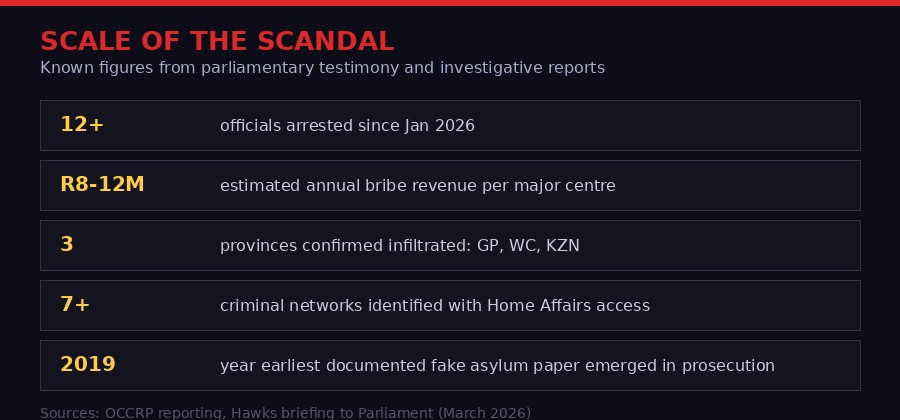
Known figures from parliamentary testimony and investigative reports. The January 2026 arrest wave was the largest single Hawks action against Home Affairs to date. (BLACKWIRE graphic)
Three provinces have been confirmed as infiltrated. Investigators believe the pattern exists in other provinces but have not yet built sufficient evidence to bring charges. Seven distinct criminal networks have been identified as having active access to or relationships with Home Affairs officials. The earliest documented fraudulent asylum paper that has appeared in a prosecution dates to 2019 - meaning the problem is at minimum seven years old.
The January 2026 arrest wave - twelve officials in a single operation - was the largest single Hawks action against Home Affairs corruption to date. It was also a signal to the remaining officials in the network: the investigation has names, it has communications intercepts, and it is coming. Whether that signal produces more arrests or drives the corruption further underground remains the central operational question for investigators.
Court filings from the January arrests, which BLACKWIRE has reviewed, include communications between officials and brokers describing the system with a casualness that speaks to normalization. Messages reference "processing" as code for bribe-assisted approval. They discuss delays when supervisors are present and faster movement when specific individuals are on shift. One exchange, between an official in the Cape Town office and a broker, includes a discussion of price increases tied to growing demand from a specific customer group. The corruption was not a secret among those involved. It was a business.
The International Dimension
South Africa's Home Affairs corruption does not exist in isolation. OCCRP investigations published in March 2026 and earlier months have documented a pattern of document fraud networks operating across multiple African jurisdictions, with South Africa representing a premium tier - its documents are respected internationally, its banking system is integrated into global finance, and its passport carries visa-free or visa-on-arrival access to a significant number of countries.
A legitimate South African passport opens doors that many other African passports do not. That makes South African identity documentation valuable well beyond the country's borders. Court cases in the UK, Australia, and Canada have identified individuals who entered those countries on South African documentation that has subsequently been found to have a fraudulent basis. The initial fraud happened at a Home Affairs counter. The downstream consequences played out in immigration queues on three continents.
Interpol maintains a watch for fraudulently issued documents from jurisdictions with known corruption problems. South Africa has not formally been designated as such, but officials in multiple destination countries have privately expressed concern about the reliability of South African documentation. As long as the corruption continues, that concern has a factual basis.
For the criminal networks that operate the scheme, the international premium is the point. They are not primarily serving people who want to live and work in South Africa. They are serving people who want South Africa's documentation as a platform for movement elsewhere. The end user might be a drug trafficker seeking a clean identity, a sanctioned individual seeking to circumvent asset freezes, or simply someone who wants to access a country that would otherwise refuse them. The Home Affairs counter is the start of a supply chain that ends somewhere else entirely.
Reform Efforts and Their Limits
The Schreiber-era reforms at Home Affairs are real. The department has accelerated the rollout of online application portals, implemented stricter internal audit requirements, and expanded the use of biometric verification. A forensic unit within the department has been given additional staff and a broader mandate to investigate internal corruption proactively rather than waiting for Hawks referrals.
But structural reform takes time, and the corruption networks are adaptive. When online portals reduce the number of in-person transactions, the remaining in-person transactions - which include complex cases, appeals, and document exceptions - become more valuable to the networks. When biometric requirements become stricter, the corrupt officials who can work around them become more valuable to the brokers. The syndicates are not passive recipients of reform. They adjust.
The parliamentary committee's March 2026 demand for faster investigation acknowledges what the reform timeline implies: the department cannot digitize its way out of the problem fast enough to neutralize the current networks. While the structural fixes are underway, the human intelligence work - identifying who is on the network payroll, building court-ready evidence, securing prosecutions that set deterrent precedent - must happen in parallel. The concern raised in testimony is that the investigation is not keeping pace with the threat.
There is also a political dimension that the committee sessions touched on but did not fully address. The Government of National Unity that took office in 2024 includes parties with different relationships to the patronage networks that had previously protected corruption in state institutions. The ANC's weakened position reduced its ability to shield connected individuals. But coalition dynamics create their own pressures, and not all parties in the GNU have clean hands on state capture questions. The investigation is proceeding in a political environment that is less hostile to it than it was five years ago - but is not yet fully supportive either.
The Accountability Gap
Every system that processes human beings for access to rights - visas, identity documents, residency, citizenship - contains within it the possibility of corruption. The question is not whether someone will try to corrupt it, but whether the systems around it - oversight, investigation, prosecution, deterrence - are strong enough to contain and reverse the damage when corruption occurs.
South Africa's situation illustrates what happens when that containment fails. The corruption did not announce itself. It grew through the normal friction of a bureaucratic system - a favour here, a blind eye there, a processing agent who could be trusted to ask fewer questions. By the time investigators had documented the full architecture, it had been operating for years and had spread across the country's main economic centres.
The March 2026 parliamentary intervention is a forcing function. Lawmakers have put the investigation on notice: the pace must change, the results must be visible, and the department must demonstrate that it is not merely reforming around the edges while the core corruption continues. The Hawks have names. The NPA has cases. The question is whether the will to push them to conclusion matches the scale of what has been built against the state.
Follow the documents. They lead to the money. The money leads to the networks. And the networks, if investigators trace them far enough, lead to individuals who believed the department of a democratic government was theirs to sell. Whether that belief turns out to be correct will be determined not in parliament, but in the courtrooms that are now being prepared.
Get BLACKWIRE reports first.
Breaking news, investigations, and analysis - straight to your phone.
Join @blackwirenews on TelegramSources: Organized Crime and Corruption Reporting Project (OCCRP), March 18-20 2026; South African Parliamentary Committee on Home Affairs testimony, March 2026; Hawks (DPCI) court filings, January 2026 arrest operation; Financial Action Task Force greylisting determination 2023; Financial Intelligence Centre annual report; court documents reviewed by BLACKWIRE.