'He Came Back in a Coffin': The 21 Million South Asian Workers Trapped in a War They Didn't Start
They built the towers. They laid the pipes. They drove the tuk-tuks and swept the refineries and wired the skyscrapers. Now missiles are falling near their dormitories, and they cannot afford to go home.

Kuna Khuntia was 25 years old. He had moved to Doha only a few months earlier, in late 2025, to work as a pipe fitter. His family in Naikanipalli village in Odisha, eastern India, had borrowed 300,000 rupees - roughly $3,200 - to pay for his two sisters' marriages. He was sending home 15,000 rupees ($164) every month to help clear the debt.
On the night of March 6, he called his father Jaya. He said: "I am safe here, don't worry." It was the last thing he ever said.
The next morning, missile interceptions were screaming overhead. Debris fell near his residence. Kuna collapsed from a heart attack. He was declared dead later that day. His body arrived home in a coffin.
"We thought our suffering was finally ending. My only son would say, 'Baba, don't worry, I am here.' He was our only hope. Our everything." - Jaya Khuntia, father. Naikanipalli village, Odisha, India. Reported by Al Jazeera.
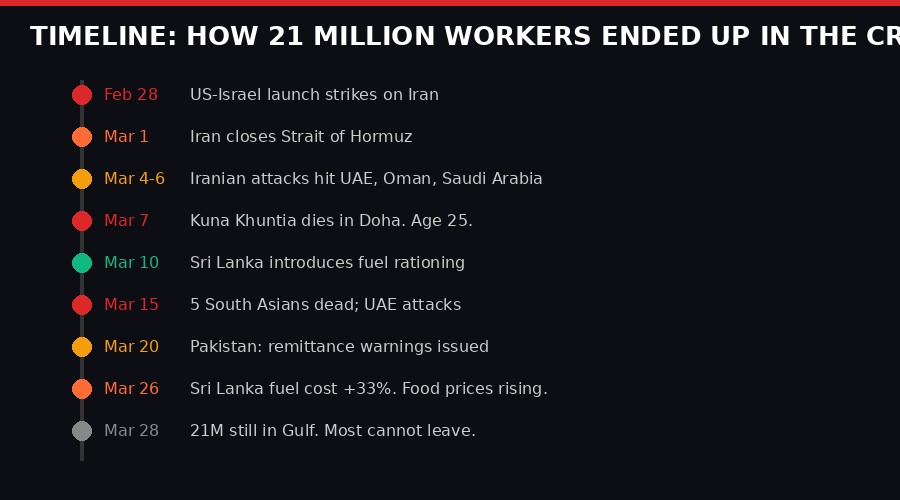
Twenty-one million people like Kuna are currently working across the six Gulf nations - Bahrain, Kuwait, Oman, Qatar, Saudi Arabia, and the UAE. They constitute a third of the region's entire population. They are the ones who, since the United States and Israel launched their war on Iran on February 28, have been dying in the spaces between armies.
The Invisible Casualties
The headline death tolls from the Iran war tell one story. The South Asian casualty count tells another, quieter one - the one that rarely makes front pages in Washington or Tel Aviv.
Of the eight people killed in the UAE from Iranian strikes, only two were Emirati military personnel. The remaining six were civilians. Five of those civilians were South Asians - three from Pakistan, one from Bangladesh, one from Nepal. All three people killed in Oman were Indian nationals. The two confirmed civilian deaths in Saudi Arabia: one Indian, one Bangladeshi.
That is at least 11 South Asian civilians dead in a conflict they had no part in starting. In a war framed as a confrontation between great powers and regional states, the body count among the poorest, most vulnerable workers - the ones with no evacuation plans, no diplomatic clout, no corporate relocation packages - keeps quietly rising.
Hamza, a Pakistani migrant laborer working at an oil storage facility in the UAE, watched a drone strike a storage unit directly in front of him. "We were completely shaken," he told Al Jazeera. "Most of us there are from India, Pakistan and Bangladesh. We couldn't sleep for nights after that. For a moment, I thought we would be next."
He wants to leave. He cannot.
"We want to go back, but we can't. Our families depend on us. It's dangerous here, but if we stop working, they will have nothing to eat. We have no choice." - Hamza (name changed), Pakistani migrant laborer, UAE oil storage facility. Reported by Al Jazeera.
Imran Khan, a migration economics faculty member at the New Delhi Institute of Management, said this trap is not accidental. "These workers are the worst affected during crises - whether war or natural disasters. They cannot simply quit. Their income would stop immediately, and there are very limited opportunities back home. They have families to support, and without these jobs, survival becomes difficult."

The Architecture of Dependence
To understand why 21 million people are refusing to leave a war zone, you have to understand the architecture of South Asian economic migration to the Gulf. It was built, deliberately, on desperation.
These workers did not arrive wealthy and choose to stay for adventure. They arrived indebted. The kafala system - the Gulf's labor sponsorship arrangement - binds a worker's legal status to their employer. Walking off a job site without a contract release can mean arrest, detention, deportation, and a ruined record. Many arrive having already paid recruitment fees of $2,000 to $10,000 to labor brokers - money borrowed at high interest rates from moneylenders back home. The first year or two of Gulf wages goes entirely to paying that back.
The Khuntia family's $3,200 marriage debt is not unusual. It is the modal story of South Asian labor migration. A family pools its resources, takes on debt, and sends its youngest and strongest member across the sea to build the Gulf's towers and pipelines in exchange for the only lifeline available. The math only works if the worker keeps working.
Kuna Khuntia understood this. He said "don't worry" because he knew his father was already worried enough. He was 25 years old and he was the plan.
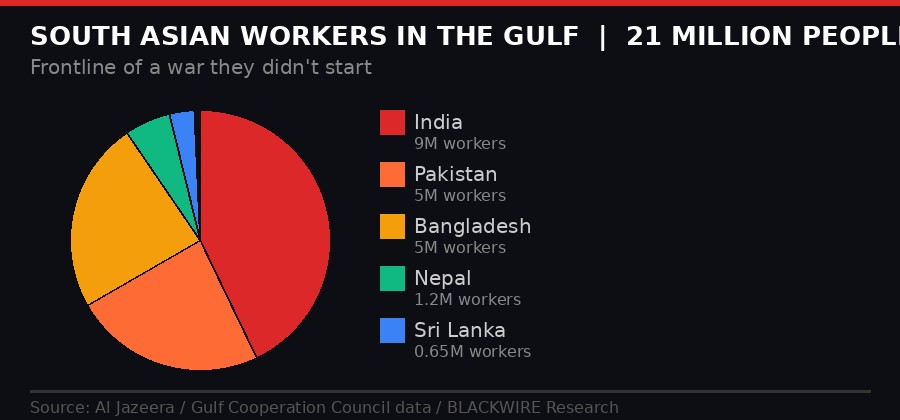
Faisal Abbas, director at the Centre of Excellence on Population and Wellbeing Studies in Pakistan, put numbers to the existential weight of what is now at risk. "Remittances are a critical pillar for Pakistan and other South Asian economies, and a large share comes from Middle Eastern countries," he told Al Jazeera. "If the situation worsens, it will not be a positive development for the region."
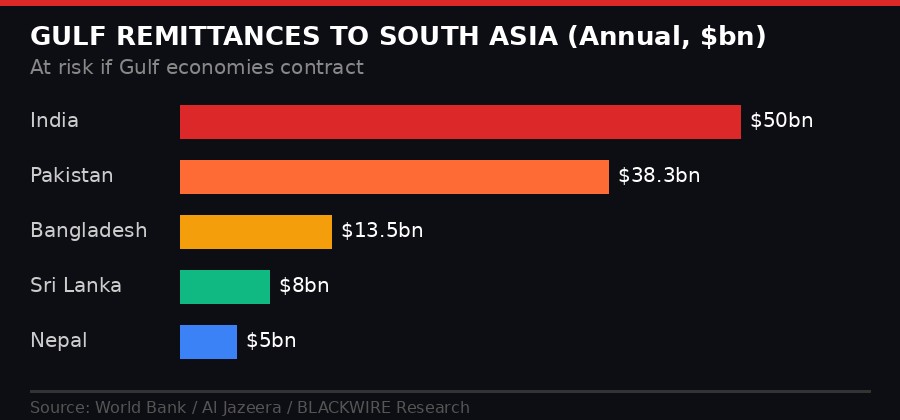
That is an economist's way of saying: this could be catastrophic. Pakistan's Gulf remittances are roughly 10 percent of its GDP - a country of $400 billion. India receives $50 billion annually from the Gulf, more than Bahrain's entire GDP. Bangladesh pulls in $13.5 billion. Sri Lanka $8 billion. Nepal $5 billion. Combined: $103 billion per year. Comparable to Oman's entire economic output.
These are not bonus income figures. They are survival numbers. Pakistan and Bangladesh have both run through periods where remittance income was the single largest source of foreign exchange - more than exports, more than foreign investment. For Nepal, it constitutes roughly 25 percent of GDP in some years. These are economies that have quietly outsourced their employment problem to the Gulf, and the Gulf has sent the wages home in wire transfers.
That entire structure is now operating under fire.
Sri Lanka's Second Crisis: The Memory Is the Warning

In the hill city of Kandy, Sri Lanka, a tuk-tuk driver named Keerthi Rathna is waiting in a queue. He has been here before.
In 2022, Sri Lanka's government collapsed. The economy imploded under the weight of foreign debt, policy failures, and a foreign exchange crisis. Fuel ships sat anchored offshore because there was no money to unload them. People queued for hours. The president fled to the Maldives. A youth-led uprising stormed the presidential palace.
What Rathna is queuing for today is not exactly the same as what he queued for in 2022. But the queue looks identical.
Sri Lanka imports 60 percent of its energy needs, much of it via the Strait of Hormuz. When Iran responded to the US-Israeli strikes by halting most traffic through the strait - through which 20 percent of the world's oil and gas passes - Sri Lanka had roughly one month of reserves. The government introduced QR-based fuel rationing. Prices at the pump went up 33 percent. Bus fares, which hit low-income Sri Lankans hardest, rose more than 12 percent. The government is now absorbing $63 million in monthly losses by subsidizing fuel below market rate - a social welfare measure disguised as energy policy.
"This time, no one can put the blame on this government as the war on Iran is not in Sri Lanka's hands. But during the 2022 crisis, the fuel ships were anchored around the country. The government had no money to buy it. Now, the government has foreign currency reserves - but the ships are not arriving." - Keerthi Rathna, tuk-tuk driver, Kandy. Reported by Al Jazeera.
The bitter irony is precise. In 2022, the money existed nowhere. In 2026, the money exists - but the fuel cannot move. The Strait of Hormuz is functioning as Iran's weapon: not a blockade by sea, but by consequence. Every nation that built its energy infrastructure on Gulf imports is now discovering the price of that dependency in real time.
For Sri Lanka, the fear is not just fuel. Half of the world's urea, a key fertilizer ingredient, moves through the Strait of Hormuz. China, from which Sri Lanka imports fertilizers, sources sulphur from the Middle East. If the disruption continues through planting season, food prices could rise 15 percent according to researchers at Germany's Kiel Institute for the World Economy. Sri Lanka has not fully recovered from the food insecurity of 2022.
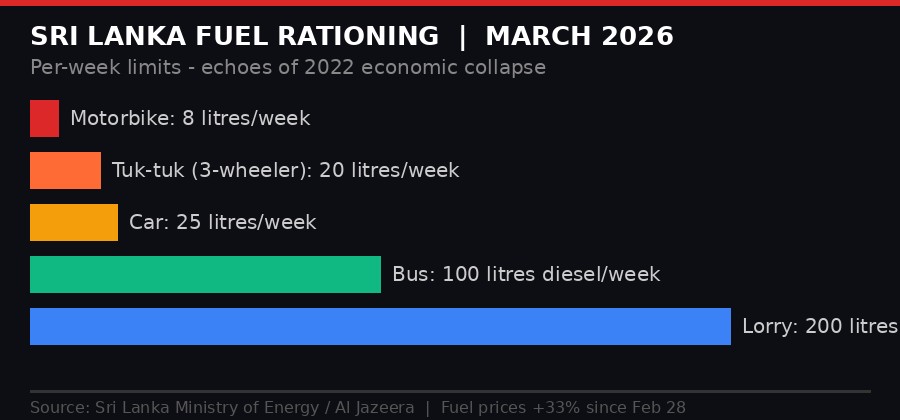
Shiran Illanperuma, a political economist at the Tricontinental Institute for Social Research, put it plainly to Al Jazeera: "The knock-on effect of the fuel crisis will be drastic for Sri Lanka." He is urging medium-term investment in storage infrastructure - Sri Lanka can currently hold only one month of reserves across three facilities - and bilateral energy agreements with Russia and India. The government is already in talks with Moscow. Russia's Deputy Energy Minister Roman Marshavin visited Colombo this week.
Iran offered to supply fuel. Sri Lanka declined - because it has no ship to transport it.
That sentence deserves to sit on its own for a moment. A country of 22 million people, navigating its second existential energy crisis in four years, turned down emergency fuel supplies because it lacks the physical infrastructure to receive them. That is what decades of colonial economic extraction followed by post-independence debt dependency looks like in practice.
Bangladesh and Pakistan: When the Wire Transfer Stops

Noor is a Bangladeshi migrant laborer at an oil facility in Saudi Arabia. Drone attacks have struck near his workplace. His children call him crying. They are scared for his life.
When his contract ends, he is going home. He will not come back.
"I will never come back here again. It's too dangerous. We can't even sleep at night. The fear never leaves us. I would rather go back and struggle to survive with my family than live here in constant fear. At least there, I will be with them." - Noor (name changed), Bangladeshi migrant worker, Saudi Arabia. Reported by Al Jazeera.
Noor knows what going home means. It means hardship. Bangladesh's formal employment sector cannot absorb the mass return of its Gulf workers - not even close. The country's garment industry, its primary export engine, is already under structural pressure from rising wages and competition. The informal economy can absorb some workers, but not the wave that would return if the Gulf contracts significantly.
Pakistan faces the same arithmetic, but at greater scale and in the context of an economy that was already on IMF life support. Pakistan's remittances from the Gulf constitute roughly 10 percent of GDP. A significant interruption - whether from worker flight, Gulf economic contraction, or blocked financial channels - would hit the Pakistani rupee, push inflation higher, and strain the country's ability to service its foreign debt. This is not a distant hypothetical. It is a sequence that begins the moment enough workers decide, like Noor, that survival means going home.
Abbas at the Centre of Excellence on Population and Wellbeing Studies warned that the disruption could ripple beyond individual wire transfers. "Migration patterns could also be disrupted. Many workers may return home, while those planning to migrate might reconsider. This could further increase unemployment in a region already facing job shortages."
That last point is often overlooked. It is not just about the workers currently in the Gulf. It is about the hundreds of thousands of young men and women in villages across South Asia who had a plan - save money, pay a recruiter, get a Gulf visa, go work, send money home. That plan is now in question. And for many South Asian families, it was the only plan available.
Who Dies in Other People's Wars
There is a pattern here that runs through history. When powerful nations go to war - particularly in resource-rich regions - the people who die in the greatest proportions are not the soldiers of the warring states. They are the workers, the servants, the invisible labor scaffolding that holds the region together.
This has been true in every Gulf conflict. During the 1991 Gulf War, hundreds of thousands of South Asian and Southeast Asian workers fled Kuwait and Iraq under fire. During the 2003 invasion of Iraq, South Asian contractors and service workers were killed in far higher numbers than has ever been adequately documented. During Yemen's civil war since 2015, South Asian workers employed in Saudi Arabia have been caught in cross-border strikes and drone attacks while the international community focused on the warring parties.
The pattern is not incidental. It flows from the structure of Gulf labor: the kafala system's legal bind, the debt burden that prevents leaving, the poverty at home that makes staying in a war zone the rational choice. A worker with no other options is a worker who cannot exercise the most basic right in a conflict - the right to get out of the way.
Imran Khan at the New Delhi Institute of Management has spent years studying this migration corridor. He notes that Western countries have "dramatically raised entry barriers for less-educated blue-collar foreign workers" in recent years - pushing precisely the demographic that once had multiple migration options into total dependence on Gulf employment. "These workers are the worst affected during crises," he said. "I have been speaking to several migrant laborers, particularly Indians in the Middle East, and many are living in distress since the conflict began."
Distress is not a strong enough word for Jaya Khuntia in Naikanipalli, Odisha. His son is dead at 25. The debt that sent him to Qatar is still there - 300,000 rupees that will now have to be repaid some other way, by people who had no other way, which is why Kuna went in the first place.
"That one call finished us," Jaya said. "He promised to return after clearing our debts. But he came back in a coffin. We have nothing left now."

What the Governments Are Doing - and Not Doing
India has 9 million nationals in the Gulf. The Indian government has issued travel advisories and set up emergency helplines. It has not organized any mass evacuation. It did not do so in 2022 during the Russia-Ukraine war when Indian students were stranded either, waiting nearly two weeks to act after the first shells fell.
Pakistan and Bangladesh have similarly issued advisories. Neither country has the financial or diplomatic leverage to meaningfully compel the Gulf states to give their workers protective priority. The kafala system means their workers are legally attached to private employers, not to states - which makes collective protection nearly impossible to operationalize.
Nepal, whose 1.2 million Gulf workers represent a staggering share of its national income, has quietly appealed to Qatar and Saudi Arabia for assurances. Nepal has one of the world's lowest levels of diplomatic capital in the region. It has very few cards to play.
Sri Lanka's President Anura Dissanayake faces the challenge that his predecessor's predecessor created: a country with one month's fuel reserves, no large storage capacity, and a population that has been through this before. His government has done what it can - rationing, subsidizing, negotiating with Moscow and Delhi. The no-work Wednesday policy, closing government offices and schools to reduce fuel consumption, is the kind of measure that feels improvised because it is improvised. It is the policy equivalent of asking people to hold their breath.
The truth is that South Asian governments have spent decades exporting their labor surplus to the Gulf and importing the remittances. They have not built the diplomatic architecture to protect those workers when the Gulf burns. And the Gulf states, for all their sovereign wealth funds and gleaming skyscrapers, have never pretended that their migrant workers are anything other than a renewable resource.

The Silence of the Invisible
There will be no candlelight vigil for Kuna Khuntia that trends on social media. There is no government press conference listing the names of the South Asian workers killed in UAE drone attacks. When the UN counts civilian casualties in this war, the South Asian dead will appear in footnotes, if at all.
This is partly structural: these workers exist in a legal gray zone that makes their deaths hard to classify. They are not nationals of the warring states. They are not UN-designated refugees. They are not combatants. They are pipe fitters who happened to be near the wrong storage unit at the wrong time in a war that neither their governments nor the international community had any mechanism to keep them out of.
It is also partly cultural. The silence is imported from home. In South Asian societies where sending a son to the Gulf is a sacrifice made with eyes open, to complain about the conditions is almost taboo - it questions the choice that the entire family structure was built around. Jaya Khuntia's grief is immense. But he did not go to the press. Al Jazeera found him.
Hamza, in the UAE, is still working at the oil storage facility. He is working because his family has nothing to eat if he stops. He is not invisible by accident - invisibility is the condition of employment.
Noor is leaving when his contract ends. That is the closest thing to resistance available to him.
And in Sri Lanka, Keerthi Rathna is in the queue again. He knows this queue. He was in it four years ago. He will note, with the dry recognition of someone who has survived a crisis before, that there is a difference between then and now: the government has the money. The ships just aren't coming.
The war being fought over Iran's nuclear program and American regional hegemony and Israeli security calculus is, in one sense, a geopolitical contest between powerful actors with sophisticated military capabilities and enormous economic leverage. In another sense, it is a catastrophe falling on people who borrowed $3,200 to pay for their daughters' weddings and sent their only son to Qatar to earn it back.
That son came home in a coffin. The debt remains. The war continues. And 21 million people who hold entire national economies on their backs are still showing up for work because there is no other choice.
Key figures at a glance (Al Jazeera / World Bank / Kiel Institute, March 2026): 21 million South Asian workers in the Gulf, a third of the region's total population. $103 billion in combined annual remittances to India, Pakistan, Bangladesh, Sri Lanka, and Nepal. At least 11 South Asian civilians confirmed dead in Iranian strikes in UAE, Oman, and Saudi Arabia as of mid-March. Sri Lanka fuel prices up 33 percent since February 28. Food prices could rise 15 percent if the Hormuz disruption continues through planting season.
Get BLACKWIRE reports first.
Breaking news, investigations, and analysis - straight to your phone.
Join @blackwirenews on Telegram