The Alliance Cracks: Spain Shuts Airspace to US Military as NATO Fractures Over the Iran War
Spain has closed its entire airspace to American military aircraft conducting operations in the Iran war. Defense Minister Margarita Robles announced the decision Monday, escalating a confrontation that has turned the Iberian nation into the loudest European critic of Washington's monthlong campaign against Tehran - and exposed fracture lines running through the heart of NATO that no amount of diplomatic language can paper over.
The airspace ban expands on Spain's earlier refusal to let the US use the jointly operated Rota Naval Station and Moron Air Base in Andalusia. It is the most significant act of defiance by a NATO member against the United States since Turkey refused to allow American ground troops to cross its territory for the 2003 Iraq invasion. And it arrives at a moment when the alliance is under more strain than at any point in its 77-year history.
US Secretary of State Marco Rubio fired back within hours, warning that the entire NATO framework would need to be "reexamined" if allies deny basing rights to the country that guarantees their defense. The implicit threat was unmistakable: pay up and fall in line, or face the consequences of American disengagement from European security. (AP News, March 31, 2026)
This is not a diplomatic spat. It is the visible surface of a structural crisis that has been building for years, now accelerated to breaking speed by a war that the Spanish government calls illegal, reckless, and unjust. The question is no longer whether NATO can survive disagreement over the Iran war. The question is what kind of alliance comes out the other side.
What Spain Did - and Why It Matters
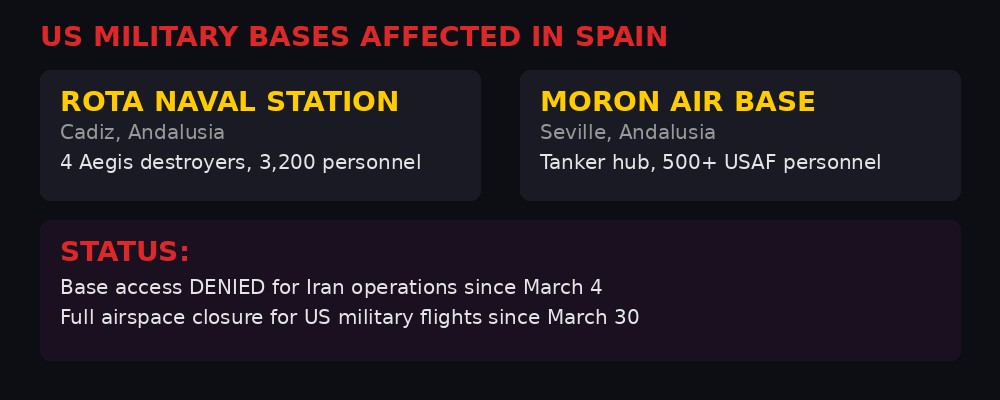
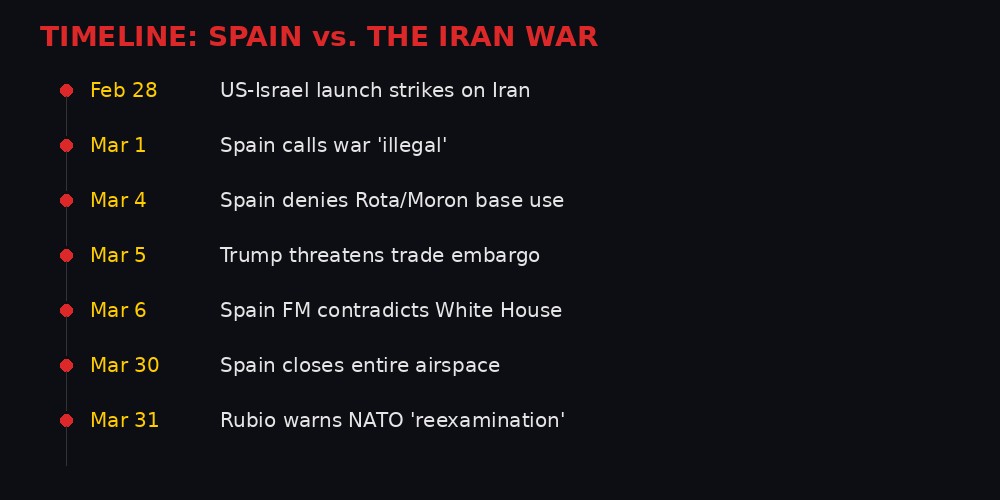
The sequence of Spanish defiance has been methodical, not impulsive. On March 1, just two days after the first US-Israeli strikes hit Iranian territory, Prime Minister Pedro Sanchez called the war "profoundly illegal." By March 4, Foreign Minister Jose Manuel Albares formally notified Washington that the Rota Naval Station and Moron Air Base - home to four Aegis-class destroyers, over 3,200 American military personnel, and a critical aerial refueling hub - could not be used for operations related to the Iran conflict.
Trump responded with his signature instrument: a trade threat. "We're going to cut off all trade with Spain," he told reporters during an Oval Office meeting with German Chancellor Friedrich Merz on March 5. "We don't want anything to do with Spain." He even suggested the US could simply fly into the bases without permission. "Nobody's going to tell us not to use it, but we don't have to." (AP News, March 5, 2026)
Spain did not blink. On March 6, Foreign Minister Albares publicly contradicted White House Press Secretary Karoline Leavitt's claim that Madrid had heard Trump's message "loud and clear" and was now cooperating. Spain's position had not changed by a comma. And on March 30, Robles extended the prohibition to cover all Spanish airspace - not just the bases, but every square kilometer of sky above the Iberian Peninsula.
"This was made perfectly clear to the American military and forces from the very beginning. Therefore, neither the bases are authorized, nor, of course, is the use of Spanish airspace authorized for any actions related to the war in Iran."- Margarita Robles, Spanish Defense Minister (AP News, March 31, 2026)
The practical military impact is debatable. The US has bases scattered across Europe and the Middle East, and other allies have continued to cooperate. But the symbolic weight is enormous. Spain is not a peripheral member of NATO. It sits on the Atlantic flank, controls access to the Mediterranean through the Strait of Gibraltar, and has hosted American forces continuously since the Cold War - a relationship that predates Spanish democracy itself, stretching back to agreements with the Franco dictatorship in the 1950s.
For a NATO ally to close its sky to the alliance's dominant military power during an active war represents a break in the presumption of cooperation that has held the bloc together since 1949. Daniel Baer, director of the Europe Program at the Carnegie Endowment for International Peace and a former US ambassador to the OSCE, put it plainly: "NATO allies operate with a presumption of cooperation, but of course they retain sovereignty." (AP News, March 31, 2026)
The Sanchez Doctrine: A Left-Wing Challenger to the American Order
Pedro Sanchez is 54 years old, first took power in 2018, and has built a political identity on being everything the Trump-era political right despises. He defends feminism, authorized immigration, the rules-based international order, and climate action. He has openly positioned himself as an ideological counterweight to MAGA - and he has done it from within the NATO tent, which makes him uniquely dangerous to the cohesion Trump demands.
The Iran war did not create this friction. It revealed it.
Long before the first cruise missile hit Iranian soil, Sanchez was among the most vocal critics of Israel's military campaign in Gaza. "This is not self-defense, it's not even an attack - it's the extermination of a defenseless people," he said during a tour of European and Middle Eastern capitals to broker a peace deal. He recognized Palestinian statehood. He drew Israel's fury. (AP News)
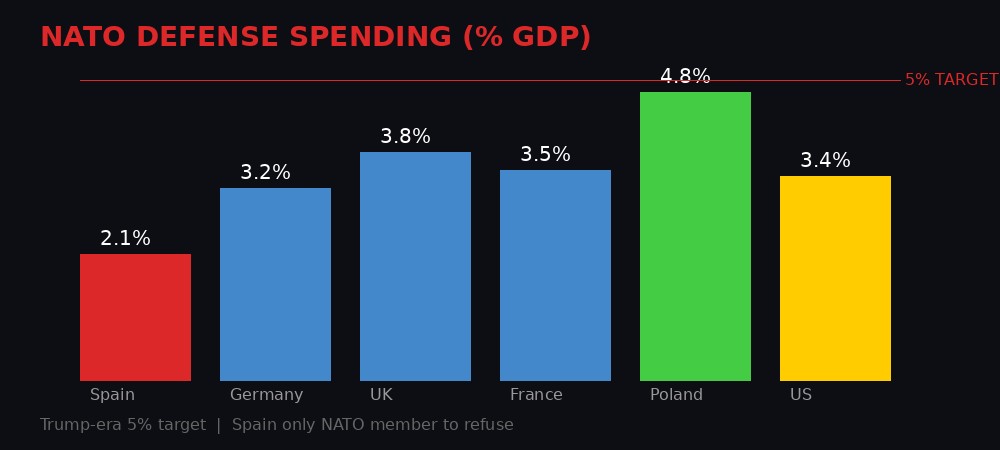
He was also the only NATO leader to refuse the 5% GDP defense spending target that Trump pressured the alliance into adopting. Spain negotiated a last-minute exemption, committing to 2.1% - a figure Sanchez called "sufficient and realistic." Trump responded by floating the idea of expelling Spain from NATO entirely, though the threat has remained, so far, a veiled one. (AP News)
On immigration, while most of Europe tightened borders and the Trump administration broadened its crackdown, Spain began granting work and residency permits to half a million undocumented foreigners already living in the country. Sanchez taunted the critics directly: "MAGA-style leaders may say that our country can't handle taking in so many migrants - that this is a suicidal move, the desperate act of a collapsing country. But don't let them fool you. Spain is booming." (New York Times op-ed, via AP)
On Big Tech, his government moved to ban social media for under-16s, drawing Elon Musk's personal ire. Musk called Sanchez "the true fascist totalitarian" - a phrase that, in the current media landscape, functions as something between an insult and a badge of honor depending on where you sit.
All of this made the airspace closure inevitable once the Iran war began. Sanchez has built his political brand on the idea that Europe should not be a vassal of American foreign policy. The Iran war gave him his biggest stage yet - and he is performing to the gallery of European voters who are watching oil prices soar, sirens blare in allied capitals, and wondering what exactly they're getting from the Atlantic relationship.
"You cannot respond to one illegality with another, because that's how humanity's great disasters begin."- Pedro Sanchez, Prime Minister of Spain (AP News, March 2026)
Rubio's Warning and the NATO Reexamination Threat
Secretary of State Marco Rubio's response to the airspace closure was calculated and cold. Speaking to Al Jazeera on Monday - the same interview where he claimed US war objectives in Iran would be achieved in "weeks" - Rubio framed Spain's action not as a bilateral dispute but as an existential question for the entire alliance.
"NATO is useful for the United States because it allows us to station troops and aircraft and weapons in parts of the world that we wouldn't normally have bases, and that includes in much of Europe. But if NATO is just about us defending Europe if they're attacked, but then denying us basing rights when we need them, that's not a very good arrangement. That's a hard one to stay engaged in and say this is good for the United States. So all of that is going to have to be reexamined."- Marco Rubio, US Secretary of State (AP News, March 31, 2026)
The word "reexamined" is doing heavy diplomatic lifting. It stops short of threatening withdrawal but opens a door that previous administrations kept firmly shut - the possibility that the United States might fundamentally rethink its commitment to European security based on whether allies cooperate with American military operations outside NATO's collective defense mandate.
This is the crucial legal and moral fault line. Article 5 of the NATO Treaty - the collective defense clause - was never invoked for the Iran war. The US-Israeli operation against Iran is not a NATO mission. It was not authorized by the UN Security Council. It was not sanctioned by the NATO North Atlantic Council. Spain's argument is straightforward: sovereign nations have no obligation to support military operations they consider illegal under international law, regardless of alliance membership.
The US counter-argument is equally direct but rests on expectation rather than treaty obligation. Washington's position, distilled: we guarantee your safety, we station troops on your soil, we spend more on your defense than you spend on yourselves - and when we need your airspace, you close the door? The transactional logic is pure Trump, and it resonates with an American electorate that has grown skeptical of European free-riding.
Whether other NATO members will follow Spain's lead is uncertain. Baer doubts it: "Most Europeans are focused on keeping some measure of US cooperation in supporting Ukraine, so I think it's less likely that others join, even as they voice concerns about a lack of clarity around US strategic objectives in Iran." The calculus is simple. Ukraine's survival depends on American military aid. No European leader wants to antagonize Washington when Kyiv's fate hangs in the balance - even if they privately agree with Madrid on the Iran war's legality.
Historical Precedents: When Allies Said No
Spain's decision is rare, but it is not without precedent. And the precedents tell us something important: allies who refuse American requests pay diplomatic costs but rarely suffer strategic consequences - at least in the short term.
In 1986, France and Italy blocked US military aircraft from using their airspace for Operation El Dorado Canyon, the American bombing raid targeting Libyan leader Moammar Gadhafi. The refusal forced US F-111 bombers to fly a circuitous route from British bases, adding over 2,500 nautical miles and six hours of aerial refueling to the mission. Washington was furious. The alliance survived.
In 2003, Turkey - arguably America's most strategically vital NATO ally given its proximity to Iraq - refused to allow the US 4th Infantry Division to cross Turkish territory for the invasion. The decision forced a complete redesign of the northern front. US-Turkish relations cratered. But Turkey remained in NATO, continued hosting Incirlik Air Base, and the relationship eventually stabilized.
The French case from 2003 is perhaps most instructive. Then-Foreign Minister Dominique de Villepin delivered his famous speech at the UN Security Council opposing the Iraq invasion, one of the most dramatic moments of diplomatic dissent in the post-Cold War era. But France still allowed US and British overflights. "There are practices between allies that exist that we must respect, including overflight rights," de Villepin told the French parliament. Spain in 2026 has crossed a line that even Villepin would not. (AP News)
The critical difference between then and now is cumulative stress. In 1986, NATO was unified by the Cold War. In 2003, the alliance was fraying but the threat landscape was clear enough to hold. In 2026, NATO faces simultaneous crises - the Russia-Ukraine war grinding into its fourth year, the Iran war dividing opinion, defense spending disputes, trade threats, and a US president who openly questions whether the alliance serves American interests. Spain's airspace closure is not an isolated act. It is a symptom of structural decay.
The EU's role adds another layer of complexity. Spain is a member of the European Union. Trump's threat to "cut off all trade with Spain" collides immediately with EU trade law - the EU negotiates trade agreements on behalf of all 27 member states, and Spain cannot be unilaterally embargoed without triggering a wider confrontation with Brussels. The European Commission has already responded: "The Commission will always ensure that the interests of the European Union are fully protected." Treasury Secretary Scott Bessent's suggestion that the Supreme Court's ruling gives Trump embargo authority has yet to be tested against EU trade mechanisms.
The Economic Backdrop: $4 Gas, $107 Oil, and a World on Edge
Spain's defiance does not exist in a vacuum. It draws its political oxygen from the economic devastation the Iran war is inflicting on ordinary people worldwide - including in the US itself.
On Tuesday, the national average price of gasoline in America crossed $4 a gallon for the first time since 2022, according to AAA. Diesel - the fuel that moves freight, delivers packages, and powers the supply chain - hit $5.45. In Paris, the equivalent price per gallon is $10.27. Buses and trucks conducted a slow-moving protest through the French capital against rising fuel costs. In Myanmar, drivers queue for hours at petrol stations. In Somalia, the UN says the fuel crisis is worsening hunger. Korean Air announced emergency cost-cutting measures. (AP News, BBC, March 31, 2026)
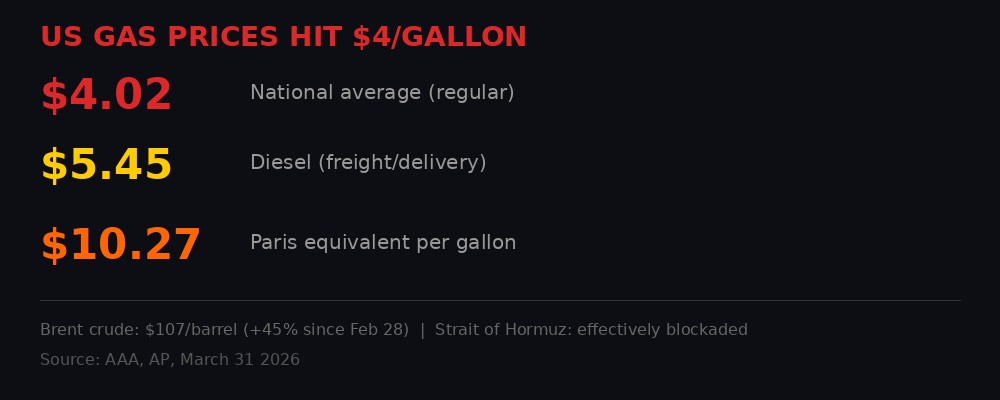
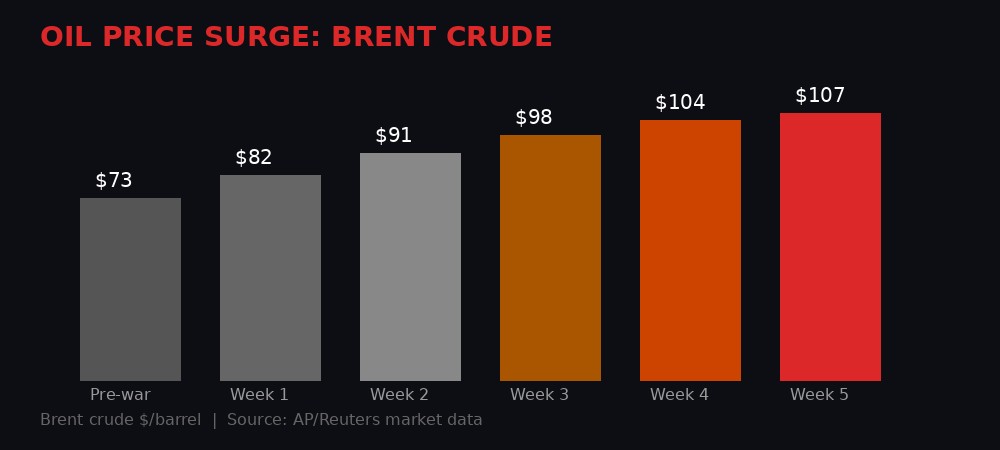
Brent crude hovered around $107 a barrel on Tuesday, up more than 45% since February 28 when the first strikes landed. The Strait of Hormuz - the narrow waterway through which roughly a fifth of the world's oil normally transits - remains effectively blockaded by Iran. Tehran has imposed what amounts to a "toll booth" on remaining traffic, leveraging its geographic chokepoint position to maximum effect. The International Energy Agency has pledged to release 400 million barrels from emergency stockpiles. Trump has eased sanctions to free up Venezuelan oil. None of it has been enough. (AP News)
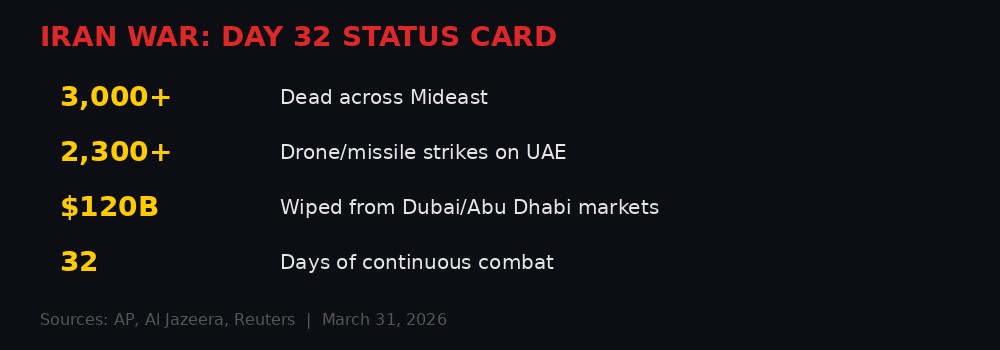
The financial markets tell the same story. The Iran war has wiped $120 billion off Dubai and Abu Dhabi stock markets, according to Al Jazeera. Tokyo's Nikkei 225 was down 1.6% Tuesday, with losses since February erasing the year's gains. South Korea's Kospi plunged 4.3%. Gold surged to $4,590 an ounce. Silver hit $72.56. The safe-haven trade is not a signal of confidence - it is a signal of fear. (AP News, Al Jazeera, March 31, 2026)
This is the context in which Sanchez is operating. Every European voter filling their tank at $10 a gallon is a voter receptive to the argument that this war is not their war, was not their choice, and should not be their cost. Sanchez is saying out loud what polling data across Europe increasingly suggests many citizens feel: the Iran war is an American-Israeli project that is dragging the world economy into a ditch, and allied nations have no obligation to help drive.
The economic pain is not abstract. The United Postal Service is seeking a temporary 8% surcharge on Priority Mail. US diesel prices have risen nearly 45% from pre-war levels. Grocery analysts warn that food transportation costs will hit consumer prices within weeks. And all of this is happening while the conflict shows no sign of ending - Trump himself vacillates between claiming Iran is "ready to settle" and threatening to seize Kharg Island, attack desalination plants, and send ground troops to occupy the Strait of Hormuz.
The Gulf Allies Want More War - Europe Wants Out
The divergence between America's Gulf allies and its European partners could not be sharper. While Spain shuts its skies, Saudi Arabia, the UAE, Kuwait, and Bahrain are privately urging Trump to intensify the war. According to AP reporting based on US, Gulf, and Israeli officials speaking on condition of anonymity, Gulf nations have conveyed that they do not want military operations to end until there are "significant changes in the Iranian leadership or a dramatic shift in Iranian behavior." (AP News, March 31, 2026)
The UAE has emerged as the most hawkish voice, actively pushing for a ground invasion. After absorbing more than 2,300 missile and drone attacks from Iran, Abu Dhabi's patience has been replaced by fury. Kuwait and Bahrain also favor the ground option. Only Oman and Qatar - traditional intermediaries between Iran and the West - are pushing for diplomatic resolution.
Trump himself quoted the Gulf enthusiasm on Air Force One Sunday evening: "Saudi Arabia's fighting back hard. Qatar is fighting back. UAE is fighting back. Kuwait's fighting back. Bahrain's fighting back. They're all fighting back." In reality, Gulf countries host US forces and bases from which strikes are launched, but have not joined offensive operations directly. The "fighting back" is defensive - intercepting Iranian missiles and drones targeting their territory. (AP News)
This creates a bizarre geopolitical geometry. Gulf monarchies that share no democratic values with Western allies are more enthusiastic about the war than the democratic allies themselves. Spain, which has a free press, elected government, and constitutional commitment to human rights, calls the war illegal. The UAE, which has no free elections and routinely jails dissidents, wants ground troops in Tehran. The alliance structure that was supposed to bind democracies together is being realigned along lines of interest, not values - and the Iran war is the catalyst.
Meanwhile, Pakistan has emerged as an unlikely mediator. Islamabad's role as intermediary between Washington and Tehran "took many by surprise," BBC reported, "but perhaps it shouldn't have." Pakistan maintains working relationships with both Iran (its neighbor) and the United States (its military patron), and has positioned itself as a neutral channel at a moment when traditional diplomatic infrastructure has broken down.
Israel, for its part, is using the war to consolidate domestic power. The Knesset passed its annual budget in an overnight marathon session Monday, with air raid sirens from Iranian missiles interrupting proceedings three times. The $270 billion budget - Israel's largest ever - includes a 20% increase for the Ministry of Defense, now consuming $45 billion. The budget's passage means Netanyahu avoids early elections and can complete his term through October. Opposition leader Yair Lapid called it "the greatest theft in the state's history." (AP News, March 31, 2026)
Day 32: Isfahan Burns, Dubai Takes Fire, and No End in Sight
On the ground, the war's intensity has not diminished. On Tuesday, US strikes hit Isfahan - the central Iranian city that houses one of the country's three nuclear enrichment facilities attacked during the initial 12-day campaign in June. Trump shared footage of the attack showing a massive fireball. NASA fire-tracking satellites confirmed explosions in a mountainous region on the city's southern edge. Analysts believe much of Iran's highly enriched uranium stockpile - material enriched to 60% purity, a short technical step from weapons-grade - is stored in the area. (AP News, March 31, 2026)
Iran has not confirmed the Isfahan strike. But it responded in kind. An Iranian drone hit a Kuwaiti oil tanker in waters off Dubai, sparking a blaze that was later contained with no oil spill. Four people were wounded when debris from an intercepted drone fell into a residential area of the emirate. Loud explosions from a subsequent attack rattled Dubai - a city that has built its entire identity on being safe, pristine, and open for business. Air raid sirens sounded in Bahrain. Saudi Arabia intercepted three ballistic missiles.
The cycle is self-reinforcing. Each escalation provokes retaliation. Each retaliation is cited as justification for the next escalation. Trump warns of broadening the offensive if a ceasefire is not reached "shortly." Iran's parliamentary speaker denies any negotiations are taking place. Gulf allies push for more intensity. European allies push for de-escalation. The war grinds forward on its own momentum, a machine that no single actor seems capable of stopping.
Israel's war with Hezbollah in Lebanon is intensifying simultaneously. The Houthis in Yemen have joined the conflict by striking Israeli territory. The conflict is not a bilateral affair between the US-Israel axis and Iran - it is a regional conflagration involving at least six countries in direct military action, with economic shockwaves reaching every continent.
Netanyahu, shielded by his new budget from the accountability of elections, told reporters Monday that Israel's military aims in Iran are "beyond halfway complete." What that means in practice - whether it refers to degrading nuclear infrastructure, eliminating military leadership, or something broader - remains undefined. The absence of clear war aims from either Washington or Jerusalem is itself a source of allied frustration. As Baer noted, European concerns include "a lack of clarity around US strategic objectives in Iran." If you cannot define victory, you cannot define an endpoint. And if you cannot define an endpoint, you cannot ask allies to keep the door open indefinitely.
What Comes Next: The Alliance After Spain
The immediate question is whether other European nations follow Spain's lead. The smart money says no - at least not overtly. The Ukraine factor constrains European dissent. Every European capital knows that alienating Washington risks the flow of weapons to Kyiv, and that calculus overrides concerns about the Iran war's legality for most governments.
But quiet non-cooperation is another matter. The gap between what NATO allies say publicly and what they permit privately has always been part of the alliance's operating system. Spain's airspace closure forces that gap into the open. Other nations may not issue formal bans, but they can slow-walk approvals, impose administrative obstacles, and find procedural reasons to be unhelpful - the bureaucratic equivalent of looking the other way.
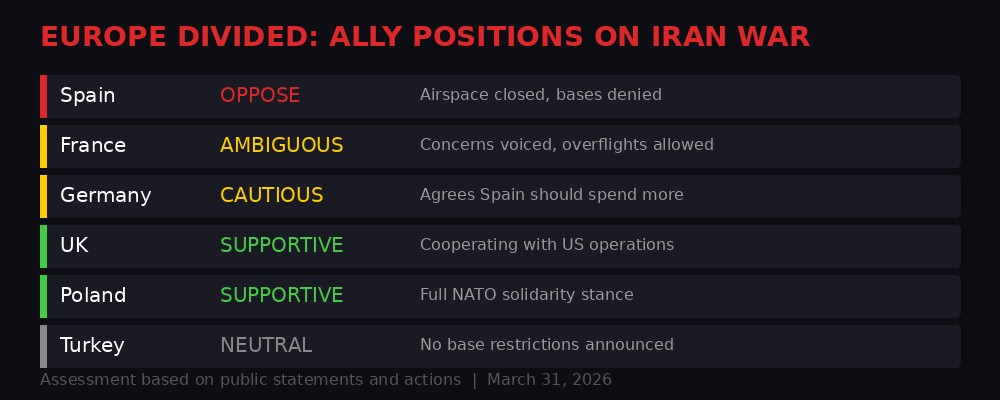
Germany's position is particularly watched. Chancellor Merz sat in the Oval Office when Trump announced his trade threat against Spain. He agreed that Spain should increase defense spending. But Germany's own relationship with Washington is complicated by the Ukraine war, energy policy, and the memory of Trump's first-term hostility toward Berlin. Merz will not want to be seen as Spain's co-conspirator, but neither will he want to be seen as Washington's enforcer in European affairs.
France, the other major European military power, has so far maintained a studied ambiguity. Paris has concerns about the Iran war but has not moved to restrict American access. The French strategic tradition favors autonomy from Washington but also pragmatic cooperation - the de Villepin precedent, where you oppose the war at the UN but allow the overflights. Whether that balance holds as the war extends into its second month and European economies absorb the oil shock remains to be seen.
The longer-term question is what the Spain crisis means for NATO's future architecture. Rubio's "reexamination" comment, if taken seriously, suggests Washington is prepared to decouple alliance membership from security guarantees based on operational cooperation - a fundamental shift from the treaty's original design. If the US begins conditioning Article 5 protection on support for non-NATO military operations, the alliance becomes something different: not a mutual defense pact but a patron-client system where the patron sets the terms.
Spain's gamble is that Europe is ready for that conversation. Sanchez is betting that the political ground has shifted, that European voters no longer see automatic alignment with Washington as a virtue, and that sovereignty - including the sovereignty to refuse participation in wars you consider illegal - matters more than transatlantic loyalty. Whether that bet pays off depends on whether the economic pain of the Iran war gets worse before it gets better.
At $107 a barrel and climbing, with the Strait of Hormuz choked, 3,000 dead, $120 billion erased from Gulf markets, and no ceasefire in sight, the conditions favor the Sanchez thesis. The question is whether the rest of Europe has the nerve to say so out loud.
For now, Madrid stands alone. But in the corridors of Brussels, Berlin, and Paris, the phones are ringing.
Get BLACKWIRE reports first.
Breaking news, investigations, and analysis - straight to your phone.
Join @blackwirenews on Telegram