Stablecoin War: Circle Crashes 20%, Tether Hires Big Four Auditor as Clarity Act Kills the Yield Play
In 48 hours, the $270 billion stablecoin market got rearranged. One regulation draft wiped $20 out of every $100 of Circle's market cap. Tether moved at the exact right moment. This is not a coincidence.

The stablecoin sector absorbed a dual shock this week - regulatory and competitive simultaneously. Photo: Pexels
Two moves, 24 hours apart, just redrew the map of the stablecoin industry.
First: Senate Banking Committee members released language from the Digital Asset Market Clarity Act banning yield payments on stablecoin balances. The text is tighter than anyone expected. It doesn't just clip rewards programs - it outlaws anything "economically equivalent to interest." That phrase hit Circle like a precision strike on its core business model.
Circle's stock (CRCL) fell 20% on Tuesday. Coinbase (COIN) dropped 10% in sympathy. The combined wipeout erased roughly $3 billion in market cap across the two companies in a single session. That's the size of some entire crypto ecosystems, gone in an afternoon because of four words in a Senate draft.
Then Tether moved. On the same day Circle was bleeding, the USDT issuer announced it had hired a Big Four accounting firm - one of Deloitte, EY, KPMG, or PwC - for its first-ever full financial statement audit. After years of operating on periodic attestations and resisting the call for independent verification, Tether chose the exact moment its rival was most vulnerable to launch its legitimacy offensive.
The timing is either coincidence or the most aggressive competitive play in crypto this year. Given Tether's track record, bet on the latter.
Market Snapshot - March 25, 2026
What the Clarity Act Language Actually Says

The Senate Banking Committee language on stablecoin yield caught the crypto industry off guard with its breadth. Photo: Pexels
The crypto industry got its first closed-door look at the revised Clarity Act text on Monday. The session on Capitol Hill in Washington was described by a person familiar with the draft as a shock. The language was narrower than anyone had lobbied for and more restrictive than the version that passed in the House last year.
Specifically, the new language from Senators Angela Alsobrooks and Thom Tillis would do three things. It bans yield payments for simply holding a stablecoin. It restricts any structure that makes a stablecoin program equivalent to a bank deposit. And it adds further limits to "other potentially allowed activities" - a catch-all phrase that leaves the mechanics of any activities-based rewards program deliberately vague.
"Clarity Act could potentially ban yield payments for simply holding a stablecoin (e.g. passive balances) and restrict any approach that makes the program in any way equivalent to a bank deposit." - Dan Dolev, analyst at Mizuho
The deal that got to this point was itself a compromise. Bankers had insisted that stablecoin rewards look nothing like interest-bearing deposits. The concern was competitive disruption - if a stablecoin held on a crypto platform pays 5% while a savings account pays 4.5%, that's a bank run in slow motion. The banking lobby won. The compromise language allows rewards tied to user activity, not passive balance holding. But even that carve-out is left structurally ambiguous in the current draft.
The GENIUS Act, which became law last year as the first major piece of U.S. crypto legislation, already banned issuers from paying yield directly. What Circle and Coinbase built was a workaround: Circle collects interest earned on USDC's Treasury-backed reserves and shares it with Coinbase, which passes it to users as rewards. It's not technically yield. Or it wasn't, until this week's language targeted anything "economically equivalent."
Amir Hajian, a digital asset researcher at Keyrock, called it what it is.
"It pulls the rug on the pass-through model that has been driving stablecoin adoption." - Amir Hajian, Keyrock
That pass-through model accounted for roughly 20% of Coinbase's total revenue. Kill it and you don't just hurt stablecoin adoption - you restructure the P&L of the largest publicly traded U.S. crypto exchange.
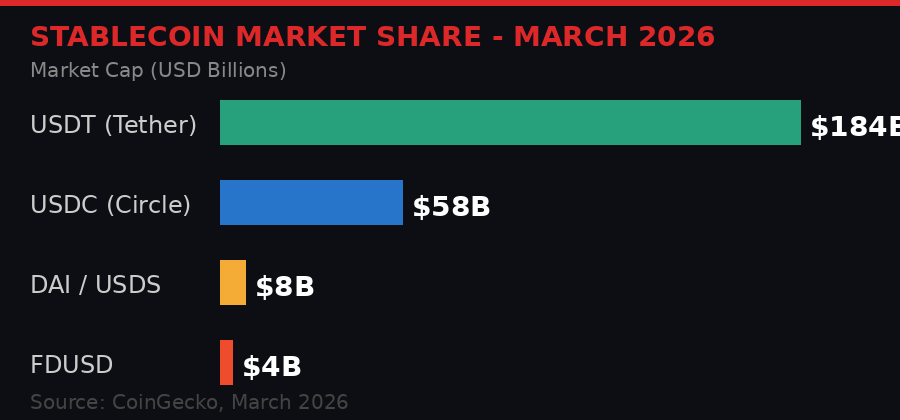
USDT holds $184B in market cap versus USDC's $58B. The gap widened in the aftermath of Tuesday's regulatory shock. Chart: BLACKWIRE / CoinGecko data
Circle's Anatomy of a 20% Crash

Circle's stock had run over 170% since early February before the Clarity Act text arrived. Photo: Pexels
Context matters here. Circle's stock had been one of the year's most explosive trades. From early February through Monday, CRCL was up more than 170%. Investors were pricing in the USDC issuer as the primary beneficiary of a U.S. stablecoin regulatory framework - a company finally getting its moment after years of operating in legal gray zones.
That narrative was not wrong, exactly. It was premature. And it built a position that was dangerously overcrowded heading into the moment when actual legislative text arrived.
When CoinDesk published the Clarity Act language details late Monday, the market responded the only way an overcrowded trade can respond to bad news: it sold everything that moved. Circle led. Coinbase followed. The crypto-adjacent stocks that had been carried up on stablecoin optimism got dragged down in a correlated flush.
The daily decline of 20% snapped what had been a historic rally. Even after Tuesday's collapse, CRCL remained up more than 30% year-to-date. That context cuts both ways - the run was spectacular enough that even a 20% single-day crater leaves investors ahead on the year. But it also tells you how much air was built into the valuation on legislative hopes that have now gotten complicated.
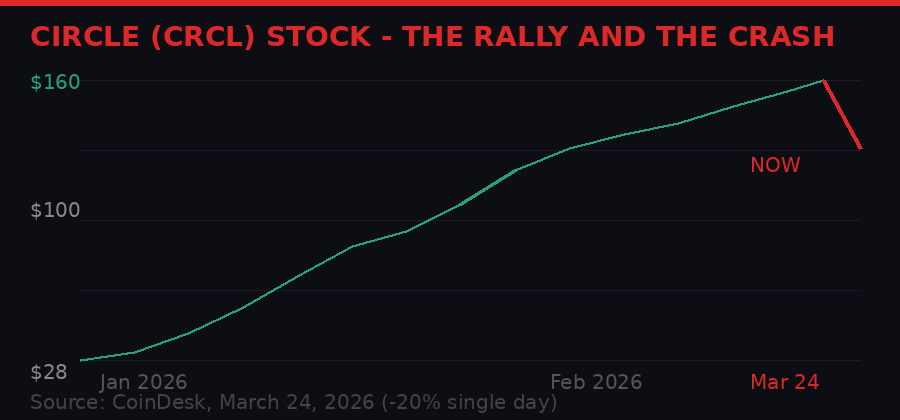
Circle's parabolic run from January to March 2026 and the single-session reversal on March 24. Chart: BLACKWIRE analysis
Not all analysts read Tuesday as a breaking point. Mizuho's Dolev noted that USDC's volume has recently outpaced USDT's for the first time since 2019, suggesting "use cases are starting to proliferate" regardless of yield mechanics. Owen Lau at Clear Street called the selloff an overreaction. Ryan Rasmussen at Bitwise said "there will be workarounds" to the yield restriction.
That may be true. But in markets, being right eventually and being wrong right now are two very different financial experiences. Circle holders learned that on Tuesday.
Tether's Perfect Timing: The Big Four Move

Tether's decision to hire a Big Four firm after years of resisting full audits is viewed as a calculated competitive strike. Photo: Pexels
Tether announced the Big Four hire on the same day Circle was collapsing.
The company behind USDT - the world's largest stablecoin at $184 billion in market cap - said Tuesday it had selected a top auditing firm through a competitive process to conduct its first full financial statement audit. CFO Simon McWilliams confirmed the hire with unusual directness: "The audit will be delivered."
Tether didn't name the firm. The Big Four are Deloitte, EY, KPMG, and PwC. Any one of them carrying the Tether engagement would be a significant credibility event - these firms don't attach their brand to reserve attestations lightly, and the liability exposure of auditing a $184 billion float means they will have done substantial diligence before signing.
The difference between what Tether has done historically and what a full audit delivers matters enormously. Periodic attestations, which Tether has published quarterly, tell you that on a specific date a specific firm verified that assets equaled liabilities. A full audit goes deeper - it examines the quality of those assets, the controls around reporting, the operational systems that generate the financial data, and the management's representations about forward-looking risks.
Tether's reserve portfolio has been a persistent source of skepticism. The company says it holds primarily U.S. Treasury bills - which, at current short rates, yield somewhere around 5.2% on a $184B float, generating roughly $9.5 billion annually in interest income. But it also holds gold, bitcoin, and loans to counterparties. S&P downgraded Tether's USDT rating in November 2025, citing bitcoin's price risk as a concern in the reserve mix.
A Big Four audit doesn't eliminate those concerns. But it dramatically raises the bar for Tether's critics. If Deloitte signs off on the reserve quality, the argument that USDT is backed by mystery assets becomes much harder to sustain. If the audit reveals gaps, the fallout would be historic. Either outcome changes the market.
"The audit will be delivered." - Simon McWilliams, CFO, Tether
The competitive angle is sharp. If Circle's yield-sharing model gets legislatively strangled and USDC loses its primary incentive for institutional holding, the floor of USDC's market share growth disappears. At the same time, if Tether demonstrates through a credible audit that its reserves are sound, the long-standing trust gap between USDT and USDC - which has been USDC's core differentiating pitch to institutional clients - narrows significantly.
Tether just played both sides of the board simultaneously.
The Rate Hike Repricing Nobody Saw Coming

Markets have swung from pricing multiple rate cuts to pricing rate hike risk - a historic reversal in central bank expectations driven by oil inflation. Photo: Pexels
Six weeks ago, the rate debate was about how many cuts the Federal Reserve would deliver in 2026. Today, it's about hike risk. That 180-degree rotation is the macro backdrop compressing every risk asset in the market, including crypto.
CME FedWatch data shows zero probability of a rate cut at either the April or June Federal Reserve meetings. More significantly, there is now roughly a 15% chance of a rate hike by June. That hike probability was effectively zero as recently as mid-February.
The driver is the Iran war's inflationary persistence. Brent crude above $100 for a sustained period - it only broke below that level Wednesday morning on the Iran ceasefire plan report - adds 0.5% to 1% to PCE inflation depending on the duration. That's enough to push the Fed's calculus from "when do we cut" to "do we need to tighten further."
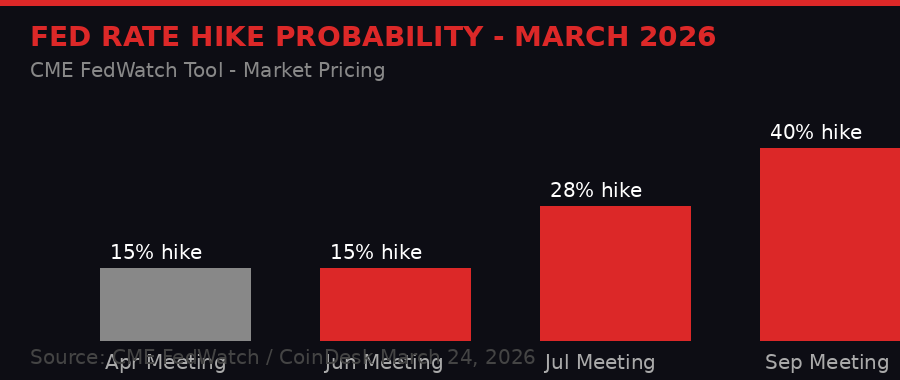
CME FedWatch now shows 15% probability of a June rate hike. Six weeks ago this probability was near zero. Chart: BLACKWIRE / CME data
The irony is that Kevin Warsh - Trump's nominee to replace Jerome Powell as Fed Chair - was chosen precisely to deliver lower rates. The political intent was a dovish pivot that would goose markets heading into midterms. Instead, Warsh may inherit a Fed that has to raise rates to fight war-driven inflation. The gap between Trump's rate expectations and reality is widening by the week.
For crypto, the macro overlay is straightforward: higher for longer means tighter liquidity, which means less risk appetite, which means pressure on assets that only work when capital is looking for yield. Bitcoin has held up relatively well through this period - it's roughly flat since the war began on February 28. Every major altcoin is down between 4% and 9% over the past week.
Bitcoin's resilience is worth noting. Its 90-day correlation with the S&P 500 remains elevated, but the sensitivity has been asymmetric. While equities have buckled on every inflation print, BTC has absorbed the shocks without breaking key support levels. FxPro chief market analyst Alex Kuptsikevich told CoinDesk: "Simply remaining at these high levels now suggests confidence among the bulls."
The Iran Wildcard: Oil Below $100 and What It Changes

Brent crude broke below $100 Wednesday morning on the Iran 15-point peace plan report - the first time since mid-March. Photo: Pexels
Wednesday morning brought the most significant macro catalyst of the week. Bloomberg reported the U.S. has drafted a 15-point plan to end the Iran conflict and delivered it to Tehran via Pakistan. Israel's Channel 12 reported separately that Washington is seeking a one-month ceasefire.
Brent crude fell 4.7% to $99.55. Asian equities jumped 1.9%. The dollar weakened. U.S. and European futures pointed higher. Bitcoin held above $71,000 for a third consecutive day.
The 15-point plan is the most concrete diplomatic development since the war began on February 28. The terms reportedly include a prohibition on Iran obtaining nuclear weapons or enriching radioactive material, though full details remain classified. The Strait of Hormuz is still effectively closed - only a trickle of vessels transiting - so even a ceasefire wouldn't immediately fix supply chain disruption.
But every dollar off the oil price is a data point that marginally improves the Fed's room to hold rather than hike. The market is doing that arithmetic in real time.
"Whether the 15-point plan leads to an actual ceasefire or becomes another headline that gets denied by Tehran within hours is the only question that matters this week." - CoinDesk Markets, March 25, 2026
Crypto's reaction to the ceasefire news has been measured rather than explosive. Bitcoin added 0.9% on the day. Ethereum gained 1.7% to $2,164. Solana was the strongest mover at +2.5% to $91.69. Most of the weekly losses remain intact - BTC is still down 6.4% on the seven-day, ETH down 9.2%, XRP off 8.5%.
The market spent four weeks absorbing escalation headlines, liquidation cascades, oil shocks, and now stablecoin legislative bombs. The net result is a range that has neither broken higher nor collapsed lower. That's either consolidation before a breakout or exhaustion before capitulation, and the Iran ceasefire outcome is the variable that decides which it is.
Stablecoin War: The Competitive Picture Going Forward

The stablecoin landscape is being reshaped simultaneously by regulation, war-driven macro pressure, and a credibility audit campaign. Photo: Pexels
Zoom out and what you see is a market structure rearrangement playing out in public view.
USDC's growth story was built on three pillars: regulatory compliance, yield pass-through, and institutional trust through transparency. The Clarity Act just knocked out the yield pillar. The remaining two pillars - compliance and transparency - are real but less differentiated now that Tether is aggressively pursuing its own transparency narrative.
USDT's growth was built on network effects, liquidity depth, and the fact that it works everywhere crypto trades. Its weaknesses were opacity and the persistent question marks around reserve quality. A Big Four audit addresses both in one move.
The other competitor watching this carefully is Ripple's RLUSD. Ripple announced Wednesday it is piloting RLUSD in Singapore's MAS BLOOM sandbox to automate cross-border trade finance payments, working with supply chain firm Unloq. The use case - smart contract triggered payments when shipment conditions are verified - is narrow but concrete. Ripple is building stablecoin infrastructure in the trade finance corridor that neither USDC nor USDT has meaningfully captured.
Solana Foundation is also moving. The organization announced a partnership with Mastercard, Western Union, and Worldpay for an institutional developer platform that lets enterprises build tokenized assets, stablecoins, and payment flows on Solana using APIs. The timing is deliberate - Solana is positioning itself as the settlement layer for whatever stablecoin wins the regulatory compliance war.
The picture emerging from this week is not a death blow to Circle. The analysts saying "it looks like an overreaction" are probably right about the long-term. Circle is still up 30% year-to-date after Tuesday's crater. USDC volume beat USDT's in March for the first time since 2019. Those are not the metrics of a losing company.
But the easy money in CRCL is behind us. The next leg requires either a more favorable Clarity Act revision, a workaround structure that survives legislative scrutiny, or expansion into yield-generating use cases that don't touch the banned "passive balance" category. None of those is a given.
Timeline: How We Got Here
What Happens Next: Three Scenarios

The path forward for stablecoins depends on three variables: the final Clarity Act text, the Tether audit outcome, and the macro inflation trajectory. Photo: Pexels
Three things have to resolve for the stablecoin sector to find equilibrium, and they're all moving simultaneously.
Scenario one - Clarity Act tightens further: The banking lobby holds its ground, the "economically equivalent to interest" language survives into the final bill, and Circle is structurally blocked from the pass-through yield model that powered its growth. In this scenario, USDC remains a payments utility but loses its institutional yield advantage. Tether - which never built a yield-sharing revenue model in the first place - captures the institutional gap. Circle stock retests pre-rally levels. Timeline: 3-6 months depending on Senate floor schedule.
Scenario two - Workaround emerges: Industry lawyers find a structure - possibly activity-based, possibly through a separate affiliated entity - that passes the "economically equivalent" test while still delivering yield economics to Coinbase users. The Senate Banking Committee accepts it. Circle and Coinbase recover. This is the base case most analysts are betting on given the bipartisan legislative incentive to get Clarity Act done before midterms. Timeline: 2-4 months.
Scenario three - Iran ceasefire, oil below $80: A genuine ceasefire holds, the Strait of Hormuz reopens, Brent crude drops toward $80-85, and the inflation headwind disappears. The Fed reverts to cutting expectations. Risk appetite returns. Crypto across the board rallies. Stablecoin market grows in a rising crypto tide. Circle's regulatory problems become secondary to the broader bull market. This scenario is possible but depends entirely on geopolitics that are still unresolved. Timeline: unpredictable.
Right now, the market is pricing a combination of scenario one and a partial scenario three. That means continued pressure on yield-generating stablecoin models, continued Bitcoin resilience as a macro hedge, and continued weekly volatility tied to Tehran's response to the 15-point ceasefire plan.
The stablecoin war is real, it's unresolved, and the combatants are not who most people were watching. Tether and Circle are fighting a regulatory and credibility battle simultaneously. The $270 billion float they collectively manage is the prize. Wednesday's moves set up the next phase - and the smart money is watching whether Tehran accepts that peace plan, because that single variable unblocks more market upside than anything Circle's lawyers can draft.
Key Numbers to Watch
Get BLACKWIRE reports first.
Breaking news, investigations, and analysis - straight to your phone.
Join @blackwirenews on Telegram