Strategy Reloads $42B. Europe's Bitcoin Treasury War Begins. Congress Just Killed Stablecoin Yield.

Bitcoin held $70,600 at midnight Berlin time, capping a session that opened at $67,500, spiked to $71,200 on a Trump Truth Social post about Iran, and then clawed back after Iran denied any communication had occurred. The net result: $415 million in liquidations, a $3 trillion global equity whipsaw, and by end of session, BTC sitting almost exactly where it would have if none of the geopolitical drama had happened.
But the market structure story running underneath the war headlines is what's worth tracking. This is a week when the corporate and regulatory infrastructure for Bitcoin crossed several significant thresholds at once. Strategy's new 8-K, H100 Group's acquisition letters, and the Senate Banking Committee's closed-door session on stablecoin yield all landed within hours of each other. Coincidence of timing. Convergence of direction.
Section 1: Saylor Reloads - Strategy's $42 Billion War Chest

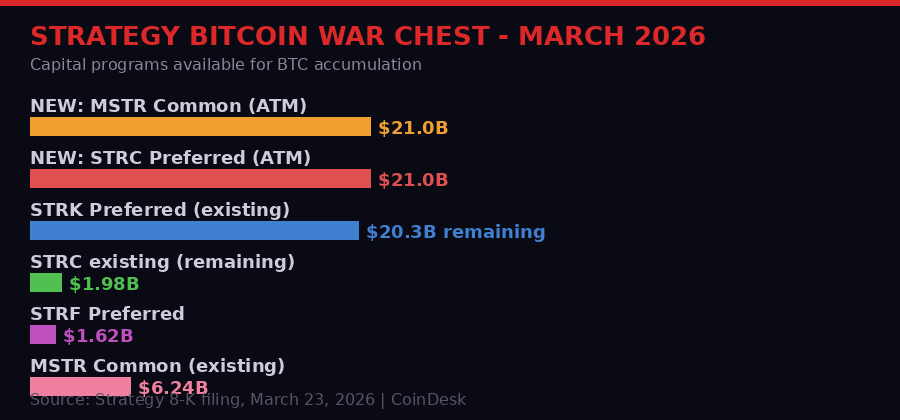
Michael Saylor's company filed an 8-K on Monday that reads less like a corporate disclosure and more like a declaration of intent. Strategy unveiled a new $42 billion at-the-market equity program, split cleanly down the middle: $21 billion of Class A common stock and $21 billion of STRC Variable Rate Series A Perpetual Stretch Preferred Stock. On top of that, a $2.1 billion new ATM for STRK preferred stock, replacing a prior program.
Here's the math that matters: the company still had roughly $30 billion available across existing ATM programs as of March 22. The new $42 billion program doesn't replace that - it sits alongside it. Total theoretical purchasing power: somewhere north of $70 billion. That's the size of a mid-tier sovereign wealth fund positioned exclusively on bitcoin.
STRATEGY CAPITAL SNAPSHOT - MARCH 23, 2026
Source: Strategy 8-K SEC filing, March 23, 2026. CoinDesk reporting.
The sales syndicate expansion is the operational detail most analysts are missing. Strategy added Moelis and Company, A.G.P./Alliance Global Partners, and StoneX Financial on Monday, bringing the total number of agents selling shares into the market to 19. These aren't just broker-dealers. They're pipelines - each one tapping a different pool of institutional and retail capital that gets recycled into bitcoin.
Last week's purchase was described internally as "small" - 1,031 BTC for $76.6 million. That's the company being patient. When you have 19 distribution channels and $42 billion freshly authorized, patience isn't restraint. It's strategy. The Wintermute desk flagged this pattern last month: Strategy tends to accelerate purchases during volatility windows when spot supply loosens and price dislocates from long-term positioning.
The STRC preferred structure deserves specific attention. "Variable Rate" means the dividend yield is linked to prevailing rates - currently elevated given the Fed's hold at 3.50%-3.75% with hike risk now priced at 40% by year-end according to CME FedWatch. That makes the preferred attractive to income-seeking institutional capital even in a rising rate environment, while the proceeds flow directly into bitcoin. It's an elegant funding arbitrage: borrow against rate expectations, buy a scarce fixed-supply asset.
Since Saylor began the strategy in August 2020, Strategy has accumulated 762,099 BTC at an average cost basis the company has not officially disclosed for this year's purchases, but publicly available on-chain data suggests blended cost somewhere between $43,000 and $58,000 per coin depending on the tranche. At $70,600 spot, the unrealized gain is north of $9 billion at minimum estimates. That gain is the collateral base that makes continued capital raising creditworthy.
Section 2: Europe's Bitcoin Treasury War - H100 Goes for the Record

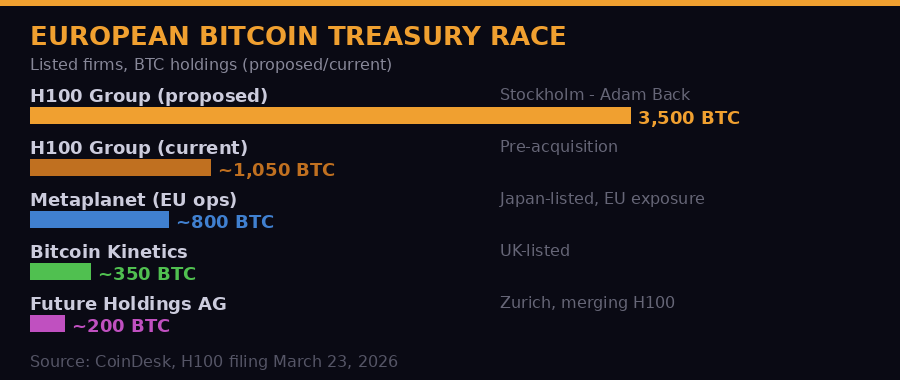
While Strategy dominates U.S. headlines, a quieter arms race has been running in European capital markets. On Monday, Stockholm-listed H100 Group signed letters of intent to acquire two Norwegian bitcoin treasury companies - Moonshot AS and Never Say Die AS - in a deal that would triple its holdings to approximately 3,500 BTC and position it as the largest publicly listed bitcoin treasury firm in Europe. CoinDesk confirmed the LOI filings.
The two target companies collectively hold around 2,450 BTC. H100 currently holds roughly 1,050 BTC. Combined: 3,500 coins worth approximately $247 million at current prices. That's not MicroStrategy scale. But it's a meaningful position for a European listed vehicle - and the structure of the deal is interesting.
The transaction is structured as a pure bitcoin-for-bitcoin exchange. No cash changes hands. Ownership in the combined entity is determined solely by how much bitcoin each counterparty contributes. This preserves bitcoin exposure per share for existing H100 investors - they don't get diluted by cash-based acquisitions or debt instruments. The BTC-per-share ratio is the only metric that matters, and the deal is designed to protect it.
H100 is backed by Adam Back - the British cryptographer, Blockstream co-founder, and one of the few individuals Satoshi Nakamoto directly cited in early Bitcoin communications. Back's institutional network is running through this structure. H100 previously announced plans to merge with Future Holdings AG, a Zurich-based bitcoin treasury company also in the Back orbit. That merger is still proceeding alongside Monday's Norwegian acquisitions.
"The transaction is structured as a bitcoin-for-bitcoin exchange, meaning ownership in the combined entity will be determined solely by the amount of bitcoin contributed. This approach preserves bitcoin exposure per share for existing investors." - H100 Group filing, March 23, 2026
Definitive agreements are expected by April 22. Completion is targeted shortly after H100's annual general meeting in May, subject to final regulatory approvals in three jurisdictions - Sweden, Norway, and Switzerland. H100 shares moved up 2% on Monday following the announcement.
The broader context: Europe has been slower than the U.S. to develop listed bitcoin treasury infrastructure. Part of that is regulatory - the EU's MiCA framework created compliance complexity that pushed institutional bitcoin adoption into private structures. But as MiCA enforcement patterns clarify and U.S. treasury models prove out, European capital markets are beginning to replicate the playbook. H100, Metaplanet's European operations, and a handful of UK-listed vehicles are competing for first-mover positioning in what could become a multi-billion-dollar category as European institutional demand for listed BTC exposure builds.
The Norway angle is specifically interesting. Norway's sovereign wealth fund - the Government Pension Fund Global, the world's largest at $1.7 trillion - holds indirect bitcoin exposure through equity stakes in companies like MicroStrategy and Coinbase. It has repeatedly declined to hold bitcoin directly due to mandate constraints. The growth of listed treasury vehicles in the Norwegian private markets may partly reflect this demand overhang: domestic institutional capital that can't buy BTC directly, finding listed vehicles as a proxy.
Section 3: Senate Kills Stablecoin Yield - What Just Happened to Your Returns

Monday evening, the crypto industry got its first look at the revised stablecoin yield language in the Senate's Digital Asset Market Clarity Act - and the reaction inside the room was not favorable. Industry insiders described the language as "overly narrow and unclear." The key provision: stablecoin issuers cannot pay rewards simply for holding their token. Not a fee. Not a rebate. Not interest. Nothing. If you hold a stablecoin and the issuer wants to pay you something, Monday's draft says that's illegal under the new framework. CoinDesk confirmed the language through a person familiar with the closed-door session.
This is the endgame of a lobbying battle that has been running for months. Banks drew a clear line: stablecoin yield that resembles interest on a bank deposit is a competitive threat to the deposit franchise they've spent 150 years building. They pushed Congress hard. Congress blinked. The compromise allows rewards tied to activities - transacting, staking, providing liquidity - but not simply for existing in a wallet.
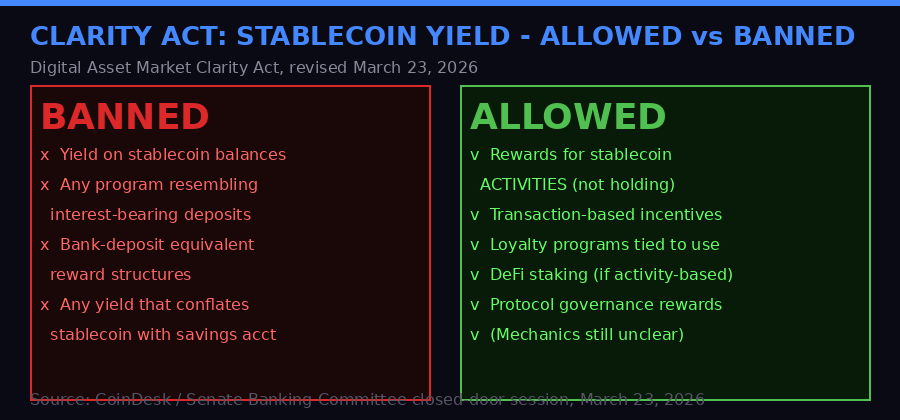
The practical implications cut across multiple DeFi protocols. Platforms that built yield products around USDC, USDT, or future compliant stablecoins - Aave, Compound, Curve, and dozens of smaller operators - will need to restructure how they frame those yields. Is "providing liquidity to a pool" an activity? Probably. Is "depositing into a savings rate contract" an activity or just holding with extra steps? That's where the language becomes ambiguous, and ambiguity is expensive in compliance terms.
CLARITY ACT - STATUS TRACKER
Source: CoinDesk policy desk, March 23, 2026.
Three friction points remain before the Clarity Act can reach a full Senate vote. First: DeFi oversight provisions, which Democratic senators want to include illicit finance protections and Republicans want to keep minimal. Second: the Trump conflict-of-interest ban. Democrats are insisting on language that would prohibit senior government officials from personally profiting from crypto markets - a provision aimed directly at Trump's WLFI token holdings and Melania's NFT launches. The White House has signaled opposition. Third: the mechanics of what qualifies as an "activity" for yield purposes remain undefined in the current text, meaning the industry will spend months lobbying over the specifics even after a Senate hearing clears.
The overall stakes are real. When the Clarity Act eventually passes, institutional capital that has been sitting on the sidelines due to regulatory uncertainty flows in. JPMorgan's digital assets desk, Goldman's crypto custody arm, and dozens of European asset managers with crypto mandates are waiting for statutory clarity to unlock allocations. The stablecoin yield fight is a speed bump, not a blocker - but every month of delay is a month of deferred institutional adoption.
Section 4: Prediction Markets Go Institutional - The $35M Bet on Crypto's New Asset Class

Buried under the Saylor and Senate headlines: the CEOs of Polymarket and Kalshi are co-founding a $35 million venture fund focused exclusively on prediction market infrastructure. The firm is called 5c(c) Capital - named after the section of the Commodity Exchange Act that governs event-based markets - and it launched Monday with backing from a Millennium Management portfolio manager and twenty-plus early investors. Bloomberg first reported the fund details.
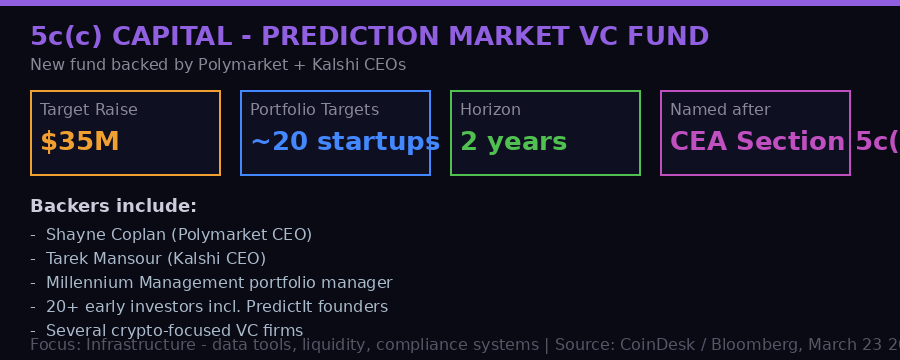
This matters beyond the $35 million number. Shayne Coplan built Polymarket into the most liquid on-chain prediction market in the world. Tarek Mansour built Kalshi into a CFTC-regulated event contract marketplace that survived legal challenges from the agency it's regulated by. These two men have seen prediction markets from the inside - both the infrastructure gaps and the opportunity set. When they say they want to fund the "second-, third-, and fourth-order effects" of what they built, they're flagging specific problems they couldn't solve while running their own platforms.
The target portfolio - roughly 20 startups in two years - points at data tools, liquidity provision, and compliance infrastructure. These aren't glamour businesses. Data tools for prediction markets means building real-time oracle systems that price obscure events accurately. Liquidity provision means market-making algorithms that can handle the unique dynamics of event markets where every contract expires at either 0 or 1. Compliance means building the legal and regulatory scaffolding to operate across jurisdictions where event-based trading is a legal gray area.
The broader context: prediction market volumes exploded during the 2024 and 2026 election cycles. Polymarket saw hundreds of millions in volume during the 2024 U.S. election. Kalshi expanded its CFTC-regulated contracts to include economic data events and weather. Coinbase launched its own prediction market product. Robinhood added event contracts. The market went from niche to mainstream in roughly 18 months. 5c(c) Capital is betting the infrastructure layer hasn't caught up - and that the real money is in picks-and-shovels, not the prediction platforms themselves.
Millennium Management's participation is the institutional credibility signal. Millennium runs north of $60 billion in assets and is known for backing quantitative and data-driven strategies. A portfolio manager there co-investing in a prediction market VC fund signals that hedge funds see event markets as a serious data source, not just a gambling venue. When sophisticated capital treats prediction probabilities as actionable intelligence, demand for better prediction market data infrastructure follows directly.
Section 5: The Bond Market Is Running This Show

Step back from the individual corporate and legislative stories and the macro picture comes into focus. Bitcoin is not trading on crypto fundamentals right now. It's trading as a beta-levered expression of the global risk-on/risk-off cycle, and the factor driving that cycle is sovereign bond yields.
The U.S. 10-year yield climbed from 3.97% on February 27 - the day before the Iran war began - to 4.39% by March 20, before easing to 4.36% after Trump's Iran pause post. That 42 basis point move in three weeks is significant. Each basis point of yield increase tightens financial conditions for every levered asset - equities, credit, and crypto included. CryptoSlate's morning macro analysis flagged the bond-to-BTC transmission channel before Monday's session opened.
MACRO CHAIN: OIL TO YIELDS TO BITCOIN
Sources: TreasuryDirect.gov, CME FedWatch, CoinGlass, CryptoSlate, March 23-24, 2026.
The transmission mechanism is straightforward: oil prices above $100 push inflation expectations higher, which pushes bond yields up, which tightens financial conditions, which pressures every leveraged and duration-sensitive asset. Bitcoin sits at the sharp end of that chain because derivatives dominate its market - Binance futures volume is running at five times spot volume - which means every macro repricing gets amplified through liquidation cascades.
Monday's session showed both sides. When Trump's Iran pause post landed, oil dropped 12%, yields fell 20 basis points, and bitcoin ripped $3,700 in an hour. When Iran denied any communication, oil bounced, yields crept back, and BTC gave back $1,200. The net movement was modest. The damage to leveraged traders was not: $415 million in liquidations over four hours, split nearly 2-to-1 between short liquidations ($280 million) and long liquidations ($135 million).
The asymmetric ratio - more shorts got blown up than longs - tells you the market was positioned for escalation before Trump posted. Traders had been building short exposure betting that the 48-hour ultimatum on Iranian power plants would trigger strikes. They were right about the direction of the war. They were wrong about the direction of the next Truth Social post. That's prediction market dynamics playing out in leveraged crypto markets.
Japan's 10-year yield is the variable most are missing. Japanese government bonds have been moving higher since Friday in a parallel selloff to U.S. Treasuries. Japan's massive carry trade - yen-denominated borrowing used to fund higher-yielding global assets - is sensitive to JGB yield levels. When JGB yields rise, carry trade profitability compresses, yen-funded positions get unwound, and global liquidity tightens. This dynamic was a central factor in August 2024's crypto crash and it's building again in the background of the current Iran war macro environment.
Section 6: Weekly Outlook - Five Numbers to Watch

The week of March 23 is a compressed macro event calendar. CoinDesk's weekly preview flagged five catalysts that will determine whether bitcoin tests the $74,000-$76,000 resistance range or retreats back to the mid-$60,000s: Fed's Miran speech, BitGo earnings, Casper hard fork, flash PMI data, and jobless claims. Here's the read on each.
Fed's Miran speech: Stephen Miran, Chair of the Council of Economic Advisers, is speaking this week. Not a Fed governor - but the White House economic team is increasingly coordinated on messaging around yield levels. After Trump's Truth Social intervention timed suspiciously to a moment when 10-year yields were threatening 4.50%, the market will parse every word from administration economists for signals on tolerance for higher rates. If Miran talks down yield concerns, risk assets get a boost. If he emphasizes inflation fight, yields stay elevated and the headwind persists.
Flash PMI data: Preliminary March purchasing managers index readings for the U.S., EU, and UK land mid-week. PMIs below 50 signal contraction; above signal expansion. In a stagflation environment - rising prices, slowing growth - PMI readings carry extra weight. A surprise contraction number validates stagflation fears and pushes the Fed further into impossible-territory: can't cut because inflation, can't raise because recession. That's the worst setup for risk assets generally and crypto specifically.
Jobless claims: Initial claims for unemployment insurance land Thursday. The labor market has been remarkably resilient through the Iran war shock, but that resilience is keeping the Fed on hold rather than cutting. A spike in claims would be read two ways: bearish for growth but potentially dovish for Fed expectations. The net effect on crypto is unclear - but a big miss would move markets.
BitGo earnings: BitGo is one of the largest crypto custodians globally, processing billions in institutional digital asset flows. Its earnings provide a rare window into institutional crypto custody and transaction volumes that aren't captured in exchange data. A strong quarter suggests institutional demand is absorbing the macro headwinds. A weak quarter - or cautious forward guidance - signals that big money is pulling back from crypto exposure.
Casper hard fork: Lower profile than the macro catalysts but worth monitoring for anyone with Casper Network exposure. The hard fork is live this week and introduces changes to consensus parameters. Hard forks create temporary supply-side uncertainty - miners and validators sometimes sell before forks to avoid exposure to potential chain splits. Monitoring Casper on-chain flows will indicate whether the upgrade is proceeding cleanly.
The critical variable above all of these: Iran. Every headline from the Gulf region is now a direct input to U.S. 10-year yields, oil prices, and therefore bitcoin. The five-day pause Trump announced buys until roughly March 28. If the pause leads to genuine talks, Brent crude retreats toward $85, yields ease toward 4.20%, and bitcoin retests $74,000. If Iran escalates - new missile launch, Strait of Hormuz mining, a Gulf energy infrastructure strike - oil spikes back above $100, yields push toward 4.50%, and BTC tests the $65,000 support level. This is geopolitics as monetary policy, and the market is priced for an outcome somewhere in the middle.
Wintermute's trading desk, one of the most liquid crypto market makers, said Monday that bitcoin's next directional move hinges specifically on whether shipping through the Strait of Hormuz stabilizes. Not on Fed decisions. Not on ETF flows. On whether tankers can safely transit a 21-mile chokepoint between Iran and Oman. That's where we are in March 2026.
Section 7: Brazil, Solana Privacy, and the Regulatory Week in Full

Two regulatory stories outside the Clarity Act deserve tracking. Brazil's finance minister delayed a proposed crypto tax plan Monday amid pushback from the industry and concern about triggering a congressional confrontation during an election year. The proposed tax would have classified certain stablecoin transactions as foreign exchange operations, subject to rates as high as 3.5%. Industry groups called it illegal and economically damaging. The finance ministry's delay doesn't kill the proposal - it shelves it temporarily while political winds shift. Latin America is the fastest-growing crypto region globally, with an estimated $730 billion in crypto activity and three times the U.S. growth rate. Brazil setting bad precedent on stablecoin taxation would have outsized regional impact.
The Solana Foundation announced a new institutional privacy framework on Monday, targeting financial institutions that want to build compliant DeFi applications on the Solana network. The framework addresses the core tension in institutional DeFi: public blockchains make all transactions visible, which violates financial institutions' confidentiality obligations to clients. Solana's approach uses a combination of encrypted mempools and zero-knowledge proof verification to allow transaction confidentiality without breaking the chain's auditability for regulators. Whether this satisfies bank compliance departments is an open question - most have been burned before by crypto promises that didn't survive regulatory scrutiny. But the demand is clearly there: Deutsche Bank's crypto custody arm, BNY Mellon's digital asset division, and three EU-based asset managers have all publicly expressed interest in institutional DeFi access that doesn't require publishing client trades on-chain.
The SEC's March 17 crypto framework - which formally declared most tokens are not securities and created a five-part taxonomy covering proof-of-work mining, staking, wrapping, airdrops, and investment contract separation - is now moving through the Federal Register's formal publication process. This is significant: Commission-level interpretation replacing staff guidance carries substantially more legal weight than the informal no-action letters that governed crypto compliance for the last five years. The framework is still revisable by a future Commission, and Chair Atkins explicitly said only Congress can future-proof the rulebook. But for now, it's the clearest regulatory direction crypto has received from Washington since the GENIUS Act enacted in July 2025. The market's muted initial reaction to the SEC announcement last week reflected not skepticism about the content but awareness that Commission interpretations, however favorable, are legally less durable than statute.
The convergence of these regulatory inputs - Clarity Act advancing, SEC framework formalizing, Brazil stepping back, Solana building institutional infrastructure - is the clearest signal that crypto's regulatory environment is shifting from enforcement-first to framework-first. That's the precondition for the next wave of institutional capital. When the Clarity Act finally passes, the institutions that have been watching from the sidelines will need compliant infrastructure to participate. Every company building that infrastructure now is positioning for a client base that doesn't yet fully exist but is arriving on a schedule that's becoming measurable.
Get BLACKWIRE reports first.
Breaking news, investigations, and analysis - straight to your phone.
Join @blackwirenews on Telegram