2,036 Dead in Hospital Strikes: Sudan's Drone War Has No Ceasefire
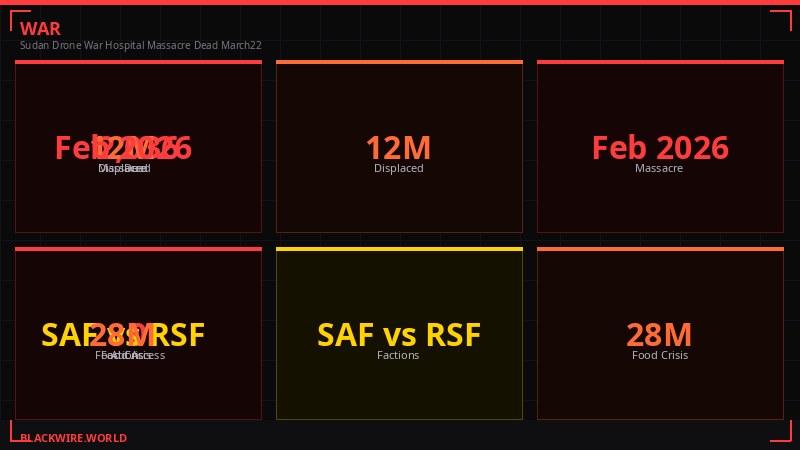
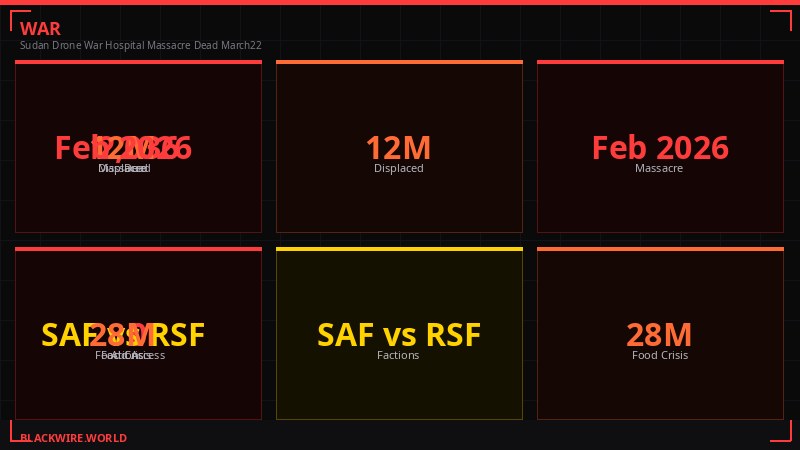
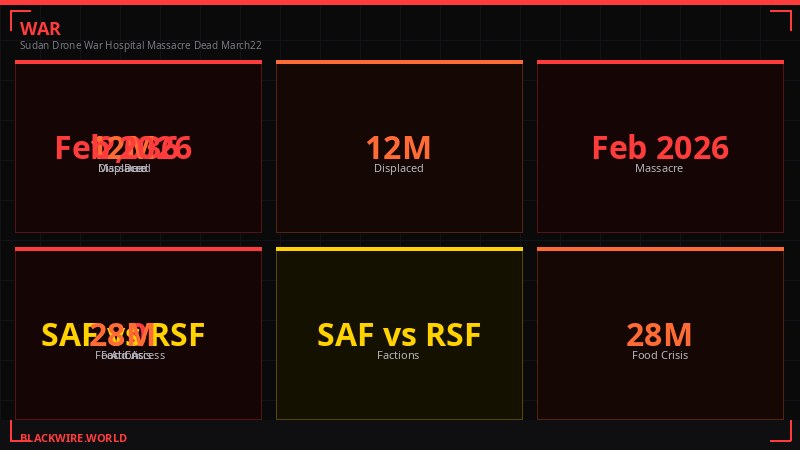
Sudan's army bombed al-Daein Teaching Hospital on Eid night, killing 64 - including 13 children and hospital staff. As of March 22, the WHO confirms 2,036 people have now been killed in 213 attacks on healthcare. The world is watching the Iran war. Sudan burns alone.
On the night of Friday, March 21 - Eid al-Fitr, the most significant celebration in the Islamic calendar - a drone struck al-Daein Teaching Hospital in East Darfur, Sudan. It killed 64 people. Thirteen of them were children. Two female nurses died at their posts. A doctor died alongside his patients. Eighty-nine more people were wounded.
The paediatric ward is destroyed. The maternity department is destroyed. The emergency unit is gone. The hospital - the central medical facility for al-Daein, capital of East Darfur state - is now completely non-functional. [WHO Director-General Tedros Adhanom Ghebreyesus, X/Twitter statement, March 22, 2026]
The Sudanese rights group Emergency Lawyers documented the attack and attributed it to a Sudanese army drone. The SAF has not claimed responsibility, but al-Daein is in RSF-controlled East Darfur - an area the government-aligned army has repeatedly struck as it tries to push the paramilitary Rapid Support Forces back toward their Darfur strongholds.
This single strike pushed a running tally over a threshold that should be impossible to ignore. The total number of people killed in attacks on healthcare facilities during Sudan's war has now passed 2,000. Two thousand and thirty-six dead. Two hundred and thirteen confirmed attacks. Not since World War II has any conflict accumulated this kind of systematic destruction of medical infrastructure.
The War Nobody Is Watching
Sudan's civil war began in April 2023. Twenty-three months of fighting between the Sudanese Armed Forces (SAF) and the Rapid Support Forces (RSF) have produced what the United Nations calls the world's largest humanitarian crisis. [UN OCHA Sudan Situation Report, March 2026]
Right now, 33.7 million people - nearly two thirds of Sudan's entire population - require humanitarian assistance. That figure comes from the UN's own tracking, and it is the largest such number recorded anywhere on earth. [UN OCHA, WFP figures, March 2026]
More than 12.4 million people have been forced from their homes. At least 21.2 million, or 41 percent of the population, face acute food insecurity. The World Food Programme classifies parts of Sudan as experiencing famine-level conditions - the first such formal classification in decades. [WFP Sudan Emergency Update, February 2026]
Tens of thousands have been killed in the fighting itself. Credible casualty counts are impossible to verify with precision - both sides restrict access, and independent journalists cannot operate freely. But the death toll from healthcare attacks alone, now over 2,000, is a floor, not a ceiling.
This is the war that barely registers. While global media devote wall-to-wall coverage to the US-Israel campaign against Iran, while Hormuz Strait deadlines and Dimona missile strikes fill every front page, Sudan's killing continues at industrial scale with almost no international attention and zero external intervention.
"Beyond the devastating human toll, attacks on healthcare have immediate and long-term consequences for communities already in desperate need of both emergency and routine medical services. Healthcare should never be a target. Peace is the best medicine." - WHO Director-General Tedros Adhanom Ghebreyesus, March 22, 2026
March 2026: An Aerial War on Civilians
The month of March 2026 alone has seen an extraordinary concentration of mass-casualty drone strikes on civilian targets - markets, hospitals, schools, transport, and residential areas. The pattern is not incidental. It is policy.
On March 4, at least 152 civilians were killed in al-Muglad, West Kordofan, when drone strikes hit a market and a hospital simultaneously. The attacks were attributed to the SAF. [Al Jazeera, March 13, 2026]
Three days later, on March 7, drones struck markets in Abu Zabad and Wad Banda, leaving at least 40 more people dead. [UN Human Rights Chief Volker Turk, statement, March 13, 2026]
On March 10, a civilian truck was struck in al-Sunut. At least 50 people were killed - among them women and children. Then, on March 12, RSF drones hit a secondary school and health centre in the village of Shukeiri in White Nile State. Seventeen people died: female students, teachers, a health worker. [Sudanese Doctors Network, Al Jazeera, March 12, 2026]
On March 13, the Adikong market near the Chad border was struck, killing 11 and igniting fuel reserves that burned for hours. Doctors Without Borders (MSF) treated more than 20 of the wounded at a hospital across the border in Chad. Seven of those wounded were children. MSF noted it was the second deadly strike on the same area in less than a month. [MSF statement, March 14, 2026]
Then came Eid night. Al-Daein Teaching Hospital. Sixty-four dead.
UN Human Rights Chief Volker Turk has publicly stated that more than 200 civilians were killed by drones across the Kordofan region and White Nile State in just eight days - between March 4 and March 12. His statement called the pattern "deeply troubling" and noted that "despite multiple reminders, warnings and appeals, parties to the conflict continue to use increasingly powerful drones to deploy explosive weapons in populated areas." [UN Human Rights, statement by Volker Turk, March 13, 2026]
The Drone War: Who Is Flying What, and Who Is Arming Them
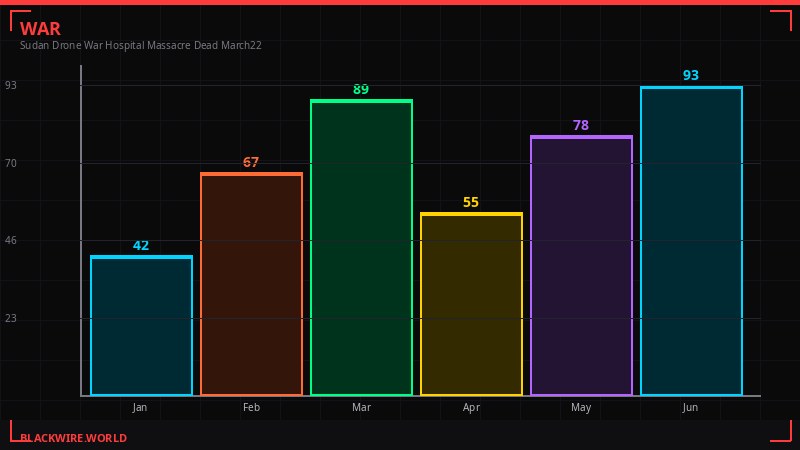
Drones have become the defining weapons system of Sudan's war. The Armed Conflict Location and Event Data project (ACLED) has documented more than 1,000 drone attacks since the conflict began in April 2023. In the first two months of 2026 alone, ACLED recorded 198 drone strikes by both sides - at least 52 of which caused direct civilian casualties, killing 478 people. [ACLED Sudan conflict data, cited by Al Jazeera, March 13, 2026]
Sudan accounted for more than half of all drone attacks recorded across the entire African continent in 2024, according to the Africa Center for Strategic Studies. [Africa Center for Strategic Studies, 2025 annual report]
The Sudanese Armed Forces operate conventional aircraft - MiG-29s and Soviet-era ground-attack jets - but increasingly rely on drone platforms for their strike campaigns. Iranian Mohajer-6 combat unmanned aerial vehicles have been documented in SAF inventories, with deliveries confirmed as recently as 2024. The SAF has also received Turkish military support, including Bayraktar TB2 drones, and has Chinese-made CH-4 and CH-5 variants in its arsenal. [ACLED, Africa Center for Strategic Studies, multiple verified reports]
The RSF has no formal air force and no conventional aircraft. Its drone capability has emerged from a network of supply routes allegedly running through Chad and other transit states. Multiple investigative reports and UN expert panels have pointed to the United Arab Emirates as a key enabler of RSF arms supply - allegations Abu Dhabi categorically denies. The RSF uses modified commercial drones alongside purpose-built military platforms, and has increasingly deployed low-cost FPV (first-person view) suicide drones adapted from civilian racing models. [UN Panel of Experts on Sudan, Al Jazeera investigations, multiple 2025-2026 reports]
Professor Mukesh Kapila of the University of Manchester, an expert in global health and humanitarian affairs, described the strategic logic plainly: "It is cheap, it is easily launched from anywhere, and the main effect is that it is a weapon of mass terror." [Mukesh Kapila, quoted by Al Jazeera, March 13, 2026]
Kapila identified the consistent pattern in target selection - hospitals, water points, markets, and displacement camps - as evidence that the purpose is "to spread terror" through strikes designed to project force well beyond any active front line. That assessment aligns with the targeting pattern documented throughout March 2026.
The Front Lines in March 2026
While the air campaign against civilians continues, the ground war has shifted significantly since the SAF retook Khartoum in March 2025. After being pushed out of the capital, the RSF relocated the centre of gravity of its campaign to the Kordofan region and to el-Fasher in North Darfur - which had been the Sudanese army's last stronghold in the vast western region until it fell to RSF forces in October 2025. [Al Jazeera conflict tracker, multiple reports, 2025-2026]
Following the fall of el-Fasher, accounts emerged of mass killings, rape, abductions, and systematic looting by RSF forces. A recent United Nations report concluded that the RSF's conduct in el-Fasher bore "all the hallmarks of genocide." The International Criminal Court has opened a formal probe into alleged war crimes by both parties. [UN report on el-Fasher, ICC statement, 2026]
In the most significant recent battlefield development, the SAF announced on March 6 that its forces had retaken the city of Bara - the second-largest city in North Kordofan state - in a combined air and ground operation. A senior SAF source told Al Jazeera that air attacks in the early hours struck RSF deployment positions inside the city, destroying 32 RSF combat vehicles and killing dozens of fighters. A subsequent ground assault from the north, advancing from al-Dankoj, secured the city's main entrances. Ten RSF vehicles were captured intact. [SAF statement via Al Jazeera, March 6, 2026]
The SAF has also consolidated control of el-Obeid, the North Kordofan state capital. These gains represent a meaningful compression of RSF territory in the central corridor - but they have not translated into reduced aerial bombardment of civilian areas. If anything, the drumbeat of drone strikes has intensified as the SAF tries to consolidate its advantage and deny the RSF the ability to regroup.
Meanwhile in the Darfur region, the RSF continues to dominate all five Darfur states. West Kordofan remains contested. The White Nile State has seen an uptick in RSF drone attacks against civilian infrastructure - schools, power stations, health centres. The March 12 strike on Shukeiri's secondary school, which killed female students and teachers, is part of this pattern. [Sudanese Doctors Network, Al Jazeera, March 12, 2026]
The Healthcare System in Ruins
The attack on al-Daein Teaching Hospital on March 21 is not an anomaly. It is the 213th confirmed attack on a healthcare facility in Sudan since the war began. The WHO's Surveillance System for Attacks on Health Care (SSA) has been tracking each incident with methodical precision - while the attacks themselves become steadily more lethal.
In 2023, the first year of the war, 64 confirmed attacks on healthcare killed 38 people. In 2024, 72 attacks killed 200. Then in 2025, the drone war intensified dramatically: 65 attacks caused 1,620 deaths. That single year's figure - 1,620 dead in healthcare strikes - represented 82 percent of all reported deaths from attacks on healthcare facilities globally in 2025. Sudan was not one of several troubled hotspots. Sudan was the overwhelming majority. [WHO SSA data, reported March 22, 2026]
The destruction at al-Daein Teaching Hospital illustrates what these numbers mean in practice. The facility's paediatric ward - where children with malnutrition, disease, and war injuries receive treatment - is destroyed. The maternity department, serving pregnant women in a region with already catastrophically high maternal mortality rates, is gone. The emergency department that handles trauma, snake bite, gunshot wounds, and acute illness across the city is non-functional.
Al-Daein is the capital of East Darfur state. It is RSF territory. The city's civilian population now has no functioning teaching hospital. MSF and other humanitarian organizations are stretched to their operational limits across Sudan - there is no rapid replacement for what was lost on Eid night.
"As a result of this tragedy, the total number of fatalities linked to attacks on health facilities during Sudan's war has now surpassed 2,000. Enough blood has been spilled. Enough suffering has been inflicted." - WHO Director-General Tedros Adhanom Ghebreyesus, March 22, 2026
The SAF has carried out repeated attacks on al-Daein in recent weeks. Earlier this month, a SAF strike on the city's market ignited oil barrels that burned for hours. The pattern of targeting civilian infrastructure in RSF-held territory - markets, fuel supplies, hospitals - tracks with counterinsurgency doctrine that targets the economic and social infrastructure sustaining enemy-controlled populations. Whether that constitutes a war crime is, at minimum, a question the ICC's active probe will need to answer.
The Combatants: Who Started This and Where It Stands
The war between the SAF and RSF erupted in mid-April 2023 - a power struggle between the two dominant military factions that had cooperated to overthrow Sudan's transitional government in a 2021 coup. General Abdel Fattah al-Burhan leads the SAF and Sudan's sovereign council; General Mohamed Hamdan Dagalo, known universally as "Hemedti," commands the RSF. Both men had been nominally allied partners in the coup. The question of how to integrate the RSF into the regular army - and who would ultimately control Sudan's security apparatus - broke that partnership violently. [Al Jazeera background reporting, 2023-2026]
The RSF emerged from the Janjaweed militias that carried out atrocities in Darfur during the 2003-2005 genocide. Hemedti built it into a paramilitary force of between 70,000 and 100,000 fighters with significant battlefield experience, including deployments to Yemen alongside Saudi forces. The RSF is not a ragtag insurgency. It is a professional military organisation with international connections and significant external funding. [Africa Center for Strategic Studies, UN Panel of Experts on Sudan]
The SAF, with conventional air power and state resources, has the structural advantage - but its battlefield performance has been inconsistent. The recapture of Khartoum in March 2025 was a significant strategic achievement after the RSF had held the capital for nearly a year. The subsequent push into Kordofan - retaking el-Obeid and Bara in early March 2026 - represents continued momentum. But Darfur, where the RSF has deep roots and strong supply lines, remains effectively out of reach.
Both sides have been accused of war crimes. Both sides have been accused of crimes against humanity. The UN, ICC, and multiple credible human rights organisations have documented systematic atrocities by both the SAF and RSF, including mass executions, rape, destruction of civilian property, and deliberate targeting of non-combatant populations. Neither side is acting within the laws of war. That distinction matters less and less to the civilians caught between them. [UN Human Rights, ICC probe, Amnesty International, Human Rights Watch, 2025-2026]
US Involvement: Blacklisting the Brotherhood, Ignoring the Bombs
Washington's engagement with Sudan's war has been selective and ideologically inflected. On March 9, 2026, the Trump administration designated the Sudanese Muslim Brotherhood as a "specially designated global terrorist" organisation, with Secretary of State Marco Rubio announcing that the group would also receive a "foreign terrorist organisation" designation the following week. [US State Department statement, Marco Rubio, March 9, 2026]
The State Department accused the Sudanese Muslim Brotherhood of receiving support from Iran's Islamic Revolutionary Guard Corps (IRGC) and of conducting "mass executions of civilians." The designation enables economic sanctions and makes material support to the group a federal crime under US law. [US State Dept, March 9, 2026]
The UAE welcomed the move immediately. In a statement from Abu Dhabi's Ministry of Foreign Affairs, the designation was described as reflecting "sustained and systematic efforts undertaken by the administration of President Trump to halt excessive violence against civilians." This framing conveniently positioned the UAE - which is itself accused by UN investigators of arming and financing the RSF - as aligned with the Trump administration's counterterrorism priorities. [UAE Ministry of Foreign Affairs statement, March 9, 2026]
The RSF and its supporters have long argued that they are fighting the Muslim Brotherhood. The US blacklisting effectively validates that framing - without any corresponding designation, sanction, or pressure on the RSF itself, or on the external actors accused of enabling its arms supply. No US action has been taken against drone manufacturers, supply networks, or transit states that may be enabling either side's aerial campaign against civilians.
There is no US envoy actively engaged in ceasefire negotiations. There is no active UN Security Council process with teeth - resolution after resolution condemning the conflict has been issued without enforcement mechanisms. The UN Security Council did condemn RSF attacks in Kordofan in a statement in February 2026, but issued no binding resolution. [UN Security Council statement, February 2026, via Al Jazeera]
The international community's response to Sudan's war has been humanitarian in character and almost entirely absent in strategic or coercive terms. Donate, evacuate, condemn, repeat. Meanwhile the strikes continue.
The World's Largest Crisis in the World's Largest Shadow
There is a phrase that has appeared in multiple Al Jazeera reports covering Sudan in March 2026. It shows up almost verbatim in several distinct pieces: "While the world focuses on the United States-Israel war on Iran and its reverberations... the brutal civil war in Sudan is nearly three years long now."
That sentence encapsulates exactly what is happening. The Iran war is the dominant global story. The Hormuz Strait ultimatum, the Dimona strikes, the Diego Garcia missile launches - these command attention because they involve great powers, nuclear adjacency, and oil price consequences that hit consumers in Europe and America. Sudan has none of those attributes from the perspective of Western foreign policy calculus. It has no oil chokepoint. It has no nuclear facilities. Its combatants are not proxies in a superpower rivalry that matters to Western electorates.
What Sudan has is the world's largest displacement crisis, the world's largest population in humanitarian need, and - as of March 21, 2026 - 2,036 documented dead in attacks on the hospitals and clinics those 33 million desperate people depend on.
The UN Security Council has condemned the conflict. UN human rights bodies have documented atrocities with precision and regularity. The WHO has issued increasingly urgent warnings. The ICC has opened investigations. And none of it has stopped a single drone.
"Sudan accounted for more than half of all drone attacks recorded across the entire African continent in 2024. In the first two months of 2026 alone, ACLED recorded 198 strikes, killing 478 civilians." - Africa Center for Strategic Studies / ACLED data, March 2026
The acceleration is notable. In 2025, the SAF claimed to have shot down more than 100 RSF drones in just 10 days - suggesting both the volume and sophistication of the drone campaign had reached industrial levels. The counter-drone problem alone has become a significant military burden, while the offensive drone campaign against civilians continues without effective constraint. [Africa Center for Strategic Studies, ACLED, Al Jazeera]
Capacity and international resolve do exist for decisive action. The same week that the US issued a 48-hour ultimatum to Iran over the Hormuz Strait, accompanied by explicit threats to destroy Iranian power plants, not a single senior US official issued a public demand that the SAF stop bombing hospitals. The asymmetry is total.
What Happens Next: No Exit in Sight
The trajectory of Sudan's conflict does not point toward de-escalation. The SAF's battlefield gains in Kordofan have not produced any political opening. There is no functioning ceasefire mechanism. The last serious ceasefire attempt - the Jeddah talks brokered by Saudi Arabia and the United States in 2023 - collapsed quickly and has never been meaningfully revived. International mediation efforts lack both the leverage and the sustained political will needed to compel either party to negotiate in good faith.
The RSF controls Darfur. Its supply lines through Chad are intact. Its leadership - Hemedti and his brother Abdul Rahim Dagalo - have shown no disposition toward compromise. The group's backers in the Gulf have financial interests in Sudan's gold sector that give them positive incentives to keep the RSF operational. Gold mining operations in Darfur, which the RSF controls and taxes, have been a significant revenue stream for the paramilitary even during the fighting. [BLACKWIRE previous investigation: rsf-sudan-gold-uae-pipeline-march-2026.html]
The SAF, for its part, has demonstrated military momentum but governs a country in complete economic and institutional collapse. It cannot win the war decisively without entering Darfur at scale - a prospect that implies enormous further casualties. And even a SAF military victory would not resolve the underlying political conditions that produced the RSF in the first place: the fragmentation of Sudan's governing structures, the reliance on armed groups as political proxies, the exclusion of civilian democratic forces from power.
For the 33.7 million people in humanitarian need, none of this matters in immediate terms. What matters is food. Medical care. Safety. The ability to sleep without listening for the drone overhead that may or may not carry a warhead.
Al-Daein Teaching Hospital's paediatric ward will not be rebuilt quickly. The children of East Darfur who need medical care tonight do not have a facility to go to. Two nurses who went to work on Eid morning did not come home. A doctor died in his emergency room.
The WHO's total - 2,036 dead in healthcare attacks - will continue to rise. The pace of strikes in March 2026 is among the highest recorded since the war began. There is no ceasefire. There is no credible international enforcement mechanism. There is no meaningful political process.
There is only the drone, the hospital, and the number that keeps climbing.
Timeline: Sudan's Drone War Escalation - March 2026
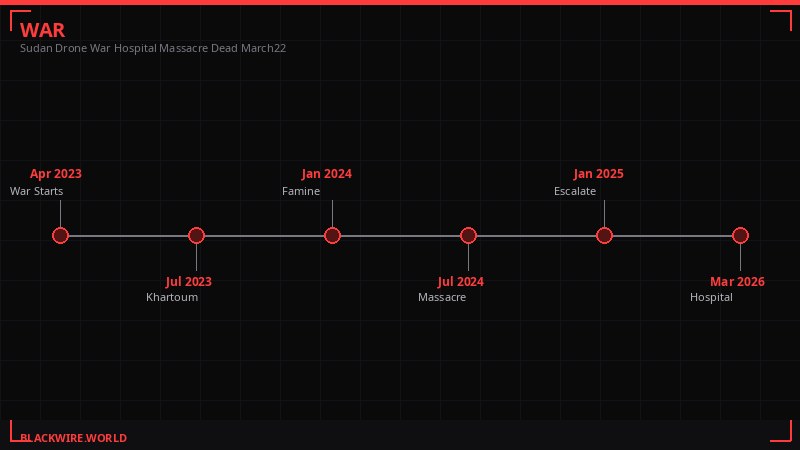
- March 4: al-Muglad, West Kordofan - SAF drones strike market and hospital simultaneously. At least 152 civilians killed. [Al Jazeera, UN Human Rights]
- March 7: Abu Zabad and Wad Banda - market strikes kill 40+. [UN Human Rights]
- March 10: al-Sunut - civilian truck destroyed, 50+ killed including women and children. [UN Human Rights]
- March 12: Shukeiri, White Nile State - RSF drones hit secondary school and health centre. 17 dead: female students, teachers, health worker. 10 wounded. [Sudanese Doctors Network, Al Jazeera]
- March 13: Adikong market, Chad border - 11 killed, fuel depot ignited, 20+ wounded (7 children treated by MSF in Chad). Second attack on same area in a month. [MSF, Al Jazeera]
- Earlier March: al-Daein city market - SAF strike ignites oil barrels, burns for hours. [Emergency Lawyers, Al Jazeera]
- March 21 (night, Eid al-Fitr): al-Daein Teaching Hospital, East Darfur - 64 killed (13 children, 2 nurses, 1 doctor), 89 wounded. Paediatric, maternity and emergency departments destroyed. Hospital rendered non-functional. WHO total: 2,036 dead in 213 healthcare attacks since April 2023. [WHO, Emergency Lawyers, BBC, Al Jazeera]
Get BLACKWIRE reports first.
Breaking news, investigations, and analysis - straight to your phone.
Join @blackwirenews on Telegram