SuperMicro's $2.5 Billion Secret: How Nvidia AI Chips Bled to China

AI chips - the most contested hardware on Earth. Photo: Pexels
Three people connected to Super Micro Computer - including the company's co-founder - were charged by federal prosecutors on Thursday in what the Department of Justice is calling one of the most significant AI chip export control violations in US history. The scale: $2.5 billion worth of Nvidia-made AI servers funneled to Chinese buyers through a network of dummy companies, fake documents, and decoy hardware. The operation ran for at least three years. Nobody at the company, prosecutors allege, stopped it.
The scheme worked through industrial-scale deception. Thousands of Nvidia H100-class chips - the gold standard of AI training hardware, explicitly banned from sale to China without a US export license - crossed borders in unmarked boxes while auditors in the United States inspected elaborate look-alike dummy machines that had been rigged to pass inspection. One operational detail in the DOJ indictment has already become the defining image of the case: a suspect was captured on surveillance cameras using a hair dryer to peel serial number stickers off real servers and transfer them to the fakes.
That image - a heat gun and a box of sticky labels, unlocking billions in illegal technology transfers - says everything about how the most consequential technology export battle of the 21st century is actually being fought on the ground. Not with encrypted channels and sophisticated cyber tools. With a hair dryer, a warehouse in Southeast Asia, and an insider who knew which numbers to swap.
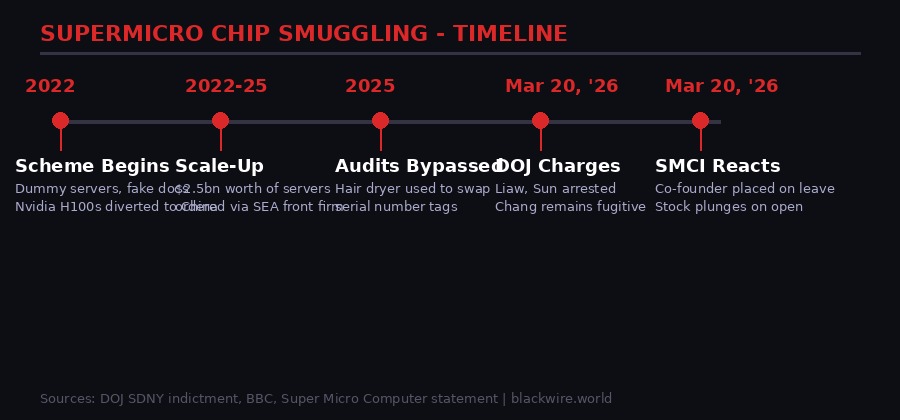
Operation timeline from 2022 to March 2026 DOJ charges. Source: DOJ SDNY indictment | BLACKWIRE
Who Got Charged - And Who Is Missing

DOJ Southern District of New York filed charges on March 20, 2026. Photo: Pexels
The DOJ's Southern District of New York unsealed three indictments on March 20, 2026. Yih-Shyan "Wally" Liaw, a US citizen and co-founder of Super Micro Computer, was arrested. So was Ting-Wei "Willy" Sun, a Taiwanese citizen who worked as a contractor for the company. The third defendant, Ruei-Tsang "Steven" Chang, a Taiwanese citizen who worked as a sales manager, remains a fugitive. He is believed to be in Taiwan, which does not have an extradition treaty with the United States.
Super Micro Computer - officially Super Micro Computer Inc., ticker SMCI on the Nasdaq - is not named as a defendant in the charges. The company is one of the world's largest server manufacturers, supplying data centers globally and building the physical machines that run AI workloads at scale. Founded in 1993 in San Jose, California, it has grown into a multibillion-dollar enterprise with major government and commercial contracts across the technology industry.
The company moved quickly to contain the public damage. In a formal statement issued the same day as the charges, Super Micro said it was "cooperating fully with the investigation" and confirmed that co-founder Liaw had been placed on administrative leave. Chang, the sales manager, was also placed on leave. Sun, the contractor, had his working relationship terminated entirely. The speed of the response suggested the company had some prior awareness the charges were coming.
"The conduct by these individuals alleged in the indictment is a contravention of the company's policies and compliance controls, including efforts to circumvent applicable export control laws and regulations."
- Super Micro Computer Inc. statement, March 20, 2026
Conspicuously, the DOJ indictment refers only to "a California-based manufacturer" - it does not name Super Micro directly. That legal technicality has not stopped the market from doing the math. Super Micro shares fell sharply on open on March 20, with institutional investors processing what it means to have your co-founder and two other senior employees arrested for running a multi-year, multi-billion-dollar export crime operation from inside the company's sales structure.
The charges carry potential sentences of up to 20 years in federal prison per count. For Liaw, who built Super Micro from a startup into a Nasdaq-listed technology giant over three decades, the arrest represents a catastrophic personal and professional collapse. His lawyers had not commented publicly at time of publication.
How the Operation Worked: The Southeast Asia Shell and the Hair Dryer Trick

The real servers left the US in unmarked boxes via a Southeast Asian logistics chain. Photo: Pexels
The mechanics of the scheme, as laid out in the DOJ indictment, are a masterclass in industrial-scale deception. At its center was an unnamed Southeast Asia-based company - referred to throughout the legal filing as "Company-1" - that served as the official purchasing entity for the hardware.
Company-1 would place orders for servers from Super Micro, including machines loaded with Nvidia AI chips subject to US export controls. The paperwork would name Company-1 as the legitimate end user, located in Southeast Asia. No export license for China was required, because officially the hardware was staying in the region. Everything looked clean on paper.
Then the swap happened. Company-1 would repackage the real servers with the help of a separate logistics firm. The genuine machines - loaded with Nvidia GPUs worth tens of thousands of dollars each - would be concealed in unmarked boxes and routed to buyers in China. In their place, thousands of dummy replica servers would be assembled and kept in warehouses, available for inspection if US auditors came calling.
The operational detail that has already entered the folklore of export control enforcement: Ting-Wei "Willy" Sun was captured on surveillance cameras using a hair dryer to remove serial number stickers from real servers and applying them systematically to the dummy machines. The DOJ said this was not a one-time improvisation but a documented, repeated operational step in a scheme designed to defeat audit controls at industrial scale. The cameras caught the method. The investigators did the math on how many times it had been used.
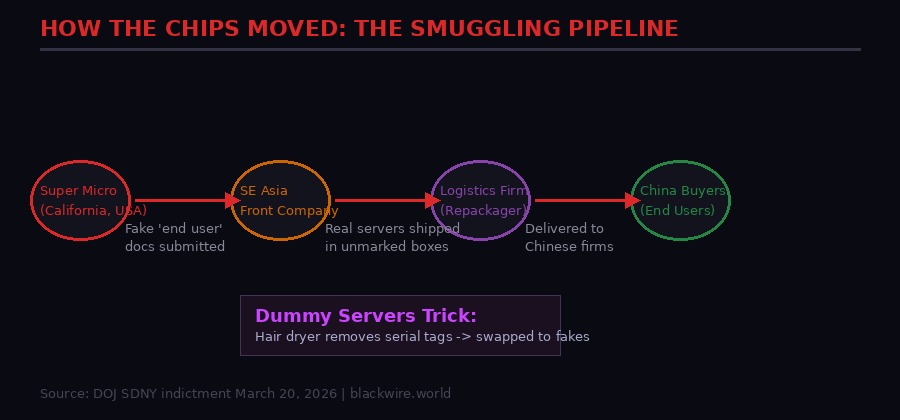
How the hardware moved: from California to Southeast Asia to Chinese buyers. Source: DOJ SDNY | BLACKWIRE
The buyers on the China side were brokers in close contact with Liaw and Chang, the two Super Micro insiders named in the indictment. The DOJ alleged that the trio "conspired to sell billions of dollars' worth" of technology to Chinese buyers "by faking documents and using dummy equipment to slip past audits." According to the indictment, Company-1 bought approximately $2.5 billion worth of equipment over the life of the scheme and sent "massive quantities of servers with controlled US artificial intelligence technology" to China with no valid export authorization at any point.
A separate, related case announced the same day charged two Chinese nationals - operating through a company called ALX Solutions - with an identical playbook. They allegedly told their supplier, believed to also be Super Micro, that the ordered chips were for a Singapore-based customer. The hardware was then routed to companies in Hong Kong and mainland China between 2022 and 2025. Two separate schemes, same corridor, same method, same target: China's insatiable appetite for Nvidia's AI chips.
Why Nvidia's H100 Chips Are Worth Smuggling at This Scale

Nvidia's advanced AI chips are the most export-controlled hardware on the planet. Photo: Pexels
To understand why people run multi-year, multi-billion-dollar criminal enterprises to move server chips across borders, you need to understand what these chips are worth - and why China cannot legally buy them.
Nvidia's H100 GPU, and its successors the H200 and now the Blackwell-series architecture, are the primary hardware enabling large-scale AI model training. Training a frontier AI model - the kind being built by Chinese tech giants like Baidu, Alibaba, ByteDance, and state-backed research labs competing with OpenAI and Google - requires clusters of hundreds or thousands of these chips running in parallel, sometimes for months at a stretch. Without them, Chinese AI development stalls. With them, it accelerates.
A single H100 GPU retails at approximately $30,000 to $40,000 on the open legal market. In China, where US export restrictions have made them formally unavailable since October 2022, the grey market premium has historically pushed the effective price to $70,000-$100,000 per unit depending on supply conditions. A standard server containing eight H100 chips costs around $320,000 at retail in the US. On the Chinese black market, the same machine commands upwards of half a million dollars. At scale, those margins make a criminal operation that moves $2.5 billion in hardware financially rational even accounting for the logistics overhead, the fake documentation infrastructure, and the bribes or payments required to maintain the network.
The US government began restricting Nvidia's most advanced chips from export to China in October 2022, citing national security concerns about military AI development. The Biden administration progressively tightened those controls through 2023 and 2024, adding more chip models and closing loopholes that had previously allowed scaled-down versions to reach Chinese buyers. The Trump administration partially reversed some restrictions in late 2025, allowing lower-tier chips to flow again, but the core prohibitions on frontier AI hardware remained intact. For Chinese companies racing to build competitive AI infrastructure, the shortage is existential. They cannot train cutting-edge models at scale without these chips. The grey market and the criminal smuggling market exist because the demand pressure is enormous, the price differential is massive, and enforcement has historically lagged far behind the volume of evasion.
"Unlawful diversion of controlled US computers to China is a losing proposition across the board. Nvidia does not provide any service or support for such systems, and the enforcement mechanisms are rigorous and effective."
- Nvidia spokesperson statement to BBC, March 2026
Nvidia said it works closely with customers and the government on compliance programs. What the company cannot fully control is what happens after a server leaves a legitimate purchaser's hands and enters a repackaging warehouse somewhere in Southeast Asia. The liability chain breaks at the point of resale. That is precisely why the insiders in the indictment were so valuable to the operation - they could ensure the original purchase looked clean.
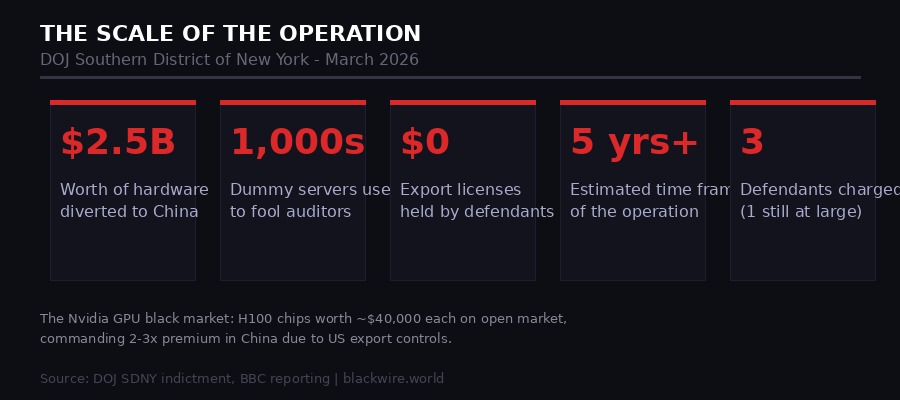
The numbers behind the largest AI chip export case in US history. Source: DOJ SDNY | BLACKWIRE
Super Micro's Turbulent History - This Is Not the First Time

Super Micro has faced repeated scrutiny over accounting and governance practices. Photo: Pexels
If this is your first exposure to Super Micro drama, you have missed a remarkable and increasingly alarming corporate saga. The company has been a lightning rod for controversy for years - and the latest DOJ charges arrive on top of an unresolved pile of institutional credibility problems that would have sunk most companies of its size.
In August 2024, Super Micro disclosed that its auditor, Ernst and Young, had resigned - citing concerns about the board's commitment to transparency and complete disclosures to auditors. Auditor resignations of this kind are nuclear-level corporate governance events. Auditing firms do not walk away from major clients lightly. They resign when they believe they cannot trust the information they are being asked to certify. Super Micro's stock collapsed 40% within days of the disclosure. The company then missed multiple SEC filing deadlines and faced a formal Nasdaq delisting threat. It eventually brought on new auditors, filed its delayed annual report in February 2025, and avoided delisting. But the institutional shadow over its governance never fully lifted.
Before that, in 2018, Bloomberg Businessweek published an explosive report claiming that Chinese intelligence had inserted tiny spy chips into Super Micro server motherboards destined for US government and major corporate clients, including Apple and Amazon. Both companies denied the report vigorously. Super Micro denied it. No physical chip evidence was ever produced publicly. The story was never formally retracted. It left a permanent unresolved question mark hanging over the company's supply chain security that the company never fully answered to the market's satisfaction.
That 2018 Bloomberg report feels different now, viewed through the lens of the 2026 indictment. The 2018 narrative was about Chinese intelligence inserting hardware into Super Micro's supply chain without the company's knowledge. The 2026 narrative is about Super Micro insiders actively participating in diverting US hardware to China. Different direction of information flow, different mechanism, but the same geographic and institutional intersection: Super Micro and Chinese technology access, repeatedly, across decades.
The co-founder now under arrest, Wally Liaw, was a foundational figure in Super Micro's growth. His name is embedded in the company's origin story. His arrest forces the question that investors and regulators will be wrestling with for months: was this a case of individual misconduct by a rogue founder, or does it reflect something structural about the company's culture, compliance environment, and willingness to enforce its own rules against people at the top?
The Export Control War: Enforcement Finally Catches Up

The US-China technology decoupling is being enforced one indictment at a time. Photo: Pexels
The DOJ charges against the Super Micro trio represent the enforcement arm of a technology decoupling strategy that Washington has been constructing for years. But the scale of what prosecutors uncovered exposes how wide the gap between policy and reality has been running.
The US government has invested billions of dollars and enormous diplomatic capital building a coalition-based export control regime. Washington convinced allied governments in Europe, Japan, South Korea, and the Netherlands to restrict their own companies' sales of advanced chip manufacturing equipment to China. The CHIPS and Science Act committed $52 billion to domestic semiconductor production. The Commerce Department's Bureau of Industry and Security has issued increasingly aggressive Entity List designations targeting Chinese technology firms, blocking them from purchasing US-origin goods. The diplomatic architecture is substantial.
But if $2.5 billion worth of the most restricted hardware in the world can be moved through a single operation - run from inside a major US-listed company, using paper audits and dummy hardware as the primary security layer - then the enforcement infrastructure has a fundamental gap. The Super Micro case is not an aberration. It is a single data point in a well-documented pattern.
In November 2023, the Commerce Department's BIS acknowledged that a significant volume of restricted semiconductors was continuing to reach Chinese entities through third-country intermediaries in Singapore, Malaysia, Hong Kong, and the United Arab Emirates. The use of Southeast Asian shell companies as pass-through purchasing entities - exactly the structure described in the Super Micro indictment - has been the dominant evasion technique since controls were first imposed. Investigators have known about it for years. The enforcement has simply not kept pace with the volume.
The ALX Solutions case announced alongside the Super Micro charges describes the same playbook running independently and in parallel. Order hardware from a US supplier, list a Singapore customer as end user, route through Hong Kong, deliver to China. The geographic corridor is a known enforcement vulnerability. Whether the new charges signal a genuine scaling-up of enforcement capacity, or represent isolated prosecutions amid a much larger ongoing flow, is the critical open question.
"The global economy is full of uncertainty at this point in time. Interruptions to technology supply chains compound the damage from energy market disruptions. The US cannot afford enforcement gaps in its most strategically critical export controls."
- Adapted from WTO Director General Dr. Ngozi Okonjo-Iweala, March 2026
Washington has not been blind to the enforcement problem. In December 2025, the Trump administration permitted Nvidia to resume exports of some lower-tier chips to China, responding to lobbying pressure from US tech companies about the economic cost of blanket restrictions. But the core prohibitions on frontier AI chips - the H100, H200, and Blackwell-series hardware - remained firmly in place. The Super Micro case demonstrates that those remaining restrictions were being systematically and industrially circumvented, at a scale that required insider cooperation at a major listed company and a logistics network spanning multiple countries over multiple years.
What Happens to Super Micro Now - Legal, Market, and Regulatory Exposure

Super Micro shares fell sharply on March 20 as DOJ charges were announced. Photo: Pexels
Super Micro faces overlapping threats from the DOJ charges on multiple fronts simultaneously, and how each resolves will shape one of the most consequential corporate technology crime cases in recent American history.
The immediate legal exposure falls on the three individuals charged, not the company. The DOJ has so far declined to name Super Micro as a defendant in the criminal proceedings. That designation could change. Corporate criminal liability and deferred prosecution agreements are standard prosecutorial tools in export control cases - the DOJ has used them against major financial institutions, pharmaceutical companies, and defense contractors to force structural reforms, extract substantial financial penalties, and install compliance monitors. If prosecutors determine that the misconduct was systemic rather than individual - if the evidence shows that senior people at Super Micro knew or should have known what Liaw and Chang were doing - a corporate charge becomes likely.
The more acute threat to the business may be debarment. Super Micro holds significant US government contracts. A formal debarment proceeding, triggered by the export control violations, would bar the company from receiving new federal contracts and potentially cancel existing ones. For a company that has positioned itself as a critical infrastructure supplier to US government agencies and defense-adjacent clients, that exposure is potentially catastrophic to the business model.
There is also the Nasdaq question. Super Micro barely survived delisting in 2025 following the auditor resignation crisis. A criminal case involving its co-founder and a multi-billion-dollar illegal operation discovered running inside the company's sales structure is not the kind of news that stabilizes an institution already under heightened scrutiny. Institutional investors and governance watchdogs will be focused on the board's response - specifically whether Super Micro can demonstrate credibly that its compliance infrastructure is now capable of detecting and preventing misconduct at the level of a co-founder.
The fugitive Chang remaining at large complicates everything. Taiwan does not extradite its citizens to the United States. The political geometry of pressing Taiwan for cooperation on a case that intersects with China policy, Taiwan's own economic relationships, and US-Taiwan diplomatic considerations makes a quick resolution unlikely. Chang's continued freedom - and his potential access to information about the full scope of the operation - is a variable the DOJ cannot control.
The Bigger Picture: AI Chips Are the New Strategic Resource

Data centers running AI chips are the critical infrastructure of the 21st century strategic competition. Photo: Pexels
Step back from the indictment specifics and look at what this case actually represents in a broader strategic context.
The US government has made an explicit determination that Nvidia's most advanced AI chips are a strategic national security asset - so critical to military AI development and future geopolitical competition that their sale to China must be prevented even if doing so costs US companies billions in annual revenue. This is a profound and historically unusual policy position. The United States has not formally prohibited the export of specific industrial goods to a major economy at this scale since Cold War-era COCOM controls on the Soviet bloc. The framing is that different: Washington views AI chip access as an asymmetric advantage that must be protected the way previous generations protected nuclear technology or advanced weapons systems.
The Chinese response to those controls has been economically predictable and strategically rational: acquire the hardware through whatever channels remain available. When the legal price is $40,000 per chip and the grey market price is $100,000, and the cost of falling behind in the AI race is existential competitive disadvantage for China's technology sector and military modernization program, the math supports paying the premium every time. It supports building elaborate logistics networks. It supports corrupting insiders at US-listed companies. The demand is structurally immune to legal deterrence at current enforcement levels.
The Super Micro case is what $2.5 billion of that demand pressure looks like when it finds a willing insider network. There will be more cases like this. The fundamental dynamics driving them have not changed and will not change with a single set of indictments. The price differential between the US legal market and the Chinese grey market remains enormous. Chinese AI development requires this hardware at scale. Complex international supply chains create multiple points of vulnerability. Compliance programs that rely on paper documentation and periodic audits can be defeated by anyone with access to a hair dryer and a box of replica serial number stickers.
What the DOJ charges do change - potentially significantly - is the risk calculus for insiders. Liaw, if convicted on all counts, faces decades in federal prison. Chang, the fugitive, cannot travel freely to most Western countries or return to normal business operations. Sun, the contractor, faces the same federal exposure. The message is being delivered in personal terms that are very difficult to ignore. Whether that message reaches the next potential insider before they make the same calculation as Liaw - before the next $2.5 billion quietly crosses the Pacific in unmarked boxes - is the open question in the technology decoupling strategy that defines the US-China relationship for the coming decade.
The AI chip war is not being fought with missiles or trade delegations. It is being fought with hair dryers and dummy servers in unmarked boxes, with fugitives in Taiwan and shell companies in Singapore, with co-founders in handcuffs and compliance forms that say one thing while the actual hardware says another. That is the real shape of the most consequential technology conflict of our era. And by any honest accounting, the enforcement side is still significantly behind.
Get BLACKWIRE reports first.
Breaking news, investigations, and analysis - straight to your phone.
Join @blackwirenews on TelegramSources: Department of Justice Southern District of New York indictment, March 20, 2026 | BBC Business reporting, Peter Hoskins, Nick Edser, Osmond Chia | Super Micro Computer Inc. official statement | Nvidia spokesperson statement via BBC | BIS enforcement data and Entity List filings | World Trade Organisation Global Trade Outlook 2026 | BBC Verify Hormuz Strait shipping data | Capital Economics, PwC UK, AJ Bell analyst commentary