
Joandri Velazquez Zaragoza is 40 years old. He works as an evangelical pastor when he can, a mason when he must, and a husband and father always - even though his wife and two children are 2,000 miles away in a Cuba that is falling apart. He arrived in Tapachula, Mexico, near the border with Guatemala, in August 2024. He came because of the CBP One app. He stayed because the app died the moment Donald Trump returned to the White House.
On Tuesday night, Joandri walked out of Tapachula with 1,200 other people. They had nowhere specific to go. The United States was not the destination - not anymore. The point was to move, to refuse to stay frozen. To prove they existed.
"Without papers, there are no opportunities. We migrants feel like prisoners in Tapachula."
- Joandri Velazquez Zaragoza, 40, Cuban national, speaking to AP News
What is happening in and around Tapachula right now is one of the least-covered humanitarian slow-burns of 2026. It lacks the spectacle of a military conflict. There is no single dramatic event. There is just an accumulating human weight - thousands of people in bureaucratic limbo, increasingly desperate, increasingly willing to risk their lives to move. And on Monday, 229 of them were found locked inside a stolen truck at a police impound lot in Veracruz, screaming for help. Workers heard the banging hours after the truck had been towed. The migrants were dehydrated. Seventeen were children.
That is the shape of this crisis. Not a single headline. A slow drowning, punctuated by moments that remind you people are still inside.
Tapachula: City Built on Transience, Now a Trap

Tapachula sits in the far south of Chiapas state, 30 kilometers from the Guatemalan border. The Suchiate River marks the crossing point, and it has always been a place people passed through. Seasonal agricultural workers. Hondurans heading north. Guatemalans going back and forth. The city had a rhythm. Transit was the economy.
That rhythm broke decisively around 2022, when surges of migrants from Venezuela, Cuba, Ecuador, and beyond began pooling in Tapachula waiting for CBP One appointments - the Biden administration's mobile app system that let migrants book asylum hearings at US ports of entry. The app gave people hope and a reason to stay in southern Mexico rather than attempt the dangerous overland route through the Darien Gap and Central America. For a time, it worked. Tapachula's population of stranded migrants swelled, but there was movement, there was a process, there was a door.
Then January 20, 2025 came. On the first day of Trump's second administration, CBP One was shut down. Overnight. Fifty thousand active appointments - cancelled. People who had waited months for their slots, who had built their lives around those dates, found their phones showing nothing. The door did not close gradually. It slammed.
Those who had appointments pivoted to Mexico's own asylum system, administered by an agency called COMAR. But COMAR was not built for this volume. Losiel Sanchez and his wife arrived in Tapachula in November 2024. He had hoped for a CBP One appointment. When that disappeared, he filed for asylum in Mexico. His application was rejected. His appeal was rejected. He is still there. He does not know what happens next. He told AP News he hopes to find better luck in Mexico City, though what "better luck" means without any legal status is unclear.
Another Cuban migrant, Anery Sosa, has been in Tapachula for a year. Her asylum process collapsed when someone stole her documents. She has a daughter with a Mexican national. She wants to find childcare so she can work. Her husband's earnings don't cover rent and food. The city has a pulse-rate of desperation that is not dramatic enough for news cameras but is crushing the people living inside it.
The March That Went Nowhere - and Everything

The caravan that left Tapachula on Tuesday night was not organized by any migrant rights group or political party. It was organized - loosely, without a named leader - through social media platforms where people simply agreed: we are going to walk. Cubans made up the majority. But there were Hondurans, Ecuadorians, Brazilians, Haitians. Roughly 1,200 people in total, according to AP News. They walked under the watch of Mexico's National Guard, the National Migration Institute, and local police - none of whom moved to stop them.
This is a specific kind of protest: the protest of exhaustion. Not marching toward a specific enemy or toward a specific demand that could be met. Marching because standing still has become unbearable. Because Tapachula, as one migrant put it, is a city where migrants feel like prisoners. They cannot get papers to work elsewhere. They cannot get work without papers. They cannot leave for the north. They cannot afford to return home - and for many Cubans, home is a country with rolling blackouts and food shortages so severe that leaving was survival.
The march targeted Mexican federal authorities. The demand: speed up asylum processing, issue humanitarian permits allowing them to work in other Mexican states that have actual labor markets. On the same day the caravan began, the Mexican government announced a new agreement to boost labor inclusion for transit migrants in southern states - Campeche, Chiapas, Tabasco, Quintana Roo. Whether that announcement was coincidence, response, or performance is unclear. What is clear is that southern Mexico's employment landscape is severely limited, and migrants without papers are locked out of even those limited opportunities.
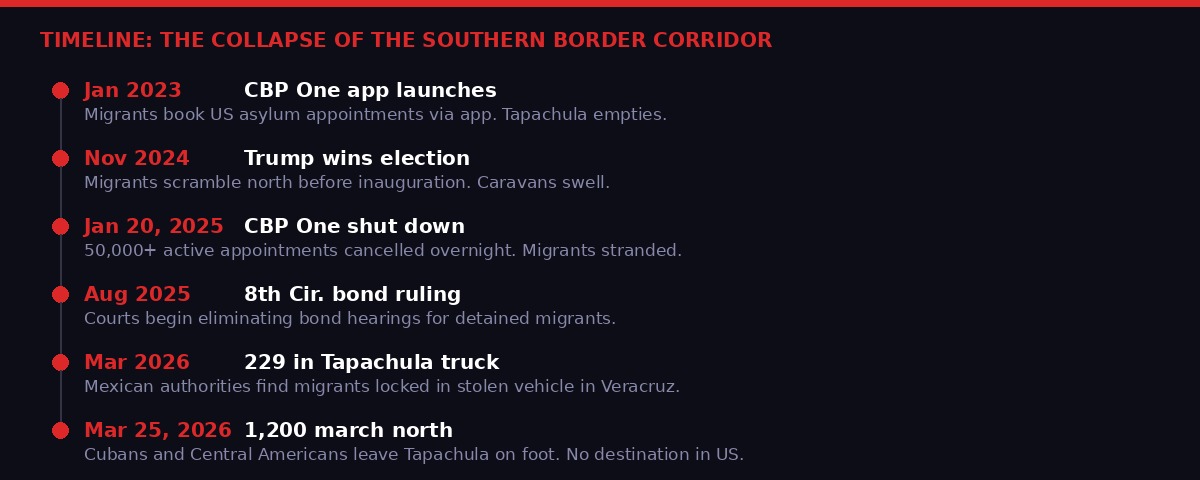
Past caravans in this region typically dispersed within days. Mexican authorities would let people walk, offer document help after a few days, sometimes provide transport. The pattern was almost choreographed: walk, be seen, receive minimal concessions, return to waiting. Whether this march will follow that pattern or signal something different - a genuine escalation, a population that has simply run out of patience - remains to be seen as of this writing.
229 People in a Box: The Veracruz Truck

On Monday, the day before the Tapachula march, a stolen truck was towed to a police impound lot in Xalapa, in Mexico's Veracruz state. Workers there heard shouting and banging from inside the trailer hours after it arrived. When emergency services opened the vehicle, they found 229 migrants - most from Central America, 17 of them minors, a number dehydrated. The truck had been stopped about 45 kilometers southeast of the city.
None of the migrants knew they had been towed to a police lot. They had been locked in the dark, in a vehicle they believed was still moving. The discovery came only because they started screaming. If they had stayed quiet - perhaps believing that attracting attention from the vehicle's smugglers would be worse than staying hidden - the outcome may have been different.
Veracruz is one of the historic crossing states for migrants heading north from Central America. The route runs through Oaxaca and Veracruz before reaching the northern border states. Cartels have controlled this corridor for years, charging "tolls" - sometimes in money, sometimes in forced labor, sometimes in lives. According to AP News, migration north had plummeted since Trump took office, making these interceptions rare. The Veracruz truck is being read as a signal: movement is quietly picking back up.
"This year, shelters in southern Mexico told the AP that in addition to receiving non-Mexican foreigners deported by Trump, they have once again begun to take in Central Americans heading north, although in very small numbers."
- AP News, March 25, 2026
For every migrant found in a truck, there are dozens who make it through without detection and dozens more who don't make it at all. The San Antonio truck tragedy of 2022 - 53 migrants dead of heat and suffocation inside an abandoned tractor-trailer - is less than four years ago. The conditions that created that tragedy have not changed. If anything, desperation has deepened, border enforcement has intensified, and the price that smugglers can charge has risen accordingly.
The Legal Trap Closing Around Them

While migrants in Tapachula lack papers, migrants already inside the United States are losing the legal right to ask a judge whether their imprisonment is lawful. This week, the 8th Circuit Court of Appeals in St. Louis ruled that the US government can continue to detain immigrants without bond hearings - the second federal appeals court to side with the Trump administration on this issue, following the 5th Circuit in New Orleans last month. The decisions collectively mean that millions of immigrants who have lived in the US for years can now be arrested and held indefinitely without any neutral arbiter reviewing whether that imprisonment is constitutional.
The case before the 8th Circuit involved Joaquin Herrera Avila, a Mexican national who had lived in Minneapolis for decades. He was arrested in August 2025 for lacking legal documents. DHS detained him without bond and began deportation proceedings. A lower court ruled he was entitled to a hearing. The 8th Circuit reversed that, with Circuit Judge Bobby Shepherd writing that under immigration law, Avila was an "applicant for admission" - a novel legal categorization that the dissenting judge, Ralph Erickson, called unprecedented. Erickson wrote that Avila would have been entitled to a bond hearing during any of the previous five presidential administrations. Now he is not.
Attorney General Pam Bondi celebrated the ruling on social media: "MASSIVE COURT VICTORY against activist judges and for President Trump's law and order agenda." What she was celebrating, stripped of the framing, was the legal authority to imprison people without asking a judge if that imprisonment is lawful. The American Civil Liberties Union is representing Avila. The case is likely headed to the Supreme Court.
The Supreme Court has already entered the picture, ordering the Trump administration to facilitate the return of Kilmar Abrego Garcia - a Salvadoran man wrongly deported to El Salvador - only to watch the administration decline to comply in any meaningful way. The message from the executive branch to the courts has been consistent: we will litigate every centimeter of our detention authority, and we will ignore orders we don't like. The message to migrants in Mexico, watching from outside, is starker: the door is not just closed. It is being welded shut.
Cuba Burning: Why They Left in the First Place

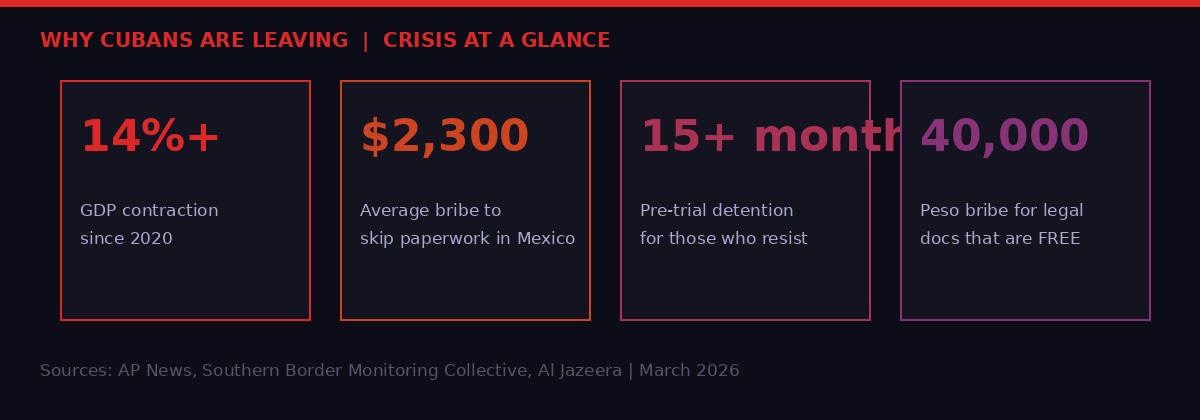
It is worth understanding what Cubans are leaving behind, because the desperation in Tapachula does not exist in a vacuum. Cuba's economy has contracted by more than 14% since 2020, according to figures from regional economists cited by AP News and Reuters. Rolling blackouts hit for 10 to 20 hours daily in many provinces. Food shortages that would have been unthinkable a decade ago are now routine. The Cuban government's response to the crisis has been to tighten control, arrest protesters, and blame the US embargo - all simultaneously and with diminishing persuasive effect on a population that is voting with its feet at historic rates.
Between 2022 and 2024, Cubans fled to the United States in unprecedented numbers. The US Customs and Border Protection recorded over 300,000 Cuban encounters at the southern border over those three years - more than any comparable period in history. Many came through the CBP One app system, which required them to wait in Mexico, usually Tapachula, for their appointments. When the app was shut down, those waiting joined those already stranded. The city became a compression point for years of accumulated desperation.
Some Cubans who were deported from the United States under Trump's mass deportation programs have been sent back to Mexico rather than Cuba, because Cuba has limited cooperation agreements for repatriations. This means Trump's deportation machinery has in some cases been adding bodies to Tapachula's streets, not removing them. The city absorbs them. The city has no mechanism to process them. They wait.
Joandri, the pastor-turned-mason, applied for asylum in Mexico after CBP One closed. His application was rejected. His appeal was rejected. He walks now not because he expects to reach somewhere specific, but because movement is the only agency he has left. He is supporting a wife and children in Havana from a town near the Guatemalan border where there is nothing for him to do and no legal way to do it. The evangelical church he leads - he preaches to other migrants in makeshift services in Tapachula's parks and shelters - is his continuity. His vocation continues even when everything else has stopped.
The Price of Papers That Should Be Free

The Southern Border Monitoring Collective - a coalition of civil society groups that tracks conditions for migrants in Mexico - issued a warning this week about a specific exploitation pattern in Tapachula: migrants are being charged up to 40,000 Mexican pesos, approximately $2,300, for documentation that is legally free under Mexican law. That sum is not a luxury for a Cuban family. It is two or three months of wages that many Cubans earn in a year, in a currency that is barely worth exchanging.
The scam works because the Mexican immigration bureaucracy is slow, opaque, and understaffed. People pay because they believe it will speed up the process. Sometimes it does - because the person they're paying works inside the process and can actually manipulate it. Sometimes they are simply robbed. Losiel Sanchez told AP News he was scammed by someone claiming to be a lawyer who promised to expedite his papers. The money is gone. The papers never came.
The Collective also flagged the increasing militarization of Mexico's southern border - a direct consequence of pressure from the Trump administration, which has linked US trade relations and tariff threats to Mexico's willingness to police migration on America's behalf. Mexico has deployed National Guard units to the southern border region in numbers far exceeding what was present in 2020 or even 2022. The humanitarian groups say this militarization has intensified risks and abuses faced by migrants without reducing migration itself. The Tapachula caravan walked under National Guard observation and was not stopped - but the Guardsmen's presence was a reminder of where the pressure ultimately comes from.
The Collective's warning is a familiar pattern in enforcement-heavy migration regimes: when legal channels close, criminal actors fill the void. The smuggler charging $15,000 to move someone north is extracting the price of a closed border, one desperate family at a time. The corrupt official in Tapachula charging $2,300 for a free document is doing the same. The beneficiaries of "hard-line" immigration policy are rarely the border communities that policy claims to protect. They are, reliably, the criminal intermediaries who profit from desperation.
The Shrinking American Town: What the Numbers Actually Say

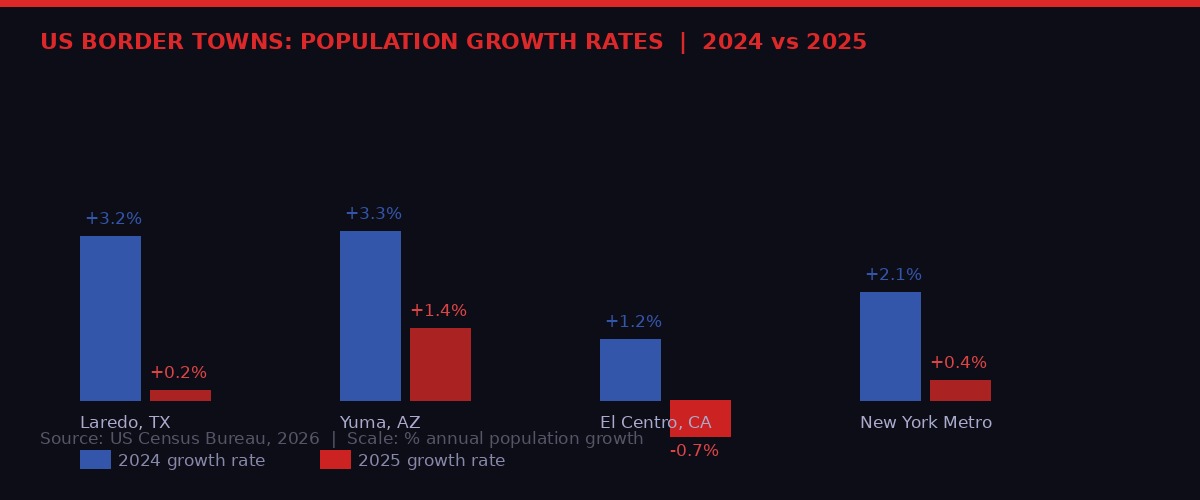
The US Census Bureau released population estimates this week that quantify, in cold numbers, what the immigration crackdown has done to American communities. The findings are not the story that "secure the border" advocates expected. Laredo, Texas - a city whose economy is built on cross-border commerce and labor - saw its growth rate collapse from 3.2% in 2024 to 0.2% in 2025. Yuma, Arizona fell from 3.3% to 1.4%. El Centro, California went from positive territory to negative: -0.7%.
The national average growth rate for metro areas fell from 1.1% in 2024 to 0.6% in 2025. The Census Bureau attributed this primarily to the slowdown in international migration. Kenneth Johnson, senior demographer at the University of New Hampshire, explained the structural reality plainly: "With so little natural increase, migration determines whether an area grows or declines, particularly in the big metro cores that have continuous domestic out-migration and are dependent on immigration."
The implications compound. The New York metro area, which had led the country in new residents in 2024, dropped to 13th place in 2025 because the immigrant pipeline slowed. Houston and Dallas held the top spots - driven by domestic migration and existing economic momentum, not new immigration. Nine out of ten US counties had lower immigration in 2025 than in 2024. An aging population with declining birth rates is losing the one source of demographic renewal that kept its communities growing.
The Louisiana crawfish industry tells a version of the same story. Louisiana is a $300 million crawfish production state, and spring is peak season. This year, at least 15 of the state's 20 major crawfish processing plants have no guest workers - because the Trump administration failed to release H-2B visa supplements until February, after the season had already begun, and then rejected applications from facilities that had applied in advance with start dates before January. Alan Lawson, who runs a processing facility in Crowley, Louisiana, told AP News bluntly: "This industry would not exist without it because the American people don't want to do the jobs we're offering." Restaurant prices will spike. Processors face losses. Republican officials in Louisiana who broadly support Trump's immigration agenda are furious that their pleas for legal labor went unanswered.
The politics and the economics of immigration have never fully aligned. But the Census Bureau data and the Louisiana crawfish crisis make the misalignment vivid in ways that GDP figures alone don't capture. These are towns. These are industries. These are the actual lived effects of the policy that Pam Bondi is celebrating on social media as a "MASSIVE COURT VICTORY."
Walking Toward Uncertainty: What Comes Next

The 1,200 people who left Tapachula on Tuesday night are not likely to reach the United States. They know this. Their march is not aimed at the Rio Grande. It is aimed at the Mexican capital, at Mexican authorities, at whoever is watching and might be moved to act. Whether that works depends on whether anyone is watching and whether anyone who is watching has the political will to do anything about it.
The Mexican government's announcement of a new labor inclusion agreement on the same day the march began may be cosmetic - a gesture timed to defuse the caravan's pressure without making structural changes. Or it may represent genuine policy intent. The difference will become visible in the weeks ahead, as migrants with pending applications either see those applications move faster or discover that the announcement meant nothing.
The Veracruz truck is a different kind of signal. Migration north had been suppressed by enforcement and fear. It is now picking back up, quietly, in small numbers that shelters are only beginning to notice. If the Tapachula pressure keeps building without release, the truck-in-the-dark routes will see more traffic. The 229 people found in Veracruz were lucky - they were found. In 2022, the 53 people in San Antonio were not found until it was too late.
The 8th Circuit's bond ruling means that any of those migrants who do make it to the United States can be detained indefinitely without a hearing. They can lose years to detention without a judge ever being asked whether that detention is lawful. The legal architecture of mass detention is being assembled court decision by court decision, while the human consequences accumulate in Tapachula and in impound lots in Veracruz and in crawfish plants in Louisiana with no workers to peel the catch.
Joandri, the pastor from Cuba, is somewhere on a road in Chiapas. He has his faith. He has the small church he has built among the other stranded migrants - services held in parks, prayers offered in borrowed rooms, a community constructed from the materials available, which is to say: people with nothing but each other and time. He is trying to reach somewhere he can work, send money home, see his children again. The system that was supposed to provide a path for people like him has been methodically dismantled. What remains is the walking.