Tether Blinks: KPMG, Kraken's Fed Key, and the Sacks Exit That Shook Crypto Policy
Three seismic moves in less than 24 hours rewrote the institutional playbook for crypto. Tether finally caved on a real audit. Kraken got direct Federal Reserve access. And the man who built Trump's crypto policy just handed in his badge. Here's what it all means.

Friday morning arrived with the crypto world running three parallel fires simultaneously. Tether - the $185 billion stablecoin that props up the entire industry - named KPMG as its long-awaited auditor. Kraken became the first crypto exchange in history to receive a Federal Reserve master account. And David Sacks, the Silicon Valley billionaire who served as Trump's crypto and AI policy architect, announced he was stepping down from his czar role with the cryptocurrency chapter of his tenure conspicuously unmentioned.
None of these events are unconnected. Each one is a node in the same expanding network: the mainstreaming of crypto as regulated financial infrastructure, the collapse of the old "move fast and avoid oversight" model, and the question of who actually controls the policy architecture now that the man who built it has left the building.
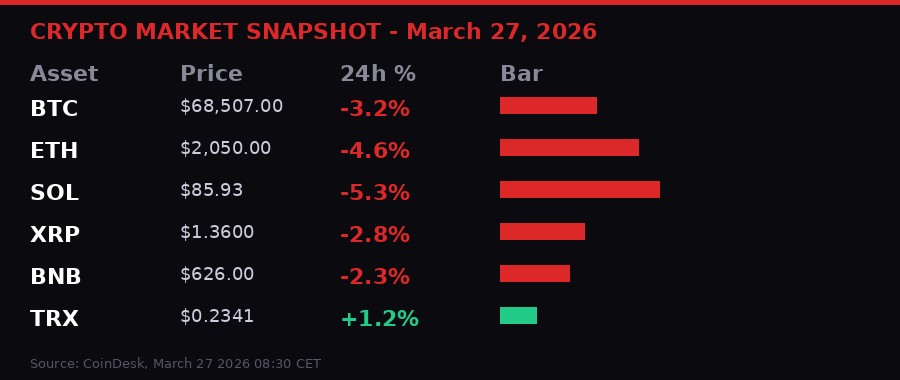
Bitcoin traded at $68,507 as these stories broke - down 3.2% on the day, down 2.7% on the week, caught in the same Iran war whipsaw that has suppressed price discovery for five consecutive weeks. The institutional moves happening beneath the surface tell a different story entirely.
The Audit That Took 12 Years to Happen

Let's be precise about what this announcement actually means. Tether has not completed an audit. It has hired one. The Financial Times, citing sources familiar with the matter, identified KPMG as the unnamed "Big Four" firm that Tether disclosed earlier this week. Tether has also separately brought in PwC to prepare its internal control systems ahead of that audit - a fact that tells you the distance between Tether's current state and Big Four-ready financial reporting is wide enough to require two major accounting firms just to get there.
CFO Simon McWilliams made the company's position clear in a statement this week: Tether is "already operating at Big Four audit standard." That framing is either confident or defensive depending on your prior beliefs about Tether's reserves. Given that USDT has never had a full financial statement audit in its 12-year existence, "already at Big Four standard" is a claim that deserves scrutiny.
For context: what Tether publishes today is an attestation from BDO Italia - a quarterly snapshot confirming that reserves roughly match liabilities at a single point in time. An attestation is not an audit. An audit requires reviewing internal controls, examining transactions, testing the existence and valuation of assets, and issuing a formal opinion. The gap between "attestation" and "audit" is the gap between someone checking your bank balance once versus a full forensic review of every financial system you operate.
Why now? The answer is regulatory, financial, and competitive - all at once.
The GENIUS Act, signed into law last July, created the first federal framework for dollar-pegged stablecoins in the United States. Under those rules, stablecoin issuers of Tether's scale would be required to submit to regular independent audits and meet reserve composition standards. Tether has already launched a compliant token - USAT - under the new framework, signaling it intends to compete in the U.S. market rather than stay offshore indefinitely.
The financial angle is equally pressing. The Financial Times previously reported that Tether was attempting to raise $15 billion to $20 billion at a valuation of $500 billion - a fundraising round that would rank among the largest in financial history. Institutional investors balked, citing concerns about regulatory risk and pricing. Getting KPMG's name on the door changes that calculus. You cannot raise $15 billion from pension funds and sovereign wealth managers while operating as an auditor-free offshore company headquartered in El Salvador.
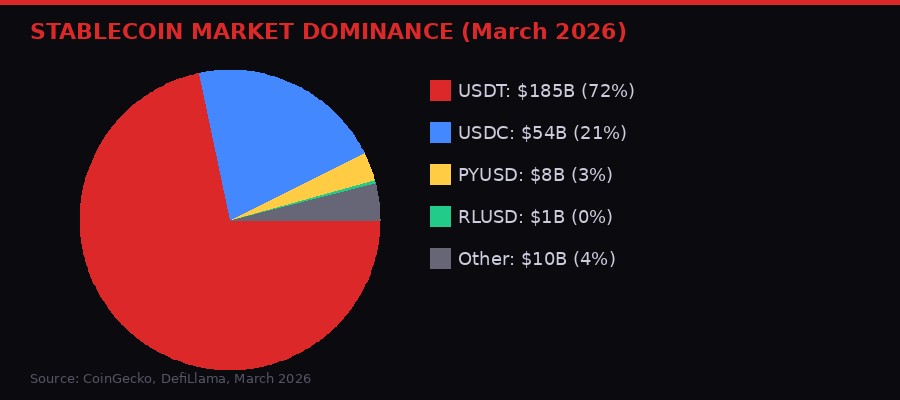
The competitive pressure comes from USDC, RLUSD, and PYUSD - all regulated, all audited, all steadily gaining market share among institutions that require compliance. Circle's USDC has $54 billion in circulation. PayPal's PYUSD has $8 billion. Ripple's RLUSD crossed $1 billion within its first year. These are not rounding errors. They are the institutional migration that happens when regulated alternatives exist and compliance requirements kick in.
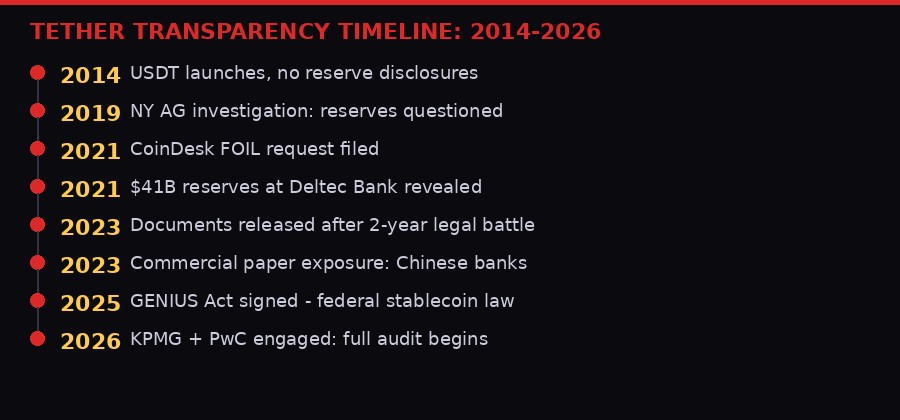
The history here matters. In 2021, CoinDesk filed a FOIL request with the New York Attorney General's office seeking documents on USDT's reserve composition. Tether fought the release twice in court and lost both times. The documents, eventually received after a two-year legal battle in 2023, revealed that Tether held the vast majority of its then-$40.6 billion in reserves at Bahamas-based Deltec Bank, with heavy exposure to commercial paper issued by Chinese banks including Agricultural Bank of China, Bank of China Hong Kong, and ICBC. That was not a flattering picture. Tether has since shifted heavily toward U.S. Treasury bills and claims to have cleaned up its reserve composition significantly.
The audit, if it happens, will either validate that claim or not. That binary outcome is why KPMG's engagement matters beyond the headline.
Kraken Gets the Master Key: What a Fed Account Actually Means

Buried slightly beneath the Tether news is a development that may have more structural consequence for crypto's long-term trajectory: Kraken has secured a Federal Reserve master account.
For most people, "Federal Reserve master account" sounds like bureaucratic plumbing. It is not. It is the most important piece of infrastructure in the U.S. payment system, and until this month, no crypto company had ever held one.
A master account at the Federal Reserve gives the holder direct access to Fedwire - the real-time gross settlement system that processes trillions of dollars in interbank transfers daily. Banks use Fedwire to move money between themselves without relying on correspondent banks. Having direct access means you are part of the core payment infrastructure, not a passenger riding on top of it. You can settle in central bank money rather than commercial bank money. You can accept deposits and process payments at the same level as any commercial bank.
The Federal Reserve Bank of Kansas City, one of the 12 regional Fed banks, approved what it calls a "limited purpose account" for Kraken. This is not the full master account that traditional banks hold, but it is the closest any crypto entity has come, and it grants Kraken access to Federal Reserve payment services on a basis no competitor currently enjoys.
The announcement drew immediate political fire. Representative Maxine Waters, the ranking Democrat on the House Financial Services Committee and likely future chair if Democrats retake the House - current Polymarket odds put that at 84% - sent a letter directly to the president of the Kansas City Fed, Jeff Schmid, questioning the legal basis for the approval.
"The announcement raises questions about the approval because neither statute nor the Federal Reserve Board's Account Access Guidelines refer to a 'limited purpose account' type." - Rep. Maxine Waters (D-CA), letter to Kansas City Federal Reserve, March 26, 2026
Waters' concern is specific: the legal framework for Fed master accounts simply doesn't define the "limited purpose" category that Kansas City used to approve Kraken. That means the approval may be operating on novel legal ground that neither Congress nor the Federal Reserve Board has explicitly authorized. If Democrats retake the House, she has made clear this will be a priority review.
Meanwhile, Custodia Bank - a Wyoming state-chartered crypto bank that spent years and millions in legal fees pursuing its own Fed master account - had its case effectively closed by a federal court just weeks before Kraken's approval. The timing is brutal. Custodia fought in court. Kraken, a larger and more politically connected firm, got in through a side door that didn't previously exist.
Several other crypto-native firms are watching Kraken's approval closely, waiting to see whether it creates a template they can follow or whether political backlash shuts the door again before they can apply. The Federal Reserve Board in Washington is separately working on rules for "skinny" master accounts for crypto businesses - a process that is still in early stages and may be overtaken by the Kansas City precedent.
For Kraken specifically, the master account transforms its competitive position. The exchange can now offer settlement services, custody solutions, and payment capabilities that bypass the correspondent banking layer entirely. In a market where Coinbase, Gemini, and Kraken have been roughly comparable on infrastructure, this is a meaningful differentiation - assuming the account survives political scrutiny.
What a Fed Master Account Unlocks
Direct Fedwire access: Real-time gross settlement in central bank money, no correspondent intermediaries
Deposit insurance proximity: Closer to bank-equivalent consumer protection frameworks
Institutional clearing: Can settle institutional trades directly vs. current multi-step workarounds
24/7 rails: Access to FedNow instant payment system for retail dollar transfers
Competitive moat: No other crypto exchange currently holds equivalent access
Sacks Leaves the Building - Quietly

David Sacks' departure from the White House AI and Crypto Czar role was announced with polished talking points and a prestigious new title: co-chair of the President's Council of Advisors on Science and Technology (PCAST). The committee includes names like Jensen Huang, Sergey Brin, Marc Andreessen, Mark Zuckerberg, and Lisa Su. By any measure, it sounds like a promotion.
Read the announcement more carefully and a different picture emerges. In his Bloomberg interview announcing the transition, Sacks spoke at length about artificial intelligence, quantum computing, and nuclear energy. He mentioned crypto exactly zero times.
The explanation Sacks gave for the timing of his departure is technically accurate but politically revealing: as a "special government employee," he was legally prohibited from serving more than 130 working days in the czar role. Democrats in Congress had raised concerns as early as last fall that Sacks had exceeded this limit. Rather than fight those concerns, he moved to a role without the restriction.
What Sacks accomplished in his time as czar is substantial by any measure. The GENIUS Act - the first federal stablecoin law in U.S. history - passed under his watch. The executive order establishing a Strategic Bitcoin Reserve was signed. The crypto market structure bill is moving through Congress, even without his direct shepherding. These are real legislative achievements in an area that had spent years stuck in regulatory limbo.
The question is what happens next. Sacks was the connective tissue between the crypto industry, Silicon Valley, and the White House policy apparatus. He came from the Founders Fund world, was close to Peter Thiel and Elon Musk, and understood both the technical details and the political angles. His replacement hasn't been announced. The crypto czar role may not survive his departure as a standalone position.
The industry reaction has been measured rather than alarmed. Most major crypto executives view the GENIUS Act as the critical win - it exists in statute now regardless of who occupies what advisory role. The market structure bill, which would define regulatory jurisdiction over spot crypto markets between the SEC and CFTC, is the next legislative frontier, and that battle will play out in Congress with or without a named czar.
But the soft power dimension matters. Sacks' presence meant there was always a named, accessible, crypto-sympathetic ear directly in the White House. That access shaped regulatory timelines, influenced whom agencies consulted, and provided a backstop when industry-hostile moves were being considered. Without that role occupied by someone with equivalent standing and relationships, the industry's direct line to executive branch policy becomes less clear.
Bitcoin Below $68,500: Reading the War Noise Correctly

Bitcoin's price action this week has been a masterclass in what happens when geopolitical headline flow dominates short-term trading while institutional accumulation continues in the background.
The pattern has been identical for five consecutive weeks. A de-escalation headline - Trump extends the Iran ceasefire deadline, talks are going "very well," Brent crude dips. Relief buying. Then an escalation headline - the Pentagon is considering deploying up to 10,000 additional ground troops to the Middle East, the Wall Street Journal reports. Relief buying evaporates. Net result: everyone stopped out, the underlying trend unresolved.
This week's specific headlines: Trump extended his Iran strike deadline by 10 more days. Brent crude dropped 1.3% to $106.40 on the news. Then the Pentagon troop deployment report hit and those gains vanished. Bitcoin dropped from roughly $70,800 to $68,507. The broader crypto market shed nearly 1%, pushing total market cap to $2.4 trillion.
Ethereum fell 4.6% to $2,050 - back below the level it has been fighting to hold all month. Solana dropped 5.3% to $85.93. XRP lost 2.8% to $1.36, extending its weekly loss to 6.5%. BNB slid 2.3% to $626. Dogecoin fell 2.8% to $0.091. Tron was the lone bright spot at +1.2%.
Asian equities mirrored the risk-off mood. South Korean tech stocks led losses, with Samsung and SK Hynix dragging the KOSPI down 2.3%. Taiwan dropped 1.2%. Wall Street hit its lowest level since September on Thursday before the war headline extension provided partial relief.
The macro overlay compounds the war noise. Ukraine's strikes on Russian oil infrastructure disrupted what had been a workaround offset for the supply shock caused by the Iran conflict. Higher oil sustained means persistent inflation, which means tighter-for-longer monetary policy expectations, which suppresses risk assets across the board. Bitcoin sits inside that framework along with equities and any other asset that benefits from cheap money.
FxPro chief market analyst Alex Kuptsikevich put the technical picture plainly: the crypto market cap is approaching its 50-day moving average but still holding above it, which he called "a bullish sign." The market "must make an early decision - either break through the uptrend line from early February or confirm the 50-day MA as support and break the downtrend."
That decision will likely come with the next binary Iran event. The 10-day deadline extension pushes the next critical moment to early April.
The Institutional Bid Nobody Is Talking About
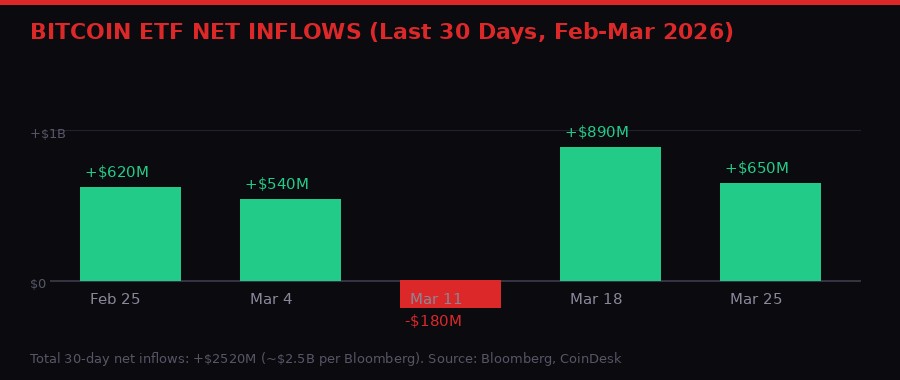
The price chart looks bearish. The institutional data does not.
Bitcoin ETFs have attracted $2.5 billion in net inflows over the past 30 days, according to Bloomberg - offsetting nearly all the outflows that had been draining the product since January. BlackRock's bitcoin ETF has ranked among the top 2% of all ETFs by inflows year-to-date. That is not a statistic associated with an asset being abandoned.
Net bitcoin outflows from exchanges last month signaled structural accumulation: investors buying coins and moving them to self-custody, reducing exchange float. When exchange balances fall while ETF inflows rise, the market is concentrating ownership in fewer hands. That is historically a precursor to reduced selling pressure, not increased supply.
BlackRock offered a notable framing this week: large investors are concentrating specifically in bitcoin and ether while avoiding the broader altcoin market. The institutional playbook in war conditions is not "sell crypto." It is "sell smaller positions, hold or add to the highest-liquidity names."
The $2.5 billion figure over 30 days also needs context. The Iran war started 35 days ago. The institutional accumulation happened during the war, not before it. These are buyers who are not waiting for resolution - they are pricing in a resolution eventually and buying the price suppression now.
ETF data also confirms Ethereum is seeing institutional attention, though at a lower magnitude. The convergence of Tether's audit, Kraken's Fed access, and the GENIUS Act's implementation is building a regulated infrastructure layer that institutions require before deploying serious capital. They are building positions while retail waits for the all-clear.
Institutional Signals vs. Price Action (March 2026)
BTC ETF net inflows (30 days): +$2.5 billion (Bloomberg)
BlackRock BTC ETF YTD rank: Top 2% of all ETFs by inflows
Exchange net outflows (Feb-Mar): Negative - coins leaving exchanges to self-custody
BTC price range (50 days): $65,000 - $75,000 - tight consolidation
50-day MA status: Market cap holding above it (FxPro)
BlackRock guidance: Concentrate in BTC/ETH, reduce altcoin exposure
Three Moves, One Trend: What It All Means

Pull back from the individual stories and a single trend is visible: the regulatory and financial infrastructure that institutional capital requires to flow into crypto is being assembled, piece by piece, in real time.
Tether's KPMG engagement is the audit layer. Kraken's Fed account is the banking infrastructure layer. The GENIUS Act is the legislative layer. The Sacks PCAST role keeps crypto-aligned thinkers in advisory positions even as the dedicated czar post goes vacant. These are not random events. They are sequential steps in the construction of a compliant crypto system.
The counterargument is obvious: crypto took 12 years to get a proper audit of its largest stablecoin. Kraken's Fed access is legally contested and may be reversed. Sacks' departure removes a critical advocate at a moment when the market structure bill still needs to cross the finish line. The war is suppressing prices and keeping retail sidelined. There are real risks in all of these narratives.
But the direction of travel is clear. The era of "crypto operates outside the rules" is definitively over. The question is not whether regulation is coming - it arrived. The question is whether crypto emerges from this institutional transition stronger or weaker.
The $2.5 billion in ETF inflows over 30 days, during a Middle East war that has suppressed prices by 10-15%, suggests institutional investors have already answered that question.
The Timeline: 48 Hours That Changed the Map
What to Watch Next

KPMG audit timeline: The engagement is signed. The timeline is not public. Given Tether's scale ($185 billion in circulation, operations across multiple jurisdictions, complex reserve composition), a full financial statement audit typically takes 6-12 months for an institution this size. Watch for BDO Italia's next attestation for any interim reserve data.
Kraken's Fed account: Waters' letter demands a response. The Kansas City Fed said it "received the letter and will review it." If Democrats make this a political flashpoint heading into the 2026 midterms - now roughly seven months away - the account's legal status could face formal challenge. Watch for Congressional hearings and any Federal Reserve Board statements on the "limited purpose" designation.
Crypto czar succession: The White House has not announced who, if anyone, will succeed Sacks as the dedicated crypto policy point. The market structure bill needs active White House engagement to cross the finish line. Without a named advocate, the bill risks getting deprioritized against competing legislative demands.
Bitcoin early April: Trump's extended Iran ceasefire deadline expires in approximately 10 days. That is the next hard catalyst. A genuine ceasefire deal would likely release significant pent-up buying pressure that five weeks of war-driven suppression have built. A breakdown would test the $65,000 support level.
Tether's $500 billion fundraise: Now that KPMG is named, watch for renewed fundraising discussions. The original round was stalled by investor hesitation over regulatory risk and reserve transparency. KPMG's engagement directly addresses both concerns. If the audit engages seriously and interim disclosures are positive, a fundraising round at scale becomes significantly more viable.
The three stories that broke in 48 hours are, individually, significant. Together, they mark something bigger: the moment crypto's institutional era stopped being theoretical and started requiring real accounting firms, real banking licenses, and real policy infrastructure. The era of flying without instruments is over.
Get BLACKWIRE reports first.
Breaking news, investigations, and analysis - straight to your phone.
Join @blackwirenews on Telegram