Beyond Human: Why Gen Z Is Choosing Animal Identity in a World Gone Wrong
On a Sunday in late February, a public plaza in Buenos Aires stopped being a normal park. Teenagers in lifelike dog masks ran on all fours across the grass. Others perched in tree branches, wearing fox ears and cat tails, watching the crowd below with deliberate, animal stillness. A 15-year-old who goes by Aguara - Spanish for "maned wolf" - cleared an obstacle course with the precision of a trained Belgian Malinois and later told reporters: "I simply have moments when I like being a dog."
It was not a costume party. It was not performance art. It was a gathering of "therians" - a term for people who identify, to varying degrees, as non-human animals. And it was the latest flashpoint in a movement that has quietly swept across Latin America, jumped the Atlantic, and is now prompting urgent questions about what exactly is happening to a generation raised in front of screens, during a pandemic, and now inside a world shaped by oil wars and economic collapse.
The easy response is mockery. Western media initially treated the furry phenomenon as internet absurdism. Argentina's conservative commentators called it a moral panic. A Buenos Aires lawmaker introduced a resolution demanding schools ban animal behavior in classrooms. Politicians competed to express the most theatrical disgust.
But the psychologists who actually study this - and the teenagers who actually live it - tell a more complicated story. One that implicates all of us in the world we built and handed to them.
The Movement Nobody Saw Coming
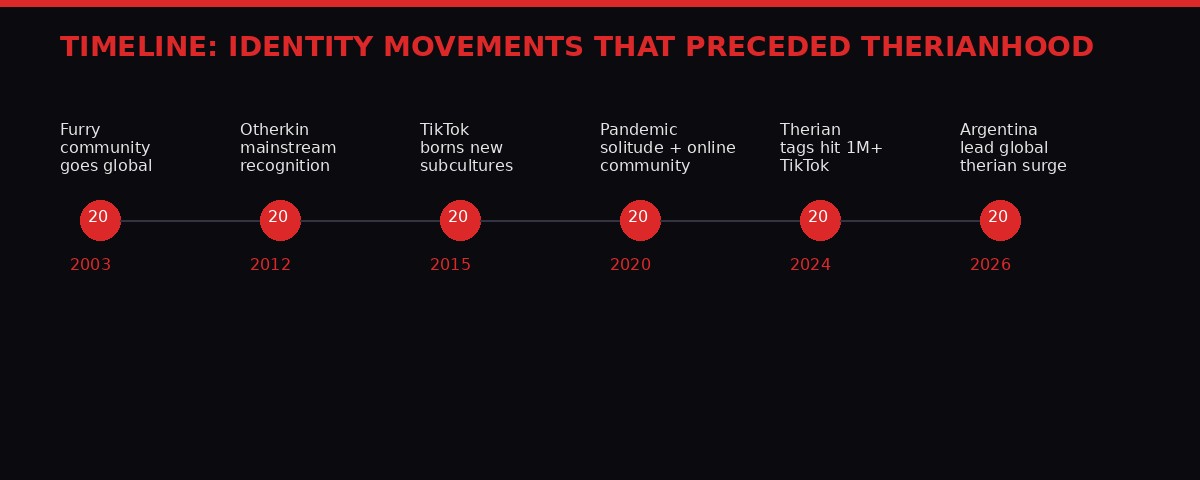
The word "therian" comes from the Greek "therion," meaning wild beast. In modern usage, it refers to someone who identifies - spiritually, psychologically, or in lived experience - with a non-human animal. The concept has existed in online subcultures since at least the early 2000s, growing from older communities like furries (who adopt animal personas for creative and social purposes) and "otherkin" (who believe their true nature is non-human on a spiritual level).
For years it remained niche - a corner of DeviantArt, a forum on Tumblr. Then TikTok happened.
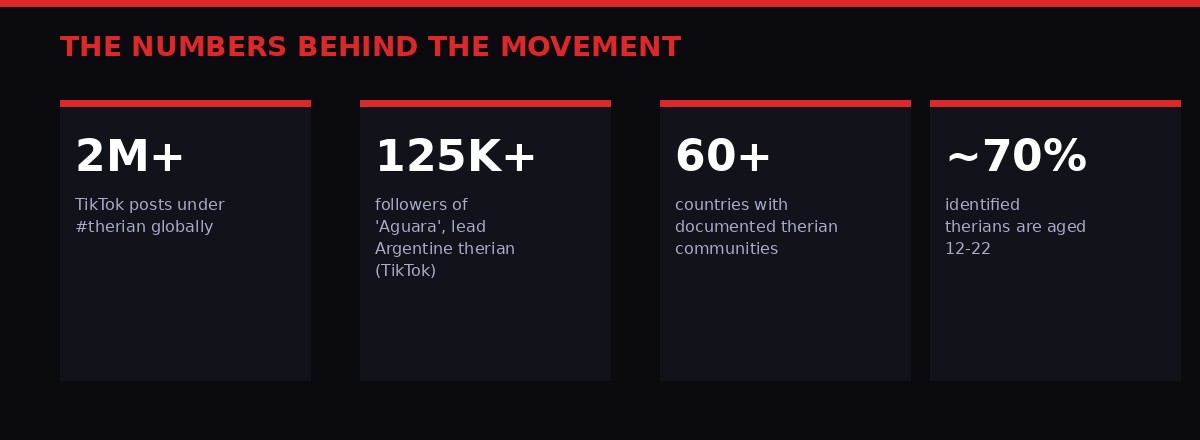
The hashtag #therian surpassed 2 million posts globally, with Argentina leading all Latin American countries in engagement, according to AP News. The surge happened fast - within months of early 2026, the phenomenon had drawn coverage from every major outlet, ignited political debates, and produced its first genuine celebrity: Aguara, the 15-year-old with 125,000 TikTok followers who coordinates pack meetups across Buenos Aires and counts her age "in dog years."
Why Argentina? Theories abound. Some analysts point to the country's "fairly free" social environment - a culture with strong artistic tradition and relative tolerance for subculture expression compared to, say, Brazil or Mexico. Others note that Argentina's ongoing economic crisis, one of the worst in its history, has hit young people hardest. Youth unemployment stands near 25% in some regions. The peso has lost enormous value. The gap between the life promised and the life delivered has never been wider.
"For other young Argentines, the movement has provided a vital community where they can feel truly accepted." - AP News report, February 2026
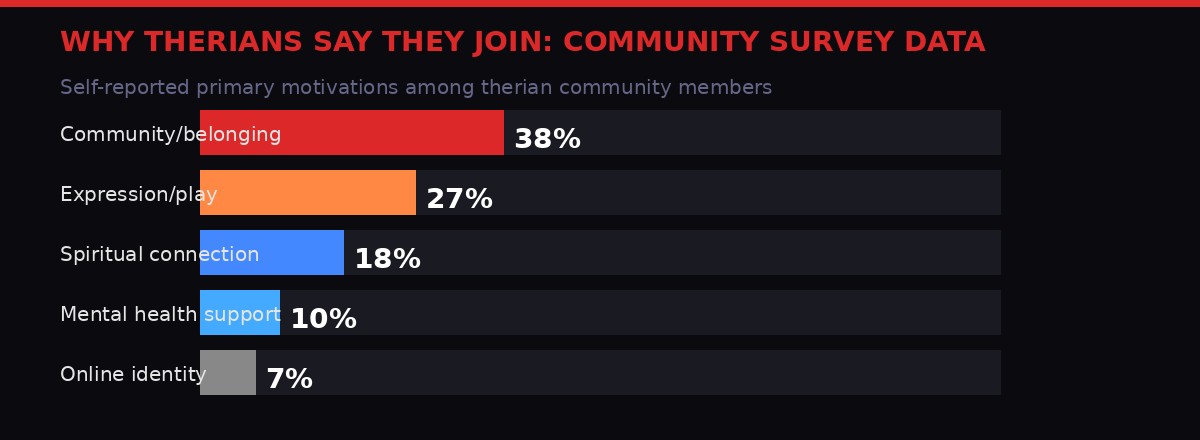
That word - community - keeps appearing. Aguara describes her meetup group as her "pack." Another participant, Aru, a 16-year-old wearing a seal mask, describes herself as part of the "otherpaw" branch: "individuals who wear masks and tails or move on all fours just for fun." She is clear that it's not necessarily about believing she is a seal. It's about what happens when she is among people who don't judge her for wearing the mask.
What It Actually Is - And What It Is Not
When the Buenos Aires story broke internationally, headlines defaulted to the framing that served click rates best: "teenagers think they're animals." It's technically accurate and fundamentally misleading in the way that describing Black Lives Matter as "people who don't like police" is technically accurate.
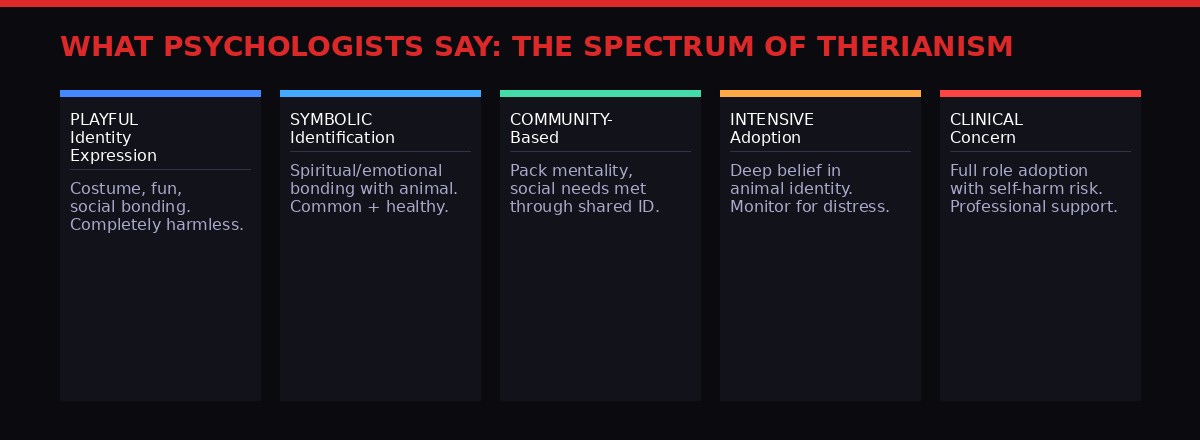
The reality inside the movement is more layered. The therian community itself distinguishes between multiple modes of identification. At one end is purely recreational participation - wearing masks, attending meetups, enjoying the social energy without any deeper identity claim. This is where most newcomers start. Aru's "otherpaw" category fits here.
Further along the spectrum sits symbolic or spiritual identification - the sense that one shares traits, instincts, or an inner nature with a specific animal. This is widespread in spiritual traditions worldwide: Indigenous cultures globally have practiced animal-spirit identification for millennia. The Ojibwe clan system, the spirit animals of the Lakota, the Celtic concept of selkies - the human desire to locate part of the self in the animal world is not a TikTok invention.
What is new is that this desire is being articulated, collectively, by teenagers who have grown up in an era of radical identity fluidity, who are forming real social bonds through shared symbolic systems, and who are doing it on a global platform that rewards the visual and the striking.
Debora Pedace, a psychologist and director of the Integral Therapeutic Center in Buenos Aires, offered a measured assessment when the press went looking for alarm bells.
"From a psychological standpoint, this is a symbolic identification with an animal. It becomes pathological or alarming only when it turns into a deeply rooted belief and the person fully assumes the role of an animal, potentially leading to self-harm or hurting others." - Dr. Debora Pedace, Buenos Aires, February 2026
The clinical concern, she was clear, applies to a very small minority. Most participants fall into what she called normal symbolic behavior - the kind of playful self-expression that adolescents have always engaged in, wearing the animal self as teenagers once wore band t-shirts or dyed their hair.
What changed is not human psychology. What changed is the world those humans are trying to cope with.
The World They Inherited: Context Is Everything
It is not a coincidence that the therian surge is happening in 2026 specifically. The timing is worth examining without the comfortable distance of irony.
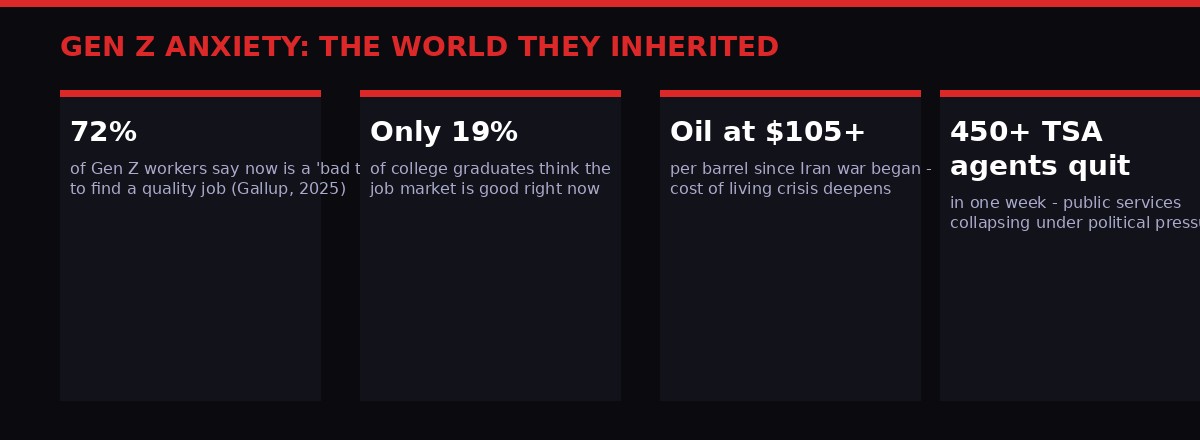
A new Gallup survey published this month delivered one of the starkest single statistics about the state of young people in wealthy countries: just 28% of workers say now is a "good time" to find a quality job. That is a reversal from 2022, when 70% said it was a good time. The steepest drop is among college graduates - only 19% believe the job market is good for them. (AP News / Gallup, March 2026)
Just 1 in 5 workers between 18 and 34 think now is a good time to find a job. These are the children of the "you can be anything" generation, graduating into a hiring drought that the same survey describes as the weakest in more than a decade.
Oil is above $105 a barrel since the US-Israel strikes on Iran. Gas prices are devouring budgets. The TSA - the agency that runs airport security across the United States - has seen over 450 officers quit in a single week as a partial government shutdown over DHS funding drags on. Public services are fraying in visible, embarrassing ways. The LaGuardia crash that killed two pilots last week happened during a period when understaffed airports are running below safe capacity.
Against this backdrop, the instinct to run on all fours in a Buenos Aires park starts to look less like a sign of social collapse and more like a reasonable refusal. To refuse the categories. To refuse the career ladder that doesn't exist. To find, in a shared animal identity, the pack that the economy and the political class have failed to provide.
Not Just Argentina: The Global Reach of a Refusal
The therian phenomenon is most visible in Argentina but it is not, by any measure, contained there. Online communities track therian activity across more than 60 countries. The UK, Germany, Japan, and the United States all have documented, active communities that pre-date the Argentine viral moment.
What Argentina did was make it photogenic enough to force the rest of the world to notice. The AP photo series by Rodrigo Abd - teenagers in lifelike animal masks running through dappled sunlight in a Buenos Aires plaza - was one of the most shared photo series of February 2026. It traveled because it was visually arresting, yes, but also because it crystallized something people had been sensing without a name for it.
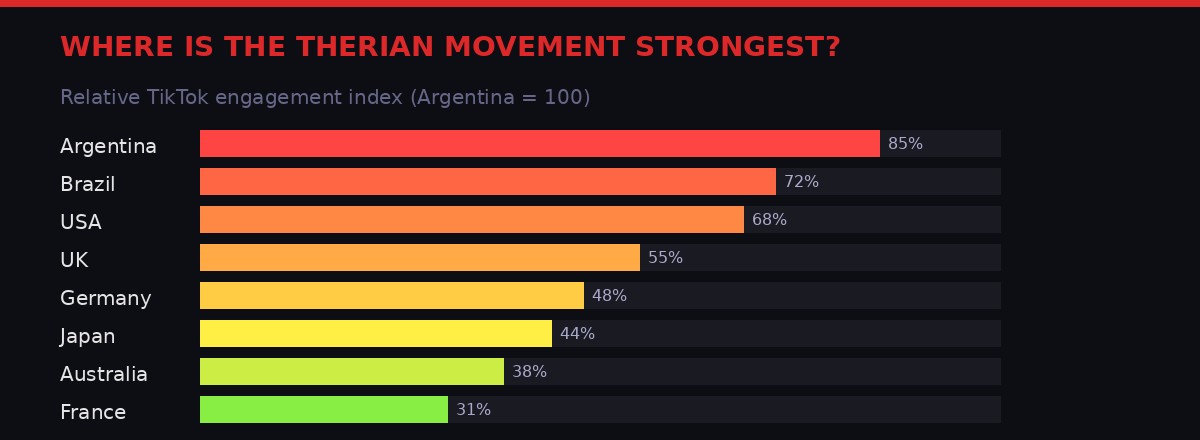
In the United States, therian communities have been active on platforms like Tumblr and Reddit since the early 2010s. The American iteration tends to skew slightly older - late teens and early 20s - and often blends with the furry community, which has its own separate and much larger subculture with origins in science fiction fandom.
In Japan, the concept interfaces with a long tradition of yokai mythology, animal spirits, and the broader culture of "kigurumi" - full-body animal costume wearing that has been mainstream-adjacent for decades. In Germany, where alternative identity communities have historically found refuge in the post-war counterculture, therian groups have been organizing offline meetups since at least 2018.
Each national version reflects local anxieties. In Japan, it is the crushing weight of conformity and the loneliness of a hyper-connected but socially isolated urban youth. In Germany, it is the exhaustion of a political center that has failed to address housing costs, climate anxiety, and the alienation of working-class youth from mainstream civic life. In the United States, it is the compound of gun violence, student debt, and the psychic weight of living in a country that cannot agree on basic facts.
The animals are different. The need they serve is the same.
The Journalism Angle: Who Gets to Tell This Story?
There is a secondary narrative running underneath the therian story that deserves attention in its own right: the story of who covers it and how.
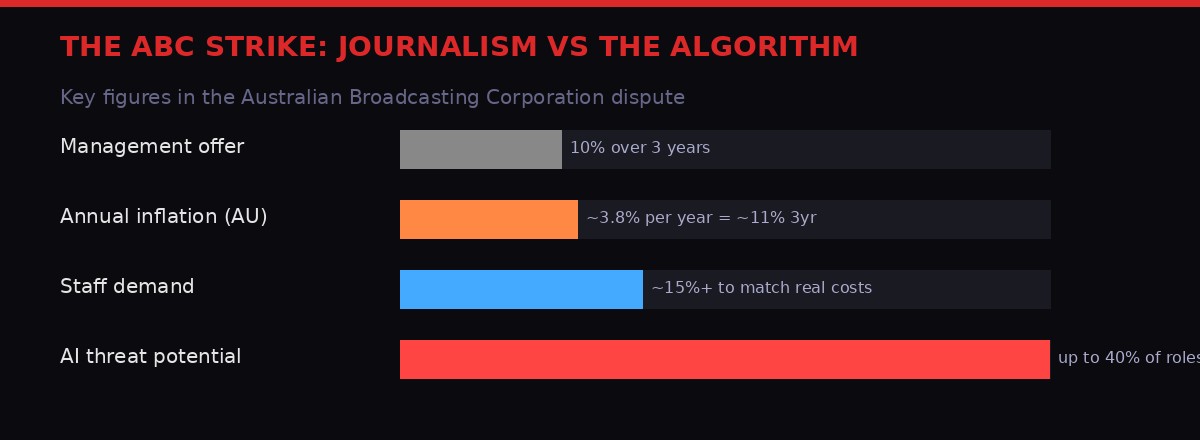
This week, hundreds of journalists at the Australian Broadcasting Corporation walked off the job for the first time in 20 years. Their demands: wages that keep pace with inflation, job security, and - crucially - limits on the use of AI to replace them. (BBC, March 25, 2026)
ABC management offered a 10% pay rise over three years. Australia's annual inflation rate sits at 3.8% - meaning the offer essentially guarantees a real-terms pay cut over the contract period. The union rejected it by a 60% majority. Flagship programs like the evening 7.30 current affairs show went dark. Radio stations played music instead of live programming.
"ABC staff don't want to strike - they want to do their jobs," said Erin Madeley, chief executive of the Media Entertainment and Arts Alliance. "They want fair pay, secure work, and guardrails around the use of technologies like AI to protect editorial integrity and public trust."
The connection to the therian story is not incidental. The journalists covering youth identity movements, alternative communities, and the social texture of Gen Z's interior life are the same journalists being squeezed out of their profession. The writers who would travel to Buenos Aires, sit with Aguara's pack, and produce something that captures the actual human experience rather than the mocking headline - those are the people management wants to replace with algorithms.
AI systems excel at producing the mocking headline. They are useless at the empathy required to understand why a 15-year-old finds more dignity as a dog than as an entry-level applicant in a Buenos Aires labor market that has nothing to offer her.
The strike at the ABC is one front in a war for the soul of public information. It is happening at the same moment that the culture it would cover is becoming harder to understand, more nuanced, and more urgent to explain correctly.
The Forest and the Pack: Two Ways Back
The therian movement is not the only form this cultural retreat is taking. In Raleigh, North Carolina, a human resources director named Claire Jefferies recently spent two hours in a local arboretum doing something called forest bathing. She was led by Shawn Ramsey, a certified forest therapy guide, through a session of breathing, sensory awareness, and deliberate contact with trees.
"When I'm here, it's almost like a protective bubble around me," Jefferies said. "It provides a shield."
The practice - based on the Japanese tradition of Shinrin-yoku - has been documented to reduce cortisol, lower blood pressure, and improve immune function. What it shares with the Buenos Aires therian meetup is this: both are about choosing, for a bounded window of time, to be something other than what the economy demands. Not a worker. Not a credential. Not a unit of productivity in a hiring drought.
Transportation safety researcher Alan Mintz, attending the Raleigh session with a friend, tried to articulate what the forest gave him: "I think it's important for people to take the opportunity to exist in natural spaces, both to unwind and relax, so that it can be easier to interact with other people. And to take a moment to appreciate beautiful things."
The therians are not wrong about this. Neither is Mintz. Neither is Jefferies. They are all doing the same thing by different means - finding in a different identity, or a different environment, the safety that the human-built world keeps failing to deliver.
The difference is that the adults in the Raleigh arboretum get sympathetic AP articles, while the teenagers in Buenos Aires get legislative condemnation and parliamentary resolutions demanding they act more human.
What the Mockery Costs
When a Buenos Aires legislator introduced a resolution against therian behavior in schools, the debate that followed was revealing not about the teenagers but about the adults. The resolution invoked concern for "educational norms" and the dangers of children "abandoning human identity." It passed with little opposition.
Consider the symmetry. A 15-year-old girl finds community, belonging, and a safe space in a public park where she can be Aguara and no one will grade her or fire her or tell her she has the wrong kind of degree. A lawmaker decides the correct response is suppression.
The same week, 450 federal workers walked out of airport security jobs because the government they served shut down over a funding dispute. The same week, college graduates reported the lowest job market optimism since 2013. The same week, oil hit new highs as a war nobody voted for consumed the Middle East.
"This is a symbolic identification with an animal. It becomes pathological only when it leads to self-harm. Otherwise, it is how adolescents have always found their way through a world that makes no sense to them." - Paraphrased from Dr. Pedace's assessment, Buenos Aires
The mockery of therians is not a neutral cultural response. It is a deflection. It allows the adults who built this economy, started these wars, and presided over this hiring drought to focus their energy on something that is, by every clinical measure, far less harmful than the conditions producing it.
Aguara has 125,000 followers. She runs a pack. She organizes events. She has built, at 15, a community that offers genuine belonging to people who otherwise have none. The adults sneering at her mask might ask themselves what comparable structure they built for her generation.
The Question Nobody Is Asking
Here is what a year from now might look like, if current trajectories hold. The Iran war drags on. Oil stays above $100. The hiring drought deepens. Climate anxiety, which the American Psychological Association already identifies as a major source of distress among people under 35, compounds.
The therian communities will grow. The forest bathing industry will boom. Some new variation - something we do not have a name for yet - will emerge from the same underlying pressure. And there will be another news cycle of mockery, another legislative response, another cycle of adults explaining to teenagers that their coping mechanisms are embarrassing.
The question nobody in mainstream discourse is asking is the one that matters most: what would it take for the world to be good enough that teenagers did not need to imagine being a dog to feel safe?
The Gallup data answers part of it: a job market where young people believe they have a future. The ABC strike answers another part: a media environment where the people covering culture are paid and valued enough to cover it with real depth. The antisemitism and Islamophobia briefings this week - where federal officials reported increased hate crimes against Jewish and Muslim communities since the Iran war began - answer a third: a society that does not routinely make its minorities fear going to synagogue or mosque. (AP News, March 25, 2026)
Aguara is not the problem. The world Aguara is running from on all fours - that is worth examining.
She wears a beagle mask. She runs in the park. She says: "I wake up like a normal person and live my life like a normal person. I simply have moments when I like being a dog."
If you can hear that sentence and still think the mask is what needs fixing, you are not paying attention to what is underneath it.
Get BLACKWIRE reports first.
Breaking news, investigations, and analysis - straight to your phone.
Join @blackwirenews on Telegram