Thirty Days of Fire: America's Casualty Count, Troop Surge, and the Creep Toward Ground War in Iran
Thirteen American service members are dead. More than 300 are wounded. Fifty thousand troops are deployed across the Persian Gulf. And on the thirtieth day of the Iran war, the Pentagon is drawing up plans for ground operations while the Secretary of State insists no ground troops are needed. This is the military math of a conflict that nobody in Washington will call what it is.
The Iran war hit the one-month mark on Saturday, March 29, 2026. What began as a volley of precision strikes against Iranian nuclear and military infrastructure on February 28 has metastasized into a multi-front regional conflagration stretching from the streets of Tehran to the waters of the Red Sea. The death toll across all theaters has surpassed 3,200 people. Iran's stranglehold on the Strait of Hormuz has triggered the worst energy supply disruption in modern history. Oil is trading above $105 a barrel. American gasoline has hit $4 a gallon. And the diplomats gathering in Islamabad to broker peace are operating in the shadow of 3,500 fresh Marines who just stepped off an amphibious assault ship.
This is not a contained operation. This is a war. And after thirty days, it is worth examining exactly what it has cost, who is fighting it, and where the trajectory points.
The Dead: Thirteen Names, Three Incidents
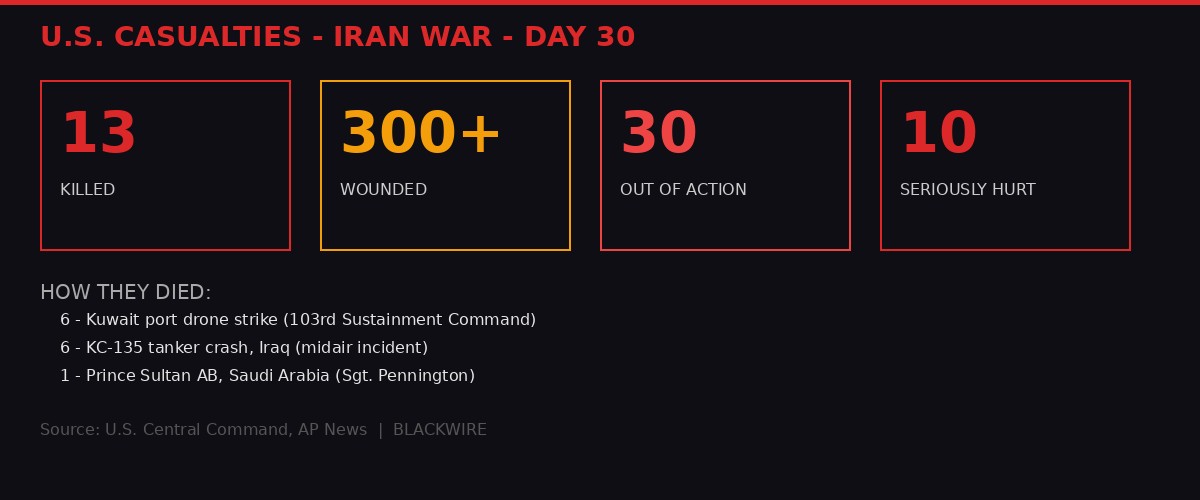
The Pentagon's casualty figures, confirmed by U.S. Central Command on Friday, March 28, paint a picture of a force under persistent attack. Thirteen American service members have been killed in the war. More than 300 have been wounded. Of those wounded, most have returned to duty - but 30 remain out of action and 10 are classified as seriously injured.
The deaths cluster around three incidents, each revealing a different dimension of the threat American forces face in the Gulf.
The single largest loss of life came on a civilian dock in Kuwait. Six soldiers from the 103rd Sustainment Command were killed when an Iranian drone - one of scores launched at Gulf state infrastructure - struck an operations center at a commercial port. The soldiers were logistics personnel, not frontline fighters. They were coordinating supply movements through a civilian facility that nobody had expected to become a target. Iran's willingness to hit ports, refineries, and commercial infrastructure means that the traditional distinction between military and civilian space has effectively collapsed in this theater.
Six more Americans died when their KC-135 Stratotanker refueling aircraft went down over Iraq. Central Command stated the crash was "not due to hostile or friendly fire," attributing it to an incident involving another aircraft. The details remain classified. But the loss of an aerial refueling tanker - the invisible backbone of American air superiority - underscores the operational strain on a force conducting continuous bombing sorties across a theater that spans thousands of miles.
The thirteenth death was Army Sergeant Benjamin N. Pennington, 26 years old, wounded in the very first attack on Prince Sultan Air Base on March 1 and dead days later. Pennington was the first American to die in the war. He will not be the last.
"It's amazing how low the casualties have been, given the amount of stuff that the Iranians have fired."- James Jeffrey, former Deputy National Security Adviser under President George W. Bush, now at The Washington Institute for Near East Policy (AP News, March 29)
Jeffrey's assessment carries a grim subtext. The casualties are low because American forces are largely not on the ground. They are flying sorties from bases in Saudi Arabia, launching cruise missiles from warships in the Arabian Sea, and coordinating strikes from hardened facilities deep inside allied territory. The moment boots touch Iranian soil, the arithmetic changes entirely.
Prince Sultan Air Base: The Most Dangerous Address in the Gulf
Prince Sultan Air Base sits 96 kilometers southeast of Riyadh, deep inside Saudi Arabia. It is operated by the Royal Saudi Air Force but has hosted a significant American military presence for decades. In this war, it has become the single most-attacked installation housing U.S. personnel - and the attacks are getting worse.
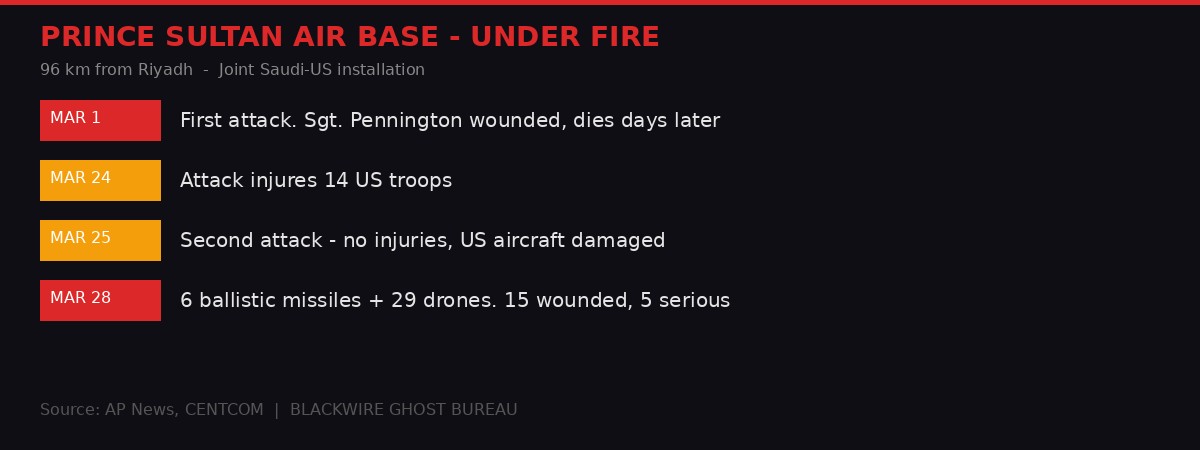
The base was hit almost immediately after hostilities began. Sergeant Pennington was wounded in that first strike on March 1. Since then, the facility has come under attack at least four separate times, with escalating lethality each round.
The most devastating strike came on Friday, March 28. Iran launched six ballistic missiles and 29 drones at the installation. At least 15 American troops were wounded, including five seriously. Earlier that same week, two more attacks had already injured 14 troops and damaged a U.S. aircraft. The base is absorbing repeated blows, and the Iranian targeting is improving.
What makes Prince Sultan strategically critical - and therefore strategically vulnerable - is its role as an air operations hub. American fighter jets, refueling aircraft, and surveillance planes cycle through the base. The E-3 Sentry AWACS aircraft, the flying radar stations that give the U.S. military its ability to track drones, missiles, and aircraft from hundreds of kilometers away, operate from facilities like this one. Iran has reportedly hit at least one AWACS and multiple aerial refueling tankers. Degrading these assets does not just kill individual service members - it degrades the entire surveillance and strike architecture that makes American air superiority possible.
Saudi Arabia's air defenses are intercepting most of what Iran throws at the kingdom. On Sunday alone, the Saudi Defense Ministry reported shooting down 10 drones. But "most" is not "all," and the drones and missiles that get through are finding their targets.
The base operates under persistent threat. Every service member stationed there understands that the next attack could come in hours. The frequency is relentless: roughly one major strike per week, with probing attacks and drone swarms in between. This is not a base under siege in the traditional sense. It is a base that has become a permanent target in an air war that Iran intends to fight asymmetrically - bleeding American forces through attrition rather than confrontation.
The Surge: 50,000 Troops and Growing
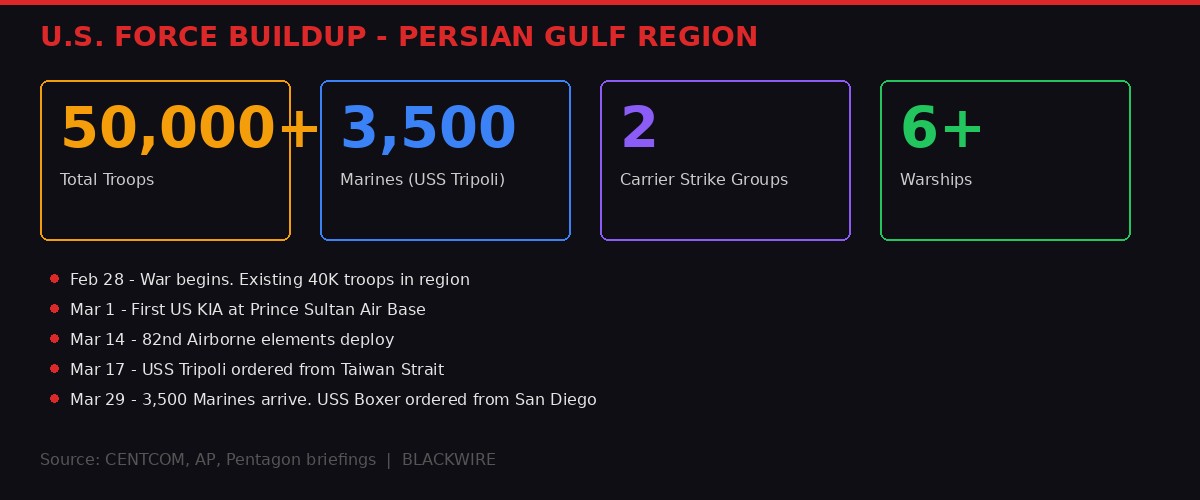
Before the war, the United States maintained approximately 40,000 military personnel across the Middle East - a legacy footprint from decades of Gulf security commitments, counterterrorism operations, and the long afterlife of the Iraq and Afghanistan wars. In thirty days, that number has swelled to over 50,000, with more on the way.
The most significant recent addition arrived on Saturday: the USS Tripoli, an amphibious assault ship, pulled into the Gulf carrying approximately 3,500 Marines from the 31st Marine Expeditionary Unit. These Marines were not originally destined for this war. They had been conducting exercises near Taiwan when the order came roughly two weeks ago to divert to the Middle East. The Tripoli brings transport helicopters, strike fighter aircraft, and - critically - amphibious assault assets. The kind of equipment you use to put troops on beaches.
The Tripoli is not alone. Central Command has ordered the USS Boxer and two additional ships, along with another Marine Expeditionary Unit, to deploy from San Diego. When those forces arrive, the total Marine presence in the theater will approach 6,000 - the largest concentration of expeditionary Marines in the Gulf since the 2003 Iraq invasion.
The existing force structure already included two aircraft carrier strike groups, though one - the USS Gerald R. Ford, the Navy's newest and most advanced carrier - recently departed for repairs in Crete after a fire in a laundry room damaged sleeping quarters. That a warship worth $13 billion was forced to withdraw from a combat zone due to a laundry fire says something about the strain on naval assets operating in contested waters for extended periods.
Add to this the 82nd Airborne elements that deployed in mid-March, the Air Force units cycling through bases in Qatar and the UAE, the special operations forces that are reportedly already conducting reconnaissance inside Iran, and the picture that emerges is of a military rapidly approaching a scale that cannot be sustained by air power alone.
U.S. FORCE BUILDUP TIMELINE
Five Fronts: The War Nobody Planned For
The Pentagon's original war plan - if the available reporting is any guide - envisioned a rapid, concentrated air campaign against Iran's nuclear facilities, missile production sites, and command-and-control infrastructure. Hit hard, degrade capability, force Tehran to the negotiating table. The model was the 2011 Libya intervention, not the 2003 Iraq invasion.
That model has failed. The war is now being fought across five distinct theaters, each with its own logic, its own casualty rate, and its own escalation dynamics.
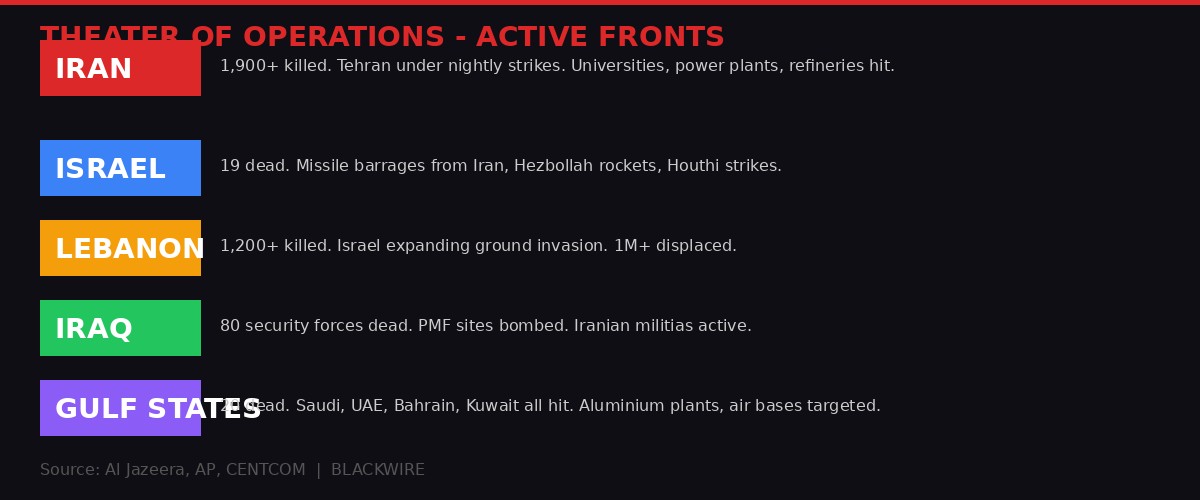
Iran proper remains the primary theater. More than 1,900 Iranians have been killed, according to Iranian authorities. Tehran is struck nightly. On Sunday, powerful explosions rocked the capital, with strikes hitting residential areas in Saadat Abad and western Tehran. Two people died and at least twelve were wounded in a single night's attacks. Universities, power plants, refineries, and water facilities have all been hit. Iran's parliament speaker, Mohammad Bagher Qalibaf, dismissed peace talks as cover and warned that Iranian forces are "waiting for the arrival of American troops on the ground to set them on fire" (AP News, March 29). This is not the language of a government preparing to surrender.
Lebanon has become the second deadliest front. Over 1,200 people have been killed since Israel expanded its invasion of the country's south, ostensibly targeting Hezbollah. On Sunday, Prime Minister Netanyahu announced the military would widen its invasion further, expanding the "existing security strip." More than one million Lebanese have been displaced. Hezbollah continues to fire rockets and drones at northern Israel, targeting airfields and military installations. The group hit the Ein Shemer airfield and the Regavim military camp with "high-quality missiles" on Saturday, according to its own statements. In Beirut, protesters have taken to the streets after Israeli forces killed three journalists from Al Mayadeen and Al-Manar on Saturday. The Lebanon front is not winding down. It is widening.
Iraq is the front nobody discusses. Eighty members of Iraq's security forces have died in strikes targeting Iranian-backed militia groups. The Popular Mobilization Forces have been hit in Mosul and Salah ad-Din province. Iran accused the U.S. and Israel of attacking the residence of the president of the Iraqi Kurdish region, calling it part of a pattern of "cowardly assassinations." Iraq's sovereignty is being violated by all sides, and Baghdad has no capacity to stop it.
The Gulf states are absorbing punishment they never expected. Twenty people have been killed across Saudi Arabia, the UAE, Bahrain, and Kuwait. Emirates Global Aluminium reported "significant damage" to a facility in Abu Dhabi. Aluminium Bahrain had two employees injured. Kuwait has shot down drones on multiple occasions, with air raid sirens sounding across the country. These are nations that built their modern prosperity on the assumption that American military presence in the Gulf made them untouchable. That assumption is dead.
Yemen has just entered the war. The Houthis launched their first strikes on Israel on Saturday, March 28, and followed up with a second operation on Sunday using cruise missiles and drones. The significance is not the damage these attacks inflict on Israel - it is what comes next. The Houthis control the approaches to Bab al-Mandeb, the 29-kilometer-wide strait connecting the Red Sea to the Gulf of Aden. If they blockade that waterway while Iran maintains its chokehold on the Strait of Hormuz, two of the world's most critical shipping lanes will be closed simultaneously. Elisabeth Kendall of Cambridge University called this a "nightmare scenario" (Al Jazeera, March 29). It may be weeks or days away.
The Human Cost: 3,200 Dead and Counting
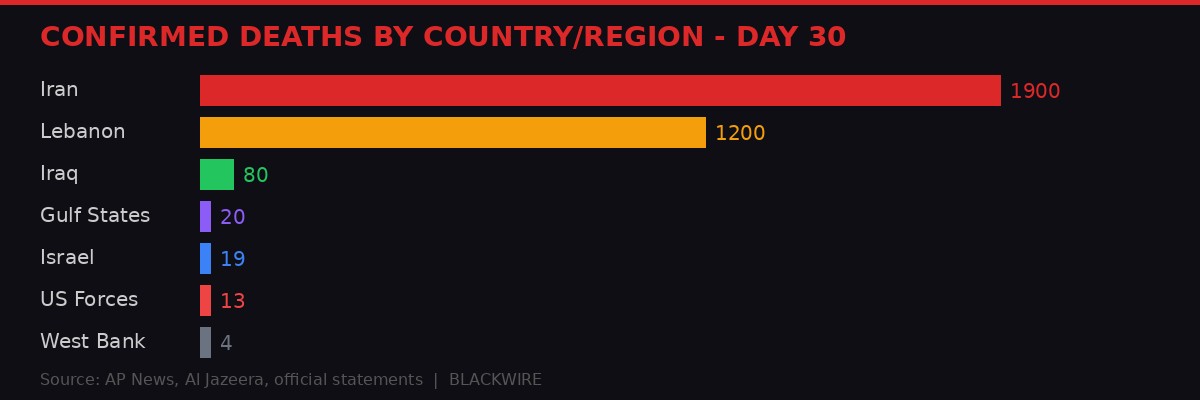
The aggregate death toll across all theaters has exceeded 3,200, based on figures compiled from official statements, AP reporting, and Al Jazeera's trackers. The breakdown is stark:
Iran: 1,900+ killed. These are not exclusively military deaths. Israeli airstrikes have hit residential neighborhoods, universities, and water treatment plants. A family of four was killed in Bushehr province on Saturday. The Iranian government has documented strikes on dozens of universities and research centers, including the Iran University of Science and Technology and Isfahan University of Technology. The IRGC has responded by declaring that Israeli universities and branches of American universities in the region are "legitimate targets" unless Israel stops bombing Iranian academic institutions by midday Monday - a deadline that will have passed by the time this article publishes.
Lebanon: 1,200+ killed. The expansion of Israel's ground invasion is generating new casualties daily. Three journalists were killed in a single strike on Saturday. The death toll among Lebanese journalists covering the war is now among the highest for any conflict in recent memory.
Iraq: 80 security forces killed. The figure does not include civilian casualties, which are uncounted.
Gulf states: 20 killed. Primarily industrial workers at facilities hit by Iranian strikes.
Israel: 19 dead. Iran's missile barrages, Hezbollah's rockets, and now Houthi strikes continue to target the country. The Israeli military intercepts most incoming projectiles, but the persistent threat has disrupted daily life, closed holy sites in Jerusalem, and created a population living under permanent alert.
West Bank: 4 killed. Largely unreported amid the larger conflict.
United States: 13 killed, 300+ wounded. The wounded figure is certain to be an undercount. Military reporting of non-combat injuries, psychological casualties, and delayed-onset conditions typically lags behind real-time events by weeks or months.
These numbers will grow. Every theater is escalating, not contracting. No ceasefire is in effect anywhere. And the entry of the Houthis into the war adds an entirely new vector of violence that did not exist five days ago.
The Economic Weapon: Hormuz, Bab al-Mandeb, and the Price of Everything
Iran's most devastating military asset is not a missile or a drone. It is a body of water.
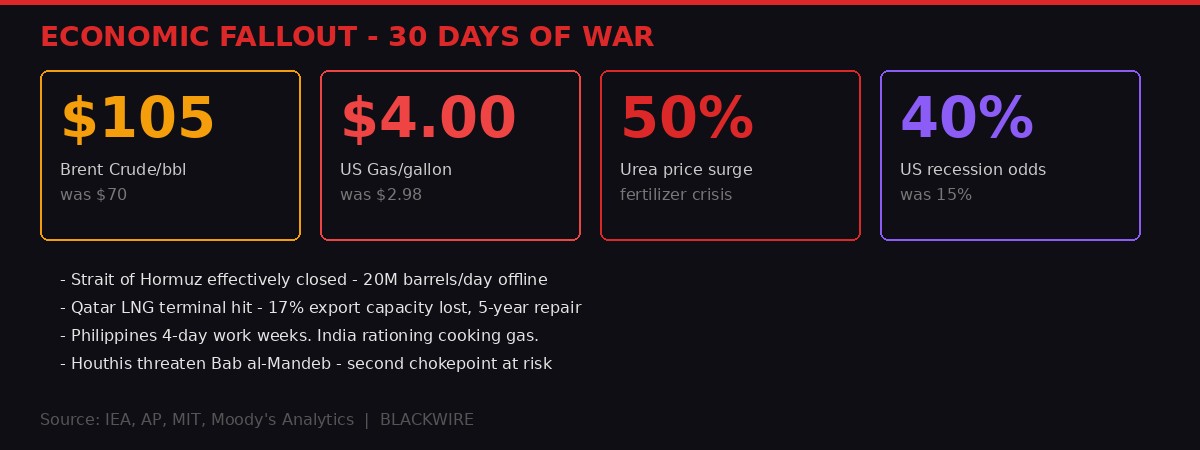
The Strait of Hormuz, through which 20 percent of the world's oil supply transits, has been effectively closed to unescorted commercial shipping since the opening days of the war. Iran responded to the first American and Israeli strikes by threatening tankers attempting to pass through. The result has been what the International Energy Agency calls "the largest supply disruption in the history of the global oil market."
Brent crude has risen from roughly $70 per barrel before the war to $105.32 as of Friday's close - a 50 percent increase. U.S. benchmark crude settled at $99.64 per barrel. American gasoline prices have jumped from $2.98 to nearly $4.00 per gallon in one month. Urea fertilizer prices are up 50 percent. Ammonia is up 20 percent.
The infrastructure damage is not temporary. Iran hit Qatar's Ras Laffan natural gas terminal, which produces 20 percent of the world's liquefied natural gas, on March 18. The strike wiped out 17 percent of Qatar's LNG export capacity. State-owned QatarEnergy says repairs will take up to five years. Five years. That is not a disruption. That is a restructuring of the global energy market.
The downstream effects are already visible in ways that reach into kitchens and classrooms on the other side of the world. The Philippines has imposed four-day work weeks for government offices and mandated air conditioning temperatures no cooler than 75 degrees Fahrenheit. Thailand is telling public employees to take the stairs instead of elevators. India, the world's second-largest importer of liquefied petroleum gas, is rationing cooking fuel - prioritizing households over restaurants, forcing eateries to shorten hours or close entirely.
South Korea has reinstated fuel price caps that were dropped in the 1990s. Cambodia's diesel prices continue to climb weekly. Brazil, which imports 85 percent of its fertilizer, faces a planting season that could be catastrophically expensive.
"A week ago or certainly two weeks ago, I would have said: If the war stopped that day, the long-term implications would be pretty small. But what we're seeing is infrastructure actually being destroyed, which means the ramifications of this war are going to be long-lived."- Christopher Knittel, energy economist, Massachusetts Institute of Technology (AP News, March 29)
Gregory Daco, chief economist at EY-Parthenon, has raised the probability of a U.S. recession over the next twelve months to 40 percent, up from a baseline of 15 percent. The U.S. economy was already fragile - GDP grew at an annual pace of just 0.7 percent in the fourth quarter of 2025, and employers unexpectedly cut 92,000 jobs in February.
And this is before the Houthis potentially close Bab al-Mandeb. If both straits are blocked simultaneously, roughly 30 percent of global seaborne oil and the majority of Europe-bound energy shipments will have no viable route. The word "catastrophe" is not hyperbole in this scenario. It is arithmetic.
James Jeffrey, the former Bush administration official, identified the core strategic reality: Iran's goal is not to kill American soldiers. It is to inflict economic devastation on the global system that sustains American power. "We have not stopped Iran from its campaign against the Gulf," he told AP. "We have not eliminated all of their missiles. And of course, they still have the 400-plus kilograms of highly enriched uranium. It's buried, but still it's there."
The Diplomacy: Pakistan's Gambit and the April 6 Deadline
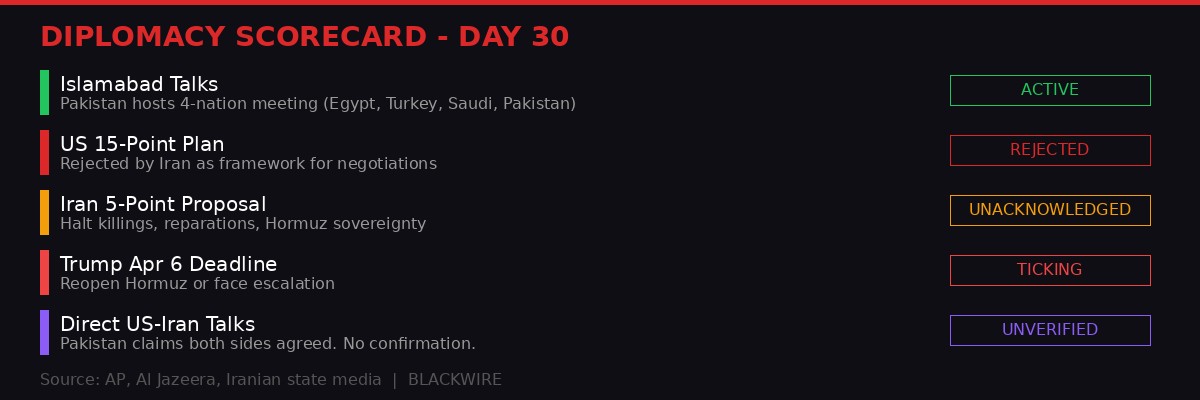
On Sunday, Pakistan's Foreign Minister Ishaq Dar made an announcement that would have been unthinkable six months ago: Islamabad will host talks between the United States and Iran. "Pakistan is very happy that both Iran and the U.S. have expressed their confidence in Pakistan to facilitate the talks," Dar said after hosting foreign ministers from Turkey, Egypt, and Saudi Arabia.
There is reason to treat this announcement with extreme caution. Neither Washington nor Tehran confirmed the arrangement. Iran's mission to the United Nations declined to comment. Pakistan's foreign ministry did not answer follow-up questions. And the diplomats who gathered in Islamabad departed for their home countries on Sunday - talks that were supposed to continue Monday were apparently concluded early, or collapsed.
The diplomatic landscape is littered with contradictions. The U.S. has proposed a 15-point "action list" as a framework for negotiation. Iran has rejected it publicly and dismissed the idea of negotiating under military pressure. But Iranian state media has reported that Tehran drafted its own five-point counterproposal, reportedly calling for a halt to the killing of Iranian officials, guarantees against future attacks, reparations, and Iran's "exercise of sovereignty over the Strait of Hormuz." That last point is the deal-breaker. American strategic doctrine treats freedom of navigation through international waterways as non-negotiable. Iran is demanding the right to toll and control Hormuz as sovereign territory. These positions are irreconcilable without one side capitulating or both sides accepting a creative ambiguity that does not currently exist.
Meanwhile, Iran's parliament speaker dismissed the Islamabad talks as theater. "Cover," Qalibaf called them, pointing to the 2,500 Marines who arrived on the USS Tripoli as evidence that Washington is preparing for escalation, not negotiation. The Iranian military's joint command spokesperson went further, threatening to attack the homes of American and Israeli "commanders and political officials" in the region.
President Trump has set April 6 as the deadline for Iran to reopen the Strait of Hormuz. Iran says it has not engaged in any negotiations. The deadline is nine days away. There is no visible mechanism for enforcement, and no indication that Iran takes it seriously.
Anwar Gargash, an adviser to the UAE, called for any settlement to include "clear guarantees" that Iranian attacks on Gulf neighbors will not be repeated and demanded compensation for strikes on civilian infrastructure. This is the voice of a government that has been bombed by its theoretical ally's enemy and now wants something in writing before it trusts anyone.
Pakistan's ability to mediate is real but limited. Islamabad maintains relatively good relations with both Washington and Tehran. It has secured the passage of 20 Pakistani-flagged vessels through the Strait of Hormuz - a small but symbolic concession from Iran. But Pakistan is a mediator without leverage. It cannot compel either side to agree to anything. The four-nation meeting in Islamabad was, at best, a staging exercise for negotiations that have not yet begun.
The Ground War Question: Pentagon Plans vs. Political Rhetoric
The most dangerous gap in this war is the space between what the Pentagon is preparing and what politicians are saying.
The Washington Post, citing unnamed U.S. officials, reported on Saturday that the Pentagon is preparing for "weeks of ground operations" in Iran. The officials described a plan that "would fall short of a full-scale invasion" and could involve raids by special operations forces and "conventional infantry troops" targeting strategic sites, potentially including Iran's Kharg Island oil export terminal.
On the same day, Secretary of State Marco Rubio told reporters that the United States can meet its objectives "without any ground troops." Then he added the caveat that gives the entire game away: Trump "has to be prepared for multiple contingencies," and American forces are in the region "to give the president maximum optionality and maximum opportunity to adjust to contingencies should they emerge."
"Maximum optionality" is the bureaucratic language for "we might invade." The 3,500 Marines who just arrived on the Tripoli brought amphibious assault equipment - the hardware you use to land troops on contested shorelines. The 82nd Airborne is the Army's rapid-deployment forced-entry division, designed specifically for operations that begin with paratroopers jumping into hostile territory. These are not defensive assets. They are offensive capabilities positioned within striking distance of Iran.
The political dynamics in Washington are moving in two directions simultaneously. Some Republican lawmakers are demanding that Congress vote on any deployment of ground troops - a constitutionally required step that the executive branch has consistently circumvented in modern conflicts through creative interpretation of the Authorization for Use of Military Force. But at the same time, the former Iranian shah's son, Reza Pahlavi, addressed CPAC on Saturday and urged Trump not to seek a deal with Iran but to pursue regime change outright. The regime-change caucus is loud, well-funded, and has the president's ear.
Iran's response to ground invasion planning has been direct. Qalibaf's warning that Iranian forces are "waiting for the arrival of American troops on the ground to set them on fire" is not empty rhetoric coming from a government that has demonstrated the willingness and capability to hit American bases, sink drones, damage warships, and strike allied infrastructure across six countries.
If American ground forces enter Iran, even in a "limited" capacity, the casualty calculus changes from 13 dead to something that nobody in Washington is publicly discussing. Iran's terrain is mountainous, its population is 88 million, and its military has spent thirty days demonstrating that it can reach targets the U.S. thought were safe. A ground incursion into Kharg Island might be militarily achievable. A withdrawal from Kharg Island, under fire, with Iranian missiles targeting the evacuation ships, is the scenario that keeps planners awake.
What Comes Next: The Nine Days That Matter
The Iran war at thirty days is a conflict defined by its contradictions. The United States has achieved air superiority but cannot stop Iranian missiles from hitting its bases. Israel has expanded its invasion of Lebanon but cannot stop Hezbollah rockets from hitting its airfields. Iran has closed the Strait of Hormuz but cannot prevent its cities from being bombed nightly. Diplomats are meeting in Islamabad while Marines are loading amphibious landing craft in the Gulf.
The next nine days will be determined by three variables.
First: the Houthis. If Yemen's rebels make good on their threat to blockade Bab al-Mandeb, the economic pressure on the global system doubles overnight. That blockade would force the United States to open a sixth front in Yemen - something it has neither the forces nor the political appetite to do. But it would also force a response, because the closure of both Hormuz and Bab al-Mandeb would trigger an economic crisis that makes the current disruption look manageable by comparison.
Second: the April 6 deadline. Trump has publicly committed to a timeline for Iran reopening Hormuz. If that deadline passes without action, the president faces a choice between escalation and humiliation. Given the political incentives, escalation is the path of least resistance. The ground operations that the Pentagon is planning may be Trump's response to a missed deadline, not an alternative to diplomacy.
Third: the IRGC's university ultimatum. Iran has given the United States until midday Monday to condemn the bombing of Iranian universities or face retaliatory strikes on American university campuses in Qatar, the UAE, and Lebanon. Georgetown, New York University, and Northwestern all operate campuses in the Gulf. The American University of Beirut and the Lebanese American University have already moved classes online. If Iran strikes a campus housing American students and faculty, the domestic political pressure for massive retaliation - including ground troops - becomes irresistible.
The war is thirty days old. The dead number 3,200 across all theaters. The economic damage already inflicted will take half a decade to repair. And every indicator points toward escalation, not de-escalation.
In the words of an elderly Iranian man named Razzak Saghir al-Mousawi, 71, who was fleeing airstrikes in his country and crossing into Iraq: "We don't know at what moment our homes could be targeted. I am definitely afraid." (AP News, March 29)
He is not alone in that fear. He is just more honest about it than the officials who are managing this war.
Get BLACKWIRE reports first.
Breaking news, investigations, and analysis - straight to your phone.
Join @blackwirenews on Telegram