
Tiger Woods was arrested Friday afternoon on suspicion of driving under the influence after his Land Rover clipped a pressure-cleaning truck on a residential road near his Jupiter Island, Florida home and rolled onto its side. The golfer walked away without injury but was taken into custody after refusing to submit a urine test - his second drug-related arrest in nine years. AP News
Martin County Sheriff John Budensiek confirmed at a news conference that Woods "did exemplify signs of an impairment" but that a Breathalyzer test returned no sign of alcohol. Investigators believe he had taken "some type of medication or drug," the sheriff said, adding that because Woods refused the urine test, authorities may "never get definitive results with what he was impaired on." AP News
Under Florida law, Woods was required to spend at least eight hours in jail before he could post bail. The sheriff confirmed Woods was being held separately from the general population. "He's not going to be with other inmates that could hurt him or try to capitalize on what he did," Budensiek said. "He'll pay the price, but he's not going to pay the price by getting punished in jail." AP News
President Donald Trump, speaking to reporters in Miami where he had arrived for an investment summit, expressed sympathy for his longtime friend. "I feel so badly. He's got some difficulty," Trump said. "Very close friend of mine. He's an amazing person. Amazing man. But, some difficulty." AP News

Woods was 12 days from the Masters when the crash occurred. (Pexels)
What Happened: The Crash Scene on Jupiter Island
The incident unfolded just before 2 p.m. local time on a quiet two-lane road in Martin County with a posted speed limit of 30 mph. According to Sheriff Budensiek, Woods was attempting to pass a pressure cleaner truck when his black Land Rover swerved to avoid a collision and clipped the back end of the truck's trailer. The vehicle then rolled onto its driver's side. AP News
Budensiek said his department could not definitively determine how fast Woods was traveling. He said the truck's driver described Woods as moving at "high speed," but investigators were unable to independently confirm the exact velocity from the evidence at the scene.
Woods was able to crawl out of the passenger side of the overturned vehicle unassisted, the sheriff said. Deputies arriving at the scene found him cooperative but displaying signs consistent with drug impairment. He agreed to the Breathalyzer, which came back clean, but declined the urine test - a decision the sheriff described as legally within his rights but one that effectively prevents a conclusive determination of what substance, if any, had affected his driving.
The road where the crash occurred runs not far from Woods' Jupiter Island estate, a private barrier island community on Florida's Treasure Coast known for its exclusivity and low-key atmosphere. Jupiter Island is home to several ultra-high-net-worth residents. It is perhaps fitting - or ironic - that the most scrutinized athlete of his generation has now been arrested twice within miles of the same enclave where he chose to make his home.
"He's cooperative, but he's not trying to incriminate himself." - Martin County Sheriff John Budensiek, press conference, March 27, 2026

Martin County Sheriff's deputies responded to the scene just before 2 p.m. (Pexels)
The 2017 DUI That Set the Pattern
Friday's arrest was not the first time Woods has been taken into custody for suspected impaired driving. On May 30, 2017, deputies in Jupiter - just a few miles away - found him asleep at the wheel of a parked Mercedes, engine running, in the early hours of the morning. The driver's side was damaged. He was barely coherent when officers roused him. AP News
Woods said at the time that he had taken a bad combination of prescription painkillers following one of his back surgeries - the fourth, a lumbar fusion procedure performed in April of that year. The DUI charge was ultimately dropped after he pleaded guilty to reckless driving in October 2017 and entered a court-supervised diversion program.
The 2017 incident was striking in its own right: a mugshot of one of the world's most famous athletes, visibly disoriented and barely able to stand, circulated globally within hours of his arrest and became one of the defining images of his off-course narrative. It was a low point in a decade that had already seen enormous personal turmoil.
Now, almost nine years later, the pattern has repeated itself. This time he was in motion - not parked - and the vehicle rolled. The physical consequences could have been catastrophic given Woods' existing injuries. They were not, and on that narrow point at least, Friday's story could have been far worse.

The 2026 arrest follows an identical pattern to the 2017 incident - drugs, not alcohol. (Pexels)
Seven Surgeries, Four Crashes: The Body Behind the Legend
To understand Friday's arrest in full, you have to understand the body Tiger Woods has been living in for the better part of two decades. The man who won 15 major championships and 82 PGA Tour events - tied with Sam Snead for the all-time record - has spent more cumulative time in operating rooms and rehabilitation facilities than most professional athletes ever spend injured. AP News
His medical history reads like a trauma report. His first back surgery came in 2014. A second in September 2015. A third procedure that October. A fourth - the lumbar fusion that preceded the 2017 DUI arrest - in April 2017. A fifth in January 2021. Then, on February 23, 2021, came the crash that nearly cost him his leg: a single-vehicle rollover on a coastal road outside Los Angeles, where authorities determined he had been driving at 84 to 87 mph on a 45 mph road. The damage to his right leg was severe - comminuted open fractures requiring a rod, screws, and pins. Surgeons later said they had considered amputation.
That was not the end. In April 2023, he had a subtalar fusion procedure on his right ankle to address post-traumatic arthritis from the LA crash. In September 2024, a sixth back surgery - a microdecompression for nerve impingement. Then in March 2025, while ramping up training ahead of the Masters, he ruptured his left Achilles tendon and required surgery. He missed the entire 2025 season. In October 2025, a seventh back surgery - this time a disk replacement in his lower back. AP News
The pain management requirements for someone with that surgical history are significant. The medications involved - and the interactions between them - are a persistent variable in any calculation of what he might have been taking on Friday afternoon. That is not an excuse. It is context, and context matters when trying to understand how a 50-year-old man who just had his seventh back surgery and ruptured his Achilles tendon twelve months ago ends up in a rolled Land Rover on a 30 mph road a week before the Masters.
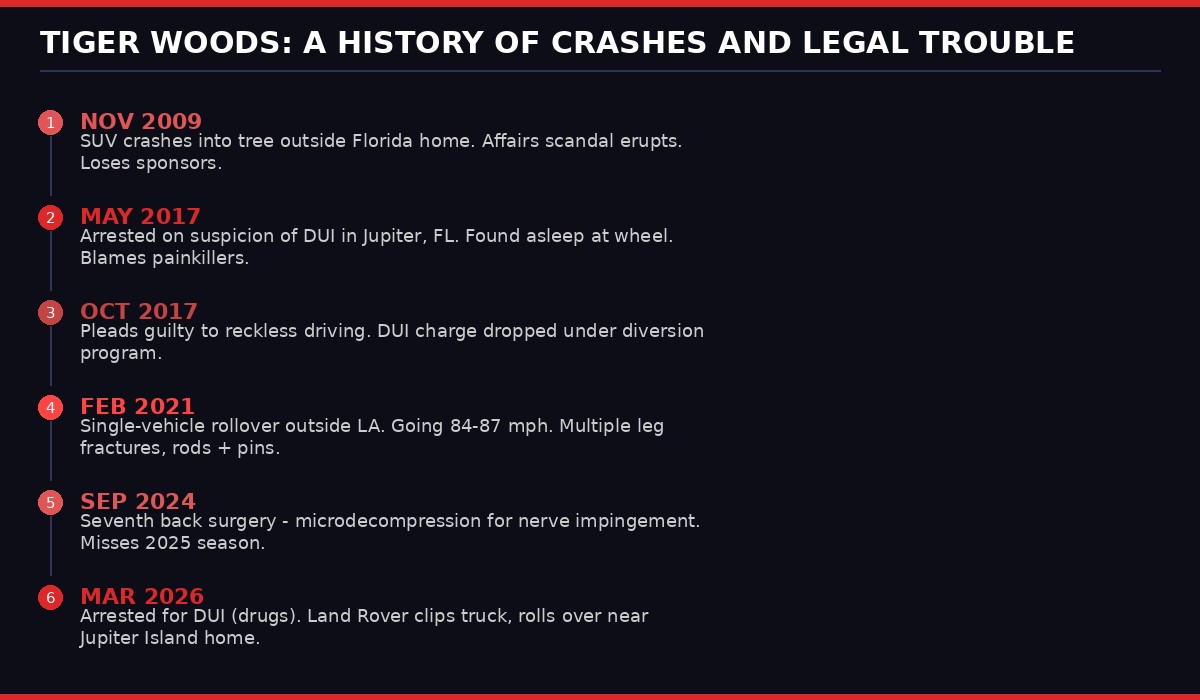
A timeline of Tiger Woods' significant legal and physical incidents from 2009 to 2026. (BLACKWIRE)
The Masters, the Ryder Cup, and What Comes Next
Timing is everything in sports, and the timing of Friday's arrest could not be more consequential for what happens next in golf. The Masters begins April 9 at Augusta National - 13 days from now. Woods had been working toward a possible appearance, recovering from his seventh back surgery and trying to determine whether his body was capable of competing. His manager at Excel Sports did not immediately respond to requests for comment on Friday. AP News
Just days before the crash, Woods played in his indoor TGL golf league on a Tuesday night - the most visible recent signal that he was physically capable of swinging a club. He was also scheduled to be in Augusta on April 5 to unveil a golf course design project with Masters chairman Fred Ridley. That appearance, and any Masters start, must now be viewed through the lens of a legal case that is in its earliest stage.
Beyond Augusta, there was a second major question hanging over Woods' immediate future. He had been on the verge of deciding whether to accept the role of United States Ryder Cup captain for the 2027 matches in Ireland - a "soft deadline" that was reportedly days away. The captaincy would have represented a new chapter: leadership rather than competition, a formal passing of the torch while still remaining central to the sport. That decision may now be complicated, or delayed, or taken out of his hands entirely depending on how Friday's arrest develops legally. AP News
As chairman of the PGA Tour's Future Competition Committee, Woods has been deeply embedded in restructuring the tour's business model during one of the most turbulent periods in professional golf's history. That role carries reputational weight. Tour leadership has not publicly commented on the arrest as of Friday evening.

Augusta National opens for the Masters on April 9, less than two weeks away. (Pexels)
Florida Law and the Refusal Question
Under Florida's implied consent statute, any person who drives on the state's roads is deemed to have consented to a breath, blood, or urine test if lawfully arrested for DUI. Refusing a test after a valid DUI arrest is itself a civil infraction on the first offense - and can be used as evidence of consciousness of guilt in a subsequent criminal proceeding. Florida Statute 316.1932
Woods submitted to the Breathalyzer and tested negative for alcohol, which complicates the prosecution's case in some respects while clarifying it in others. The negative alcohol result means the allegation is drug-impaired driving - which falls under the same DUI statute in Florida but typically requires more forensic work to prove.
By refusing the urine test, Woods denied prosecutors the clearest possible route to that forensic evidence. The sheriff acknowledged this openly: "We will never get definitive results with what he was impaired on." That creates an evidentiary gap. But Florida courts have long held that refusal to submit to testing is admissible evidence of impairment, and prosecutors can also call witnesses who observed Woods' behavior at the scene, including the deputies who made the arrest call.
Woods spent Friday night in Martin County jail, held separately from the general population as Budensiek noted - standard practice for high-profile arrestees. He was entitled to post bail after completing the mandatory eight-hour hold. If charged, he faces a first-degree misdemeanor carrying up to one year in jail and fines. His 2017 case, in which the DUI charge was dropped and replaced with reckless driving, set a prior precedent - but that outcome also means a court diversion program is no longer available to him in the same form. Martin County Sheriff's Office

Legal proceedings will determine whether the charge advances to trial. (Pexels)
The Career Behind the Mugshots
It is impossible to process Friday's news without grappling with what Tiger Woods was - and what he accomplished over a 30-year professional career that reshaped golf from a niche sport into a global television product. The numbers are not debatable: 15 major championships. 82 PGA Tour victories. Dominance so complete during his peak years from 1997 to 2009 that competitors openly discussed whether the sport was irreparably stratified into Woods and everyone else. AP News
He won the 1997 Masters at age 21, younger than any champion in the tournament's history, with a record total of 270 strokes and a 12-shot margin that still stands as the largest winning margin in Masters history. In 2000, he won the U.S. Open at Pebble Beach by 15 shots - the largest margin of victory in major championship history. In 2001, he completed the so-called "Tiger Slam," holding all four professional major trophies simultaneously, a feat no golfer had ever achieved.
The 2009 Thanksgiving crash at his Windermere home - the fire hydrant, the SUV, the unraveling of his personal life in the weeks that followed - began the second act of his story. Corporate sponsors fled. He went to a rehabilitation clinic. He did not return to golf until the 2010 Masters. Elin Nordegren, his wife, filed for divorce that August.
The comeback story was not linear, and it was not free. It cost him several more surgeries and culminated in the 2019 Masters, where he won his 15th major championship and his first in 11 years - the kind of sporting resurrection that happens maybe once per generation. The Masters gallery roared. Players cried. Woods' children watched from the green as he tapped in the winning putt. For one afternoon, it appeared the story might end there, cleanly, the way only sports can construct endings.
It did not end there. February 2021, outside Los Angeles. The rollover. The nearly amputated leg. Then five more years of surgeries and grinding and playing on a body that no longer functions the way it once did - finishing 16 or more shots from the winner on the four occasions he managed to complete 72 holes since the LA crash. His last official tournament was the British Open in 2024. His last surgery was October 2025. And then Tuesday night's TGL appearance, and then Friday afternoon on a 30 mph road in Martin County, Florida.
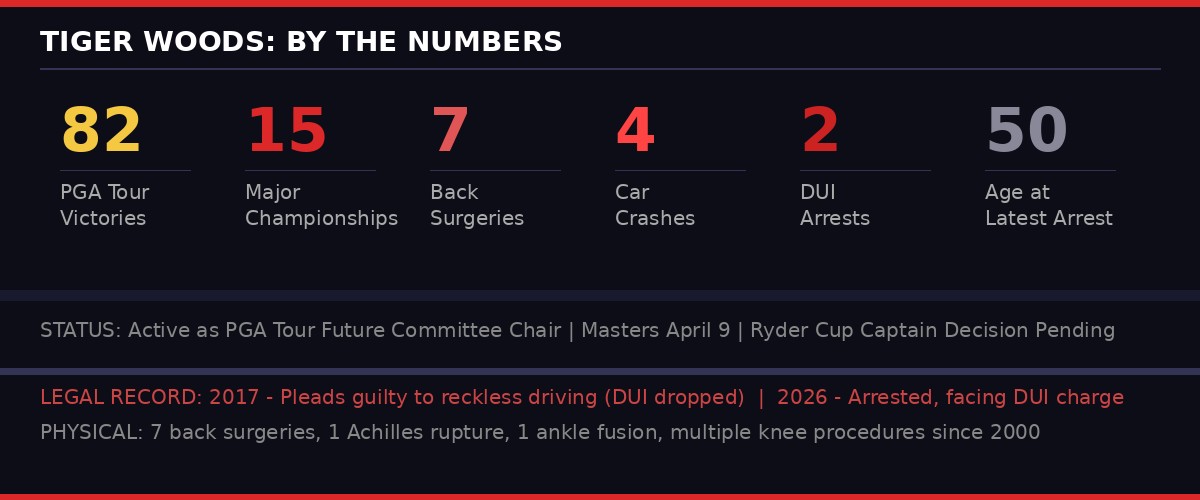
82 PGA Tour wins, 15 majors, 7 back surgeries, 4 car crashes, 2 DUI arrests. (BLACKWIRE)
The Reaction: Silence, Sympathy, and the Sport's Next Move
As of late Friday evening, the official response from the golf world remained largely muted. The PGA Tour had not issued a public statement. Augusta National had not responded to requests for comment. The Ryder Cup committee did not issue any public guidance on whether the captaincy decision would be affected. That silence is itself a kind of answer: institutions that want to distance themselves do so quietly, and institutions that are simply watching and waiting do the same.
Trump's remarks on the tarmac in Miami were the highest-profile public response, and they were characteristically personal rather than judgmental - a friend offering sympathy, not an official rendering judgment on conduct. Trump's former daughter-in-law, Vanessa Trump, has been publicly linked to Woods in recent years, which adds a layer of relational complexity to the president's sympathetic framing. AP News
On social media, reaction split predictably between those who expressed concern for someone they see as battling severe pain and medical dependency, and those who argued that a second drug-related DUI incident in nine years - regardless of the mitigating context - reflects a pattern that cannot be explained away. Both positions are defensible. They are also not mutually exclusive.
What happens in the next 72 hours will shape the near-term narrative substantially. If Woods is formally charged, his legal team will begin building a defense that almost certainly centers on the complexity of his pain management regime and the involuntary nature of any impairment. If the charge is reduced or handled differently - as it was in 2017 - the story shifts to golf: does he appear at Augusta in 12 days, and if he does, what does that mean?
The Masters has always been the tournament most associated with Tiger Woods. It is where he made his most spectacular arrival, where he made his most improbable comeback, and now where, once again, his ability to appear hangs on factors that have nothing to do with a golf swing.
What Happens Next: Legal Timeline and the Road to Augusta
Friday's arrest triggers a series of procedural steps that will play out over coming days and weeks. After completing the mandatory eight-hour hold, Woods was eligible to be released on bail. Florida prosecutors will review the evidence from the Martin County Sheriff's Office, which includes field sobriety test observations, the Breathalyzer result, witness accounts from the truck driver and responding deputies, and the evidence from the crash scene itself. A formal charging decision typically follows within 30 to 60 days of an arrest, though the timeline can vary. Florida Rules of Criminal Procedure
For the Masters specifically, there is no formal mechanism by which Augusta National could prevent Woods from playing based solely on an arrest that has not resulted in a conviction. The club has broad discretion over its field - invitations to the Masters are extended, not automatic, with narrow exceptions for category qualifiers - but it has historically been reluctant to wade into players' legal matters before those matters are resolved. Woods, as a former champion, retains a lifetime invitation to compete. Augusta National
The more immediate practical question is whether Woods himself is in any physical or legal condition to prepare for a major tournament in less than two weeks. His body survived Friday's crash without apparent injury - a remarkable statement given what his right leg, left ankle, and lower back have been through in recent years. But the circumstances of the arrest, and any conditions that may be attached to his bail or release, could create logistical complications for travel to Augusta.
The April 5 golf course design reveal with Masters chairman Fred Ridley at Augusta National is a separate question. That is a ceremonial commitment, not a competitive one, and there is reason to think both parties might want to maintain it regardless of the legal situation - or quietly postpone it to avoid optics. No word had emerged on that front as of late Friday.
Whatever comes next, the arrest closes one chapter and opens another in a story that has defied every conventional endpoint the sports world has tried to assign it. Tiger Woods has been written off, mourned, celebrated, and resurrected so many times that the sports media has largely run out of templates for him. Friday's events fit no clean narrative - not the redemption arc, not the cautionary tale, not the triumphant final chapter. They are just more of what his story has always been: larger than expected, messier than comfortable, and impossible to look away from.

Golf is watching and waiting to see what comes next. (Pexels)
Get BLACKWIRE reports first.
Breaking news, investigations, and analysis - straight to your phone.
Join @blackwirenews on Telegram