$1.5 Trillion for War, Nothing for You
Trump drops the largest defense budget in American history while a 49-day government shutdown grinds on. Domestic programs face the axe. The message is clear: the Pentagon eats first.

The U.S. Capitol, where Congress remains deadlocked over funding while the White House demands the largest defense increase in decades. Photo: Pexels
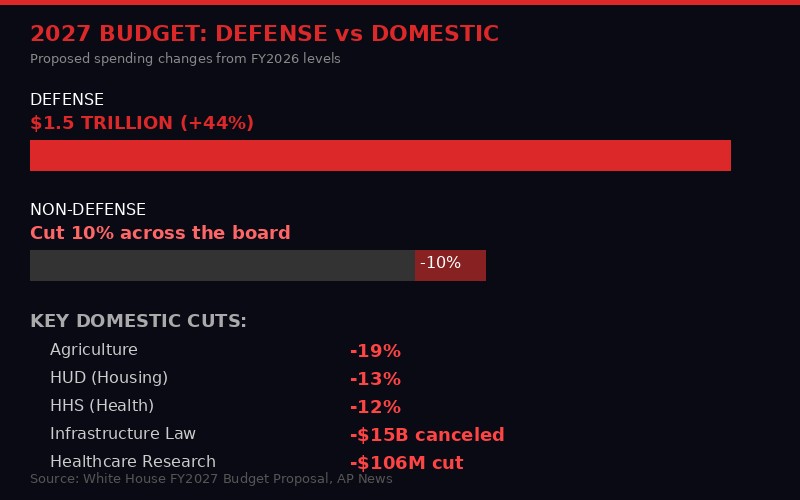
President Donald Trump unveiled his fiscal year 2027 budget on Friday, and the numbers tell a story that Washington's spin machines cannot obscure. The Pentagon gets $1.5 trillion - a 44 percent increase over current levels - making it the largest defense spending request in modern American history. Everyone else gets less.
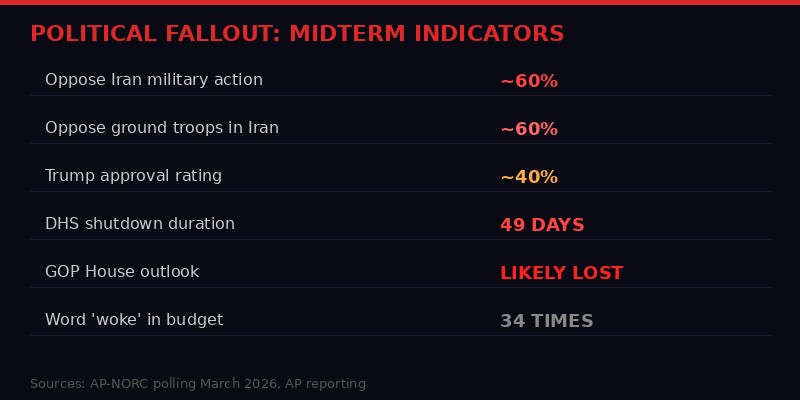
The budget proposal, dropped while Congress is on a two-week spring break and the Department of Homeland Security enters its 49th day of a partial government shutdown, reads like a wartime manifesto. Agriculture takes a 19 percent cut. Housing and Urban Development loses 13 percent. Health and Human Services drops 12 percent. Green energy projects worth $15 billion get canceled outright. The word "woke" appears 34 times in the document.
This is not a budget. It is a declaration of priorities. And the priorities are clear: bombs over bread, jets over jobs, detention beds over day care.
I. The $1.5 Trillion Ask

U.S. military operations have expanded dramatically since the Iran campaign began in late February. Photo: Pexels
The headline figure is staggering. One point five trillion dollars for the Department of Defense. To put that in context, the entire GDP of Australia is roughly $1.7 trillion. Trump is proposing to spend nearly the economic output of the world's 12th-largest economy on weapons, personnel, and military infrastructure in a single fiscal year.
The 44 percent increase dwarfs any defense buildup since the post-9/11 era. Even during the peak of the Iraq and Afghanistan wars, defense spending never approached these levels in inflation-adjusted terms. The Reagan-era buildup of the 1980s, often cited as the benchmark for peacetime militarization, topped out at roughly $800 billion in today's dollars.
Budget Director Russell Vought framed the request as a promise kept. "President Trump promised to reinvest in America's national security infrastructure, to make sure our nation is safe in a dangerous world," he wrote in the budget's introductory letter, according to the Associated Press.
The administration's plan splits the defense funding into two tracks. Roughly $1.1 trillion would move through the regular appropriations process, which traditionally requires bipartisan support. The remaining $350 billion would be pushed through budget reconciliation - a legislative mechanism that allows Republicans to pass spending with simple majority votes, bypassing Democratic opposition entirely.
This reconciliation maneuver is significant. It means the GOP is prepared to fund a substantial chunk of the defense increase without a single Democratic vote. That is not consensus-building. That is legislative warfare.
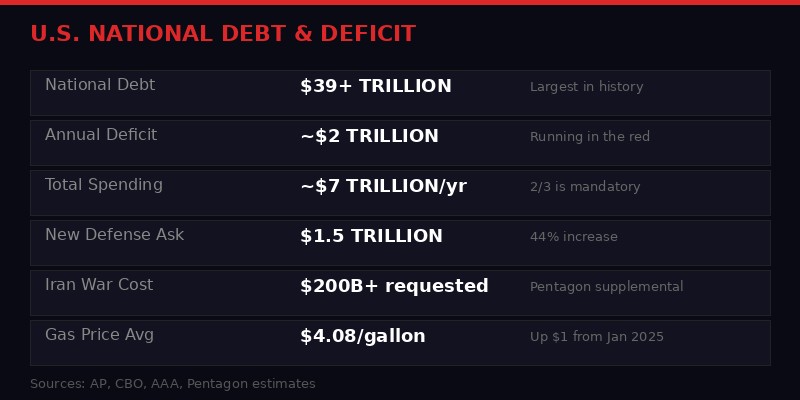
The timing of the request matters as much as the number. It arrives five weeks into a military campaign against Iran that has already cost American lives. At least 13 U.S. service members have been killed. Hundreds more have been wounded. Two U.S. warplanes were shot down over Iran just hours before the budget dropped, with one crew member still missing. The Pentagon has separately requested an additional $200 billion in supplemental war funding.
Add the supplemental request to the baseline budget, and Trump is effectively asking Congress to commit $1.7 trillion to the military in a single year. That is more than the combined GDP of the 50 poorest countries on Earth.
II. What Gets Cut

Federal agencies across the domestic spectrum face cuts ranging from 10 to 19 percent under the proposed budget. Photo: Pexels
While the Pentagon feasts, domestic agencies are being told to tighten their belts until they choke. Non-defense spending faces an across-the-board 10 percent reduction. But some departments are being carved far deeper.
The Department of Agriculture absorbs a 19 percent cut, the steepest of any cabinet agency. University research grants - the pipeline that funds everything from crop science to veterinary medicine to rural development studies - face elimination. In a country where the farm sector contributes over $200 billion annually to GDP and rural communities already struggle with hospital closures, school consolidations, and infrastructure decay, the cut is not theoretical. It is a direct hit on millions of livelihoods.
The Department of Housing and Urban Development takes a 13 percent reduction. This hits hardest in cities where affordable housing shortages have reached crisis proportions. Community Development Block Grants, which fund everything from homeless shelters to job training programs, face cuts that the administration labels as targeting grants "hijacked by radicals" to promote equity and green energy. Senator Patty Murray, the top Democrat on the Senate Appropriations Committee, was blunt in her response.
"Trump wants to build a ballroom. I want to build more affordable housing, and only one of us sits on the Appropriations Committee." - Sen. Patty Murray (D-WA), Senate Appropriations Committee ranking member
The Department of Health and Human Services faces a 12 percent cut. The Low Income Home Energy Assistance Program - which helps poor families heat their homes in winter and cool them in summer - is on the chopping block. The Agency for Healthcare Research and Quality, which the administration accuses of pushing "radical gender ideology onto children," would lose $106 million. Community Services Block Grants, which fund financial counseling, job placement, and housing assistance for low-income communities, face cuts as well.
More than $15 billion from the Biden-era bipartisan infrastructure law gets canceled, including funds for renewable energy projects and grants from the National Oceanic and Atmospheric Administration. These are projects that were already funded, already authorized by bipartisan votes, already in progress. The administration is pulling the rug out from under them.
III. The Shutdown That Won't End

The DHS shutdown has stretched to 49 days - the longest partial government shutdown in American history. Photo: Pexels
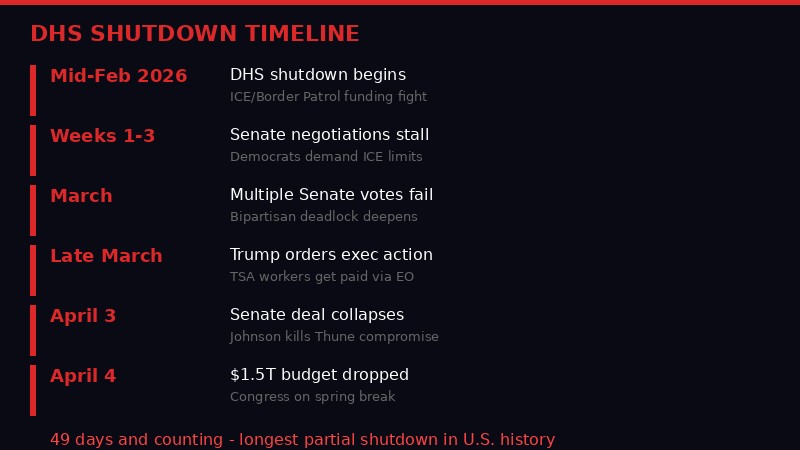
The budget proposal lands against the backdrop of a government that is already partially broken. The Department of Homeland Security has been in a state of partial shutdown since mid-February. On Friday morning, April 4, that shutdown hit its 49th day - making it the longest partial government shutdown in U.S. history.
The shutdown was triggered by a fight over immigration enforcement funding. Democrats demanded restrictions on Immigration and Customs Enforcement operations. Republicans refused. The standoff has left tens of thousands of DHS employees working without pay, including Border Patrol agents, Coast Guard personnel, and Secret Service officers.
Trump signed an executive order to ensure TSA workers get paid, a stopgap that addressed the most visible pressure point - airport chaos - without resolving the underlying dispute. But the order does nothing for the thousands of other DHS employees who continue to work without paychecks or have been furloughed entirely.
On the eve of the budget release, a Senate deal to fund most of DHS collapsed in spectacular fashion. Senate Majority Leader John Thune had negotiated a compromise with Democrats that would have set aside the ICE funding fight and reopened most of the department. The deal passed the Senate unanimously in the early morning hours of Friday.
Then House Speaker Mike Johnson killed it.
"I have to protect the House, and I have to protect the American people." - House Speaker Mike Johnson (R-LA), rejecting the Senate's bipartisan DHS funding deal
Johnson called the Senate's deal a "joke" and stormed out of his office to address reporters. The collapse exposed a deep fracture between the two Republican leaders in Congress - a rift that has implications far beyond DHS funding. Rep. Nick LaLota, a New York Republican, captured the mood on a private GOP conference call: "The Senate chickened out. The cowards there, only a few of them in the middle of the night with I think only three to five senators present on the floor, chickened out because they wanted to go home for two weeks."
Congress is now on spring break. The shutdown continues. And into this dysfunction, the White House has dropped a budget proposal that demands the largest military spending increase in decades.
IV. War Economics

Gasoline prices have surged to $4.08 per gallon - nearly a dollar higher than when Biden left office - as the Strait of Hormuz remains closed. Photo: Pexels
The Iran war is reshaping the American economy in ways that the budget document barely acknowledges. The Strait of Hormuz, through which roughly 20 percent of the world's oil supply flows, has been effectively closed since the conflict began. The direct result is visible at every gas station in America.
The average price for a gallon of gasoline hit $4.08 on Thursday, according to AAA. That is nearly a dollar higher than on President Biden's last day in office. In California, prices have breached $5.50. In rural areas where families drive long distances for work and groceries, the increase is not an inconvenience - it is a financial crisis.
During his prime-time address to the nation earlier this week - his first since the U.S. and Israel attacked Iran more than a month ago - Trump insisted that gas prices would fall quickly once the war concluded. But he offered no solution for reopening the Strait of Hormuz. Instead, he invited skeptical U.S. allies to handle it themselves.
"This is a true investment in your grandchildren and your grandchildren's future. When it's all over, the United States will be safer, stronger, more prosperous and greater than it has ever been before." - President Donald Trump, prime-time address to the nation, April 1, 2026
The speech satisfied almost no one. Trump simultaneously suggested the war was ending and expanding, telling Americans they should expect intense military operations for "the next two to three weeks" while claiming that U.S. military objectives were "on track." That mixed message was undercut hours later when two American warplanes were shot down over Iran, contradicting Trump's repeated assertions that Tehran's military capabilities had been "all but destroyed."
The economic ripple effects extend far beyond gas prices. Energy costs feed into everything - food prices, shipping costs, manufacturing inputs, heating bills. The Producer Price Index has been climbing steadily since March. Import costs are rising. Small businesses that operate on thin margins are watching their cost structures shift beneath them.
And into this environment, the president is asking Congress to slash domestic spending by 10 percent while pouring $1.5 trillion into the military. The message to Americans struggling with higher costs is, as Trump himself put it with startling candor at a private White House event: "We're fighting wars. We can't take care of day care."
He then extended the logic further: "It's not possible for us to take care of day care, Medicaid, Medicare - all these individual things. They can do it on a state basis. You can't do it on a federal."
That single quote may define the 2026 midterm elections more than any policy document or campaign ad.
V. The Immigration Machine

The budget maintains ICE funding at current levels while proposing 100,000 adult detention beds and 30,000 family detention beds. Photo: Pexels
While the budget slashes housing, health, and agriculture, one domestic priority is conspicuously protected: immigration enforcement. The proposal maintains Immigration and Customs Enforcement funding at current-year levels and draws on increases from last year's spending bills to continue expanding detention capacity.
The numbers are striking. The budget proposes 100,000 detention beds for adults and 30,000 for families. To put that in perspective, the entire federal prison system holds approximately 155,000 inmates. The administration is proposing an immigration detention apparatus that rivals the federal prison system in scale.
The Department of Justice receives a 13 percent funding increase, explicitly tied to "violent criminals" and what the White House calls "migrant crime" - a term that critics argue conflates immigration status with criminal behavior. Meanwhile, a refugee resettlement aid program faces elimination entirely.
This selective generosity reveals the budget's internal logic. The document is not really about fiscal responsibility or deficit reduction. It is about redirecting federal resources toward two objectives: military power projection abroad and immigration enforcement at home. Everything else - health, housing, education, agriculture, the environment, energy independence - is relegated to the category of things the federal government supposedly cannot afford.
The administration's own framing reinforces this. The budget uses the word "woke" 34 times to describe programs it wants to cut. Community Services Block Grants, which fund financial counseling and housing assistance, are characterized as having been "hijacked by radicals." Healthcare research is accused of promoting "radical gender ideology." These are not spending arguments. They are cultural arguments dressed in fiscal language.
VI. The Debt Bomb Nobody Wants to Talk About

The national debt has surpassed $39 trillion, with annual deficits running near $2 trillion. Photo: Pexels
The arithmetic of the federal budget is unforgiving. The national debt has surpassed $39 trillion. Annual deficits are running at nearly $2 trillion. Total federal spending approaches $7 trillion per year, and roughly two-thirds of that - Medicare, Medicaid, Social Security, and interest on the debt - is essentially locked in, growing automatically alongside an aging population.
That leaves Congress fighting over roughly one-third of the budget. And within that third, Trump is now proposing to give the Pentagon nearly half. The math does not leave room for much else.
The administration's fiscal trajectory is made worse by last year's tax cut legislation - the "big beautiful bill" that Trump signed with fanfare. That law included at least $150 billion in additional Pentagon funding over several years, plus $170 billion for immigration enforcement at DHS. The tax cuts themselves reduced federal revenue by hundreds of billions annually. The Congressional Budget Office projected that the law would add trillions to the national debt over the next decade.
Now the White House is asking for even more defense spending on top of that baseline. The deficit hawks who once populated the Republican Party are conspicuously silent. There is no Balanced Budget Amendment rhetoric. There are no Tea Party protests about government spending. The deficit, apparently, only matters when it funds health care or housing.
The budget document makes no serious attempt to address the structural deficit. It does not propose reforms to Social Security or Medicare. It does not include revenue increases. It simply proposes to spend vastly more on defense while spending somewhat less on everything else - and hopes that the math works out somehow.
It will not.
VII. The Political Fallout

With midterm elections approaching, Republican strategists are warning of a difficult November. Photo: Pexels
The budget arrives six months before Americans begin casting ballots in midterm elections that will determine control of Congress. For Republicans, who currently hold both chambers by narrow margins, the timing could not be worse.
AP-NORC polling from March shows that roughly 60 percent of U.S. adults believe the military action in Iran has "gone too far." About 60 percent oppose deploying ground troops. Only about one in ten favor ground deployment. Trump's overall approval rating has stagnated at roughly 40 percent throughout his second term.
Republican pollster Neil Newhouse delivered a grim assessment to the AP: "You're looking at an ugly November. At a point in time when we need every break possible to hold the House and Senate, our edge is being chipped away."
The political landscape has shifted dramatically from where Republicans expected to be. A year ago, party leaders believed they could hold the House and easily defend the Senate. Now they privately concede that the House is "all but lost" and Democrats have a realistic shot at taking the Senate.
The Republican National Committee has largely avoided mentioning the war in its talking points to surrogates. Campaign committee leaders responsible for House and Senate races have declined interview requests. Vulnerable Republican candidates are dodging the issue, unwilling to either defend or challenge Trump publicly.
The internal fracture is already visible. Former Rep. Marjorie Taylor Greene - once among Trump's most vocal allies - lashed out after his prime-time address: "I wanted so much for President Trump to put America First. That's what I believed he would do. All I heard from his speech tonight was WAR WAR WAR. Nothing to lower the cost of living for Americans."
On the other side, Sen. Lindsey Graham called the same speech the "best I could've hoped for" and praised Trump for providing "a clear and coherent pathway forward." The Republican Party is not merely divided on the war. It is splitting along fault lines that the budget proposal will only deepen.
Republican strategist Ari Fleischer, who served in George W. Bush's administration, drew an uncomfortable parallel. Bush received a massive polling bounce after the 2003 Iraq invasion - the kind of boost that Trump has conspicuously failed to receive. Bush also worked to build public support before going to war. Trump made "little effort to sell the conflict to Americans before the initial attack," the AP notes.
"Ultimately, he is not going to get judged on his persuasion or his explanations or his assertions, he's going to get judged on results." - Ari Fleischer, Republican strategist and former Bush administration aide
VIII. The $10 Billion Ballroom
Buried in the budget is an item that crystallizes the document's priorities with almost satirical clarity: a $10 billion fund within the National Park Service for "construction and beautification" projects in Washington, D.C.
Ten billion dollars for making the capital look pretty. While agricultural universities lose their funding. While low-income families lose heating assistance. While housing programs get cut by 13 percent. While healthcare research is gutted.
The budget also includes a $481 million increase for aviation safety, including an air traffic controller hiring surge - one of the few non-defense, non-immigration items that receives a boost. It is a tacit acknowledgment that the air traffic control system is dangerously understaffed, a problem that multiple administrations have failed to solve and that has become acute as near-miss incidents at airports have increased in recent years.
But the air traffic controller funding, welcome as it may be, is a rounding error compared to the defense increase. It amounts to less than 0.04 percent of the Pentagon's proposed budget. It is the kind of investment that makes the budget look reasonable on cable news segments while the structural reality - massive military spending at the expense of everything else - remains unchanged.
The budget also directs the Department of Justice to prioritize what it calls "migrant crime," a framing that conflates the immigration debate with public safety in ways that critics say is misleading. Studies consistently show that immigrants - including undocumented immigrants - commit crimes at lower rates than native-born citizens. But the political utility of the term transcends the data.
IX. Congress on Recess, Government in Crisis

Congress departed for a two-week spring break with the DHS shutdown unresolved and the budget proposal unanswered. Photo: Pexels
The most remarkable aspect of the budget's release is its context. Congress is on a two-week spring break. The DHS shutdown continues with no resolution in sight. The Senate's last-ditch funding deal collapsed Friday when Speaker Johnson rejected it. Senators have already left Washington.
There is no mechanism in place to end the shutdown before Congress returns. There is no bipartisan framework for addressing the budget. There is no scheduled vote, no continuing resolution, no stopgap measure on the horizon. The government is, in the most literal sense, on autopilot - and part of it is not funded at all.
When lawmakers return, they will face a cascade of competing demands. The $1.5 trillion defense budget. The $200 billion Iran war supplemental. The DHS shutdown. Trump's demand for strict voter ID legislation. The reconciliation process for the defense funding. And the midterm elections bearing down on every vote.
Senate Democrats have already signaled their opposition. The budget fight will inevitably become entangled with the shutdown fight, the war funding fight, and the voter ID fight. Each issue has its own constituency, its own pressure points, its own potential for deadlock.
Republican leaders in the House and Senate are not even aligned with each other. Johnson and Thune's relationship has been strained by the DHS deal collapse. The budget proposal, which requires both chambers to cooperate, arrives at the worst possible moment for intra-party unity.
Senator Susan Collins, who chairs the Senate Appropriations Committee, called Democrats "intransigent and unreasonable" on the DHS deal. Senate Minority Leader Chuck Schumer said he was "proud of his caucus for holding the line." Both sides blame the other for moving the goalposts. Neither side has an incentive to compromise with midterms approaching.
The result is a federal government that is simultaneously trying to prosecute a war abroad, fund the largest military buildup in decades, resolve the longest partial shutdown in history, and prepare for elections - while Congress is literally on vacation.
X. What This Budget Really Says
Presidential budgets are not legislation. They are statements of intent. They do not carry the force of law. Congress controls the purse, and Congress routinely ignores presidential budget proposals, often dramatically.
But the document matters as a declaration of values. And the values embedded in Trump's FY2027 budget are unmistakable.
The federal government's primary purpose, in this telling, is to wage war and enforce immigration law. Everything else - the health of citizens, the roofs over their heads, the food they eat, the air they breathe, the universities that educate them, the energy that powers their homes - is secondary. Optional. A state responsibility.
"We're fighting wars. We can't take care of day care."
That line will echo through the midterm campaign season. It will appear in Democratic attack ads. It will be quoted on debate stages. It will be cited by Republican challengers trying to distance themselves from the administration without losing Trump's base.
The budget also reveals a deeper strategic calculation. By splitting defense funding between regular appropriations and reconciliation, the administration is betting that it can ram through the military increase without Democratic cooperation. The reconciliation track allows Republicans to pass $350 billion in defense spending with simple majority votes. That is not negotiation. That is force.
The question is whether Republican lawmakers - especially those in competitive districts and states - will go along. Voting for $1.5 trillion in defense spending while cutting housing assistance and healthcare research is a political risk that some may not be willing to take, especially with polling numbers moving against the party.
For now, the budget sits on Capitol Hill like an unexploded ordnance. Congress is on break. The shutdown grinds on. The war continues. Gas prices climb. And the president of the United States has told the country, in terms that cannot be misunderstood, what he intends to prioritize.
Guns, not butter. That is the oldest trade-off in political economy. Trump is not the first president to make the choice. But he may be the first to make it this brazenly, this openly, this unapologetically - while the government he leads cannot even agree to pay its own employees.
Key Budget Numbers at a Glance
- $1.5 trillion - proposed defense spending (44% increase)
- $350 billion - defense funds via reconciliation (no Democratic votes needed)
- $200 billion+ - separate Iran war supplemental request
- $15 billion - canceled from bipartisan infrastructure law
- $10 billion - D.C. "beautification" fund
- 19% - agriculture cut
- 13% - housing cut
- 12% - health/human services cut
- 100,000 - proposed adult detention beds
- 49 days - DHS shutdown duration
- $39+ trillion - national debt
- $4.08 - average gas price per gallon
- 34 - times the word "woke" appears in the budget
Get BLACKWIRE reports first.
Breaking news, investigations, and analysis - straight to your phone.
Join @blackwirenews on Telegram