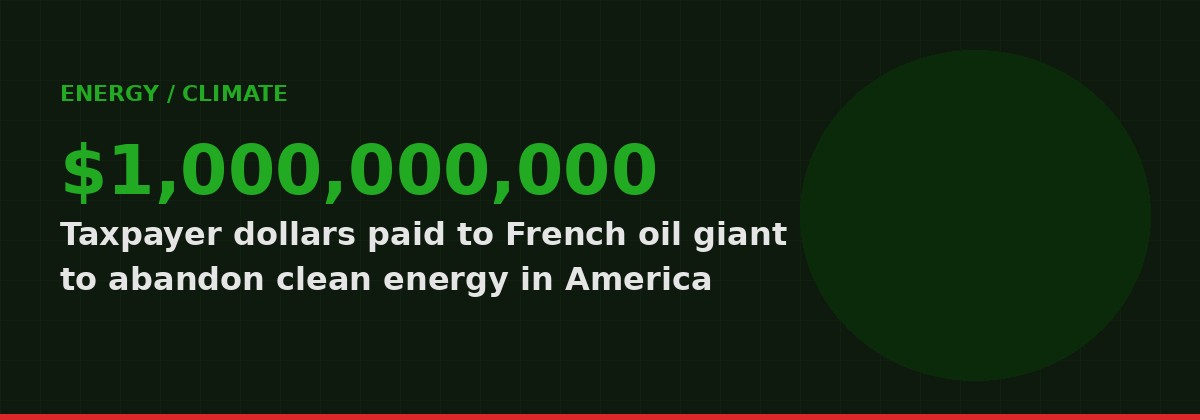
The Trump administration announced Monday it will pay $1 billion to French energy giant TotalEnergies to walk away from two offshore wind leases - handing the company a full refund of its lease purchases after federal courts blocked every attempt to kill the projects through executive order. Critics are calling it what it looks like: a billion-dollar bribe paid with taxpayer money to accomplish through cash what the courts refused to allow.
The deal is unprecedented. No prior U.S. administration has paid a foreign company to stop building clean energy infrastructure. It marks a new escalation in President Trump's war on offshore wind - one that bypasses the judiciary entirely by making it financially unviable for developers to operate in the United States, regardless of what any judge rules.
In a bitter twist of timing, the announcement came on the same day that Coastal Virginia Offshore Wind - one of the five East Coast projects the Trump administration had tried to halt - started delivering power to the grid for the first time. Clean energy killed in one state, coming online in another, on the same afternoon. AP News, March 24, 2026
01 / What Was Actually Announced
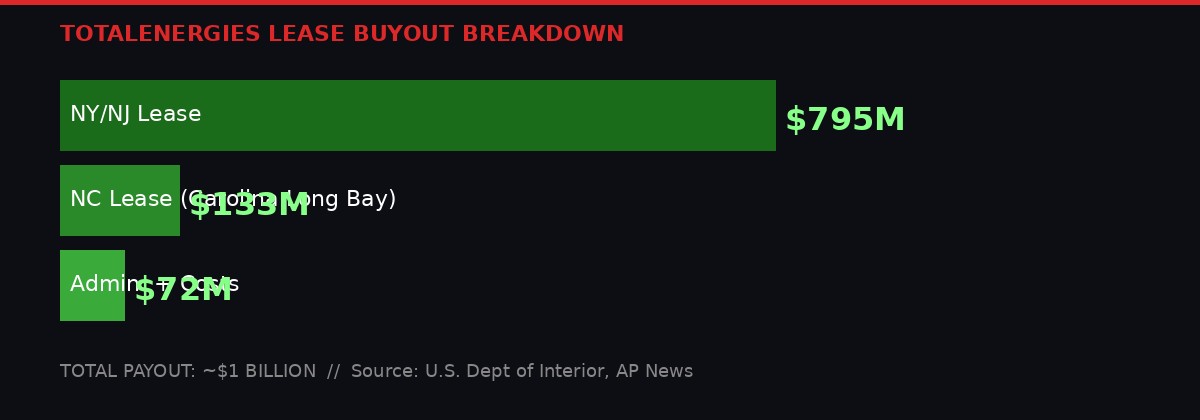
The U.S. Department of Interior announced Monday that TotalEnergies has agreed to surrender two offshore wind leases in exchange for a refund of what the company paid to acquire them. The leases cover:
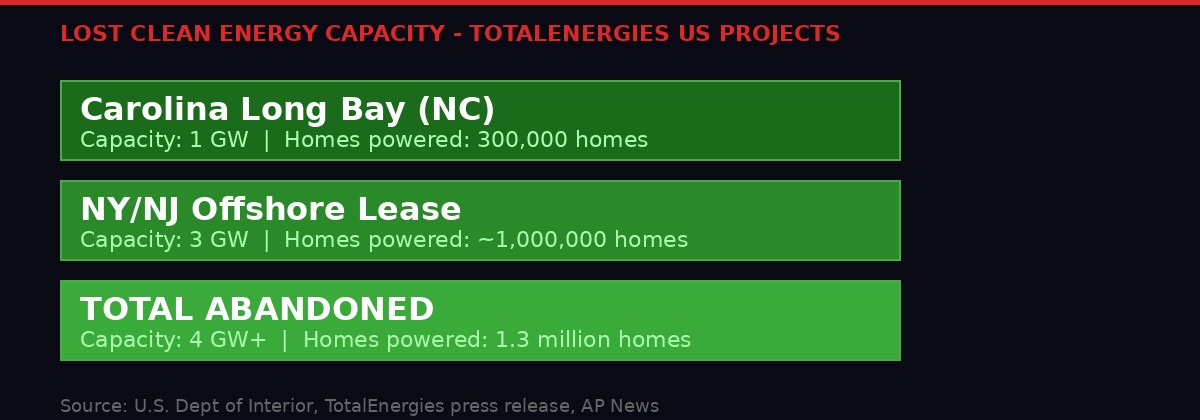
The Carolina Long Bay project, off the coast of North Carolina, which TotalEnergies purchased in 2022 for approximately $133 million. The project was designed to generate more than 1 gigawatt of power - enough to supply roughly 300,000 homes. The second lease covers an area off New York and New Jersey, also acquired in 2022 for $795 million. This was planned as a 3-gigawatt project capable of powering close to one million homes.
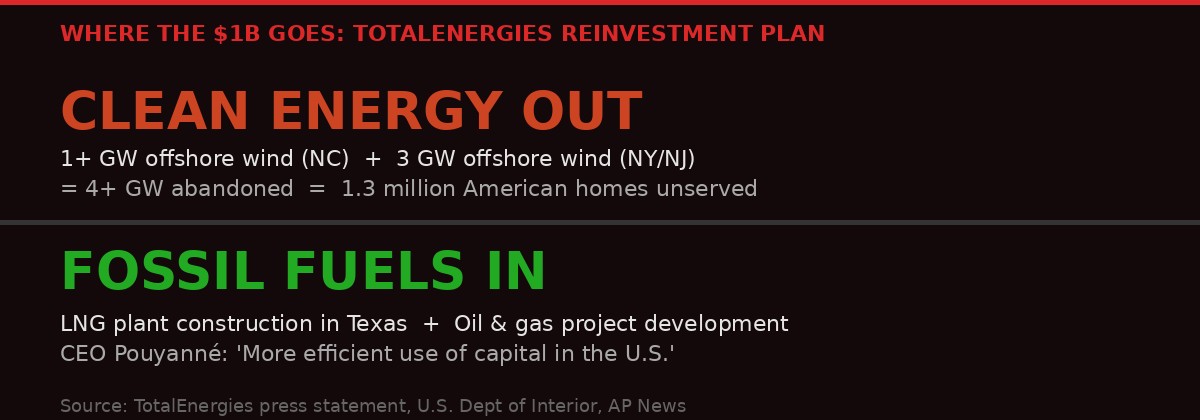
Together, TotalEnergies' abandoned projects represent over 4 gigawatts of lost generating capacity - energy that would have powered approximately 1.3 million American homes. Under the deal, TotalEnergies pledged to never develop any new offshore wind projects in the United States. AP News
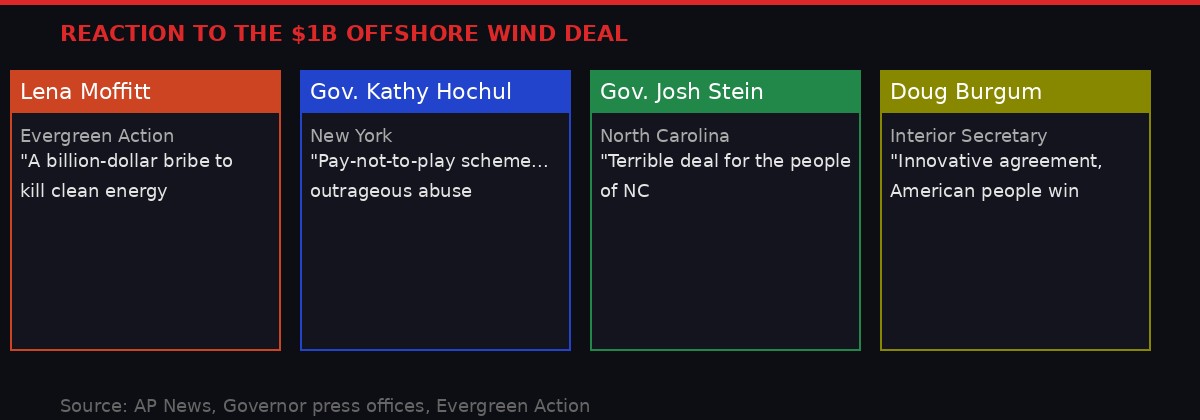
Interior Secretary Doug Burgum called it an "innovative agreement," saying "the American people will no longer pay for ideological subsidies that benefited only the unreliable and costly offshore wind industry." In a statement, TotalEnergies CEO Patrick Pouyanné confirmed the company renounced offshore wind development in the U.S. and said the refunded lease fees would be redirected to build a liquefied natural gas plant in Texas and fund the expansion of its oil and gas activities. He called it a "more efficient use of capital." TotalEnergies press statement, March 24, 2026
TotalEnergies will first make investments in LNG and oil-and-gas in the U.S., then be reimbursed by the government up to the amount originally paid for the offshore wind leases. The money effectively flows from American taxpayers to a French fossil fuel company.
02 / The Court Battle That Forced This Move
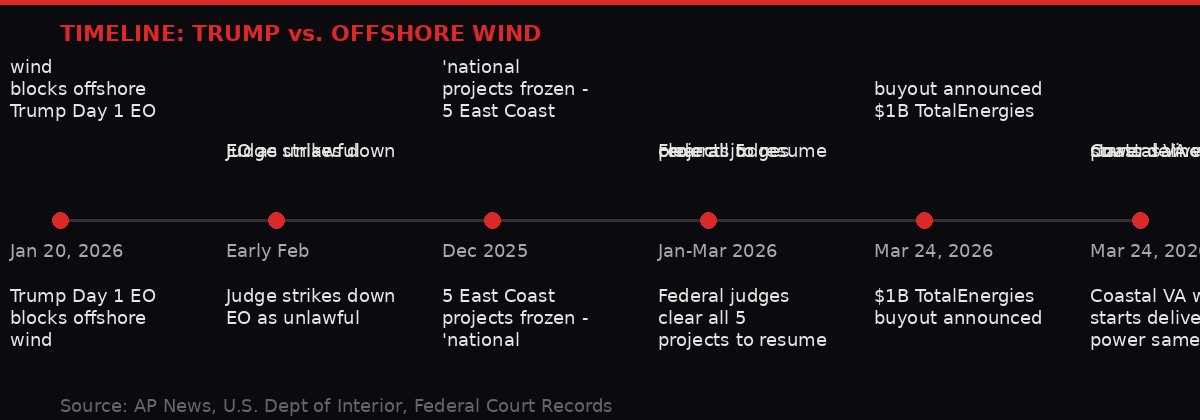
To understand why the Trump administration turned to cash payments, you need to understand how comprehensively it lost in court on offshore wind. Trump has called wind energy "the scam of the century" and made killing it a signature policy goal. On his first day in office, he signed an executive order blocking virtually all offshore wind leasing and permitting. Federal courts struck it down.
The administration then froze five major East Coast offshore wind projects days before Christmas 2025, citing national security concerns. Developers and states sued. Federal judges allowed all five projects to resume construction - finding the government had not shown any imminent security risk that would justify halting construction. AP News
U.S. District Judge Royce Lamberth, clearing Sunrise Wind to proceed, concluded the government had not demonstrated offshore wind posed the kind of urgent threat that warranted stopping construction. The court system, in case after case, sided with the developers. AP News, federal court records
A separate ruling by Judge Patti Saris of the U.S. District Court for Massachusetts vacated Trump's Day One executive order blocking wind energy projects, calling it "arbitrary and capricious" and declaring it unlawful. That ruling came following a lawsuit by a coalition of 17 state attorneys general led by New York's Letitia James. AP News
"After losing again and again in court on his illegal stop-work orders, Trump has found another way to strangle offshore wind: pay them to walk away." - Lena Moffitt, Executive Director, Evergreen Action
The judicial record is unusually clear. The courts did not just decline to block wind projects - they repeatedly found the administration's reasoning deficient, its national security arguments unsupported by evidence, and its executive orders unlawful. Every legal avenue had closed. So the administration wrote a check. AP News
03 / Who Is TotalEnergies and Why Did They Take the Deal
TotalEnergies is France's largest energy company, one of the world's seven "supermajors" in oil and gas. With revenues exceeding $200 billion and operations in more than 130 countries, it is not a company that acts out of weakness. It had already paused its two U.S. projects after Trump's election in November 2025, recognizing the regulatory environment had become hostile.
The company's decision to accept the buyout and pledge never to return to U.S. offshore wind is rational from a business perspective - but it is also a political statement. TotalEnergies is an active offshore wind developer globally, with major projects in France, the United Kingdom, Brazil, South Korea, and Taiwan. Its CEO's language about "efficiency" and fossil fuel investment being preferable in the U.S. context is a calculated positioning for the Trump era, not a rejection of renewables globally. TotalEnergies CEO statement
What the company gets: $928 million back that it had sunk into leases for projects it had already paused, plus a clear business justification to reallocate capital to LNG and oil-and-gas in a country where those sectors face no political headwinds. What it gives up: the option to develop U.S. offshore wind for an indefinite future. Given current politics, that is not much of a sacrifice. AP News
National security expert Kirk Lippold, former Commander of the USS Cole, disputed the administration's framing. "The offshore projects were awarded permits following years of review by state and federal agencies, including the Coast Guard, the Naval Undersea Warfare Center, the Air Force and more," he said. "The record of decisions all show that the Department of Defense was consulted at every stage of the permitting process." AP News
04 / State Governments React With Fury
Democratic governors of the two states that stood to benefit most from the abandoned projects came out swinging. New York Governor Kathy Hochul called it a "pay-not-to-play scheme," accusing Trump of using it to pressure TotalEnergies not to build offshore wind. "This is an outrageous abuse of taxpayer dollars," she said in a statement. AP News
North Carolina Governor Josh Stein was equally direct. "Our state has the offshore wind potential to power millions of homes with renewable American-made energy. It's ludicrous and wasteful that the Trump administration is spending $1 billion in taxpayer money to pay off a company to stop it from investing private dollars to create the clean energy we need," Stein said. AP News
The governors' frustration goes beyond clean energy ideology. Offshore wind projects represent substantial economic activity - construction jobs, supply chain development, port upgrades, long-term operation and maintenance employment. North Carolina had positioned itself as a hub for offshore wind manufacturing and assembly. Those plans are now on hold. AP News
New York Attorney General Letitia James, who led the 17-state coalition that successfully challenged Trump's wind executive order, said the administration was circumventing the courts by using money instead of regulation. Her office was reviewing options. AP News
"Energy independence is national security. We remain committed to an all-of-the-above approach that includes renewables, nuclear power and other energy sources." - Governor Kathy Hochul, New York
Ted Kelly, clean energy director at the Environmental Defense Fund, called the deal "an outrageous misuse of taxpayer dollars to prevent Americans from having clean, affordable power exactly when they need it most." He noted that East Coast states are building offshore wind because it boosts affordable electricity supply on the grid, even as natural gas prices are rising under pressure from the ongoing Iran war and global energy disruption. AP News, Environmental Defense Fund
05 / The Bigger Pattern: Killing Renewables by Any Means
The TotalEnergies buyout is not a one-off deal. It is the latest move in a methodical campaign to restructure U.S. energy production toward fossil fuels - a campaign that has used executive orders, regulatory freezes, national security pretexts, court battles, and now direct cash payments.
Trump declared an "energy emergency" on his first day in office, framing oil, gas, and coal as the solution to rising energy costs and AI infrastructure demands. His administration has reversed offshore wind permitting, removed tax credits for electric vehicles, and worked to accelerate liquefied natural gas export terminal approvals.
The Iran war has added urgency - and cover - to this agenda. With oil prices elevated above $110 per barrel and global energy markets under strain, Trump has used the crisis to push "drill, baby, drill" messaging and justify fossil fuel investment as patriotic necessity. The TotalEnergies deal neatly fits: a French company abandons wind, takes government money, and builds an LNG plant in Texas instead. The administration frames this as American energy security. Critics frame it as a government-funded fossil fuel subsidy dressed up as an exit payment. AP News
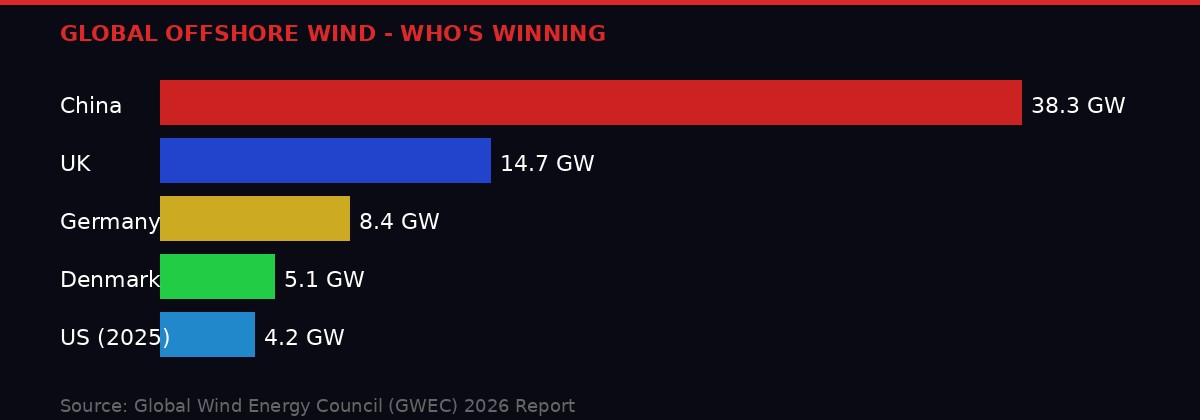
The international dimension matters. TotalEnergies continues to be a major offshore wind developer outside the United States. The Global Wind Energy Council (GWEC) reports that China installed more than 38 gigawatts of offshore wind in 2025, dwarfing U.S. totals. The UK, Germany, and Denmark are all aggressively scaling. The U.S., which had been emerging as a major market, is now actively contracting - buying its way out of the technology race at taxpayer expense. GWEC 2026 Global Offshore Wind Report
06 / The Irony of March 24: Power On, Power Off
The timing of Monday's announcement contained an almost theatrical irony. The same day the Interior Department announced the TotalEnergies buyout - paying a company to stop generating clean energy - Coastal Virginia Offshore Wind started delivering electricity to the grid for the first time.
Coastal Virginia is one of the five East Coast projects the Trump administration had tried to halt in December. Dominion Energy, based in Richmond, Virginia, won a court ruling allowing construction to resume. On Monday, it hit a milestone: the project began producing power. AP News
Dominion's project survived. TotalEnergies' projects will not be built. The difference is partly corporate resilience - Dominion fought and won in court - and partly deal-making calculus. TotalEnergies was offered a clean exit. The question now is whether other offshore wind developers will face similar offers, or whether the buyout model was tailored specifically to a foreign company less politically invested in U.S. market presence.
Danish company Orsted, Norwegian company Equinor, and U.S.-based Dominion Energy all have projects that survived the legal battles. None of them have received buyout offers. Their projects are proceeding under court protection. The TotalEnergies deal may be a one-time play against a company willing to be paid to leave - or it may be a template. AP News
What is certain is that the administration has now demonstrated it will use direct cash payments, not just regulatory pressure, to shape the U.S. energy sector. That is a significant expansion of the playbook. And unlike executive orders, direct financial agreements are much harder to challenge in court. AP News, Environmental Law experts
07 / What Happens to the Remaining Projects
Five offshore wind projects are currently under construction on the U.S. East Coast, all under court protection after surviving the administration's legal challenges. They are: Vineyard Wind in Massachusetts, Revolution Wind in Rhode Island-Connecticut, Coastal Virginia Offshore Wind, Empire Wind in New York, and Sunrise Wind in New York. Together they represent approximately 6 gigawatts of generating capacity, enough to power roughly 2.5 million American homes and businesses. Turn Forward advocacy group, AP News
The construction pauses imposed by the administration cost developers tens of millions of dollars in delays and injected substantial uncertainty into future project development. Even though the courts cleared the projects to proceed, the damage to the broader offshore wind investment environment in the U.S. is real. Developers planning future projects are watching closely.
Hillary Bright, executive director of offshore wind advocacy group Turn Forward, argued that the country cannot afford to fall further behind. "At a time when electricity demand is rising rapidly and grid reliability is under increasing strain, these projects represent critically needed utility-scale power sources that are making progress toward completion." AP News
The Iran war has increased electricity demand pressure across the country, as energy-intensive AI data centers, military operations, and manufacturing expansion all compete for grid capacity. The Energy Information Administration had projected offshore wind as one of the fastest pathways to new generating capacity on the East Coast. That pathway is now narrowing. U.S. EIA projections
The key question going forward is whether the administration will attempt similar buyout deals with other foreign-owned offshore wind developers. Equinor (Norwegian, Empire Wind) and Orsted (Danish, Sunrise Wind and Revolution Wind) are both European companies with less political entrenchment in U.S. policy battles than domestic players like Dominion. They could theoretically be offered similar arrangements. Their response would determine whether the TotalEnergies deal marks a turning point or a one-off. AP News, industry analysis
08 / The $1 Billion Question: Legal and Political Fallout
Environmental groups are exploring legal options, but the pathway is harder than challenging an executive order. The Interior Department structured the deal as a standard lease reimbursement, which is within its statutory authority. The political argument - that it's a deliberate end-run around judicial oversight - is compelling, but the legal argument requires showing the department exceeded its authority or acted in bad faith, not merely that it used its authority to pursue a policy courts would have blocked through other means.
Lena Moffitt of Evergreen Action said the administration "found another way to strangle offshore wind" after losing in court. But "finding another way" is not by itself unlawful, even when the underlying goal was repeatedly ruled impermissible through other channels. Legal experts interviewed by major outlets noted that the case for challenging the buyout is substantially weaker than the successful challenges to stop-work orders. AP News, environmental legal analysis
On Capitol Hill, Democratic senators from the affected states demanded hearings. Senator Sheldon Whitehouse of Rhode Island called it "vindictive harassment" dressed up as energy policy. But with Republicans controlling the Senate, the prospect of meaningful oversight action is limited. AP News
The political math for Trump is straightforward: his base supports fossil fuels and opposes what he calls "expensive, ugly windmills." The billion-dollar price tag is largely invisible to most voters, buried in the Interior Department's budget. The optics of paying a French company to not build clean energy are negative in the abstract but do not easily translate into the kind of visceral voter reaction that drives political consequences.
What may matter more in the long run is the economic argument. Natural gas prices are rising. Electricity demand is surging. The Iran war has disrupted global energy markets in ways that make energy price volatility a daily reality for American households. Every gigawatt of clean energy capacity that doesn't get built is a gigawatt that has to be replaced with something else - and that something else, in the current environment, is more expensive. The administration is betting that voters blame Biden-era policies and not Trump's rollback. That is a bet whose outcome will play out over years, not months. AP News, Energy Information Administration
Get BLACKWIRE reports first.
Breaking news, investigations, and analysis - straight to your phone.
Join @blackwirenews on TelegramSources: AP News (multiple reports, March 24, 2026); U.S. Department of Interior press release, March 24, 2026; TotalEnergies CEO Patrick Pouyanné statement, March 24, 2026; Federal court records (Friedman, Lamberth, Saris rulings); Global Wind Energy Council 2026 Report; Evergreen Action, Environmental Defense Fund, Turn Forward statements; Governors Hochul and Stein press offices; Energy Information Administration projections.