
Trump Fires Attorney General Pam Bondi After 14 Months - Epstein Fallout, Political Prosecutions, and a DOJ in Crisis
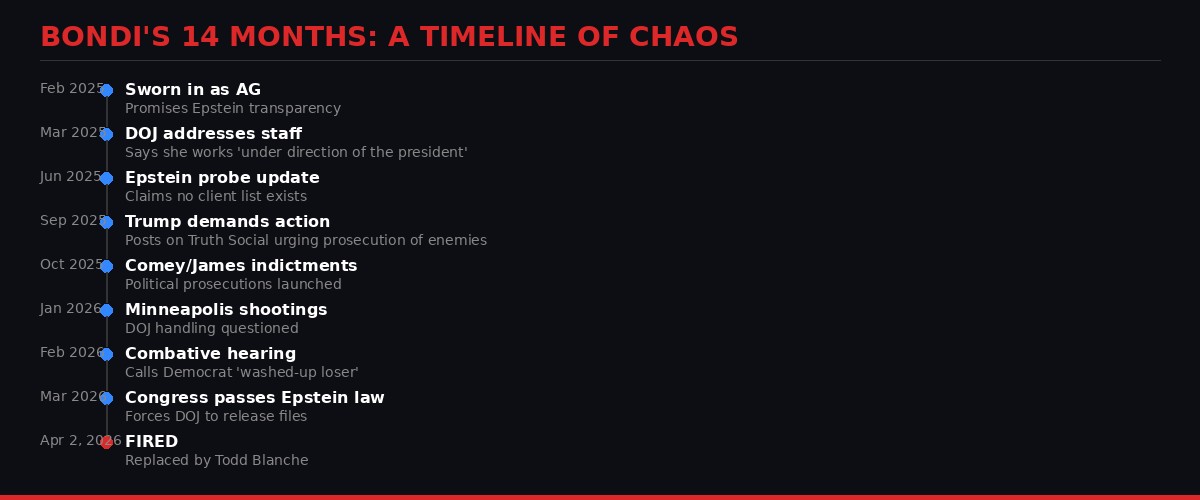
The announcement came via Truth Social on Thursday evening, April 2, with Trump praising Bondi's service while simultaneously confirming she was done. He said she would be "transitioning to a much needed and important new job in the private sector" - a job he declined to name. There was no Rose Garden farewell. No joint press conference. Just a social media post and a career ended.
Bondi responded hours later, calling her time as attorney general "the honor of a lifetime" and "easily the most consequential first year of the Department of Justice in American history." She said she would work "tirelessly" to transfer her duties to Blanche and would "continue fighting for President Trump and this administration" in her new role.
For anyone paying attention, the writing was on the wall. Trump had grown visibly frustrated with Bondi on two fronts: her handling of the Jeffrey Epstein investigation, which became a bipartisan lightning rod, and her failure to successfully prosecute the political enemies he publicly demanded she go after. In September 2025, Trump posted directly at Bondi on Truth Social: "We can't delay any longer, it's killing our reputation and credibility."
Seven months later, she's out. The speed of the collapse - from "doing a good job" on Thursday morning to fired by Thursday evening - captures the whiplash pace of governance in the second Trump term.
The Epstein Files: Promises Made, Promises Broken

When Pam Bondi was sworn in as the 86th Attorney General of the United States in February 2025, she made one promise louder than all others: transparency on Jeffrey Epstein. Standing in the Great Hall of the Department of Justice, she told assembled prosecutors and staff that the so-called Epstein client files were "on my desk" and that the American people would get answers.
It was a promise that defined - and ultimately destroyed - her tenure.
The claim that client files sat on her desk turned out to be, at best, premature. At worst, fabricated. Months later, Bondi reversed course entirely, announcing alongside FBI Director that their investigation had concluded and "no client list" existed. The reversal was devastating. Trump supporters who had championed Epstein transparency as a core MAGA cause felt betrayed. Democrats, who had long pushed for accountability, saw confirmation of what they suspected: that the DOJ was protecting powerful people.
The bipartisan backlash was extraordinary. Republican Congressman Thomas Massie of Kentucky became one of Bondi's most vocal critics, publicly questioning why a department with subpoena power couldn't deliver what journalists and advocacy groups had been assembling from public records. South Carolina's Nancy Mace accused Bondi of having "stonewalled every effort to hold the guilty accountable" and "seriously undermined" President Trump himself.
The pressure eventually forced Congress to act. A bipartisan bill - co-authored by Massie and California Democrat Ro Khanna - compelled the Department of Justice to release all unclassified Epstein-related records. The law passed with overwhelming support. Millions of pages of documents eventually came out, but the rollout was chaotic. Lawmakers from both parties accused the DOJ of failing to redact identifying information about survivors while simultaneously protecting the identities of those who were not victims - a stunning inversion of basic prosecutorial ethics.
Epstein survivors told the BBC that Bondi had never met with them, never responded to their emails, and that the matter had become a "political liability" for Trump rather than a pursuit of justice. Bondi called Epstein a "monster" and said she was sorry for what survivors endured, but words without action only deepened the sense of institutional betrayal.
Former acting assistant attorney general Mary McCord, now at Georgetown Law, told PBS NewsHour that the Epstein debacle was likely Bondi's defining legacy. "Way back early, she really promised that the client files were on her desk," McCord said. "That had to have just been made up, because it was only months later that she said, we don't have anything here."
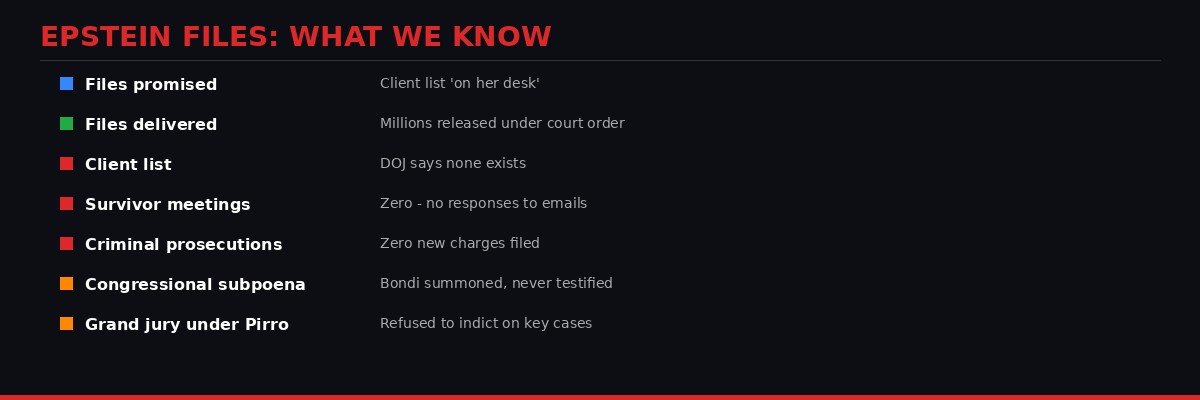
Most damning of all: a congressional committee had formally subpoenaed Bondi to testify about her handling of the Epstein investigation. She was expected to appear this month. Now she'll never have to. The question of whether her replacement, Todd Blanche, will honor that subpoena or find a way to sidestep it will define the opening days of his leadership.
The Political Prosecution Machine That Stalled

The Epstein files were Bondi's public wound. The failed political prosecutions were what bled her out behind closed doors.
Trump made no secret of wanting his Department of Justice to go after his political opponents. Adam Schiff, Letitia James, James Comey - these were names the president wanted indicted, prosecuted, and convicted. He said so publicly, repeatedly, in posts and press conferences. In September 2025, he addressed Bondi directly on Truth Social, demanding faster action against his adversaries.
Bondi tried. Under her direction, the DOJ launched multiple investigations and pursued indictments against several of Trump's targets. The U.S. Attorney for the District of Columbia, Jeanine Pirro, became the tip of the spear. But the courts refused to cooperate.
A Washington, D.C. grand jury rejected efforts to indict members of Congress who had issued a public statement reminding military personnel that they owe their oath to the Constitution, not to individual commanders, and that they are not required to obey unlawful orders. The statement was factually true. The grand jury refused to treat truth as a crime.
In the cases against Letitia James and James Comey, courts dismissed the charges on procedural grounds - specifically, that special counsel Lindsey Halligan had been unlawfully appointed to her office. But the dismissals came with a sting: judges noted powerful motions alleging vindictive and selective prosecution, and suggested that Halligan may have obtained her indictments by telling grand jurors things she was not supposed to say.
McCord laid it out plainly to PBS: "A different person doesn't change whether there is a lack of evidence. And some of the suggested prosecutions are just really straining to find something to prosecute."
The failed prosecutions put Bondi in an impossible position. The evidence wasn't there. The courts were pushing back. Grand juries were refusing to cooperate. But Trump didn't want explanations. He wanted results. When the machinery of justice wouldn't bend to political will, the operator of that machinery became expendable.
This tension - between a president who views the DOJ as a personal enforcement arm and a legal system that still, despite enormous pressure, maintains some institutional resistance - is the core crisis of American governance in 2026. Bondi's firing doesn't resolve it. It intensifies it.
Todd Blanche: The Defense Lawyer Who Now Runs Prosecution

Todd Blanche's promotion to acting attorney general is remarkable even by the standards of the Trump era. Blanche was, until recently, Donald Trump's personal criminal defense attorney. He represented the president during the New York hush money trial that ended in May 2024 with a conviction on 34 counts of fraud - a verdict Trump is still appealing.
The journey from defending a client against fraud charges to running the entire federal law enforcement apparatus of the United States would be considered a serious conflict of interest in any previous administration. In this one, it barely registers as news.
Blanche was confirmed as deputy attorney general after Bondi brought him into the DOJ. His most notable action in that role was conducting a high-profile interview with Ghislaine Maxwell, the convicted sex trafficker and Epstein associate. The interview was supposed to represent progress on the Epstein investigation. It didn't.
McCord told PBS that Blanche "really made a mess of things" with the Maxwell interview, noting that the questioning didn't track with standard prosecutorial technique for interviewing someone complicit in crimes. "He was a prosecutor. He does know better," she said. The implication was clear: the interview was theater, not investigation.
Blanche has positioned himself as a steady hand who will maintain continuity. "Pam Bondi led this Department with strength and conviction and I'm grateful for her leadership and friendship," he wrote on X. "We will continue backing the blue, enforcing the law, and doing everything in our power to keep America safe."
The real question is whether Blanche will be more willing than Bondi to pursue the political prosecutions Trump demands. As Trump's former personal lawyer, his loyalty is not in question. But loyalty and legal viability are different things. The same evidentiary problems that stalled Bondi's efforts will confront Blanche. Grand juries don't change their standards because the attorney general changes.
California Democrat Ro Khanna told BBC Newsnight that the Senate should refuse to confirm any permanent replacement unless they commit to "investigating and prosecuting this Epstein class, this group of men who felt that they could write their own rules." Whether Senate Republicans have any appetite for such conditions is doubtful, but the Epstein issue has proven to be one of the few truly bipartisan pressure points in American politics.
Punchbowl News senior congressional reporter Andrew Desiderio warned that the firing could backfire on Trump precisely because any confirmation hearing for a new AG will revive the Epstein conversation. "This will be another opportunity for senators to question whoever the nominee is in a confirmation hearing about that very issue, which is something that we know gets under the president's skin," he told PBS.
A DOJ Independence Crisis That Predates Bondi

The collapse of DOJ independence didn't start with Pam Bondi. It started the day she was confirmed and chose to stand in the Great Hall and tell career prosecutors that she was "so pleased to be working under the direction of the president of the United States."
That line, delivered with apparent pride, violated a norm that has existed since Watergate. The entire post-Nixon architecture of Department of Justice independence rests on a simple principle: the attorney general serves the law, not the president. The AG runs the department. The president appoints but does not direct. The separation exists to ensure that Americans can trust that prosecutorial decisions are based on evidence, not politics.
Bondi shattered that norm publicly, proudly, on her first day. And the consequences cascaded from there.
Career prosecutors - the men and women who investigate drug trafficking, white-collar crime, organized crime, terrorism, and civil rights violations - watched their boss publicly subordinate herself to the White House. The message was unmistakable: political loyalty matters more than legal independence. For prosecutors handling cases that might embarrass or implicate presidential allies, the chilling effect was immediate.
The 23,000 criminal cases dropped or deprioritized during Bondi's tenure to redirect resources toward immigration enforcement (as BLACKWIRE previously reported) represented the operational consequence of that philosophical shift. Drug cases, fraud investigations, public corruption probes - all fell down the priority list as the DOJ reoriented around the president's political agenda.
Former federal prosecutors have described the atmosphere inside Main Justice as one of demoralization and fear. Career staff who spent decades building cases watched them collapse as political appointees redirected resources. Some resigned. Others stayed and kept their heads down. A few pushed back through internal channels and were reassigned.
The question now is whether Todd Blanche will restore any semblance of independence or whether he will complete the transformation of the DOJ into what critics call a political enforcement arm. Given his background as Trump's personal attorney, the answer seems clear. But institutions have a way of absorbing even the most determined political actors. Grand juries still follow evidence. Federal judges still cite precedent. Career prosecutors still know the difference between a legitimate case and a political hit job.
The machinery of justice is battered but not broken. Whether it survives the next AG will depend less on who occupies the fifth floor of Main Justice than on the thousands of prosecutors, agents, and judges who refuse to let the system become something it was never designed to be.
The Broader Purge: Bondi, Noem, and the Disposable Cabinet

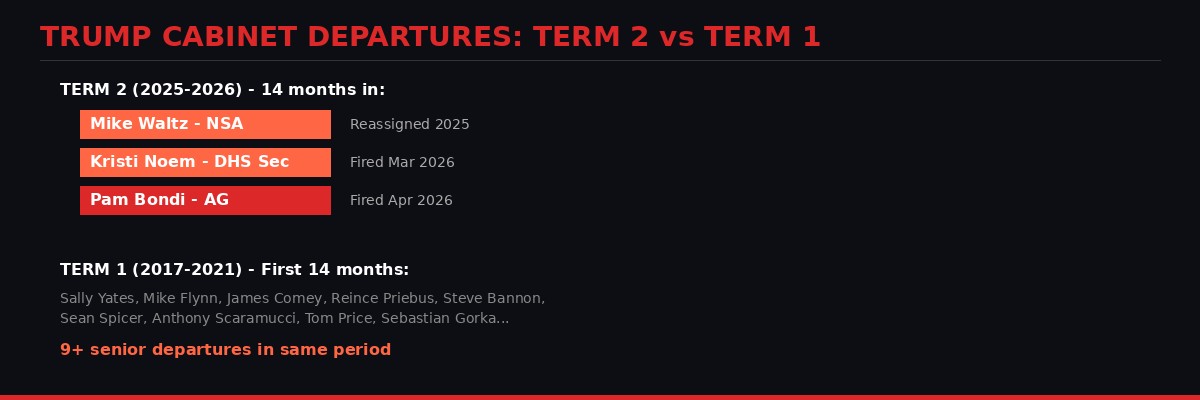
Bondi is the third high-profile cabinet departure in Trump's second term. National Security Adviser Mike Waltz was reassigned in 2025, with his duties handed to Secretary of State Marco Rubio. DHS Secretary Kristi Noem was fired in March 2026. Now Bondi is out.
The pace is accelerating. And it's happening against a backdrop of simultaneous crises that would test even the most stable administration.
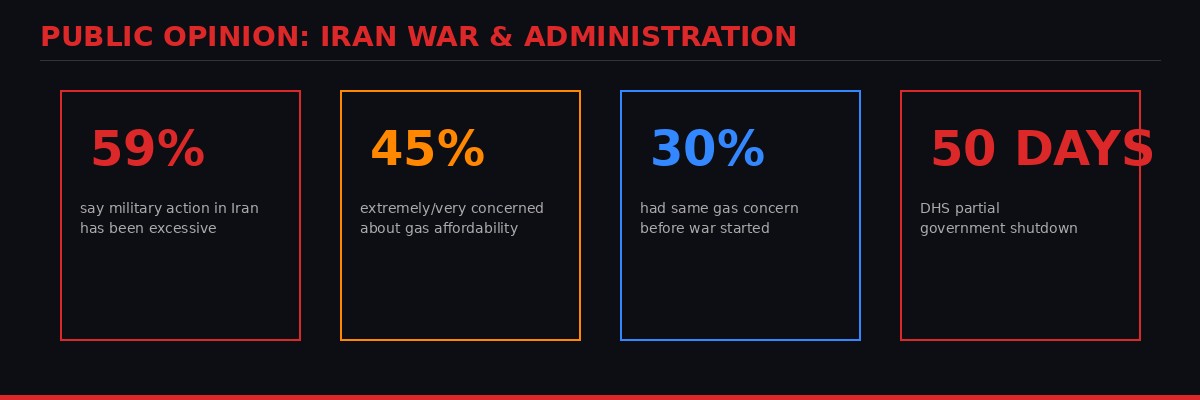
The Department of Homeland Security has been in a partial shutdown for nearly 50 days. Congress can't agree on how to fund ICE and CBP. Senate Majority Leader Thune and House Speaker Johnson keep passing funding bills back and forth like a legislative game of hot potato. A deal announced Thursday would fund most of DHS but punt the most contentious elements - ICE and CBP funding - to a reconciliation process that won't conclude until June at the earliest.
Meanwhile, the Iran war grinds into its second month with no clear exit strategy. Trump addressed the nation on Wednesday evening, asking Americans to show patience while promising military objectives would be completed "shortly." The speech offered no specifics on negotiations, no timeline for reopening the Strait of Hormuz, and no plan for bringing troops home. An AP-NORC poll found that 59% of Americans believe military action in Iran has been excessive.
Oil prices have surged past $110 per barrel. Asian markets fell during Trump's address. The EU has warned that oil and gas prices won't return to normal even if the war ends. At the White House Easter lunch, Trump himself acknowledged the domestic pressure: "People in the country sort of say, 'Just win. You're winning so big. Just win. Come home.'"
Into this environment, Trump chose to fire his attorney general. The timing has led to immediate speculation about distraction. McCord noted that Trump "had a bad day in the Supreme Court yesterday with the birthright citizenship argument" and suggested the Bondi firing might be an attempt to shift the news cycle. If so, it's a distraction that creates its own problems - the Epstein conversation is now back at the top of every news broadcast.
Adding to the sense of institutional upheaval, Defense Secretary Pete Hegseth asked Army Chief of Staff General Randy George to step down on the same day as Bondi's firing. George, a career military officer nominated by Biden in 2023, was forced into immediate retirement. He is the latest in more than a dozen senior military officers Hegseth has fired since taking office - a purge that is happening while the United States is actively at war.
The Pentagon's chief spokesperson, Sean Parnell, said they were "grateful for General George's decades of service." The Pentagon also notably referred to itself as the "Department of War" in the official statement - a name change Hegseth has championed that critics see as both cosmetic and ideological.
What Comes Next: Confirmation Fights, Epstein Pressure, and a Weaponized DOJ

Blanche will serve as acting attorney general until Trump names a permanent replacement. The Senate doesn't return from recess until April 13, which means at minimum two weeks where the nation's top law enforcement agency is run by a former defense attorney with no confirmation vote.
Names already circulating as potential nominees include EPA Administrator Lee Zeldin and Jeanine Pirro, the U.S. Attorney for the District of Columbia who oversaw several of the failed political prosecutions. Desiderio of Punchbowl News said that unless Trump nominates someone "really out there like Matt Gaetz," Senate Republicans will likely fall in line.
But the confirmation hearing will be a gauntlet. Senators from both parties have made clear that the Epstein investigation will be the central question for any nominee. Massie has already said he hopes "the next AG will release all the Epstein files according to the law and follow up with investigations, prosecutions, and arrests." Khanna has gone further, saying the Senate should refuse to confirm anyone who won't commit to investigating "this Epstein class."
The political dynamics are treacherous. For Republican senators, supporting a nominee who promises Epstein accountability means risking exposure of people who may be politically connected to the party. Blocking such a nominee means explaining to voters why they opposed transparency on a case involving the sexual exploitation of minors. There is no comfortable position.
For Democrats, the Epstein issue offers rare leverage in a Senate they don't control. The bipartisan nature of the demand - Massie and Khanna working together, Mace and Democrats aligned in their criticism of Bondi - creates a coalition that transcends normal partisan lines. Any nominee who tries to downplay or sidestep Epstein will face fire from both sides of the aisle.
The deeper question is whether any attorney general can serve Trump's desire for political prosecutions without running into the same walls Bondi hit. The evidence problems don't change with new leadership. Grand juries still require probable cause. Federal judges still evaluate motions for vindictive prosecution. The career staff at DOJ still know the difference between a case and a political errand.
McCord captured the fundamental tension: "A different person doesn't change whether there is a lack of evidence."
But a different person might be more willing to push the boundaries, to pressure grand juries, to forum-shop for sympathetic judges, to reassign career prosecutors who resist. Blanche, with his background as Trump's personal lawyer, has less institutional attachment to DOJ norms than even Bondi did. And whoever Trump eventually nominates for the permanent role will be chosen specifically for their willingness to deliver what Bondi couldn't.
The Department of Justice has survived worse. It survived Watergate. It survived the Saturday Night Massacre. It survived the politicization of the U.S. Attorney firings in 2006. But each crisis left scars, and the institution that emerges from this era will not be the same one that entered it.
Bondi's firing is not the end of the story. It's the end of a chapter. The next one begins when the Senate returns and the confirmation fight exposes, once again, the tension between a president who wants a loyal enforcer and a legal system that still - barely, imperfectly, under enormous strain - insists on something closer to justice.
The files are still out there. The survivors are still waiting. And the names that Bondi couldn't - or wouldn't - pursue are still free.
Sources: BBC News, PBS NewsHour, AP, Punchbowl News, CBS News, Truth Social
Get BLACKWIRE reports first.
Breaking news, investigations, and analysis - straight to your phone.
Join @blackwirenews on Telegram