"A Whole Civilization Will Die Tonight": Trump's 8 PM Ultimatum, the UN Veto, and the Infrastructure Campaign That Is Already Rewriting the Laws of War
The US president has given Iran until 8 PM Washington time to reopen the Strait of Hormuz or face the systematic destruction of every bridge and power plant in the country. Russia and China blocked a UN Security Council resolution hours ago. The deadline expires in hours. Day 39 of the war.

Infrastructure under fire. The US-Israeli campaign has verified strikes on bridges, steel plants, pharmaceutical labs, and university buildings. (Unsplash)
The message appeared on Donald Trump's Truth Social account on Tuesday morning: "A WHOLE CIVILIZATION WILL DIE TONIGHT, NEVER TO BE BROUGHT BACK AGAIN."
It was not a tweet from a fringe account. It was not satire. It was the sitting president of the United States announcing, on his personal social media platform, that he intended to destroy the civilization of a nation of 85 million people unless that nation agreed to his terms before 8 PM Eastern time.
The terms: free passage of oil through the Strait of Hormuz. The deadline: tonight. The threat: every bridge, every power plant, every piece of infrastructure across the entire country. He used the phrase "Stone Age" to describe where he planned to send them.
By Tuesday afternoon, Russia and China had vetoed a UN Security Council resolution that "strongly encouraged" defensive efforts to reopen the strait. Eleven of fifteen council members voted in favor. Two abstained. Two vetoed. The resolution - already watered down from Chapter VII authorization of military force to a mild encouragement of defensive coordination - died on the floor of the chamber where the post-World War Two international order was built.
This is where the world stands at the close of Day 39 of the US-Iran war. A deadline expires in hours. The UN has no mechanism left to intervene. Iran has not signaled any willingness to meet the terms. And the infrastructure of a country is being verified, target by target, as already partially demolished.
The Ultimatum: What Trump Actually Said
The final hours before a deadline that has been extended three times. The fourth extension - if it comes - will define Trump's credibility on the war. (Unsplash)
The sequence of statements from the White House on Tuesday is worth documenting precisely, because language is evidence.
Trump's Truth Social post stated: "A whole civilization will die tonight, never to be brought back again." He then added, in the same post, that he hoped this would not happen, but that it "probably will." The qualifier did not soften what preceded it. It simply acknowledged that he was contemplating an outcome he described as the death of a civilization while simultaneously suggesting it was the likely outcome.
He also said, separately, that if Iran did not make a deal "acceptable to me" before his deadline, US forces would target every bridge and power plant in Iran. He gave a four-hour window after 8 PM for the destruction to be completed. At a Monday press conference - hours before the Tuesday morning Truth Social post - Trump said the rebuilding cost would be "a century" if he followed through. He acknowledged this. He said it directly. Then he threatened to do it anyway. (Source: BBC News, April 7, 2026)
Brian Finucane, a former legal adviser at the US State Department, called the "whole civilization" statement "plausibly interpretable as a threat of genocide." He is not a polemicist. He spent years advising the US government on the precise definitions of these terms. His assessment carries the weight of that expertise. The US State Department's response, when asked directly whether the president's post constituted a genocide threat: "That is not what the president said. Go read his statement again." (Source: BBC Verify, April 7, 2026)
United Nations Secretary-General Antonio Guterres responded through his spokesperson, Stephane Dujarric, who said Guterres was "deeply troubled" by recent threats against civilian populations. He did not name Trump directly. He used passive construction throughout. He said there is "no military objective that justifies the wholesale destruction of a society's infrastructure" and that war can end "when leaders choose dialogue over destruction." The Secretary-General was not at the Security Council meeting. He was not in a position to enforce anything. His words landed in the same void as every prior statement about proportionality, international law, and civilian protection in this conflict. (Source: BBC, UN spokesperson statement, April 7, 2026)
"Do I want to destroy their infrastructure? No. Right now, if we leave today, it will take them 20 years to rebuild their country. If I do what I've threatened, it will take them a century." - Donald Trump, Monday press conference, April 6, 2026
The BBC's security correspondent Frank Gardner noted that Trump's "end-of-civilisation" rhetoric is "even more shocking" than his prior threats because it invites direct comparison with the Taliban's destruction of the Buddhas of Bamiyan and ISIS's demolition of Palmyra. Gardner asked whether Trump planned to go down in history as the man who bombed Persepolis - a UNESCO World Heritage Site - or the Friday Mosque at Isfahan, another UNESCO listing. Even Vladimir Putin, Gardner wrote, "in his savage war on Ukraine, has spared the golden domes of Kyiv's cathedrals." (Source: BBC, Gardner analysis, April 7, 2026)
The UN Security Council: The Veto That Buried the Last Option
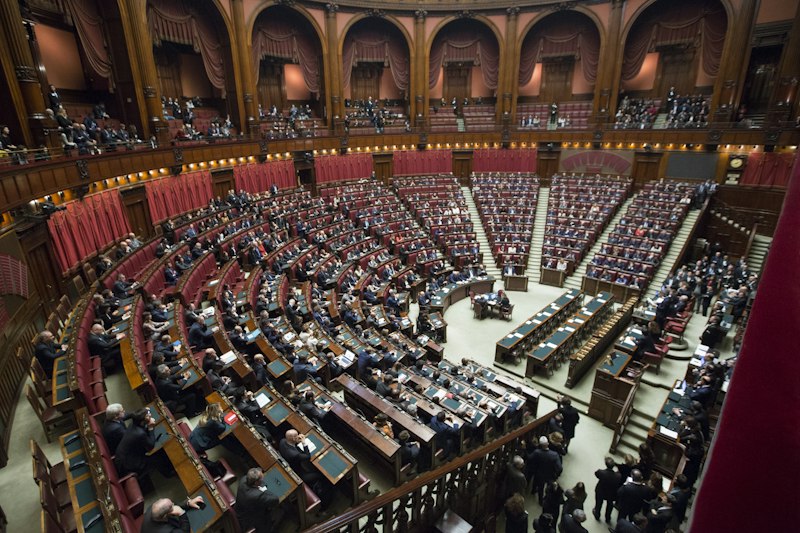
The UN Security Council chamber. Tuesday's Hormuz vote ended in Russian and Chinese veto. Eleven voted in favor, two abstained, two vetoed. (Unsplash)
The UN Security Council met on Tuesday to vote on a resolution concerning the Strait of Hormuz. Bahrain held the Council presidency and chaired the meeting. Its foreign minister, Dr. Abdullatif bin Rashid Al Zayani, delivered a blunt assessment before the vote: failure to respond would have "grave consequences for the world" and could establish a precedent that other nations could weaponize other strategic waterways in future conflicts, "transforming the world into a jungle." (Source: BBC, UN coverage, April 7, 2026)
The resolution's trajectory tells the story of international law under pressure. It began as a Chapter VII resolution - the UN's highest-authority category, which authorizes member states to use military force. That was too strong for the veto powers. It was reduced to language authorizing "all defensive means necessary." Still too strong. It was reduced again to language that "strongly encouraged" defensive, coordinated efforts to ensure navigational safety through Hormuz. That version went to a vote.
Eleven of fifteen council members voted yes. Pakistan and Colombia abstained. Russia and China vetoed.
Russia's veto is consistent with its interests: international sanctions on Russian oil have been relaxed as a direct consequence of the Hormuz closure, as Iran's blockade has pushed oil prices above $100 per barrel and created pressure to find alternative supply. Russia benefits from high oil prices. Russia benefits from reduced pressure on its own crude exports. Russia benefits from a world order where the United States is fighting a war in the Middle East rather than focused on Ukraine. (Source: BBC analysis, April 7, 2026)
China's veto requires a different explanation. China is among the countries that has, according to BBC reporting, been able to keep using the Strait of Hormuz since the closure - presumably through arrangements with Iran that have not been publicly disclosed. China imports approximately 40 percent of its oil through Hormuz under normal conditions. The decision to veto a resolution that would have opened the strait to more shipping is not obviously in China's energy interests. What it is clearly in: China's interest in demonstrating that the US-led international order cannot mobilize the Security Council against Chinese opposition. Every veto is also a statement about who holds power in the multilateral system. (Source: BBC Verify, Kpler data, April 7, 2026)
After the vote, Iran's Foreign Ministry spokesperson Esmaeil Baqaei posted on X: "The power of a 'civilized' nation's culture, logic, and faith in its righteous cause will undoubtedly prevail over the logic of brute force." He used the hashtag "IranWillWin." This is the language of a government that watched the Security Council fail to authorize any enforcement mechanism against it, twenty-four hours before a deadline set by the most powerful military in human history. Whatever it signals about Iranian confidence, it signals something about the gap between rhetoric and operational reality on both sides. (Source: Iranian Foreign Ministry, X, April 7, 2026)
What the Bombs Have Already Hit: A Verified Record

Bridges, steel plants, pharmaceutical manufacturers, universities, hospitals. BBC Verify has confirmed strikes on each category. (Unsplash)
Trump's threat to destroy all bridges and power plants in Iran by midnight requires context: verified strikes have already targeted civilian infrastructure at scale. BBC Verify, working from confirmed video footage, satellite imagery, and on-the-ground reporting, has documented the following over the preceding two weeks alone. (Source: BBC Verify investigation, published April 7, 2026)
Bridges: The B1 bridge in Karaj was struck twice in confirmed footage. Video shows a large gap in the bridge after the attack, with construction cranes visible on either side. The IDF announced on Tuesday that it had bombed ten "key" parts of the Iranian railway network. A verified video from Aminabad village in central Iran showed a collapsed railway bridge. A video posted by the Iranian Red Crescent showed paramedics carrying an injured man away from a railway line near Karaj. The IDF, writing in Farsi before the strikes, warned Iranian civilians against travelling near trains and railway lines because their "presence on trains and near railway lines endangers your life." (Source: BBC Verify, IDF statement, April 7, 2026)
Steel: The Isfahan Mobarakeh Steel Company - Iran's largest steel manufacturer - was struck on March 27. Verified footage showed smoke billowing from the complex. Workers were forced to suspend operations. Satellite images also confirmed damage at the Khuzestan Steel Company, Iran's second largest. Local officials said repairs could take up to a year. Israeli Prime Minister Benjamin Netanyahu claimed the combined strikes had disrupted up to 70 percent of Iran's steel manufacturing capacity. Arman Mahmoudian, a research fellow at the University of South Florida's Global and National Security Institute, assessed that if 70 percent of Iran's steel production capacity is indeed destroyed, "nearly 20 million tons of output" would be at risk, affecting "around 3-3.5 percent of Iran's GDP." (Source: BBC Verify, Mahmoudian interview, April 7, 2026)
Pharmaceuticals: On March 31, the IDF struck Tofigh Daru Research and Engineering Company in Tehran. The company produces active pharmaceutical ingredients for anticancer drugs, cardiovascular medications, immunomodulatory agents, and narcotics. The IDF claimed the company had transferred "chemical substances, including fentanyl, for research and development of chemical weapons." The BBC stated it "cannot independently verify that claim." Iranian domestic pharmaceutical production supplies over 90 percent of the country's medicines - a figure that, if accurate, means these strikes are degrading the medical supply chain for tens of millions of civilians with no connection to any weapons program. (Source: BBC Verify, IDF statement, March 31, 2026)
Universities: Shahid Beheshti University in Tehran sustained significant damage in strikes on Saturday. Images showed debris around the exterior with parts of the building destroyed. Sharif University of Technology in Tehran was also damaged on Monday. These are not weapons facilities. They are universities. (Source: BBC Verify, April 7, 2026)
Religious sites: In Zanjan, a strike leveled parts of the Husseinya Mosque. Local officials said two people were killed. The strike also destroyed a clinic and a library within the mosque complex. (Source: BBC Verify, Tasnim, April 7, 2026)
The independent conflict monitoring organization ACLED assessed that "civilian harm has largely remained clustered around US-Israeli strikes on military, security, and state-linked sites, rather than indiscriminate bombardment across urban neighborhoods." It also found that 40 dual-use sites had been hit since February 28. The legal question around dual-use sites is not resolved: a facility that produces both civilian goods and materials with potential military application may or may not be a lawful target depending on proportionality assessments that are rarely conducted transparently. (Source: ACLED, April 2026)
TIMELINE - APRIL 7, 2026 - DEADLINE DAY
The Hormuz Numbers: A War That Has Not Achieved Its Stated Objective
Commercial shipping through Hormuz has collapsed from roughly 100 vessels per day to a fraction of normal traffic. The pre-war average was 100 ships daily. (Unsplash)
The primary stated objective of the US-Israel campaign against Iran has been the reopening of the Strait of Hormuz to commercial shipping. Thirty-nine days into the war, that objective has not been achieved.
Maritime intelligence firm Kpler confirmed to BBC Verify that at least 45 commercial ships crossed the Strait of Hormuz between Friday and Tuesday. Since the war began on February 28, a total of 324 vessels have transited the strait. The pre-war average was approximately 100 vessels per day. At 39 days, that pre-war average would have produced roughly 3,900 transits. The actual figure is 324 - roughly 8 percent of normal traffic. (Source: Kpler via BBC Verify, April 7, 2026)
The highest single day of traffic since the war began was February 28 itself - 31 vessels - before Iran completed its blockade posture. Since then, traffic has been a fraction of normal. Separate analysis from maritime intelligence company Windward indicates that ships which do transit are using the southern side of the strait, closer to Oman's coastline, presumably to maximize distance from Iranian territorial waters. Several vessels on this route have been Omani-flagged - possibly operating under arrangements with Tehran that other shipping companies cannot access.
The commercial impact extends far beyond shipping ledgers. Australia has reported hundreds of petrol stations running out of fuel. Senegal has banned ministers from foreign travel as the oil price shock hits government budgets. In the UAE, Easter religious services were cancelled. A Bangladeshi farmworker was killed by shrapnel from an intercepted missile. In Bahrain, highway traffic was diverted multiple times due to debris from intercepted projectiles. In Kuwait, a drone strike caused a fire at the international airport that burned for hours. (Source: BBC, Al Jazeera, April 2026)
Oil prices have remained above $100 per barrel throughout the conflict. The economic pressure this creates is distributed unevenly: it hits import-dependent developing nations hardest while benefiting oil exporters, including Russia. The same conflict that the US is conducting in the name of protecting the international order is generating structural benefits for the country most invested in undermining that order. This is not an accident of war. It is a consequence that should have been modeled before the first strike landed on February 28.
The Rescue Operation: What It Actually Demonstrated

The rescue of the downed airman required 155 aircraft and Navy SEALs operating deep inside Iranian territory. Two planes were destroyed to keep them from enemy hands. (Unsplash)
The weekend's rescue operation received extensive celebration from the Trump administration. Trump said at Monday's press conference: "We won." He marveled at US military precision. Defense Secretary Pete Hegseth praised the operation's complexity. Multiple officials described it as a demonstration of American military dominance.
The facts of the operation are worth examining separately from the framing.
An F-15E Strike Eagle was shot down over south-western Iran on Friday - the first US aircraft shot down in this conflict. Both crew members ejected. The pilot was recovered the same day. The weapons operator became separated in a "sparsely populated, rugged region" and remained stranded for approximately 36 hours inside Iranian territory.
Iran offered a 50,000 pound bounty for anyone who found the airman alive. Videos appeared on social media, unverified by BBC, appearing to show armed civilians searching mountain terrain. Iran's IRGC claimed to have shot down a US drone over Isfahan during the search. Iranian state media said troops were actively hunting the missing airman and closing in on his position. (Source: BBC News, rescue reconstruction, April 6, 2026)
The recovery operation involved 155 aircraft: four bombers, 64 fighters, 48 refueling tankers, 13 rescue aircraft, and additional support planes. The CIA traced the airman's location and ran a deception campaign, spreading false information inside Iran about where US forces had found him. Navy SEALs were airdropped into a remote area of central Iran. Strikes were launched to keep Iranian forces away from the extraction zone. The airman himself, reportedly seriously wounded and bleeding, scaled cliffs to high ground to transmit his beacon signal and communicated Iranian troop positions from his hiding place to assist with targeting.
Two US transport aircraft became bogged in soil at the improvised airfield used for the extraction and could not take off. Both were destroyed by US forces to prevent capture - standard military procedure, but also evidence of how close the operation came to becoming a catastrophic failure with US troops and equipment in Iranian hands. Iran's military claimed two C-130 transport planes and two Black Hawk helicopters were destroyed. US officials denied the aircraft came under attack. Both accounts agree on one fact: two planes were abandoned and destroyed on Iranian soil during the rescue. (Source: CBS News, BBC Verify, April 6-7, 2026)
BBC North America correspondent Anthony Zurcher put the operational narrative in context: the rescue was "to avoid what Defense Secretary Pete Hegseth acknowledged was a 'potential tragedy.'" The "triumph" being celebrated was the prevention of a disaster that should not have been possible in the first place. US aircraft are being shot down over Iran. That is not the operational picture of a concluded military victory. That is the operational picture of an active, contested air war thirty-nine days in.
Trump acknowledged this directly, perhaps unintentionally, when he said: "We can bomb the hell out of them. We can knock them for a loop. But to close the Strait, all you need is one terrorist." (Source: BBC, Trump Monday press conference)
Istanbul: The Consulate Attack and the War's Expanding Geography
Istanbul's Israeli consulate building was attacked by gunmen on Tuesday. No Israeli diplomats were present - the consulate has been empty since Turkey-Israel relations deteriorated. (Unsplash)
On Tuesday afternoon, a gunman attacked the Israeli consulate building in Istanbul's Besiktas business district. Turkish Interior Minister Mustafa Ciftci confirmed one attacker was killed in a shootout with police. Two attackers were injured and taken into custody. Two police officers were wounded - one shot in the leg, one in the ear. (Source: BBC, Turkish Interior Ministry statement, April 7, 2026)
The consulate building was empty. No Israeli diplomats have been stationed in Turkey for the past two and a half years, amid the prolonged deterioration of Turkey-Israel relations since the Gaza war. The building, located in one of Istanbul's main commercial districts, was nonetheless the target - its symbolic value apparently sufficient in the absence of any operational value.
Turkish President Recep Tayyip Erdogan called the attack "a heinous act of terror." The interior ministry named the killed attacker as Yunus E.S. and described the group as "connected to the terrorist organisation that exploits religion" - language understood to refer to the Islamic State. No group claimed responsibility as of Tuesday evening. The two injured attackers, identified as brothers named Onur C. and Enes C., were in custody undergoing interrogation. Investigators said the three had traveled to Istanbul from the city of Izmit by rental car. (Source: BBC, Turkish Interior Ministry, April 7, 2026)
The Istanbul attack illustrates the diffuse nature of escalation during major regional conflicts. Wars create conditions in which actors who were previously dormant, contained, or focused elsewhere re-emerge. Islamic State's operational capacity in Turkey and the broader region has not been eliminated. The US-Iran war has drawn security attention and military resources away from counterterrorism missions. The attack on an empty consulate by gunmen who came from a nearby city by rental car is not the opening of a second front. It is a reminder that the secondary and tertiary effects of a major war are not confined to the primary theater.
The Fourth Deadline - And What Credibility Requires

Trump has extended his Hormuz deadline three times in the past three weeks. A fourth extension, if it comes, fundamentally changes the negotiating dynamic. (Unsplash)
This is the fourth deadline Trump has set for Iran in the past three weeks. Three previous deadlines passed without the promised consequences being fully delivered. Anthony Zurcher's assessment at the BBC is precise: "If there is no agreement, Trump could extend his deadline - for the fourth time in the past three weeks. But backing away after such detailed threats, punctuated with expletives and dire warnings, could undercut his credibility as the war grinds on." (Source: BBC, Zurcher analysis, April 7, 2026)
This is the paradox at the center of coercive diplomacy under Trump: the more specific and vivid the threat, the more costly it becomes to not follow through, but the more catastrophic the consequences if the threat is executed. "A whole civilization will die tonight" is not a statement that can be walked back to a partial strike on dual-use infrastructure without some loss of the psychological leverage it was designed to create. The credibility of the next threat depends on whether this one lands.
Iran's response has been to reject what US officials described as "maximalist" demands from Tehran - implying Iran has issued its own terms rather than simply accepting or refusing Washington's. Iran has rejected temporary ceasefire proposals. Its foreign ministry is posting triumphalist hashtags. This is not the behavior of a government preparing to capitulate before an 8 PM deadline. It is the behavior of a government that has watched three previous deadlines pass and is calculating the probability that the fourth will too.
Trump said on Monday: "We have an active, willing participant on the other side. They would like to be able to make a deal. I can't say any more than that." This is opaque in a way that could mean genuine back-channel progress. It could also be a face-saving formulation that allows for a fourth extension if tonight passes without either a deal or the promised strikes. The two possibilities are not distinguishable from the outside, which is precisely how the administration wants it. (Source: BBC, Trump Monday press conference)
The Legal Architecture Under Siege

Over 100 US international law experts have signed an open letter calling the US-Israeli campaign a potential violation of international humanitarian law and possibly the UN Charter. (Unsplash)
On April 3, more than 100 US-based international law experts published an open letter on Just Security, a legal analysis platform hosted at New York University School of Law. The letter declared that the US-Israeli campaign "was a clear violation of the United Nations Charter" and that US forces' conduct "raises serious concerns about violations of international human rights law and international humanitarian law, including potential war crimes." Signatories included Oona Hathaway and Harold Koh of Yale Law School, Philip Alston of NYU, and former Human Rights Watch director Kenneth Roth. (Source: Just Security, April 3, 2026)
The letter identifies four categories of legal violation. First: the war itself was initiated without UN Security Council authorization and without Iran having attacked the United States or Israel - the legal threshold for self-defense under the UN Charter. Second: the conduct of hostilities, documented strikes on schools, hospitals, pharmaceutical facilities, and religious buildings that do not constitute military objectives under the laws of armed conflict. Third: threatening rhetoric from senior officials, including Defense Secretary Pete Hegseth's declaration of "no quarter" - a phrase that constitutes a war crime under the Rome Statute and is taught as such in US military academies. Fourth: the systematic dismantling of civilian harm mitigation structures within the Pentagon under what Hegseth has called a "gloves off" doctrine.
The UN's human rights chief Volker Turk stated on Tuesday that "deliberately attacking civilians and civilian infrastructure is a war crime" and warned those responsible would face accountability. Sir Geoffrey Nice, a former prosecutor at The Hague who led the trial of Slobodan Milosevic, told the BBC that attacks on power plants and water facilities would likely be "disproportionate under international law." He said that interfering with "the basic means of life" - including by destroying the infrastructure that produces electricity, clean water, and medicine - risks "causing completely disproportionate damage, ultimately including by starvation and disease." (Source: BBC, Nice interview, April 7, 2026)
Trump dismissed these concerns directly. Asked at Monday's press conference whether threats to strike energy facilities could amount to war crimes, he said he was "not worried about it." He then said: "You know the war crime? The war crime is allowing..." and did not complete the sentence in a way that engages with the legal definition of what he was being asked about.
The problem with this is not philosophical. It is institutional. The United States helped write the Geneva Conventions. It helped establish the International Criminal Court's predecessor tribunals. Its military academies have trained generations of officers in the principle of distinction - the fundamental rule that belligerents must distinguish between combatants and civilians, between military objectives and civilian infrastructure. When the Secretary of Defense publicly mocks civilian protection standards as "stupid rules" and the President of the United States threatens the destruction of an entire civilization's infrastructure, those institutions are not merely criticized. They are being actively dismantled from within.
The War's Broader Toll: What Is Known as of Day 39

The humanitarian toll in Iran, Lebanon, and neighboring countries continues to compound with each passing week. WHO has documented over 20 verified attacks on healthcare facilities in Iran alone. (Unsplash)
The cumulative cost of thirty-nine days of war, as documented from verified sources:
US military casualties: 13 service members killed in combat, 2 in noncombat causes, over 200 wounded. One F-15E shot down over south-western Iran. Two transport aircraft and two Black Hawk helicopters destroyed on Iranian soil during the rescue operation. The USS Gerald R. Ford aircraft carrier departed Croatia after repairs following an onboard fire. (Source: Department of Defense statements, BBC)
Iranian infrastructure: Verified strikes on bridges including the B1 bridge in Karaj, 10 railway segments, two steel plants representing up to 70 percent of national production capacity, pharmaceutical manufacturers including Tofigh Daru, universities including Beheshti and Sharif University of Technology, a mosque complex in Zanjan, and a vaccine research laboratory at the Pasteur Institute. WHO has verified over 20 attacks on healthcare facilities in Iran since February 28. (Source: BBC Verify, WHO, Iranian Red Crescent)
Lebanese healthcare: 53 medical workers killed, 87 ambulances or medical centers destroyed, five hospitals closed, double-tap strikes documented against first responders. Over one million people displaced, straining Beirut's medical system. (Source: Lebanon Ministry of Public Health, WHO)
Regional spillover: Petrol shortages in Australia. Fuel price shock hitting government budgets across Africa and South Asia. Cancelled flights across Gulf hubs. A fire at Kuwait's international airport from a drone strike. Sirens and highway diversions in Bahrain from intercepted missiles. A civilian killed by shrapnel in the UAE. Shipping through Hormuz at 8 percent of pre-war volume. Global oil prices above $100 per barrel for 39 consecutive days. (Source: BBC, Al Jazeera, Kpler, Reuters, April 2026)
HMS Dragon, the UK's sole warship in the Eastern Mediterranean, docked Tuesday for a routine logistics stop and minor maintenance to its water system. The Ministry of Defence confirmed it would remain at "high readiness" and can "sail at short notice." It is one warship. The Eastern Mediterranean is a large body of water.
What 8 PM Means - And What Comes After
At 8 PM Eastern Daylight Time on Tuesday, April 7, 2026 - approximately 2 AM Wednesday morning in Iran, and midnight UTC - Donald Trump's deadline for Iran to announce a deal reopening the Strait of Hormuz will expire.
If Iran announces a deal before that time, the war's dynamics shift immediately toward the complex and contested process of verifying compliance, negotiating terms, rebuilding destroyed infrastructure, and managing the domestic political fallout in both countries. That process will not be clean. Iran's "maximalist" negotiating posture suggests any deal will be contested at the margins. But the killing stops, at least in the primary theater.
If Trump extends the deadline for the fourth time, the war continues at its current tempo - infrastructure strikes, air operations, Iranian mine-laying and drone harassment of shipping, the ongoing humanitarian crisis in both Iran and Lebanon. The credibility of US threats takes a hit that adversaries in other theaters - China, North Korea, Russia - will note and price into their own calculations. The world learns something about how seriously to take American ultimatums.
If Trump follows through - if US forces begin systematic destruction of Iran's bridges and power plants at approximately midnight UTC - the war enters a phase that has no recent precedent in the American record. The destruction of civilian infrastructure across an entire country, compressed into four hours, would represent the largest single escalation since the conflict began. The humanitarian consequences would be immediate: hospitals losing power, water treatment plants offline, heating systems failing. In April in Tehran, the average overnight temperature is around 10 degrees Celsius. Not cold enough to kill on the first night. Cold enough to begin a cascade.
Trump said on Monday that he hoped it would not come to that. He also said it "probably will." He is either negotiating through maximalist threats he has no intention of executing - the fourth time this month - or he is describing what he plans to do in a few hours' time, and the phrase "a whole civilization will die tonight" is not rhetoric but a schedule.
The UN Security Council has no mechanism left to intervene. The legal architecture built after 1945 to prevent exactly this has been vetoed into irrelevance on the specific question it was asked to address. The military professionals who might have counseled restraint are being removed from command. The deadline expires tonight.
"There is no military objective that justifies the wholesale destruction of a society's infrastructure or the deliberate infliction of suffering on civilian populations. The choice to end this conflict through dialogue still exists." - UN Secretary-General Antonio Guterres, spokesperson statement, April 7, 2026
It exists. Whether anyone with the power to make that choice is prepared to take it - tonight, before 8 PM - is the only question that matters right now. The war has been going for thirty-nine days. The bombs have already found bridges, steel plants, vaccine laboratories, universities, and mosques. The word "civilization" has been invoked by both sides in the same twenty-four hours. One side used it as a threat. The other used it as a shield.
Both claims land on the same clock, which is running down.
SOURCES: BBC News live blog (April 7, 2026); BBC Verify infrastructure strikes investigation; BBC analysis by Frank Gardner, Anthony Zurcher, Tom Bateman; UN Secretary-General spokesperson statement; Iranian Foreign Ministry statement; Turkish Interior Ministry statement; Kpler maritime intelligence via BBC Verify; Windward maritime analysis; ACLED conflict monitoring; Just Security international law scholars open letter (April 3, 2026); Airwars civilian casualty tracking; WHO Surveillance System for Attacks on Health Care; IDF statements via X; CBS News rescue reconstruction; New York Times rescue reconstruction.