Trump Blinks: 5-Day Pause on Iran Power Plant Strikes as Tehran Flatly Denies Talks Happened
With hours left on his own ultimatum, Trump claimed "very good and productive" US-Iran talks had taken place - and paused the threatened strikes. Tehran says no such talks occurred. Oil fell 8%. Markets surged. Nothing is resolved.

The Strait of Hormuz - the 21-mile chokepoint through which a fifth of the world's oil normally flows. Iran has effectively closed it to what it calls "aggressors." Credit: Unsplash
Trump announced a 5-day pause on threatened strikes against Iranian power plants, citing "very good and productive conversations" with Iran. Tehran's Foreign Ministry responded by denying any negotiations took place. Iranian state TV framed Trump's move as a retreat "following Iran's firm warning."
The message arrived on Truth Social at 6:41 AM Eastern time on Monday, written in Trump's familiar all-capitals style, and it sent shockwaves from Tehran to Tokyo. After threatening over the weekend to "obliterate" Iran's power plants unless the country reopened the Strait of Hormuz within 48 hours, President Donald Trump reversed course - announcing a five-day pause to allow talks to continue.
There was one problem. Iran said no talks had happened at all.
The episode captures the bizarre, whiplash-inducing nature of the fourth week of a war that has already killed more than 2,000 people, shut the world's most critical oil shipping lane, and triggered the worst energy shock since the 1973 Arab oil embargo. Trump is cycling through strategies - diplomacy, sanctions relief, ultimatums, threats of war crimes - with no clear exit and mounting pressure from markets and midterm politics alike. (AP, March 23)
The five-day reprieve offers something. It averts, for now, strikes that legal scholars had warned could constitute war crimes and that Iran had promised to answer with attacks on desalination plants supplying drinking water to millions across the Gulf. But it resolves nothing. The Strait of Hormuz remains closed. Oil prices remain nearly 40% above pre-war levels. And Iran insists it will not negotiate while under fire.
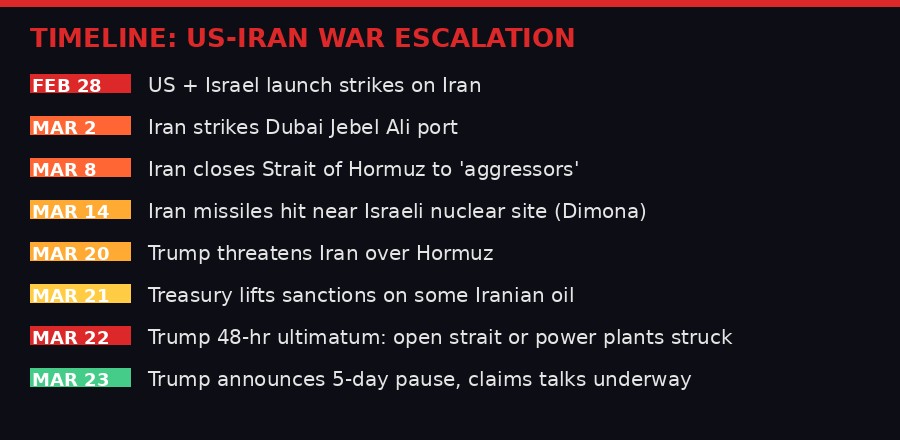
Key events in the US-Iran war's first four weeks, from the February 28 opening strikes to Trump's March 23 pause announcement.
The Ultimatum That Was and Then Wasn't

Global oil tanker traffic through the Persian Gulf has been severely disrupted since early March when Iran imposed its de facto blockade. Credit: Unsplash
Saturday's post was classic Trump escalation. In 51 words - much of it in capitals - he told Iran to reopen the Strait of Hormuz within 48 hours or the United States would strike its power plants, "STARTING WITH THE BIGGEST ONE FIRST." The deadline would have expired late Monday Washington time, around 8 PM Eastern.
The threat went far beyond anything Trump had said previously about the war. His earlier messaging had focused on targeting Iran's military - its air force, navy, missile production facilities. Power plants are civilian infrastructure. They supply hospitals, homes, schools. Cutting them in a desert nation in summer is not a tactical inconvenience - it is a potential catastrophe for millions of civilians.
"It certainly has a feeling of ready, fire, aim... He overestimated his ability to control the events once he unleashed this torrent of violence." - Geoffrey Corn, Texas Tech University law professor and retired Army lieutenant colonel
Geoffrey Corn, a professor at Texas Tech University School of Law and a former Army Judge Advocate General officer, told AP the post "did not have the appearance of a message that underwent the careful legal scrutiny needed to justify an attack on civilian infrastructure." Corn said carrying out such an attack would "probably be a war crime." (AP, March 23)
Iran's UN ambassador fired off a letter to the Security Council warning the targeting of power plants would be "inherently indiscriminate" - itself a war crime under international humanitarian law. Iran's Revolutionary Guard promised to retaliate by striking power plants supplying American military bases and "the economic, industrial and energy infrastructures in which Americans have shares." (AP, March 22-23)
Iranian parliament speaker Mohammad Bagher Qalibaf went further, saying Iran would treat all Gulf infrastructure as legitimate targets - including desalination plants that supply drinking water to cities across Saudi Arabia, the UAE, Kuwait, and Bahrain. The message was clear: attack our lights and we attack your water.
The Reversal: "Very Good and Productive Conversations"

Envoys Steve Witkoff and Jared Kushner reportedly conducted talks Sunday into the evening, though Iran denies anyone from Tehran was on the other end. Credit: Unsplash
Shortly before dawn on Monday in Washington, Trump posted on Truth Social: the United States and Iran had held talks over the previous two days that were "very good and productive," and the discussions could yield a "complete and total resolution" of the conflict. He was pausing the power plant strikes for five days.
Within hours, speaking to reporters on the tarmac at Palm Beach before boarding Air Force One, Trump added color: his Middle East special envoy Steve Witkoff and son-in-law Jared Kushner had conducted the talks on Sunday evening. They would continue by phone on Monday. "They want very much to make a deal," Trump said. "If it goes well, we're going to end up with settling this. Otherwise, we'll just keep bombing our little hearts out." (Reuters, AP, BBC, March 23)
"Things are going very well with Iran." - President Donald Trump, to AFP reporters, March 23, 2026
Iran's response was immediate and categorical. The Foreign Ministry issued a statement: "We deny what US President Donald Trump said regarding negotiations taking place between the United States of America and the Islamic Republic of Iran." It added that Iran "adheres to its position rejecting any type of negotiations before achieving Iran's goals from the war." (CBS News / BBC, March 23)
The IRGC-affiliated Fars and Tasnim news agencies reported separately from unnamed Iranian official sources that there had been "no direct or indirect contact with Trump" and that he had simply "backed down." Iranian state television went live with a straightforward declarative: the American president had retreated "following Iran's firm warning." (BBC Persian Service, March 23)
Trump did not name the Iranian official or officials involved in the purported talks, saying only that the U.S. had not spoken directly to Supreme Leader Ayatollah Mojtaba Khamenei. Turkish Foreign Minister Hakan Fidan confirmed a phone call with his Iranian counterpart Abbas Araghchi on Monday, which could indicate Ankara is again playing intermediary - a role it has played before in US-Iran diplomacy. Egypt's President el-Sissi separately said Egypt had delivered "clear messages" to Iran focused on de-escalation. (AP, March 23)
Why Trump Changed Course - and What the Pressure Really Is

Wall Street surged after Trump's announcement, with the S&P 500 jumping 1.3% - but global markets had already taken heavy losses overnight before the news. Credit: Unsplash
The war's economic consequences are building toward a political crisis for Trump. The Strait of Hormuz carries approximately 21% of the world's petroleum liquids and a third of all global LNG exports. Iran's effective blockade - which it calls a closure to "aggressors" while technically leaving some traffic moving under restricted conditions - has pushed oil prices from roughly $74 per barrel before the war to a peak of nearly $120 last week. (AP, Reuters)
As of Monday, Brent crude sat at $103.23, down 8% on the day after Trump's pause announcement - but still 39% above pre-war levels. The S&P 500 jumped 1.3%, the Dow rose 654 points, European indexes flipped from losses to gains. But Asian markets, which closed before Trump's announcement, had already absorbed the weekend's fear: South Korea's Kospi fell 6.5%, Japan's Nikkei dropped 3.5%, Hong Kong's Hang Seng lost 3.5%. (AP Markets, March 23)
The economic math for Trump is brutal. Gas prices at the pump are rising just as Americans receive their tax refunds - the single most visible economic benefit Trump promised from his tax policy. That sting is being compounded by broader inflation fears tied to the oil shock. Midterm elections are months away. Every additional week the strait stays closed tightens the vice.
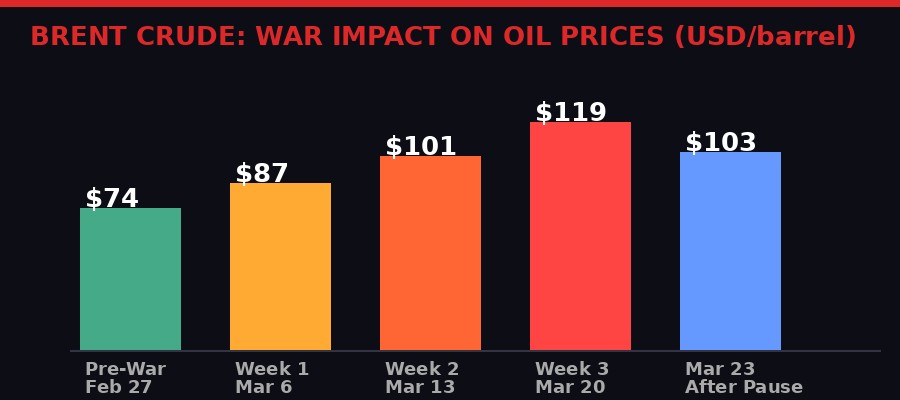
Brent crude prices during the first four weeks of the US-Iran war. The conflict has driven the biggest sustained oil price shock since 1973.
Trump's strategy has visibly fractured under the pressure. AP documented the pattern: he pushed for a new international coalition to escort ships through the strait - allies turned him down. He said the US could manage alone. He suggested other nations would "have to take over." Hours later he indicated the strait would "open itself." On Friday, the Treasury Department lifted sanctions on some Iranian oil for the first time in decades - stripping away leverage in exchange for marginal market relief while handing Tehran hard currency. The ultimatum on Saturday was the latest, most desperate move. (AP, March 23)
"Trump has no plan to reopen the Strait of Hormuz, so he is threatening to attack Iran's civil power plants. This would be a war crime." - Sen. Ed Markey (D-Mass)
Even Republicans are uncomfortable. Sen. Thom Tillis of North Carolina told ABC's "This Week": "You can't all of a sudden walk away after you've kind of created the event and expect other people to pick it up." NATO Secretary-General Mark Rutte tried to smooth things over, saying over 20 countries were "coming together to implement his vision" of making the strait navigable again - without explicitly endorsing the power plant threat. (AP, March 23)
The Strait of Hormuz - and the Water War Nobody Is Talking About

Gulf nations depend on desalination plants for the majority of their freshwater supply. The war has brought strikes dangerously close to critical water infrastructure. Credit: Unsplash
The oil shock gets the headlines. But analysts covering the conflict say the more immediate humanitarian threat may be water.
Hundreds of desalination plants line the Persian Gulf coast, turning saltwater into the freshwater that sustains cities in one of the world's driest regions. In Kuwait, approximately 90% of all drinking water comes from desalination. In Oman, it is roughly 86%. In Saudi Arabia, around 70%. These are not backup systems - they are the only systems. Without them, major Gulf cities cannot sustain their current populations. (AP, March 22)
"Everyone thinks of Saudi Arabia and their neighbors as petrostates. But I call them saltwater kingdoms. They're human-made fossil-fueled water superpowers," Michael Christopher Low, director of the Middle East Center at the University of Utah, told AP. "It's both a monumental achievement of the 20th century and a certain kind of vulnerability." (AP, March 22)
The vulnerability is being tested. On March 2, Iranian strikes on Dubai's Jebel Ali port landed roughly 12 miles from one of the world's largest desalination plants. Satellite data initially suggested a fire near the Fujairah F1 power and water complex in the UAE. Damage was reported at Kuwait's Doha West desalination plant. On Sunday, Bahrain accused Iran of damaging one of its desalination facilities. Iran, in turn, said a US airstrike had damaged a desalination plant on Qeshm Island in the Strait of Hormuz, cutting water supply to 30 villages. (AP, March 22)
Most desalination plants in the Gulf are co-generation facilities - physically integrated with power stations. An attack on electrical grid infrastructure does not just cut power. It cuts water. Trump's power plant ultimatum, had it been executed, could have triggered cascading failures in drinking water supply across multiple nations simultaneously - not just in Iran, but in the Gulf states whose populations are already watching the war with growing alarm.
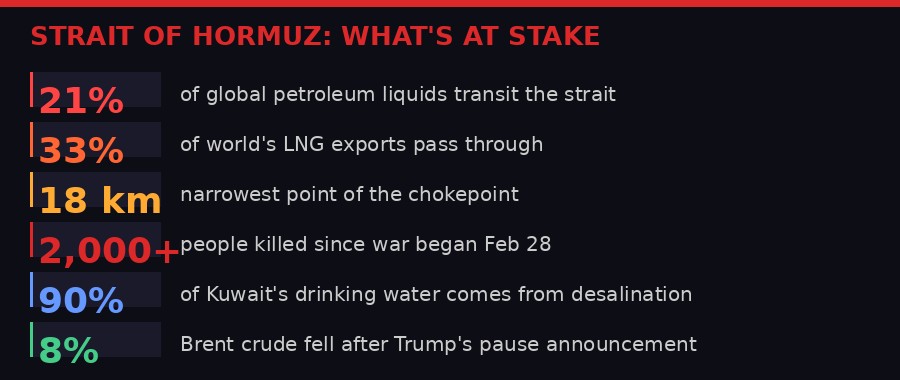
The Strait of Hormuz connects the Persian Gulf to the Gulf of Oman. Its near-closure has sent global energy markets into crisis and now threatens water supply chains across the region.
Iran's War Logic - Why Tehran Won't Back Down

Iran's military doctrine rests on asymmetric deterrence - the ability to impose catastrophic costs on adversaries at relatively low cost to itself. The Strait of Hormuz is its most powerful lever. Credit: Unsplash
Iran's public posture is one of defiant confidence. The IRGC-affiliated Tasnim news agency captured the logic in a statement that has circulated widely: "Since the start of the war, messages have been sent to Tehran by some mediators, but Iran's clear response has been that it will continue its defense until the required level of deterrence is achieved. With this kind of psychological warfare, neither the Strait of Hormuz will return to pre-war conditions nor will calm return to energy markets." (Tasnim, via AP, March 23)
The war began on February 28 when the United States and Israel launched strikes on Iran. Iran's supreme leader - Ayatollah Mojtaba Khamenei, who succeeded his father Ali Khamenei following the latter's death - has not engaged in any direct communications with Washington, according to Trump himself. Iran's position, publicly stated and privately conveyed through intermediaries, is categorical: no negotiations while under attack.
Iran's strategic asset is the strait itself. Controlling that chokepoint - 21 miles wide at its narrowest, through which roughly a fifth of the world's oil normally flows - gives Tehran leverage that its military cannot match against US and Israeli forces. It does not need to win the air war. It needs to make the economic cost of the war unbearable for the United States and its allies. Every week of elevated oil prices does that work for them.
Iran has also demonstrated it can absorb punishment. The war has seen US and Israeli strikes on Iran's air force, navy, missile production facilities, gas fields, and now - after a missile that killed more than 165 children in an elementary school in what the US attributed to degraded targeting intelligence - the kind of collateral damage catastrophe that makes US domestic support for the war politically fragile. (AP)
Iran meanwhile fired missiles targeting Dimona in Israel near the country's primary nuclear weapons research facility. The facility was not damaged, but the symbolism was not lost: Iran was signaling it could reach Israeli nuclear sites. The IRGC also explicitly listed the UAE's nuclear power plant as a legitimate target in its retaliatory threat list. The war is escalating toward nuclear-adjacent infrastructure on multiple sides. (AP, BBC, March 22-23)
What Five Days Actually Means

The five-day window gives diplomacy a narrow opening - but Iran's public position rules out talks while strikes continue, and strikes have continued even as Trump announced the pause. Credit: Unsplash
Five days is a thin window. The deadline clock resets to roughly Saturday March 28 Washington time. In that period, the conditions for any actual deal remain opaque. Trump wants the strait open. Iran says it will not open the strait until it has achieved "the required level of deterrence" - a phrase with no defined threshold. Israel, whose forces are also engaged in Lebanon and which has ground forces potentially involved in operations, has its own war aims that are not necessarily aligned with a quick Trump-Iran settlement. (AP, BBC)
Israel's US ambassador Yechiel Leiter offered a note of caution that reads almost as a warning to Trump: "We want to leave everything in the country intact, so that the people who come after this regime are going to be able to rebuild and reconstitute," he told CNN's "State of the Union." The framing is notable - Israel is already thinking about post-regime Iran, which implies a longer war horizon than Trump's five-day pause contemplates. (AP, March 23)
There is also the question of what Trump actually promised. He said he would hold off on power plant strikes for five days. He said the US has been "holding talks" with a "respected" Iranian leader whose name he declined to provide. He said if a deal is reached, the US would move to take possession of Iran's enriched uranium. None of those terms have been publicly acknowledged by Iran. The International Energy Agency's Fatih Birol put the stakes plainly: "No country will be immune to the effects of this crisis if it continues to go in this direction." (AP, March 23)
In practical terms, the five-day pause does not reopen the Strait of Hormuz. Tanker traffic remains disrupted. Fuel prices remain elevated. The US military - which has been deploying additional amphibious assault ships and Marines to the region - remains in a posture of active hostility. Strikes, including one that hit a building linked to a sanctioned Iranian electronics firm in Tehran on Monday, have continued. The war has not paused. The power plant clock has. (BBC, March 23)
The Broader Picture: A War Without an Exit Plan

The US-Iran war entered its fourth week on March 23. Neither side has defined victory conditions in terms the other could satisfy. Credit: Unsplash
The AP's analysis of Trump's strategy is damning in its precision. Over the course of roughly a week, the administration's posture on the Strait of Hormuz has gone from: seeking a new international coalition to escort ships (rejected by allies) to declaring the US could manage alone to suggesting other countries should take over to hinting the waterway would "open itself" to lifting Iranian oil sanctions to issuing a 48-hour ultimatum to pausing that ultimatum to claim talks are happening while Iran says they are not. (AP, March 23)
Geoffrey Corn, the Texas Tech legal expert, said the power plant ultimatum "has a feeling of ready, fire, aim" - and that it reflects an administration that "overestimated its ability to control the events once he unleashed this torrent of violence." Corn and other legal scholars had warned that a direct attack on Iran's power grid would face an almost impossible legal justification under international humanitarian law, which requires proof that military advantages outweigh civilian harm. (AP)
Meanwhile, the US military is expanding its Middle East presence. Additional amphibious assault ships and Marine units have been deployed. More than 20 NATO and partner nations are reportedly working on plans to eventually escort commercial shipping through the strait, though no timeline exists. The US has not committed ground forces to Iran and Trump has said he does not intend to, but he has also said he retains all options. Israel has suggested its own ground forces could take part at some point. (AP, BBC)
The IEA's Fatih Birol framed the long-term economic risk in terms that go beyond oil prices. The longer the strait stays disrupted, the more the world economy reconfigures around the assumption that Persian Gulf energy is unreliable - accelerating shifts toward alternative supply chains, renewable energy, and strategic reserve drawdowns that may take years to reverse. The cost is not just in petrol prices today. It is in the structural realignment of the global energy economy for a decade. (AP, March 23)
The five-day clock is now running. Trump says talks are going well. Iran says there are no talks. Every government in the Persian Gulf is watching what happens to the desalination plants that keep their cities alive. Global markets are treating the pause as relief - but not resolution. The war is now in its fourth week, with more than 2,000 dead and an oil shock reshaping the global economy. Five days will not fix that. What happens at the end of five days if nothing has changed is a question nobody in Washington or Tehran is publicly answering.
Key Facts
- Trump announced 5-day pause on Iran power plant strikes on March 23, citing productive talks
- Iran's Foreign Ministry denied any negotiations have taken place
- US envoys Steve Witkoff and Jared Kushner reportedly conducted talks Sunday evening
- Brent crude fell 8% to $103.23 after Trump's announcement - still 39% above pre-war levels
- S&P 500 up 1.3%, Dow up 654 points; Asian markets had already fallen 3-6% overnight
- War is in its fourth week; over 2,000 people killed since February 28
- Iran threatened to strike desalination plants supplying water to millions across Gulf nations
- Iranian missiles targeted Dimona, Israel, near nuclear research facility - no damage reported
- Trump's ultimatum called targeting civilian power plants, which legal experts called potential war crime
- Five-day window expires approximately Saturday March 28
Get BLACKWIRE reports first.
Breaking news, investigations, and analysis - straight to your phone.
Join @blackwirenews on Telegram