59% Say the Iran War Has Gone Too Far. Gas Is $3.88. And Trump Just Lost Florida.
A sweeping new national poll shows the American public is turning on the Iran war. Gas prices are at a 2.5-year high. A Democrat just flipped the state legislative seat that includes Trump's Mar-a-Lago estate. The political math is starting to move - and not in the White House's favor.

American drivers paid an average of $3.88 per gallon of regular gasoline on March 26, 2026 - up 30% since the U.S. and Israel launched strikes on Iran on Feb. 28. (Pexels)
Twenty-six days into the Iran war, the bill is coming due at home. The U.S. and Israel entered the conflict on Feb. 28 promising swift degradation of Iran's military and nuclear programs. What arrived instead: $108 oil, near-$4 gas, a fractured diplomatic landscape, and a new poll that reveals the American public is watching the costs climb and reaching a verdict.
According to a survey from the AP-NORC Center for Public Affairs Research conducted March 19-23 among 1,150 U.S. adults, 59% of Americans say U.S. military action in Iran has gone too far. Forty-five percent are "extremely" or "very" concerned about affording gasoline in the coming months - up sharply from 30% just after Trump's November election win. And just 35% approve of how Trump is specifically handling the Iran conflict.
The numbers carry a weight beyond any single survey. They arrive alongside a concrete electoral signal: this week, Democrat Emily Gregory flipped a Florida state legislative district that literally encompasses Donald Trump's Mar-a-Lago estate in Palm Beach. Republicans privately describe the result as a five-alarm warning.
The Poll: A Nation That Wanted Nuclear Containment, Not an Open-Ended War
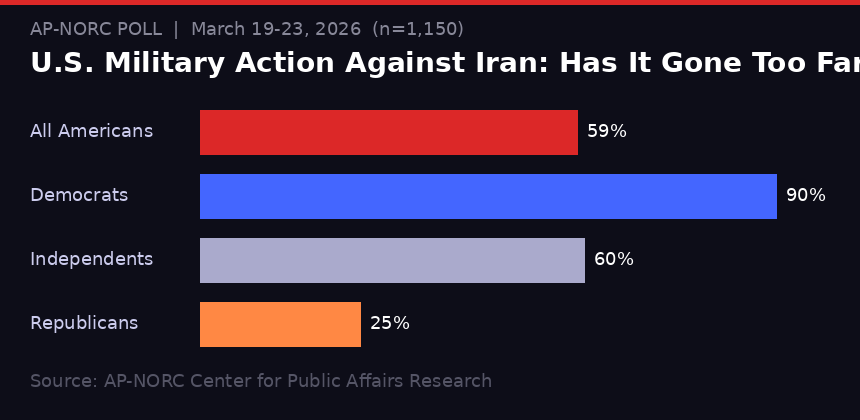
AP-NORC poll breakdown by party affiliation, March 2026. Democrats and independents are overwhelmingly opposed; Republicans are split roughly half and half. (BLACKWIRE / AP-NORC data)
The AP-NORC survey lands as a complex document. Americans are not pacifists on Iran. About two-thirds say preventing Iran from obtaining a nuclear weapon should be an "extremely" or "very" important foreign policy goal. That number actually enjoys bipartisan support - roughly 80% of Republicans and about half of Democrats sign on.
The problem for the White House is the rest of the poll. Americans are equally insistent that preventing U.S. oil and gas prices from rising should be a top priority. And right now, both cannot simultaneously be achieved. The war that was supposed to neutralize Iran's nuclear threat has also sent oil to $108 a barrel and gas past $3.88 a gallon nationally.
"It's pretty hard. I mean, times are tough for everybody right now. I'm getting way less gas and paying way more money." - Amanda Acosta, Louisiana resident, speaking to the Associated Press
The partisan divide within the poll is notable but not reassuring for Republicans. Among Democrats, a near-total 90% say the war has gone too far. Among independents, the figure is roughly 60% - a devastating number for an incumbent administration heading into midterms. Even among Republicans, only about half say the military action has been "about right," while roughly a quarter say it's gone too far and just 2 in 10 want it to go further.
Equally striking: 59% of Americans "somewhat" or "strongly" oppose deploying U.S. ground troops in Iran. That includes 8 in 10 Democrats and close to half of Republicans. The window for escalation - should the conflict require it to achieve its stated objectives - is narrow, and getting narrower as casualties mount and gas prices rise.
Half of U.S. adults also say they have "only a little" trust or "none at all" in Trump when it comes to making the right decisions about the use of military force outside the United States. That number is consistent with polling from February, suggesting the Iran war itself has not moved the needle on this foundational metric of presidential credibility.
$3.88 a Gallon: The Number That Haunts the White House
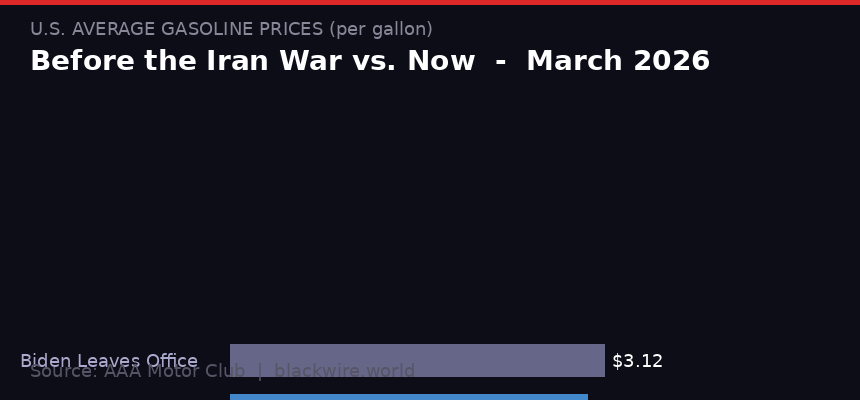
Average U.S. regular gasoline price per gallon, from Biden's final week in office through March 26, 2026. The war launched Feb. 28 drove a 30% spike in under four weeks. (BLACKWIRE / AAA data)
The number that will define the political battle ahead is not approval ratings or poll margins. It is $3.88 per gallon of regular gasoline, as of Wednesday per AAA. That is up from $2.98 before the war began - a 30% jump in less than four weeks.
Diesel has climbed even faster. The national average hit $5.10 a gallon, a 36% surge from $3.76 pre-war - the highest level since 2022. For the trucking industry that moves American commerce, that price spike arrives as an operating crisis. Dan Bradley, a Pennsylvania flatbed truck driver, told the AP simply: "It sucks when you're filling up. What are you going to do, not get gas?"
In California, drivers are paying an average of $5.62 a gallon. California's aging refinery infrastructure relies heavily on imported gasoline from Asia - the region now absorbing Iran's most concentrated energy disruptions. The trickle-down is direct and immediate.
Patrick Penfield, a professor of supply chain practice at Syracuse University, told the AP that $4 per gallon has historically been the inflection point where American consumers start visibly pulling back on spending and behavior.
"That's usually when people start to pull back. They may not drive as much, or they may not go out. They have decisions to make: either you can spend it on going out, or you spend it buying gas for your car." - Patrick Penfield, Syracuse University supply chain professor, to the Associated Press
National average gas stands at $3.88 today. Analysts at GasBuddy and elsewhere are projecting $4 within a week or two, barring a diplomatic breakthrough that reopens the Strait of Hormuz. That breakthrough, as of Thursday, appears further away than it did 72 hours ago.
The macro picture compounds the pump pain. Brent crude was trading at $104-$110 per barrel through the week - up roughly 40-55% from the $70 range where it sat the day before the war began. Patrick De Haan, petroleum analyst at GasBuddy, put a hard number on the aggregate impact: higher fuel prices are now costing the U.S. economy over $500 million more every single day compared to three weeks ago.
The Political Arithmetic: Florida and the Midterm Warning Signals

The Florida special election result - a Democrat flipping a district that includes Mar-a-Lago - has sent private warning signals through GOP ranks ahead of November's midterms. (Pexels)
Trump spent Wednesday evening at the National Republican Congressional Committee's annual fundraising dinner in Washington, telling the room he expects "bigger majorities" in the House and Senate after November's midterms. He acknowledged the historical odds against him - incumbent presidents almost always lose seats - before brushing them aside: "From now until November, we're going to fight."
But the dinner backdrop was not reassuring. The Florida special election result had just landed. Democrat Emily Gregory won the state legislative seat in a district that wraps around Trump's Mar-a-Lago estate in Palm Beach. Republicans privately described it as a significant warning sign. It is not an isolated data point.
Polling consistently shows about 6 in 10 Americans say Trump has "gone too far" on a range of issues - tariffs, presidential power, immigration enforcement, and now the Iran war. That 60% threshold is sticky. The Iran war appears to be landing in the same broad bucket of grievances, rather than standing apart as a national security consensus around the commander-in-chief.
Senator Lisa Murkowski, a moderate Republican from Alaska, put the anxiety plainly after the NRCC dinner:
"There's a lot that people want to know, so whether it's how it's being communicated in the media, or how it's being communicated here in the Congress, I think it's lacking right now." - Sen. Lisa Murkowski (R-AK), speaking to reporters, March 25, 2026
The political math on oil prices is also non-trivial. Gas was $3.12 a gallon when Biden left office - a number Republicans spent years wielding as an economic indictment. Gas was $2.98 the day before the war began. It's $3.88 today. That is a 30% increase that arrived entirely on Trump's watch, in under a month, as a direct consequence of a war his administration launched.
Trump's response has been to pivot. Where he once celebrated low gas prices as a personal achievement, he now argues that high oil prices benefit the U.S. as the world's largest crude producer. "When oil prices go up, we make a lot of money," he told supporters last week. The argument is technically accurate for oil-producing states like Texas and Oklahoma - but it is a difficult message to sell to the 45% of Americans who say they're "extremely" or "very" worried about affording gas in the coming months.
Trump's Mixed Signals and a Strategy Nobody Can Read
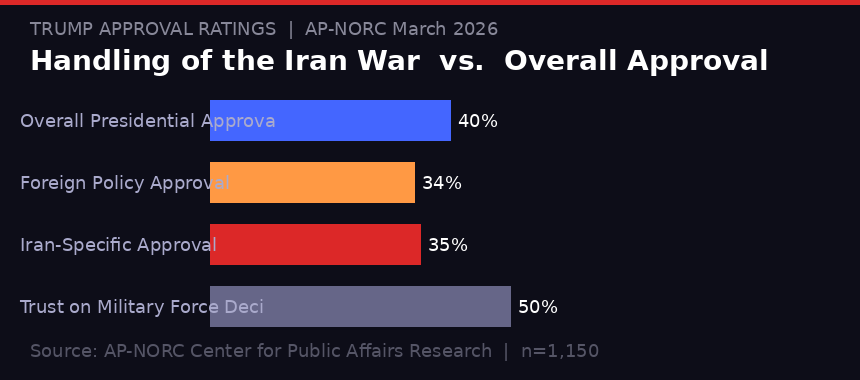
Trump approval metrics from AP-NORC, March 2026. His Iran-specific approval at 35% tracks his overall foreign policy number - both significantly below his overall approval rating. (BLACKWIRE / AP-NORC data)
The White House has sent contradictory signals about the war's direction so often that the contradiction itself has become the story. Over the span of just 24 hours late last week, Trump said the U.S. was "getting very close" to winding down military efforts in the Middle East - and then, 24 hours later, threatened to "hit and obliterate" Iran's power plants unless the country opened the Strait of Hormuz within 48 hours.
Within that same 24-hour window, the administration announced it was sending three more warships and 2,500 additional Marines to the region. The Pentagon simultaneously sought an additional $200 billion from Congress to fund the war - a budget request that, as one AP analysis noted, "does not suggest that the war was being wound down."
The administration also, in a move that confused analysts and markets alike, lifted sanctions on Iranian oil sales for the first time in decades - a relief of the very economic pressure Washington typically uses as leverage - without apparent diplomatic concessions in return.
As of Thursday, U.S. Central Command Admiral Brad Cooper stated publicly that American forces have struck more than 10,000 targets since the war began, destroying 92% of Iran's largest ships and more than two-thirds of the country's missile, drone, and naval production facilities. "We're not done yet," Cooper said in a video message. "We are on a path to completely eliminate Iran's wider military apparatus."
The military progress is real. Iran's conventional capability has been substantially degraded in less than four weeks. But the question the poll is asking is not whether the U.S. military is winning. It is whether the objective - whatever it now is - justifies the cost. On that question, the American public, as of this week, says no.
The Hormuz Toll Booth: Why Peace Talks Are Further Away Than They Look

Iran has formalized a de facto toll-booth regime at the Strait of Hormuz, charging ships in Chinese yuan to pass through the waterway that carries 20% of the world's traded oil and gas. (Pexels)
On Thursday, Iran moved to formalize what shipping intelligence firm Lloyd's List Intelligence had already dubbed a "de facto toll booth" at the Strait of Hormuz. Iranian lawmaker Mohammadreza Rezaei Kouchi, citing sources close to the Revolutionary Guard, said parliament was working to encode fees for ships wishing to pass through the strait.
"We provide its security, and it is natural that ships and oil tankers should pay such fees." - Iranian lawmaker Mohammadreza Rezaei Kouchi, quoted by Fars and Tasnim news agencies, March 26, 2026
Lloyd's List said vessels must now provide manifests, crew details, and their destination to Iran's Revolutionary Guard for sanctions screening, cargo alignment checks, and what it described as "geopolitical vetting." At least two vessels have already paid direct tolls, with payment settled in Chinese yuan - a deliberate sidestepping of the U.S. dollar system.
The Hormuz chokehold is the sharpest pressure point Iran holds. About 20% of all globally traded oil and natural gas transits the strait in peacetime. Iran's ability to tax, delay, or block that flow is its single greatest strategic lever - and any peace deal that does not address it is no peace deal at all.
The U.S.-drafted 15-point ceasefire proposal, transmitted to Tehran through Pakistani intermediaries, explicitly calls for reopening Hormuz. Iran's five-point counteroffer explicitly claims "sovereignty over the Strait of Hormuz." These positions are not starting points for a negotiation. They are incompatible axioms. The gap between them is not a gap negotiators can bridge in Friday talks in Islamabad, if those talks materialize at all.
Iran's Foreign Minister Abbas Araghchi was unambiguous Thursday: "We have not engaged in talks to end the war, and we do not plan on any negotiations." Trump insisted Wednesday night at the fundraiser that Iran "wants to make a deal so badly, but they're afraid to say it." One of these statements is not true. Markets, energy analysts, and military planners are left to decide which one - and to price that uncertainty accordingly.
Who's Running Iran Now - and Why That Complicates Everything

Iran's leadership structure has been fundamentally reorganized since Israel's opening strikes killed Supreme Leader Khamenei and multiple top officials on Feb. 28. Mojtaba Khamenei, now supreme leader, has not appeared publicly since the attacks. (Pexels)
Complicating the diplomatic picture further: the entity the United States and Israel are fighting is not the Iran that existed a month ago. The war's opening strikes, launched Feb. 28, killed Supreme Leader Ayatollah Ali Khamenei and a cascade of senior political and military figures. His son, 56-year-old Mojtaba Khamenei, was quickly named as successor - but has not been seen publicly since the airstrike that reportedly also wounded him and killed his wife.
Israeli Prime Minister Benjamin Netanyahu noted the absence bluntly this week: "I'm not sure who's running Iran right now. Mojtaba, the replacement ayatollah, has not shown his face. Have you seen him? We haven't, and we can't vouch for what exactly is happening there."
"Iran's command and control structure is in utter chaos," Netanyahu added. Whether that assessment is accurate or strategic positioning, the practical effect is the same: there is no confirmed decision-maker on the Iranian side who has both the authority and the security to engage in diplomatic talks. The Revolutionary Guard - analysts' best current estimate of where real power now resides - is the same institution currently running the Hormuz toll booth and firing missiles at Gulf neighbors.
Burcu Ozcelik, a senior research fellow at the Royal United Services Institute, cautioned against expecting rapid change even from a leadership decapitation this severe: "The fixation on the terminology of 'regime collapse' is obscuring the fact that the regime is already changing. But the full impact of the war on the country could take time to emerge. We need to be prepared for change that may take years, not weeks or months."
That timeline - years, not weeks - is not the timeline the American public, staring at $3.88 gas and a Democrat winning in Palm Beach, is prepared to accept.
Timeline: Four Weeks of War, Rising Costs, and Shifting Public Opinion
The $4 Threshold and What Comes Next
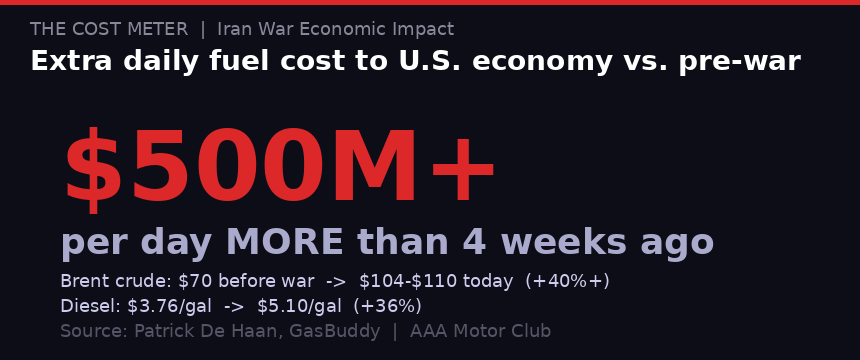
The extra daily cost to the U.S. economy from elevated fuel prices has passed $500 million per day compared to pre-war levels. Analysts warn the figure will climb if Brent crude remains above $100. (BLACKWIRE / GasBuddy)
The analysts watching the gas price tape most closely are not geopolitical strategists or pollsters. They're the petroleum economists who have watched the pump price approach - and potentially breach - the $4 psychological threshold that has historically marked the point at which American consumer behavior shifts.
Patrick Penfield at Syracuse is watching the same data point that every Republican political strategist is watching. Gas at $4 means people drive less. People drive less means restaurants, retail, and entertainment take hits. Those hits ripple into earnings. Earnings guide the Federal Reserve's rate decisions - and the Fed is already frozen, unable to cut into a wartime inflation spike without feeding it further.
The economic feedback loop is straightforward and brutal: war drives oil prices up, oil prices drive gas and diesel up, diesel drives shipping costs up, shipping cost drives the price of everything else up, inflation goes up, the Fed stays stuck, growth slows, consumer confidence falls, and the political cycle turns.
For context: Americans' concern about affording gas jumped from 30% to 45% in less than four months. That is a 50% increase in financial anxiety about a single consumer item, tracked between AP-NORC's post-election poll and this week's survey. If gas crosses $4 and holds there through spring, that anxiety number moves again.
For now, Trump's approval rating has held steady at roughly 40% overall - a number consistent with his second-term honeymoon period and an extraordinary level of partisan loyalty among Republican voters who have absorbed each controversy of his presidency without wavering. But his approval on the Iran war specifically, at 35%, is already trailing his overall number by five percentage points. As the war drags on and the pump price climbs, that gap is liable to widen.
The midterm elections are eight months away. The special election in Palm Beach is a data point, not a prophecy. But at 59% opposition to the current war posture, and gas prices near their highest in two and a half years, the political landscape is shifting in real time. The question the White House cannot yet answer is whether the war's objectives - nuclear containment, Hormuz reopening, regime transformation - are achievable on a timeline short enough to matter before American voters weigh in.
"To make it crystal clear, this war is a catastrophe for world's economies." - German Defense Minister Boris Pistorius, speaking during a visit to Australia, March 26, 2026
Iran is now formally charging ships to transit one of the world's most critical waterways. U.S. paratroopers are inbound to a region where the strategic endgame remains undefined. Gas is $3.88 and climbing. A new supreme leader who hasn't been seen in public since his father was killed is technically in charge of the country the U.S. is fighting. And 59% of Americans say enough.
The war's military ledger may be favorable. Its political ledger is increasingly not.
Get BLACKWIRE reports first.
Breaking news, investigations, and analysis - straight to your phone.
Join @blackwirenews on TelegramSources: AP-NORC Center for Public Affairs Research (poll conducted March 19-23, 2026, n=1,150); Associated Press reporting by Zeke Miller, Christopher Rugaber, Colleen Barry, and AP correspondents in Dubai, Budapest, and Washington; AAA Motor Club daily gasoline price tracker; GasBuddy petroleum analyst Patrick De Haan (X/formerly Twitter); Patrick Penfield, Syracuse University; Lloyd's List Intelligence on Hormuz shipping; Royal United Services Institute analyst Burcu Ozcelik; International Crisis Group Iran project director Ali Vaez. All figures cited as of March 25-26, 2026.