Trump's $5 Million Ambassador: How a Nursing Home Mogul Bought a Budapest Post
Benjamin Landa donated $5 million to a Trump super PAC two months before the president nominated him as ambassador to Hungary. His nursing homes are now suing the Trump administration over $31.2 million in Medicare overpayments - even as New York's attorney general pursues him for financial fraud and resident neglect.
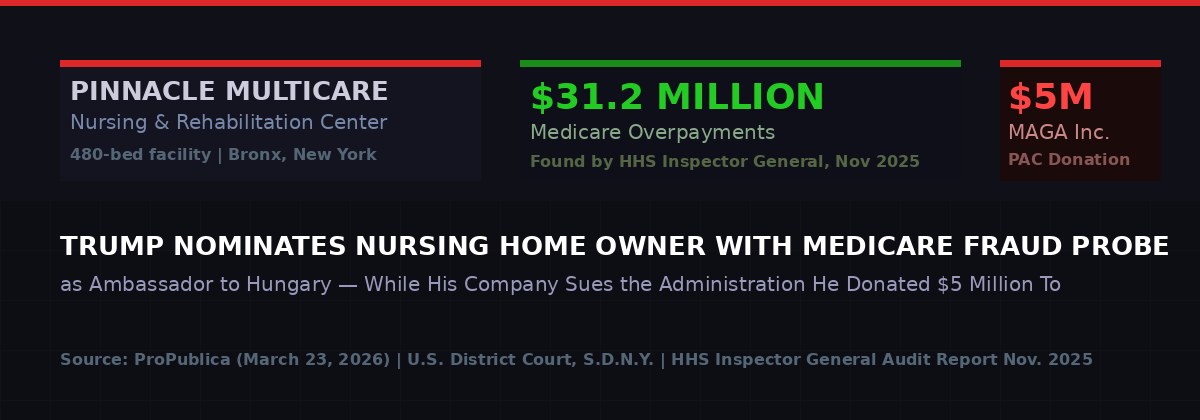
The pattern is almost too brazen to believe. In August 2025, Benjamin Landa - a New Jersey nursing home operator with a net worth estimated at over $300 million and a track record that includes active lawsuits by the New York attorney general - wrote a $5 million check to MAGA Inc., the pro-Trump super PAC.
Two months later, in October 2025, President Donald Trump nominated Landa to serve as Ambassador to Hungary. It is one of the more symbolically charged diplomatic appointments in the current administration, placing a donor in a country whose leader, Prime Minister Viktor Orban, is among Trump's closest ideological allies in Europe.
One month after the nomination, the inspector general of Trump's own Department of Health and Human Services issued an audit finding that Pinnacle Multicare Nursing and Rehabilitation Center - a 480-bed facility in the Bronx that Landa co-owns - received Medicare overpayments of at least $31.2 million and recommended the government recoup the money.
In February 2026, Pinnacle responded by suing the Trump administration itself - naming HHS Secretary Robert F. Kennedy Jr., Centers for Medicare and Medicaid Services Administrator Mehmet Oz, the HHS Inspector General, and a Medicare contractor as defendants. The suit asks a federal court to stop the government's collection efforts.
The same man is simultaneously a Trump donor, a Trump diplomatic nominee, and a defendant in a lawsuit against Trump's own cabinet. A federal judge has already denied Pinnacle's request for a temporary restraining order.
The Audit: 99 of 100 Claims Violated Billing Rules
The November 2025 HHS Inspector General audit is damning in its specificity. It was the agency's first review tied to a new nursing home payment system introduced during Trump's first term, designed to shift reimbursements from volume-based therapy billing toward patient-centered care.
Under the old system, facilities earned more by providing more therapy minutes. Critics had long argued that this created perverse incentives to over-treat patients. The new system was supposed to fix that by paying based on patient condition and need, not billable service hours. Pinnacle's reimbursements jumped markedly under the new system.
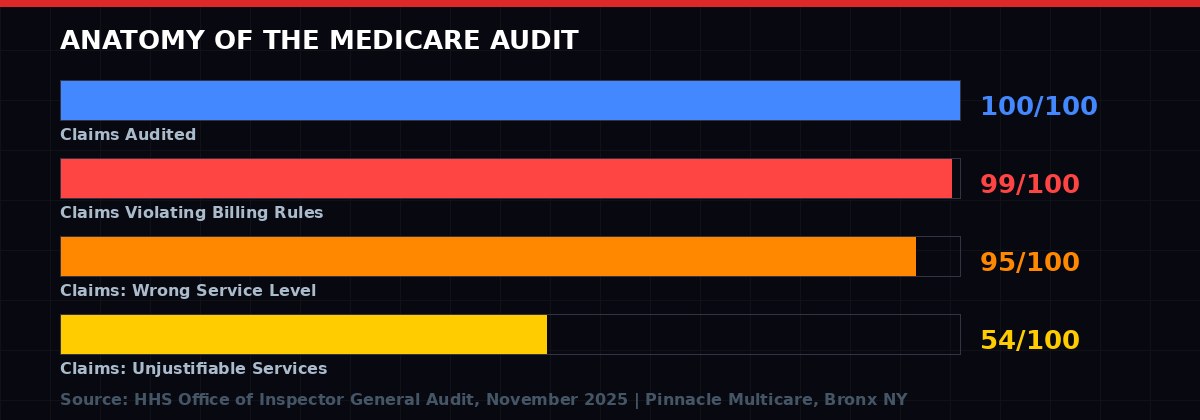
The IG's office audited 100 randomly selected Medicare claims from Pinnacle. What they found was systematic: 99 of those 100 claims violated CMS billing requirements. In 95 cases, Pinnacle had requested reimbursement for service levels higher than what was actually justifiable based on patients' medical charts.
The examples are precise. In one instance, Pinnacle billed Medicare for speech therapy for aphasia treatment - for a patient whose clinical notes explicitly stated that no speech therapy was needed. In 54 of the 99 problematic claims, the facility billed for services that could not be justified at all based on patients' own records. This included billing for "bed mobility and wheelchair training" for patients who were documented as able to walk independently.
The IG estimated the overpayments at a minimum of $31.2 million. The HHS IG's office has declined to comment further, citing pending litigation.
Pinnacle's lawsuit frames the audit as bureaucratic overreach. It argues that auditors "blatantly ignore" emergency waivers for documentation and billing requirements that were issued during the COVID-19 public health emergency. The facility notes it had only two COVID-related deaths at the height of the pandemic - a strong outcome for a 480-bed Bronx facility - and says that its "decisive actions during COVID-19 prioritized patients and saved lives."
The counterclaim from watchdogs is blunt. "That's their constant refrain whenever they don't get what they want," said Kevin Walsh, former New Jersey comptroller who investigated tens of millions of dollars in nursing home fraud during his tenure, speaking to ProPublica. "The risk of closure based on the finances and cost reports that I've seen seems low. They're not going to kill the golden goose they're using to siphon profits."
The Pay-to-Play Architecture: $5 Million and a Budapest Post
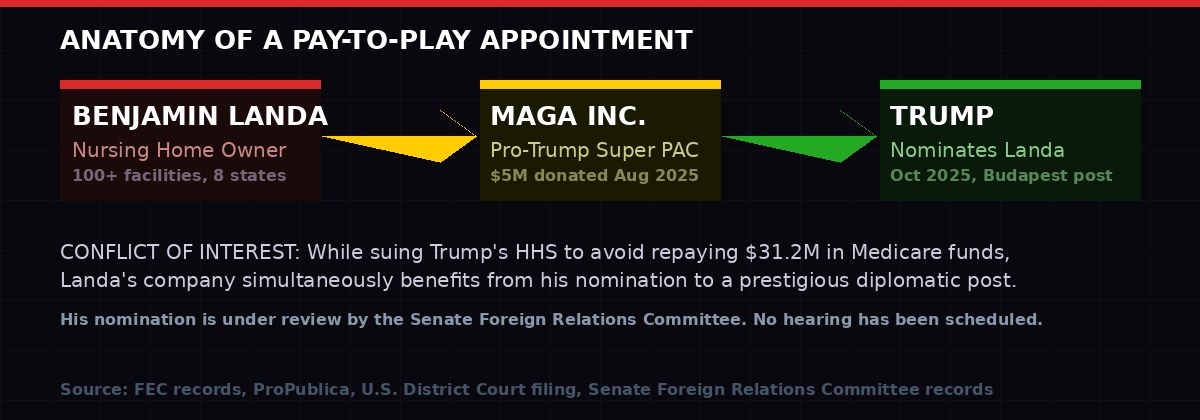
The $5 million donation to MAGA Inc. stands out even in an era of maximalist political giving. According to FEC records reviewed by ProPublica, it was by far the largest single political donation Landa has made. He had donated to Republican causes before, but the August 2025 contribution represented a qualitative shift - a nine-figure PAC investment placed precisely two months before his diplomatic nomination was announced.
Pay-to-play ambassadorships are not new in American politics. They are, in fact, a bipartisan tradition that neither party has seriously tried to end. During the Biden administration, roughly a third of ambassadorial appointments went to political donors. The Trump administration's first term followed similar patterns. What distinguishes the Landa case is the compounding of financial conflicts: the nominee's businesses are not merely in tension with the national interest in abstract terms - they are in active litigation against the administration that nominated him.
The White House and the State Department have not responded to requests for comment on the status of Landa's nomination. His nomination remains under consideration by the Senate Foreign Relations Committee. No hearing has been scheduled as of late March 2026.
Senator Ron Wyden of Oregon, the ranking member of the Senate Finance Committee - which has oversight jurisdiction over Medicare and Medicaid - has been explicit about what he sees in the Landa case.
"Giant corporate health care interests that prey on the vulnerable and use clever tricks to exploit loopholes at taxpayers' expense. It's no surprise that these companies and their owners are cozy with Trump: instead of accountability, they've been rewarded - with plum political appointments and ambassadorships in Europe." - Sen. Ron Wyden (D-OR), Ranking Member, Senate Finance Committee, March 2026
Landa's attorney, Alyssa Friedman, has denied wrongdoing across the board. In a written statement to ProPublica, she characterized the Medicare audit issues as decisions made during the extraordinary circumstances of the COVID-19 pandemic that are now being retroactively reinterpreted. "Pinnacle's efforts to provide exceptional care to its patients were an undeniable success," she wrote. "Let's be clear: this is about decisive actions taken during the height of COVID-19 that prioritized patients and saved lives in one of the pandemic's epicenters."
A Pattern Across the Portfolio: The New York AG Lawsuits
The Medicare audit at Pinnacle did not arrive without context. Benjamin Landa has been the subject of significant legal scrutiny for years, across multiple New York facilities.
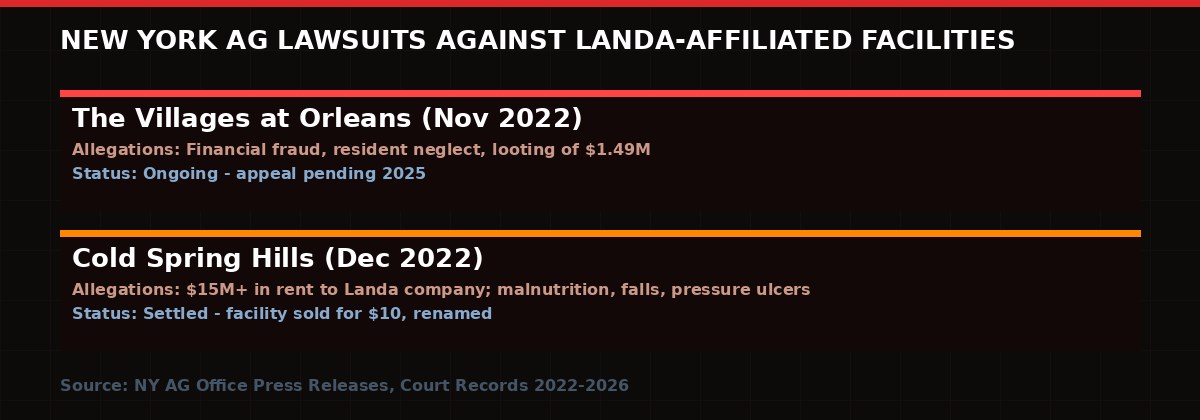
In November 2022, New York Attorney General Letitia James sued The Villages at Orleans Health and Rehabilitation Center and named Landa and others as owners. The suit alleged "years of financial fraud that resulted in significant resident neglect and harm." Between 2015 and 2022, the lawsuit alleged, Landa extracted at least $1.49 million from the facility through means James characterized as "looting" - while "contributing nothing and failing to prevent the abuse and neglect" that occurred on the premises.
The documented harms to residents were not abstract. James described a pattern of potentially preventable deaths due to delayed wound care, suicides, and systemic understaffing tied to relentless cost-cutting. In 2024, a state Supreme Court judge allowed multiple claims in the case to proceed. In 2025, Landa appealed. The case remains unresolved.
One month after the Orleans suit, James filed a second, nearly identical action against Cold Spring Hills Center for Nursing and Rehabilitation on Long Island. The pattern alleged was similar: Landa owned 25% of the facility's property holding company. Over several years, the facility paid over $15 million in rent to that Landa-affiliated company. It paid over $1.4 million to a management company Landa co-owned. It paid almost $500,000 in consulting fees to a Landa-controlled entity.
Meanwhile, residents were documented losing significant weight, developing malnutrition, suffering life-threatening pressure ulcers, and enduring repeated unwitnessed falls - the predictable outcomes of a facility bled dry of resources by entities that extracted money upward while providing minimum care downward.
In March 2024, a Long Island judge ordered four defendants - including Landa - to repay $2 million to the nursing home and appointed an independent health care monitor to run it. Various orders are under appeal. In January 2025, Cold Spring Hills filed for bankruptcy. In March 2025, the facility sold itself for $10 to a third-party receiver and rebranded. "A new chapter in compassionate care has begun," its new website announces.
Landa's attorney has consistently maintained that her client was a landlord, not an operator, at both facilities - that he had no involvement in running the homes and that all financial arrangements were approved by state authorities. She noted that in the Cold Spring Hills case, the judge found no fraud committed by Landa specifically.
Timeline: From Trafficking Verdict to Trump Nomination
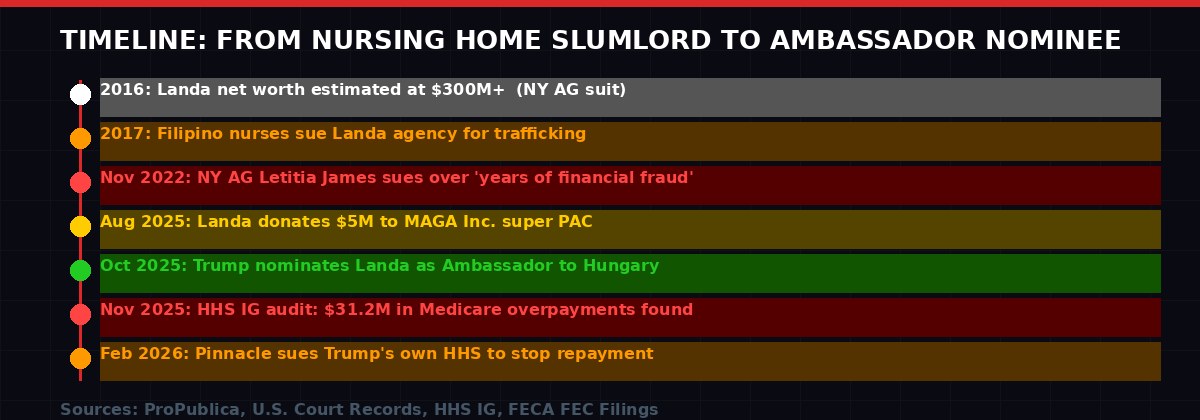
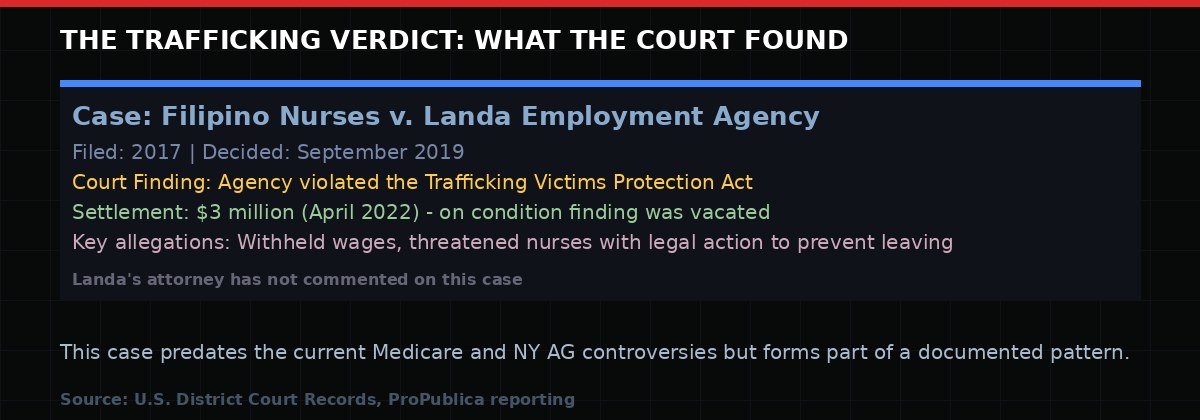
The legal history predates the current wave of litigation. In 2017, an employment agency co-owned by Landa was sued by a class of Filipino nurses alleging trafficking, wage withholding, and threats of legal retaliation to prevent the nurses from leaving their employment.
In September 2019, a federal district court in New York found that the agency had violated the Trafficking Victims Protection Act - a serious federal finding with significant legal weight. In April 2022, the case was settled for $3 million. But the settlement came with a notable condition: the trafficking findings were vacated as part of the deal.
The structure of that settlement is worth examining. The agency paid $3 million to make a federal trafficking violation disappear from the court record. That is a significant sum - but it is also the cost of a clean record, at least formally. The underlying facts of what the court found in 2019 do not disappear with the vacatur of the finding. They remain in the public record of the case.
Landa's attorney did not respond to follow-up questions about that case when contacted by ProPublica.
The accumulation matters. In any single case, a nursing home operator might credibly argue that disputes are normal in a heavily regulated industry, that COVID-19 created impossible documentation environments, that the attorney general has political motivations. The pattern across a decade of cases - including a federal trafficking verdict, two AG suits alleging systematic financial extraction and resident neglect, a $31.2 million Medicare audit, and now a lawsuit against the administration that just nominated him for a prestigious diplomatic post - is harder to dismiss as the work of adversarial bureaucrats.
Why Budapest: The Orban Relationship and Conservative Soft Power
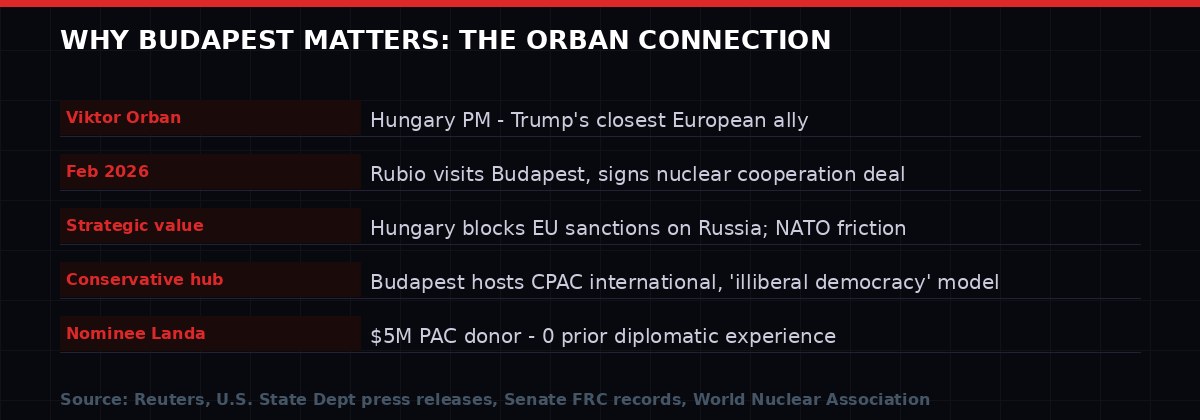
The choice of Hungary as Landa's posting is not incidental. It signals the administration's ideological commitments as clearly as any policy document.
Viktor Orban has been in power in Hungary since 2010. He has systematically dismantled judicial independence, brought public media under government control, passed legislation restricting civil society organizations, and positioned Hungary as a laboratory for "illiberal democracy" - his own term for a system that maintains the electoral form of democracy while eroding its substantive constraints on executive power.
Trump has spoken warmly of Orban for years. He endorsed the Hungarian prime minister for reelection, saying he "does an unbelievable job." The relationship between the two leaders has become a touchstone of the international conservative movement, celebrated at CPAC conferences held in Budapest and amplified by think tanks on both sides of the Atlantic.
In February 2026, Secretary of State Marco Rubio made a visit to Budapest that went largely unreported in American media. Rubio signed an agreement to deepen U.S.-Hungary cooperation on civilian nuclear power development. "We are entering this golden era of relations between our countries," Rubio said at a press conference, "not simply because of the alignment of our people, but because of the relationship that you have with the president of the United States."
Hungary has also been a persistent complication within NATO and the European Union. Orban has repeatedly blocked EU sanctions packages targeting Russia over the Ukraine war. He maintains close economic and political ties with Moscow, earning him criticism from European partners but praise from parts of the American right who see his independence from Brussels as a virtue. Placing a loyal donor in Budapest - rather than a career diplomat - signals which direction the Trump administration wants to lean in managing that relationship.
Landa has no prior diplomatic experience. His qualifications for the Hungary post are, by any professional standard, thin. What he does have is $5 million in documented support for the president who nominated him, a business network that spans more than 100 nursing homes across eight states, and a net worth that the New York attorney general estimated at over $300 million as of 2016.
The Senate Confirmation Battle: A Stalled Calendar
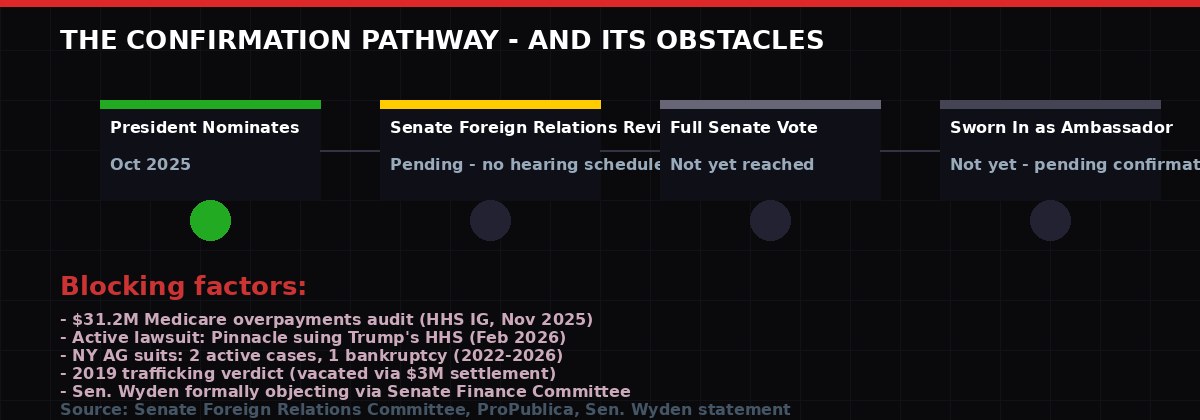
Landa's nomination sits in a kind of bureaucratic limbo. The Senate Foreign Relations Committee, which holds jurisdiction over ambassadorial appointments, has scheduled no hearing. The reasons for the delay are not publicly stated, but the situation his nomination presents is genuinely unusual: a nominee whose company is suing the administration that nominated him, while other facilities in his portfolio fight active state attorney general actions.
Senator Wyden has made clear that the Senate Finance Committee - which has oversight of Medicare and Medicaid - views the Landa nomination as a legitimate subject of scrutiny. The Finance Committee does not have a vote on confirmation, but Wyden's public statements represent an opening salvo in what is likely to be a contentious confirmation process if and when it moves forward.
The Pinnacle lawsuit against HHS is proceeding in federal district court in New York. A judge already denied the facility's request for a temporary restraining order - meaning the government's collection efforts are not currently blocked. But the underlying litigation continues, meaning Landa's company is in active adversarial proceedings against two members of Trump's cabinet: Kennedy at HHS and Oz at CMS, both named defendants.
There is no legal prohibition on confirming an ambassador whose company is simultaneously suing the federal government. But the optics are complicated enough that even a Republican-controlled Senate may find the confirmation calendar difficult to schedule. Doing so would require members to vote for a nominee whose primary business model is, at minimum, under serious federal investigation for defrauding the Medicare program by tens of millions of dollars.
The HHS Inspector General's office issued its audit during a period when Landa's nomination had already been announced. That timing raises a question the audit itself does not address: whether the IG's office was aware of the political sensitivity of the nomination, and whether the audit's release represented routine scheduling or a deliberate signal from watchdogs within the administration. The IG's office has declined to comment.
The Broader Picture: Donors, Diplomats, and Democratic Accountability
The Landa case is not an anomaly. It is an instance of a durable feature of the American political system. The practice of rewarding large political donors with ambassadorships is well-documented, broadly criticized, and persistently unchanged. Career diplomats have spent decades arguing that political appointments weaken American foreign policy by placing unqualified people in positions requiring specialized knowledge and institutional trust. Their arguments have not prevailed.
What the Landa nomination illustrates, however, is a particular intensification of the pattern. The donation-to-nomination timeline is compressed - two months, with a $5 million figure that is one of the largest individual PAC contributions tied to a specific diplomatic appointment in recent history. The legal complications surrounding the nominee's business are not minor or distant: they involve the nominee's company actively suing the departments run by the administration that nominated him, at the same time that the nominee's other facilities face active state attorney general actions alleging years of systematic financial fraud and resident harm.
Senior federal watchdogs within the Trump administration's own bureaucracy found, after reviewing 100 Medicare claims at Pinnacle, that 99 of them violated federal billing requirements. That is a 99% violation rate. It is not a finding that can be easily attributed to bureaucratic overreach or COVID-era ambiguity. It is a systematic finding, based on patient medical records, that a facility co-owned by a presidential ambassador nominee repeatedly billed Medicare for services patients did not need and in some cases explicitly did not receive.
Key Facts at a Glance
- $5 million: Landa's donation to MAGA Inc. super PAC, August 2025 (FEC records)
- October 2025: Trump nominates Landa as Ambassador to Hungary - 2 months after the donation
- $31.2 million: Minimum Medicare overpayments found by HHS IG at Landa's Pinnacle Multicare facility
- 99/100: Percentage of audited Medicare claims at Pinnacle that violated billing rules
- February 2026: Pinnacle sues Trump's HHS, naming Kennedy, Oz, and the IG as defendants
- 2 active NY AG lawsuits: Alleging financial fraud and resident neglect at two other Landa-affiliated homes
- 2019 trafficking verdict: Federal court found Landa employment agency violated TVPA; vacated via $3M settlement
- $300M+ net worth estimated by NY AG in 2016, based on court filings
- 100+ nursing homes across 8 states as of March 2026 (CMS data)
The nomination also arrives at a moment when the administration is simultaneously pursuing an aggressive cost-cutting agenda under the banner of DOGE - cutting federal spending, eliminating agencies, demanding accountability for taxpayer money. The Landa case sits in striking tension with that narrative. A company that allegedly over-billed Medicare by at least $31.2 million is now trying to avoid repaying those funds - while its co-owner is being positioned for a diplomatic post by the same administration nominally dedicated to eliminating waste.
Whether the Senate confirms Landa will test whether Republican senators have an appetite to create a precedent that active litigation against the executive branch is no barrier to securing an ambassadorship purchased with a timely $5 million contribution. The Foreign Relations Committee calendar, for now, remains empty.
Kevin Walsh, the former New Jersey comptroller who has spent years investigating nursing home financial fraud, offered the clearest summary of the threat dynamic Pinnacle invoked in its lawsuit when it warned that repayment demands would "immediately paralyze" the facility and lead to closure of a life-saving institution.
"They're not going to kill the golden goose they're using to siphon profits," he said.
The golden goose in this case appears to be the Medicare program itself. The question now is whether a Senate confirmation process - and the federal courts - will treat it that way.
Get BLACKWIRE reports first.
Breaking news, investigations, and analysis - straight to your phone.
Join @blackwirenews on Telegram