Trump Orders Federal Voter Registry, Seizes Control of Mail Ballots Seven Months Before Midterms

President Donald Trump signed an executive order on Tuesday night directing the creation of a national registry of eligible voters and instructing the United States Postal Service to transmit mail ballots only to individuals verified against that federal list. Within minutes, state officials from Oregon to Arizona pledged lawsuits, calling the order the most aggressive presidential seizure of election authority in modern American history.
The order, which landed just seven months before the November 2026 midterm elections, assigns the Department of Homeland Security - working with the Social Security Administration - to compile citizenship-verified voter rolls for every state. Federal funding could be stripped from jurisdictions that refuse to comply. Mail ballot envelopes would need unique barcodes for tracking. And the Postal Service, an independent agency the president has no legal authority to direct, was told to stop delivering ballots to anyone not on the approved list.
"The cheating on mail-in voting is legendary. It's horrible what's going on," Trump said at the signing ceremony, repeating claims that numerous audits, investigations, and courts have debunked. "I think this will help a lot with elections."
Constitutional scholars disagree. The order appears to violate Article I, Section 4 of the Constitution, which assigns states the power to determine the "Times, Places and Manner" of elections. Congress can alter those regulations. The president cannot.
The Architecture of a Federal Voter List

The executive order instructs DHS to "compile and transmit to the chief election official of each State a list of individuals confirmed to be United States citizens who will be above the age of 18 at the time of an upcoming Federal election and who maintain a residence in the subject State." The practical implication is staggering: for the first time in U.S. history, the federal government would decide who appears on state voter rolls.
The system DHS would use is called SAVE - the Systematic Alien Verification for Entitlements database. Originally designed to verify immigration status for benefits programs, SAVE was never built to handle election-scale verification of 160 million registered voters. NPR has documented cases where U.S. citizens were inaccurately flagged by the system as noncitizens. A DOJ official admitted in court last week that the department already plans to share voter data obtained from states with DHS for SAVE processing.
"Our government's citizenship lists are incomplete and inaccurate. The United States Postal Service is overburdened and inadequate. This combines a car crash with a train wreck."
- Brennan Center for Justice, statement on March 31, 2026
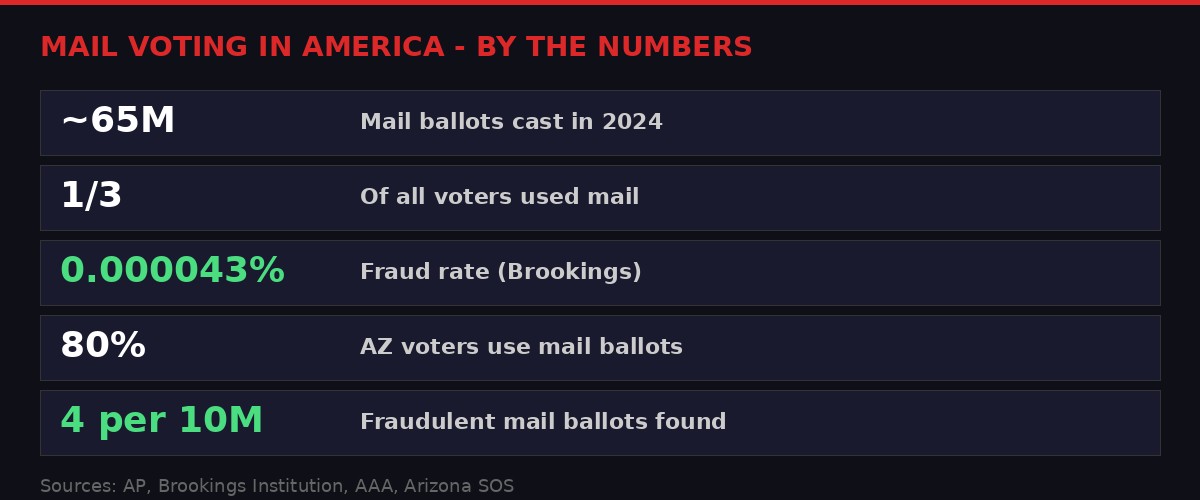
The order also mandates that the USPS send mail ballots only to individuals enrolled on a "State-specific Mail-in and Absentee Participation List." This would effectively gate-keep ballot access through a federal filter. Nearly one-third of all voters in the 2024 general election - roughly 65 million Americans - cast their ballots by mail. In states like Oregon, Washington, Colorado, Hawaii, and Utah, all-mail elections are the default. Arizona's system, designed by Republicans, is used by 80% of the state's voters.
The tracking barcode requirement raises additional concerns. While proponents argue barcodes would enhance ballot security, privacy advocates note that linking unique identifiers to individual voters could enable unprecedented federal surveillance of voting behavior. No state currently shares individualized ballot-tracking data with the federal government.
States Fire Back Within Minutes

The legal response was nearly instantaneous. Arizona Secretary of State Adrian Fontes, a Democrat, called the order a direct assault on his state's election sovereignty.
"It is just wrongheaded for a president of the United States to pretend like he can pick his own voters. That's just not how America works."
- Adrian Fontes, Arizona Secretary of State, to the Associated Press, March 31, 2026
Maine Secretary of State Shenna Bellows went further, calling the order "laughably unconstitutional" and declaring that her state would not comply. More than a quarter of Maine voters cast mail-in ballots in the 2024 election. Nevada Secretary of State Francisco Aguilar said the order would "cripple local election officials" and "silence voters counting on casting a mail ballot."
"It doesn't benefit anybody in this country except himself," Aguilar told reporters.
Oregon Secretary of State LaVonne Griffin-Valade, whose state has conducted all-mail elections since 2000, pledged to sue within 48 hours. Oregon's system has been widely cited as a model for secure, accessible voting, with fraud rates so low they are statistically undetectable.
Even some Republican officials maintained distance. Georgia Secretary of State Brad Raffensperger's office noted that Georgia already verifies citizenship through its own systems and would "continue to do so regardless of the outcome" of the executive order's legal battles. The statement conspicuously avoided endorsing the order itself.
David Becker, a former Justice Department lawyer who leads the Center for Election Innovation and Research, identified another fatal flaw: the president has no legal authority to direct the Postal Service, which is governed by an independent board. "The president cannot tell USPS what mail it can and cannot deliver," Becker told reporters. A USPS spokesperson said the agency would "review the order."
The Constitutional Collision Course
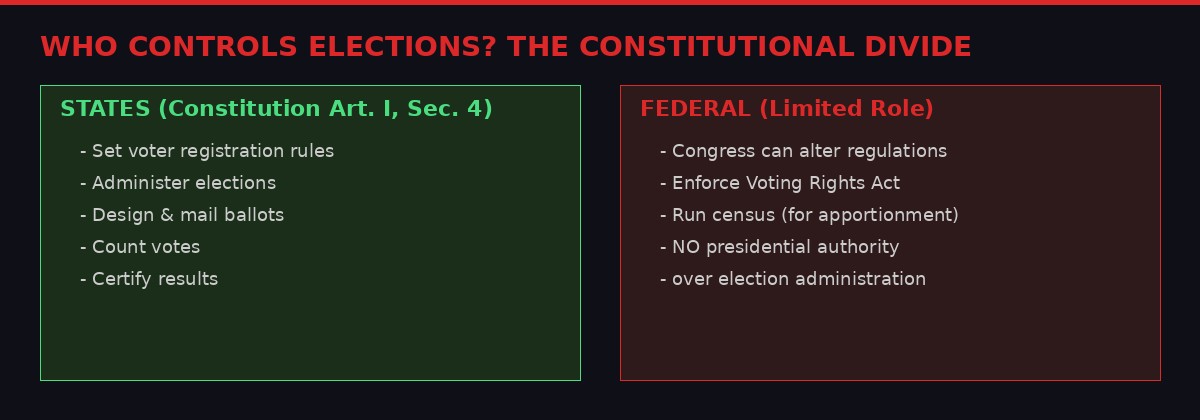
The legal framework here is not ambiguous. The Elections Clause of the Constitution - Article I, Section 4 - states: "The Times, Places and Manner of holding Elections for Senators and Representatives, shall be prescribed in each State by the Legislature thereof; but the Congress may at any time by Law make or alter such Regulations." Congress. Not the president. The distinction matters enormously.
Rick Hasen, an election law professor at UCLA and one of the country's foremost authorities on voting rights, wrote on his Election Law Blog that the order is "likely unconstitutional" and noted that "the timing here makes this virtually impossible to implement in time for November's elections." Even if courts allowed the order to stand - which Hasen considers extremely unlikely - the logistical challenges of building a nationwide voter verification database from scratch in seven months are insurmountable.
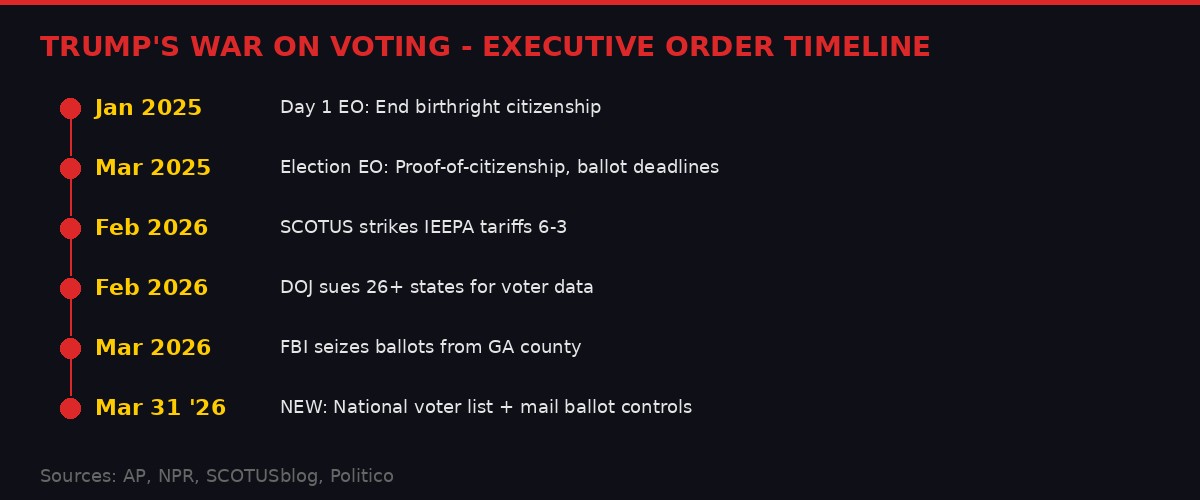
This is not Trump's first attempt to federalize election control. In March 2025, he signed an executive order requiring documentary proof-of-citizenship on federal voter registration forms and mandating that mailed ballots arrive at election offices by Election Day. Federal judges blocked much of that order, finding it an unconstitutional power grab. The president also told a conservative podcaster in February 2026 that he wanted to "take over" elections from Democratic-run areas - a statement his critics now cite as evidence of intent.
The Justice Department under Attorney General Pam Bondi has been building the infrastructure for this fight for months. The DOJ has sued more than 26 states demanding access to detailed voter registration lists, claiming it needs the data to enforce voter roll maintenance laws. Federal judges in three states have dismissed those lawsuits. In January, the FBI seized ballots from a Georgia county election office that has been central to right-wing conspiracy theories about Trump's 2020 loss. Bondi has also appointed a "special attorney" with nationwide authority to prosecute cases "relating to the integrity of federal elections."
Maya Wiley, president and CEO of the Leadership Conference on Civil and Human Rights, did not mince words: "This is Donald Trump turning the Department of Homeland Security into the department of controlling the homeland."
The Fraud That Does Not Exist

The executive order rests on a premise that has been exhaustively investigated and debunked: that mail-in voting is rampant with fraud. A 2025 report by the Brookings Institution found that mail voting fraud occurred in only 0.000043% of total mail ballots cast - roughly four cases per 10 million ballots. The Heritage Foundation, a conservative think tank that maintains a database of proven voter fraud cases, has documented fewer than 1,600 cases since 1979 across all forms of voting, in a country that has processed billions of ballots.
Trump himself has used mail ballots repeatedly, including just last week in local Florida elections. The White House has attempted to draw a distinction between "universal mail-in voting" and individual absentee ballots, but the executive order makes no such distinction in its operational mechanics - it gates all mail ballot delivery through a federal verification filter.
The irony is sharp. The states most reliant on mail voting tend to be run by both parties. Utah, a deeply Republican state, conducts all-mail elections. So does red-leaning Montana. Arizona's vote-by-mail system was created by Republican legislators. Colorado's all-mail system has been in place since 2013 and enjoys bipartisan support. The order does not carve out exceptions for friendly states.
Numerous audits following the 2020 election - including a Republican-commissioned audit in Arizona's Maricopa County - found no evidence of widespread fraud. Courts rejected more than 60 legal challenges to the 2020 results. Trump's own attorney general, William Barr, stated publicly that the DOJ had "not seen fraud on a scale that could have effected a different outcome." None of this has altered the president's public position.
The SAVE System: A Database Built for Something Else Entirely

Central to the executive order is the SAVE system - the Systematic Alien Verification for Entitlements program, operated by U.S. Citizenship and Immigration Services. SAVE was built to allow government agencies to verify immigration status for benefits applications. It was never designed, tested, or scaled for the purpose of verifying the citizenship of every registered voter in the United States.
The Brennan Center for Justice has documented significant flaws in the system. States conducting bulk SAVE searches need Social Security numbers, but few states collect full SSNs during voter registration. The system's error rates - acceptable for individual benefits verification - become catastrophic when applied to millions of records simultaneously. A 1% error rate across 160 million registered voters would incorrectly flag 1.6 million eligible citizens.
The Trump administration overhauled SAVE in 2025, but legal challenges remain pending over its accuracy and the privacy implications of sharing voter data with immigration authorities. The chilling effect is already apparent: immigrant communities, including naturalized U.S. citizens with every legal right to vote, may be deterred from registering or casting ballots if they know their information will be processed through an immigration enforcement database.
This is not hypothetical. After Texas cross-referenced its voter rolls against a flawed DHS database in 2019, the state flagged nearly 100,000 voters as potential noncitizens. The list was riddled with errors - naturalized citizens, military veterans, lifelong Americans with clerical mismatches. Texas eventually abandoned the effort after lawsuits and public backlash. The Trump administration is now proposing to replicate that failed experiment nationwide.
The USPS Problem: Independent Agency, Presidential Orders

The executive order directs the United States Postal Service to transmit mail ballots only to voters on federally approved lists. There is one significant problem: the USPS is an independent agency. It is governed by a Board of Governors, not the Oval Office. The president does not have the legal authority to instruct the Postal Service on what mail it can and cannot deliver.
This matters practically. In all-mail election states, county election officials - not the USPS - determine who receives a ballot. The ballots are prepared by county clerks, printed by contracted vendors, and then handed to USPS for delivery. The executive order would insert a federal checkpoint between the county clerk's office and the voter's mailbox.
Trump has previously attempted to bring USPS under direct presidential control. His Commerce Secretary, Howard Lutnick - who was present at the signing ceremony - has been tasked with a proposal to fold the Postal Service into the Commerce Department. That proposal faces bipartisan opposition in Congress, where the USPS's independence has been protected by statute since 1970.
During the 2020 election, Trump installed Postmaster General Louis DeJoy, who implemented operational changes - removing mail sorting machines, reducing overtime - that critics said were designed to slow mail ballot delivery. DeJoy denied the charges. The episode remains a scar on public trust in USPS's role in elections. The new executive order would formalize what critics called a quiet sabotage campaign into explicit policy.
A USPS spokesperson said Tuesday that the agency would "review the order." Legal experts said that review would likely conclude with the same answer: the president lacks the authority to issue the directive.
The Midterm Stakes: Why November 2026 Matters

The timing of the executive order is not coincidental. The November 2026 midterm elections are seven months away, and Republicans face a challenging political landscape. Trump's approval ratings have been battered by the Iran war, $4-per-gallon gas prices, and the ongoing economic drag from the Supreme Court's February ruling striking down his tariffs. Democrats are running aggressive campaigns in swing districts, weaponizing pocketbook issues and the administration's domestic chaos.
Mail ballots have historically favored Democrats, though the gap has narrowed. In 2020, Joe Biden won mail-in voters by a 2-to-1 margin. In 2024, the disparity was smaller but still significant. Restricting mail ballot access would disproportionately affect Democratic-leaning voters in urban areas, elderly voters who rely on absentee ballots, military members stationed overseas, and disabled voters who cannot easily reach polling places.
The executive order also arrives as Congress stalls on the SAVE America Act, a sweeping election overhaul bill that would impose new voter ID and documentation requirements. The bill passed the House but is stuck in the Senate due to Democratic opposition and the legislative filibuster. The executive order appears designed to accomplish through presidential decree what Trump cannot achieve through legislation.
Rick Hasen's assessment is blunt: even if courts allowed the order to stand, implementation before November is "virtually impossible." Building a nationwide voter verification database from scratch, training election workers on new protocols, printing barcoded ballot envelopes, and resolving the inevitable errors - all within seven months - defies administrative reality.
But the order may not need to succeed operationally to achieve its political goal. By publicly casting doubt on the integrity of mail voting, Trump creates a narrative framework for contesting unfavorable results in November. This playbook is familiar.
What Happens Next: Courts, Congress, and Chaos

The executive order will face immediate legal challenges in multiple federal courts. Based on the precedent set by judges who blocked Trump's 2025 election executive order, the odds of a preliminary injunction are high. The question is whether the Supreme Court - which has shown willingness to intervene rapidly on Trump's behalf in some cases - would overrule lower courts.
The Court is already loaded with election-related cases. It will hear oral arguments today, April 1, on Trump's attempt to end birthright citizenship - with the president himself attending, a first for a sitting president at SCOTUS oral arguments. It is also expected to rule on whether Mississippi can count mail ballots received after Election Day, a case that could reshape mail voting nationwide.
In Congress, the reaction splits predictably along party lines. Senate Majority Leader John Thune offered cautious support for "election integrity measures" without specifically endorsing the executive order's mechanisms. Senate Minority Leader Chuck Schumer called the order "authoritarian overreach" and pledged to introduce legislation protecting mail voting access.
The practical concern for election administrators is immediate. County clerks in all-mail states are already preparing for November. Ballot designs are being finalized. Vendor contracts are being signed. A federal mandate to restructure the entire mail ballot delivery system mid-cycle would create administrative chaos - even if the order is eventually struck down, the disruption to planning could suppress voter turnout by creating confusion about whether mail ballots will be delivered at all.
This is, perhaps, the most insidious element of the order. Whether it survives legal challenge is almost beside the point. The uncertainty it creates - will my ballot arrive? Am I on the federal list? Will my vote count? - may be sufficient to achieve the desired suppression effect.
The Historical Parallel: When Federal Power Overrode Voting Rights
The last time the federal government intervened this aggressively in state election administration was during Reconstruction, when Union troops occupied former Confederate states to enforce the 15th Amendment and protect newly enfranchised Black voters. That intervention expanded voting rights. Trump's executive order would contract them.
The comparison is imperfect but instructive. After Reconstruction ended in 1877, southern states constructed elaborate systems - poll taxes, literacy tests, grandfather clauses - to prevent Black citizens from voting. The federal government retreated from election oversight for nearly a century until the Voting Rights Act of 1965, which Congress passed after the violence at the Edmund Pettus Bridge in Selma, Alabama, shocked the national conscience.
The Voting Rights Act did not give the president power over elections. It gave Congress and the courts enforcement mechanisms. The distinction is critical. When the Supreme Court gutted the Act's preclearance requirement in Shelby County v. Holder (2013), it did so by arguing that states no longer needed federal supervision to protect voting rights. Trump's executive order now proposes a form of federal supervision that would restrict, rather than protect, the franchise.
Voting rights historians see a pattern. "Every generation has faced attempts to narrow who counts as a legitimate voter," said Carol Anderson, author of "One Person, No Vote" and a professor of African American Studies at Emory University, in a statement released Tuesday. "What changes is the mechanism. Poll taxes became voter ID laws. Literacy tests became proof-of-citizenship requirements. And now, a federal database becomes the gatekeeper for your ballot."
The executive order's requirement that voters prove citizenship through a federal database before receiving a mail ballot is functionally similar to the documentary proof-of-citizenship laws that several states have attempted to implement - and that courts have repeatedly struck down as unconstitutional barriers to voting. Kansas's proof-of-citizenship law, championed by Kris Kobach (who later led Trump's disbanded voter fraud commission), was blocked by a federal judge in 2018 after evidence showed it prevented tens of thousands of eligible voters from registering.
The Trump administration is betting that a federal executive order can accomplish what state legislatures and commissions could not. The courts will decide whether that bet pays off. But the disruption to American democracy - the erosion of trust, the confusion among voters, the burden on election administrators - is already underway.
- Trump signed an executive order on March 31 creating a national voter registry and restricting USPS mail ballot delivery
- DHS would compile citizenship-verified voter lists using the SAVE immigration database
- USPS would only deliver mail ballots to federally approved voters
- Constitutional experts say the president lacks authority to control state elections
- States including Arizona, Oregon, Maine, and Nevada have pledged lawsuits
- Mail voting fraud occurs at a rate of 0.000043% per ballot cast
- Nearly 65 million Americans voted by mail in 2024
- Implementation before the November 2026 midterms is considered logistically impossible
Get BLACKWIRE reports first.
Breaking news, investigations, and analysis - straight to your phone.
Join @blackwirenews on Telegram