Trump to Address Nation Tonight on Iran Exit - Threatens to Quit NATO Over Allied 'Betrayal'

Military operations continue across the Middle East as the Iran war enters its second month. Photo: Pexels
President Donald Trump will deliver a primetime national address at 9 PM Eastern tonight to provide what the White House calls "an important update" on the Iran war. The announcement follows 48 hours of whiplash-inducing statements from the president - pledging to withdraw American forces "pretty quickly," threatening to bomb Iran "into oblivion," claiming Iran's president requested a ceasefire that Tehran flatly denies, and telling NATO allies they are on their own securing the Strait of Hormuz.
The address lands on Day 33 of a conflict that has killed at least 1,574 Iranian civilians - including 236 children - left 13 American service members dead, effectively shut down 20 percent of global oil supply, and driven Brent crude above $100 a barrel. Europe faces its worst energy crisis since the 1970s. Two-thirds of Americans want out. And the president of the United States just called the most successful military alliance in history a "paper tiger."
This is the most dangerous night of the war so far - not because of what happens on the battlefield, but because of what Trump says to the cameras.
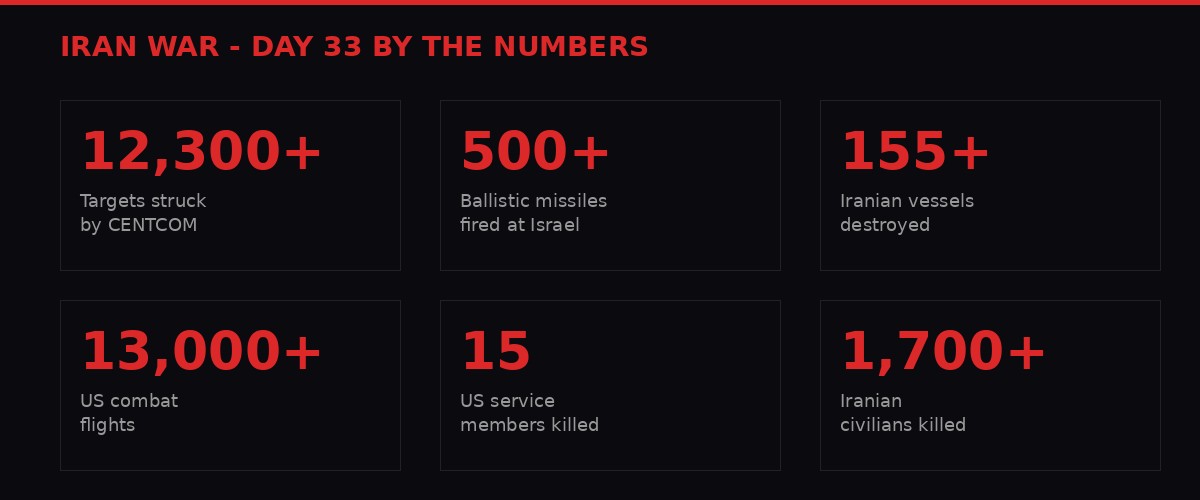
The war in numbers: 33 days of conflict have reshaped global energy markets and transatlantic relations. BLACKWIRE Graphic
The Mixed Signals: What Trump Has Said in the Last 48 Hours

Trump has issued a flurry of contradictory statements on the war's endgame. Photo: Pexels
The president's messaging over the past two days has been a masterclass in contradiction, even by Trumpian standards. On Tuesday from the Oval Office, he told reporters the war would end in "two weeks, maybe three," adding: "We'll be leaving very soon." He said gasoline prices would "come tumbling down" once the U.S. pulled out. He said Iran "doesn't have to make a deal" - the clearest signal yet that Washington is prepared to exit without achieving its stated objectives.
Then came Wednesday morning. Trump posted on Truth Social that "Iran's New Regime President, much less Radicalized and far more intelligent than his predecessors, has just asked the United States of America for a CEASEFIRE!" He added a condition: the U.S. would only consider it "when Hormuz Strait is open, free, and clear. Until then, we are blasting Iran into oblivion or, as they say, back to the Stone Ages!!!"
There are problems with nearly every part of this statement. Iran's president, Masoud Pezeshkian, has been in power since 2024 - he is not new. Tehran's Foreign Ministry spokesperson Esmail Baghaei called Trump's ceasefire claim "false and baseless." And demanding the Strait open as a precondition for ceasefire directly contradicts what Trump said hours earlier - that the U.S. would leave even with the strait still closed, telling allies to "go get your own oil."
"We will consider when Hormuz Strait is open, free, and clear. Until then, we are blasting Iran into oblivion." - President Trump, Truth Social, April 1, 2026
In a Reuters interview Wednesday, Trump offered yet another formulation. The U.S. would leave Iran "pretty quickly" but could return for "spot hits" if necessary. He confirmed he is "absolutely" considering withdrawing from NATO and said he would express "my disgust" with the alliance during tonight's address. No timeline was given for the withdrawal from Iran, despite the two-to-three-week estimate from the previous day.
The contradictions matter. Markets move on presidential statements. Allies calibrate their own military and diplomatic postures around Washington's signals. And tonight's address - watched by hundreds of millions globally - will either clarify the endgame or deepen the chaos. Based on the last 48 hours, the smart money is on chaos.
The NATO Rupture: 76 Years of Alliance on the Brink

European capitals are bracing for the most significant transatlantic rupture since the founding of NATO. Photo: Pexels
Trump's threat to quit NATO is not new. He floated it during his first term. He made it a campaign talking point. But this time is different. The rhetoric has escalated beyond anything heard before, and the machinery of the U.S. government appears to be moving in the same direction.
In an interview with Britain's Daily Telegraph published Wednesday, Trump called NATO a "paper tiger" and said his reconsideration of U.S. membership was "beyond reconsideration." He added: "I was never swayed by NATO. I always knew they were a paper tiger - and Putin knows that too."
Secretary of State Marco Rubio reinforced the message on Fox News Tuesday evening. "I do think, unfortunately, we are going to have to reexamine whether or not this alliance that has served this country well for a while is still serving that purpose," he said. Rubio framed NATO as a "one-way street where America is simply in a position to defend Europe - but when we need the help of our allies, they're going to deny us basing rights and they're going to deny us overflight."
Defense Secretary Pete Hegseth went further, declining to reaffirm NATO's Article 5 collective defense guarantee when directly asked. "As far as NATO is concerned, that's a decision that will be left to the president," he said. "But I'll just say a lot has been laid bare."
The specific grievance driving the rupture: European allies refused to join the U.S.-Israel military campaign against Iran, denied basing and overflight rights for combat missions, and declined to send naval forces to help reopen the Strait of Hormuz. Spain closed its airspace to U.S. warplanes. France restricted military flights. Italy's Giorgia Meloni - once considered Trump's closest European ally - denied permission for U.S. bombers to use the Sigonella air base in Sicily. Poland refused a request to redeploy Patriot air defense systems to the Gulf.
"If NATO is about us defending Europe, but they deny us basing rights when we need them, that's not a very good arrangement." - Secretary of State Marco Rubio, Fox News, March 31, 2026
Francois Heisbourg, senior adviser at the International Institute for Strategic Studies, called it "a new step. It's a very disturbing one. I think that no member of NATO signed on to join an offensive alliance." That distinction - NATO as defensive pact versus tool of American power projection - sits at the heart of the crisis. The Europeans never agreed to the Iran war. They see it as Washington's choice, not NATO's obligation. Trump sees their refusal as betrayal.
There is a legal barrier. The Biden-era Defense Act requires two-thirds of the Senate or a Congressional act to actually withdraw from NATO. But the damage to deterrence happens long before any formal exit. If Vladimir Putin believes the alliance is disintegrating, the strategic calculus in Eastern Europe changes immediately. Ukraine - already fighting Russia with European support - would be the first casualty of an American pullout.
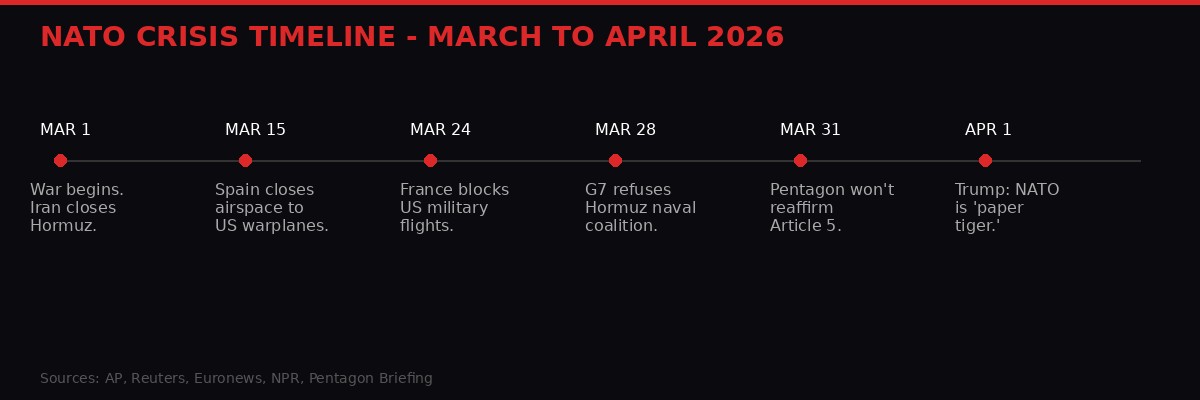
The transatlantic rift has deepened week by week since the war began. BLACKWIRE Graphic
The Strait of Hormuz: A Chokepoint That Could Strangle Europe

Tanker traffic through the Strait of Hormuz has dropped to near zero since the war began. Photo: Pexels
The Strait of Hormuz - 21 miles wide at its narrowest point, straddling the waters between Iran and Oman - is the single most important chokepoint in global energy. Before the war, roughly 20 million barrels of oil per day transited the strait. That represented about 20 percent of all seaborne crude oil traded worldwide. It also carried significant volumes of liquefied natural gas, with Europe receiving 12 to 14 percent of its LNG from Qatar through the passage.
Since February 28, when Iran's Islamic Revolutionary Guard Corps began threatening and then attacking vessels in response to U.S.-Israeli strikes, tanker traffic has collapsed. It dropped by 70 percent in the first week, then effectively fell to zero. The IRGC has conducted at least 21 confirmed attacks on merchant ships. On March 27, the Guards announced the strait was formally closed to any vessel traveling to or from ports of the U.S., Israel, and their allies.
The International Energy Agency called it the largest disruption to global energy supply since the 1970s oil crisis. On March 11, all 32 IEA member countries unanimously agreed to release 400 million barrels from strategic reserves - more than twice the previous record set after Russia's invasion of Ukraine. That volume, equivalent to roughly 26 days of normal Hormuz flow, was designed as a "time bridge" to prevent total collapse of the supply chain.
It is running out. IEA head Fatih Birol warned Wednesday that "oil supply disruptions from the Middle East will rise in April and begin to impact Europe's economy." The European Commission has called on member states to coordinate emergency measures to secure petroleum products. Ryanair CEO Michael O'Leary said if the conflict continues through April, airlines face jet fuel supply disruptions by June. "If it runs into May, then we don't know what goes on," he said.
Brent crude traded around $102 per barrel on Wednesday, down slightly from a peak of $126 earlier in March on hopes Trump's withdrawal signals might ease the blockade. WTI was at roughly $99.50. But Trump's own statement - that he would leave Iran with the strait still closed - means prices have no reason to fall further. The blockade is Iran's leverage, and Tehran has no incentive to give it up.
"47 years of hospitality are over forever. Trump has finally achieved his dream of 'regime change' - but in the region's maritime regime!" - Ebrahim Azizi, Head of Iran's National Security Committee, April 1, 2026
An estimated 20,000 seafarers are currently trapped on vessels near the strait, in an active war zone. Most are from the Philippines, Bangladesh, and India. Some ships are running low on food and water. The UN International Maritime Organization is negotiating with all sides to arrange evacuation. Iran has approved a bill to charge vessels for crossing the waterway - a signal it intends to maintain permanent control, not temporary leverage.
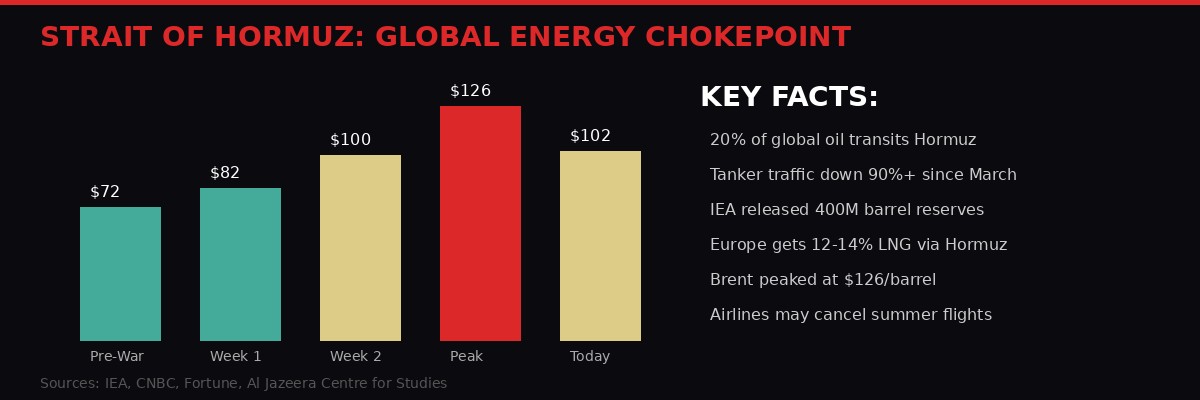
The Hormuz closure has sent oil prices to four-year highs and triggered emergency reserve releases worldwide. BLACKWIRE Graphic
On the Ground: Day 33 of Bombs, Drones, and Expanding Fronts

Residential areas in Tehran have been hit by Israeli strikes, drawing international condemnation. Photo: Pexels
While Washington debates NATO membership and market traders watch oil futures, the actual war is escalating on multiple fronts simultaneously. The Israeli military said it hit 230 targets in Iran overnight Tuesday into Wednesday. Strikes have targeted steel mills, pharmaceutical factories, and research facilities - infrastructure Iran says is civilian, which Israel claims houses military-linked operations.
Israel is also widening its invasion of Lebanon. Defense Minister Israel Katz announced plans to occupy all territory from the border to the Litani River, prohibiting the return of more than 600,000 displaced southern Lebanese until "safety and security of northern Israeli residents is ensured." Israeli strikes have killed more than 1,260 people in Lebanon and injured more than 3,750 since March, according to the Lebanese Health Ministry. A senior Hezbollah commander - Haj Youssef Ismail Hashem, leader of the Southern Front - was killed in overnight Beirut strikes, confirmed by both sides.
Iran's retaliatory capacity remains active despite five weeks of sustained bombardment. Missiles fired at central Israel injured 14 people Wednesday, including children, according to Israeli emergency services. Iranian drones struck fuel depots at Kuwait's international airport, igniting a massive fire. A cruise missile hit an oil tanker leased to QatarEnergy in Qatari territorial waters - the IRGC later claimed it was an Israeli-owned vessel called "Aqua 1." Qatar's military intercepted two of three incoming missiles but could not stop the third.
Yemen's Houthi rebels, backed by Iran, claimed additional missile attacks on Israel and vowed further escalation. The multi-front nature of the conflict - stretching from Lebanon through Syria to Iran, with proxy attacks across the Gulf and into the Red Sea - makes any "clean exit" nearly impossible. Trump's suggestion of a two-to-three-week withdrawal timeline ignores the reality that American forces are engaged across an arc spanning thousands of miles.
The human toll in Iran is staggering. The Human Rights Activist News Agency puts the civilian death count at 1,574, including 236 children. The World Health Organization reported that attacks on Tehran struck near its office and shattered its windows. Director General Tedros Adhanom Ghebreyesus said U.N. agencies have been "clearly identified" and that strikes damaging them "cannot be tolerated." A UNDP report released Monday estimated that just one month of war could cost the Arab region $194 billion, shrink its economy by 6 percent, and push 4 million more people into poverty.
On Tuesday, American freelance journalist Shelly Kittleson was kidnapped in Baghdad. Iraqi security forces said a suspect with ties to the Iranian-aligned militia Kataib Hezbollah was arrested after intercepting a crashed vehicle, but Kittleson remains missing. The State Department confirmed it had previously warned the journalist of threats. The kidnapping underscores the lawless environment spreading outward from the conflict's epicenter.
The European Response: Caught Between Washington and Their Own Populations

European leaders face mounting domestic pressure over rising energy costs and the transatlantic alliance crisis. Photo: Pexels
European leaders are threading a needle that gets thinner by the hour. Their populations overwhelmingly oppose the Iran war. Energy prices are crushing households and businesses. But the threat of American withdrawal from NATO terrifies defense establishments that have depended on the U.S. security umbrella for 76 years.
British Prime Minister Keir Starmer addressed the nation Wednesday about the rising cost of living caused by the conflict. He repeated his vow that the U.K. would take only "defensive" action against Iranian attacks and would not be drawn into the war. He called NATO "the single most effective military alliance the world has ever seen." His Foreign Secretary, Yvette Cooper, will host a virtual meeting Thursday of 35 countries that have signed up to help ensure postwar shipping security in the Strait of Hormuz. British military planners are working on a long-term security framework for the waterway.
Australian Prime Minister Anthony Albanese gave his own national address Wednesday, warning citizens that "the economic shocks caused by this war will be with us for months." His government halved the fuel tax for three months and urged Australians to use public transport and avoid hoarding fuel. The fact that a Pacific nation is giving wartime economic addresses to its citizens shows how far the Hormuz crisis has spread beyond the Middle East.
The European Commission has taken emergency action, calling on EU member states to coordinate oil security measures. Spain remains the most vocal critic - having closed its airspace to U.S. war-related flights, it has positioned itself as the leading European voice against the conflict. France has restricted military access. Germany and Italy have walked a careful middle line, criticizing the war while trying not to antagonize Washington so badly that it accelerates the NATO exit.
Around 30 countries, including European states and Japan, are discussing a "coalition of the willing" to support efforts to reopen the Strait of Hormuz - but only once hostilities end. The United Arab Emirates is lobbying for a UN Security Council resolution authorizing forceful reopening. The G7 foreign ministers suggested a UN-led mission similar to the Black Sea grain initiative during the Russia-Ukraine war.
But none of this addresses the immediate problem: Trump wants allies to help now, during an active shooting war they never endorsed. They are willing to help after, through multilateral frameworks they can sell to their voters. The gap between these positions is where the transatlantic alliance is dying.
The American Public: Two-Thirds Want Out

Domestic support for the war has collapsed as gas prices surge and service members die. Photo: Pexels
A Reuters/Ipsos poll released this week found that 66 percent of Americans want the U.S. to end its involvement in Iran quickly, even if that means the country does not achieve the goals set by the Trump administration. Only 27 percent said the country should finish its mission regardless of how long it takes. The survey polled 1,021 people from Friday through Sunday.
Even within Trump's own base, the numbers are fracturing. About 40 percent of Republican respondents supported ending the war soon even if the president does not achieve his stated goals. Fifty-seven percent of Republicans supported continuing. For a war that Trump launched, losing four in ten of his own voters after just one month is a devastating political signal.
The domestic economics explain the erosion. Gas prices have surged nationwide as Hormuz-driven supply disruptions ripple through global markets. The war's cost in American lives - 13 service members killed - may seem modest compared to Iraq or Afghanistan, but it is accumulating at a rate that erodes the "quick operation" narrative Trump originally sold.
Trump's promise that gas prices would "come tumbling down" once the U.S. exits is almost certainly false. The Strait of Hormuz remains closed regardless of American withdrawal. Iran's Revolutionary Guard has made it clear they view control of the waterway as a permanent strategic asset, not a bargaining chip. Prices are being driven by the supply disruption, not by the presence of American troops. Leaving does not reopen the strait.
This creates a political trap. The public wants the war to end. The war ending does not fix the economic pain. And the economic pain is the primary reason the public wants the war to end. Tonight's address will likely focus on the withdrawal timeline because it is the only thing Trump can control. What he cannot control - the strait, oil prices, NATO's future, Iran's behavior - are the things that actually matter.
What Could Trump Actually Announce Tonight?

Every major network will carry Trump's address live at 9 PM ET. Photo: Pexels
Based on the cascade of statements, interviews, and posts over the past 48 hours, several possibilities emerge for tonight's primetime address. None of them are mutually exclusive, and given Trump's track record, the speech may contain elements of all of them.
Scenario 1: Withdrawal Declaration. Trump announces a formal timeline for pulling U.S. forces from Iran within two to three weeks. He declares the mission accomplished - Iran's nuclear program degraded, military infrastructure destroyed, a message sent. He leaves the Strait of Hormuz for the international community to deal with. This is the "declare victory and leave" approach. It polls well domestically but leaves every strategic problem unsolved.
Scenario 2: NATO Ultimatum. Trump uses the address to directly threaten NATO withdrawal unless allies commit naval forces to the Strait within a defined window. This would be the most dramatic escalation of the transatlantic crisis in the alliance's history. It would send shockwaves through European capitals and defense markets worldwide. The legal barriers to actual withdrawal make this largely theater - but theater that weakens deterrence against Russia.
Scenario 3: Escalation Before Exit. Trump announces a final wave of intensified strikes against Iranian military and infrastructure targets as a parting blow, then sets a withdrawal timeline. The "blasting into oblivion" rhetoric on Truth Social suggests this is at least partially in play. It would satisfy hawkish supporters while also delivering on the withdrawal promise.
Scenario 4: The Muddle. The most likely outcome. Trump delivers a speech that contains aggressive language about Iran, complaints about NATO, a vague withdrawal timeline, claims of ceasefire negotiations that Tehran denies, and no clear resolution. Markets react to whichever sentence traders focus on. The war continues largely unchanged the next morning.
The China-Pakistan peace plan - calling for immediate ceasefire, renewed negotiations, infrastructure protection, and Hormuz reopening - remains on the table. Trump declined to comment when asked about it. If the address includes any reference to negotiations, it could signal a path toward resolution. If it is purely focused on withdrawal and NATO grievances, the war's worst phase may still be ahead.
Key Timeline: The Road to Tonight's Address
The Nuclear Shadow: What the War Has Not Solved

Experts warn the war may accelerate, not prevent, nuclear proliferation across the Middle East. Photo: Pexels
Trump's stated justification for the war was preventing Iran from acquiring nuclear weapons. Five weeks of bombardment later, there is no evidence Iran's stockpile of highly enriched uranium has been destroyed or removed. The Bushehr nuclear reactor has been struck three times, with its Russian managers warning of deteriorating safety conditions. But nuclear weapons programs are designed to survive exactly this kind of attack - dispersed, hardened, and redundant.
Worse, experts warn the war may trigger the very proliferation it was supposed to prevent. A DW analysis published Wednesday raised the alarm about a potential nuclear arms race across the Middle East. If Iran's program survives - or if regional powers conclude that only nuclear weapons can deter future American strikes - Saudi Arabia, Turkey, the UAE, and Egypt may all pursue their own programs. The logic is straightforward: countries with nuclear weapons do not get invaded.
The Bushehr situation presents its own risks. Strikes near a nuclear facility raise the specter of radioactive contamination. The IAEA has expressed concern but has limited access. If tonight's address includes claims of nuclear "mission accomplished," the factual basis will be thin. Intelligence assessments have not confirmed the destruction of Iran's enrichment capabilities, and the facilities at Fordow are buried deep enough underground to survive conventional bombing.
U.S. Central Command issued a statement Tuesday refuting reports that American airstrikes hit civilian areas in Lamerd during the opening days of Operation Epic Fury. The denial came amid growing scrutiny of civilian casualties - the kind of damage assessment that becomes more politically toxic the longer a war continues. If Trump is looking for an exit, unresolved nuclear questions and mounting civilian death tolls provide strong incentive to leave before the narrative worsens.
What Happens After Tonight
Whatever Trump says at 9 PM, several things remain true at 9:01 PM. The Strait of Hormuz is closed. Iran's Revolutionary Guard controls it. Oil prices will stay elevated until it opens. NATO's cohesion is fractured regardless of whether the U.S. formally withdraws. The war has already killed thousands of people and displaced hundreds of thousands more. Europe faces months of energy pain. The nuclear question is unresolved. And two-thirds of the American public has turned against a conflict their president started 33 days ago.
The immediate market watch will be energy futures. If Trump signals a firm, fast withdrawal with no resolution on the strait, oil could spike further as traders price in extended disruption. If he hints at negotiations - the China-Pakistan plan, or a genuine ceasefire framework - prices could ease. The delta between those outcomes is tens of billions of dollars in global economic impact.
For NATO, the damage is done. Even if Trump walks back the "paper tiger" language tonight - which he almost certainly will not - the fact that the Secretary of State, Defense Secretary, and President have all questioned the alliance's value in a single week marks a new low. European defense spending was already rising before this crisis. It will accelerate now, not out of alliance solidarity, but out of the dawning realization that America may not come when called.
Thursday's meeting of 35 countries organized by British Foreign Secretary Yvette Cooper on Hormuz shipping security will be the first concrete test of whether the international community can self-organize around the crisis without American leadership. If that meeting produces meaningful commitments, it could become the template for a post-American security order in the Gulf. If it produces more statements, the order is chaos.
The Iran war has already reshaped the global landscape more dramatically than any conflict since Russia's invasion of Ukraine. Tonight, the man who started it will tell the world how he plans to end it. Based on the last 48 hours, the answer is: he doesn't know. And that might be the most honest thing anyone has said about this war since it began.
Get BLACKWIRE reports first.
Breaking news, investigations, and analysis - straight to your phone.
Join @blackwirenews on TelegramSources: NPR, Reuters, AP, USA Today, DW, Euronews, Just Security, CNBC, Fortune, Al Jazeera Centre for Studies, Politico EU, Wikipedia, European Commission, UNDP, IEA, Human Rights Activist News Agency, WHO. All claims sourced inline. This article reflects reporting available as of April 1, 2026, 6:00 PM ET. Trump's primetime address is scheduled for 9 PM ET.