Trump Threatens to Quit NATO as Europe Refuses to Back Iran War - Hormuz Deadline Expires Monday
The six-week-old US-Iran war has cracked the Western alliance open. Spain locked its skies. France withdrew support. Trump called allies "cowards" and floated leaving NATO entirely. And the deadline he set to open the Strait of Hormuz runs out in less than 48 hours.
The Iran war is now straining the Western alliance to its limits. Source: BLACKWIRE
On Saturday morning, April 5, the United States military was searching a remote mountain range in southwestern Iran for a missing pilot while an Iranian general warned that "the doors of hell" would open if American forces escalated further. Simultaneously, in Washington, the alliance that has anchored Western security for 77 years was quietly being questioned by the president who controls its largest military contributor.
This is not a war going according to plan. Six weeks after US and Israeli jets first struck Iran on February 28, the conflict has produced two downed American aircraft in a single day, a second strategic waterway under threat, a tech company's Dubai headquarters with a hole in its wall, and a NATO fracture that foreign policy analysts call unprecedented in the alliance's modern history. (AP News, April 4, 2026)
The deadline Trump set for Iran to reopen the Strait of Hormuz expires Monday. Tehran has responded by threatening a second chokepoint - the Bab el-Mandeb, through which more than ten percent of the world's seaborne oil passes. Iran's parliamentary speaker, Mohammad Bagher Qalibaf, posted a pointed question on social media late Friday asking which countries and companies depend most on that strait. The implication was not subtle. (AP News, April 4, 2026)
This is the story of how a US president who declared Iran "completely decimated" now faces a fractured alliance, a live war at a critical inflection point, and a missing airman somewhere in the mountains of Kohgiluyeh and Boyer-Ahmad province.
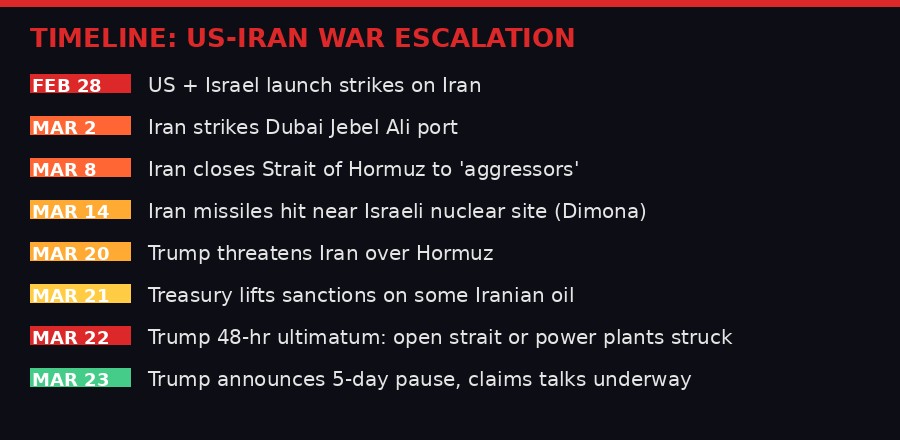
Six weeks of war, compressed. Source: BLACKWIRE / AP News
The Missing Pilot and the Week That Broke the Narrative
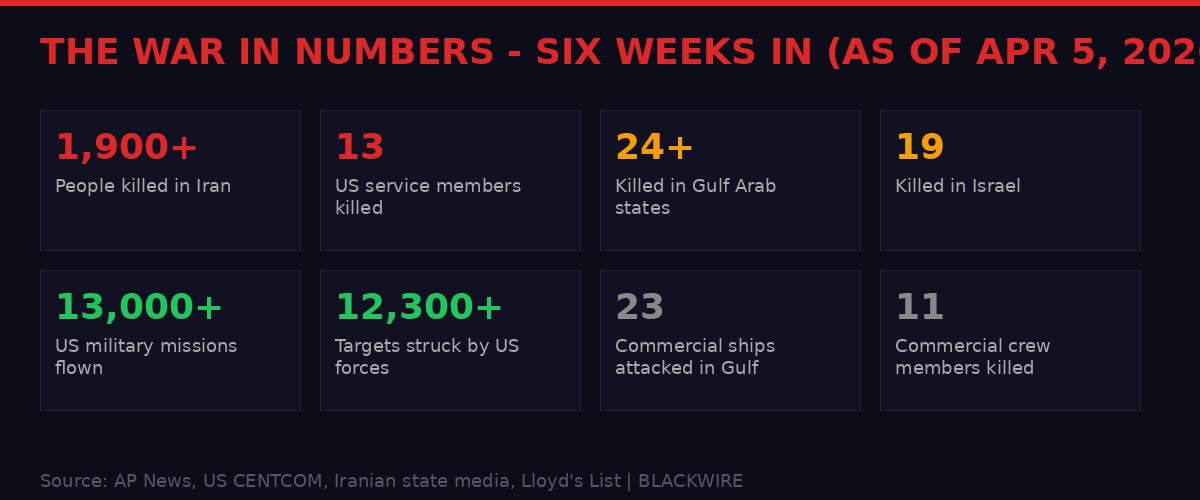
The war in numbers - six weeks of combat. Source: BLACKWIRE / AP News / US CENTCOM
On Friday, April 3, Iran shot down a US F-15E Strike Eagle fighter jet. One crew member was rescued. A second remains missing. The Pentagon notified the House Armed Services Committee that the second service member's status was unknown. Iranian state media urged citizens to report any "enemy pilot" to police. The search was ongoing Saturday morning. (AP News)
The same day, Iranian air defenses struck a second US aircraft - an A-10 Thunderbolt II attack jet. Iranian state media reported it crashed into the Persian Gulf after being hit. A US official, speaking on condition of anonymity, confirmed a second combat aircraft went down but said it remained unclear whether it was shot down or crashed independently. Iran also reported striking two US Black Hawk helicopters, which the AP could not independently verify. (AP News, April 4, 2026)
The last time a US warplane was shot down by enemy fire in combat was an A-10 Thunderbolt II during the 2003 US invasion of Iraq. Retired Air Force Brigadier General Houston Cantwell, a former F-16 fighter pilot who served four combat tours, told AP that the absence of greater losses until now is "an absolute miracle." He explained: "We're flying combat missions here, they are being shot at every day." Cantwell now serves as a senior resident fellow at the Mitchell Institute for Aerospace Studies.
"A disabled air defense system is not a destroyed air defense system. We shouldn't be shocked that they're still fighting." - Behnam Ben Taleblu, senior Iran program director, Foundation for Defense of Democracies
The expert consensus is that Iran is using shoulder-fired portable missiles rather than fixed surface-to-air systems - a harder-to-detect capability that reflects what Ben Taleblu called a military that is "weak but still lethal." American planes have been flying missions at lower altitudes over Iran, increasing their exposure to exactly these weapons. Mark Cancian, a retired Marine colonel and senior defense adviser with the Center for Strategic and International Studies, agreed a shoulder-fired missile was likely used and noted that despite the losses, the American air war against Iran has been a "tremendous success" so far - framing the losses in historical context: during World War II over Germany, the loss rate for American warplanes reached 3%, which would equal approximately 350 aircraft in the current campaign.
Trump responded to the losses by issuing a new ultimatum. "Remember when I gave Iran ten days to MAKE A DEAL or OPEN UP THE HORMUZ STRAIT," he posted on social media. "Time is running out - 48 hours before all Hell will reign down on them." When asked by NBC News whether the downed planes would affect negotiations, Trump said it would not. He did not appear in public on Friday. (AP News)
Iranian state media reported that airstrikes in southwestern Iran on Saturday - the same region where the missing pilot is believed to be located - killed at least three people and wounded others. The search for the American crew member continued amid active combat operations in the same geography. Iranian state television anchors affiliated with state media urged residents to hand over any "enemy pilot" to police, suggesting Tehran believes the airman survived ejection and may be on the ground.
NATO on the Edge: A 77-Year Alliance Under Strain
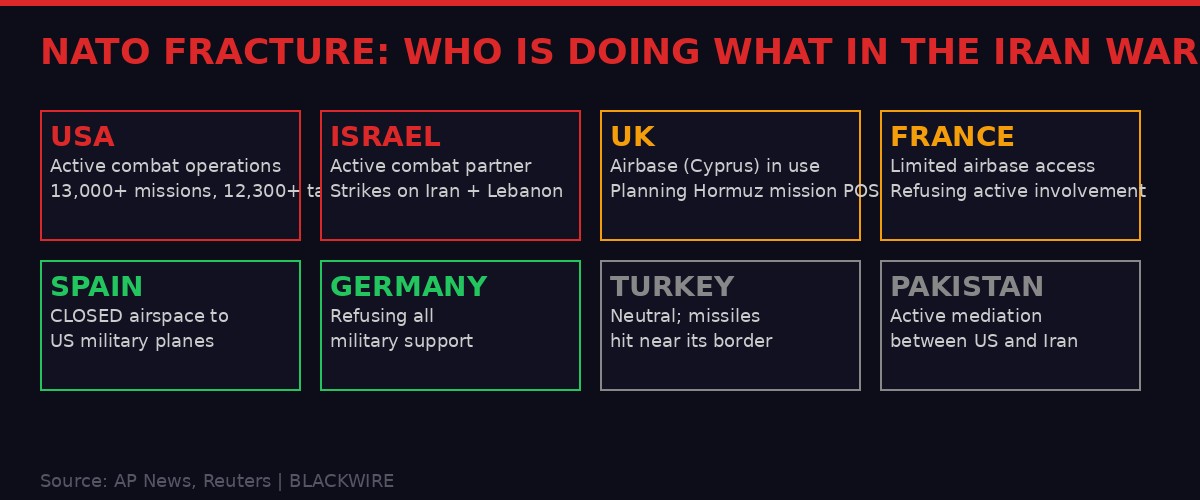
The Western alliance has fractured over the Iran war. Source: BLACKWIRE / AP News
The Iran war has not just created military problems for the United States. It has created a structural rupture in the Western security architecture that multiple administrations spent years carefully managing.
Trump this week mused openly about leaving NATO. At a private White House Easter lunch - footage of which was posted online by a Business Insider reporter - he told Cabinet members and religious leaders: "NATO treated us very badly, and you have to remember it because they'll be treating us badly again if we ever need them." In a separate interview with The Telegraph UK, he suggested he could potentially try to leave the alliance. In his televised Wednesday address to the American people about the war, he chose not to mention NATO by name - suggesting only that countries depending on Hormuz oil "must grab it and cherish it" because the US would not. (AP News, April 4, 2026)
Congress passed legislation in 2023 requiring congressional approval before any president can withdraw from NATO - a law co-championed by none other than Marco Rubio, who was then a Florida senator and is now Trump's secretary of state. It remains unclear whether Trump would legally challenge that legislation. Senate Majority Leader John Thune, a Republican from South Dakota, said bluntly that there were not enough votes in the Senate to support a NATO withdrawal. "We got an awful lot of people who think that NATO is a very critical, incredibly successful post-World War II alliance," Thune said. Both Thune and Senator Chris Coons, a Delaware Democrat, issued a joint statement affirming that "the Senate will continue to support the alliance." (AP News)
But the political damage is already running. Trump has called NATO allies "cowards" for refusing to send naval vessels to the Strait of Hormuz. Secretary of State Rubio said this week the US needs to "reexamine whether or not this alliance that has served this country well for a while is still serving that purpose." Speaking on Fox News, Rubio questioned whether NATO had "become a one-way street where America is simply in a position to defend Europe - but when we need the help of our allies, they're going to deny us basing rights and they're going to deny us overflight." (AP News)
That concern is not hypothetical. Spain has closed its airspace to US military planes involved in the Iran war. France's government, which briefly granted limited airbase access after receiving a "full guarantee" that only non-strike aircraft would use it, has refused to expand that arrangement. Italy's Meloni government - long considered one of Europe's most Trump-friendly governments - is facing mass anti-war protests in Rome and other cities. Germany has refused all military support. The UK has provided airbase access through Cyprus but refused to enter combat operations.
"This is not our operation." - French President Emmanuel Macron, April 2026
Former Trump national security adviser John Bolton, who has since become a critic of the administration, called the failure to build a coalition before the war "a serious mistake." "If you don't build your coalition before the war, it's pretty tough to do it while you're in it," Bolton said. He also cautioned European leaders against reflexively opposing Trump out of frustration - calling that "juvenile and petulant." But the coalition problem is now structural, not merely political. It was built in, from the first strike.
At the deeper strategic level, the NATO fracture creates a risk that analysts have been warning about since the war began: the weakening of deterrence against Russia. NATO's core mechanism is the credible threat that an attack on any member will trigger a collective response. If Trump is actively questioning that commitment, and if European nations are refusing to support US military action, the alliance's internal coherence - the thing that makes the deterrence real - begins to erode. Iulia-Sabina Joja, a senior fellow at the Middle East Institute, noted that European countries are "not keen to go into an active warfare situation" to secure their energy. NATO Secretary-General Mark Rutte is scheduled to visit Washington next week for urgent talks. (AP News)
The Hormuz Chokehold and the Second Front Threat
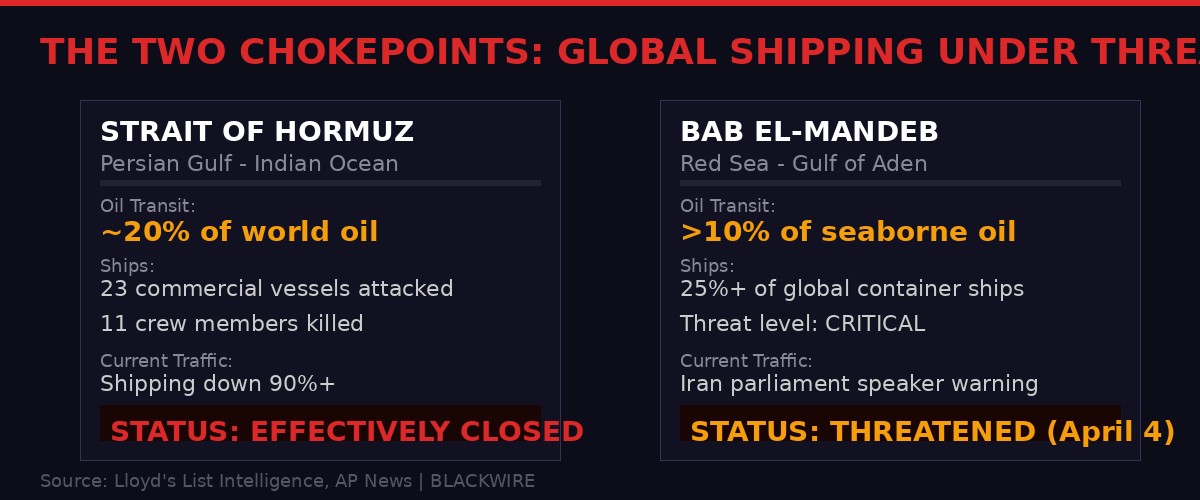
Two straits, two threats. Source: BLACKWIRE / Lloyd's List Intelligence / AP News
The Strait of Hormuz is effectively closed. Not symbolically - operationally. The channel, 54 kilometers wide at its narrowest point between Iran and Oman, carries roughly one-fifth of the world's oil. Since the war began, 23 commercial vessels have been attacked in the Persian Gulf, according to shipping data firm Lloyd's List Intelligence. Eleven crew members have been killed. Traffic has slowed to a trickle, with the remaining flow dominated by sanctions-evading tankers carrying Iranian oil through an informal screening operation run by Tehran itself. (AP News, April 3, 2026)
On Thursday, British Foreign Secretary Yvette Cooper hosted a virtual meeting of 41 nations to discuss reopening the strait. The United States did not attend. No concrete measures were announced. "We have seen Iran hijack an international shipping route to hold the global economy hostage," Cooper said at the meeting's opening. She cited "unsustainable" spikes in oil and food prices as hitting households and businesses "in every corner of the world." The meeting discussed tightening economic pressure on Tehran, working with the UN's International Maritime Organization to free 2,000 ships and 20,000 seafarers trapped by the conflict, and potential post-ceasefire mine-clearing operations. (AP News)
France's Macron stated openly that reopening the strait by force is "unrealistic." "The reopening of the strait can only be done in coordination with Iran," he told reporters during a visit to South Korea, arguing that any physical operation would follow a ceasefire rather than replace one. No country appears willing to try forcing the strait open while fighting rages and Iran can target vessels with anti-ship missiles, drones, attack craft, and mines. The UK said military planners from an unspecified number of countries would meet next week to plot post-war security measures, including potential mine-clearing and "reassurance" escort missions for commercial shipping.
Then came the second threat. Iran's parliamentary speaker Qalibaf's late-Friday message about the Bab el-Mandeb - the 32-kilometer-wide strait linking the Red Sea to the Gulf of Aden and Indian Ocean - landed like a depth charge. More than ten percent of the world's seaborne oil passes through it. A quarter of global container ship traffic uses it. The Houthis spent 2024 demonstrating what a non-state actor could do to that corridor with relatively modest drone capability. Iran, with far greater resources and a regime fighting for survival, is signaling it could do far more. (AP News)
The economic knock-on effects are already severe. Oil prices have spiked globally. Gas prices in the United States have risen sharply, with some markets touching $4 per gallon - a politically toxic threshold. Fertilizer prices have surged with Iranian exports disrupted. Food costs from Pakistan to Portugal have climbed. The war that began as a targeted military operation against Iran's nuclear and military infrastructure is now running an invisible second campaign against the global economy - and the second front may prove harder to end than the first.
Oracle Dubai, Bushehr Again, and the War on Infrastructure
The Iran war has not stayed within Iran's borders. That was never the plan - not Tehran's, and arguably not Washington's either. Each side is targeting the other's dependencies, and the geography of that targeting has expanded steadily across six weeks.
On Saturday, the Dubai offices of Oracle Corporation were struck. The Associated Press verified footage showing a large hole in the building's southwestern corner. Dubai's Media Office described it as "a minor incident caused by debris from an aerial interception that fell on the facade" and confirmed no injuries. Oracle did not immediately respond to requests for comment. (AP News)
The attack was not random. Iran's Islamic Revolutionary Guard Corps has explicitly accused large US technology companies of involvement in "terrorist espionage" operations against Iran and has declared them legitimate targets. Oracle was not the first. Amazon Web Services facilities in the UAE and Bahrain were struck in earlier drone attacks. The pattern is a deliberate campaign to raise the cost of hosting US digital infrastructure in Gulf Arab states - a pressure campaign designed to destabilize American allies without triggering the direct military response that hitting a US military base would produce. It is Iran's version of asymmetric economic warfare, conducted from the air.
On the nuclear front, Iran's Bushehr facility was struck for the fourth time in the war. The Atomic Energy Organization of Iran confirmed the strike, reporting a security guard killed and a support building damaged. Russia's state nuclear corporation Rosatom announced it was evacuating 198 workers from the site. The repeated targeting of Bushehr - a civilian nuclear power plant built and partly staffed by Russian personnel - is one of the most legally and geopolitically fraught dimensions of the conflict. It introduces Moscow directly into the casualty calculus, even if Russia has not yet escalated diplomatically over the evacuations.
Israeli Prime Minister Benjamin Netanyahu confirmed that Israeli forces struck a petrochemical complex in Mahshahr, saying it "helps to fund the war." Iranian state media reported five people killed and 170 injured in that strike. Both sides have now hit civilian industrial infrastructure. International law experts and UN officials have warned of possible war crimes under the laws of armed conflict. The total death toll since February 28 stands at over 1,900 inside Iran, 13 US service members, more than two dozen killed in Gulf Arab states, and 19 in Israel. (AP News)
The Mediation Track: Pakistan, Turkey, and the Narrow Path Out
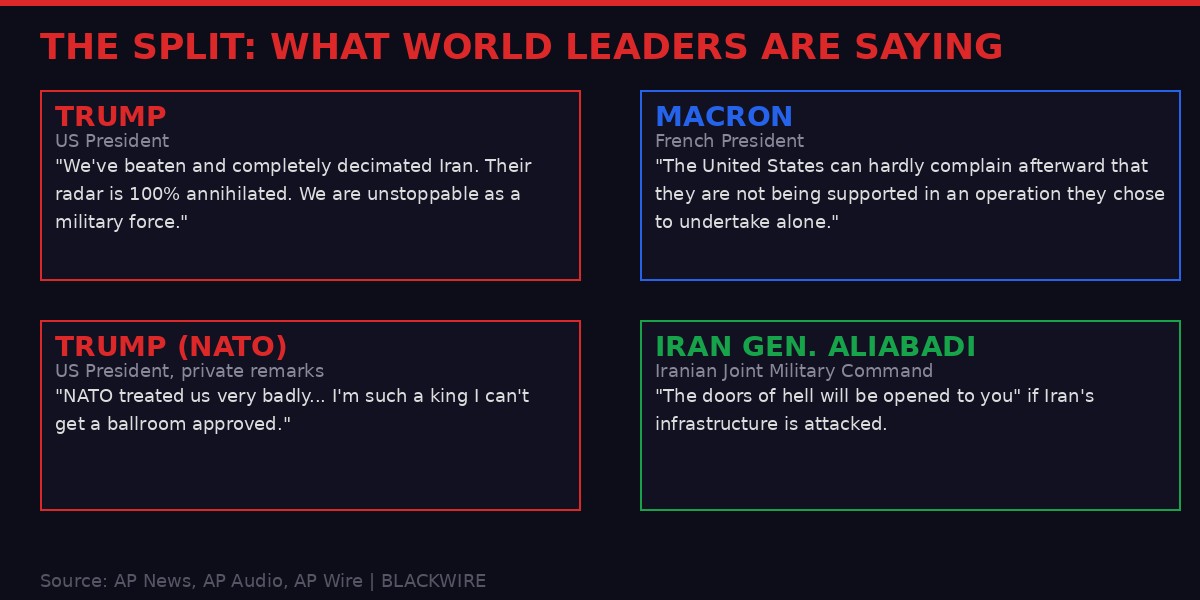
What leaders are actually saying. Source: BLACKWIRE / AP News
While the military escalation continues, a parallel diplomatic track is quietly operating - and it may represent the only realistic off-ramp before Monday's deadline forces a choice nobody wants to make.
Pakistan's Foreign Ministry spokesperson Tahir Andrabi told the AP Saturday that ceasefire efforts are "right on track" after Islamabad last week said it would soon host direct US-Iran talks. Iran's Foreign Minister Abbas Araghchi confirmed that Iranian officials "have never refused to go to Islamabad." That language - careful, non-committal, but not a rejection - is diplomatic code for a process that is alive. (AP News)
According to two regional officials briefed on the mediation effort, Pakistan, Turkey, and Egypt are working jointly to bring the US and Iran to a negotiating table. The proposed framework includes a cessation of hostilities to allow a diplomatic settlement. A Gulf diplomat familiar with the discussions, who spoke on condition of anonymity, described the proposal as a structured compromise - not a capitulation by either side, but a face-saving framework that would let both parties claim partial victory and step back from the current trajectory.
The practical obstacles are significant. Trump has publicly set a Monday deadline for Iran to open the Strait of Hormuz - a demand Iran has flatly rejected as "unbalanced and foolish." Iran's joint military command responded to Trump's renewed threat with the warning about "doors of hell" opening if Iran's infrastructure is attacked further - language calibrated to match the president's own rhetorical register. The domestic politics on both sides make visible concession almost impossible: Trump cannot be seen backing down after declaring total victory, and Iran's regime cannot accept terms that look like surrender.
The Pakistan-Turkey-Egypt mediation track represents the least bad option for both sides. Islamabad has the relationships and the motivation: Pakistan shares a long border with Iran, depends on Gulf oil, and cannot afford a prolonged regional conflict that disrupts trade routes and raises energy prices for its already-struggling economy. Turkey has its own concerns, having seen missiles and drones fired toward its territory as conflict spillover. Egypt controls the Suez Canal and has massive economic exposure to any disruption of regional shipping. All three mediators have something to lose if the war continues - and something to gain in regional standing if they can broker a pause.
There are also signs of back-channel movement in the US-Iran dynamic itself. Trump told NBC News the downed aircraft would not affect negotiations - an unusual statement suggesting the military and diplomatic tracks are being deliberately compartmentalized. Whether that compartmentalization holds through the Monday deadline is the critical question of the next 36 hours.
Europe's Street vs. Europe's Governments
The political pressure on European governments is not only coming from Washington. It is coming from their own populations - and in the six weeks since the war began, that pressure has built into something governments can no longer easily absorb.
On Saturday in Rome, thousands of people marched against the war, waving red trade union banners alongside Palestinian and Cuban flags, chanting for the Meloni government's resignation. "The United States and Israel are destroying any form of coexistence dictated by international law," demonstrator Sandra Paganini told AP. "They are dragging us towards a world war in which they are targeting completely innocent people." The Rome protests were entangled with a domestic political fight over judicial reforms, turning the rally into a combined anti-war and anti-government demonstration ahead of a major March referendum that has become a test of Meloni's survival. (AP News)
Across Spain, simultaneous protests took place in dozens of cities organized by a coalition of civic groups. In Madrid, thousands chanted against the war and expressed solidarity with civilians caught in the conflict. Earlier in the week, demonstrations had swept Athens and other Greek cities. The continent-wide anti-war movement has become the most significant popular mobilization against a US-led military operation since the 2003 Iraq War protests - and in terms of geographic breadth, reaching from Madrid to Athens, it arguably exceeds those demonstrations in scope.
For European leaders, the politics are genuinely difficult. Their populations oppose the war. Their economies are suffering from the energy shock. The United States is demanding military and logistical support. The consequences of a complete rupture with Washington - on NATO, on trade, on the security architecture against Russia - are severe enough that no European government has been willing to cross the line into active opposition. But Spain's airspace closure has come close. If Greece follows, if Italy moves from protest to policy, the coalition dynamics shift again.
The US military has already flown more than 13,000 missions in the conflict and struck more than 12,300 targets, according to US Central Command. Sustaining that operational tempo requires basing and overflight access across a wide geography. Losing partial European cooperation creates operational friction that compounds over time - not a crippling blow on day one, but a grinding problem over weeks and months of a war with no clear endpoint.
Trump's Go-It-Alone Presidency Hits Its Limits
There is a larger pattern here that historians of American foreign policy will spend years analyzing: a president whose entire governing philosophy is built on unilateral action encountering the structural limits of unilateralism in wartime.
Trump launched the Iran war alongside Israel and without consulting Congress or traditional allies. His domestic justification was the familiar one: he alone could fix it. His geopolitical bet was that overwhelming American and Israeli air power would quickly neutralize Iran's military capacity, and that other countries would accept the outcome and move on. The Strait of Hormuz would be reopened. Iranian proxies across the region would be defanged. The nuclear threat would be eliminated. It would be over before the political cost became unbearable.
Six weeks in, none of those outcomes have materialized on the timeline or at the cost implied. Iran's air defenses, while damaged, are still shooting down American aircraft. The Strait of Hormuz is still closed, and a second waterway is now under threat. Iranian proxies and forces continue to strike at Gulf neighbors, regional tech infrastructure, and American naval assets. The nuclear facilities at Bushehr have been hit four times - and Russia is now evacuating its personnel, introducing a Moscow dimension that was not in the original strategic calculus. (AP News, April 4, 2026)
"You can be the most assertive, aggressive president in the world but you don't control what happens overseas." - Julian Zelizer, history professor, Princeton University
The gap between Trump's public characterizations and operational reality has become a liability he can no longer fully manage. "We've beaten and completely decimated Iran," he said in his prime-time Wednesday address. "Their radar is 100% annihilated. We are unstoppable as a military force." Within 48 hours, an F-15E and an A-10 were down. The disconnect between the declared victory and the lived reality of the war is now impossible to paper over.
At home, Trump's go-it-alone approach faces parallel resistance across multiple fronts. The Supreme Court struck down his far-reaching tariff program. Courts have challenged his birthright citizenship executive order, and when he appeared in the Supreme Court chamber as his administration defended it, the justices seemed skeptical. His wanted White House ballroom renovation has been blocked by a judge. He quipped at the Easter lunch: "I'm such a king I can't get a ballroom approved." The joke landed - but it also illustrated a structural truth about American governance that his foreign policy has not fully internalized: power in a republic, even executive power, operates within constraint.
Princeton historian Julian Zelizer framed the core problem precisely: "You can be the most assertive, aggressive president in the world but you don't control what happens overseas." That is not a critique of Trump's determination. It is a description of the fundamental difference between domestic politics, where the president can command, and international conflict, where the adversary votes too.
What Monday's Deadline Actually Means
The 48-hour deadline Trump issued Saturday expires sometime Monday, April 6. Trump has given no specific time, no specific terms, and no specific indication of what "all Hell" actually means in operational terms. That ambiguity is almost certainly deliberate - it preserves flexibility and avoids committing to an escalation he may not be ready to execute, or that the military has not pre-positioned for.
The realistic scenarios on Monday are not binary. The war does not simply intensify or stand down. More likely, Trump extends the deadline with new language, claims some partial Iranian action as compliance, or redescribes the situation in terms that reset the clock. The mediation track through Pakistan provides the most useful face-saving mechanism: an announced "negotiating framework" that both sides can claim as movement without a clear winner or loser. It would not end the war. But it would convert the Monday deadline from a test of credibility into a step toward something else.
What the deadline has already accomplished is political. It has reset the public frame for the war - from a completed operation (as Trump's Wednesday speech implied) to an ongoing one with unresolved objectives that require continued pressure. It has also sent a signal to Iran that regardless of the military losses on the US side, Washington is not walking away. That signal may be the most important component of the 48-hour message. Deadlines, even unenforceable ones, change the diplomatic geometry.
For the missing pilot somewhere in the mountains of Kohgiluyeh and Boyer-Ahmad province, Monday's deadline is an abstraction. The search continues. Iran's state television urges citizens to report any "enemy pilot" to police, suggesting Tehran believes the airman survived the ejection and is on the ground in Iranian territory. The rescue mission - conducted at low altitude, in active combat airspace, by helicopter crews that Cantwell described as performing "such a brave and honorable act" - is the human story at the center of the geopolitical one.
The war Iran's government is fighting, as Ben Taleblu put it, is the war of a "regime that is fighting for its life." That kind of war does not end on a deadline set by the other side. It ends when one or both parties concludes that the cost of continuing exceeds the cost of stopping - or when a face-saving framework makes stopping politically possible without looking like defeat. Neither condition has been met yet. A missing American pilot, two downed aircraft, a fractured alliance, a closed strait, and a second strait now threatened: this is what week six looks like. The doors of hell, whichever direction they open, remain close at hand.
Get BLACKWIRE reports first.
Breaking news, investigations, and analysis - straight to your phone.
Join @blackwirenews on Telegram