Trump's Name on Every Dollar Bill: A First for Any Sitting President
The U.S. Treasury Department announced Thursday that President Donald Trump's signature will appear on all new paper currency - a historic break from 163 years of American tradition that puts a sitting president's name directly in the hands of every citizen. No president has ever done this before. Not Lincoln. Not Roosevelt. Not Washington himself.
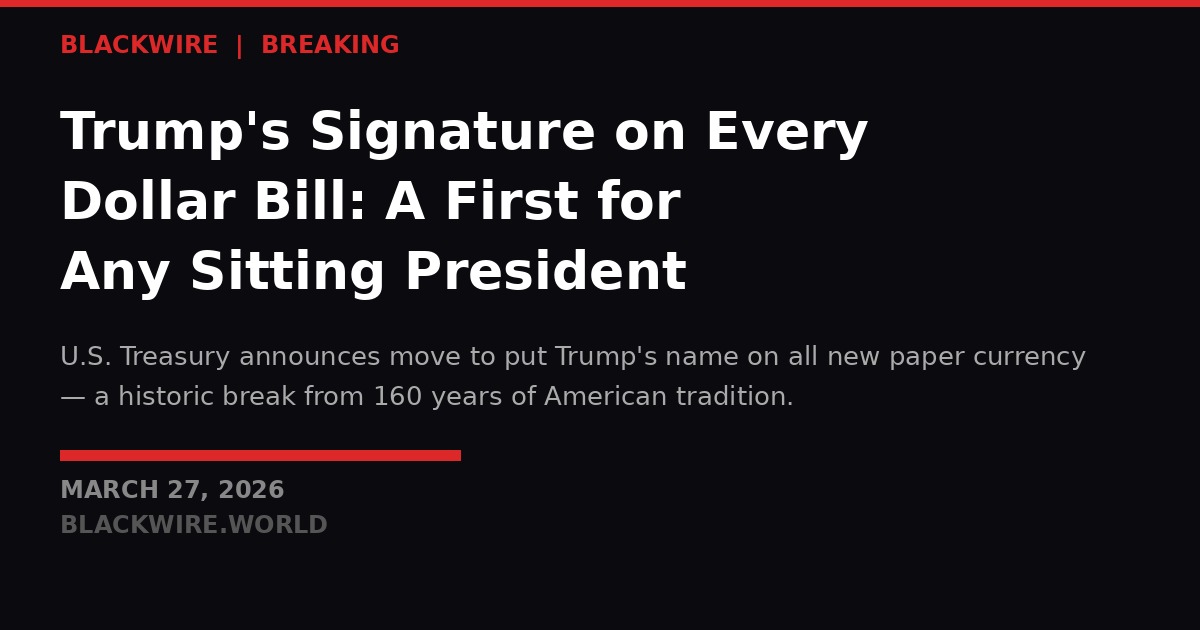
The announcement came Thursday evening, the same week Trump pushed back his self-imposed deadline for Iran to open the Strait of Hormuz, signed an emergency order to pay furloughed TSA agents, and interrupted a Cabinet meeting to talk about Sharpie pens. In that context - days overloaded with crisis management and wartime decision-making - the Treasury Department quietly announced something that will outlast every other decision made this week by a very wide margin.
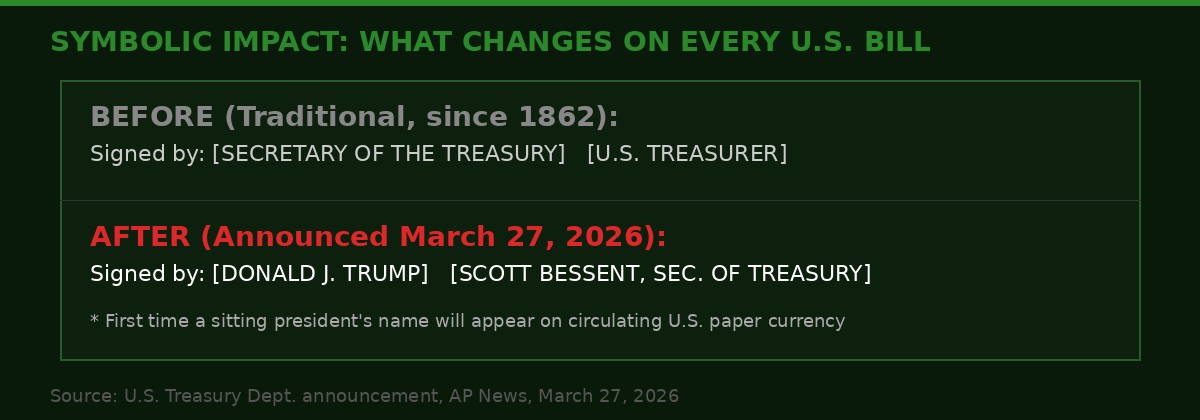
Every new dollar bill, five, ten, twenty, fifty, and hundred dollar note printed from this point forward will carry Donald Trump's signature alongside Treasury Secretary Scott Bessent's. That signature will circulate globally, embedded in more than two trillion dollars' worth of Federal Reserve notes that pass through hundreds of millions of hands each year in more than 170 countries. The U.S. dollar is not just an American instrument. It is the foundation of the global financial system. And from now on, it will bear the sitting president's personal name. (AP News, March 27, 2026)
The Treasury Department framed the move as an honor tied to America's 250th birthday on July 4. Bessent issued a statement calling it "the most powerful way to recognize the historic achievements of our great country." U.S. Treasurer Brandon Beach called it "not only appropriate, but also well deserved." Democrats called it gross and un-American. Historians called it unprecedented. Financial analysts quietly noted that it changes nothing about the dollar's value today but raises long-term questions about the currency's institutional symbolism.
Breaking 163 Years of Tradition
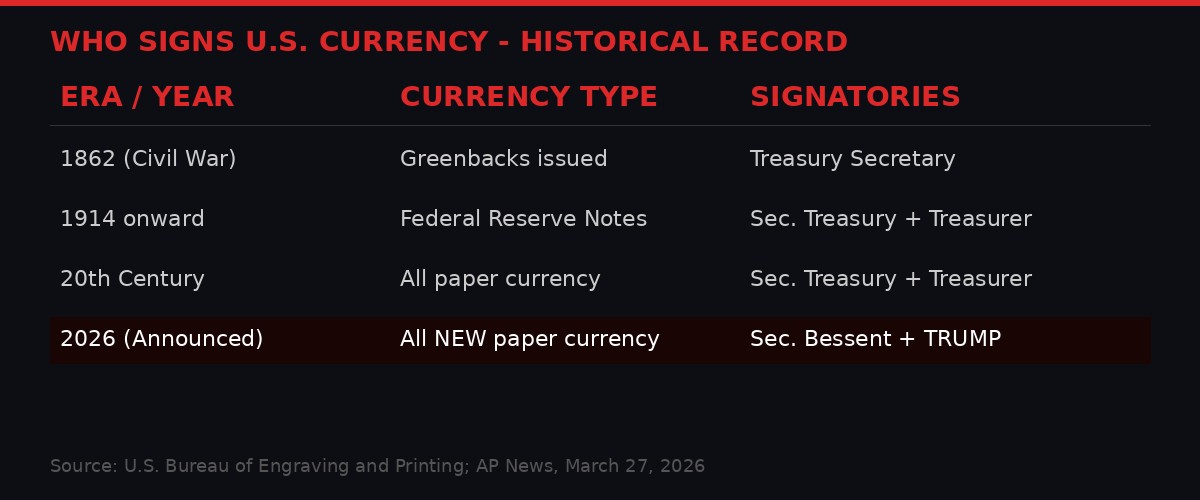
To understand how unusual this is, consider the structure that has governed U.S. paper currency since 1862. When Congress authorized the Treasury Secretary to design and print "greenbacks" to finance the Civil War, it established a clear operational principle: the currency belongs to the nation, not to whoever happens to be president at the time of printing.
Since then, through 27 presidencies and two world wars and a Great Depression and a Cold War and a financial crisis, every single piece of paper money produced by the Bureau of Engraving and Printing has carried exactly two signatures: the Secretary of the Treasury and the U.S. Treasurer. Not the president. Not elected officials. Not party leaders. Two civil servants whose job is to oversee the monetary system.
That is 163 years of institutional continuity, now broken by a single Treasury announcement. (Federal Reserve; U.S. Bureau of Engraving and Printing)
Michael Bordo, director of the Center for Monetary and Financial History at Rutgers University, told AP News the move will "undoubtedly come with political pushback" but acknowledged uncertainty about whether it crosses any legal lines. "I do not know if he has crossed any legal red lines," Bordo said, "since the Treasury Secretary may have the authority to decide who signs the currency." He has been studying American monetary history for four decades. He said this is genuinely new territory.
"There is no more powerful way to recognize the historic achievements of our great country than with U.S dollar bills bearing Trump's name."
- Treasury Secretary Scott Bessent, statement March 27, 2026
Bordo added a wry historical footnote: bills bearing Trump's signature "will be collectors' items many years from now." That framing implies the academic consensus already expects this to be reversed by a future administration. The bills themselves, however, will persist in circulation for years after any such reversal - a physical record embedded in the money supply.
The Legal Gray Zone
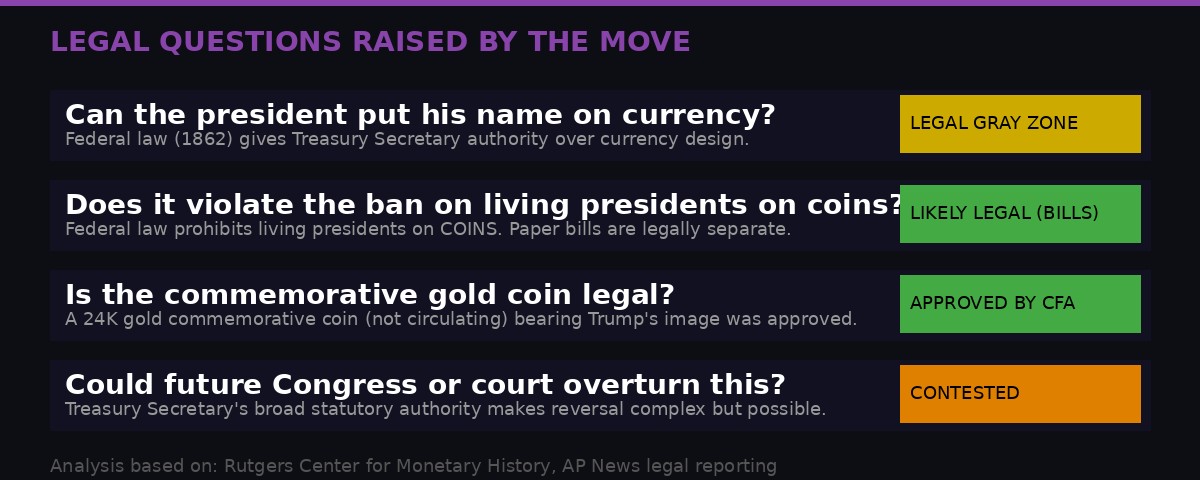
Federal law governing U.S. currency does not explicitly prohibit a president's name on paper bills. The relevant statute - the 1862 authorization that created greenbacks - delegates design authority broadly to the Treasury Secretary. That statutory flexibility is apparently what the Trump administration is relying on to justify the move.
Separately, federal law does prohibit the image of a living person on circulating U.S. coins. That is a distinct law covering coins specifically - not paper currency. The administration is threading a narrow legal gap between the two categories. A signature is not a portrait, and paper is not metal.
The commemorative 24-karat gold coin bearing Trump's image, approved earlier this month by the U.S. Commission of Fine Arts, is technically a non-circulating commemorative item, which sits in a different legal category again. The CFA - whose members were appointed by Trump this year - voted without objection to approve the design for a coin celebrating America's 250th birthday. (U.S. Commission of Fine Arts, March 2026)
The combination - Trump's signature on every paper bill, Trump's face on a gold commemorative coin - forms an unprecedented dual imprint of a sitting president on the U.S. monetary system. Legal scholars will likely contest the paper currency signature in coming weeks. Whether courts would be willing to intervene in what the Treasury Secretary presents as a routine design decision remains to be seen. Similar challenges to presidential executive actions have faced steep odds in federal courts under the current judicial landscape.
Key legal distinction: Federal law explicitly bans living presidents on COINS used as circulating currency. No equivalent law covers paper currency design, leaving the 1862 statute's delegation to the Treasury Secretary as the operative authority. This legal gap may be intentional - or simply never anticipated by the lawmakers of the Civil War era who could not have imagined a president placing his own name on the money.
The Broader Branding Campaign
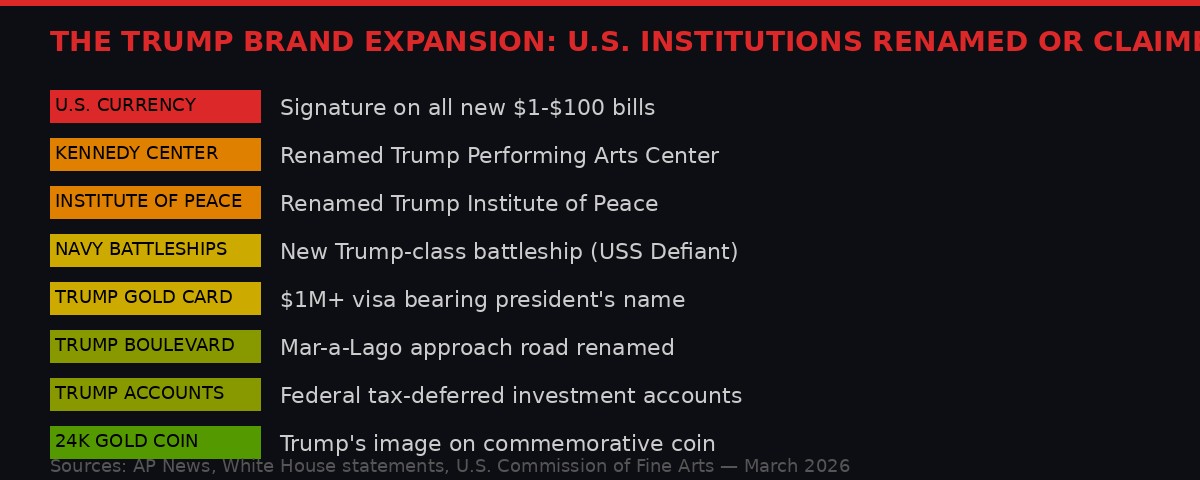
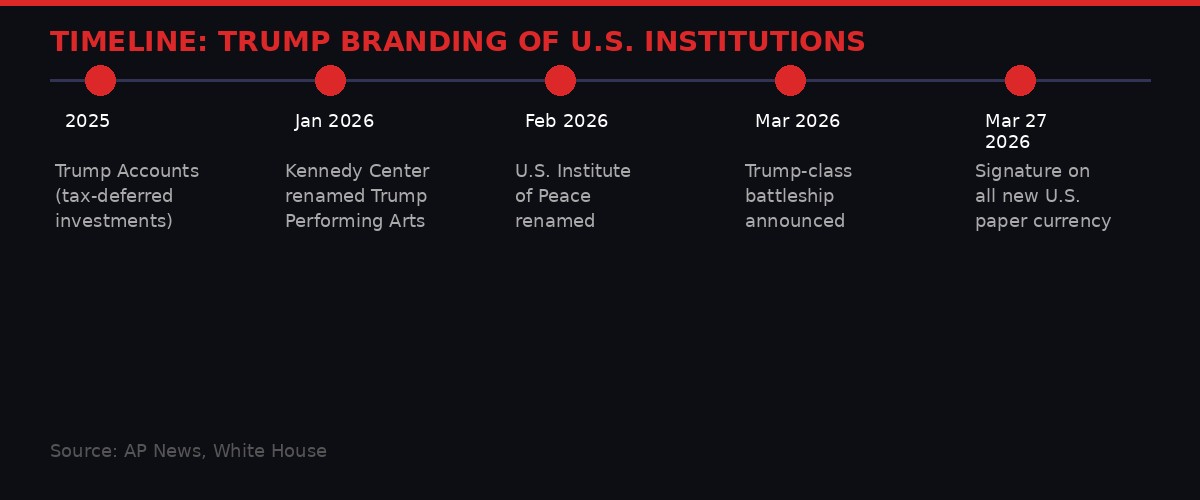
The currency announcement is not an isolated act. It is the latest and most sweeping entry in a systematic rebranding of American public institutions that began at the start of Trump's second term and has accelerated sharply in 2026.
The Kennedy Center for the Performing Arts in Washington - one of the most recognized cultural venues in the world - was renamed the Trump Performing Arts Center earlier this year. The U.S. Institute of Peace, a nonpartisan body established by Congress in 1984, was renamed the Trump Institute of Peace. A new class of Navy battleships is designated the Trump class, with the first vessel named the USS Defiant. Trump announced that ship would be "the fastest, the biggest, and by far 100 times more powerful than any battleship ever built," though defense analysts noted several of the promised technologies remain decades from practical deployment on any warship. (AP News, Navy announcement reporting)
Federally funded investment accounts for children - the "Trump Accounts" - were included in his tax legislation. A government website selling prescription drugs directly to consumers is branded "TrumpRx." A one-million-dollar-plus visa program became the "Trump Gold Card." A transit corridor brokered between Armenia and Azerbaijan was named the "Trump Route for International Peace and Prosperity." A stretch of road approaching Mar-a-Lago was renamed "President Donald J. Trump Boulevard" at a ceremony Trump attended personally.
Jeffrey Engel, the David Gergen Director of the Center for Presidential History at Southern Methodist University in Dallas, has tracked this pattern closely. "At no previous time in history have we consistently named things after a president who was still in office," Engel told AP News. "One might even extend that to say a president who is still alive. Those kind of memorializations are supposed to be just that - memorials to the passing hero." He described the currency move, when reached for additional comment by multiple outlets, as categorically different from road renamings because of the global systemic significance of U.S. paper currency.
The White House pushed back on historical comparisons, noting that Washington D.C. was named after George Washington while he was alive, and that the Hoover Dam was named for Herbert Hoover while he served as president. Critics noted those were named by Congress or state authorities as tributes - not rebranded by Washington or Hoover themselves at their own direction.
The Currency Numbers: Scale and Global Reach
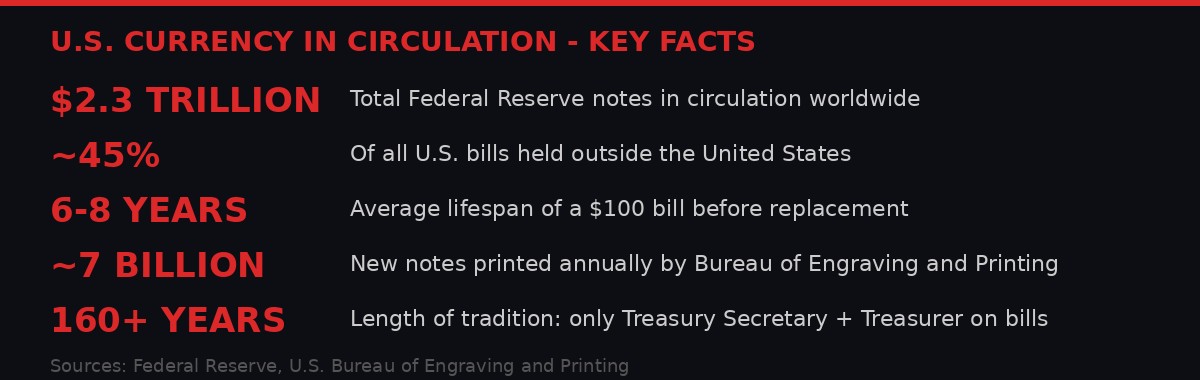
To grasp the full scope of Thursday's announcement, consider what U.S. paper currency represents in the global economy and how widely it reaches beyond American borders.
More than $2.3 trillion in Federal Reserve notes are currently in circulation worldwide, according to the Federal Reserve. Roughly 45% of all U.S. currency is held outside the United States - in the hands of foreign nationals, businesses, and governments who rely on the dollar as a reserve asset, a store of value, or a medium for international trade. The dollar underwrites contracts, settles trades, and backs sovereign wealth in dozens of countries. It is not just an American artifact. It is the architecture of global commerce.
The Bureau of Engraving and Printing produces approximately 7 billion new notes every year. A typical $100 bill lasts six to eight years before wearing out and being replaced. As existing currency gradually cycles out of circulation over the coming years, Trump-signed bills will systematically replace them - embedding his name into the physical dollar as permanently as any engraved portrait on the face of the bill.
For the 160 million Americans who use cash daily, and for the billions of people worldwide who hold or accept U.S. dollars, the signature is not abstract symbolism. It is a physical artifact that will sit in wallets, pass across counters, and flow through economies for the next decade and beyond. A market vendor in Lagos, a tourist in Bangkok, a shopkeeper in Buenos Aires - all will handle Trump-signed currency without choosing to do so.
"It also means that many years from now those bills will be collectors' items."
- Michael Bordo, Director, Center for Monetary and Financial History, Rutgers University
What Bordo's collector-item comment implies - and what Treasury's framing carefully avoids - is that these bills will not last forever as Trump bills. Future administrations retain the same statutory authority the Treasury Secretary is invoking today. A successor president's Treasury Secretary can instruct the Bureau of Engraving and Printing to remove Trump's name from new currency at any time. The bills already in circulation, however, will remain - a physical historical record of 2026 stamped into the money supply for the lifespan of every note currently being planned for print.
The Political Reaction
Democratic reaction was swift and sharp, arriving within hours of the announcement Thursday evening.
Representative Shontel Brown of Ohio posted on X that the Treasury plan is "gross and un-American. But at least it will remind us who to thank when we pay more for gas, goods, and groceries." The timing was pointed: oil prices are up more than 45% since the U.S. and Israel attacked Iran on February 28, with Brent crude trading above $107 a barrel on Friday morning. Grocery prices, fuel costs, and airline fares have all spiked sharply. Americans are paying for the war in Iran at every checkout counter, and the Treasury is announcing the president's name will now appear on the money they pay with. (AP News, March 27, 2026)
The juxtaposition is uncomfortable. A Treasury announcement celebrating Trump's name on the currency was released the same week Americans watched their government fail to pay TSA agents for 42 consecutive days, creating 40% callout rates at major airports and forcing nearly 500 TSA officers to quit outright. The Senate worked through Thursday night to approve a partial DHS funding deal. Trump signed an emergency executive order directing Homeland Security to pay TSA agents immediately using funds from his 2025 tax legislation - a legally creative workaround that bypassed congressional appropriations entirely. (AP News, TSA funding report)
On the political right, reaction to the currency announcement was mostly celebratory or silent. The White House's formal statement that the administration is focused on "delivering on President Trump's goal of Making America Great Again" rather than "smart branding" was received with some skepticism by political analysts who noted the chosen delivery mechanism - putting the president's personal name on the national currency - is, definitionally, branding of the most visible kind imaginable.
Internationally, the reaction has been quieter but the implications are significant. Foreign governments, central banks, and sovereign wealth funds that hold dollar reserves as a sign of faith in U.S. institutional stability and neutrality are watching an American president place his personal name on the world's reserve currency. No formal commentary has emerged yet from Beijing, the European Central Bank, or Gulf sovereign wealth funds. But the symbolism will not be lost on them. The dollar's global dominance has historically depended on its perception as an instrument of the U.S. government broadly, not of any individual leader. That perception is now being actively tested.
What the Precedent Means Long-Term
There is no obvious way to undo the immediate impact of the announcement. New notes will begin rolling off the Bureau of Engraving and Printing with Trump's signature embedded. The legal authority appears to exist within the broad delegation of the 1862 statute. The physical reality will follow on a production timeline measured in weeks, not years.
But the precedent created by Thursday's action has implications that extend far beyond Trump himself. If the Treasury Secretary can unilaterally add a sitting president's name to circulating currency as a design choice - without legislation, without a congressional vote, without a constitutional amendment - then every future president has the same option available to them. The norm against presidential names on currency was not written into law. It was simply something no one had ever done. Now it has been done. The seal is broken permanently.
Does that mean future presidents will all do the same? Not automatically. But the decision will now have to be made explicitly rather than assumed. Every incoming Treasury Secretary will face a choice that previously did not exist. Some administrations will decline. Others may embrace it. The institutional buffer against presidential personalization of the currency has been removed.
Historically, paper currency's design has projected national symbols chosen by consensus: George Washington, Abraham Lincoln, Alexander Hamilton, Benjamin Franklin, Andrew Jackson, Ulysses Grant. These figures were selected over generations for their historical significance and placed on the currency long after their deaths - or, in Washington's case, through a process that Washington himself reportedly disliked. Inserting a living, sitting, politically active president into that iconography blurs a line that democratic systems have typically kept sharp: the difference between the state and the person temporarily leading it.
France used currency and monumental public space to project leader cults during Napoleon's era. Mussolini's Italy did the same. So did most of the authoritarian regimes of the twentieth century. The United States had, until now, consciously and consistently avoided that category of self-referential display by leaders currently in power. Whether this announcement marks a genuine departure from that tradition or simply an aggressive use of an available legal mechanism - or whether those are even different things - is a question historians will debate long after the bills are in circulation.
The 250th Birthday Framing and What It Hides
The official rationale from Treasury is straightforward and carefully worded: America turns 250 years old on July 4, 2026. The semiquincentennial is the stated occasion. Bessent's statement frames Trump's signature as a recognition of "historic achievements" in honor of the nation's 250th birthday. U.S. Treasurer Beach called it "well deserved."
That framing is doing a significant amount of work. The 250th birthday of the United States is a genuine national milestone, one planned for years with events, commemorative items, and infrastructure spending. The gold commemorative coin bearing Trump's image was explicitly tied to the July 4 celebration and approved by the Commission of Fine Arts as a bounded commemorative item.
But the decision to put a president's signature on circulating paper currency - not a commemorative coin, not a parade banner, not a limited-edition certificate - is categorically different from typical anniversary observances. Circulating currency does not have an expiration date. There is no mechanism by which these bills are recalled on July 5, 2026. The semiquincentennial framing suggests a bounded commemoration. The actual policy creates an indefinite, ongoing feature of U.S. monetary instruments. Every new bill printed after the production change takes effect will carry Trump's signature until a future administration reverses it - which may not happen for years, if ever.
Bessent's statement said Trump's signature would appear alongside his own on new currency. That pairing is itself notable. Treasury Secretary Bessent is a financial professional with deep market credibility who has generally been regarded as a stabilizing force within an administration known for economic volatility. His name will now be permanently linked - on every new bill printed - to an action that most monetary historians consider unprecedented and many consider a serious departure from institutional norms. Whether Bessent privately views the move the way his public statement suggests is unknown. Senior administration officials who disagree with presidential decisions rarely announce it.
What Happens Next
The Bureau of Engraving and Printing will need to update its printing templates to include Trump's signature. That is not an overnight technical process - engraving the intaglio plates used in currency production takes weeks, and production cycles for new notes are already scheduled months in advance. The first Trump-signed notes will likely begin appearing in circulation sometime before the July 4 anniversary, possibly in late spring.
Legal challenges are likely. The ACLU and other civil liberties organizations have successfully challenged multiple Trump executive actions in federal courts. The most plausible legal argument would focus on whether the Treasury Secretary's broad design authority extends to adding the sitting president's personal name - as opposed to a presidential seal or institutional title - to circulating monetary instruments. That argument faces the challenge that the 1862 statute is written broadly and courts have historically given significant deference to executive branch design decisions on currency.
Congressional Democrats may introduce legislation explicitly prohibiting a sitting president's name on circulating currency. Whether such a bill would pass a Republican-controlled House and Senate, or survive a presidential veto even if it did, is unlikely in the current political environment.
Internationally, the dollar's reserve currency status has long rested partly on its perceived institutional independence from political manipulation. Central banks and sovereign wealth funds that hold dollars as a reserve of trust in American institutional neutrality may treat this announcement as a data point in longer-running debates about dollar alternatives - the yuan, a digital reserve unit, or gold. That effect, if any, will emerge over years rather than days.
For ordinary Americans, the practical change will be quiet. A new $20 at the grocery checkout might catch someone's eye - the same two-signature format, but with a different name in an unexpected place. Whether that registers as historic, offensive, amusing, or nothing at all depends entirely on the person holding the bill. What is not subject to debate is the historical significance of the act itself. For 163 years, American presidents left the dollar alone. That ended Thursday night in Washington.
Get BLACKWIRE reports first.
Breaking news, investigations, and analysis - straight to your phone.
Join @blackwirenews on Telegram