The Files Are Opening: Trump Orders UFO Declassification as Pentagon Sits on 757 Cases It Cannot Explain
The U.S. government has 457 aerial incidents it cannot identify, explain, or attribute to any known nation or technology. Now a presidential order is forcing those files out into the open - at the exact moment humans are returning to the moon for the first time in 53 years, and as the Pentagon is fighting in court over whether AI should control autonomous weapons without human oversight. The timing is not coincidence. The implications are not reassuring.
The Order That Changed the Conversation
President Trump announced via social media that he is directing the Pentagon and all government agencies to identify and release files related to "alien and extraterrestrial life, unidentified aerial phenomena (UAP), and unidentified flying objects (UFOs), and any and all other information connected to these highly complex, but extremely interesting and important, matters." The announcement came within hours of Trump publicly accusing former President Barack Obama of disclosing "classified information" when Obama said on a podcast that aliens are "real" - while simultaneously clarifying he had not personally seen evidence of alien contact.
The order did not come entirely out of nowhere. It was preceded by Obama's casual podcast appearance in which he stated, with unusual candor, that extraterrestrials exist in some form - a statement that set off a week of speculation, congressional pressure, and eventual presidential action. Trump told reporters aboard Air Force One: "I don't know if they're real or not," and said of Obama, "I may get him out of trouble by declassifying."
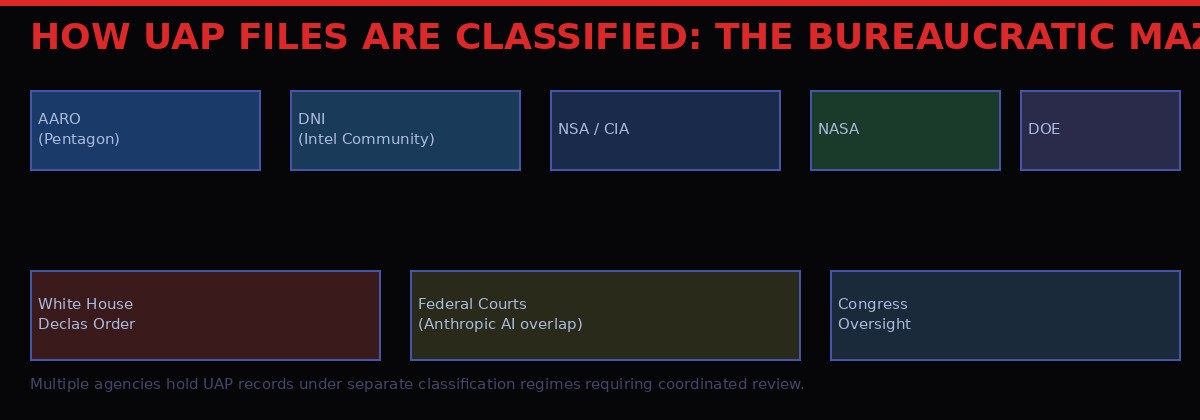
That framing - a political joke about getting someone out of trouble - understates what is actually being ordered. Releasing UAP files means forcing multiple intelligence agencies, military branches, and classified programs to inventory, review, and expose decades of material that has been protected under national security classifications. That is not a press release. That is a bureaucratic excavation that will take months, generate legal challenges, and almost certainly produce sanitized versions of the actual information involved.
"I'm directing government agencies to release files related to alien and extraterrestrial life, unidentified aerial phenomena (UAP), and unidentified flying objects (UFOs), and any and all other information connected to these highly complex, but extremely interesting and important, matters." - President Donald Trump, social media post, April 2026 (AP News)
What the order does immediately is shift the political frame. For decades, asking about UFOs was a way to get dismissed. Now the president of the United States has explicitly ordered a declassification review. The Overton window has not just moved - it has been removed entirely from the building.
What the Pentagon Actually Has: 757 Cases, 457 Unexplained
The most substantive public document in this space is the Pentagon's FY2024 Consolidated Annual Report on UAP, submitted to Congress in November 2024. It covers 757 cases reported to U.S. authorities from May 2023 through June 2024, including 272 incidents that occurred earlier but had not previously been reported to the All-Domain Anomaly Resolution Office, known as AARO.
Of those 757 cases, investigators found explanations for approximately 300. The explanations are mundane: balloons, birds, commercial aircraft, Elon Musk's Starlink satellite chains, drones. Starlink alone has become a significant source of misidentifications as the satellite internet network expands - chains of satellites seen from certain angles can look genuinely inexplicable to someone who does not know what they are looking at.
That leaves 457 cases with no satisfactory explanation. The report is careful to note that "unexplained" often means "insufficient data" rather than "genuinely anomalous" - many reports lack enough information to draw conclusions. But some cases are different. In one documented incident, a commercial flight crew reported a near-miss with a "cylindrical object" while flying over the Atlantic Ocean off the coast of New York. That incident remained under active investigation at the time of the report. Three separate military air crews reported being followed or shadowed by unidentified aircraft - and investigators found no evidence linking the activity to any known foreign power.
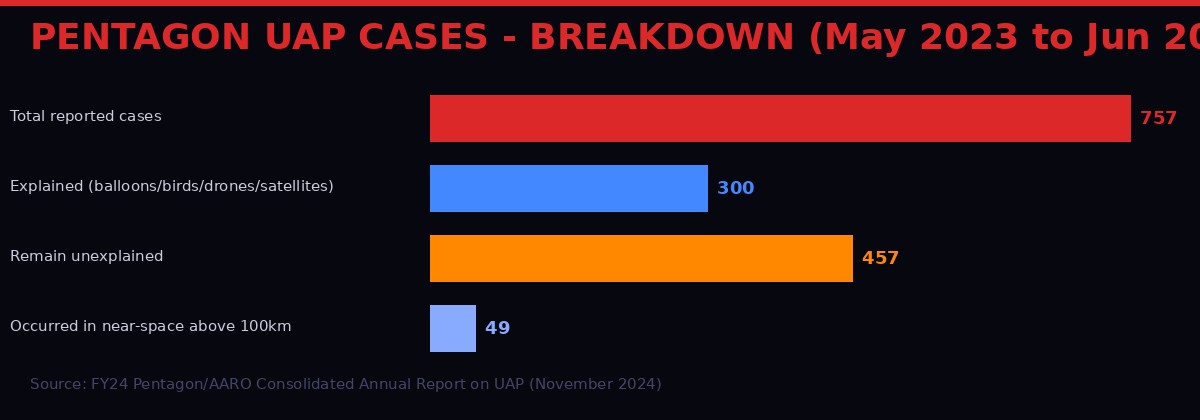
Forty-nine of the 757 cases occurred at altitudes estimated to be at least 100 kilometers above the Earth's surface - the internationally recognized boundary of space. No injuries and no crashes were reported across any of the 757 incidents. Reporting witnesses ranged from commercial and military pilots to ground-based observers. Visual descriptions most commonly described unidentified lights or spherical orb shapes. One witness reported what appeared to be a jellyfish with flashing lights.
The report's authors stressed, repeatedly, that "AARO has discovered no evidence of extraterrestrial beings, activity, or technology." That statement is doing a lot of work. It does not say AARO found evidence of domestic technology. It does not say the objects are explainable. It says there is no evidence of extraterrestrial origin - which is a very specific and technically defensible denial that leaves a large amount of space unaddressed.
From Roswell to AARO: How the Government Has Managed UAP for 79 Years
The history of official UAP management in the United States is a study in strategic ambiguity. The pattern has been consistent: acknowledge enough to appear transparent, classify enough to avoid specifics, and never say anything that confirms the most alarming interpretations.
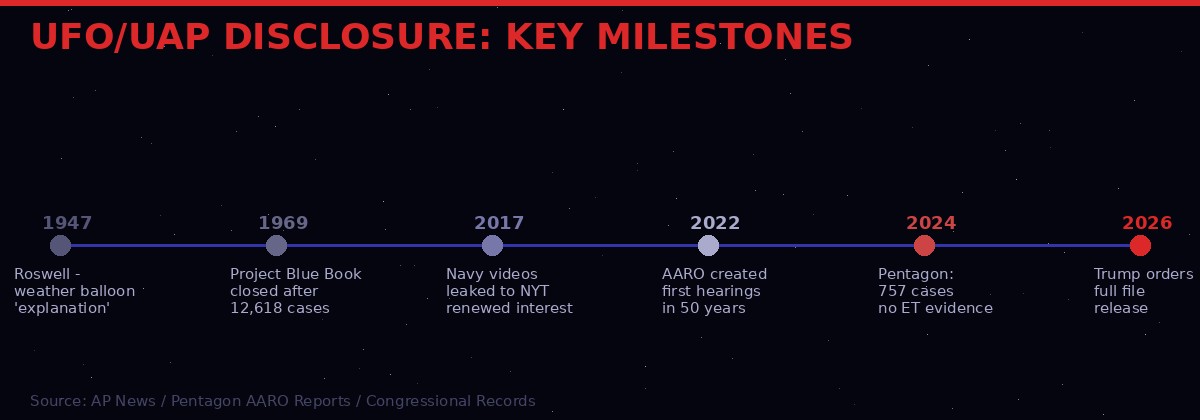
The 1947 Roswell incident set the template. The military initially announced the recovery of a "flying disc." Within days, that was walked back to a weather balloon. The weather balloon story held for decades - until internal documents emerged in the 1990s suggesting it was actually a classified Project Mogul balloon designed to detect Soviet nuclear tests. The official story was true in a narrow technical sense while being misleading in every practical one.
Project Blue Book, the Air Force's systematic investigation of UFO sightings, ran from 1952 to 1969 and examined 12,618 reported incidents. The Air Force declared 701 of them "unidentified" at closure - meaning Project Blue Book itself closed with nearly 6% of its cases unexplained. The project was disbanded after the Condon Report (1968) concluded that further study was unlikely to produce findings of scientific value. Critics have noted that the Condon Report's conclusions did not always match the evidence presented in the report itself.
The modern era of UAP transparency began in 2017, when a group of former Pentagon officials and government contractors leaked Navy videos of unidentified objects to The New York Times and Politico. The videos - later officially released by the Pentagon - showed objects exhibiting flight characteristics that existing publicly-known aircraft could not replicate: sudden stops, hypersonic speed without visible propulsion or sonic boom signatures, rotation patterns inconsistent with conventional aerodynamics.
Those leaks triggered a political process. Congress held the first public hearings on UFOs in 50 years in May 2022. Objects that appeared to be green triangles floating above Navy ships - initially described as mysterious - were eventually identified as likely unmanned aircraft systems, with the triangle shape being an artifact of night-vision camera distortion. In July 2022, the Pentagon established AARO as a centralized office for UAP reporting, replacing a patchwork of separate military and intelligence programs that had operated without coordination for decades.
The 2024 congressional hearings escalated further. Former military officers testified about recovered craft and non-human intelligence. The most dramatic claim came from retired Rear Admiral Timothy Gallaudet, who said: "The nonhuman intelligence that operates them or controls them are absolutely real. We've recovered crashed craft. We don't know if they're extraterrestrial in origin." That testimony, given to Congress under oath, has received relatively limited mainstream coverage compared to its explosive content.
The People Who Study This Seriously
Harvard physicist Avi Loeb has done more than anyone in mainstream academia to legitimize rigorous scientific study of UAP. As director of the Galileo Project for the Systematic Scientific Search for Evidence of Extraterrestrial Technological Artifacts, Loeb has argued that the scientific community's dismissal of UAP research is itself a form of motivated reasoning - a refusal to examine evidence because the implications are culturally uncomfortable.
Loeb is not gentle about his assessments. "If I were looking at Earth from a distance, I would be pretty disappointed," he told AP. "Most of our investing is dealing with conflicts to prevent other people from killing us or us killing others." His view is that any civilization capable of interstellar travel would almost certainly find humanity's behavior - currently split between a war over Iranian oil shipping lanes and arguments about AI weapons ethics - less than impressive.
"They might be laughing at us. They might be watching us ... to make sure we will not become predators, that we will not become dangerous to them." - Avi Loeb, Harvard physicist and director of the Galileo Project (AP News)
Bill Diamond, president and CEO of the SETI Institute - which has systematically searched for extraterrestrial intelligence for decades - takes a more cautious but still open position. "Absolutely, there are such things as UAPs and UFOs," Diamond said. "People observe things in the sky that they can't immediately identify or recognize as either human engineering or animals."
Diamond's more pointed observation concerns government classification. "We have pretty advanced technologies - satellite, ground-based - that are for various purposes mostly national security and defense that are pointing at the sky or things on board aircraft. Sometimes these pick up objects. The technology behind it is sensitive and protected." This is a critical point: the reason UAP data remains classified is often not because of what the objects are, but because of what the sensor systems that detected them reveal about U.S. intelligence capabilities.
Edwin Bergin, astronomy professor at the University of Michigan, adds the cosmological perspective: with billions of galaxies each containing billions of stars, the probability of life developing elsewhere is statistically very high. His view on what advanced beings would do upon arriving: "I would think that they would look at us like we were crazy... but they would come out. I mean, why come here otherwise unless you're going to sit and observe."
The Anthropic Connection: When AI, Weapons, and UAP Collide
Here is where the story becomes genuinely strange - and genuinely important. Happening simultaneously with the UAP declassification order is a court battle over whether AI systems should be allowed to operate autonomous weapons without human oversight. The two stories seem unrelated. They are not.
The Pentagon is currently appealing a federal court order that blocked it from designating Anthropic - maker of the Claude AI - as a "supply chain risk." The dispute began when Anthropic refused to allow its AI to be used in fully autonomous weapons or for mass surveillance of American citizens. The Pentagon's position, articulated by Defense Undersecretary Emil Michael, is that the military needs AI that will work on "all lawful use" cases - including scenarios where humans cannot make decisions fast enough.
Michael's specific example: Golden Dome, Trump's proposed missile defense program that aims to place weapons in space. He described a scenario where the U.S. has 90 seconds to respond to a Chinese hypersonic missile. A human operator "may not be able to discriminate with their own eyes," he argued - implying that an AI making that decision autonomously is the intended design. His other scenario: autonomous laser systems defending military bases against drone swarms.
"I need a reliable, steady partner that gives me something, that'll work with me on autonomous, because someday it'll be real and we're starting to see earlier versions of that. I need someone who's not going to wig out in the middle." - Emil Michael, Pentagon Chief Technology Officer, on the All-In podcast (AP News)
The link to UAP is this: if the U.S. military is designing autonomous AI weapons systems that can independently identify and engage aerial targets in space - and simultaneously has 457 unidentified aerial phenomena in its logs, 49 of which occurred in near-space - the question of what the AI shoots at becomes non-trivial.
U.S. District Judge Rita Lin, who blocked the Pentagon's retaliation against Anthropic, was explicit about what she saw: "Nothing in the governing statute supports the Orwellian notion that an American company may be branded a potential adversary and saboteur of the U.S. for expressing disagreement with the government." The Trump administration appealed her ruling. The Ninth Circuit has set an April 30 deadline for the Justice Department to file arguments for overturning her decision.
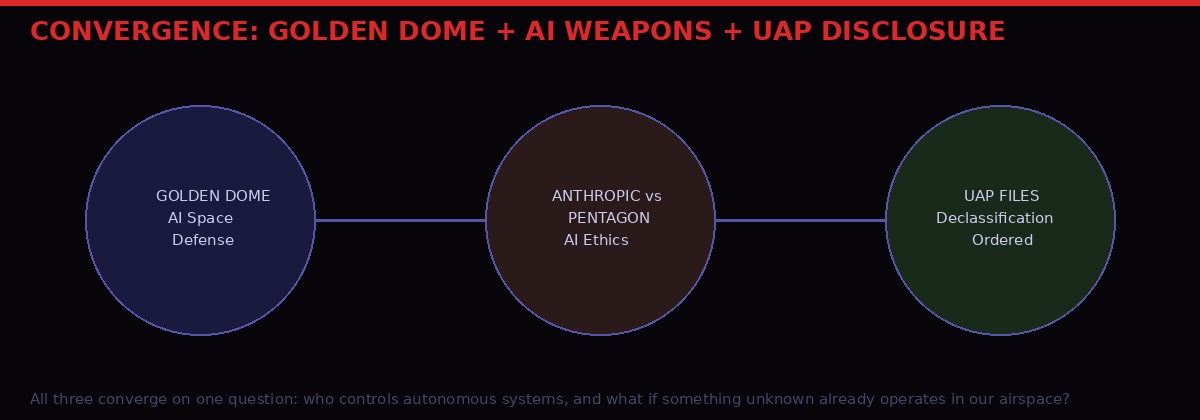
This is the second-order effect that most coverage misses. The debate about autonomous weapons is not abstract. It is about whether AI systems will be designed to engage unknown aerial objects without human confirmation of what those objects are. The Pentagon already cannot explain hundreds of aerial incidents. It now wants AI systems that can act on classifications it makes autonomously. The UAP files - whatever they contain - would feed directly into the training data and threat assessment frameworks of any AI deployed in that role.
Anthropic's position - that current AI systems "are simply not reliable enough to power fully autonomous weapons" - takes on a different dimension when placed alongside the UAP data. Google, OpenAI, and Elon Musk's xAI all agreed to the Pentagon's "all lawful use" terms. Those companies' AI systems are now cleared for autonomous weapons deployment under whatever rules the Defense Department writes for itself.
Artemis II: Humans Return to the Moon During the Strangest Week in UAP History
While Trump orders files released and courts battle over autonomous weapons, four astronauts are currently traveling through space 252,000 miles from Earth. The Artemis II crew - Reid Wiseman, Victor Glover, Christina Koch, and Canadian Jeremy Hansen - launched Wednesday on NASA's Orion capsule. By Saturday they were more than halfway to the moon, preparing for a lunar flyby on Monday April 6 that will take them deeper into space than any human crew since Apollo 13 in 1970.
"The Earth is quite small and the moon is definitely getting bigger," reported pilot Victor Glover from the capsule. Glover is the first Black astronaut to travel to the moon. Koch is the first woman. Hansen is the first non-U.S. citizen to travel to the lunar vicinity. The Canadian Space Agency's president, Lisa Campbell, speaking from Quebec during a live televised linkup, said: "Today he is making history for Canada. As we watch him taking this bold step into the unknown, let his journey remind us that Canada's future is written by those who dare to reach for more."
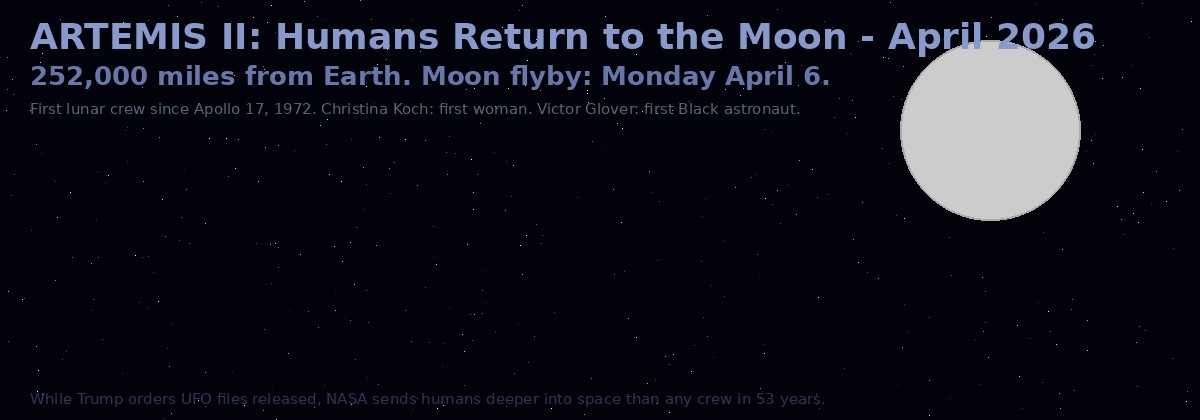
Artemis II is not attempting a lunar landing - that mission, Artemis III, is targeting 2028 near the lunar south pole. What the current mission is doing is validating the Orion capsule's life support systems, navigation, and crew performance under real deep-space conditions. The mission will set a new distance record for humans: over 400,000 kilometers from Earth before the capsule loops behind the moon and heads home. The crew will photograph the lunar far side - the hemisphere permanently facing away from Earth that humans have never observed at close range from a crewed vehicle.
The timing is notable. The Artemis program was conceived as a return to lunar science and a stepping stone to Mars. Under Trump, NASA's strategic priorities have shifted, with some gateway lunar orbit station components deprioritized. The fact that Artemis II launched successfully, with the crew performing well, represents momentum that is difficult to reverse politically - even in the middle of the Iran war, debates about autonomous weapons, and the reopening of UFO files.
The question that Avi Loeb asks - what would beings advanced enough for interstellar travel think of us? - has a particularly pointed answer this week. We are sending four humans on a 10-day trip around the moon. We are simultaneously fighting over whether our AI can decide to shoot things in space without checking with a human first. And we are finally agreeing to look at 79 years of files we have been keeping from ourselves.
What the Files Are Likely to Contain - and What They Won't
Intelligence professionals and legal experts are generally skeptical that Trump's declassification order will produce dramatic revelations. The reasons are structural, not conspiratorial.
First, declassification requires review. Before any document is released, it must be examined for information that would compromise ongoing operations, expose sources and methods, reveal capabilities of allied intelligence services, or disclose the existence of classified sensor systems. That review process can take years. The JFK assassination records - a far simpler declassification task - have been under review for decades and still have not been fully released. UAP records involve significantly more agencies and more sensitive technology.
Second, the most sensitive material may not be in files at all. Bill Diamond's point about sensor technology protection means that classified UAP detections are often buried inside signals intelligence programs, satellite tasking orders, and radar system technical specifications. The anomalous objects themselves may be undocumented - only the capabilities that detected them are written down, and those capabilities are what is actually classified.
What UAP Declassification Will Likely Produce
- Historical records: Roswell-era documents, Project Blue Book files not yet public
- Redacted AARO reports with sensor and method information removed
- Pentagon and DNI summary reports that acknowledge cases without explaining them
- Congressional testimony transcripts (some already public)
- Possibly: classified military video footage with sensitive metadata stripped
What Is Unlikely to Appear
- Technical specifications of sensor systems that detected objects
- Operational details of programs that investigated recovered material
- Intelligence community assessments of whether objects are foreign technology
- Any material that would reveal a foreign adversary's capabilities
- Anything classified higher than Secret in its current form
Gallaudet - the retired Rear Admiral who testified before Congress - wants the Navy's "trove" of classified UAP video shared with scientists for analysis. His argument is that even if the underlying platform data must remain classified, the anomalous signatures themselves could be extracted and analyzed by researchers who sign appropriate agreements. That approach is scientifically sensible. Whether the intelligence community will accept it is a different question.
The most likely outcome of Trump's order is a batch of historical documents, a set of redacted contemporary reports, and a formal acknowledgment that the government has been monitoring unexplained aerial phenomena for decades. Whether that acknowledgment comes with any actual explanation is unlikely - because the government genuinely does not have one for the 457 open cases.
Why This Moment Is Different - and the Second-Order Effects to Watch
Every UAP disclosure wave since 1947 has eventually been followed by a period of quieting. The Roswell excitement subsided. Project Blue Book was closed. The 2017 Navy video leaks produced hearings and then relative silence. This cycle may be different for several reasons that have nothing to do with the files themselves.
The technology gap is closing. For decades, the argument against serious scientific investigation of UAP was that there were no good data collection tools available to the public. That is no longer true. SETI has radio telescopes. Loeb's Galileo Project has all-sky cameras with AI-powered object detection. Commercial satellite networks provide global imagery at unprecedented resolution. If anomalous objects are operating in airspace, the probability of systematic independent detection is now much higher than it was in 1969 when Project Blue Book was closed.
The autonomous weapons question creates political pressure. The debate about AI and weapons is not going away. As that debate intensifies - as courts rule, as companies choose sides, as international competitors build their own autonomous systems - the question of what those systems might encounter in contested airspace becomes unavoidable. The military cannot simultaneously argue it needs AI that can autonomously engage aerial objects and refuse to acknowledge that it has hundreds of aerial objects it cannot identify.
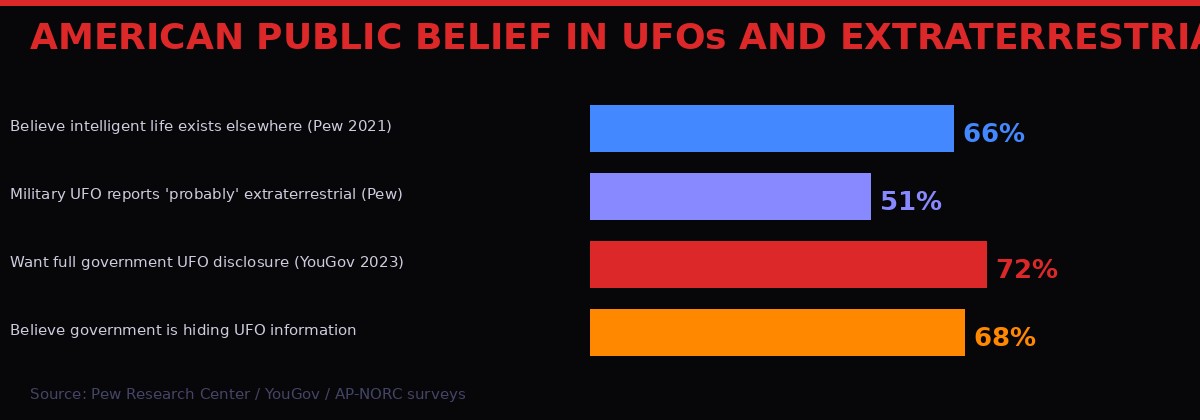
The Artemis program changes the public frame. Humans being in space, heading to the moon, seeing the Earth from 252,000 miles away - this is precisely the context in which the scale of the universe becomes visceral rather than abstract. Pew Research found in 2021 that 66% of Americans believe intelligent life exists elsewhere. When astronauts are live-streaming from lunar distance and Trump is ordering UFO files released in the same week, public engagement with these questions reaches a different level.
Finally, the credibility of the witnesses has changed. The people now making the most dramatic claims about UAP are not anonymous internet posters. They are retired military officers, former intelligence officials, university professors, and sitting members of Congress. Republican Representative Andy Ogles of Tennessee put it plainly at the 2024 hearings: "There is something out there. The question is: Is it ours, is it someone else's, or is it otherworldly?"
That question is now, officially, one the U.S. government says it wants to answer.
The Timeline: From Roswell to Declassification
The bureaucratic machinery is now moving. Whatever comes out will be filtered, redacted, and carefully managed. But the order has been given. The files are opening. Whether what they contain will match 79 years of speculation, institutional denial, and increasingly credible witness testimony - that question will have at least a partial answer before 2027.
The less politically comfortable scenario is not that the files reveal something extraordinary. It is that they confirm what the AARO data already suggests: there are objects in U.S. and global airspace that no government agency can explain, that have been there for decades, and that the most powerful military apparatus in human history genuinely does not know what to do about.
As the Artemis II crew photographs the lunar far side from 252,000 miles away, and as AI systems capable of autonomous targeting decisions go through final regulatory approvals, that scenario deserves more attention than the alien hunter discourse usually allows.
Get BLACKWIRE reports first.
Breaking news, investigations, and analysis - straight to your phone.
Join @blackwirenews on TelegramSources: AP News - Trump UAP declassification order (April 2026); AP News - Pentagon/Anthropic autonomous weapons dispute (March-April 2026); Pentagon FY24 Consolidated Annual Report on UAP (November 2024); AP News - Artemis II lunar mission (April 2026); Pew Research Center - American beliefs about extraterrestrial life (2021); Congressional UAP hearings testimony (2022, 2024); Avi Loeb / Harvard Galileo Project statements via AP; SETI Institute CEO Bill Diamond via AP; AP News - UAP public interest analysis (April 2026).