Emergency Order, Day 41: Trump Bypasses Congress to Pay TSA as American Airports Collapse
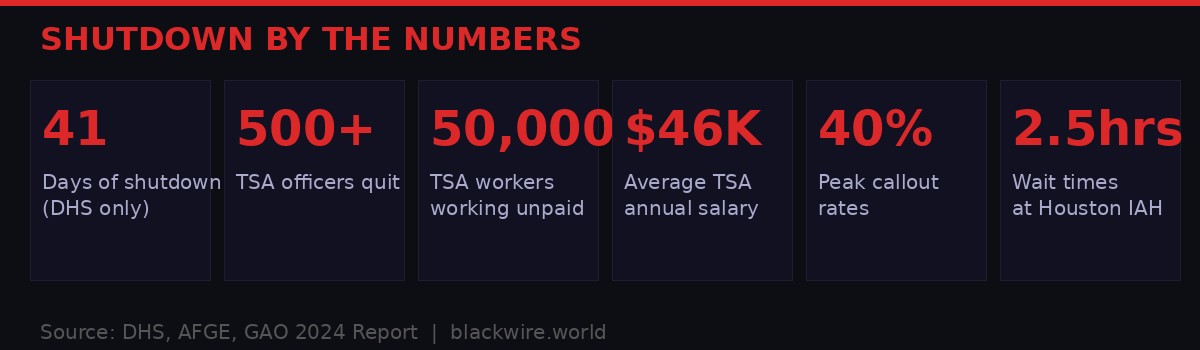
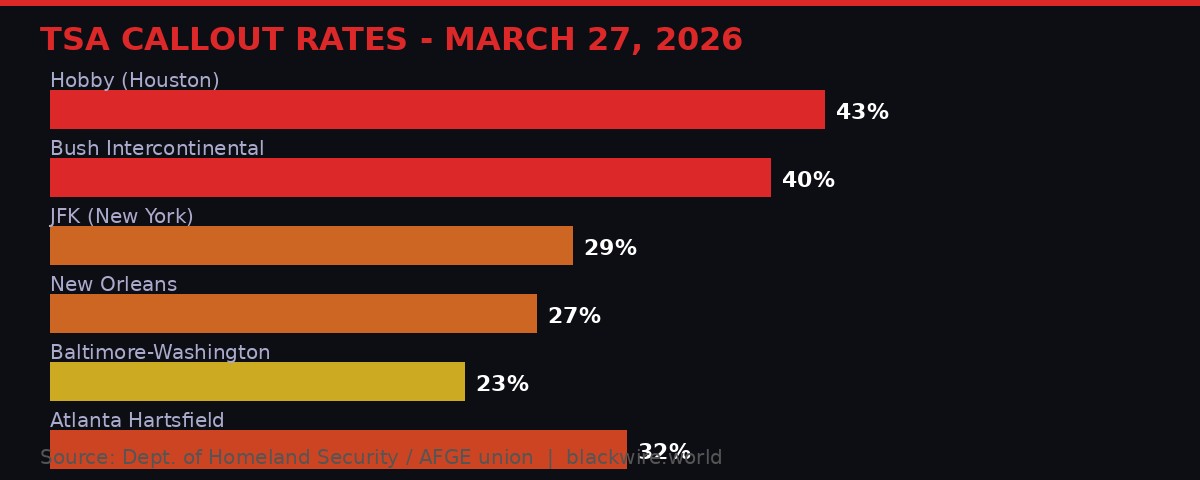
Five hundred airport screeners have quit rather than work for nothing. Callout rates hit 43 percent at Houston's Hobby Airport. Security lines stretch past two hours at a dozen major hubs. On Day 41 of the Department of Homeland Security funding shutdown, President Donald Trump stopped waiting for Congress and announced he would sign an emergency executive order to keep the agency's paychecks flowing - bypassing the deadlock that has turned America's air travel system into a slow-motion collapse.
The announcement came Thursday afternoon as senators, already scheduled to leave Washington for their two-week spring recess, scrambled for a "last and final" deal that never materialized. Trump posted on his social media network that he wanted to stop the "Chaos at the Airports" - his words - and would act without waiting for lawmakers.
"It is not an easy thing to do, but I am going to do it!" the president wrote. (Source: AP News, March 27, 2026)
The legal mechanics behind the emergency order were not immediately clear. Options floated by the White House included invoking a national emergency - a politically combustible move sure to face court challenges - or simply transferring funds from other accounts within the executive branch budget. Sen. Susan Collins of Maine, the Republican who chairs the Appropriations Committee, said there were legal pathways to pay TSA workers without a formal emergency declaration.
What was clear by the time the news broke was that America's airports were in trouble. Not symbolic trouble. Real, operational, passengers-missing-flights trouble that has been building for weeks and just crossed into a new category of severity.
How a Partial Shutdown Became a Total Airport Crisis
To understand why Thursday's emergency order was necessary, you have to understand what has been done to TSA workers over the past eighteen months.
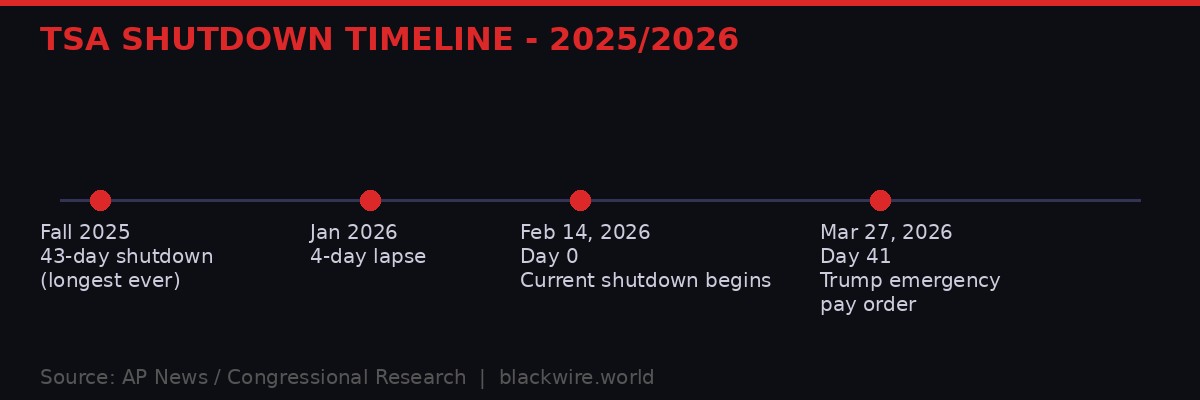
The current shutdown began Valentine's Day - February 14, 2026 - and has now stretched to 41 days. But it is not a clean 41 days. TSA screeners have spent almost half of the past 170 days working without paychecks. There was a brutal 43-day fall 2025 shutdown - the longest in American history at the time. A brief four-day funding lapse in January 2026. And now this.
Each cycle has left the same people holding the bag. TSA screeners are classified as essential workers, meaning they cannot simply stay home when Congress fails to pass a budget. They are legally required to report for work. They screen your bags, your shoes, your liquids, your children - and they do it whether or not a paycheck arrives on Friday.
"It's just exhausting. Every day it just feels like this weight gets heavier and heavier on us." - Cameron Cochems, TSA union leader, Boise, Idaho. Source: AP News
Cochems, a four-year veteran screener and vice president of his regional American Federation of Government Employees chapter, already holds a seasonal second job - screening college sports teams at airports - to supplement his TSA pay. Even that is not enough anymore. His wife was laid off two weeks ago. He described going to his airport's food drive to pick up supplies for his family. (Source: AP News)
This is not an outlier story. It is the norm.
A 2024 Government Accountability Office report found that TSA had some of the lowest employee morale in the entire federal government, driven by years of comparatively low pay, inconsistent management and poor work-life balance. The starting salary for a TSA agent is approximately $34,500. The average range is $46,000 to $55,000. These are the workers responsible for the security of 2.6 million daily flights. (Source: GAO 2024 Workforce Report; TSA careers website)
The GAO report warned explicitly that unless underlying structural issues were fixed, attrition would persist. Nobody fixed them. Now the bill is due.
The Numbers: 500 Quit, Dozens of Airports Hemorrhaging Staff
As of Thursday, more than 500 TSA officers have resigned outright since the shutdown began. The Department of Homeland Security confirmed at least 376 resignations in its official count, but union officials believe the true number is higher, and note that a tighter labor market is the only thing preventing an even larger exodus. (Source: DHS, AFGE)
Nationwide, about 10 to 11 percent of scheduled TSA workers are missing their shifts daily. That average conceals a catastrophic picture at specific airports.
At George Bush Intercontinental in Houston - the nation's seventh-busiest airport, with 48.4 million passengers in 2024 and a United Airlines hub - the crisis has been particularly visible. Of 37 normal checkpoint lanes, only a third to a half are currently staffed. The result: warning signs plastered at the airport entrance advertising 4-hour wait times. Lines snaking down escalators and around terminal floors. Travelers missing their flights. (Source: Houston Airport System director Jim Szczesniak; AP News)
"And we've been in this airport since 8 o'clock in the morning. Very tired, queuing and queuing and very slow." - Edgaer Fernando, traveler to Guatemala, George Bush Intercontinental Airport. Source: AP News
Melissa Gates, trying to reach Baton Rouge from Houston on Thursday, said she would not make her flight after more than two and a half hours in line. No other flights were available until Friday. "I should have just driven, right? Five hours would have been hilarious next to this," she told AP. (Source: AP News)
These are not isolated complaints. They are a systemic indicator of an agency being hollowed out in real time.
Why Houston Hit Hardest
Every major US airport is struggling. But Houston has become the symbol of this crisis, and the reasons are structural, not random.
First, the economic profile of Houston's TSA workforce. The city has some of the highest housing costs and cost-of-living pressures among major US metros outside of coastal megacities. TSA workers in Houston are already living close to the financial edge on $46,000 average annual pay. When paychecks stopped, the math collapsed faster than in smaller cities where living costs are lower.
Second, Bush Intercontinental's traffic volume. The airport moved 48.4 million passengers in 2024, making it the major United Airlines hub for the South and Southwest. A callout rate that might be manageable at a regional airport becomes a logistical catastrophe at a hub carrying 130,000 passengers a day.
Third, timing. March is Houston's historically strongest tourism month. CERAWeek - the energy industry's annual mega-conference, drawing 10,000+ executives and analysts from across the world - ran earlier in March. The Houston Livestock Show and Rodeo drew 2.6 million attendees. NCAA Tournament Sweet 16 games were played in Houston this week. The airport was already stretched before a single TSA officer missed a shift.
Johnny Jones, secretary-treasurer of AFGE Council 100 representing TSA workers nationally, put it simply: "If everybody's being paid, you wouldn't have no lines." (Source: AP News)
But nobody has been getting fully paid. And no new TSA workers have been hired anywhere in the country for approximately a year - a hiring freeze that has compounded the staffing gap on top of the shutdown attrition. (Source: AFGE, AP News)
What the Politics Broke
This shutdown is not a standard government funding lapse. It is specifically limited to the Department of Homeland Security - the agency that houses TSA, ICE, CBP, FEMA, the Coast Guard, and the Secret Service. The rest of the federal government is funded. DHS is not.
The reason is immigration politics, and it has been grinding since February 14.
Democrats have refused to vote for DHS appropriations until guardrails are placed on Trump's immigration enforcement operations - particularly after the fatal shootings of Alex Pretti and Renee Good in Minneapolis, where Border Patrol agents shot two Americans during a confrontation with immigration protesters. Democrats want ICE agents to wear visible ID badges, remove face masks, stay away from churches and schools, and submit to judicial warrants before searching private spaces rather than using administrative warrants signed internally. (Source: AP News; Congressional testimony)
Republicans have refused to accept what they call restrictions on lawful enforcement. The standoff has produced 41 days of unpaid TSA workers, 500+ resignations, and 2-hour airport lines - but has produced no deal.
Senate Majority Leader John Thune presented a "last and final" offer to Democrats on Thursday. Details were not disclosed, but the framework reportedly picked up from weekend proposals - including some concessions toward immigration enforcement guardrails, and promises to address Trump's proof-of-citizenship voting bill in subsequent legislation. As of filing time, the offer remained under review. Both chambers are scheduled to recess for two weeks in April.
Meanwhile, the money for immigration enforcement itself kept flowing. Trump's tax cut bill signed last year directed $75 billion to DHS specifically for ICE and deportation operations. ICE agents and immigration enforcement officers have continued to receive their paychecks throughout the shutdown. It is the TSA screeners - the workers checking your luggage, not deporting people - who have gone without. (Source: AP News; Congressional Budget Office)
The resulting image is politically sharp: armed ICE agents deployed to airports to check travelers' IDs - a practice drawing legal challenges - while the unarmed workers who run the actual security checkpoints stand at food drives collecting donated groceries.
The Timeline: Forty-One Days of Accumulated Damage
The Human Cost: Evictions, Empty Fridges, Cancer Treatments Missed
The acting TSA administrator, Ha Nguyen McNeill, testified before the House Committee on Homeland Security on Wednesday, cataloguing the human damage with clinical precision: eviction notices. Vehicle repossessions. Empty refrigerators and overdrawn bank accounts. (Source: House Homeland Security Committee hearing, March 25, 2026)
Aaron Barker, a local TSA union leader in Atlanta, held a press conference outside Hartsfield-Jackson this week.
"I've heard from officers who cannot afford copayments for cancer treatments or office visits for their sick children." - Aaron Barker, AFGE local union leader, Atlanta. Source: AP News
These are not abstract policy consequences. They are people with specific cancers and specific children who are missing specific appointments because the US Congress cannot pass a budget for the agency that secures America's airports.
Cameron Cochems in Boise put it another way: "I think more people are staying with the TSA that don't want to be here." In a stronger job market, he believes the resignation count would be far higher. The current 500+ figure is likely a floor, not a ceiling. (Source: AP News)
The financial pressure compounds in ways that do not show up in resignation statistics. Officers are taking extra shifts at side jobs - cutting their rest time between security shifts. They are not eating properly. They are stressed in ways that affect judgment. And they are still putting their hands on 2.6 million passengers per day of baggage, still making the thousand-small-decisions that airport security requires, still working through it.
The GAO's 2024 report warned explicitly that persistent financial stress, low morale, and high attrition created security risks. Nobody cited that report in the last 41 days of negotiations. Nobody appears to have checked the box asking what happens to security quality when the security workforce is running on empty and waiting for their government to notice.
What the Emergency Order Actually Does - and What It Doesn't
Trump's announcement was characteristically light on details. The "emergency order" language was confirmed by the president's social media post Thursday, but the exact mechanism - whether it constitutes a national emergency declaration, a discretionary funds transfer, or some other executive authority - was not specified before the end of Thursday's trading session.
Sen. Collins's comments suggest the administration may have a cleaner option than a full emergency declaration: redirecting money from other executive branch accounts that does not legally require the national emergency label. If that path holds, it reduces but does not eliminate the likelihood of immediate court challenges.
What the order almost certainly does not do is end the shutdown. Paying TSA workers out of redirected funds does not resolve the fundamental dispute between Democrats and Republicans over ICE and immigration enforcement guardrails. It removes the most visible and politically costly symptom - collapsed airport lines, workers quitting, canceled flights - while leaving the underlying standoff intact.
For Democrats, the calculus is now different. The most visceral public pressure point - airport chaos - is being neutralized by Trump's order. Their leverage just shrank. For Republicans, the order provides political cover to leave Washington for spring break without voting. The incentive to reach a deal before recess has just dropped significantly.
That is the strategic picture. The workers who quit their jobs this month do not get those jobs back when the order goes through. The 500 resignations are permanent. The security expertise that walked out with them does not return.
The Broader Context: What America's Airports Look Like Right Now
Beyond the TSA crisis, America's airports are navigating an extraordinary confluence of pressures in March 2026. Oil prices have spiked to above $100 per barrel since Iran's effective closure of the Strait of Hormuz - a development that affects jet fuel costs, airline profitability, and ultimately ticket prices. The Iran war's effects on global travel insurance rates, Gulf transit routes, and international passenger confidence are still being tabulated. (Source: AP News; Lloyd's List Intelligence)
Meanwhile, Trump's deployment of ICE agents to airport gate areas for domestic ID checks - beyond what TSA already screens - has added a new variable. Legal challenges have been filed across multiple federal circuits. Some travelers report being approached for documentation while waiting at domestic departure gates. The program has drawn criticism from civil liberties organizations and even some Republican senators who worry about the optics of immigration enforcement mingling with ordinary domestic travel.
The combination - TSA callout chaos at security, ICE agents at the gates, $100 oil making flights more expensive, and a government that cannot pass a budget to pay the people who make it all work - adds up to something that does not have a clean name yet.
It is not a crisis in the traditional sense of an acute event. It is the product of 41 days of political calculus applied to an essential infrastructure workforce that had already been pushed to its breaking point by 18 months of intermittent non-payment.
What Comes Next: Recess, Precedent, and the 500 Who Already Left
Congress is scheduled to leave Washington for its April recess. Both chambers. Two weeks. If Trump's emergency pay order holds legally, lawmakers will return to a situation where TSA workers are being paid, airports are functional, and the political pressure to negotiate has partially dissipated.
That creates a path where the shutdown persists indefinitely but becomes invisible - paid through executive funds rather than congressional appropriations, with no visible crisis driving urgency. Democrats and Republicans each return to base positions. The underlying dispute over ICE guardrails remains unresolved. And the next time there is a funding fight, both sides have now observed that a president can unilaterally paper over a DHS shutdown if needed.
For the TSA workforce specifically, the emergency order is better than no order. The second missed paycheck was set to arrive Friday. For workers already borrowing against car titles and missing cancer treatment co-pays, that paycheck matters more than any press release about congressional negotiations.
But it does not restore the 500 who resigned. It does not fill the security lanes that closed because of understaffing. It does not address the year-long hiring freeze that left TSA with no slack in the system when the shutdown began. It does not undo the eviction notices already served, the vehicles already repossessed, the children who already went without a doctor visit this month.
"There's high call outs, but it's also the excessive origination point for a lot of flights." - Johnny Jones, AFGE Council 100. On why Houston's crisis is structural, not incidental. Source: AP News
The emergency order is a tourniquet on a wound that needed surgery six months ago. It stops the bleeding. It does not fix anything that is actually broken.
The Senate's "last and final" offer remained under review as of this filing. Ha Nguyen McNeill, the acting TSA administrator, told Congress this week: "This is a dire situation." She was describing staffing. She could have been describing any part of the system she is trying to run on a workforce that has been told, repeatedly, over eighteen months, that the rules of essential work apply to them but the obligation of payment does not.
Day 41. The emergency order is signed. The recess looms. And at Bush Intercontinental in Houston, the line at Terminal C security is still two hours long at 7 in the morning.
Get BLACKWIRE reports first.
Breaking news, investigations, and analysis - straight to your phone.
Join @blackwirenews on TelegramSources: Associated Press (March 26-27, 2026): Wall Street drops, TSA shutdown coverage, Houston airport impact report, Trump emergency order announcement, TSA workers resign / airport wait times; U.S. Government Accountability Office, TSA Workforce Report 2024; House Committee on Homeland Security testimony, Ha Nguyen McNeill, March 25, 2026; American Federation of Government Employees Council 100; Department of Homeland Security official callout rate figures; Houston Airport System director Jim Szczesniak; Congressional Budget Office budget analysis.