Day 40: America's Airports Are on the Edge - TSA Warns of Closures, ICE Takes the Checkpoints

Travelers face record wait times at major U.S. airports as the DHS shutdown enters its 40th day. (Pexels)
The acting administrator of the Transportation Security Administration stood before Congress on Wednesday and said the words that travel industry officials had feared for weeks: some American airports may have to shut down.
Ha Nguyen McNeill, confirmed to lead the TSA on an interim basis, used her three-hour testimony before the House Homeland Security Committee to describe a workforce in crisis - hundreds of agents donating plasma to pay rent, others sleeping in cars, parents skipping meals so their children can eat. More than 480 officers have quit outright since the Department of Homeland Security lost its funding on February 14. Callout rates at the busiest airports have climbed past 40 percent. And the political standoff that triggered all of it remains fully intact, with no end in sight after 40 consecutive days.
"At this point, we have to look at all options on the table," McNeill told lawmakers. "And that does require us to, at some point, make very difficult choices as to which airports we might try to keep open and which ones we might have to shut down as our callout rates increase."
It was the starkest official acknowledgment yet that the DHS funding fight - a battle ostensibly about immigration enforcement - is now threatening the basic infrastructure of American air travel. And it landed on Day 40 of a standoff that has already produced the longest security lines ever recorded at U.S. airports, deployed immigration agents to domestic departure terminals, and handed Democrats their first political scalp in Trump's own backyard.
How Valentine's Day Became the Day Air Travel Started Dying

TSA checkpoint lines at major hubs have hit multi-hour waits not seen before in U.S. aviation history. (Pexels)
The current DHS shutdown began on February 14 - the third funding lapse in less than six months - when Congress missed a deadline to renew the department's operating budget. Unlike broader government shutdowns, this one is surgical: it targets only the Department of Homeland Security and the more than 300,000 federal employees under its umbrella.
TSA officers are classified as essential personnel. That means they must report for duty regardless of whether a paycheck is coming. It is a legal requirement. It is also, increasingly, an impossible one.
The starting salary for a TSA agent is approximately $34,500. The average runs $46,000 to $55,000, according to the agency's own careers site. These are not high earners. They are people with car payments, mortgages, children in school, medical bills. Forty days without income has broken the finances of tens of thousands of families.
"Some are sleeping in their cars, selling their blood and plasma, and taking on second jobs to make ends meet, all while being expected to perform at the highest level when in uniform to protect the traveling public," McNeill said in her prepared remarks. (AP, March 25, 2026)
The situation is not new - the U.S. Government Accountability Office published a report in 2024 flagging persistent low morale, high attrition, and chronic pay dissatisfaction at TSA as systemic risks. But that structural weakness was a slow burn. The funding lapse turned it into a fire. TSA spent roughly 43 of the past 170 days without pay during shutdowns that began in the fall of 2025. Each episode depleted savings, strained families, and pushed more agents toward the exit. This time, the math may finally catch up.
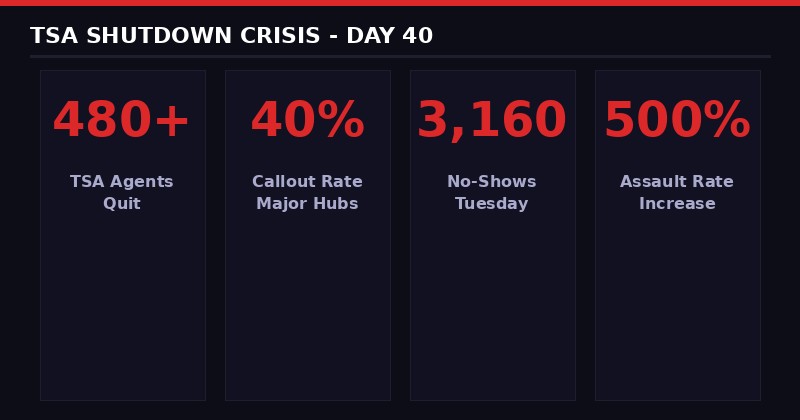
By the numbers: The TSA workforce crisis on Day 40 of the DHS funding lapse. (BLACKWIRE infographic)
The Numbers Behind the Warning
The callout data released by DHS this week tells the story in plain terms. On Tuesday, March 24, more than 3,160 TSA employees nationwide did not report for duty. That figure represents approximately 11 percent of all scheduled TSA workers for that day - a rate that would cripple any service operation. At the airport level, the situation is worse.
McNeill confirmed multiple airports are experiencing callout rates above 40 percent. The specific figures reported to Congress:
Houston's William P. Hobby Airport logged a 43 percent callout rate. George Bush Intercontinental, Houston's primary hub, reached 40 percent. Atlanta's Hartsfield-Jackson International - the single busiest airport in the United States by passenger volume - came in at nearly 37 percent. New York's JFK International, the gateway for tens of millions of international travelers, also hit 37 percent. New Orleans' Louis Armstrong International followed at 36 percent.
"Every day I come to the airport and I look at the food drive, see what things I can get for my family." - Cameron Cochems, TSA union leader, Boise, Idaho, speaking to the AP
The consequences for travelers are direct. Security lines at George Bush Intercontinental stretched to four hours or more on Tuesday. United Airlines has waived change fees for Houston passengers through Friday. Delta is doing the same at Atlanta through April 6. Allegiant Air has opened no-penalty cancellation for all travelers for the duration of the shutdown. The airlines are adapting. The airports are not.
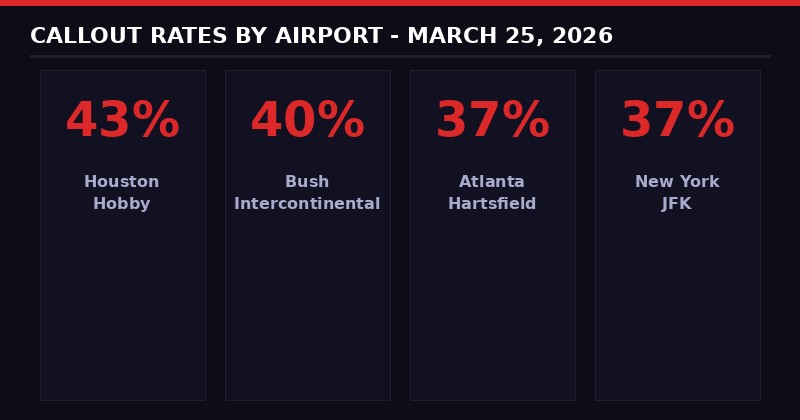
TSA callout rates at major U.S. airports as reported to the House Homeland Security Committee, March 25, 2026. (BLACKWIRE infographic)
ICE in the Terminal: A New and Unsettling Reality

Armed ICE officers began appearing at domestic security checkpoints this week following a direct order from President Trump. (Pexels)
President Trump's solution to the TSA staffing gap arrived on Monday in the form of Immigration and Customs Enforcement agents. Dozens of them, in tactical gear, deployed to some of the most-traveled domestic terminals in the country.
AP journalists observed ICE officers and agents patrolling terminals and standing near long passenger queues at Atlanta's Hartsfield-Jackson, JFK in New York, Newark Liberty International in New Jersey, George Bush Intercontinental in Houston, and Louis Armstrong International in New Orleans. A handful of other airports - including Phoenix Sky Harbor - also confirmed ICE would be on-site. Chicago Mayor Brandon Johnson said his office was monitoring the deployment at O'Hare International.
The optics are striking. ICE agents are not screeners. Their training is in immigration enforcement - tracking down undocumented people, executing removal orders, conducting raids. Their presence in the domestic checkpoint environment, where travelers expect uniformed TSA agents focused narrowly on security, has unnerved travelers and raised legal and procedural questions that neither DHS nor the White House has moved to clarify.
What exactly are these agents doing at the checkpoints? Are they screening bags? Checking travel documents? Running passenger names through immigration databases? The Trump administration offered few details when announcing the deployments, and none of the airport authorities confirmed what specific functions the ICE officers are performing.
The legal framework matters. Federal law enforcement officers are a routine presence at international terminals - CBP officers screen arriving international passengers, and Homeland Security Investigations agents handle cross-border criminal matters. But ICE agents operating at domestic departure checkpoints represent a genuinely novel use of the agency, one that conflates border enforcement with routine air travel screening in a way that has no precedent in the TSA era.
"Stop asking me about the long lines. Ask me if somebody's gonna eat today." - Hydrick Thomas, president of the national American Federation of Government Employees council representing TSA, to reporters, March 24, 2026
Critically, while TSA workers are reporting without pay as essential employees, ICE agents and CBP officers are still receiving their paychecks. That anomaly is a direct result of Trump's 2025 tax bill, which ring-fenced immigration enforcement funding from any future DHS shutdown. The political calculus of that provision is now on public display: the enforcement apparatus Trump built continues operating while the security apparatus that keeps American airports functioning is being cannibalized for personnel.
The Political Deadlock That Won't Break

Congressional negotiations on the DHS funding standoff collapsed again Wednesday as neither party moved toward the other's core demands. (Pexels)
The structure of the standoff has been fixed since February 14 and nothing in the past 40 days has moved it.
Democrats refuse to fund DHS unless the Trump administration makes changes to immigration enforcement operations. That demand crystallized after federal officers shot and killed two U.S. citizens - Alex Pretti and Renee Good - during protests in Minneapolis earlier this year. Democrats are insisting on requirements such as mandatory body cameras for ICE officers, identification requirements for agents conducting raids, and prohibitions on enforcement actions near schools, churches, and hospitals.
Republicans, under pressure from Trump, are demanding full DHS funding with no restrictions on enforcement. The latest proposal from a group of Republican senators - considered a compromise attempt - would fund most of DHS but exclude immigration enforcement and removal operations. While it added some new constraints on ICE, including body cameras, it stopped well short of Democrat demands.
Trump killed the deal himself. Despite White House staff having pitched him on the framework, Trump said at a Wednesday fundraiser: "I think any deal they make, I'm pretty much not happy with it." Senate Majority Leader John Thune put the ball back in the Democrats' court, saying Wednesday night that if they put "a more realistic offer on the table, we'll be back in business."
Senate Democratic leader Chuck Schumer said his party would not accept cosmetic changes. "We've been talking about ICE reforms from day one," he said. Democrats' list of demands includes protections that Republican lawmakers have consistently rejected as restrictions on presidential authority over enforcement.
The new Homeland Security Secretary, Markwayne Mullin - confirmed by the Senate on a party-line 54-45 vote late Monday - walked into the job inheriting an agency in crisis and no clear mandate to resolve it. An MMA fighter turned Oklahoma senator who is primarily known for his personal loyalty to Trump, Mullin had promised during his confirmation hearing to "get the department off the front page of the news." That ambition seems unlikely in the near term.
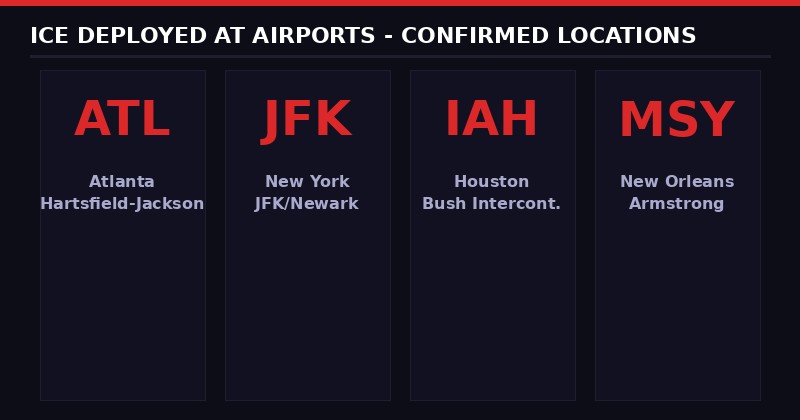
Confirmed airport locations where ICE agents have been deployed to supplement short-staffed TSA checkpoints. (BLACKWIRE infographic)
The Human Cost: Plasma Donations and Food Bank Lines

Food banks near major airports have reported surges in demand from TSA workers who have gone without pay for 40 days. (Pexels)
Behind the policy fight are people. The AP interviewed dozens of them this week, and the portrait is consistent and grim.
Taylor Desert, a seven-year TSA veteran at Indianapolis International Airport, stopped at a food bank on Monday morning before her shift to pick up meat, eggs, vegetables, and dairy products. "I never thought I would be in a position where, working for the federal government, I would need to go to a food bank to supplement my groceries," she said. Her last full paycheck came on February 14 - the day the shutdown started.
Oksana and Deron Kelly, both TSA agents at Orlando International Airport, have two young children and are burning through savings they expected never to need. Deron has been driving for DoorDash since October's shutdown in whatever hours he can carve around his TSA shifts. "If it keeps going, we will ask relatives or take out a loan," Oksana told reporters. "And I worry that would put us even deeper into debt."
Cameron Cochems, the Boise union leader, works a seasonal second job screening college sports teams at airports. He started that side income during the last shutdown. Two weeks ago, his wife was laid off. "It's just exhausting," he told AP. "Every day it just feels like this weight gets heavier and heavier on us."
In Indiana, one agent postponed dental surgery because she cannot afford the co-pay and is not being approved for time off. A grandmother in Idaho is planning to sell her car to cover rent. Another agent in Florida told the AP she has spent her entire emergency savings and now donates plasma to make grocery money.
Over 480 officers have quit rather than continue reporting without pay. McNeill told lawmakers that the 500-percent increase in assault incidents against TSA workers since the shutdown began - likely linked to passenger frustration with the long lines - is "unacceptable and will not be tolerated." But there is nothing the agency can do about it without Congress acting.
"This is a dire situation. At this point, we have to look at all options on the table. And that does require us to, at some point, make very difficult choices as to which airports we might try to keep open and which ones we might have to shut down." - Ha Nguyen McNeill, Acting TSA Administrator, testifying before the House Homeland Security Committee, March 25, 2026
The Political Fallout: Trump's District Flips, Polls Turn
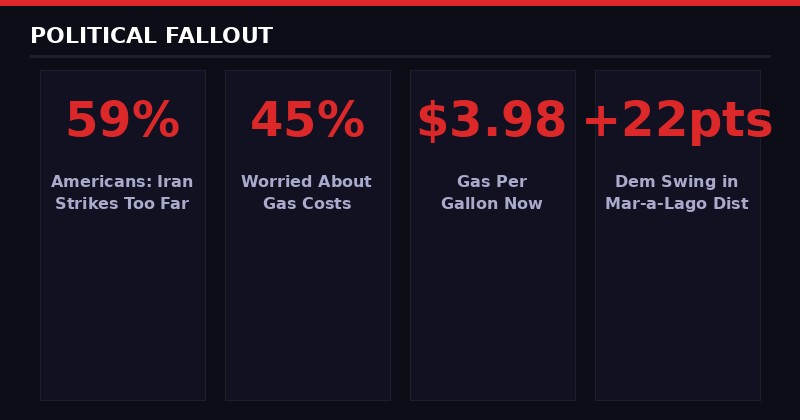
New polling and electoral results signal mounting political pressure on the Trump administration as the shutdown continues. (BLACKWIRE infographic)
On Tuesday night, a Democrat won a Florida state legislative seat that encompasses Mar-a-Lago - Donald Trump's personal residence and the symbolic beating heart of his political brand. Emily Gregory, a fitness company owner who had never run for office before, defeated Trump's personally-endorsed candidate Jon Maples by a margin of 797 votes. The district had been won by a Republican by 19 percentage points just two years ago, in 2024.
"If Mar-a-Lago is vulnerable, imagine what's possible this November," said Heather Williams, president of the Democratic Legislative Campaign Committee. She noted Tuesday's result was the 29th Republican-held seat Democrats have flipped since Trump took office. Democrats have also won the Miami mayoral race for the first time in nearly three decades and flipped a Texas state Senate district that was considered reliably Republican.
The political data coming in from polling is equally pointed. A new AP-NORC survey published this week found that 59 percent of Americans say U.S. military action against Iran has gone too far. Forty-five percent say they are extremely or very concerned about being able to afford gasoline in the coming months - up sharply from 30 percent at the time of Trump's election. The average gas price at the pump has risen from $3.12 when Biden left office to $3.98 today, a direct consequence of the Iran war and the Hormuz constraints it has imposed on global oil supply.
Trump's approval rating remains intact at roughly 40 percent, unchanged from last month. But the underlying dynamics are deteriorating. Republicans are facing the compounding effect of an Iran war with no visible exit, a DHS shutdown killing their transportation infrastructure narrative, and gas prices at nearly $4 a gallon - all heading into a midterm cycle in November.
Senator Lisa Murkowski, a moderate Republican from Alaska, gave voice to the anxiety on Wednesday: "There's a lot that people want to know, so whether it's how it's being communicated in the media, or how it's being communicated here in the Congress, I think it's lacking right now."
Trump addressed the National Republican Congressional Committee's annual fundraising dinner Wednesday evening and told the party he would deliver bigger majorities in November. "From now until November, we're going to fight," he said. The party he was addressing did not look entirely convinced.
What Happens Next: Easter Deadline and the Closure Scenario

Aviation industry analysts warn that airport closures, if triggered, would cause cascading travel disruptions across the national air network. (Pexels)
Congress is heading into an Easter recess in early April. That hard deadline has created a last-ditch urgency among a small group of Republican senators who want a deal before members scatter to their districts. The consequences of heading home without a resolution - with airports potentially shutting down during one of the busiest travel periods of the year - are not lost on them.
The closure scenario described by McNeill is not hypothetical theater. It follows a clear operational logic: as callout rates climb above 40 percent at individual airports, the agency reaches a threshold where it cannot safely staff even the basic minimum number of screening lanes. At that point, the choice is not between adequate screening and degraded screening. It is between directing available staff to hub airports and leaving smaller airports with nothing.
The specific airports that would be first to close in that scenario are likely smaller, lower-traffic facilities - the Boises and Tallahassees rather than the Atlantas and JFKs. But even targeted closures would cascade. Regional airports feed hub airports. Passengers who cannot fly from Boise will drive to Salt Lake City or Seattle, overloading those systems further. The aviation network is not designed to absorb the closure of multiple simultaneous nodes.
The airline industry has been quietly escalating pressure on Washington for weeks. The major carriers have all put travel waivers in place and are rerouting customers where possible, but they cannot absorb open-ended disruption at a rate of zero revenue from canceled flights indefinitely. The airports themselves, most of them run by municipal or regional authorities with their own budgets and political pressures, have been more vocal. The top executive overseeing George Bush Intercontinental told reporters Wednesday that four-hour security lines could get longer still if the standoff is not resolved soon.
The Deeper Problem: A System That Was Already Broken

TSA's workforce crisis predates the current shutdown - a 2024 GAO report flagged systemic morale problems driven by low pay and workplace dysfunction. (Pexels)
The current crisis is accelerating a deterioration that was already underway. The 2024 GAO report on TSA workforce management found that the agency consistently ranks among the lowest in the federal government for employee morale and job satisfaction. The drivers are structural: low starting pay relative to comparable private-sector security work, inconsistent management quality across hundreds of airports, limited promotion opportunities, and a workplace culture shaped by the peculiar stress of screening tens of millions of strangers per day.
Recent pay raises - pushed through in 2022 and 2024 - helped at the margins but did not fix the underlying problem. The GAO warned explicitly that without deeper intervention, attrition risk would persist regardless of pay improvements. The shutdowns have now confirmed that warning in the most direct possible way. TSA was a system operating without adequate redundancy or financial cushion in its workforce. Three shutdowns in six months have consumed whatever buffer existed.
The 481 agents who have quit represent an acceleration of what was already a high-attrition workforce. Unlike government agencies where retirements and departures are planned around long hiring cycles, TSA faces a unique challenge: the job requires intensive security training before an officer can work independently at a checkpoint. Replacing those 481 agents quickly is not possible. The training pipeline does not work that way. Every departure is effectively a six-to-nine-month gap in capacity before a replacement can fill the role.
This reality turns the closure threat from a political bluff into a genuine operational risk. The TSA is not crying wolf for congressional effect. The math is right there in the callout numbers. If Congress does not resolve the standoff before Easter - approximately two weeks away - some airports will face a choice between unsafe staffing levels and no staffing at all. McNeill's testimony was not a warning shot. It was a status report.
The Iran War Shadow: Why This Shutdown Is Different
Every previous DHS funding lapse occurred during relative peacetime. This one does not. The U.S. and Israel are in active combat with Iran. The Strait of Hormuz remains partially disrupted. Oil prices are elevated. Gas is nearly $4 a gallon. The country is on a war footing that sends millions of additional travelers into the air - military families, contractors, government officials - while simultaneously degrading the security infrastructure that exists to protect them.
The national security implications of degraded airport security during wartime have not been publicly addressed by the administration. The threat picture is real: Iran and its proxies have conducted drone and missile strikes across the Gulf region for weeks. The U.S. intelligence community has assessed that domestic infrastructure could become a target in the event of a significant escalation. Against that backdrop, a 43-percent callout rate at Houston's primary international hub is not merely a travel inconvenience. It is a security gap.
Trump's deployment of ICE to the airports can be read, at least in part, as an acknowledgment of this risk. Armed federal law enforcement visible in security areas creates a deterrence effect even if those officers are not performing screening functions. But it is a patch, not a solution. ICE agents are not trained as airport screeners, do not carry the technical certification to operate screening equipment, and cannot legally perform the core functions of a TSA checkpoint officer. Their presence stabilizes the optics. It does not stabilize the throughput.
The administration has said almost nothing about the intersection of the DHS shutdown and the Iran war's impact on domestic security. Pentagon officials, in classified briefings on Capitol Hill this week focused on the potential deployment of 82nd Airborne troops to the Middle East, have not addressed the domestic security gap. That silence is itself a data point.
"I never thought I would be in a position where, working for the federal government, I would need to go to a food bank to supplement my groceries." - Taylor Desert, seven-year TSA officer at Indianapolis International Airport, speaking to the AP, March 24, 2026
The shutdown began as a fight about immigration. Forty days in, it has become a stress test of whether the American government can maintain basic domestic functions while simultaneously conducting a foreign war, managing a political deadlock, and asking the people responsible for airport security to report to work without pay. On Day 40, the stress test has no obvious end date - and the cracks are widening.
Get BLACKWIRE reports first.
Breaking news, investigations, and analysis - straight to your phone.
Join @blackwirenews on TelegramSources: AP News (Ha Nguyen McNeill testimony, March 25, 2026); AP-NORC Center for Public Affairs Research poll, March 2026; Associated Press reporting on TSA worker hardships, airport callout rates, ICE deployments, and Senate negotiations; DHS figures provided to the House Homeland Security Committee; U.S. Government Accountability Office workforce report, 2024.