Dying to Protest, Starving to Work: The Human Wreckage of America's Shutdown War
Renee Good was driving her kids to school. Alex Pretti was shielding a woman from pepper spray. Both are dead - killed by federal agents during an immigration crackdown that triggered a political standoff that has left 50,000 airport workers without pay for 36 days. This is not abstract. These are real people.

Airport security lines have stretched for hours at major U.S. hubs as 50,000 TSA officers work without pay. (Pexels)
Saturday, March 22nd, 2026. Day 36. Five weeks since the U.S. Department of Homeland Security went partially dark. And still - still - the paychecks have not come for the 50,000 Transportation Security Administration officers standing at checkpoints across the country, scanning bags, waving strangers through, going home with nothing in their accounts.
The story in Washington is about politics: Democrats vs. Republicans, ICE reform demands vs. funding fights, cloture votes, rare weekend Senate sessions. The story on the ground is something else entirely. It is about Renee Good, a poet and mother of three who went to drop off her 6-year-old at school one morning in January and never came home. It is about Alex Pretti, an ICU nurse at a VA hospital who stood at a protest to shield a woman being pepper-sprayed and was shot dead by a Border Patrol officer. It is about Carissa Casares handing out boxes of pasta and peanut butter to security screeners in San Diego, because that is what it has come to.
It is about what happens when a political standoff stops being a standoff and starts being a catastrophe that lands, unevenly, on ordinary people.
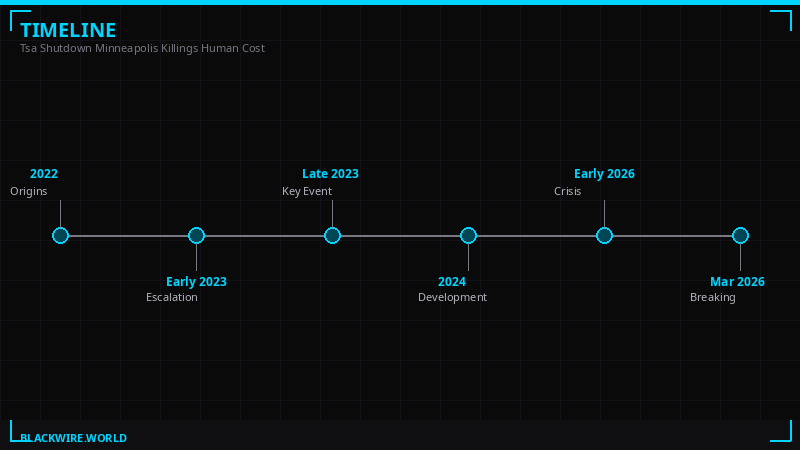
The cycle of shutdowns has accelerated, with federal workers spending nearly half of the past 171 days without full paychecks. (BLACKWIRE infographic)
The Two Deaths That Started Everything
The DHS partial shutdown began February 14, 2026. But the chain of events that triggered it starts months earlier, in the streets of Minneapolis, with two names that deserve more than footnote status in a budget fight.
Renee Nicole Good, 37, was a mother, a poet, a wife. She studied creative writing at Old Dominion University and won a prize for her prose in 2020. She described herself on social media as a "poet and writer and wife and mom." She had three children from two previous relationships and had recently relocated to Minneapolis with her youngest son and her wife. According to AP News reporting, her ex-husband said she was no activist and he never knew her to attend a protest.
On January 7, 2026, an ICE officer shot her dead behind the wheel of her Honda Pilot on a snowy Minneapolis street. The Trump administration described her as a domestic terrorist who tried to ram federal agents with her vehicle. Bystander video showed something different: an officer approaching the car and grabbing the door handle, another officer in front of the vehicle who immediately fired at least two shots when it began to move. The entire incident lasted less than 10 seconds.
"Renee was one of the kindest people I've ever known. She was extremely compassionate. She's taken care of people all her life. She was loving, forgiving and affectionate. She was an amazing human being." - Donna Ganger, Renee Good's mother, to the Minnesota Star Tribune
Her ex-husband said she was a devoted Christian who took mission trips to Northern Ireland in her youth. She loved to sing. She had never had any interaction with law enforcement beyond a single traffic ticket. She was a U.S. citizen, born in Colorado.
The protests that followed her killing brought Alex Jeffrey Pretti to the streets.
Pretti, also 37, was an intensive care nurse at a VA hospital. He was an avid cyclist, a competitive bike racer, a former Boy Scout who sang in the Green Bay Boy Choir as a child. He had a Catahoula Leopard dog named Joule who had recently died. He grew up in Green Bay, Wisconsin, graduated from the University of Minnesota in 2011, worked as a research scientist before going back to become a registered nurse. He cared for veterans for a living.
He was also deeply upset by what he was seeing in Minneapolis. According to AP reporting on his family's account, he had discussed the protests with his parents two weeks before his death. "Go ahead and protest, but do not engage, do not do anything stupid," his father Michael Pretti told him. "And he said he knows that."
On the day he was killed, bystander videos showed Pretti holding his phone in one hand while using his other arm to shield a woman being pepper-sprayed by federal agents. The Department of Homeland Security said he "approached" officers with a 9mm semiautomatic handgun. His family said he did own a handgun and had a carry permit - but that they had never known him to carry it in public. His neighbors said the same.
"He cared about people deeply and he was very upset with what was happening in Minneapolis and throughout the United States with ICE, as millions of other people are upset. He thought it was terrible, you know, kidnapping children, just grabbing people off the street." - Michael Pretti, Alex's father, speaking to AP News
Top Trump administration officials called Alex Pretti a "domestic terrorist" on social media within hours of his death. His parents first learned their son was dead when an Associated Press reporter called them. As of Saturday evening, they had still not been contacted by any federal law enforcement agency.
"The sickening lies told about our son by the administration are reprehensible and disgusting," the family's statement read. "Please get the truth out about our son. He was a good man."

Communities across Minneapolis held vigils for Renee Good and Alex Pretti, whose deaths triggered the congressional standoff that shut down DHS. (Pexels)
The Political Cascade: How Two Deaths Locked 120,000 Workers Out of Their Paychecks
The mechanism is straightforward in political terms, even if the human consequences are anything but. After the killings of Good and Pretti, Congressional Democrats drew a line: they would not vote to fund Immigration and Customs Enforcement or Customs and Border Protection without significant reforms to how those agencies operate. When the Department of Homeland Security's funding lapsed on February 14, they held the line.
Republicans rejected a piecemeal approach - fund TSA and FEMA and the Coast Guard separately, leave the ICE fight for later. Their position: fund all of DHS or none of it. The result: 120,000 federal employees working without pay, including roughly 50,000 TSA officers who are legally required to show up to work even when the Treasury isn't sending them anything.
The Democratic list of demands, according to AP reporting on Senate negotiations, includes: requiring ICE agents to obtain judicial warrants before forcibly entering homes, mandatory visible identification on uniforms, a ban on face coverings, body-worn cameras, independent investigations into misconduct, and a prohibition on enforcement operations at sensitive locations - schools, churches, polling places.
Sen. Brian Schatz of Hawaii put it with a particular brutality of precision: "All we are asking is release the hostages."
The hostages, in this metaphor, are the TSA screeners - workers who earn an average of roughly $44,000 a year, who handle some of the highest-turnover, most thankless jobs in the federal government, and who are now being told their financial lives are collateral in a fight about immigration enforcement practices in Minneapolis.
This is also not a new pattern. The current shutdown is the third time in less than a year that TSA workers have gone without pay. There was the record-breaking 43-day shutdown last fall. A brief four-day lapse in January. And now 36 days and counting. Airport screeners have spent nearly half of the past 171 days without a full paycheck, according to union officials and DHS figures cited by AP.
What 36 Days Without a Paycheck Actually Looks Like
Aaron Barker is president of AFGE Local 554, the union representing TSA officers in Georgia. He has spent the past five weeks on the phone with members facing situations that don't make the Senate floor speeches.
"People don't think about the things they just naturally have in their home, like toothpaste, bathroom tissue, milk, detergent, dish liquid," Barker told AP News. "I'm sure those things are a necessity for every TSA officer."
Union members have told him they cannot cover utility bills. They have missed children's medical procedures they cannot reschedule. They have received eviction notices. Cars have been repossessed.
"For some people it can be life or death," Barker said. "It's just sad and terrible that this is happening."
The situation has triggered an improvised mutual aid network across American airports. World Central Kitchen - the charity organization most often deployed to war zones and disaster areas - began providing meals to TSA officers at Washington D.C.-area airports. Feeding San Diego distributed 400 food boxes at the San Diego airport after a request from TSA and the county airport authority. Operation Food Search set up a temporary food pantry at St. Louis Lambert International Airport - the first time, according to their CEO Kristen Wild, they had ever distributed food directly at a job site.
Airport vendors, usually focused on feeding travelers, stepped up. Air traffic controller unions - whose members are not affected by this particular shutdown - donated money because they understand what working unpaid feels like.
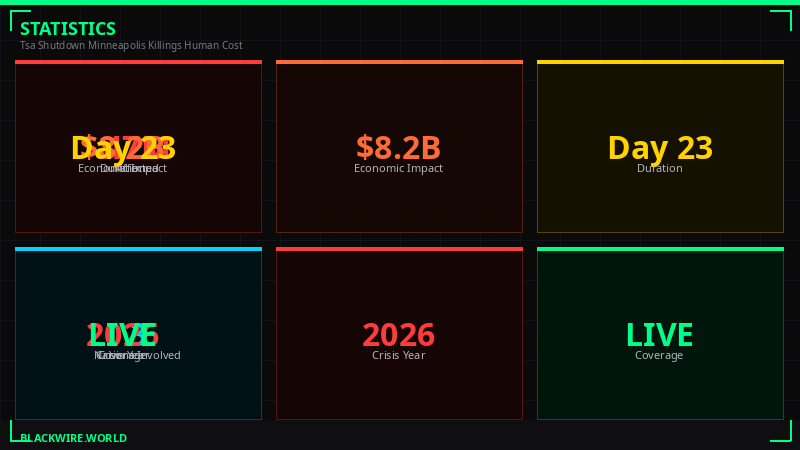
The numbers behind 36 days of crisis: from workers without pay to officers who have already quit. (BLACKWIRE infographic)
There is a dark bureaucratic logic to all of this that deserves a moment of clarity: ethics rules prohibit federal employees from accepting "gifts" at their work stations that exceed $20 in value. This means nonprofits cannot simply drive to an airport and hand TSA officers grocery bags. They have to coordinate with TSA management and airport authorities, keep individual food bags carefully under $20, and navigate rules designed to prevent corruption that are now being applied to people trying to eat.
"We didn't know for sure," said Wild from Operation Food Search. "But to play it safe we just kept it right under the $20 per bag amount so there would be no challenge to it."
Kristen Wild is handing out $19.99 boxes of rice and pasta to people who keep America's airports running. That is where things stand on day 36.
The Exodus: 376 Officers Have Already Left
At least 376 TSA officers have resigned since the partial shutdown began February 14, according to DHS figures. That number is probably an undercount - official resignation figures typically lag behind the actual departures.
TSA already had one of the highest attrition rates in the federal government before any of this. The work is physically demanding, emotionally draining, and poorly compensated relative to the authority and responsibility involved. The agency has historically struggled with low morale. Three shutdowns in a year - with the attendant financial terror of missed paychecks - is not going to help with recruiting or retention.
On Thursday of last week, roughly 10% of TSA officers nationally called out sick, according to DHS reports. In some locations, that figure was two or three times higher. Some airports were forced to close security checkpoints entirely during certain hours. Lines at Atlanta's Hartsfield-Jackson - one of the world's busiest airports - stretched as long as 90 minutes on Saturday morning.
Patrice Clark, a traveler who faced a nearly four-hour wait at Dallas Fort Worth on Saturday, put it plainly: "Everybody got bills they have to pay, and it's horrible. Times are hard for everybody at this point. Working and not getting paid and gas prices are extremely high - like everybody needs their money. They need to pay them."
There is a bitter irony here that has not been lost on observers: TSA was created after September 11, 2001, precisely to nationalize airport security and ensure it was protected from the kind of financial instability that plagued private contract screeners. Twenty-five years later, an AP analysis found that the roughly two dozen U.S. airports using private contractors under TSA oversight - including San Francisco International - actually maintained more stable operations during the shutdown because contractor pay comes from pre-allocated federal contracts rather than annual appropriations. The very privatization model TSA was designed to replace is now looking more resilient than the federal one.

Travelers at major U.S. airports have faced waits of up to four hours as TSA absences mount. (Pexels)
ICE at the Gate: Trump Escalates
On Saturday afternoon, as bipartisan Senate talks continued for a third consecutive day, President Trump announced on social media that ICE officers would deploy to U.S. airports starting Monday unless Democrats agreed to fund DHS.
"I look forward to moving ICE in on Monday, and have already told them to, 'GET READY.' NO MORE WAITING, NO MORE GAMES!" Trump wrote from his Florida weekend residence.
Trump said ICE agents at airports would specifically focus on arresting Somali immigrants, repeating a characterization of Somali-Americans in Minnesota that has drawn sharp rebuke from civil rights organizations and community leaders. Trump's previous remarks have included claims that Somali immigrants "totally destroyed" Minnesota.
The announcement landed in a particular context: the DHS shutdown was itself triggered, in part, by the deaths of two Americans - Good and Pretti - during immigration enforcement operations in Minneapolis. Democrats had demanded reforms to how ICE operates. The White House's response, as of Saturday, was to threaten to expand ICE's operational mandate into airports and to publicly target a specific ethnic community by nationality.
Transportation Secretary Sean Duffy had earlier warned on social media: "The AIRPORT LINES you're seeing now are CHILD'S PLAY compared to what you will see next week if TSA misses another PAYCHECK!"
Aviation security experts were quick to note the obvious problem with deploying immigration enforcement officers to handle passenger screening. TSA officers receive highly specialized training in threat detection, behavior analysis, X-ray interpretation, and the legally complex process of managing security checkpoints in a way that respects constitutional protections. ICE officers are trained for entirely different tasks. The two skill sets do not meaningfully overlap.
What the deployment would accomplish, critics argue, is the transformation of airport security into an immigration enforcement environment - a combination with significant implications for the tens of millions of Americans and foreign nationals who pass through U.S. airports every month.

Trump threatened to deploy ICE officers to airports starting Monday, March 23, if Democrats did not fund DHS. (Pexels)
Who Is Getting Squeezed, and Who Isn't
The structural inequity of who bears the cost of political standoffs is worth stating plainly, because it rarely makes the evening news in those terms.
The U.S. Congress and the White House will continue to receive their salaries throughout this shutdown. Members of Congress are constitutionally prohibited from having their pay withheld - a protection that does not extend to the workers they employ to make government function. TSA officers earning $44,000 a year go to food banks. Senators earning $174,000 continue direct deposit.
The shutdown also lands harder on specific communities. TSA has long been disproportionately diverse - the agency employs a higher percentage of Black, Hispanic, and female workers than most federal agencies, a legacy of its post-9/11 creation and the demographics of airport labor markets in major cities. When TSA officers miss paychecks and go to food banks, this is not an abstract federal workforce problem. It is a specific material harm concentrated in specific communities.
The workers who have quit - 376 so far - are gone. They will not come back for backpay. The institutional knowledge they carry, the accumulated experience of thousands of screening shifts, walks out the door with them. The TSA that emerges from this shutdown will be thinner, less experienced, and more reliant on workers still in their first year of employment.
And the travelers? The Patrice Clarks of the world, who waited four hours at Dallas Fort Worth on their way to Las Vegas? They are frustrated, inconvenienced, and increasingly vocal. They are, broadly, sympathetic to the workers. They want the paychecks restored. What they cannot do, as individuals, is make that happen.
"The first thing they want is their paycheck. The money is the most immediate need." - Aaron Barker, AFGE Local 554 President, to AP News
What they can do is choose to drive. Clark said exactly that on Saturday: "From now on I would drive wherever I have to go until they get this figured out." When enough people make that choice, the pressure on the aviation industry builds. Airlines begin lobbying harder. Airports begin pushing their congressional delegations. The political calculation shifts, slowly, toward resolution.

Food banks and nonprofits across the U.S. have scrambled to feed TSA workers, navigating federal gift rules that cap individual food packages at under $20. (Pexels)
The Negotiation: Close but Not Close Enough
There is movement in Washington, though nobody is promising a resolution before Monday's potential ICE airport deployment.
A bipartisan group of senators met for a third consecutive day on Saturday with White House border czar Tom Homan. Senate Democratic leader Chuck Schumer described "productive conversations." Senate Majority Leader John Thune, a Republican, urged the group to act fast: "If that group that's meeting can't come up with a solution really quickly, things are going to get worse and worse."
But Sen. Patty Murray, the top Democrat on the Senate Appropriations Committee, was not celebratory coming out of Thursday's session: "I'm glad the White House is here, but we're still a long ways apart."
Republican Sen. Susan Collins said Democratic demands "keeps growing and growing." Democrats say the list is a direct response to documented abuses - the deaths of Good and Pretti are not hypothetical outcomes of unchecked enforcement power. They are data points.
The specific Democratic demands - warrants before forced home entry, visible identification, body cameras, independent misconduct investigations, prohibitions at schools and churches - are broadly supported in public polling. A series of AP-NORC polls conducted in 2025 showed majority support across party lines for warrant requirements and body cameras for federal immigration agents.
The impasse is not, at its core, about whether these reforms are good ideas. It is about who holds leverage and what the political cost of yielding is for each side. The 50,000 TSA workers without paychecks are, in this framing, leverage - a cost distributed across an enormous and largely powerless population that cannot effectively punish either party for their suffering.
Both chambers of Congress are scheduled to recess for two weeks starting at the end of March. Senate Majority Leader Thune has said those plans will be canceled if the shutdown is not resolved by then. That deadline - the prospect of losing a scheduled break - may be a more effective motivator for resolution than 376 TSA officer resignations, four-hour airport lines, and 50,000 families choosing between groceries and rent.
What the Shutdown Has Already Broken
There is a category of damage that does not show up in any official report. It is the damage to the social contract - the fraying of the assumption that if you do your job, in good faith, for an institution that depends on you, that institution will meet its basic obligations to you in return.
Merissa Thomas, a traveler who flew out of Reagan National Airport on Saturday, was grateful to the TSA officers who waved her through. "I'm so grateful for people who are willing to sacrifice a lot to make sure we're safe," she said.
But gratitude from strangers does not pay an eviction notice. It does not reschedule a child's medical procedure. It does not put toothpaste in the bathroom cabinet.
What the 376 officers who have already quit understood - what everyone working unpaid in their fifth week without a paycheck is slowly learning - is that the sacrifice is not mutual. The institution asked for their commitment. The institution has not honored its own. The food banks and the pasta boxes and the $19.99 care packages are a kindness. They are also an indictment.
Renee Good drove her son to school on a winter morning in Minneapolis. She did not come home. Alex Pretti held out his arm to protect someone he did not know from pepper spray on a city street. He did not survive the encounter. Their names are now shorthand in Senate budget negotiations, evidence in arguments about what kinds of enforcement oversight Congress can demand as a condition of continued funding.
They are also, simply, two people who are dead. Two people whose families are living inside a grief that no legislative resolution will touch. Their children will grow up knowing their parent was killed by a federal agent during a political dispute about immigration enforcement. That fact will not be resolved when the Senate finds its way to a deal and the DHS funding resumes and the TSA paychecks start flowing again.
The political crisis will end. The human wreckage will outlast it.
Sources
- AP News: "Nonprofits, unions and airports feed TSA officers as shutdown drags" (March 21, 2026)
- AP News: "Airline passengers say TSA paychecks should be restored now" (March 22, 2026)
- AP News: "Man killed by Border Patrol in Minneapolis was ICU nurse" (February 2026)
- AP News: "Renee Nicole Good: Woman shot by ICE agent was a mom of 3" (January 2026)
- AP News: "Trump says ICE will work airport security unless Democrats fund DHS" (March 22, 2026)
- AP News: "Lawmakers and White House officials meet to tackle DHS shutdown" (March 2026)
- AP News: "What the latest government shutdown shows about privatizing TSA" (March 2026)
- AFGE Local 554, union statements and media interviews
- DHS official statements on shutdown absenteeism and resignations
- Amnesty International report on women and girls in Gaza (March 2026) - contextual reference
Get BLACKWIRE reports first.
Breaking news, investigations, and analysis - straight to your phone.
Join @blackwirenews on Telegram