
The Twin Squeeze: Fed and Bank of Japan Rate Hike Bets Collide With Half of Bitcoin Underwater
Two central banks. Two tightening bets. One market already bleeding from every vein.
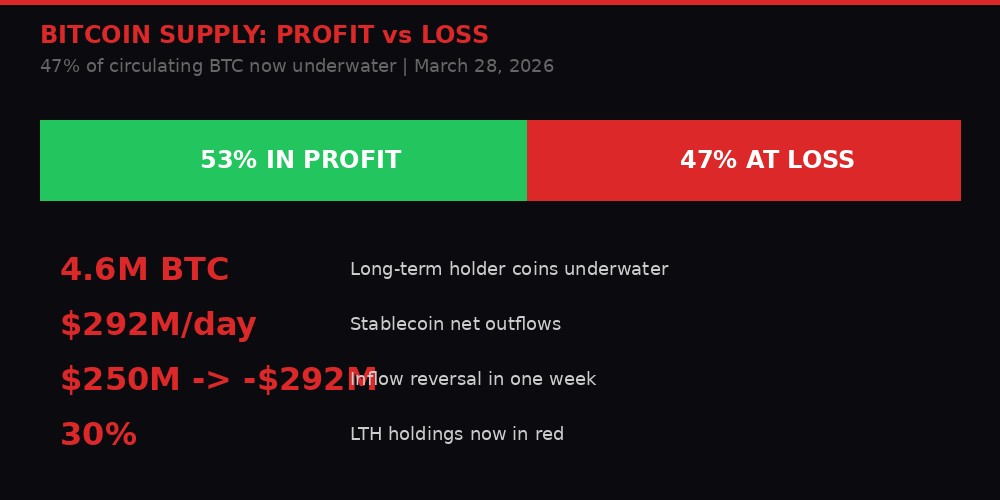
Traders are now pricing in rate hikes from both the Federal Reserve and the Bank of Japan simultaneously - something that has not happened since the pre-crisis years of 2007. The timing could not be worse for crypto. Nearly half of all circulating Bitcoin sits underwater. Long-term holders who were profitable seven days ago are now staring at realized losses not seen since 2023. Stablecoin flows have reversed from $250 million in daily inflows to $292 million in daily outflows. And the carry trade that greased risk asset rallies for years is staring at an unwind nobody has fully priced.
Bitcoin trades at $67,300 as of Monday afternoon. It bounced from a weekend low below $65,200 after Trump signaled talks with a "new regime" in Iran. But the bounce is thin. Underneath the headline noise, the plumbing of the crypto market is deteriorating in ways that matter more than any single price tick.
This is the state of play heading into one of the most consequential weeks of 2026: FTX's $2.2 billion creditor payout lands tomorrow. U.S. jobs data drops Friday. And two of the world's most powerful central banks are loading ammunition at the same time.
The Bitcoin Stress Signal Nobody Can Ignore

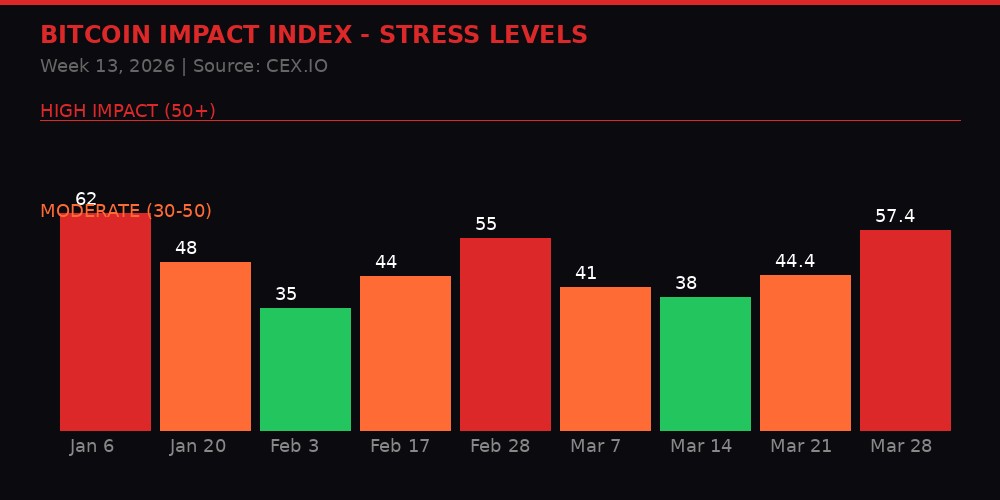
The Bitcoin Impact Index hit 57.4 for the week ending March 28, according to data from CEX.IO. That is a 13-point jump in seven days - the steepest weekly climb since January, when Bitcoin briefly traded below $60,000 before the Iran conflict sparked the current cycle of volatility.
The index measures financial stress across every major Bitcoin user cohort: onchain behavior, ETF activity, derivatives positioning, and liquidity flows. A reading above 50 places it squarely in the "high impact" zone - a territory that historically preceded double-digit price drops in 2018, 2022, and earlier this year.
What makes this reading particularly dangerous is the speed. The index sat at 44.4 just one week earlier. A 13-point weekly jump means the deterioration is not gradual. It is accelerating.
The 47% figure deserves particular attention. Nearly half of all Bitcoin in circulation is now held at a loss. That is not a marginal deterioration - it represents a fundamental shift in market structure. Seven days ago, long-term holders (wallets that held BTC for over six months) were net sellers at a profit. Today, over 4.6 million BTC from those same wallets are underwater.
Their realized losses last week hit the worst levels since 2023. CEX.IO's analysts flagged the divergence explicitly: "This kind of divergence between price action and on-chain conviction has historically been a warning sign. Similar moves occurred in mid-2018 and mid-2022 before price drops by over 25%."
Short-term holders fare no better. The data shows broad-based pain across every cohort. The only fragile positive: holders have not yet rushed to deposit BTC on exchanges en masse, a behavior pattern typically seen in full capitulation events. The selling is happening, but it is methodical rather than panicked - for now.
The Bank of Japan Wildcard

Everyone watches the Fed. Fewer watch the Bank of Japan. That is a mistake.
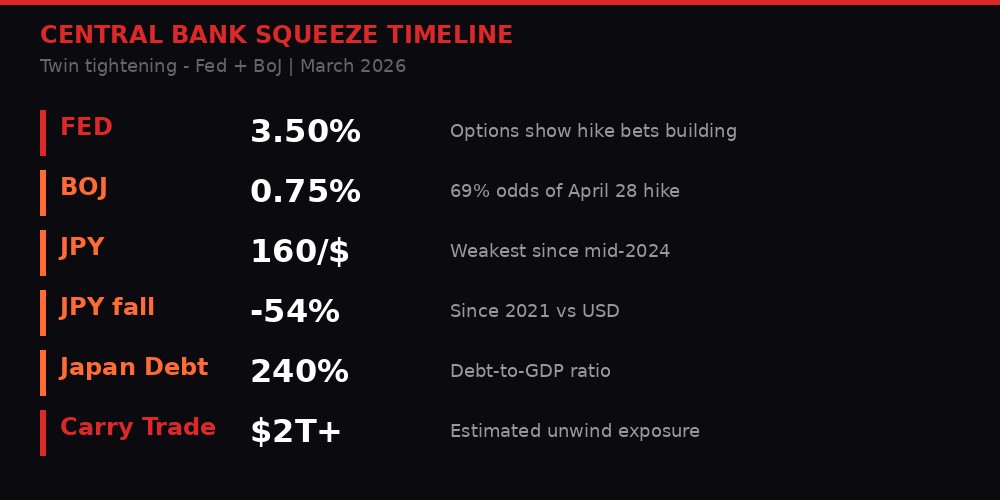
Bloomberg data shows traders are now pricing a 69% probability of a BoJ rate hike at the April 28 meeting. The BoJ's policy meeting summary released Monday included a striking detail: at least one member explicitly called for a larger rate hike in response to the Iran conflict and its inflationary impact on Japanese society.
Japan imports virtually all of its energy. With oil above $115 a barrel and the Iran war entering its fifth week, imported inflation is hitting the economy like a freight train. The yen has weakened to 160 per dollar - its lowest level since mid-2024 - having depreciated 54% against the greenback since 2021.
The BoJ has already raised its benchmark rate from -0.1% to 0.75% over the past two years while simultaneously ending its massive asset purchase program. But rates in Japan remain dramatically lower than the 3.5% in the United States. There is room to tighten further - and the war is providing the political cover to do it.
Japan's fiscal trap makes this even more precarious. The country's debt-to-GDP ratio sits at a staggering 240%. Higher rates directly increase the government's borrowing costs on the world's largest sovereign debt pile. Economists have warned that Japan is caught between a rock and a hard place: hike rates and risk a debt sustainability crisis, or hold rates low and watch the yen disintegrate further, feeding more imported inflation.
The crypto market is not pricing this risk. Most traders are focused on the Fed. But the BoJ is potentially the more dangerous actor here precisely because its moves are less expected and less hedged against. An April 28 hike, combined with continued Fed tightening bets, would create simultaneous monetary tightening from the world's largest and third-largest economies - a twin squeeze that risk assets have not faced in nearly two decades.
The Fed Side: Rate Hike Bets Keep Building

The U.S. side of the squeeze is well-documented but still underestimated. Action in options tied to U.S. interest rates shows traders are now actively positioning for the Fed to raise borrowing costs in the coming weeks, according to CoinDesk's analysis of rate markets.
The mechanism is straightforward. The Iran war has sent oil prices surging above $115 a barrel - their biggest monthly increase on record. Energy costs feed directly into headline inflation. The Fed, which paused rate cuts earlier this year, now faces a scenario where it may need to actively tighten to prevent inflation expectations from becoming unanchored.
This is a dramatic reversal from the consensus entering 2026. Markets spent the first two months of the year pricing rate cuts. The pivot to rate hike expectations has been sharp and disorienting, catching crypto bulls completely off-guard.
The impact on Bitcoin is mechanical. Higher rates increase the opportunity cost of holding non-yielding assets. They strengthen the dollar, which historically correlates inversely with BTC. And they drain liquidity from the system - the very liquidity that crypto needs to sustain rallies.
Friday's U.S. jobs report will be critical. A strong print reinforces the case for Fed tightening. A weak print raises stagflation fears - which may be even worse, because the Fed would face rising inflation alongside a weakening economy, leaving it with no good options.
Either outcome is bearish for risk assets in the near term. The only bullish scenario would be an Iran ceasefire that crashes oil prices, and while Trump's "new regime" comments on Monday gave markets a brief pop, the threats to "obliterate" Iranian infrastructure in the same breath suggest the situation is far from resolved.
Bernstein's Contrarian Call: 60% Off Is a Gift
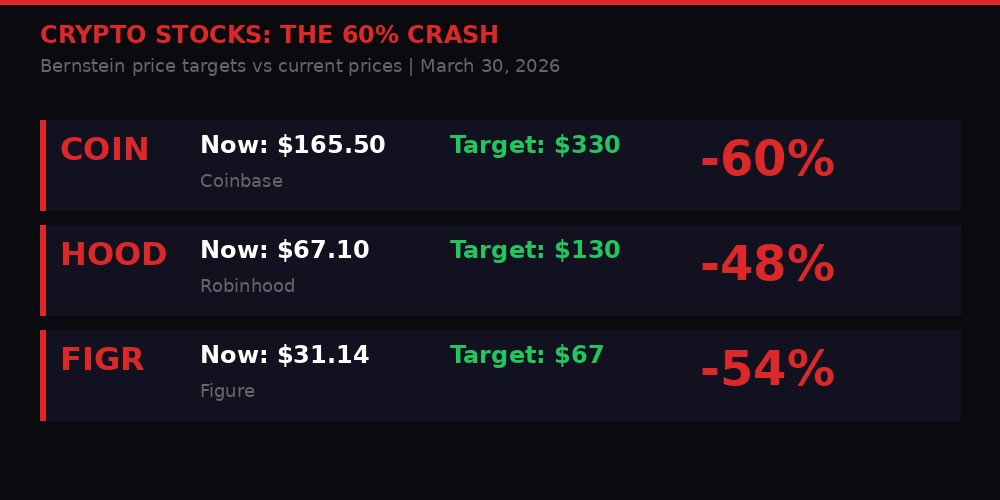
Not everyone is running for the exits. Wall Street broker Bernstein published a note Monday calling the 60% crash in crypto-linked equities a "rare chance to buy the dip at a big discount."
The numbers are stark. Coinbase (COIN) trades at $165.50, roughly half of Bernstein's revised price target of $330 (lowered from $440). Robinhood (HOOD) sits at $67.10 against a $130 target (down from $160). Figure (FIGR) trades at $31.14 versus a $67 target (from $72). All three carry outperform ratings.
Analysts led by Gautam Chhugani argue that "the combination of geopolitics and temporary crypto weak sentiment is offering big discounts on crypto stocks." The thesis rests on exposure to large and growing markets - stablecoins, tokenization, prediction markets, and derivatives - that Bernstein expects to compound regardless of Bitcoin's short-term direction.
Since the crypto market peaked in October 2025, BTC has fallen roughly 40-50% from record highs near $126,000. The broader digital asset market has shed approximately $2 trillion in value. Crypto equities, being levered bets on the ecosystem, fell even harder.
Bernstein reiterated its $150,000 year-end Bitcoin target last week, calling a bottom. That call requires either a ceasefire that crashes oil and restores the rate-cut narrative, or a fundamental repricing of Bitcoin as a wartime asset. Neither is guaranteed, but the broker is putting its reputation on the line.
The risk is obvious: if the twin squeeze materializes and Bitcoin tests lower supports, crypto equities have significant further downside. COIN traded as low as $30 during the 2022 bear market. The gap between current price and bear-case floor is not small.
DeFi's Identity Crisis: Lido, Aave, and the Governance Token Question
While macro forces squeeze Bitcoin from above, DeFi is fighting its own war below - and losing.
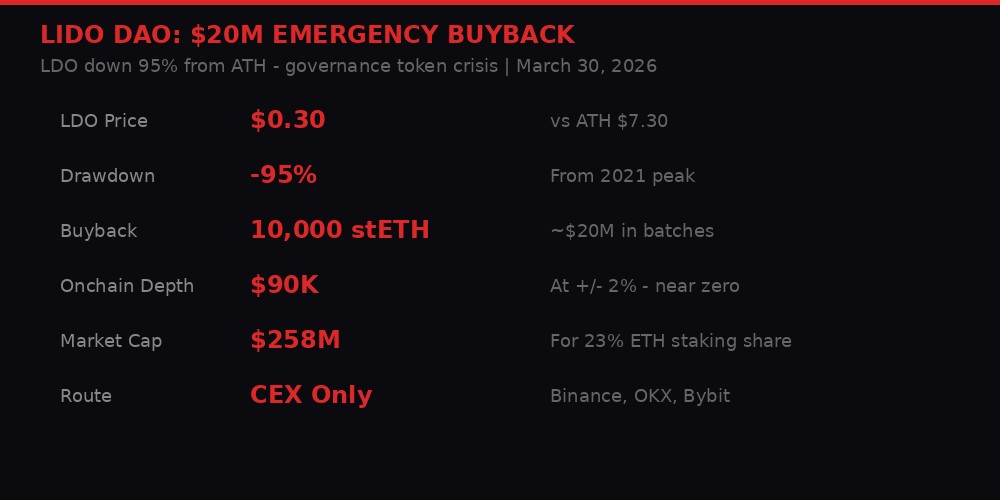
Lido DAO proposed spending up to 10,000 stETH (roughly $20 million) to buy back its LDO governance token, which has crashed 95% from its 2021 peak of $7.30 to $0.30. The move reads like desperation dressed as strategy.
The most damning detail is not the price. It is the liquidity. Onchain LDO depth sits at approximately $90,000 at plus-or-minus 2%. That means the protocol that controls 23% of all staked Ethereum - a dominant market position by any measure - has a governance token so illiquid that a single 1,000 stETH batch would blow through available onchain liquidity multiple times over.
Lido has to route its own buyback through centralized exchanges: Binance, OKX, Bybit, Gate, and Bitget. The protocol that is supposed to represent decentralized staking cannot buy its own token in a decentralized way. The irony writes itself.
The proposal authorizes the Lido Growth Committee to execute in 1,000 stETH batches, each requiring a separate governance motion with a three-day objection period. Slippage is capped at 3%. Execution would buy roughly 65 million LDO - about 8% of circulating supply at current prices.
The deeper question Lido surfaces is one every DeFi protocol is now facing: what is a governance token worth when it controls a fee switch but distributes nothing? LDO's 95% drawdown is extreme but not exceptional in the category. DeFi governance tokens as a class have been repriced toward zero throughout this bear market. Revenue is real. Protocol usage is real. But token value capture remains theoretical for most projects.
Lido's answer - buy the dip with treasury stETH - is rational at the surface level. The LDO-to-ETH ratio sits at roughly 0.00016, a 70% discount to levels that held for most of the past two years. Net protocol rewards have dropped only 20% while costs improved 13% year-over-year. The effective take rate rose to 6.11% from 5%. By every fundamental measure, the token should not be trading here.
But "should" does not move markets. Sentiment does. And sentiment on governance tokens is broken.
Aave V4 and the Real-World Credit Bet
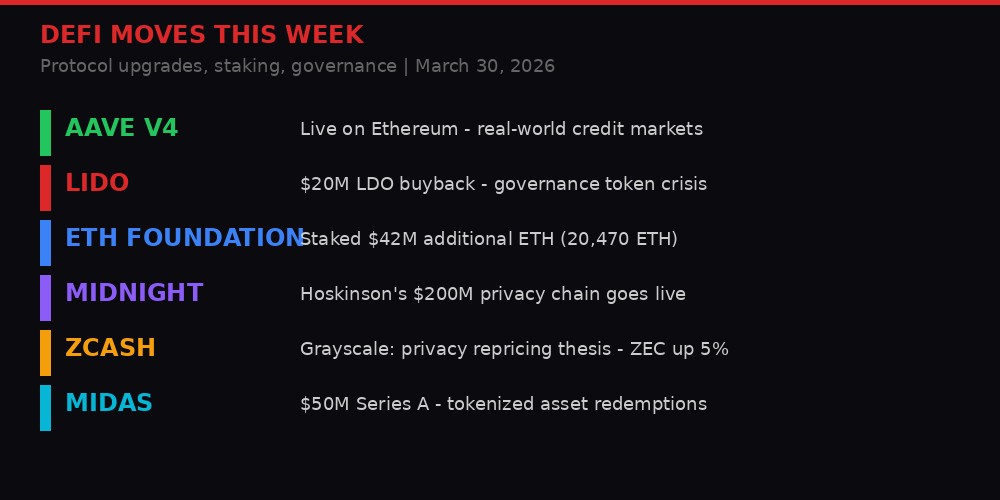
Against this backdrop of governance token nihilism, Aave quietly launched one of the most ambitious DeFi upgrades in years. Aave V4 went live on Ethereum Monday after roughly two years of development, with a design that explicitly targets real-world credit markets.
The upgrade changes how Aave organizes its markets. Instead of pooling everything together, V4 allows different types of lending markets to operate separately while sharing the same pool of liquidity. That sounds like technical plumbing. It is. But the implication is significant: Aave is building infrastructure to lend against more than just crypto tokens.
"Lending is based on trust. You need lending conditions that reflect market conditions." - Stani Kulechov, Aave Labs founder
The architecture allows institutional borrowing, real-world asset lending, and traditional credit products to run alongside standard crypto-to-crypto markets. It also enables other teams to build on top of the protocol more easily, turning Aave from a standalone lending app into a financial primitive.
Kulechov told CoinDesk that idle capital within the system can now be reinvested more efficiently - extracting yield from float that previously sat dormant. The V4 rollout started with a limited set of markets and conservative risk parameters, with more features expected through governance decisions.
The timing is interesting. Aave launches its most ambitious upgrade just as the market for DeFi governance tokens hits rock bottom. If V4 succeeds in attracting real-world credit activity, it could provide the first proof-of-concept for DeFi protocols generating revenue from sources outside the crypto speculation cycle. If it does not, it becomes another technically impressive product launched into a market that does not care.
The internal politics around the launch have been contentious. Disputes over interface fees, contributor roles, and proposals to redirect product revenue to the DAO have highlighted tensions between decentralization and coordination. The "Aave Will Win" plan proposed in February would send 100% of product revenue to the DAO - a radical experiment in protocol economics that could either prove governance tokens have value or demonstrate that shared revenue does not move prices when macro sentiment is this bleak.
The Week Ahead: FTX Pays, Jobs Data Lands, and the Carry Trade Watches

Tuesday brings the FTX creditor payout - $2.2 billion distributed to former customers of the collapsed exchange. The question is not whether the money arrives. It is where it goes next.
Some portion will re-enter crypto markets. FTX creditors who held through the bankruptcy are, almost by definition, crypto believers. But the payout arrives in cash, not in kind. Creditors need to make an active decision to buy back in. With the market underwater and macro risks elevated, the re-entry rate may disappoint the bulls who have been counting on this as a catalyst.
Friday's U.S. jobs report carries even more weight than usual. In a normal cycle, a strong number would be bullish. In the current environment, it feeds directly into the rate hike narrative that is already squeezing risk assets. A weak number raises stagflation fears - high inflation plus slowing growth - which is the worst possible environment for both stocks and crypto.
The Ethereum Foundation's decision to stake an additional $42 million in ETH on Monday (20,470 ETH in uniform chunks of 2,047 ETH, per Arkham data) adds an interesting signal. The Foundation still holds 147,400 ETH (about $303 million) in its treasury and is putting it to work at a 2.7% yield. This is a long-duration bet on Ethereum's staking infrastructure - the opposite of panic. Whether the market listens to that signal depends on whether macro forces overwhelm protocol-level confidence.
Key Dates This Week
Other Market Signals That Matter

Bitcoin's bounce from $65,200 to $67,400 over the weekend came with $340 million in liquidations over 24 hours. The largest single order was a $9.8 million BTCUSD liquidation on Bybit. Short liquidations hit $9.32 million in a single hour after Trump's Iran comments. The bounce has juice - but it is short-squeeze juice, not organic buying pressure.
Stablecoin flows tell the real story. Daily net flows flipped from $250 million in inflows to $292 million in outflows. ETFs moved from accumulation to selling. Miners followed. When the three major sources of sustained buying pressure (stablecoins, ETFs, miners) all reverse simultaneously, price has historically followed - with a lag.
The one remaining support is behavioral: holders are not rushing to deposit BTC on exchanges. Exchange inflows remain subdued relative to the stress levels. In prior capitulation events - November 2022, March 2020, January 2015 - exchange deposits spiked dramatically before the final flush. That spike has not happened yet, which means either we are not at capitulation, or this cycle's capitulation will look different from history.
Charles Hoskinson's $200 million Midnight launch adds another data point to the privacy narrative that keeps recurring in crypto cycles. Grayscale published a thesis Monday arguing that Zcash is mispriced because the market treats financial privacy as marginal rather than essential. ZEC jumped 5% on the day. Whether privacy becomes the next major crypto narrative depends on whether governments escalate surveillance enough to create real demand - a bet that the Iran war and wartime financial controls may be accelerating.
The Polymarket UFC arbitrage story - a trader turning $676 into $67,000 in under a minute by exploiting a cage announcer's mistake - is entertaining but also illustrative. Prediction markets are now fast enough that errors in source data create instant arbitrage opportunities. The line between "trading" and "exploiting information asymmetry" in these markets is getting thinner with every event. It will not be long before regulators notice.
The Bottom Line: Two Squeezes, Zero Good Options

The crypto market is caught between two central banks loading the same weapon and a user base that is already bleeding. The Fed's tightening is familiar pain. The BoJ's is not - and the carry trade unwind it could trigger is an underpriced tail risk that most crypto traders are not positioned for.
The bullish case requires at least one of: a ceasefire in Iran that crashes oil, a dovish surprise from the Fed or BoJ, or the FTX payout triggering meaningful re-entry flows. The first is geopolitically uncertain. The second contradicts current market pricing. The third is a hope, not a strategy.
The bearish case requires nothing more than the status quo to continue. Inflation stays elevated because the war continues. Central banks tighten because inflation stays elevated. Risk assets sell because central banks tighten. Each feeds the next in a self-reinforcing loop that does not need a single additional catalyst to play out.
Bernstein sees opportunity in the carnage. Onchain data suggests we are not yet in full capitulation. Aave is building for a future where DeFi touches real-world credit. The Ethereum Foundation is staking like it has a ten-year time horizon. These are long-duration bets made by people who have seen bear markets before.
But right now, this week, heading into FTX payouts and jobs data and the shadow of an April 28 BoJ decision? The market has two squeezes tightening simultaneously and zero good options for escape.
The number that matters most: 47% of Bitcoin is underwater. The number that will determine what happens next: 69% - the probability that the Bank of Japan adds a second squeeze to a market that can barely handle the first.
Keep your stops tight. This week is going to move.
Get BLACKWIRE reports first.
Breaking news, investigations, and analysis - straight to your phone.
Join @blackwirenews on Telegram