
An F-15E Strike Eagle was destroyed over Kohgiluyeh and Boyer-Ahmad province. An A-10 Warthog crashed into the Persian Gulf. One US crewmember was recovered. One remains missing over hostile territory. And in Tehran, people poured into the streets to celebrate what Iranian officials called the most significant military success of the war so far.
Day 36 of the US-Israel war on Iran ended with two American warplanes lost, a frantic search-and-rescue operation under Iranian fire, and a propaganda coup that the Trump administration had no answer for. While the Pentagon and US Central Command maintained silence, Iranian state media broadcast images of twisted metal wreckage, an ejection seat with its parachute still attached, and crowds chanting in the capital.
The downing happened hours after Iran rejected a US proposal for a 48-hour ceasefire, according to the semi-official Fars news agency. Hours after that, Defense Secretary Pete Hegseth fired the US Army's chief of staff and two other senior officers in what critics immediately called a wartime purge. The war is not going the way Washington said it would. The images from central Iran prove it.
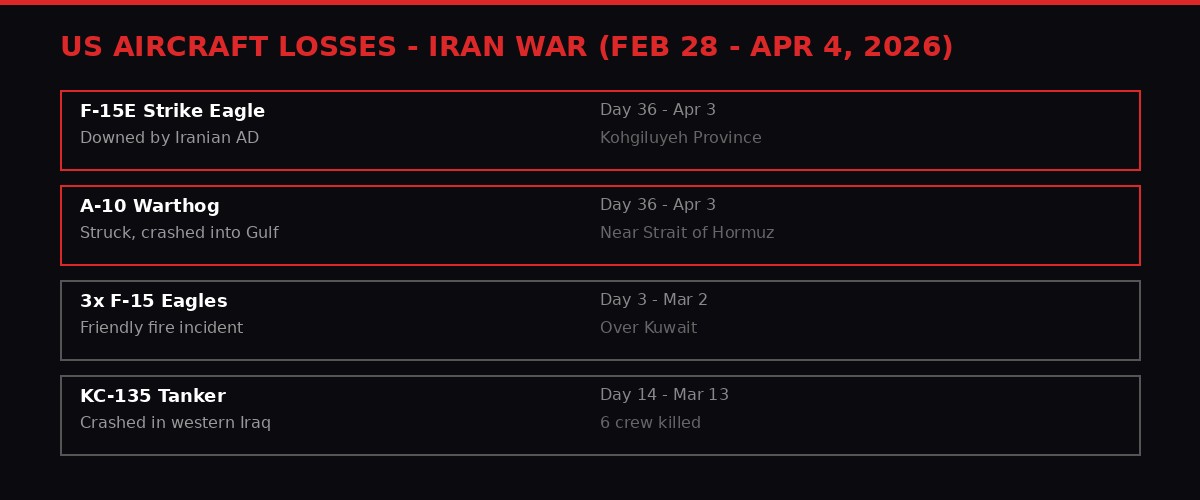

The first aircraft, an F-15E Strike Eagle - one of the US Air Force's primary strike fighters - went down over Kohgiluyeh and Boyer-Ahmad province in southwest Iran. This is mountainous terrain, rugged and remote, the kind of landscape that makes search-and-rescue operations extraordinarily difficult even without an active adversary hunting for the same people you are trying to save.
A spokesperson for the Iranian military's Khatam al-Anbiya Central Headquarters announced that air defenses "completely destroyed" the F-15. Two US officials, speaking anonymously to Reuters, confirmed Iranian reports about the shootdown. One of the two crewmembers was located and recovered by US forces. The fate of the second remains unknown. A US Black Hawk helicopter conducting the search was also hit by Iranian fire but managed to stay airborne, according to US media reports.
The second loss came later the same day. Iranian military officials said they targeted an A-10 Warthog - a low-flying close air support aircraft - near the Strait of Hormuz. The aircraft crashed into the Gulf. The New York Times cited unnamed officials as saying the A-10's pilot was safe after the crash.
The governor of Kohgiluyeh and Boyer-Ahmad province told the semi-official ISNA news agency that whoever captured the missing American crewmember "would be specially commended." Iranian officials called on civilians to search for survivors. This is not rescue language. This is hunting language.
There was no immediate comment from the Pentagon or CENTCOM, which oversees operations in the Middle East. After past Iranian claims of downing US aircraft, CENTCOM has typically been quick to deny the reports. This time, the silence said everything.
"After defeating Iran 37 times in a row, this brilliant no-strategy war they started has now been downgraded from 'regime change' to 'Hey! Can anyone find our pilots? Please?'"
- Mohammad-Bagher Ghalibaf, Iranian Parliament Speaker, via social media

For five weeks, President Trump and his national security team have told the American public the same thing: Iran's air defenses are finished. Destroyed in the opening days. The skies belong to us. On multiple occasions, Trump personally declared that Iranian military infrastructure has been "severely damaged" to the point of operational irrelevance.
The wreckage of an F-15E scattered across an Iranian mountainside says otherwise.
Iran's military said the aircraft was brought down by a "new advanced defence system," directly contradicting the administration's narrative. This claim aligns with reporting from Al Jazeera's Ali Hashem, who noted that since March 19, Iranian officials have been saying they introduced a new system developed after the 12-day war between Iran and Israel in June 2025.
Myles Caggins, a retired US Army colonel and non-resident senior fellow at the New Lines Institute, called the shootdown a "significant event" for the US military. He acknowledged that while Iran's primary air defense systems were largely destroyed or taken offline through cyber attacks in the war's opening phase, "there are still manned portable air defence systems, and possibly that is the type of system that's carried by one person that could have shot down this F-15."
The distinction matters. A MANPAD - a man-portable air defense system - is a shoulder-fired missile that costs a fraction of what it takes to build, maintain, and fly an F-15E. If Iran is downing advanced American strike fighters with infantry-level weapons, the cost calculus of this war shifts dramatically. If, as Iran claims, it deployed a new integrated system that survived five weeks of bombardment, the implications are worse. Either scenario means the Pentagon's air superiority narrative has a structural crack in it, and the crack is now visible to the entire world.
Reuters reported on March 27, citing five sources within US intelligence, that only one-third of Tehran's missile stockpile had been destroyed. That number was quietly devastating for the White House narrative. The April 3 shootdowns are the visual proof that the remaining two-thirds still have teeth.
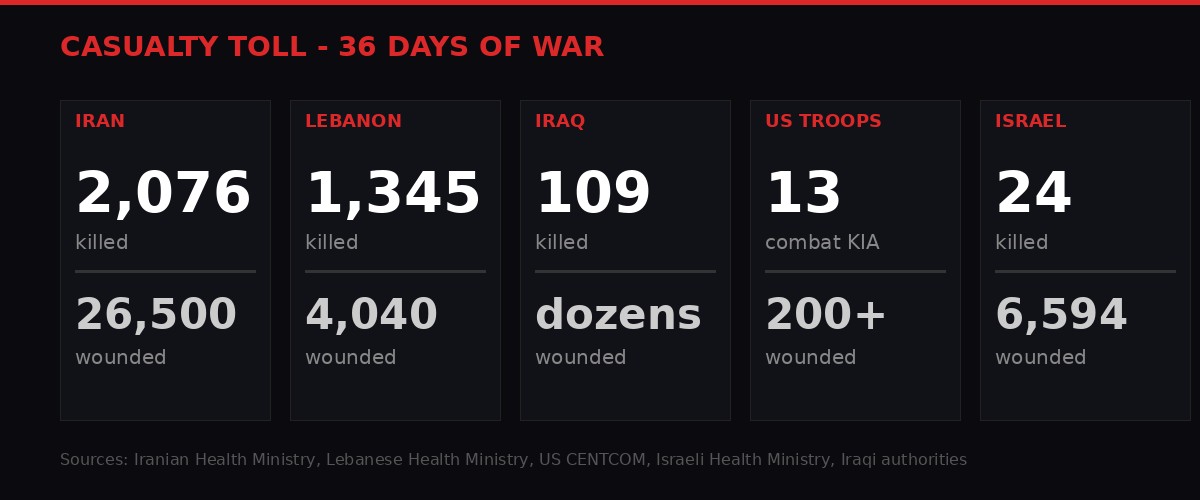
The numbers as of April 4, compiled from official sources across the region, paint a picture of a war that has already exceeded every public prediction of its duration and scope.
Iran's Health Ministry reports 2,076 people killed and 26,500 wounded since February 28. Among the dead: 240 women and 212 children. The youngest victim was eight months old. The oldest was 88. Iran's Ministry of Foreign Affairs says more than 600 schools and education centers have been hit by US-Israeli strikes.
In Lebanon, where Israel has expanded ground operations against Hezbollah, 1,345 people have been killed and 4,040 wounded. At least 125 of the dead are children. More than one million people have been displaced. A UNIFIL peacekeeper has been killed in the south.
Iraq has lost 109 people, primarily members of the Popular Mobilization Forces, in strikes that the US characterizes as targeting Iranian proxy infrastructure. A French soldier died in Erbil. Jordan has seen 29 injuries. Kuwait has lost seven people, including a child killed by shrapnel and two Fire Force officers killed "while performing duties." An Egyptian national was killed in a UAE gas facility fire caused by debris from an intercepted attack. Bahrain has lost three, including a Moroccan national and a woman killed when a residential building in Manama was struck.
On the American side: 13 service members killed in combat, one dead from a "health-related incident" in Kuwait, six crew killed when a KC-135 refueling tanker crashed in western Iraq on March 13, and over 200 soldiers wounded. Trump told NBC News that the downing of the F-15 "will not affect" the prospect of talks. "No, not at all. No, it's war. We're in war," he said.
The phrase hangs there. Five weeks ago, this was going to be a quick, decisive operation to degrade Iran's capabilities. Now the president of the United States is shrugging off aircraft losses with the casual fatalism of someone who has accepted that this war is longer than advertised and has no clear exit.

On the same day that Iran shot down two American warplanes, Defense Secretary Pete Hegseth fired Army Chief of Staff General Randy George, effective immediately. Reports indicated that two other senior officers - General David Hodne and Major General William Green Jr - were also dismissed.
The timing was either catastrophically bad optics or deliberately calculated provocation. In any military bureaucracy, firing your top uniformed officer during active combat operations is a statement. It tells the officer corps that loyalty to the political leadership matters more than operational competence. It tells the world that the chain of command is being restructured around ideology, not strategy. And it tells the enemy that the people running the war are more focused on internal politics than the fight itself.
Hegseth has already established a pattern. Earlier in the war, he loosened rules of engagement and positioned himself as the decisive civilian authority willing to overrule cautious generals. Now he is simply removing them. The question nobody in Washington is answering publicly is what these officers did or said that warranted termination in the middle of an active shooting war with over 200 American casualties.
The speculation in Washington is that the firings are part of a broader effort to align the military's leadership with Trump's political agenda. Some analysts have drawn parallels to wartime leadership changes in other conflicts, but the comparison breaks down quickly. Lincoln fired McClellan because McClellan would not fight. Truman fired MacArthur because MacArthur would not stop. Hegseth fired George during a war that nobody in the administration seems able to define the objectives of.
Geopolitical analyst Phyllis Bennis told Al Jazeera that the combination of downed aircraft and a military leadership purge "changes the propaganda equation" for the White House, even if it doesn't change the military balance. "It could make it harder for the White House to maintain public support for the war, particularly among Trump's MAGA base," she said. When your own troops are going down and you are simultaneously firing the generals, the narrative of competent strength starts to unravel.
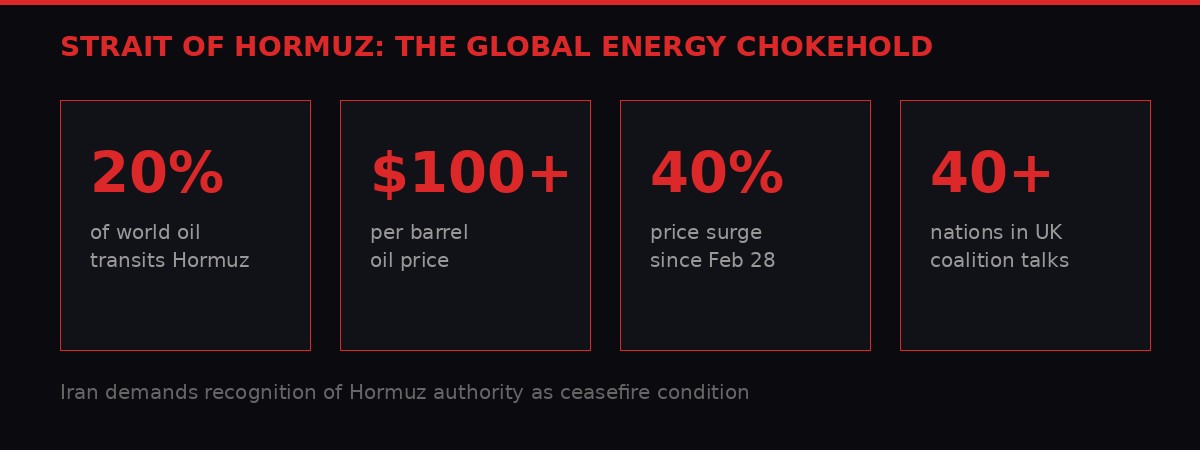
While American pilots were being hunted across Iranian territory, a parallel crisis continued to metastasize: the Strait of Hormuz remains effectively closed. Twenty percent of the world's oil supply normally transits this waterway. Since Iran blockaded it in early March, global oil prices have surged above $100 per barrel - a roughly 40 percent increase from pre-war levels.
The UK is now hosting virtual talks with more than 40 countries on strategies to reopen the strait. France, Germany, Italy, Canada, Australia, and the UAE are among participants. UK Foreign Secretary Yvette Cooper is chairing the sessions. Prime Minister Keir Starmer has acknowledged it "will not be easy."
The US is not participating.
Trump told allies earlier this week to "go get your own oil," saying it was not America's responsibility to reopen the strait. On Truth Social, he targeted countries "like the United Kingdom" which have "refused to get involved in the decapitation of Iran," adding: "You'll have to start learning how to fight for yourself, the U.S.A. won't be there to help you anymore." He then claimed Iran has been "essentially, decimated. The hard part is done."
This is a remarkable position for a wartime president. The US started this war. The US blockade - and Iran's response - created the Hormuz crisis. And now the US is telling the rest of the world to solve the consequences alone while simultaneously claiming the war is nearly won. The contradiction is not subtle. It is visible from space.
Iran has allowed a handful of vessels from "friendly" nations to pass through the strait since March - mostly ships flying Indian, Pakistani, Malaysian, and Chinese flags. The Philippines recently secured "nonhostile" status for its vessels through direct negotiations with Tehran. Iran's parliament is reportedly working on legislation to formalize a toll collection system for strait transit.
The Gulf Cooperation Council's secretary-general has called for UN Security Council authorization to use force to protect Hormuz. But any resolution would face a veto from Russia and likely China. Putin and Erdogan called for an "immediate ceasefire" during a phone call this week, warning of global impacts on energy, trade, and logistics.
Meanwhile, the real-world impacts cascade. Australia's government is urging motorists to fill up at city stations before Easter road trips, as hundreds of rural service stations have run dry. Malaysia ordered civil servants to work from home to conserve fuel. Pakistan made public transport free in its capital to reduce demand. The UN Food and Agriculture Organization reported its Food Price Index rose 2.4 percent in March. Easter Mass has been cancelled across Dubai.
The war in Iran is becoming a global rationing event. And the country that started it is sitting out the cleanup.

On Friday, Iran's semi-official Fars news agency reported that Tehran had rejected a US proposal for a 48-hour ceasefire. The report cited unnamed sources. The US did not confirm or deny the proposal's existence.
If the report is accurate, Iran rejected the ceasefire on the same day it shot down two US aircraft. The sequence suggests Tehran sees no reason to negotiate from a position of perceived strength. The downed warplanes gave Iran something it has lacked for most of this conflict: a tangible, photographable, shareable military victory. Why accept a ceasefire 24 hours after your best day of the war?
Iranian President Masoud Pezeshkian framed the rejection in moral terms, questioning whether the US is "sincere about diplomacy." He accused Washington of hypocrisy following a recent strike that killed the wife of a senior Iranian official. He consulted with Finland's president about Trump's threat to bomb Iran "back to the Stone Ages," calling the remark a "clear admission of intent to commit a massive war crime" and warning the international community against neutrality.
Pakistan continues to push mediation efforts between Washington and Tehran but admitted there are "obstacles" to peace. The US State Department said Trump is "always open to diplomacy" - a formulation that means nothing when you are simultaneously threatening to destroy a country's entire civilian infrastructure.
Former Iranian Foreign Minister Javad Zarif, who served as vice president under a previous administration, proposed a peace plan under which Iran would abandon nuclear weapons development in exchange for the lifting of US sanctions. The plan would give both sides a face-saving exit. It was ignored.
Iran's military stated bluntly that the war will continue until its enemies face "humiliation" and "surrender," and specifically warned the US against a ground invasion. This is not ceasefire rhetoric. This is the language of a country that believes time is on its side - that every day the strait stays closed, every aircraft that goes down, every rural petrol station in Australia that runs dry, shifts the global pressure equation further in Tehran's direction.

The war is not contained to Iran. It never was. But on Day 36, the expansion accelerated across multiple fronts simultaneously.
In Lebanon, Israel destroyed two critical bridges in the Bekaa Valley while Hezbollah claimed responsibility for missile strikes against Israeli soldiers and artillery positions in the south. Israel's ground operations in southern Lebanon continue to generate casualties - ten soldiers killed so far - and Lebanese displacement has surpassed one million people. Netanyahu announced an expansion of the security buffer zone in south Lebanon on March 29. The zone keeps growing, but security does not.
In Syria, Israeli fire killed a man in Quneitra province, near the occupied Golan Heights.
In the Gulf, the spillover is measured in industrial damage. An Egyptian worker was killed and four wounded at a gas complex in Abu Dhabi from debris of an intercepted Iranian attack. Kuwait confirmed strikes hit the Mina al-Ahmadi refinery and a power and desalination plant. In Bahrain, four people were injured in the Sitra area when shrapnel fell from an intercepted Iranian drone. Warning sirens sounded across Bahrain multiple times. Saudi Arabia said it intercepted and destroyed an incoming drone.
Iran launched missile attacks on southern Israel, sparking a fire at an industrial site in the Negev region. The strikes followed what Iranian state television called a "response" to earlier Israeli attacks on Iran's Natanz nuclear enrichment complex.
The economic toll on Israel specifically is staggering. According to the Bank of Israel, the combined cost of Israel's wars on Gaza, the Houthis, Lebanon, and Iran since October 2023 has reached 352 billion shekels - approximately $112 billion, or about $96 million per day. Despite this, 78 percent of Jewish Israelis still support continuing the war against Iran, according to the Israel Democracy Institute. But a majority also believe planners in both Washington and Tel Aviv underestimated Tehran's capabilities.
Back in Washington, Trump asked Congress to approve a $1.5 trillion defense budget for fiscal year 2027. The number is designed to absorb the rising costs of the Iran war and what the administration describes as "mounting global security commitments." The request came on the same day the administration lost two aircraft and had no comment about it. The budget is the quiet admission that the war Trump said would be quick and decisive has become an open-ended fiscal commitment with no defined endpoint.
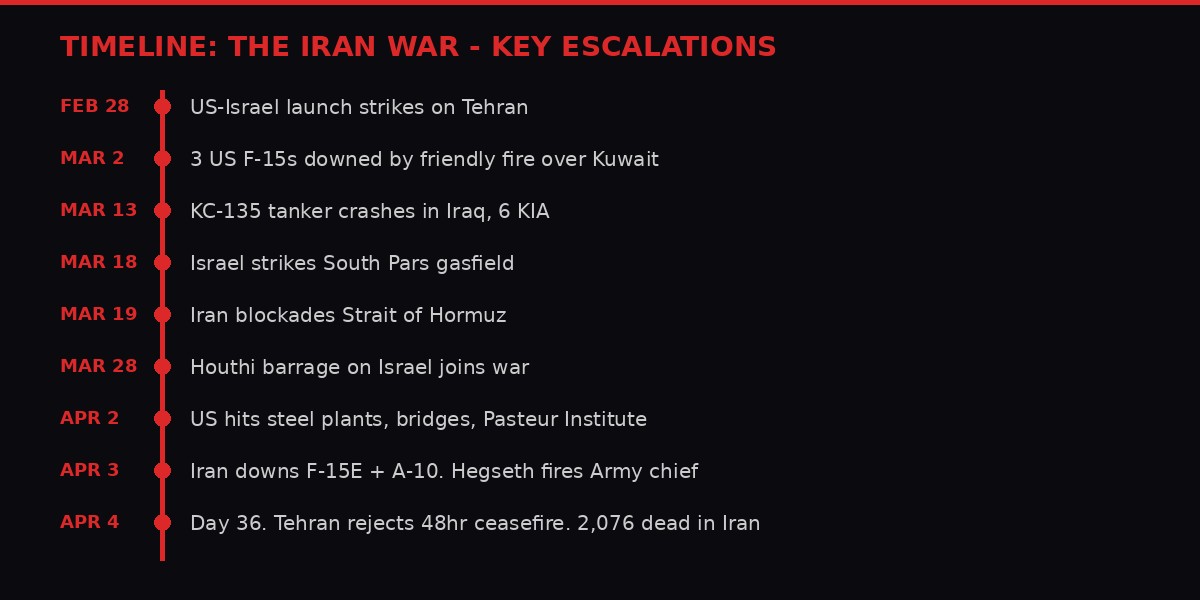
The images from Kohgiluyeh province - the wreckage, the ejection seat, the parachute - will circulate for weeks. They already are. Iranian state media is running them on loop. Social media has turned them into a hundred different narratives, from "Iran is winning" to "the US is losing," and every shade in between.
The Pentagon's silence is its own statement. In previous instances where Iran claimed to have downed US aircraft, CENTCOM was quick to deny the reports. This time, there is nothing. The officials who confirmed the shootdown spoke anonymously to Reuters, not from a podium. The White House said Trump was "briefed" about the incident. That is the extent of the official record.
Compare this with Iran's response. Parliament Speaker Ghalibaf posted mocking commentary in near real time. The governor of the province where the F-15 fell offered rewards for capturing American survivors. Iranians took to the streets in Tehran to celebrate. For a country that has endured 36 days of bombing, 2,076 dead, and 600 destroyed schools, the psychological value of seeing an American warplane's wreckage on Iranian soil is immeasurable.
This is what analysts mean when they say the shootdowns "change the propaganda equation." The military balance may not have shifted - the US still possesses overwhelming air power and the capacity to continue strikes indefinitely. But wars are not fought only with bombs. They are fought with images, narratives, and the willingness of domestic populations to tolerate the cost. Five weeks in, the cost is two warplanes in a single day, a missing airman in enemy territory, a fired army chief, a rejected ceasefire, global fuel shortages, and a $1.5 trillion budget ask.
The F-15E Strike Eagle costs approximately $100 million. The A-10 Warthog around $19 million. Whatever brought them down cost a fraction of that. This is the arithmetic of asymmetric warfare, and it is the math that eventually ends every campaign that was supposed to be quick and decisive.

The search for the missing American crewmember continues. The Black Hawk helicopter conducting the search was already hit by Iranian fire once. The terrain is mountainous, the population is hostile, and the Iranian military has explicitly told civilians to hunt for survivors. The outcome - rescue, capture, or death - will define the next news cycle and potentially the next phase of the war.
The USS Gerald R. Ford, which left Croatia after five days of fire-related repairs, is repositioning in the Mediterranean. Its next destination has not been disclosed. The carrier, which was damaged in the Arabian Sea, represents the largest single piece of American naval power in the theater. Its movements will signal whether the US is escalating or looking for distance.
Iran's five ceasefire conditions remain unchanged. Tehran demands international recognition of its authority over the Strait of Hormuz, a full lifting of sanctions, withdrawal of all US forces from the region, international guarantees against future strikes, and compensation for war damage. The US has rejected all five. Pakistan is still trying to mediate. The UK is assembling a coalition to reopen the strait without American participation. And the Easter weekend begins with petrol stations running dry across rural Australia.
Trump's $1.5 trillion defense budget will face Congressional scrutiny in the coming weeks. Senate Minority Leader Chuck Schumer responded to the shootdowns by saying he was "praying for the safe return of the crew." He did not comment on the budget, the fired generals, or the strategy. Nobody in Washington is commenting on the strategy, because articulating one would require acknowledging that this war has no defined objectives, no timeline, and no exit plan.
Thirty-six days. Two thousand and seventy-six Iranian dead. Thirteen American combat deaths. Seven aircraft lost. One airman missing in hostile terrain. A strait closed to global commerce. A hundred-dollar barrel of oil. A fired Army chief of staff. A rejected ceasefire. And a president who says it will not affect talks.
This is what Day 36 looks like. Day 37 will look the same, or worse. That is how these wars work. They do not improve. They accumulate.
Get BLACKWIRE reports first.
Breaking news, investigations, and analysis - straight to your phone.
Join @blackwirenews on Telegram