948 Drones, Two Burning Oil Terminals: Ukraine's Economic War Against Russia Is Now the Real War
MARCH 27, 2026 - 19:15 UTC // KYIV / PRIMORSK / POKROVSK
Russia fired 948 drones and 34 missiles into Ukraine in a single 24-hour window. A wartime record. Ukraine intercepted 91 percent of them, counted five dead, then sent its own drones north to the Baltic Sea. Two oil export terminals - Primorsk and Ust-Luga - went up in flames. Forty percent of Russia's oil export capacity, the revenue stream keeping Putin's military funded through a third year of war, went offline. The spring offensive is not going the way Moscow planned.
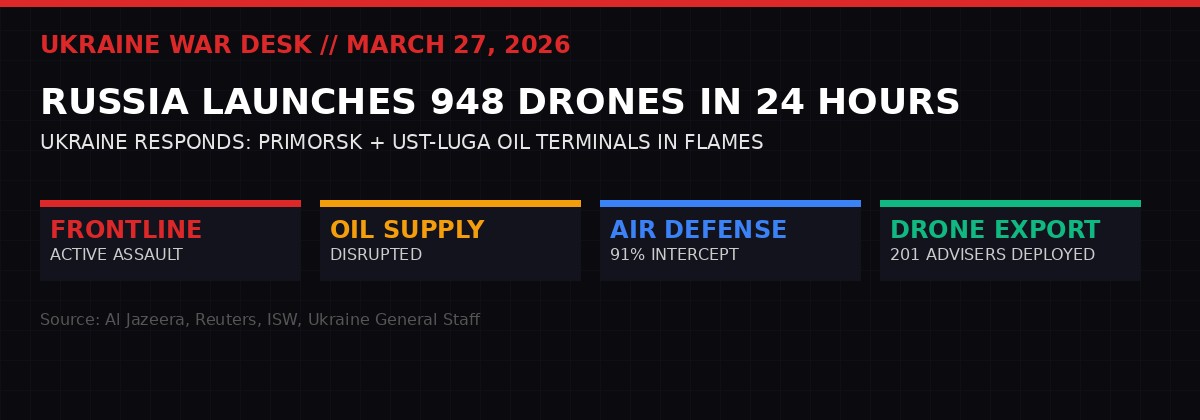
Ukraine-Russia war status dashboard, March 27, 2026. Source: BLACKWIRE / Ukraine General Staff / ISW.
SITUATION REPORT
- Russia launched 948 drones + 34 missiles in 24 hours on March 24 - the largest aerial assault of the war
- Ukraine intercepted 91% of drones and 25 of 34 missiles, killing at least 5 people
- Ukraine struck Primorsk and Ust-Luga Baltic oil terminals, cutting ~40% of Russian oil exports
- Brent crude has risen from $70.71 (Feb 27) to $108.01 (Mar 26) as the Iran war disrupts Gulf supply
- Russia launched 619 ground assaults over 4 days (Mar 17-20), suffering 8,710 casualties in one week
- Ukraine deployed 201 anti-drone experts to Gulf states; signed defence pact with Saudi Arabia on March 27
- Israel's Chief of Staff warned the IDF is approaching collapse after years of multi-front operations
The Record Barrage and What It Accomplished
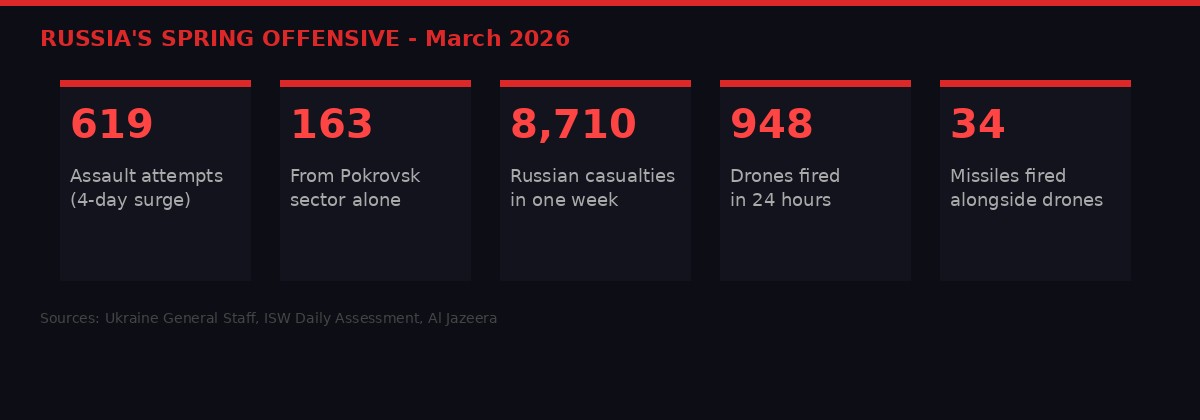
Russia's ground assault surge and aerial bombardment figures, March 17-24, 2026. Source: Ukraine General Staff, ISW.
The drones came in two waves. The first hit overnight, the usual Russian pattern - infrastructure, power grids, apartment buildings in western cities far from the frontline. Then something changed. A second wave arrived during daylight hours on Tuesday, March 24, a shift in tactics that analysts at the Institute for the Study of War (ISW) called deliberate and significant.
Combined: 948 drones, 34 missiles, 24 hours. The largest single aerial assault Russia has launched since February 24, 2022. At least five Ukrainians were killed. More than 40 were wounded. (Al Jazeera, March 27, 2026)
Ukraine's air defense responded with the efficiency of a military that has spent three years and two months learning to absorb exactly this kind of attack. It intercepted 91 percent of the drones - 1,791 of the 1,968 launched over the course of the week - and brought down 25 of the 34 missiles. Two of those missiles were Zircon anti-ship hypersonic weapons being moved into launch position; Ukrainian military intelligence tracked them to their truck mounts and destroyed them before they fired. (Ukraine General Staff, Al Jazeera)
"The scale of today's attack strongly indicates that Russia has no intention of really ending this war." - Ukrainian President Volodymyr Zelenskyy, March 24, 2026
What Russia accomplished: five dead, scattered infrastructure damage, and a psychological statement. What it did not accomplish: breaking Ukraine's air defense network, disrupting frontline logistics in any measurable way, or shifting momentum in the eastern ground campaign. The 9-percent it got through was costly for Ukraine. The 91-percent it didn't get through was catastrophically expensive for Russia in terms of drone manufacturing output.
Russia's daily drone production, according to Ukrainian Commander-in-Chief General Oleksandr Syrskii, stood at roughly 90 Shahed-type drones per day in July 2025. By January 2026, that had grown to more than 400 per day - a four-fold increase driven by Iranian technical assistance and expanded domestic production lines in Alabuga and other facilities. Firing 948 in 24 hours required drawing down stockpile reserves built over weeks. (Syrskii statement, Al Jazeera)
Ukraine Hits the War Chest: Primorsk and Ust-Luga in Flames
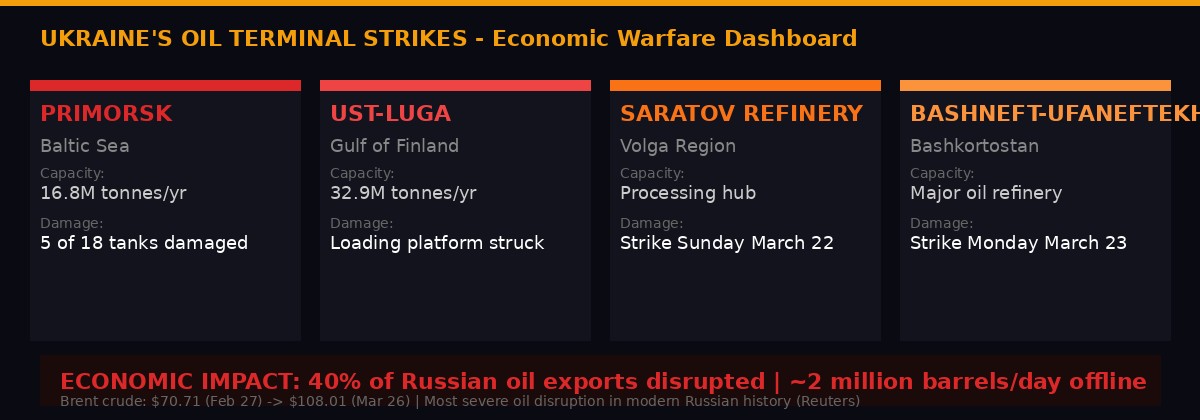
Ukraine's economic warfare campaign against Russian oil infrastructure, March 22-25, 2026. Source: Reuters, Ukraine General Staff, satellite imagery.
Ukraine's response was not symmetric. It did not fire 948 drones back at Russian cities. It fired a smaller, more precise package of long-range drones north - to the Baltic Sea coast, to two facilities that together moved nearly 50 million tonnes of petroleum products out of Russia in 2025.
The Transneft-Port Primorsk terminal, west of St. Petersburg, handles 16.8 million tonnes per year. Satellite imagery following Ukraine's strike showed at least five of the terminal's 18 storage tanks damaged or destroyed. Posted footage confirmed fires burning across the facility. (Reuters, Ukraine General Staff)
The Ust-Luga offshore oil offloading platform in the Gulf of Finland handles 32.9 million tonnes per year - nearly double Primorsk's throughput. Ukraine's General Staff said drones struck the loading platform on Tuesday night. Footage showed it burning.
Combined effect: approximately 2 million barrels of oil per day taken offline. According to Reuters, citing energy analysts, this represents roughly 40 percent of Russia's total oil export revenue - the most severe oil supply disruption in the modern history of the world's second-largest petroleum exporter. (Reuters, March 27, 2026)
The timing is not coincidental. Brent crude has climbed from $70.71 per barrel on February 27 - the day before the US and Israel first struck Iranian nuclear and military sites - to $108.01 on March 26. The Iran war cut Gulf output and scared energy markets. Russia, which had been hemorrhaging revenue through two years of sanctions, suddenly found itself with a $37-per-barrel windfall. Its war chest was refilling.
Ukraine's attack on Primorsk and Ust-Luga was designed to prevent that. It was economic warfare executed with drone strikes.
"Ukraine attacked Russian oil-exporting infrastructure on Monday and Tuesday this week. It is the most severe oil supply disruption in the modern history of Russia." - Reuters, March 27, 2026
The strikes on Saratov Oil Refinery (Sunday, March 22) and Bashneft-Ufaneftekhim refinery in Bashkortostan (Monday, March 23) preceded the Baltic terminal attacks, forming part of a coordinated four-day campaign against Russian energy infrastructure. Ukraine's deep-strike drone capability, refined through two years of increasingly ambitious operations, has now extended to targets 250 kilometers inside Russian territory on a routine basis. (Al Jazeera)
The Ground War: 619 Assaults and a Defense That Held
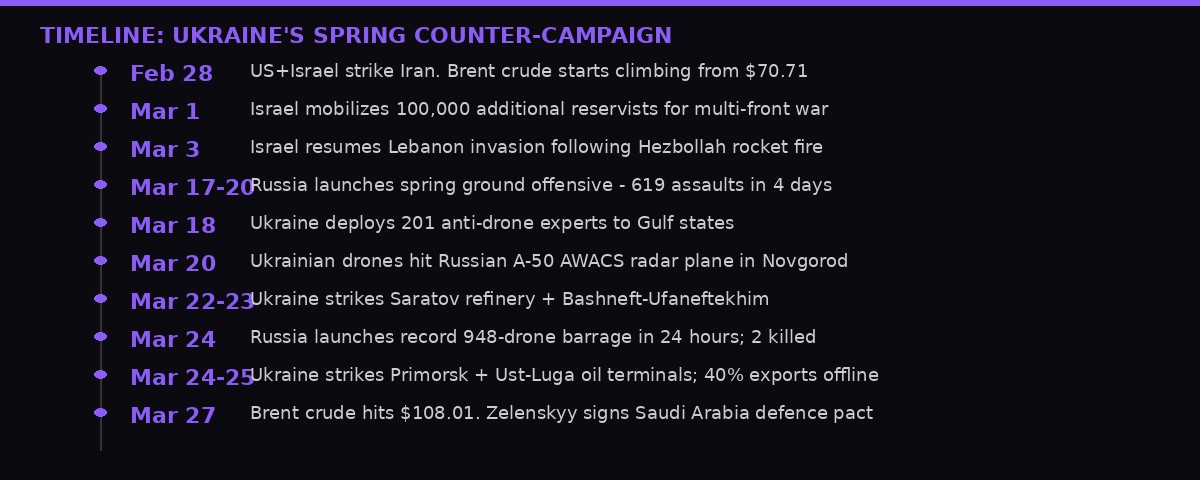
Timeline of Ukraine's spring counter-campaign and Russian escalation, February-March 2026.
Russia's spring offensive was telegraphed. Military analysts expected it. The ground froze, logistical lines solidified, and Russian commanders moved reserves into position through February. When it came, between March 17 and March 20, it came in mass.
Ukrainian Commander-in-Chief Syrskii reported 619 individual assault attempts across the entire frontline over those four days. The concentration was in Pokrovsk - the eastern Donetsk city of 60,000 people before the war, which Russian forces finally seized last month after a grinding two-year battle. From Pokrovsk, Russia launched 163 of those 619 assaults, pushing to exploit the momentum from taking the city and attempting to fracture Ukraine's defensive line south and east of Kramatorsk.
Russia also pushed toward Lyman and Kupiansk, in the northeastern Kharkiv region. These are strategic gateways - if Russia can seize them, it gains a northern approach vector toward the "fortress belt" of cities that Putin has repeatedly demanded Ukraine surrender: Sloviansk, Kramatorsk, Druzhkivka, and Konstiantynivka.
The defensive line held. Ukrainian forces stopped the breakthroughs. But the cost was significant on both sides.
"Over four days of intense assault operations, the enemy lost more than 6,090 soldiers killed and wounded. While over the course of a week, the enemy's total losses amounted to about 8,710 people killed and seriously wounded." - General Oleksandr Syrskii, Ukrainian Commander-in-Chief
The ISW, in its March 24 daily assessment, concluded that Russia is unlikely to seize the Fortress Belt in 2026 but will likely make some tactical gains at significant cost. The assessment matches the operational pattern seen so far: Russia can grind forward through attrition and numerical superiority, but it cannot break Ukraine's layered defensive system quickly enough to change the strategic situation.
On a separate axis, Vladyslav Voloshyn, Ukraine's southern forces spokesman, told Interfax that all mobilized personnel in Russian-occupied Crimea are preparing to join frontline operations by April 1. Russia is building toward a second surge. (Interfax via Al Jazeera)
The Drone Numbers Are Staggering - and Getting Bigger
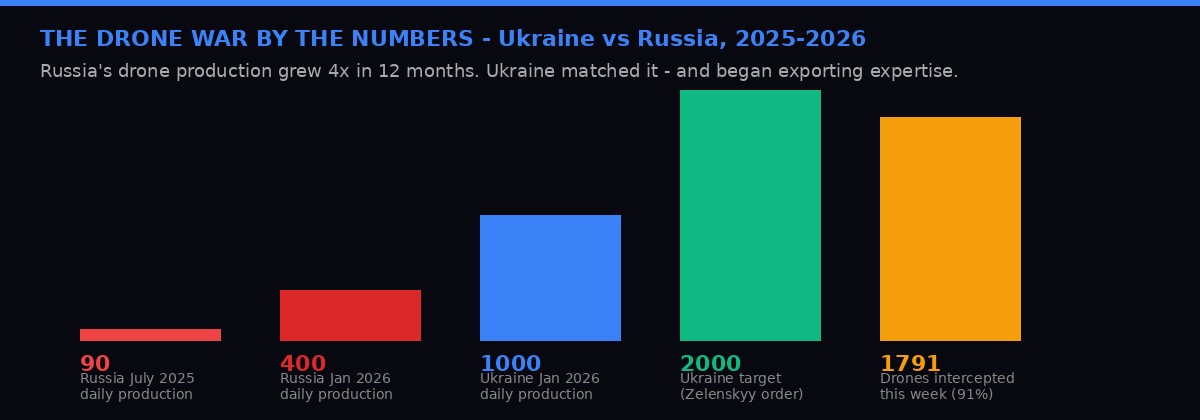
Ukraine and Russia drone production trajectories, 2025-2026. Sources: Syrskii, Shmyal, ISW, Zelenskyy statements.
The battle above Ukraine has become as significant as the battle below it. The drone war is not a sideshow. It is, increasingly, the main event - a contest of industrial production, electronic warfare, AI targeting, and human interception skills playing out at speeds and scales that conventional air defense was never designed to handle.
Russia's production has grown from roughly 90 Shahed-class drones per day in July 2025 to more than 400 per day by January 2026. That growth trajectory, if sustained, means Russia will be launching 500 to 600 drones per day by summer. The record 948 in 24 hours this week suggests it is already drawing on stockpiles to conduct occasional overwhelming surges designed to saturate Ukrainian defenses.
Ukraine has matched the growth and then some. In July 2025, Zelenskyy received intelligence about Russia's scale-up ambitions and signed orders to commission at least 1,000 interceptor drones per day. Ukrainian Defense Minister Denys Shmyal confirmed that target was hit by January 2026. By mid-March, Zelenskyy was publicly stating Ukraine could produce at least 2,000 effective interceptors every day and offered half of that capacity to Gulf states fighting Iranian drone attacks. (Al Jazeera, Zelenskyy statement March 2026)
Ukraine shot down two Beriev A-50 early-warning aircraft in early 2024, forcing Russia to operate its fighter jets without proper airborne radar coordination. On March 20, a Ukrainian drone strike on a repair plant in Russia's Novgorod region damaged another A-50 valued at approximately $500 million - Russia's eyes in the sky are getting expensive to keep operational. (Ukraine General Staff)
This week, across 1,968 Russian drone launches, Ukraine intercepted 91 percent. The interception rate has improved consistently as Ukraine's air defense crews accumulate thousands of hours of live combat experience that no training simulation can replicate. The remaining 9 percent that gets through is still enough to kill people and damage infrastructure. But it is not enough to collapse the country.
Ukraine Goes Global: Gulf States, Saudi Arabia, and the Drone Diplomacy Game

Ukraine-Saudi Arabia defence procurement MOU, signed March 27, 2026. Source: Zelenskyy/X, Saudi state news agency.
The most underreported development of the week is not the drone record or the oil terminal strikes. It is what Ukraine is doing with its drone expertise as a geopolitical instrument.
On March 18, Zelenskyy confirmed that 201 Ukrainian anti-drone military experts had been deployed to the Middle East to assist Gulf states in defending against Iranian drone attacks. The move was framed as a contribution to regional security, but the strategic logic is clear: Ukraine is converting battlefield experience into diplomatic currency. (Al Jazeera, March 18)
The same Iranian-designed Shahed drones that Russia fires into Kyiv are the ones Iran fires toward Riyadh and Abu Dhabi. Ukraine has, by now, intercepted tens of thousands of them. No other military on earth has comparable operational data on how to kill Shaheds efficiently at scale. Saudi Arabia has intercepted hundreds of drones and dozens of missiles since the US and Israel first struck Iran on February 28. Six more were intercepted just on March 27, Saudi Arabia's defense ministry confirmed. (Saudi Defence Ministry statement)
On March 27, Zelenskyy landed in Riyadh and signed a memorandum of understanding on defence procurement with Saudi Arabia. He framed the deal carefully on X:
"It lays the foundation for future contracts, technological cooperation, and investment... Saudi Arabia also has capabilities that are of interest to Ukraine, and this cooperation can be mutually beneficial." - President Volodymyr Zelenskyy, post on X, March 27, 2026
What Ukraine gets: capital for defense procurement, a neutral diplomatic channel with Gulf states that still maintain back-channel communication with Moscow, and a precedent for treating battlefield technology as an exportable strategic asset.
What Saudi Arabia gets: Ukrainian drone interception expertise, operational training from personnel who have spent years shooting down exactly the weapons Iran is now firing at Saudi cities, and a partnership that reduces Riyadh's dependence on US military hardware in one specific but critical area.
Ukraine's Al Jazeera correspondent Audrey MacAlpine noted that Ukrainian Air Force personnel confirmed an increasing percentage of intercepted objects are now being shot down by interceptor drones rather than conventional anti-aircraft missiles - a cheaper, scalable method that Gulf states are eager to adopt. The challenge in the desert: sandstorms create sensor degradation that Ukraine's operators have not encountered on the steppe. That is one of the technical adaptations the 201 deployed experts are working through in real time. (Al Jazeera, MacAlpine report)
The IDF's Breaking Point: Israel's Army Is Running Out of People
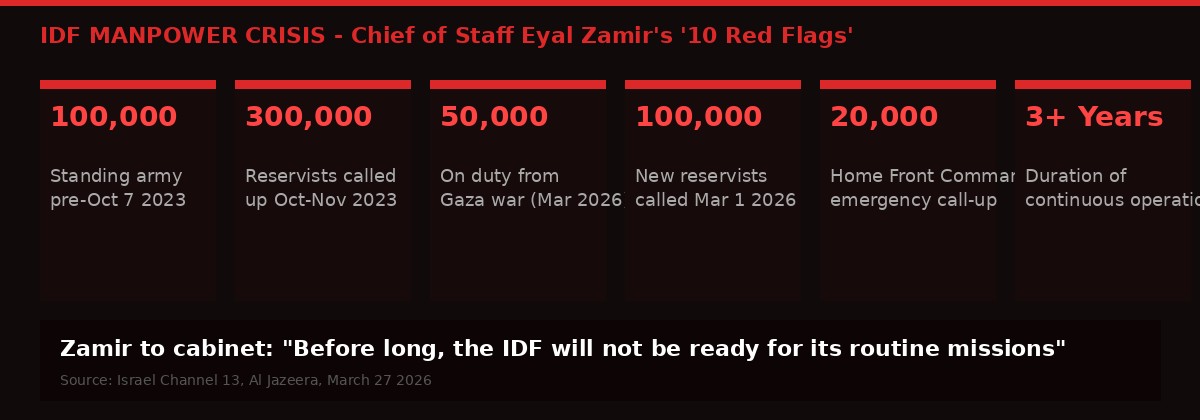
IDF reserve mobilization totals and Chief of Staff Zamir's warning to the Israeli cabinet, March 2026.
The Iran war and Lebanon ground operations have created a crisis that Israel's political leadership has been slow to address: the Israeli military is burning through its reserve force at a rate that is becoming unsustainable.
This week, Israeli Chief of Staff Lieutenant General Eyal Zamir delivered what Israeli Channel 13 described as a stark warning to the security cabinet. He told ministers he was raising "10 red flags." The army needs a conscription law, a reserve duty law, and legislation to extend mandatory service - none of which exist in current statute. Without them, Zamir said plainly:
"Before long, the [Israeli military] will not be ready for its routine missions and the reserve system will not last." - IDF Chief of Staff Lt. Gen. Eyal Zamir to the Israeli cabinet, March 2026 (via Channel 13)
The numbers tell the story. Israel's standing army numbered 100,000 before October 7, 2023. In the first weeks after Hamas's assault, Israel called up 300,000 reservists. By the time Israel resumed active military operations - Gaza, Lebanon, the West Bank, and now strikes on Iran - that initial reserve class had been cycling in and out of active duty for nearly two and a half years.
On March 1, the day after US-Israeli strikes on Iran began, Israel mobilized another 100,000 reservists - on top of the 50,000 already on duty from the Gaza war. Home Front Command issued an emergency call-up of 20,000 more, primarily for search and rescue operations. (Al Jazeera)
The scale is staggering for a country of 10 million people. Roughly 270,000 reservists have been mobilized simultaneously in a country whose entire economy, health system, tech sector, and civilian infrastructure depends on those same people not being soldiers.
Central Command chief Major General Avi Bluth added another dimension to the cabinet briefing. West Bank expansion policies approved by Netanyahu's government are consuming additional manpower. Israel has approved multiple new settlements in the Jordan Valley and elsewhere in the West Bank - each requiring military security packages in an environment that has "completely changed," Bluth said, as Palestinian resistance has grown. (Al Jazeera, Channel 13)
The political dimension sharpens the crisis. Israel's ultra-religious Haredi community - roughly 13 percent of the Jewish population and growing - has historically been exempted from mandatory military service. Resentment among exhausted reservists is acute. Opposition leader Yair Lapid went directly at the government on X: "The government must stop the cowardice, immediately halt all budgets to the Haredi draft dodgers. Send the military police after the deserters, draft the Haredim without hesitation." The warning has been given, Lapid said. It is on the government's heads.
Netanyahu responded with an announcement to extend mandatory military service. This is not the first such announcement. The structural problem - a military designed for short, high-intensity conflicts now fighting permanent multi-front operations across Gaza, Lebanon, Syria, the West Bank, and Iran - has not been solved by any legislative measure yet proposed. (Al Jazeera)
Norway and NATO's Defense Spending Surge: The Continent Rearming
The conflict system extends far beyond Kyiv and Tehran. On March 27, Norway announced an addition of more than $11 billion to its defense budget over ten years - part of a broader European rearming drive accelerated by US pressure on NATO allies to hit and exceed the two-percent GDP defense spending threshold. (Al Jazeera)
Norway's economy is oil-based. Brent crude at $108 per barrel makes defense expansion financially easier than it would be at $70. The Iran war, paradoxically, is funding Nordic security upgrades even as it destabilizes global supply chains. The geopolitical cascades are not linear.
For Ukraine, the surge in European defense spending matters primarily as a signal: the continent is treating the Russia threat as permanent, and procurement pipelines are being established for the long term. That means Ukrainian defense industries, which have evolved from pre-war mediocrity into battlefield-tested production lines, may find European markets for their hardware if the conflict freezes or ends.
The Saudi defence deal this week is the first significant example of Ukraine marketing its wartime expertise as an export product. It will not be the last. Poland, the Baltic states, Finland, and now Gulf states are all competing for Ukrainian drone and electronic warfare knowledge. (Al Jazeera, Reuters)
What Comes Next: The April Variables
Several converging pressures will shape the next 30 days of the war.
Russia's mobilized Crimea forces are reportedly preparing to join frontline operations by April 1. If that projection is accurate, the next ground surge will be larger than the March 17-20 attempt that failed to break through. Ukraine's defensive lines have been significantly reinforced since late 2025, but depth and manpower remain the variables Russia is betting can be overwhelmed.
Ukraine's oil terminal strikes have created a short-term financial shock to the Kremlin. Forty percent of export revenue offline is not sustainable for weeks without serious political and economic consequences inside Russia. The question is whether the terminals can be repaired quickly. Primorsk and Ust-Luga have repair infrastructure nearby, but operating oil terminals under active drone threat is operationally complex. The damage to storage tanks at Primorsk - five of eighteen - may take months to fully remediate.
The diplomatic track, meanwhile, is functionally frozen. Ukraine's negotiating team returned from Washington last weekend without announcing any results. The Iran war has absorbed American diplomatic attention and military logistics capacity in ways that make a Ukraine peace mediation effort politically difficult for the Trump administration to prioritize. Zelenskyy knows this. The Saudi deal is partly about building diplomatic alternatives to a Washington track that is not moving.
The drone war will continue to escalate on both sides. Russia's target of 400-plus drones per day by January 2026 will grow further. Ukraine's counter-target of 2,000 interceptors per day is already being offered to allied states. The industrial competition - which country can produce more small autonomous weapons systems faster and cheaper - is arguably the most consequential military-industrial contest since the battle of the Atlantic in 1943.
Israel's manpower crisis, if it forces a pause or drawdown in Lebanon or elsewhere, creates a strategic opening that Hezbollah, and by extension Iran, will be watching carefully. The IDF's warning is not theater. It is a structural military problem that legislative gestures alone cannot solve.
Get BLACKWIRE reports first.
Breaking news, investigations, and analysis - straight to your phone.
Join @blackwirenews on Telegram