The Great Arms Shuffle: Ukraine Sells Drone Expertise to the Gulf While the Pentagon Diverts Its Weapons to Iran's War

Thirty days into the US-Israeli war on Iran, the conflict has produced an outcome nobody in Washington or Kyiv planned for: Ukraine, the country that was supposed to be the primary recipient of American military hardware, is now selling its own defense expertise to the same Gulf states that are absorbing weapons originally earmarked for the Ukrainian front.
On March 27, President Volodymyr Zelensky touched down in Riyadh and signed a defense cooperation agreement with Saudi Arabia covering drone defense expertise, electronic warfare systems, and counter-missile technology. The deal - confirmed by Zelensky in a post on X and reported by the BBC - lays the foundation for future contracts, technological cooperation, and direct investment between Kyiv and the Kingdom.
The timing is not coincidental. Reports from the Washington Post, confirmed by President Trump himself, indicate the Pentagon is actively considering diverting weapons initially destined for Ukraine to the Middle Eastern theater. The Iran war has depleted critical US munitions stockpiles faster than anyone anticipated. Something has to give, and that something appears to be Ukraine.
This is the story of how a month-long war in the Persian Gulf created the strangest arms bazaar of the 21st century.
I. The Deal: What Ukraine Is Selling
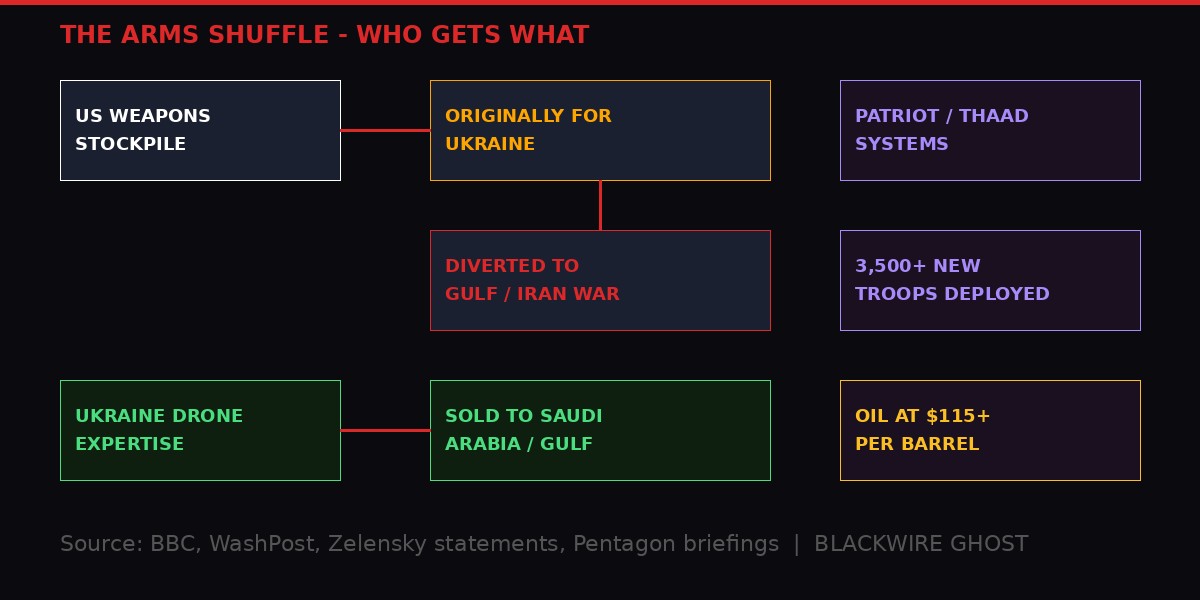
The Ukraine-Saudi defense agreement covers three primary areas, according to statements from Zelensky and reporting by the BBC's Vitaly Shevchenko from Kyiv. First, drone defense expertise - the systems and battlefield doctrine that Ukraine developed over four years of fighting Russia's aerial campaigns. Second, electronic warfare capabilities, specifically the kind of counter-drone jamming that proved decisive against Russian Shahed drones over Ukrainian cities. Third, the integration framework that ties radars, aviation assets, and air defense systems into a unified kill chain.
Zelensky drew the connection explicitly. "Saudi Arabia is facing the same type of ballistic missile and drone attacks from Iran that Ukraine had been resisting for more than four years from Russia," he said. "We are ready to share our expertise and systems with Saudi Arabia and to work together to strengthen the protection of lives."
The irony is thick enough to cut. The Shahed drones that Ukraine learned to defeat were Iranian-designed and Russian-deployed. Now that Iran is deploying similar systems against Gulf targets - hitting aluminium plants in Abu Dhabi and Bahrain, radar installations at Kuwait International Airport, and a power and desalination plant that killed an Indian worker on March 30 - Ukraine has become the world's foremost expert in surviving exactly this kind of campaign.
Multiple Ukrainian defense companies told the BBC they had been approached by Gulf states. Kvertus, a manufacturer of anti-drone electronic warfare systems, confirmed contact from both Saudi Arabia and Kuwait. TAF Industries said approaches had come from Saudi Arabia, Qatar, the UAE, and Kuwait. Both companies said they were awaiting government approval from Kyiv before proceeding - a sign that the deals are real enough to require state-level authorization.
"All of us are working to protect Ukraine, to stay with Ukraine and to keep Ukraine alive. This is about survival. And if we need to wait a few months, we will," TAF Industries CEO Volodymyr Zinovsky told the BBC. The statement carries weight. These companies are being asked to sell technology to new customers while the country that was supposed to be arming them may be pulling back.
Zelensky made his ask explicit during an interview with Le Monde: "We would like Middle Eastern states to also give us an opportunity to strengthen ourselves. They have certain air defense missiles of which we don't have enough. That's what we'd like to reach a deal on." The transaction, in other words, is not one-directional. Ukraine wants Gulf air defense missiles - Patriot-compatible interceptors, potentially Saudi-held stocks - in exchange for its drone-killing know-how.
II. The Diversion: Pentagon Robs Kyiv to Feed the Gulf

The Washington Post reported - citing sources familiar with internal Pentagon deliberations - that the Department of Defense is considering diverting weapons intended for Ukraine to the Middle East as the Iran war depletes critical US munitions at an alarming rate. The story landed like a grenade in both Washington and Kyiv.
When asked about the report on March 27, President Trump was characteristically blunt. "We do that all the time. Sometimes we take from one, and we use for another," he told reporters. The casualness of the admission belied its significance. For three years, the US had maintained - through two administrations - that arming Ukraine against Russia was a core strategic priority. Now, with Iran absorbing Tomahawk cruise missiles, Precision Strike Missiles, and advanced standoff munitions at rates that are straining Pentagon stockpiles, that priority appears negotiable.
The math is brutal. In the first thirty days of the Iran war, the US has expended munitions at a pace that defense analysts estimate exceeds the opening phases of both Gulf Wars. Tomahawk inventories are being drawn down faster than production can replace them. The Raytheon production line builds roughly 400 Tomahawks per year in peacetime. The Iran campaign has likely consumed hundreds in a single month, according to defense procurement estimates published by Jane's Defence Weekly and the Center for Strategic and International Studies.
Precision-guided munitions - JDAMs, SDBs, AGM-158 JASSMs - face similar pressure. The 3,500 additional US troops that arrived in the Middle East over the weekend need equipment, vehicles, and ammunition. The 82nd Airborne, already deployed since mid-March, requires sustained logistics. Every round that goes east is a round that does not go to Kyiv.
Congressional reaction has been muted but revealing. Several Republican lawmakers have quietly signaled support for the reallocation, arguing that the Iran theater represents an immediate threat to American forces while Ukraine represents a proxy war with lower direct exposure. Democrats have been louder in opposition but lack the votes to block executive action on weapons transfers.
The result is a slow-motion strategic abandonment disguised as resource management. Ukraine is not being told "we are cutting you off." Ukraine is being told "we have to prioritize" - which, in the language of defense procurement, means the same thing.
III. The Gulf States Under Fire: Why They Need Help Now
The urgency driving the Ukraine-Saudi deal becomes clear when you map what Iran has hit in the past month. The Islamic Revolutionary Guard Corps has conducted a systematic campaign against Gulf infrastructure that goes far beyond military targets. The strategy is calculated: make the cost of hosting American forces unbearable for Gulf governments by attacking civilian infrastructure.
On March 30, an Iranian attack struck a power and desalination plant in Kuwait, killing an Indian migrant worker and causing what Kuwait's Ministry of Electricity described as "significant material damage." The previous day, Kuwait's defense ministry reported 14 missiles and 12 drones detected in Kuwaiti airspace, with several targeting a military camp and injuring 10 servicemen. Kuwait International Airport's radar system has been "significantly damaged" by a 15-drone swarm.
In the UAE, Emirates Global Aluminium reported an Iranian strike on its Abu Dhabi facility that injured multiple workers. Aluminium Bahrain - one of the world's largest smelting operations - confirmed two employees wounded in a separate attack. The IRGC claimed both strikes were retaliation for US-Israeli attacks on Iranian industrial plants, specifically steel production sites.
Oman reported a drone strike on its southern port of Salalah that injured a foreign worker. Saudi Arabia intercepted five ballistic missiles targeting its eastern region on March 30 alone. The previous week, Iranian drones and missiles struck Prince Sultan Air Base, destroying a US E-3 AWACS command and control aircraft - confirmed by photographs verified by BBC analysts - and wounding 12 US personnel, two seriously.
The water dimension is particularly terrifying. Gulf states rely on desalination for between 40% and 90% of their drinking water, depending on the country. Kuwait sits at the extreme end - essentially all of its freshwater comes from desalination. Hitting a desal plant is not a military strike. It is an attack on the physical survival of a civilian population. Al Jazeera reported that the war has "exposed the vulnerability of critical water infrastructure in a region that is among the most water-scarce in the world."
This is why Gulf states are buying whatever they can, from whoever is selling. Ukraine happens to be selling exactly what they need most: the ability to detect, jam, and destroy the drones and missiles Iran is currently firing at them.
IV. Ukraine's Gambit: Trading Expertise for Survival

Zelensky's trip to Riyadh was not a diplomatic courtesy call. It was a survival play. With American weapons potentially being redirected away from Ukraine, Kyiv needs alternative sources of military hardware - and it needs them fast. The Gulf states have weapons. They have Patriot interceptors, THAAD components, and stockpiles of air defense missiles that Ukraine desperately wants. The drone deal is the opening bid in a much larger transaction.
Before meeting Crown Prince Mohammed bin Salman, Zelensky posted that the defense agreement "laid the foundation for future contracts, technological cooperation and investment." He added pointedly: "Saudi Arabia also has capabilities that are of interest to Ukraine, and this cooperation can be mutually beneficial." The subtext: you give us missiles, we teach you how to kill drones.
The strategic logic makes sense on paper. Ukraine has more combat-tested drone warfare experience than any military on earth. Four years of Russian aerial campaigns - including thousands of Iranian-designed Shahed drones launched against Ukrainian cities, power grids, and military positions - have produced a level of institutional knowledge that no amount of defense contracting can replicate. Ukrainian soldiers know how Shaheds fly, how they navigate, where their sensors fail, and how to bring them down cheaply.
That knowledge has immediate market value. Since the Iran war began on February 28, the Gulf states have been subjected to a version of what Ukraine endured from Russia - Iranian drones and missiles targeting civilian and military infrastructure across the Arabian Peninsula. The difference is that Gulf air defenses were designed to intercept high-end ballistic missiles, not swarms of cheap drones. They have Patriot batteries and THAAD systems, but those platforms were not optimized for the kind of low-altitude, GPS-guided drone warfare Iran specializes in.
Ukraine fills that gap. Its electronic warfare companies - Kvertus, TAF Industries, Piranha, and others - produce mobile jamming systems, drone detection radars, and counter-UAS platforms that were forged in actual combat. These are not theoretical systems tested on ranges. They were tested against real Iranian drones trying to kill real people. That provenance is worth billions in the current market.
But the deal carries risks for Kyiv. Selling defense technology to the Gulf means sharing intellectual property that took years and thousands of lives to develop. It means potentially equipping countries whose long-term strategic alignment with Ukraine is uncertain. And it means admitting, implicitly, that American support is no longer sufficient - a message that could further erode Western commitment to Ukrainian sovereignty.
Zelensky appears willing to accept those risks. Survival tends to clarify priorities.
V. The Escalation Spiral: Houthis, Oil, and the Spreading War
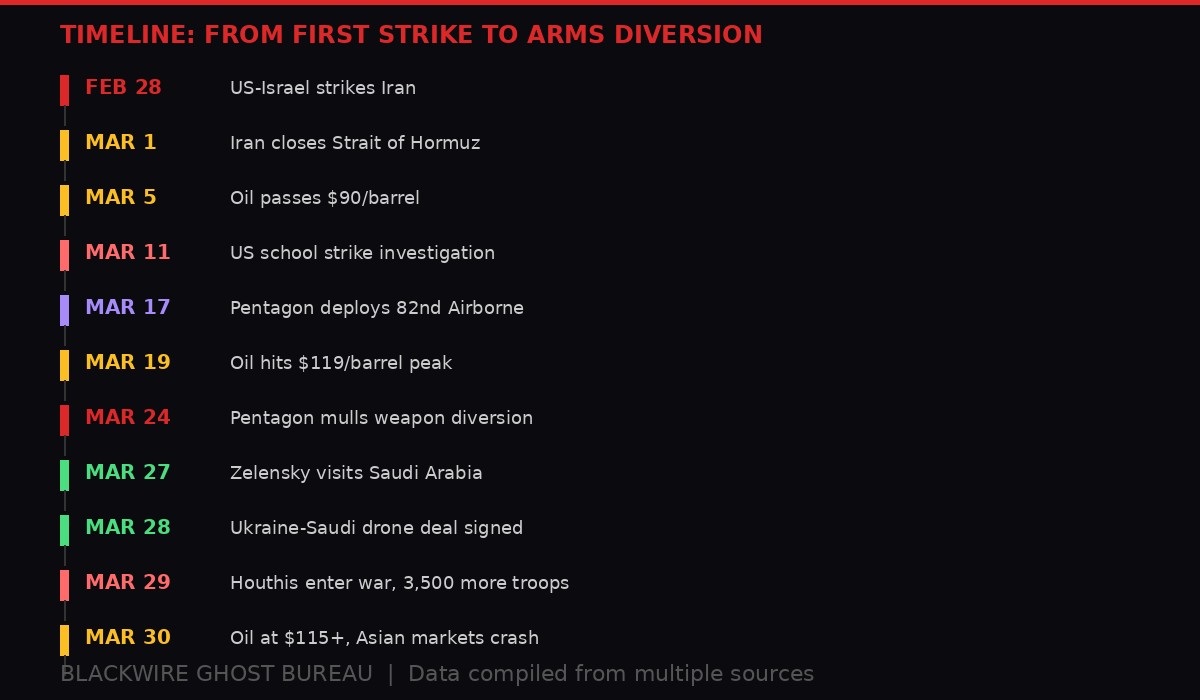
The arms shuffle is happening against a backdrop of rapid escalation. On March 29, Yemen's Houthi movement formally entered the war, launching multiple waves of ballistic missiles at Israel and claiming to have targeted "sensitive Israeli military sites." Israel said it intercepted two missiles. The Houthis vowed to continue attacks "until the aggression against all resistance fronts ceases."
The Houthi entry introduces a second maritime chokepoint to the crisis. Iran has already effectively shut the Strait of Hormuz, blocking roughly 20% of the world's oil and liquefied natural gas shipments. If the Houthis resume attacks on shipping in the Bab al-Mandab Strait - the gateway to the Red Sea and Suez Canal - a second critical waterway goes dark. The economic consequences would be catastrophic.
From November 2023 to early 2025, the Houthis conducted nearly 200 attacks on Red Sea shipping, damaging over 30 vessels and forcing major carriers like Maersk and Hapag-Lloyd to reroute around the Cape of Good Hope. Those diversions added weeks to shipping times and billions in costs. The carriers had just begun tentatively returning to the Red Sea route when the Iran war erupted. They abandoned it again immediately.
Maersk CEO Vincent Clerc told the BBC recently: "It's very hard for us to put our colleagues and our ships in harm's way and risk having an attack be successful and create damage or loss of life in the process." That statement, from the world's second-largest container shipping company, represents a corporate death sentence for the Red Sea route.
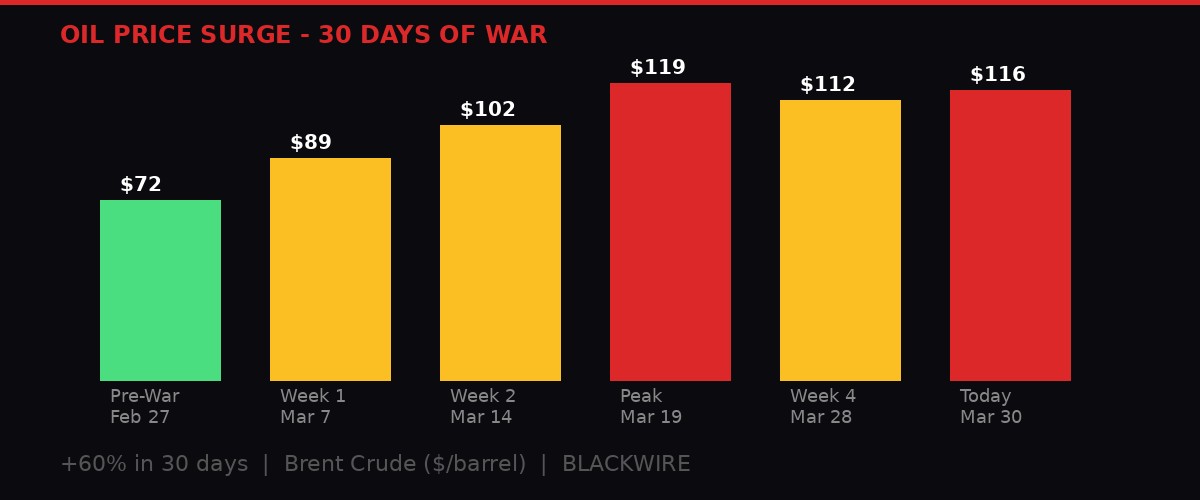
Oil prices reflect the chaos. Brent crude rose above $115 per barrel on March 30 - a 3% jump in Asian trading - putting it on track for its largest monthly gain on record. Pre-war, oil sat around $72. The 60% surge in thirty days has hammered energy-dependent economies worldwide.
Egypt ordered shops, restaurants, and cafes to close by 9 PM starting March 29, as the country's petrol bill more than doubled to $2.5 billion in March alone. Street lights are being dimmed. Government workers are being sent home one day per week to conserve fuel. Ethiopia placed non-essential state employees on leave. Asian stock markets cratered on Monday morning - Japan's Nikkei 225 fell 4.5%, South Korea's Kospi dropped 4.3%.
The economic damage extends the war's footprint far beyond the Middle East. Countries that have no involvement in the conflict - Egypt, Ethiopia, Thailand, South Korea, Japan - are absorbing its costs through energy prices, supply chain disruptions, and market volatility. The arms trade reshuffling is one dimension of a much larger reordering.
VI. Trump's Kharg Island Gambit

On March 30, President Trump told the Financial Times he could "take the oil in Iran" and was considering seizing Kharg Island, the offshore terminal that handles over 90% of Iran's crude exports. "Maybe we take Kharg Island, maybe we don't. We have a lot of options," Trump said. When asked about Iranian defenses on the island, he responded: "I don't think they have any defence. We could take it very easily."
The statement sent oil prices higher and drew immediate analysis from military experts. Kharg Island sits in the northern Persian Gulf, roughly 25 kilometers off Iran's coast. Seizing it would require a combined naval and amphibious operation - the kind of action that the Pentagon's leaked planning documents, reported by multiple outlets, suggest is already under consideration alongside broader "limited ground operations" in Iran's strategic regions.
Trump compared the potential move to Venezuela, where the US seized control of the oil industry "indefinitely" following the removal of then-President Nicolas Maduro in January. The comparison is telling. It frames oil seizure not as a military tactic but as an economic strategy - taking a hostile nation's primary revenue source and holding it.
Iran's response came through its parliament speaker, who warned that Iranian forces were "waiting for American soldiers." The IRGC's operational command - the Khatam al-Anbiya Central Headquarters - escalated further, threatening to target the homes of US and Israeli "commanders and political officials in the region" as a retaliatory measure.
Simultaneously, Trump claimed on Air Force One that the US had effectively achieved "regime change" in Iran. "The one regime was decimated, destroyed, they're all dead. The next regime is mostly dead, and the third regime we're dealing with different people than anybody's dealt with before," he said. More than 2,000 people have been killed in Iran since February 28, according to Iranian authorities, including the late Supreme Leader Ayatollah Ali Khamenei and several top officials.
Whether Trump's Kharg Island comments represent actual planning or rhetorical escalation designed to pressure Iran into negotiations remains unclear. He also said indirect talks via Pakistani "emissaries" were progressing well and "a deal could be made fairly quickly." Pakistan's foreign minister confirmed both Iran and the US had "expressed confidence in Pakistan to facilitate" talks, with Islamabad offering to host negotiations.
The contradiction is the point. Trump negotiates by keeping every option - from seizure to ceasefire - simultaneously on the table. The arms diversion to the Gulf, the troop surge, the Kharg Island rhetoric, and the Pakistan back-channel are all pieces of the same play. Whether it produces a deal or a ground war depends on variables that even the principals may not fully control.
VII. The Collateral Damage: Journalists, Civilians, and the Human Cost

While the arms deals and oil prices dominate headlines, the human cost of the war continues to compound. On March 29, three Lebanese journalists were killed in a targeted Israeli strike in southern Lebanon. Ali Shoeib, a reporter for Hezbollah-affiliated Al Manar TV, was killed alongside Fatima Ftouni and her brother Mohamed Ftouni, both from Al Mayadeen, when a strike hit their car near the town of Jezzine.
The IDF confirmed killing Shoeib, calling him a "terrorist" from Hezbollah's elite Radwan Force who "operated for years under the guise of a journalist." The IDF provided no evidence for the claim and did not comment on the Ftouni siblings' deaths. The Committee to Protect Journalists responded that they had seen "a disturbing pattern in this war and in the decades prior of Israel accusing journalists of being active combatants and terrorists without providing credible evidence."
The same day, the World Health Organization reported nine paramedics had been killed in southern Lebanon within 24 hours, bringing the total to 51 health workers killed in March. More than 1,100 civilians, including 120 children and 42 paramedics, have died in Lebanon since the conflict began. Over a million people have been displaced.
In the West Bank, settler violence has surged. Seven Palestinians have been killed by settlers since the war began, including Mohammad al-Malhi, shot in the head near Bethlehem after settlers erected an outpost on his family's land. Israel's security cabinet retroactively legalized 30 outposts throughout the West Bank this week, according to Israeli media.
Netanyahu visited Northern Command headquarters on March 30 and ordered the "existing security zone" in southern Lebanon expanded further. Defense Minister Israel Katz had already declared the zone would stretch to the Litani River - effectively placing a tenth of Lebanon under Israeli control, with no residents allowed to remain. The move mirrors Israel's 1985-2000 occupation of southern Lebanon.
In Iran, the UN's human rights chief, Volker Turk, urged the US to complete and publish its investigation into the strike on Shajareh Tayyebeh school in Minab, which killed at least 168 people - including approximately 110 children - on the first day of the war. US media reported that American military investigators believe their own forces likely hit the school unintentionally, using outdated targeting data. Expert analysis identified a Tomahawk cruise missile in video footage of the strike. A UN fact-finding mission opened its own investigation on March 17.
Pope Leo XIV addressed the carnage from the Vatican on Palm Sunday, saying God "rejects war" and "does not listen to the prayers of those who wage war." Quoting Isaiah, he added: "Even though you make many prayers, I will not listen: your hands are full of blood."
VIII. The New Arms Economy: Winners, Losers, and the Reshaping of Global Defense

The Ukraine-Saudi deal and the Pentagon's weapons diversion represent something larger than bilateral transactions. They signal the emergence of a new arms economy - one where combat-tested expertise from one conflict zone becomes tradeable currency in another.
Before February 28, the global defense trade operated on familiar axes. The US sold weapons to allies. Russia sold to its clients. China expanded its market share in Africa and Southeast Asia. Regional powers bought from whichever major supplier would take their money. The Iran war has scrambled those axes in weeks.
Ukraine is now a defense exporter - not of hardware it manufactures at scale, but of battlefield-tested doctrine, electronic warfare systems, and integration know-how. Gulf states that previously bought exclusively from the US, UK, and France are now shopping in Kyiv. The transaction creates a new dependency: Gulf security tied partially to Ukrainian expertise, Ukrainian survival tied partially to Gulf weapons stockpiles.
Thailand struck a separate deal with Iran for safe passage of its oil tankers through the Hormuz blockade. Pakistan brokered a shipping arrangement allowing its vessels through. These bilateral workarounds undermine the coherence of the blockade but also demonstrate that smaller nations are cutting their own deals, outside the framework of US-led security.
The defense industry winners are obvious. Raytheon, Lockheed Martin, and Northrop Grumman will see massive order increases as depleted stockpiles need replenishment. Ukrainian defense startups will see their valuations spike. Turkish drone manufacturers - Baykar, TAI - are positioned to fill gaps in the mid-range market.
The losers are equally clear. European NATO allies dependent on US arms transfers will face longer wait times. Taiwan, which relies on American weapons for its defense against China, may see deliveries delayed. Any country that was in the US weapons pipeline but is not directly relevant to the Iran conflict just got pushed to the back of the line.
Russia watches all of this with intense interest. Moscow has been supplying Iran with technical assistance - a fact Zelensky raised in his meeting with Mohammed bin Salman. The spectacle of the US diverting Ukraine-bound weapons to fight a war against an Iranian military partially supported by Russian technology creates a feedback loop: American resources flow away from the Russia-Ukraine front, freeing Moscow to sustain pressure on Kyiv, while the weapons that do reach the Gulf are consumed fighting Iranian systems built with Russian help.
It is, from the Kremlin's perspective, an ideal outcome. The longer the Iran war burns, the less attention, money, and ammunition flows to Ukraine. Putin did not start this fire, but he has every reason to keep it burning.
IX. What Comes Next

The next seven days will determine the shape of the conflict's second month. Trump's April 6 deadline for Iran to reopen the Strait of Hormuz approaches. If Tehran does not comply - and there is zero indication it will - the US has threatened strikes on Iranian energy infrastructure. Iran has pre-committed to retaliating against Gulf energy sites if its facilities are hit.
The Pakistan-mediated talks represent the only diplomatic off-ramp. Foreign ministers from Pakistan, Saudi Arabia, Turkey, and Egypt met in Islamabad on March 30 to discuss pathways to a ceasefire. Pakistan's foreign minister said both sides had "expressed confidence" in Pakistani mediation. China's foreign minister and the UN Secretary General have endorsed the effort.
But the escalation dynamics are running ahead of diplomacy. The Houthi entry opens a second maritime front. Netanyahu's expansion of the Lebanon buffer zone deepens Israel's commitment to a multi-front war. Iran's threats to target the homes of US and Israeli officials represent a new category of retaliation. The destruction of the E-3 AWACS at Prince Sultan Air Base demonstrated that Iranian strikes can reach high-value American assets deep inside allied territory.
The arms shuffle will continue regardless. Ukraine will sell drone expertise to whoever buys. The Pentagon will redirect munitions to wherever American troops are taking fire. Gulf states will buy from any supplier willing to ship. The neat categories of alliance and enmity that defined post-Cold War defense trade are dissolving in real time, replaced by a transactional scramble where yesterday's aid recipient becomes today's arms dealer.
Oil at $115. Two chokepoints threatened. Three-and-a-half thousand fresh troops in theater. A drone deal signed between countries that share no border and no history of military cooperation. The war is one month old and it has already rewritten the rules of who sells what to whom.
The second month will rewrite them again.
Get BLACKWIRE reports first.
Breaking news, investigations, and analysis - straight to your phone.
Join @blackwirenews on Telegram