The $2,200 Air Defense: How Ukraine's Drone Startups Are Rewriting Modern Warfare
For four years, Ukrainian engineers have raced to counter Iranian-designed drones with weapons that cost less than a used car. Now the US, Gulf states, and NATO want what they built. Inside the technology that made a $2 million missile obsolete.

The math was embarrassing. For nearly two years, Ukrainian air defenders watched as million-dollar Patriot missiles were fired at Iranian-designed Shahed loitering munitions worth perhaps $30,000. The cost ratio hovered around 66-to-1. Intercept enough Shaheds, and you could bankrupt your own defense before the enemy ran out of drones.
Someone in a frontline unit in eastern Ukraine decided there had to be a better way.
Today, that problem has produced one of the most disruptive military technology shifts in a generation. Ukrainian drone startups - operating with volunteer funding, garage-level manufacturing, and direct battlefield feedback loops - have built interceptor drones that cost between $1,000 and $2,200 each. They travel at over 300 kilometers per hour. They can be landed, repaired, and relaunched. And they have now downed hundreds of Shaheds while burning a vanishingly small fraction of the resources that conventional air defense would consume.
As the Iran war enters its fourth week and Gulf states expend Patriot missiles faster than Lockheed Martin can produce them, the world has come to Ukraine with a very specific question: can you make more of those?
How It Started: The Drone War Forced Innovation

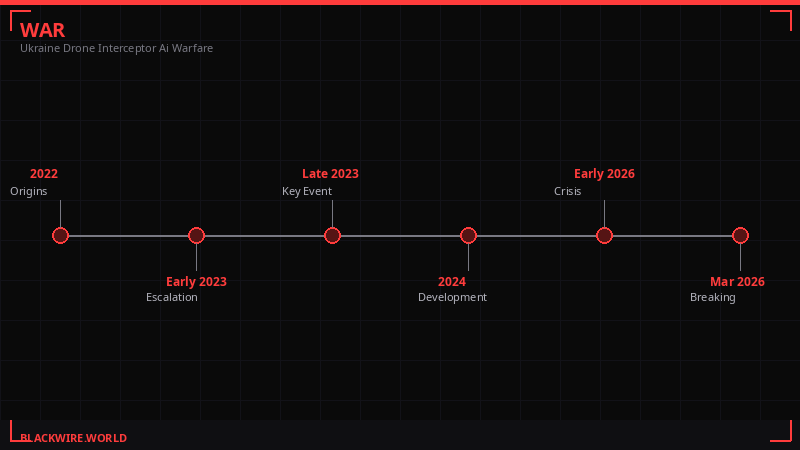
Iran shipped its first batch of Shahed-136 loitering munitions to Russia in September 2022. Within weeks, Russia was launching them in waves against Ukrainian power infrastructure - substations, transformer yards, heating plants. The triangle-winged drones, packed with an 80-kilogram warhead, flew slow and low on a GPS-guided path to their targets.
At first, Ukraine had almost nothing to stop them. Shoulder-fired missiles were available but ineffective - agile drones could jink away from slower weapons. Anti-aircraft guns worked but were scarce. Electronic jamming helped but wasn't decisive. The Patriot system could intercept Shaheds, but the economics were ruinous.
"It's not like we sat down one day and decided to fight with drones. We did it because we had nothing else." - Ukrainian drone pilot, 127th Brigade, quoted by AP News, March 2026
The breakthrough came almost accidentally. A pilot in Kharkiv was tracking a Russian Orlan reconnaissance drone with a small FPV racing drone - the kind used in competitive drone racing. He crashed his FPV into the Orlan. The Orlan fell. Something clicked.
If a nimble, fast drone could intercept a slow reconnaissance drone, what about a Shahed? The Shahed traveled at roughly 180-200 km/h, well above the top speed of a standard FPV racer. But Ukraine's drone builders got to work. The early prototypes were crude - modified racing drones with extra battery packs, pushed to their limits. Many failed. A few worked. The data from every attempt fed back into the next design.
By late 2023, Ukrainian pilots were achieving occasional successful intercepts using modified FPV systems. By 2024, the concept was validated. By early 2025, it was mass production.
The Products: Three Weapons That Changed the Equation

Three Ukrainian products now represent the frontier of cheap intercept technology. Each took a different engineering approach, and each fills a different tactical niche.
The Sting, by Wild Hornets, is described by Ukrainian soldiers as "shaped like a flying thermos." It is a stubby, fixed-wing interceptor designed for sustained pursuit rather than sprint speed. The Sting can stay aloft longer than FPV-style drones because of its aerodynamic efficiency, allowing it to chase Shaheds across extended patrol routes. Wild Hornets built it as a volunteer-driven startup with minimal institutional funding. According to AP News reporting from March 2026, it went from prototype to mass production within months in 2025. Cost: roughly $1,000 to $2,000 per unit.
The Bullet, by General Cherry, is the product that has drawn the most international attention. General Cherry emerged from Ukraine's tech startup ecosystem - Kyiv's pre-war software and hardware scene - and brought professional engineering discipline to the problem. The Bullet has downed several hundred Shahed drones, according to company spokesperson Marco Kushnir. General Cherry says it has capacity to produce tens of thousands of Bullets per month without compromising Ukraine's own air defense stocks. Current price: approximately $2,200 per unit.
The P1-Sun, by Skyfall, takes the most radical manufacturing approach. It is 3D-printed. The airframe can be produced using commercial industrial printers, which means the production line can be distributed, hidden, and scaled rapidly without specialized tooling. Top speed exceeds 300 km/h. Skyfall's stated production capacity is up to 50,000 drones per month, according to AP News. Cost: around $1,000 per unit.
A fourth system, the Skystriker by the unnamed Kharkiv company working with the 127th Brigade, takes an aircraft-style wing design to achieve longer endurance in the patrol zone - useful for intercepting targets detected at longer range by radar before they close on defended sites.
"We are inflicting serious economic damage. The drones we destroy cost anywhere from $10,000 to $300,000. We are destroying them with something that costs $2,200." - Andrii Lavrenovych, General Cherry strategic council, AP News, March 2026
The Engineering Problem: Fast, Smart, and Connected
Building a drone that can kill another drone in flight is harder than it sounds. The targeting problem alone is formidable.
A Shahed traveling at 180 km/h presents a very small radar cross-section. It flies low to avoid detection. It navigates on GPS, meaning it follows a predictable route - but that route isn't known to defenders in advance. The intercept window, from detection to engagement, can be as short as 90 seconds.
Ukrainian units solved this problem through layered systems. Acoustic sensors - essentially very sensitive microphones - can detect Shaheds' distinctive engine sound several kilometers away. Commercial radar systems, adapted from maritime and civil aviation applications, provide tracking data. AI-assisted software processes the sensor feeds and gives drone pilots a targeting vector on their screens or FPV goggles. The pilot then flies an intercept course and uses the drone as a kinetic weapon, colliding with the Shahed in the air.
The key innovation isn't just the drone itself - it is the feedback loop. Every mission, successful or failed, is analyzed. What happened when the Shahed jittered left? How did Russian electronic jamming affect targeting? What angle of approach maximizes the chance of a kill? That data drives rapid design updates. A change to the Bullet's fin geometry can enter production within days of being identified in the field.
This is the speed advantage that no traditional defense contractor can match. Lockheed Martin produced a record 600 PAC-3 MSE interceptors for Patriot batteries in all of 2025. Ukraine's General Cherry alone says it can produce 10,000 Bullets per month. Zelenskyy's claim - that Middle Eastern nations expended over 800 Patriot missiles in just three days during the current Iran war - underscores the scale mismatch.
The AI Question: Autonomous Killers in the Making

The current generation of interceptors still requires a human pilot - either watching a monitor or wearing FPV goggles. That human is the bottleneck.
Training a skilled interceptor pilot takes weeks. Operating a drone crew requires physical presence near the front line, which exposes soldiers to counter-battery fire and drone attacks. Current systems need a radar detection, a human decision, and a pilot response - all within a very tight window. At scale, that chain breaks down.
Ukrainian engineers are already building the next iteration: autonomy.
"Drones must become fully autonomous robots with artificial intelligence - as scary as that may sound - to help our soldiers survive. Our mobile groups shouldn't have to approach the front line where they become targets." - Andrii Lavrenovych, General Cherry, AP News, March 2026
The technical challenge is significant. Autonomous intercept requires the drone to identify a Shahed from sensor data alone - distinguishing it from birds, other aircraft, or debris. It requires onboard processing fast enough to update the intercept trajectory in real time. And it requires a decision to use lethal force without a human in the loop.
That last point is where this technology collides with international law and arms control debates. The International Committee of the Red Cross, along with a growing number of states, has called for binding legal frameworks governing autonomous lethal systems - often called "killer robots" in policy circles. Ukraine's situation represents an uncomfortable precedent: military necessity is driving autonomous weapons development faster than legal frameworks can respond.
Ukraine isn't alone. Russia is reportedly developing autonomous variants of the Shahed that can navigate without GPS and adjust their approach path based on air defense activity. China's drone export sector is moving toward AI-assisted targeting. The US is funding autonomous intercept capabilities through programs like the Collaborative Combat Aircraft project.
The 2022-2026 Ukraine conflict has become the world's most consequential live laboratory for autonomous weapons technology - not in some future scenario, but right now, in real combat, with real consequences.
The Innovation Infrastructure: How Ukraine Built a Defense Startup Ecosystem

What Ukraine built isn't just a product - it is a development model. Understanding why it worked matters more than the hardware specifications, because it is replicable and it is the reason others want to buy in.
The model has four components working in parallel.
First: the battlefield as laboratory. Ukrainian units like the 127th Brigade in Kharkiv operate directly alongside drone companies. Soldiers test prototypes under live fire conditions and report back - not in quarterly development cycles, but the same night. A problem identified on Tuesday becomes an engineering fix by Wednesday. This is the opposite of how Lockheed Martin or Boeing develops systems, where the feedback loop between user and designer takes months or years.
Second: volunteer and nonprofit infrastructure. The Come Back Alive Foundation - a Ukrainian nonprofit that has raised hundreds of millions of dollars since 2022 - launched a program called "Dronopad" (Dronefall) in summer 2024 specifically to bridge drone makers and military units. Taras Tymochko, who leads the project, described to AP News how the foundation identified the earliest successful intercept cases in 2024 and worked to make them repeatable and scalable. Nonprofits as defense R&D intermediaries - that is an unusual structural innovation in itself.
Third: software-first culture. Ukraine had a significant tech industry before the war - software developers, hardware engineers, embedded systems specialists. Many of them are now building weapons. Companies like General Cherry and Wild Hornets operate more like software startups than arms manufacturers. Rapid iteration, MVP (minimum viable product) thinking, continuous deployment. These habits transferred directly into drone development.
Fourth: distributed production. Because Ukraine's industrial sites are targets for Russian missiles, manufacturers don't cluster in one location. Small workshops scattered across western Ukraine assemble drones from components sourced domestically and abroad. A Russian strike might destroy one facility, but the production network survives.
"There is a huge difference between a mass-produced system proven to work in real combat and something others only promise to develop. It's like selling the house, not just the bricks." - Oleh Katkov, editor-in-chief, Defense Express, AP News, March 2026
The Global Market: Who Wants Ukraine's Drones and What It Will Cost Them
The United States, Saudi Arabia, the UAE, Bahrain, and Qatar have all made requests for Ukrainian interceptor drones, according to three Ukrainian weapons producers cited by AP News in March 2026. None of those governments confirmed this publicly.
The technology transfer isn't simple. The hardware can be shipped. The expertise cannot be easily packaged.
Andrii Taganskyi, director of camera business at Odd Systems - which supplies cameras for Wild Hornets' interceptors - was direct about this in AP News reporting: the drones are tools, and they require training. More importantly, they require radar integration. An interceptor flying blind is useless. The intercept window is too short for human spotters alone to cue the system. Gulf states would need to integrate Ukraine's interceptors with their existing radar networks, or acquire compatible new systems.
That integration layer is partly what makes Ukraine's offer a geopolitical play rather than just an arms sale. Zelenskyy's framing is explicit: interceptors in exchange for Patriot missiles. Ukraine has surplus interceptor capacity but a critical shortage of Patriot interceptors for its own ballistic missile defense. Gulf states have Patriot stocks - or access to US production - but are burning through them against Shaheds at a rate that exposes a fundamental mismatch. The swap makes economic sense for both sides.
But getting from interest to contract isn't straightforward. Ukraine technically still bans private weapons exports. The government has been discussing creating a regulated export framework, but as Yevhen Mahda from the Kyiv-based Institute of World Policy told AP News: "We need more than just presidential statements. We need action. How can we talk about exports if we officially aren't selling anything yet?"
The diplomatic path runs through Washington. Any Ukrainian arms deal with Gulf states involves US equities - both because American systems are already present in those countries and because the US is Ukraine's primary backer. This makes the negotiation three-way at minimum: Ukraine, the Gulf state, and the US State and Defense departments. That adds months of process to what is otherwise a very fast-moving military need.
What It Means for NATO and the Future of Air Defense

European defense planners have been watching the Ukraine drone war closely. The conclusions they are drawing are reshaping NATO's air defense doctrine.
The concept gaining traction is called the "drone wall" - a layered detection and intercept network along Europe's eastern borders designed to handle mass drone attacks of the kind Russia has perfected. Federico Borsari, a defense analyst at the Center for European Policy Analysis in Washington, described to AP News how interceptors have become "a cornerstone of modern counter-unmanned aerial systems" that "realign the cost and scale equation of air defense."
The drone wall, planned for a two-year rollout, would integrate radar networks, acoustic sensors, electronic warfare systems, and multiple interceptor platforms - with Ukrainian-designed systems playing a central role. Ukrainian manufacturers are already in discussions for co-production arrangements with US and European defense firms. The intent is to merge Ukraine's battle-tested designs and operational data with Western manufacturing scale and funding.
The second-order effect here is significant. Ukraine enters NATO's defense industrial base. Ukrainian companies - startups that didn't exist five years ago - become embedded in the supply chains that arm NATO's eastern flank. The geopolitical implications of that go well beyond any single weapon system.
For US defense procurement, the lesson is harder to absorb. The US military has built its air defense ecosystem around exquisite, expensive, highly reliable systems. Patriot, Aegis, THAAD - these are marvels of engineering, but they are slow to produce and expensive to consume. The Ukraine model suggests that future conflicts might be decided less by the quality of individual weapons than by the rate at which each side can manufacture, adapt, and replace systems in the field. That is a paradigm shift the Pentagon has been slow to institutionalize, even as it has funded programs like Replicator - which aims to deploy thousands of small autonomous systems - to address exactly this problem.
South Korea's government, watching both the Ukraine war and the Iran conflict, announced a 33 trillion won ($23 billion) package to strengthen its semiconductor and defense tech industries in the face of supply chain disruptions and US tariff pressures. The package explicitly targets advanced chip R&D and manufacturing infrastructure - the same integrated circuit ecosystem that feeds both civilian AI development and the sensor-processing chips that make smart weapons possible. The logic is the same as Ukraine's: in future conflict, the side with the faster production and iteration loop wins.
The Doctrine Nobody Wanted to Write

Nobody sat down to design the Ukrainian drone interceptor doctrine. It emerged from four years of battlefield necessity, volunteer fundraising, startup culture, and the specific horror of watching a city's power grid get systematically dismantled by a drone that costs less than a used hatchback.
But its implications are now being formally incorporated into military thinking in ways that will shape defense investments for the next decade.
The core insight is this: the era of decisive, expensive, scarce weapons systems may be ending. A single F-35 costs roughly $80 million. A single Patriot battery costs over $1 billion. These systems remain powerful in their specific roles. But they are not the right tool for the problem that modern drone warfare presents - which is mass, attrition, and speed of production.
When Iran launched Shaheds against Gulf energy infrastructure and US military bases, it wasn't trying to destroy specific high-value targets with precision weapons. It was trying to overwhelm air defenses through volume, forcing defenders to expend million-dollar interceptors at a ratio that cannot be sustained. The economic asymmetry is the weapon.
Ukraine understood this because it lived it. The Sting, the Bullet, and the P1-Sun are not just technical achievements. They are an answer to a strategic problem: how do you respond to asymmetric mass without going broke?
The answer, it turns out, costs $2,200 and can be 3D-printed in a workshop in Kharkiv.
The next question - the one that will define the next phase of this technology - is whether autonomous AI can remove the last bottleneck: the human pilot who needs weeks of training and can't be in two places at once. Ukrainian engineers say that system is coming. Defense lawyers and international humanitarian law scholars say the frameworks to govern it don't exist yet.
That gap between the pace of military technology and the pace of legal and ethical governance is the single most consequential unresolved tension in global security right now. Ukraine's drone war didn't create that gap. But it has made it impossible to ignore.
Get BLACKWIRE reports first.
Breaking news, investigations, and analysis - straight to your phone.
Join @blackwirenews on Telegram